Respect all members: no insults, harassment, or hate speech.
Be tolerant of different viewpoints, cultures, and beliefs. If you do not agree with others, just create separate note, article or collection.
Clearly distinguish between personal opinion and fact.
Verify facts before posting, especially when writing about history, science, or statistics.
Promotional content must be published on the “Related Services and Products” page—no more than one paragraph per service. You can also create subpages under the “Related Services and Products” page and publish longer promotional text there.
Do not post materials that infringe on copyright without permission.
Always credit sources when sharing information, quotes, or media.
Be respectful of the work of others when making changes.
Discuss major edits instead of removing others' contributions without reason.
If you notice rule-breaking, notify community about it in talks.
Do not share personal data of others without their consent.
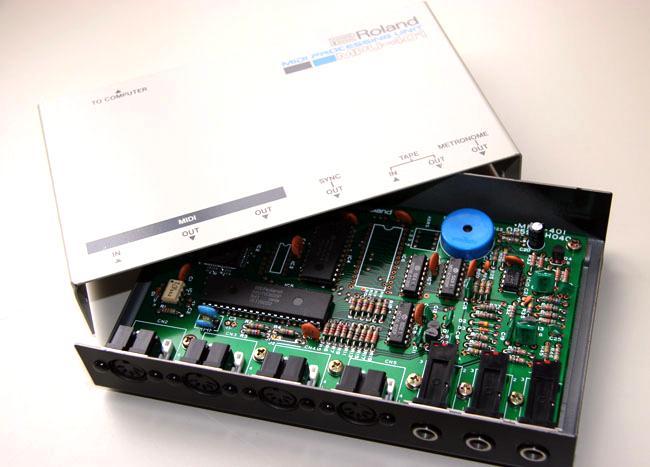
The MPU-401, where MPU stands for MIDI Processing Unit, is an important but now obsolete interface for connecting MIDI-equipped electronic music hardware to personal computers. It was designed by Roland Corporation, which also co-authored the MIDI standard.[1]
Released around 1984, the original MPU-401 was an external breakout box providing MIDI IN/MIDI OUT/MIDI THRU/TAPE IN/TAPE OUT/MIDI SYNC connectors, for use with a separately-sold interface card/cartridge ("MPU-401 interface kit") inserted into a computer system. For this setup, the following "interface kits" were made:
MIF-IPC: For the IBM PC/IBM XT. It turned out not to work reliably with 286 and faster processors. Early versions of the actual PCB had IF-MIDI/IBM as a silk screen.[6]
MIF-IPC-A: For the IBM AT, works with PC and XT as well.[6]
Xanadu MUSICOM IFM-PC: For the IBM PC / IBM XT / IBM AT. This was a third party MIDI card, incorporating the MIF-IPC(-A) and additional functionality that was coupled with the OEM Roland MPU-401 BOB. It also had a mini audio jack on the PCB.[7][8][9]
Later, Roland would put most of the electronics originally found in the breakout box onto the interface card itself, thus reducing the size of the breakout box. Products released in this manner:
MPU-401N: an external interface, specifically designed for use with the NEC PC-98 series notebook computers. This breakout-box unit features a special COMPUTER IN port for direct connection to the computer's 110-pin expansion bus. METRONOME OUT connector was added. Released in Japan only.[18][19]
MPU-IPC: for the IBM PC/IBM XT/IBM AT and compatibles (8 bit ISA). It had a 25-pin female connector for the breakout box, even though only nine pins were used, and only seven were functionally different: both 5V and ground use two pins each.
MPU-IPC-T: for the IBM PC/IBM XT/IBM AT and compatibles (8-bit ISA). The MIDI SYNC connector was removed from this Taiwanese-manufactured model, and the previously hardcoded I/O address and IRQ could be set to different values with jumpers. The break-out box has three DIN connectors for MIDI (1xIN and 2xOUT) plus three 3.5mm mini jack connectors (TAPE IN, TAPE OUT and METRONOME OUT).
MPU-IMC: for the IBM PS/2's Micro Channel architecture bus. In earlier models both I/O address and IRQ were hardcoded to IRQ 2 (causing serious problems with the hard disk as it also uses that IRQ); in later models the IRQ could be set with a jumper. It had a 9-pin female connector for the breakout box.[20]The IRQ selection on the MPU-IMC. Due to the incompatibility of IRQ 2/9 (and potentially I/O addresses) between the MPU-IMC and IBM PS/2 MCA models certain games will not work with MPU-401.[21]
S-MPU/AT (Super MPU): for the IBM AT and compatibles (16-bit ISA). It had a Mini-DIN female connector for the breakout box. The MIDI SYNC, TAPE IN, TAPE OUT, METRONOME OUT connectors was removed, but a second MIDI IN connector was added. An application to assign resources (plug and play) must be run to use the card in DOS. This application is not a TSR (it does not take up conventional memory).
S-MPU-IIAT (Super MPU II): for the IBM or compatible Plug and Play PC computers (16 bit ISA). It had a Mini-DIN female connector for the breakout box with two MIDI In connectors and two MIDI Out connectors. An application to assign resources (plug and play) must be run to use the card in DOS. This application is not a TSR (it does not take up precious conventional memory).
LAPC-I: for the IBM PC and compatibles. Includes the Roland CM-32L sound source. A breakout box for this card, the MCB-1, was sold separately.
LAPC-N: for the NEC PC-98. Includes the Roland CM-32LN sound source. A breakout box for this card, the MCB-2, was sold separately.
RAP-10: for the IBM AT and compatibles (16 bit ISA). General midi sound source only. MPU-401 UART mode only. A breakout box for this card, the MCB-10, was sold separately.
SCP-55: for the IBM and compatible laptops (PCMCIA). Includes the Roland SC-55 sound source. A breakout box for this card, the MCB-3, was sold separately. MPU-401 UART mode only.[24]
Still later, Roland would get rid of the breakout box completely and put all connectors on the back of the interface card itself. Products released in this manner:
Roland MPU-IMC, the rare 'Micro Channel' version of the card.Roland MPU-401ATRoland MPU-PC98IIRoland MPU-IPC-T card
MPU-APL: for the Apple II. Single-card combination of the MIF-APL interface and MPU-401, featuring MIDI IN, OUT, and SYNC connectors.[25][26]
MPU-401AT: for IBM AT and "100% compatibles". Includes a connector for Wavetable daughterboards.
By the late 1980s other manufacturers of PCBs developed intelligent MPU-401 clones. Some of these, like Voyetra, were equipped with Roland chips whereas most had reverse-engineered ROMs (Midiman / Music Quest).[28][29]
Examples:
Midiman MM-401 (8BIT, non Roland chip set, also sold as part of the Midiman PC Desktop Music Kit)[30]
In 2015 hobbyists developed a Music Quest PC MIDI Card 8BIT clone.[37] In 2017/2018 hobbyists developed a revision of the Music Quest PC MIDI Card 8BIT clone that includes a wavetable header in analogy of the Roland MPU-401AT.[38]
The MPU-401 can work in two modes, normal mode and UART mode. "Normal mode" would provide the host system with an 8-track sequencer, MIDI clock output, SYNC 24 signal output, Tape Sync and a metronome; as a result of these features, it is often called "intelligent mode". Compare this to UART mode, which reduces the MPU-401 to simply relaying in-/outcoming MIDI data bytes.
As computers became more powerful, the features offered in "intelligent mode" became obsolete. Implementing these in the host system's software was more efficient. Specific hardware was no longer required. As a result, the UART mode became the dominant mode of operation. Early UART MPU-401 capable cards were still advertised as MPU-401 compatible.
In the mid 2010s, a hobbyist platform software interface, SoftMPU, was written that upgrades UART (non intelligent) MPU-401 interfaces to an intelligent MPU-401 interface, however this only works for MS-DOS.[39] It also does not work for all games, especially early Sierra games.
In 2015, a PCB (HardMPU)[40] was developed that incorporates SoftMPU as logic on hardware (so that the PC's CPU does not have to process intelligent MIDI). Currently HardMPU only supports playback and not recording.[41]
Physical MIDI connections are increasingly replaced with the USB interface, and a USB to MIDI converter in order to drive musical peripherals which do not yet have their own USB ports. Often, peripherals are able to accept MIDI input through USB and convert it for the traditional DIN connectors. While MPU-401 support is no longer included in Windows Vista, a driver is available on Windows Update.[42] As of 2011, the interface was still supported by Linux and Mac OS X.
The MPU-401, short for MIDI Processing Unit, is an intelligent external interface developed by Roland Corporation in 1984 to enable communication between personal computers and MIDI-equipped electronic musical instruments, marking a pivotal advancement in desktop music production.[1][2] It functions as a dedicated MIDI processing device with its own onboard 8-bit microprocessor, 2K of RAM, 8K of ROM, and VLSI gate arrays to handle the MIDI data protocol independently, allowing for real-time data transfer without burdening the host computer's resources.[2] The unit connects to computers via a 25-pin D-sub connector—typically to the parallel port—and features MIDI IN, MIDI OUT 1, MIDI OUT 2, DIN Sync, and FSK sync jacks for versatile integration with synthesizers, sequencers, and other MIDI hardware.[2]Key to its operation are two modes: an intelligent mode that supports advanced features like timestamped MIDI buffering, polyphonic tracking (up to eight tracks initially, expandable to 32 tracks and 64 channels by chaining up to four units), and interrupt-driven multitasking for efficient composition; and a basic UART mode for simpler, byte-by-byte data passing compatible with standard MIDI implementations.[2] Measuring approximately 7.5 x 4.5 x 1.5 inches and weighing 1.5 pounds, the compact external box was priced at around £160 (plus £70 for the interface cable) upon release and was compatible with Roland's MRC sequencing software for IBM PC and Apple computers, sold separately for £50, to facilitate real-time music programming.[2] Later variants, such as the ISA bus card version MPU-401AT, extended compatibility to PC expansion slots while maintaining the core intelligent processing capabilities.[3]The MPU-401 established the de facto standard for MIDI interfaces on early personal computers, influencing sound card designs and enabling widespread adoption of digital music creation in the 1980s and 1990s by simplifying synchronization and data handling between hardware and software.[1] Its intelligent mode, in particular, supported precise timing and multi-channel sequencing that were essential for professional-level desktop production, though it became obsolete with the rise of integrated USB MIDI and built-in audio interfaces in modern systems.[2] Today, emulations like SoftMPU preserve its functionality for vintage computing and retro gaming, underscoring its enduring legacy in computer musichistory.[4]
History
Development and Release
The MPU-401, standing for MIDI Processing Unit, was invented by Roland Corporation in 1983–1984 as the first universal MIDI interface designed to connect MIDI-equipped synthesizers to personal computers, including the IBM PC, Apple II, and Commodore 64.[5][6][7] This development responded directly to the adoption of the MIDI 1.0 standard, finalized and publicly demonstrated in January 1983 at the Winter NAMM show, which created a need for reliable integration between computers and MIDI hardware beyond basic serial port connections.[7] Key developer was Jeff Rona, a programmer at Roland's U.S. division who joined in 1982 and contributed to early prototyping of the MPU-401. Tadao Kikumoto, a Roland engineer, focused on implementing MIDI in products like the Jupiter-6 synthesizer.[8] Their motivations centered on enabling desktop music production by linking keyboards for sequencing and control, addressing compatibility limitations in early MIDI implementations and showcasing the standard's potential for broader hardware-software synergy.[7][9] These efforts were supported by the formation of the MIDI Manufacturers Association (MMA) in 1983, which included Roland and Sequential Circuits, promoting standardized MIDI integration.[9]Development of the MPU-401 began in the summer of 1982 under Roland's initiative to pioneer computer-MIDI connectivity, with prototypes emerging alongside Roland's first MIDI instruments in 1983.[8] By mid-1983, collaborative efforts with other manufacturers, such as Sequential Circuits, refined the interface's design to support universal MIDI communication, building on precursors like Roland's Digital Control Bus.[9] The project emphasized an intelligent processing unit to handle MIDI data independently, incorporating innovative operational modes that allowed for advanced timing and sequencing offloaded from the host computer.[10]The MPU-401 was released in 1984 by Roland's U.S. division as an external breakout box, marking a pivotal advancement in desktop music production.[5][2] It featured MIDI IN, MIDI OUT 1, and MIDI OUT 2 ports for device chaining, along with TAPE IN and OUT connectors for FSK tape synchronization, and a MIDI SYNC port supporting RolandDIN sync and MIDI timing clocks.[10][2] The unit connected to computers via a 25-pin D-sub connector, requiring separate interface cards for compatibility.For the IBM PC, the MPU-401 was initially paired with dedicated 8-bit ISA bus interface cards, such as the MIF-IPC, to enable connectivity through the computer's expansion slots.[6] These cards handled the bus interface while the external MPU-401 unit managed MIDI processing, ensuring low-latency data transfer for early sequencing applications.[2]Early firmware for the MPU-401 utilized ROM versions starting with 1.2A, progressing through 1.2B, 1.3, 1.4, 1.4A, 1.4B, to 1.5 and 1.5A by the mid-1980s.[10] These incremental updates improved compatibility with emerging MIDI software and hardware, addressing issues like timing precision and command recognition in versions prior to 1.5A, which became the standard for later Roland products.[10]
Adoption and Decline
Following its release in 1984, the MPU-401 saw rapid initial adoption among professional musicians and early PC users, particularly for integrating MIDI synthesizers like the Roland MT-32 into IBM PC and Apple systems for music production and composition. Priced at approximately $300 in the US (equivalent to about £230 including VAT in the UK), it was positioned as a high-end solution for real-time MIDI sequencing via its bundled MRC software, which supported eight polyphonic tracks and addressed timing issues in early MIDI setups. This uptake was evident in professional studios transitioning from tape-based recording to computer-assisted MIDI workflows, where the MPU-401's interrupt-driven operation enabled more reliable data handling than basic serial ports.[2][11]By the late 1980s, the MPU-401 had reached peak usage as the de facto standard for DOS-based MIDI applications, with broad support in software such as Cakewalk for sequencing and in PC gaming titles that required intelligent MIDI processing. It became integral to early PC gaming soundtracks, notably in Sierra On-Line adventure games like King's Quest IV and Police Quest, where integration with the MT-32 provided high-fidelity, module-specific audio that enhanced immersive experiences beyond basic FM synthesis. Nearly all major MS-DOS MIDI programs directly supported the MPU-401 protocol, solidifying its role in establishing MIDI as a PC standard and influencing subsequent interface designs. The simplicity of its UART mode further aided software compatibility, allowing broader adoption without full intelligent processing in resource-constrained environments.[12][13][14]The MPU-401's decline began in the late 1980s and accelerated through the 1990s due to the rise of integrated sound cards like the Creative Labs Sound Blaster series, which incorporated affordable MIDI interfaces starting around 1989 and reduced the need for external hardware. These cards, often supporting only UART mode, offered lower cost and simpler setup for consumers, limiting the MPU-401's appeal amid its complexity and expense, while professional users shifted to multi-port alternatives for handling larger data loads on faster Pentium systems. By the mid-1990s, glitches such as missed notes and unreliable SysEx transfers on high-speed PCs further eroded its viability. Native Windows support for the MPU-401 was removed starting with Windows Vista in 2007, though drivers were available through Windows Update and legacy patches for later versions; the interface's influence persisted in MIDI standardization for PCs but saw no significant hardware production beyond the early 1990s.[11][3][15]
Technical Design
Architecture
The MPU-401 is an external MIDI processing unit designed as a standalone device separate from the host computer, featuring a dedicated eight-bit processor from the 6801 family for handling MIDI data independently. This architecture allows the unit to process MIDI messages without relying on the host's CPU for real-time operations, using 8 KB of ROM for firmware and 2 KB of RAM for internal operations such as data buffering. Specially designed VLSI gate arrays manage protocol conversion and data flow between the MIDI bus and the host interface, ensuring efficient byte-level implementation of the MIDI protocol, including parsing of status bytes, data bytes, and system exclusive messages. The unit's physical form factor is a compact metal enclosure measuring approximately 7.5 × 4.5 × 1.5 inches and weighing about 1.5 pounds, powered by a 5 V DC supply drawing around 150 mA.[2][10]Connectivity is provided through a set of ports on the rear panel: MIDI In for receiving messages, MIDI Out 1 and MIDI Out 2 for transmitting to synthesizers, MIDI Thru for daisy-chaining devices, Tape In and Tape Out jacks for loading and saving sequencer data via cassette interface and FSK synchronization, and a 5-pin DIN Sync Out jack for external clock synchronization supporting formats like 24 pulses per quarter note. The unit connects to the host computer via a 25-pin D-sub connector carrying data, handshaking, and interrupt signals, requiring a separate host interface card (such as the Roland MIF-IPC for ISA bus) to map the MPU-401 as either memory-mapped or I/O port device, typically at addresses like 0x330-0x333 with IRQ 2 or 9. This setup enables bidirectional data transfer, with the gate arrays buffering incoming and outgoing MIDI streams to prevent overflow during high-velocity message flows.[2][10]The firmware, stored in the 8 KB ROM, implements a comprehensive command set for MIDI message handling, including parsing and validation of running status, channel voice messages, and system real-time bytes, with built-in error detection for issues like buffer overruns or timing overflows via interrupt signals to the host. Data flow begins with MIDI bytes entering via opto-isolated inputs to the gate arrays, which assemble complete messages before passing them to the 6801-family processor for processing; outgoing data follows a reverse path, with the processor scheduling transmission based on internal clocks or host commands. Basic sequencing capabilities are embedded, allowing limited track recording and playback using the RAM for temporary storage, though advanced features extend into the unit's operational modes. The architecture's design emphasizes reliability in MIDI ecosystems, supporting 31.25 kbps serial rates without host intervention for protocol details.[2][10]
Operational Modes
The MPU-401 supports two primary operational modes: UART mode and Intelligent mode, each tailored to different levels of MIDI processing requirements. These modes determine how the interface handles data relay, timing, and sequencing between the host computer and MIDI devices. The protocol in both modes relies on a command-response structure using dedicated I/O ports, where the host writes commands or data to the data port (typically at base address +0) and the command port (base +1), with status checks via the status register for acknowledgments (ACK: 0xFE) or negative acknowledgments (NAK: 0xF9).[16]UART mode, often referred to as "dumb" mode, serves as a basic pass-through relay for MIDI data over a serial UART interface, with no onboard processing or buffering performed by the MPU-401. Activated by sending command 0x3F to the command port following a reset (0xFF), this mode operates at the standard MIDIbaud rate of 31.25 kbps and places full responsibility for timing, sequencing, and event management on the host application. MIDI bytes are directly written to the data port for output and read on demand for input, with the status port used to poll for data ready (bit 7) or transmit ready (bit 6); interrupts can be enabled for input handling. This simplicity makes it compatible with standard MIDI software but limits advanced synchronization features.[16][17]Intelligent mode, the default upon power-up, enables advanced functionalities through the device's onboard microcontroller, including an 8-track sequencer for timestamped MIDI event buffering, internal timer-based playback, MIDI clock generation, and synchronization options such as FSK or MIDI clock out. The sequencer supports downloading buffers of MIDI events to up to 8 tracks, with each track capable of holding timestamped events relative to the internal clock (resolution approximately 1 ms), allowing the host to offload playback control via commands like those for buffer loading and start/stop (e.g., 0x60 series for track operations). Playback is initiated with commands such as 0x80 for stop or 0x81 for continue, and the mode handles event queuing without real-time input processing to avoid conflicts during output. Error handling includes responses like 0xF8 for timing overflow if no events occur within 240 clock ticks, and buffer-related issues can trigger NAKs for overflow conditions. However, compatibility challenges arise with non-Roland devices, many of which emulate only partial intelligent mode or default to UART, leading to failures in software expecting full sequencer support.[16][13]
Hardware Implementations
Official Variants
Roland produced several official hardware variants of the MPU-401 to support different computer architectures and bus standards, ensuring compatibility with the original interface's intelligent MIDI processing while adapting to platform-specific requirements such as bus types and interrupt handling. The original MPU-401 design supports up to 8 sequencer tracks in intelligent mode, expandable to 32 tracks by chaining multiple units.The MPU-IPC, introduced in 1984, is an 8-bit ISA expansion card targeted at IBM PC, XT, and AT compatibles. It serves as an interface between the host computer and an external MPU-401 breakout box, connected via a proprietary 20-pin cable, and features firmware version 1.5A for enhanced command processing. This variant draws power from the ISA bus, with typical consumption around 1-2 watts depending on activity, and supports standard I/O addresses and IRQ settings configurable via jumpers.[18][10]In 1988, Roland released the MPU-IMC for IBM PS/2 systems using the MicroChannel Architecture (MCA) bus. This 16-bit card integrates intelligent mode support directly and includes specialized MCA interrupt handling to align with PS/2's arbitrated bus system, allowing seamless MIDI data transfer without additional external units in some configurations. It maintains the 1.5A firmware and offers improved compatibility with MCA's POS (Programmable Option Select) for automatic configuration, though it requires the full -5V rail for operation, consuming approximately 2.5 watts under load.[19][20]The MPU-401N, a Japan-exclusive variant, was designed specifically for NEC PC-98 series computers, including notebook models. Released around 1984, it features localized connectors adapted to the PC-98's proprietary expansion interface and supports the standard MIDI ports on an external breakout box, with firmware version 1.5A to ensure compatibility with Japanese software titles. This adaptation focuses on the PC-98's unique bus signaling and power requirements, limiting its use outside that ecosystem.[21]Other notable official variants include the S-MPU/AT from 1987, a 16-bit ISA card for IBM AT and compatibles that enhances multi-port MIDI handling while emulating MPU-401 protocols, though with some limitations in full intelligent mode transitions; it uses the 1.5A firmware and has higher bus compatibility for faster systems but draws about 3 watts due to additional buffering circuitry. The MPU-IPC-T, a 1990s update to the original IPC, incorporates a terminated cable design to reduce signal noise in longer runs and supports XT/AT slots with the same 1.5A firmware, maintaining low power draw similar to the MPU-IPC. Finally, the LAPC-I of 1989 integrates the MPU-401 interface with a CM-32L sound module on a single 8/16-bit ISA card for IBM PCs, providing onboard synthesis alongside MIDI I/O; it requires -5V power and consumes up to 5 watts when the module is active, with platform features like jumper-selectable MT-32 emulation modes. These variants differ primarily in bus compatibility—ranging from 8-bit ISA to MCA—and power efficiency, with later models optimizing for 16-bit systems and reduced draw through integrated components.[13][22][23]
Third-Party Clones
In the late 1980s, third-party manufacturers began producing MPU-401 compatible interfaces to expand MIDI capabilities on PCs, often with partial support for intelligent mode to enable sequencer functionality in software and games.[13] Voyetra's V-4001, an 8-bit ISA card released in 1988, provided MPU-401 compatibility using Roland chipset components, featuring MIDI in/out via 9-pin ports and normal mode operation for connecting synthesizers like the MT-32.[13] Similarly, Midiman's MM-401, introduced in 1991, was an 8/16-bit ISA card offering full MPU-401 compatibility in both intelligent and UART modes, with switch-selectable I/O address (default 330h) and IRQ (default 2), plus an external click metronome output and MIDI Time Code acceptance.[24][13] These early clones facilitated MIDI integration without requiring Roland's expensive external breakout box, though some exhibited partial intelligent mode limitations, such as incomplete sequencer track handling in certain DOS applications.[24]Music Quest emerged as a key player in the 1980s and 1990s with the PC-MIDI IH9MQ9, a full MPU-401 clone on an 8-bit ISA card that supported both intelligent and UART modes, including built-in timer functionality and compatibility with Roland drivers for Windows and DOS.[13] This card connected via a DB25 port to MIDI devices, enabling seamless integration for music production and gaming, and was noted for its reliability in emulating the original.[13] By providing a cost-effective alternative to official Roland hardware, such clones helped erode Roland's market dominance in PC MIDI interfaces during the era.[13]Hobbyist efforts revived interest in physical MPU-401 clones starting around 2014, with reproductions of the Roland MIF-IPC-A ISA card emerging to pair with original MPU-401 units.[25] The Lo-tech MIF-IPC-B, a direct clone developed by hobbyists and commercialized thereafter, is an 8-bit ISA adapter compatible with PC/XT/AT systems, featuring user-selectable IRQ/memory addresses, daisy-chaining support, and a DB25 port for standard Roland cables; it improves on originals with through-hole logic for easier assembly and extended port options.[25] Between 2015 and 2022, hobbyists produced low-cost PCB reproductions of the Music Quest PC-MIDI IH9MQ9, often sold for around $50, maintaining full mode compatibility while enhancing reliability through modern component sourcing.[26] Further developments in 2017–2018 included revised ISA cards based on the Music Quest design, incorporating UART enhancements for better timing precision and reduced latency in retro computing setups.[13] However, compatibility challenges persisted, as some clones omitted full support for the original's 8 sequencer tracks, leading to glitches in older games requiring precise intelligent mode buffering.[25] These reproductions democratized access to authentic MPU-401 functionality for vintage PC enthusiasts, often at a fraction of original prices.
Software Emulation
SoftMPU
SoftMPU is a terminate-and-stay-resident (TSR) program for DOS that emulates the intelligent mode of the MPU-401 interface, allowing UART-only MIDI ports—such as those on Sound Blaster cards—to support advanced features typically requiring dedicated hardware.[4] Developed by BJT42 in collaboration with elianda and initially released in 2013, it builds on the MPU-401 emulation code from the DOSBox project to provide software-based compatibility for legacy applications.[27] The project reached its latest version, 1.91, in 2018, with updates focusing on enhanced compatibility for specific games and hardware configurations.[4]In terms of functionality, SoftMPU intercepts MIDI data to emulate key intelligent mode capabilities, including an 8-track sequencer for timestamped event queuing and buffering to handle MIDI throughput without overwhelming the host system.[27] This enables seamless playback of music in DOS games and applications designed for Roland MT-32 or CM-32L synthesizers, such as those from the late 1980s and early 1990s, by transparently switching between UART and intelligent modes as needed.[4] Installation is performed via command-line parameters, for example, SOFTMPU.COM /I0 to initialize on the default MPU-401 port (330h), with options to specify Sound Blaster ports, IRQs, and output modes for serial or SB-MIDI interfaces; it can be loaded high into memory using tools like DOS's LH command to minimize conventional RAM usage.[27]Despite its utility, SoftMPU has notable limitations, including the absence of real-time MIDI input support, which restricts it to output-only scenarios, and a memory footprint of approximately 10 KB when resident.[4] It requires DOS 5.0 or later for compatibility with expanded memory managers like EMM386 (version 4.46+) or QEMM (version 7.03+), and may conflict with PS/2 mouse drivers or real-time clock reprogramming, necessitating a system restart in such cases.[27] Additionally, certain Sound Blaster configurations with /OUTPUT:SBMIDI can exhibit reduced reliability.[4]A primary use case for SoftMPU is retrocomputing enthusiasts seeking to enable intelligent mode MIDI output in vintage DOS games without acquiring rare or expensive MPU-401 hardware, thereby preserving authentic soundtracks on original setups featuring basic Sound Blaster cards.[27]
Modern Emulations
Modern emulations of the MPU-401 interface enable retro computing enthusiasts to experience authentic MIDI functionality in DOS environments without dedicated hardware, primarily through virtual machine software tailored for contemporary operating systems. DOSBox, a widely used x86 emulator, has provided comprehensive MPU-401 emulation supporting both UART and intelligent modes since version 0.65 in 2007, allowing seamless integration with external synthesizers or software-based sound generation.[28] This feature facilitates configurations for intelligent mode in classic games such as Wing Commander, where it handles MIDI sequencing and timing to replicate original audio output. Integration with the MUNT library further enhances this by emulating Roland MT-32 synthesizers, enabling high-fidelity reproduction of period-specific soundtracks directly within the emulator.[29]Other tools extend MPU-401 support to diverse platforms. DOSEmu2, a Linux-based DOS emulator, offers partial MPU-401 emulation with ongoing enhancements for intelligent mode since its active development began around 2017, focusing on compatibility with DPMI-hosted applications.[30] Similarly, DOSBox Pure—a streamlined fork integrated into the RetroArch frontend—incorporates MPU-401 emulation for MIDI output via MUNT, with 2024 updates improving device detection and audio routing for cross-platform use on consoles and PCs.[31] These updates addressed configuration issues, such as enabling MIDI output to prevent MPU-401 device disablement errors.[32]In 2024, developers released updates to DOSBox variants, including fixes for MIDI playback and timing issues.[33] This has popularized MPU-401 emulations in Linux and macOS setups for vintage PC gaming, allowing users to run DOS titles with original MIDI interfaces simulated over modern audio drivers. As an evolution from precursor TSR solutions like SoftMPU, these virtual implementations prioritize accessibility on current hardware.Key advantages of modern MPU-401 emulations include zero hardware acquisition costs and broad cross-platform availability, making them ideal for archival preservation and casual retro gaming.[34] However, limitations persist, such as occasional timing inaccuracies under accelerated emulation speeds, which can affect sequencer synchronization in timing-sensitive applications.
Contemporary Interfaces
Other MIDI Interfaces of the 1980s
In the 1980s, several MIDI interfaces emerged alongside the MPU-401, offering simpler alternatives for connecting personal computers to MIDI devices, often prioritizing affordability and ease of integration over advanced processing capabilities. These designs typically relied on UART-based or serial protocols, making them suitable for basic sequencing and control but less efficient for complex tasks like real-time polyphony or extensive SysEx data handling.[11]The Sound Blaster MIDI port, introduced by Creative Labs in 1989 as part of their inaugural Sound Blastersound card, provided UART-only compatibility with MPU-401 protocols, allowing MIDI output integrated directly with the card's FM synthesis capabilities via a Yamaha OPL-2 chip. This setup enabled straightforward MIDI playback for games and applications on IBM PC compatibles, though it lacked the intelligent mode's buffering and command processing, limiting it to simpler, host-managed operations. Priced around $100 as part of the full card, it emphasized cost-effectiveness and multimedia convergence over standalone MIDI sophistication.[11]Apple's MIDI interface, released in 1984 for the Macintosh, utilized the computer's serial ports—primarily the Modem port—to connect a basic hardware box with one MIDI In and multiple paralleled MIDI Out ports, operating at a 1MHz or 500kHz clock without any intelligent firmware or onboard processing. This serial-based design facilitated direct MIDI data transmission for music composition software on early Macs, but required significant CPU involvement for timing and synchronization, making it ideal for entry-level setups rather than demanding sequencing workflows.[35]Yamaha's CX5M, launched in 1984 as a dedicated music computer based on the MSX standard, incorporated a built-in MIDI input port that routed data through its Z80 processor to control an integrated four-operator FM synthesizer module, with provisions for parallel MIDI expansion via converters to interface with external devices like the DX7. This approach allowed for monophonic sequencing across six tracks using the onboard synth, though it demanded additional hardware for full serial MIDI chaining, positioning it as a self-contained yet expandable option for hobbyist composers at a cost of approximately $200.[36]The Atari ST, released in 1985, featured built-in MIDI ports using the TOS operating system for direct connection to synthesizers, enabling low-cost music production without external interfaces. Similarly, the Amiga computer supported MIDI via serial port expansions, popular in early digital audio workstations.[37]Sequential Circuits advanced early MIDI adoption with synthesizer ports, such as on the Prophet-600 (MIDI version released in 1983), one of the first commercial synthesizers featuring a five-pin MIDI interface. This enabled basic synchronization and note data exchange between keyboards and computers via software, favoring simplicity in polyphonic control.[38]While these interfaces aligned with the MPU-401's UART mode for basic compatibility, their emphasis on serial simplicity and lower costs—typically $100–200—made them more accessible for casual users, contrasting the MPU-401's intelligent mode superiority in offloading sequencing tasks from the host CPU to enable smoother, more responsive MIDI orchestration.[11]
Successors and Replacement
In the 1990s, the need for separate MPU-401 interfaces diminished with the introduction of integrated sound cards featuring on-board MPU-401 UART emulation, such as Creative's Sound Blaster 16 (released in 1992), which provided UART mode compatibility via its game/MIDI port, allowing direct connection to external MIDI synthesizers without additional hardware.[39] Similarly, the Sound Blaster AWE32 (1994) included jumper-configurable MPU-401 emulation, further embedding MIDI functionality into consumer sound cards and reducing reliance on external Roland units.[39]The advent of USB in the late 1990s marked a universal shift away from parallel or serial MIDI interfaces like the MPU-401, with the USB Device Class Definition for MIDI Devices finalized in November 1999, enabling class-compliant drivers that allowed plug-and-play operation across operating systems without custom software.[40] Roland's UM-1, introduced around 2000, exemplified this transition as a compact USB-to-MIDI adapter supporting 16-channel I/O, bus-powered operation, and seamless integration with legacy MIDI gear, effectively serving as a direct, modern successor to the MPU-401 for professional and hobbyist applications.[41]Operating system support for the MPU-401 evolved toward obsolescence in the late 2000s; Microsoft removed native MPU-401 drivers from Windows Vista onward (2007), though legacy compatibility persisted via optional Windows Update installations until at least Windows 7 (2009), after which users relied on third-party or emulated solutions.[3] In Linux, the ALSA snd-mpu401 kernel module provided ongoing UART support from early versions, enhancing MIDI sequencing and compatibility for vintage hardware in contemporary distributions.[42]By 2025, the MPU-401 holds niche relevance primarily in retro computing communities for authentic DOS-era MIDI playback, but it has been fully supplanted in mainstream use by USB MIDI interfaces and Thunderbolt-based audio solutions, which offer higher bandwidth, lower latency, and broader ecosystem integration; no new original MPU-401 hardware has entered production since the early 2000s, with modern needs met by class-compliant USB standards.[43]



.png)


