
.jpg/250px-Wassenaar_Beach_at_Night_(19927813283).jpg)


.jpg/2000px-Wassenaar_Beach_at_Night_(19927813283).jpg)
Community hub
Recent from talks
Contribute something
Nothing was collected or created yet.
Wassenaar
View on Wikipedia
Key Information

.jpg)


.svg)
Wassenaar (Dutch pronunciation: [ˈʋɑsənaːr] ⓘ; population: 26,949 in 2021) is a municipality and town located in the province of South Holland, on the western coast of the Netherlands.
An affluent suburb of The Hague, Wassenaar lies 10 km (6 mi) north of that city on the N44/A44 highway near the North Sea coast. It is part of the Haaglanden region and the Rotterdam–The Hague metropolitan area. The municipality covers an area of 62.40 km2 (24.09 sq mi), of which 11.29 km2 (4.36 sq mi) is covered by water.
Wassenaar is home to some of the Netherlands' richest residential neighborhoods as well as the country's most expensive street, the Konijnenlaan.[5][6]
History
[edit]By tradition, the 12th-century Romanesque church in Wassenaar is the spot where the Northumbrian missionary Willibrord landed in the Netherlands; the high dunes to the west were not formed until later.
Wassenaar long remained an unremarkable small town, known only as the home of the House of Wassenaer. It only began to gain prominence in the 19th century when Louis Bonaparte ordered the construction of the Heerweg ("Army Road") between The Hague and Leiden, which forms the current Rijksstraatweg. In approximately 1840, Prince Frederik had the De Paauw (Peacock) palace built, where he lived for many years; it now serves as the city hall of Wassenaar.
In 1907 a railway was built, connecting Rotterdam, The Hague, Wassenaar and Scheveningen, the course of which now forms the Landscheidingsweg. Wassenaar became attractive as a residence for wealthy people from Rotterdam. Buildings such as the monumental Huize Ivicke were constructed.[7]
Some remnants of the Atlantic wall are located on Wassenaar's beach, the Wassenaarseslag; nearly a thousand metres of underground walled tunnels are present, connecting five bunkers. The network now serves as a bat sanctuary and is no longer open to visits.[8]
From September 1944 to March 1945 Wassenaar was one of the launch sites used by the German Luftwaffe for the V-2 rockets directed mainly towards London.[9]
The American World War II and Korean War general Haywood Hansell, who helped plan the Allied bombing offensive against both Germany and Japan, lived in Wassenaar in retirement from 1957 to 1966.
In 1982 the Wassenaar Agreement between employers' organisations and trade unions in the Netherlands was signed here. This groundbreaking agreement helped in restraining wage growth in return for the adoption of policies to combat unemployment and inflation.
The Wassenaar Arrangement, a post Cold War era arms control convention, was signed here by forty member nations in May 1996.[10]
Modern history
[edit]

Since the days of Prince Frederik, Wassenaar has often served as an official residence: King Willem-Alexander of the Netherlands, his wife, Queen Máxima of the Netherlands, and their daughters lived in the villa Eikenhorst at the estate De Horsten in Wassenaar from 2003 until 2019;[11] Princess Alexia was baptized at the Romanesque church in Wassenaar. The princesses attended the Bloemcampschool in Wassenaar, founded in 1931.
From 1970 until its relocation to Amsterdam in 2016, the Netherlands Institute for Advanced Study (NIAS) which provides research time, space and support for foreign and Dutch scholars, was located in Wassenaar[12] and the Netherlands Institute of International Relations Clingendael, is situated in Huys Clingendael.
The U.S. Embassy The Hague as well as several ambassadorial residences are located here, including those of Canada, South Korea, Indonesia, and Ireland. In general, there is a large expatriate community of diplomats and business people in Wassenaar, largely due to its proximity to both the international organizations and embassies in The Hague. There are several international schools located in Wassenaar, including the American School of The Hague (ASH), and The International School Wassenaar, part of Rijnlands Lyceum Foundation.
Wassenaar has several parks and a network of bicycle paths. Trees, mainly beech, oak, and horse chestnut, are widespread, giving the town a green character. The town centre supports a number of high-end shops, delicatessens and bakeries as well as cafes, bars, and restaurants. There are Football, Field Hockey, Cricket, Rugby, and Tennis clubs. The theme park Duinrell and the race track Duindigt, the only remaining grass race track in the Netherlands, are also here. The art Museum Voorlinden was opened by King Willem-Alexander in 2016.[13]
Despite being a relatively small town, Wassenaar is well known in the Netherlands for its conspicuous wealth. Areas of the town are amongst the most affluent in the Netherlands, and residents have a reputation for being bekakt or posh. Wassenaar is home to some of the most expensive neighbourhoods in the nation. In 2018 the Konijnen laan had an average house price of around 2.5 million Euros, making it the most expensive street in the Netherlands.[6] The Dutch artists Ross and Iba released a song entitled 'Wassenaar,' which poked fun at the wealth of the town.
Wassenaar has always enjoyed good relations with the neighbouring town of Voorschoten, with which it has shared a history. The House of Wassenaer, for example, historically resided in the Kasteel Duivenvoorde in Voorschoten. A merger into one municipality has been discussed.
Local government
[edit]The municipal council of Wassenaar consists of 21 seats, which are divided as follows (from the election results of 2022):[14]
- VVD, 5 seats
- Hart voor Wassenaar, 5 seats
- Lokaal Wassenaar!, 3 seats
- CDA, 2 seats
- D66, 2 seats
- GroenLinks, 2 seats
- Democratische Liberalen Wassenaar (DLW), 1 seat
- PvdA, 1 seat
Culture
[edit]Sports
[edit]The following annual sports events take place in Wassenaar;
Notable people from Wassenaar
[edit]Academic and public service
[edit].jpg)
- Jonkheer Alidius Tjarda van Starkenborgh Stachouwer (1888–1978 in Wassenaar) nobleman and statesman, the last colonial Governor-General of the Netherlands East Indies
- Henk Hofstra (1904–1999 in Wassenaar) politician
- Gerard Helders (1905–2013) politician died in Wassenaar aged 107
- Maurits Kiek (1909–1980) World War II MI9 agent, parachuted into Nazi occupied territory.[17]
- Johan Witteveen (1921–2019 in Wassenaar) retired politician
- Sidney van den Bergh, (born 1929 in Wassenaar) Canadian retired astronomer
- Pieter Kooijmans, (1933–2013), Dutch jurist, politician and diplomat, sat at the International Court of Justice
- Teun A. van Dijk, (born 1943) discourse analyst, lived in Wassenaar between 1945 and 1962
- Corinne Hofman (born Wassenar, 1959) professor of Caribbean Archaeology at Leiden University
- Leendert de Lange (born 1972) politician, deputy mayor in Wassenaar 2013/14 and mayor since 2019
Royal family
[edit]- Willem-Alexander of the Netherlands (born 1967) King of the Netherlands
- Queen Máxima of the Netherlands (born 1971) spouse of King Willem-Alexander
- Catharina-Amalia, Princess of Orange (born 2003) heir apparent to the throne of the Kingdom of the Netherlands
- Princess Alexia of the Netherlands (born 2005) second daughter of King Willem-Alexander and Queen Máxima
- Princess Ariane of the Netherlands (born 2007) third daughter of King Willem-Alexander and Queen Máxima
The arts
[edit]
- Felix Tikotin (1893–1986) architect, art collector, art dealer; founded the Tikotin Museum of Japanese Art; lived in Wassenaar.
- Henri Friedlaender (1904–1996) Israeli typographer and book designer, lived in the attic of his house in Wassenar in WWII
- Boudewijn Büch (1948–2002) writer, poet and television presenter; grew up in Wassenar
- Theo van Gogh (1957–2004) film director and producer; TV director and producer; screenwriter, actor, critic and author[18]
- Thom Hoffman (born 1957 in Wassenaar), actor and photographer[19]
- Lorena Kloosterboer (born 1962), artist and author, lived in Wassenaar from 1972–1979 and again from 1987–1993
- Anthony Ingruber (born 1990), Canadian actor, voice actor and impressionist, currently lives in Wassenaar[20]
Science & business
[edit]
- Sidney Van den Bergh FRS (born 1929 in Wassenaar) a retired Canadian astronomer
- Morris Tabaksblat (1937–2011) ex CEO of Unilever, lived and died here
- Rattan Chadha (born 1949) joint founder of the fashion company Mexx
- Hans M. Heybroek (1927–2022) botanist, breeder of elms resistant to Dutch elm disease
Sport
[edit]- Nico van der Voet (born 1944 in Wassenaar), water polo player
- Konrad Bartelski (born 1954), skier, lived in Wassenaar for a number of years
- Junior Strous (born 1986) racing driver, racing team owner and entrepreneur from Wassenaar
- Annebel van der Knijff (born 1996 in Wassenaar) ICF Dutch-Spanish canoe slalom paddler
- Laurens van Hoepen (born 2005), racing driver
- Mark Slats Athlete, lived in Wassenaar. The fastest solo row across the Atlantic in 30 days, 7 hours and 49 minutes in 2017.[21]
Gallery
[edit]-
 Hoflaan, Wassenaar
 -
 Langstraat Wassenaar
 -
 GC Groenendael
 -
 Huis Ter Weer, Deijlerweg, Wassenaar
 -
 Artwork, Wassenaar
 -
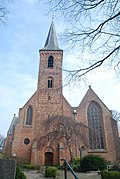 Dutch Reformed Church, Wassenaar
 -
 Wassenaar library
 -
 In the light of the forest
 -
 Autumn Beach, Wassenaar


.jpg)
.jpg)
.jpg)
References
[edit]- ^ "Samenstelling college van B&W" [Composition of the council of B&W] (in Dutch). Gemeente Wassenaar. Retrieved 28 June 2024.
- ^ "Kerncijfers wijken en buurten 2020" [Key figures for neighbourhoods 2020]. StatLine (in Dutch). CBS. 24 July 2020. Retrieved 19 September 2020.
- ^ "Postcodetool for 2242LV". Actueel Hoogtebestand Nederland (in Dutch). Het Waterschapshuis. Archived from the original on 21 September 2013. Retrieved 27 August 2013.
- ^ "Bevolkingsontwikkeling; regio per maand" [Population growth; regions per month]. CBS Statline (in Dutch). CBS. 1 January 2021. Retrieved 2 January 2022.
- ^ "Dit zijn de duurste straten en buurten van Nederland – 1 op 25 huizen is een miljoenenwoning" (in Dutch). Business Insider. 2023-04-18. Retrieved 2023-06-15.
- ^ a b "Netherlands counts 42,000 homes worth over €1 million". NL Times. 2018-04-05. Retrieved 2019-01-10.
- ^ "Ivicke". Rijksdienst voor het Cultureel Erfgoed (in Dutch). 6 December 2017. Retrieved 30 June 2020.
- ^ vleermuisbunker.nl/
- ^ "V2ROCKET.COM - Den Haag, Wassenaar, Hoek van Holland". www.v2rocket.com. Retrieved November 13, 2019.
- ^ "Wassenaar Arrangement on Export Controls for Conventional Arms and Dual-Use Goods and Technologies - Basic Documents" (PDF). Wassenaar Arrangement Secretariat. January 2015.
- ^ "Villa Eikenhorst | De Horsten Royal Estates". Royal House of the Netherlands. Archived from the original on 2021-11-29. Retrieved 2022-06-09.
- ^ "History | NIAS". nias.knaw.nl. Retrieved 2022-06-09.
- ^ Nina Siegal, "Wim Pijbes Quits Post at Museum Voorlinden After Less Than 3 Months", The New York Times, 2016. Retrieved 27 January 2017.
- ^ "Wassenaar municipal election 2022". verkiezingsuitslagen.nl (in Dutch). 16 March 2022. Retrieved 28 June 2024.
- ^ "Zwemloop Wassenaar Website". Zwemloop Wassenaar. Retrieved 28 March 2024.
- ^ "De 15 van Wassenaar Website". De 15 van Wassenaar. Retrieved 28 March 2024.
- ^ Glaudemans, Corien (29 April 2015). "Gemeente Den Haag eert Joods verzetsman Maurits Kiek (1909-1980) – Joods Erfgoed Den Haag". Retrieved November 13, 2019.
- ^ IMDb Database retrieved 24 August 2019
- ^ IMDb Database retrieved 24 August 2019
- ^ IMDb Database retrieved 12 December 2019
- ^ Talisker Whisky Atlantic Challenge Retrieved 07 June 2022
External links
[edit] Media related to Wassenaar at Wikimedia Commons
Places adjacent to Wassenaar | |
|---|---|


| International | |
|---|---|
| National | |
| Geographic | |
| Other | |

Wassenaar
View on GrokipediaWassenaar is a coastal municipality in the province of South Holland, Netherlands, situated between The Hague and Leiden along the North Sea, encompassing expansive dunes, beaches, and forested areas spanning 52.58 km². With a population of 26,949 inhabitants as of 2021 and a density of 512.5 per km², it ranks among the nation's more affluent locales, featuring high per capita income and luxurious estates.[1][2]
Historically rooted in prehistoric settlements, including a Bronze Age multiple burial discovered in the dunes, Wassenaar evolved from a noble hunting ground in medieval times to a favored residential enclave for royalty and elites by the 19th century, exemplified by estates like those of Prince Frederick. Its modern character is defined by a substantial expatriate population—about 20% international residents, many diplomats drawn to its proximity to The Hague's political and judicial hubs—fostering a serene, green environment with international schools and cultural amenities while maintaining low crime rates and strong community integration.[3][4][5][6]
Geography and environment
Location and terrain
Wassenaar is a coastal municipality in the province of South Holland, western Netherlands, positioned approximately 10 kilometers north of The Hague along the N44/A44 highway and adjacent to the North Sea coastline.[7] Its geographic coordinates are roughly 52°9′N 4°24′E.[8] The municipality borders The Hague to the south, Leidschendam-Voorburg and Voorschoten inland to the east, and Katwijk to the north, encompassing both urban and expansive natural zones.[9] The terrain of Wassenaar is predominantly flat and low-lying, with an average elevation of 3 meters above sea level, reflecting the typical Dutch coastal landscape shaped by reclamation and sea defenses.[10] It features extensive sand dunes along the western coast, including the Meijendel area, which consists of dynamic shifting sands, grasslands, and wooded sections protected as a nature reserve.[11] These dunes, part of the broader Hollandse Duinen National Park, alternate with forests, peat meadows, and bulb fields, providing a mosaic of habitats between urban development and the sea.[12] [13] The municipality spans a total area of 62.40 square kilometers, of which about 11.29 square kilometers is water, primarily consisting of channels and small lakes amid the polder lands.[14] Inland areas include agricultural polders and estates, while the coastal strip supports beaches accessible for recreation, though much of the dune system remains restricted to preserve ecological integrity against erosion and sea level influences.[11]Climate and natural features
Wassenaar's natural environment is characterized by expansive coastal dunes, sandy North Sea beaches, and interspersed forests and wetlands. The municipality lies within the Hollandse Duinen National Park, encompassing 4,500 hectares of dunes, forests, polders, and 46 kilometers of coastline formed by wind and marine forces, supporting rich biodiversity including unique flora and fauna adapted to shifting sands and saline conditions.[13] The Meijendel dune reserve, the largest contiguous dune area in South Holland at approximately 1,875 hectares, stretches between Wassenaar and Scheveningen, featuring open dune landscapes, freshwater lakes, wooded sections, and direct access to beaches; managed by Dunea for conservation and water extraction, it provides habitats for species such as natterjack toads and sand lizards while offering recreational trails.[15][16] Wassenaar experiences a temperate maritime climate with mild winters and cool summers, influenced by the North Sea and Gulf Stream. Annual temperatures typically range from a winter low of around 1°C to a summer high of 21°C, rarely dropping below -6°C or exceeding 27°C; January averages include highs of 5.8°C and lows of 3.3°C, while precipitation is evenly distributed throughout the year, averaging over 800 mm annually with high humidity and frequent overcast skies.[17][18]History
Origins and medieval period
The area encompassing modern Wassenaar has evidence of human habitation dating back to approximately 1800 BC, with early settlers utilizing the natural beach ridges for safety and resources.[19] Archaeological excavations have uncovered pottery shards from the 11th and 12th centuries, along with iron slag and other artifacts, indicating established settlement and possibly early industrial activity during this period.[20] The noble Van Wassenaer family, associated with the region's lordship, is first documented in historical records on November 3, 1200, in the County of Holland.[21] This family held significant feudal authority, with a fortified castle constructed on what is now the Burchtplein, serving as their ancestral seat and a key defensive structure in medieval Wassenaar.[22] The castle's presence underscores the area's role within the feudal system of heerlijkheden (lordships), where local lords managed land, justice, and taxation.[23] Religious infrastructure emerged early in the medieval era, exemplified by the Dorpskerk (village church), a Romanesque structure likely built in the early 12th century using tuff stone, though first explicitly mentioned in records from 1276.[24] Surviving elements of this original church highlight the consolidation of community and ecclesiastical influence amid the dunes and coastal landscape. By the late Middle Ages, Wassenaar functioned as a rural lordship with agricultural estates and emerging trade routes, reflecting broader patterns of village formation in the Low Countries from AD 800 to 1600.[25]Modern developments
In the early 20th century, Wassenaar experienced significant population growth following the death of major landowners, which freed up large tracts of land for development, attracting thousands of new residents.[19] The completion of a railway line connecting Rotterdam and The Hague in 1907 facilitated this expansion, transforming the area from a primarily agricultural village into a desirable residential suburb for affluent households.[26] During World War II, under German occupation, Wassenaar became a key site for V-2 rocket launches targeting London, with the first such attacks originating from roads and dunes in the municipality starting in September 1944; the Germans evacuated residents to secure the area for these operations.[27][28] Nazi authorities constructed bunkers, including one commissioned in 1942 by Reich Commissioner Arthur Seyss-Inquart for command purposes, while Allied commando raids, such as Operation Premium on 27-28 February 1944, targeted coastal defenses near the town.[29][30] Jewish residents faced systematic expropriation of properties, with most deported to concentration camps as part of broader Nazi policies.[31] Postwar, Wassenaar hosted pivotal diplomatic events, including negotiations at Kasteel Oud Wassenaar in September 1952 between Israeli and West German representatives, which finalized the Luxembourg Agreement on reparations for Holocaust victims, amounting to approximately 3.45 billion Deutschmarks in goods and services.[32] The municipality solidified its status as an exclusive enclave, with preserved estates and proximity to The Hague drawing international diplomats and expatriates; by the late 20th century, it featured the U.S. Embassy branch and emphasized green spaces amid suburban expansion.[6] Sand extraction continued into the mid-20th century to support infrastructure like roads and housing, shaping the local landscape.[25] In recent decades, debates over WWII-era remnants, such as repurposing bunkers, reflect ongoing efforts to balance historical preservation with modern land use.[29]Demographics
As of January 1, 2024, the municipality of Wassenaar had a population of 27,100 residents.[33] This represents a modest increase of 0.03% from the previous year, following a period of growth that saw the population rise from 26,949 in 2021.[33] The population density stands at approximately 513 inhabitants per square kilometer, reflecting the municipality's expansive dunes, forests, and low-density residential areas despite its urban proximity to The Hague.[1] Wassenaar exhibits an aging demographic profile, with 26% of residents aged 65 and older, 29% between 45 and 65, 18% between 25 and 45, 12% between 15 and 25, and 15% under 15 as of projections for 2025.[33] The gender distribution is nearly balanced, with females comprising about 52% of the population.[1] Households total around 12,111, of which 37% are single-person dwellings and 34% consist of multi-person households with children, indicating a mix of affluent families and retirees.[33] Approximately 40% of residents have a migration background, including 27% with Western origins and 13% with non-Western origins, higher than the national average due to the presence of international diplomats, business professionals, and expatriates drawn to the area near international courts and embassies in The Hague.[34] Foreign nationals account for about 16% of the population, with expatriates estimated at over 20%, predominantly from the United States, United Kingdom, and other Western countries.[1][35] This composition contributes to a cosmopolitan yet predominantly Dutch-native community, with 60% classified as autochthonous.[34]Economy
Key sectors and affluence indicators
Wassenaar's economy is predominantly service-based, with key sectors including retail, hospitality, and professional business services that cater to the local affluent population and seasonal tourism drawn to its dunes and beaches. Municipal analyses highlight mobile trade, detailhandel (retail), and horeca (catering and hospitality) as foundational, alongside enterprises on limited business parks focused on non-polluting activities. Between 2015 and 2023, jobs in the recreational and hospitality sector grew from 330 to 490 full-time equivalents, underscoring expansion in visitor-oriented services. Many residents commute to The Hague for employment in government, diplomacy, and international organizations, reflecting Wassenaar's role as a residential hub rather than a major industrial center.[36][37] Affluence indicators are pronounced, with Wassenaar consistently ranking among the Netherlands' wealthiest municipalities. In 2022, the average disposable household income stood at €58,900, exceeding the national average, while per capita income reached €41,900 and per income recipient €65,100. The employment rate for ages 15-75 was 82% that year, higher than the countrywide figure, with low dependency on social benefits. Housing market data further illustrates prosperity, as average transaction prices averaged €849,805 in recent assessments, among the highest nationally, driven by demand for spacious estates and proximity to The Hague.[38][39][40]Local government and politics
Administrative organization
The municipal council (gemeenteraad) of Wassenaar consists of 21 seats, filled by direct election every four years under proportional representation, serving as the legislative body responsible for approving budgets, ordinances, and major policies on behalf of the municipality's residents.[41] The council holds public meetings and oversees the executive through questioning and approval of key decisions.[42] Executive authority resides with the board of mayor and aldermen (college van burgemeester en wethouders), which executes council policies, manages daily operations such as permitting, public services, and land use, and holds portfolios in areas like finance, spatial planning, and sustainability. The board comprises the mayor, appointed by royal decree for a renewable six-year term and currently Leendert de Lange since July 18, 2019, alongside aldermen selected by and from the council, including Wim Koetsier (CDA, responsible for space, sustainability, and mobility) and Laurens van Doeveren (finance, economy, and sport) as of 2023.[43][44] The mayor chairs weekly non-public meetings of the board, collaborating with the municipal secretary, who also serves as general director.[45] The supporting administrative apparatus features a flat organizational structure with over 300 employees organized into 11 specialized units, such as spatial development, public space maintenance, finance and procurement, legal affairs, and customer contact, enabling efficient implementation of board directives while maintaining proximity to decision-makers and residents.[45] This setup aligns with Dutch municipal law, emphasizing dual accountability between elected representatives and professional staff.[46]Electoral trends and representation
The municipal council of Wassenaar comprises 21 seats, elected every four years. In the 2022 municipal elections held on March 16, with a turnout of 56.03%, the seats were distributed among eight parties, reflecting strong support for liberal and localist groups. VVD secured 5 seats with 2,701 votes (approximately 24%), matched by local party Hart voor Wassenaar with 5 seats and 2,604 votes (23%). Lokaal Wassenaar obtained 3 seats (1,752 votes, 15%), while CDA, D66, and GroenLinks each gained 2 seats (1,111; 958; and 945 votes respectively). Smaller parties DLW and PvdA each won 1 seat (655 and 605 votes).[47][48]| Party | Seats (2022) | Votes (2022) |
|---|---|---|
| VVD | 5 | 2,701 |
| Hart voor Wassenaar | 5 | 2,604 |
| Lokaal Wassenaar | 3 | 1,752 |
| CDA | 2 | 1,111 |
| D66 | 2 | 958 |
| GroenLinks | 2 | 945 |
| DLW | 1 | 655 |
| PvdA | 1 | 605 |
Culture and landmarks
Historical and cultural sites
The Dorpskerk, Wassenaar's village church, features elements dating to the early 12th century, when a Romanesque structure of tuff stone was erected on the site.[52] Tradition holds that this location marks the landing spot of the Northumbrian missionary Willibrord in the Netherlands, though empirical evidence for this is lacking.[53] The church, now Dutch Reformed, includes an organ built in 1769 by Albertus Antoni Hinsz, with an additional Rugwerk section installed in 1792 by Van Dam.[54] Kasteel Oud-Wassenaar, a Renaissance-style castle, was constructed between 1876 and 1879 on commission from Cornelis Jan van der Oudermeulen by architect Constantijn Muysken, drawing on Delft Renaissance influences.[55] Originally a country house, it has served various functions, including hosting celebrations such as the 1923 opening of a tram line to The Hague. Landgoed de Horsten encompasses approximately 450 hectares of estate land, integrating the sub-estates of Raaphorst, Ter Horst, and others, historically utilized as royal hunting grounds by the House of Orange.[56] As royal property, it preserves duinen, forests, and architectural features like the Jachthuis, reflecting centuries of aristocratic land management in the region.[57] Other notable historical structures include Backershagen, a garden pavilion, and Raadhuis de Paauw, the town hall opened for public tours during events like Open Monumentendag.[58] [59] For cultural engagement, Museum Voorlinden presents modern and contemporary art within a dedicated architectural space, though its 2016 establishment postdates traditional historical landmarks.[60]Sports and leisure activities
Wassenaar's coastal position and surrounding dunes enable diverse outdoor pursuits, including beach recreation at Wassenaarse Slag, where visitors engage in walking, swimming, kitesurfing, and windsurfing along the North Sea shore.[61] The area's expansive dune landscapes, integrated into Hollandse Duinen National Park, support hiking and cycling on designated trails through Meijendel nature reserve and Landgoed de Horsten, spanning forests, valleys, and coastal paths totaling over 46 kilometers of routes.[13][62] Golfing stands out as a key leisure activity, with facilities like Golf Duinzicht and Wassenaarse Golfclub Rozenstein offering 18-hole courses amid parkland and dune settings, accommodating players year-round.[61][63] Organized sports thrive through local clubs focused on field hockey, football, tennis, cricket, rugby, running, softball, and baseball, fostering community participation.[64] Indoor options include multiple gyms and fitness centers for exercise and recreation.[65] The Prince Frederick’s Park Trail, a historic 19th-century circular path across estates, further enhances walking and cycling opportunities in preserved green spaces.[65]Notable residents
Royalty and public figures
Villa Eikenhorst on the De Horsten estate in Wassenaar served as the primary residence for King Willem-Alexander and Queen Máxima from 2003 until January 2019, when the family relocated to Paleis Huis ten Bosch.[66] Their three daughters—Princess Catharina-Amalia (now the Princess of Orange), Princess Alexia, and Princess Ariane—spent their formative years there, with the estate providing a secure, wooded environment near The Hague.[67] The property, originally built in the style of a 17th-century Dutch farmhouse, had earlier been associated with the royal family, including as a residence for Princess Christina.[66] The De Horsten estate traces its royal connections to the 19th century, when Prince Frederik, son of King Willem I, acquired and developed the land, establishing a tradition of Oranje-Nassau presence in Wassenaar.[57] This historical link underscores Wassenaar's appeal to royalty, combining privacy, natural dunes, and proximity to diplomatic centers. Among public figures, Wassenaar has attracted diplomats and statesmen due to its affluent, low-density setting suitable for high-security living near international organizations in The Hague. Alidius Tjarda van Starkenborgh Stachouwer (1888–1978), a Dutch nobleman who served as the last Governor-General of the Dutch East Indies (1937–1942) and later as a diplomat, died in Wassenaar on August 16, 1978, after a career marked by colonial administration during World War II.[68] Several prominent politicians also ended their lives there, including Rudolf de Korte (1936–2020), who held positions as Minister of Economic Affairs and Speaker of the House of Representatives, dying on January 9, 2020; Hans de Koster (1914–1992), former Minister of Defence and Foreign Affairs, on November 24, 1992; and Gerard Helders (1905–2013), a long-serving parliamentarian and Minister of Economic Affairs, on September 9, 2013. These associations reflect Wassenaar's role as a retirement haven for establishment figures in Dutch politics and diplomacy.Arts and sciences
Sidney van den Bergh (born May 20, 1929, in Wassenaar), a Dutch-born Canadian astronomer, has made significant contributions to the understanding of galaxies and stellar populations. He earned degrees from Princeton University and the University of Groningen before joining the Dominion Astrophysical Observatory in Canada, where his research on the structure of the Milky Way and extragalactic astronomy earned him the Gruber Cosmology Prize in 2014 for advancing knowledge of the universe's scale and evolution.[69] In the arts, Theo van Gogh (1957–2004), born in Wassenaar, was a provocative Dutch filmmaker and television director known for documentaries and features critiquing societal issues, including Interview (2003), which addressed interracial tensions. His career, spanning over 30 films, often challenged political correctness and multiculturalism, culminating in his 2004 assassination by an Islamist extremist following the release of Submission, a short film on violence against women in Islamic contexts co-directed with Ayaan Hirsi Ali. Paul Citroen (1896–1983), a German-born Dutch painter and Bauhaus alumnus who resided in Wassenaar during his later years, produced portraits and landscapes, including works exhibited at the Stedelijk Museum Amsterdam, blending modernist influences with Dutch traditions.[70] Henri Friedlaender (1904–1996), a typographer who lived in Wassenaar during World War II—hiding from Nazi persecution with his wife's aid—designed influential Hebrew typefaces like Hadassah for the Israel Ministry of Education after emigrating postwar, contributing to graphic arts revival in Israel.[71]Business and sports
Morris Tabaksblat (1937–2011), a prominent Dutch executive who served as CEO of Unilever from 1994 to 1999, resided in Wassenaar and died there on October 20, 2011.[72][73]In sports, Nico van der Voet (born March 13, 1944, in Wassenaar), a water polo player, represented the Netherlands at the 1968 Mexico City Olympics, where the team placed 11th, and the 1972 Munich Olympics, finishing 10th; he scored 10 goals across both tournaments.[74]
Annebel van der Knijff (born March 5, 1996, in Wassenaar), a slalom canoeist, has competed internationally since 2012, initially for the Netherlands before switching allegiance to Spain, participating in events like the ICF Canoe Slalom World Championships.[75]
Konrad Bartelski (born 1954), a British alpine skier who achieved the first World Cup podium for a British male in downhill at Val Gardena in 1981, lived in Wassenaar for several years during his career.[53]