Hubbry Logo
KatwijkKatwijkMain
Open search
Katwijk
Community hub
Katwijk
logo
8 pages, 0 posts
0 subscribers
Be the first to start a discussion here.
Katwijk
Katwijk
from Wikipedia
Dutch Topographic map of Katwijk (urban area), March 2014

Key Information

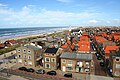
Coastal boulevard in Katwijk

Katwijk (Dutch pronunciation: [ˈkɑtʋɛik] ) is a coastal municipality and town in the province of South Holland, which is situated in the mid-western part of the Netherlands. Katwijk is located on the North Sea, northwest of Leiden and 16 km north of The Hague. The Oude Rijn ("Old Rhine") river flows through the town and into the North Sea.

In August 2020, Katwijk had a population of 65,929 and covers an area of 31.15 km2 (12.03 sq mi), of which 6.40 km2 (2.47 sq mi) is water. It shares its borders with the municipalities of Noordwijk, Teylingen, Oegstgeest, Leiden, and Wassenaar.

Katwijk is by far the largest town in the Duin- en Bollenstreek ("Dune and Bulb Region"). Katwijk is a relatively religious town and is one of the few remaining in that region that observes the Sunday rest by local law.[5]

Districts

[edit]

The town consists of a number of districts, including namesakes Katwijk aan den Rijn and Katwijk aan Zee. On 1 January 2005 the various districts had the following populations:

Lying on the coast, Katwijk aan Zee is (and has always been) the larger town. Katwijk aan den Rijn lies just slightly inland. Rijnsburg is situated east of Katwijk aan den Rijn whereas Valkenburg finds itself to the south. Katwijk-Noord is situated north of Katwijk aan Zee.

Although consisting of historically separate towns (except Katwijk-Noord) that still today maintain separate identities, the towns have more or less grown together and merged into a single conurbation. The creation of the municipality of Katwijk is a recognition of that fact. The town hall of the current municipality of Katwijk is located in Katwijk aan den Rijn, near the boundary of Katwijk aan Zee. All these districts lie along the Oude Rijn.

History

[edit]
Katwijk in 1865.
This engraving by William van der Gouwen shows a twenty-meter (70 feet) long whale, which on the third of February, 1598 was stranded on the Dutch coast between Scheveningen and Katwijk.

The name "Katwijk" probably has its origins in the name of a Germanic tribe called the Chatten (Chatti). The Dutch word "wijk" means "area", so the name probably meant something like "the Chatti area".

In Roman times, Katwijk was a place of strategic importance. It was located at the Roman Empire's northern border, at the mouth of the Rhine river, which in Roman times was larger in this area than it is today. There was a good deal of traffic along the Rhine. Katwijk was also a jumping-off point for the voyage to Britain.

Built during the reign of Emperor Claudius (41-54), the town's name was Lugdunum Batavorum. The town's name was later associated with the name of the city of Leiden, but this is now thought to be incorrect.

In 1231, the first reference to Catwijck appeared in records.

The history of the modern municipality of Katwijk is essentially the history of its constituent parts, which for each village extends back to Roman times. However, Katwijk aan Zee, Katwijk aan den Rijn and Valkenburg were part of the same heerlijkheid called "Beide de Katwijken en 't Zand" (or something similar). They have been administratively joined for centuries despite their differing characters. Katwijk aan Zee was a fishing town and Katwijk aan den Rijn had an agricultural character.

During World War II, Katwijk aan Zee was heavily damaged. On 1 May 1942 beach access was no longer permitted and large scale evacuation took place. From October 1943 houses were demolished as part of the construction of the Atlantic Wall.[6]

On 1 January 2006, Rijnsburg and Valkenburg were also merged into the municipality, it's called nowadays Katwijk.

Public transportation

[edit]
NZH Blue tram at the Rijnstraat on a celebrational heritage service, over 60 years after the abolishment of the interlocal tramway in and around Katwijk.

Katwijk is a larger town in the Netherlands without a railway station, and the largest without any railway connection. The nearest railway stations are Voorhout and Leiden. Katwijk is connected by bus with Noordwijk, Leiden, The Hague and Lisse. The public transport by bus is served by Arriva. As of 9 December 2012 new buslines came to Katwijk. In December 2023 Q-Buzz is going to take over the buslines in Katwijk.

Between 2019 and 2023 a lot changed in Katwijk and Leiden. A quick bus line from Katwijk to Leiden, a Q-Liner, numbers 430 and 431, drive from Leiden to Katwijk aan Zee (Boulevard-South) and the other (430) goes to the space agency ESTEC, and returns to Leiden after a short stop. It took years to make the Ir. Tjalmaweg (a part of the N206), a double two-sided road. See here:

Bus transportation

[edit]
  • Bus 430/432 - Travels from Noordwijk ESTEC (very close to Katwijk, outside built-up areas in Noordwijk) via the Biltlaan and Zeeweg and N206 to Leiden Centraal. During the day, this bus departs every 15 minutes in every direction.
  • Bus 431 - Travels from Katwijk Boulevard-South via Vuurbaak, Boulevard, Tramstraat and Zeeweg to the N206 to Leiden, where it ends at the railway station. During the day, this bus departs every 15 minutes (every 10 minutes during morning rush hour).
  • Bus 35 - Local bus service, running from Duinvallei to Unmanned Valley (centre for asylum seekers)
  • Bus 38 - Travels from Katwijk Raadhuis via Kon. Julianalaan and Zanderij through Valkenburg to Leiden Centraal, once an hour.
  • Bus 90 - Travels from Lisse, Noordwijkerhout, Noordwijk, Katwijk, Rijnsburg, Oegstgeest to Leiden Centraal, twice an hour. Buses on this route have been converted to allow bicycles to be brought onto the bus. Bus 90 took over the route from bus 37 (Katwijk to Leiden and back)

Additionally, Rijnsburg and the far northeastern part of Katwijk-Noord are served by bus 20 and 21, running between Noordwijk and Leiden. Peak hour buses connect industrial zones with surrounding municipalities.

Sport

[edit]

The municipality has multiple football clubs: VV Katwijk, Quick Boys and Rijnsburgse Boys are all semi-professional Tweede Divisie clubs, whereas FC Rijnvogels and Valken '68 are amateur club playing further down the league pyramid.

Grasshoppers Katwijk, are a basketball club established in 1971, playsling its home games at Cleijn Duin. Its women's team plays in the VBL, the domestic first tier, whereas the men's team plays in the Promotiedivisie, the domestic second tier.

Notable people

[edit]
Esther Ouwehand, 2010
Jaap van Duijn, 2011

Sport

[edit]
[edit]

Tourist attractions

[edit]

Katwijk is a seaside resort with a wide sandy beach. Its attractiveness is mainly due to its laid-back atmosphere. The boulevard along the shore is not spoiled by large hotels or apartment blocks and has not given in to an excessive commercialisation. Although most buildings lining the boulevard are tourist apartments and pensions, most are just three floors high (and none more than five) and offer a distinctive 'feel' of the 1950s. Besides the beach, there are a few museums in Katwijk, like the old fisherman's museum Katwijks Museum and the Spinoza-museum. A few kilometers inland is the Valkenburg Lake Steam Train, a narrow-gauge railway museum where a scenic steam locomotive driven train ride can be taken around Lake Valkenburg. Katwijk has many hotels and three camping places, mostly situated in the dunes.

Twin towns

[edit]
[edit]

References

[edit]
[edit]
Revisions and contributorsEdit on WikipediaRead on Wikipedia
from Grokipedia
Katwijk is a coastal municipality in the province of , , positioned along the at the mouth of the Oude Rijn river. It encompasses the seaside fishing village of and the inland area of Katwijk aan den Rijn, with a of 66,966 as of 2024 and a total area of 31.15 square kilometers, including significant water coverage. Historically centered on herring fishing that originated in the Middle Ages, Katwijk's economy transitioned from maritime pursuits to , bolstered by its expansive sandy beaches, protective dunes, and a lively boulevard promenade that draws visitors for recreation and seafood. The municipality maintains a distinct shaped by orthodox Reformed Protestantism, part of the Dutch , where conservative Christian political parties like the (SGP) and Christian Union exert considerable influence, often prioritizing Sabbath observance over commercial activities such as Sunday retail. This religious framework contributes to low rates of secular behaviors compared to national averages, fostering tight-knit communities with emphasis on family and tradition.

Geography

Location and Administrative Divisions

Katwijk is a in the province of , in the western , positioned along the coast at the mouth of the Oude Rijn river. The municipality borders the to the west, to the north, Teylingen to the south, and inland to the east with , , and . Administratively, Katwijk comprises distinct districts including the coastal , the inland Katwijk aan den Rijn situated along the Oude Rijn, the former village of Rijnsburg incorporated in 2006, Valkenburg also merged in 2006, Katwijk-Noord, and rural areas such as Katwijk Landelijk gebied. The municipality covers a total area of 31.15 km², of which 6.40 km² consists of water bodies including river sections and coastal inlets.

Physical Geography and Climate

Katwijk features a coastal landscape dominated by expansive sand dunes and wide beaches along the , forming part of the Hollandse Duinen system that stretches from to . These dunes, which emerged around 5,000 years ago amid post-glacial sea-level fluctuations, consist primarily of aeolian sands stabilized by vegetation, rising up to 30-50 meters in height in adjacent areas and providing a natural buffer against wave action and storm surges. The Oude Rijn influences local , depositing alluvial materials that interact with marine processes to shape the dynamic shoreline. The region exhibits a temperate maritime (Köppen Cfb), moderated by the , with annual mean temperatures averaging 10.8°C. Winter months (December-February) record daily means of 3-6°C, with minima rarely falling below -5°C, while summer highs (June-August) average 17-20°C, seldom exceeding 26°C. totals about 940 mm yearly, peaking in autumn and winter due to frequent cyclonic activity, with over 200 rainy days annually contributing to dune moisture and patterns. Dune systems historically underpin flood defense by dissipating wave energy and trapping sediments, as evidenced by their role in averting inundation during storms prior to modern reinforcements. However, exposure to swells and tidal ranges of 1.5-2 meters heightens susceptibility to , with rates varying from 0.5-2 meters per year in unprotected segments based on shoreline monitoring. Sea-level rise, measured at approximately 20 cm over the along the Dutch coast, exacerbates this through increased submersion and , prompting adaptive measures like periodic derived from empirical hydrodynamic models. Geological assessments project heightened vulnerability under scenarios of 0.5-1 meter rise by 2100, underscoring the need for sustained dune accretion to maintain protective efficacy.

Demographics

As of 1 January 2023, the municipality of Katwijk had a population of 65,995, marking a steady increase from 58,086 residents in 1995, with an estimated projection to 67,089 by the end of 2025. This growth, averaging about 0.6% annually in recent decades, stems largely from net gains—particularly suburban inflows from adjacent urban areas like —and modest natural increase via births exceeding deaths, rather than significant international inflows. Post-World War II expansion accelerated this trend, as housing development attracted families seeking coastal proximity to the conurbation while maintaining lower densities than central cities. Demographically, Katwijk's residents exhibit a median age of approximately 43 years, slightly above the national average of 42, reflecting a balanced but gradually aging structure with 20-22% under 18 and around 18-20% over 65, aligned with broader Dutch patterns of low fertility (1.5-1.6 children per woman) and lengthening . Average household size stands at 2.46 persons, comprising 26,822 families, with a near-even split of 49.6% and 50.4% . Ethnically and origin-wise, the population is overwhelmingly of native Dutch heritage, with over 88% classified as autochtoon (both parents born in the ), and the share holding a migration background—defined by as at least one parent born abroad—remaining below 12%, far lower than the national figure of 25%. Non-Western backgrounds constitute a small fraction (under 5%), primarily from (e.g., 2,256 individuals) and limited African or Latin American origins, with Western migration (e.g., , ) accounting for most diversity; this homogeneity persists due to limited international settlement patterns in the , prioritizing internal Dutch relocations over global inflows.

Religious and Cultural Demographics

Katwijk maintains a notably religious , with approximately 87.5% of its population identifying as Christian in , substantially higher than the national average where over 50% report no religious affiliation. This adherence is predominantly to orthodox Reformed Protestant traditions, including denominations such as the Christelijke Gereformeerde Kerken (with 410 members as of recent records) and Gereformeerde Kerken Vrijgemaakt, resulting in church densities exceeding national norms by a wide margin. The town's location within the Dutch Bible Belt amplifies this concentration, where conservative shapes daily life more pervasively than in urban areas. Secularization in Katwijk proceeds at a slower pace than in the broader , where Protestant affiliation has declined to 13% nationally by 2023. High church attendance and communal observance of religious practices, such as rest, underscore this resilience, contrasting with urban trends toward irreligiosity. Limited participation in secular festivals and sustained family-based further evidence lower secular influences. Culturally, this religious predominance fosters ethnic and value-based homogeneity, with the vast majority of residents of Dutch origin adhering to traditional Protestant norms that prioritize large families and marital stability. Such structures promote social cohesion, as orthodox communities emphasize communal support networks and scriptural guidelines on life, diverging from national patterns of and higher family dissolution.

History

Origins and Early Settlement

Archaeological investigations have identified the site of modern Katwijk as the location of Batavorum, a Roman and fortified military granary established at the estuary of the Oude Rijn (Old ) to secure the northern limes, or frontier, of the during the 1st century AD. This settlement supported naval operations and grain storage for legions, with evidence including structural remains exposed by coastal erosion and confirmed through 1980s excavations revealing a coastal Roman presence. Further discoveries, such as a preserved 125-meter stretch of Roman unearthed in 2018, underscore military infrastructure linked to Emperor Claudius's expansions along the delta. Post-Roman continuity is suggested by early medieval farmsteads at sites like Katwijk-Zanderij Westerbaan, indicating agrarian communities from the 6th to 8th centuries that may have built on earlier Roman land use patterns amid shifting river courses and dune formation. These settlements likely involved small-scale fishing and farming adapted to the coastal environment, predating organized reclamation efforts. The missionary landed nearby in 690 AD to evangelize , marking early Christian influence at the mouth, though settlement persisted through Frankish transitions without major disruption. The earliest documentary reference to Katwijk appears in 1231 as "Catwijck," describing a modest cluster of wooden houses engaged in rudimentary and , with a noted around 1380. Medieval in the broader coastal region, including dune stabilization for arable use, drew on monastic initiatives from orders like the , which promoted drainage and embankment techniques from the 12th century onward, indirectly supporting inland expansion from coastal nuclei like Katwijk.

Medieval to Early Modern Developments

During the medieval period, Katwijk functioned as a modest fishing settlement within the , where local inhabitants pursued maritime activities from coastal dunes along the [North Sea](/page/North Sea). Archaeological and historical records indicate that sea commenced as early as the , sustaining the community through catches of and other coastal species using rudimentary flat-bottomed boats suited to the shallow sands. This reliance on fisheries, rather than extensive inland due to the sandy , established Katwijk's pre-industrial economic foundation under the feudal oversight of Holland's counts, who granted coastal access rights that encouraged gradual population growth tied to seasonal hauls. The saw infrastructural consolidation, including the construction of churches like the Dorpskerk in Katwijk aan den Rijn, founded originally in 1231 as a leper but expanded to serve the burgeoning village. While formal craft proliferated across the for urban trades, Katwijk's economy operated more through informal communal practices and lord-granted privileges than documented guild charters specific to the locality, reflecting its rural, seafaring character amid broader regional institutionalization. The Protestant Reformation exerted a decisive causal influence in the 16th century, transitioning ecclesiastical control from Catholic to Reformed hands around 1575, with Katwijk's communities initially worshiping at inland churches like the Dorpskerk before reclaiming coastal structures. This religious realignment, propelled by Calvinist doctrines emphasizing and communal , reinforced Protestant and spurred church adaptations, such as the 1599 repairs to the Andreaskerk in , fostering a cohesive identity that underpinned social stability amid confessional strife elsewhere in . Katwijk's early modern prosperity peaked in the 17th-century , driven by the boom that integrated the village into national export networks via innovative driftnet (vleet) techniques on specialized busses, targeting migratory stocks northward to the Shetland Islands. The fishery, yielding up to thousands of barrels annually from fleets of around 500 vessels nationwide, generated wealth through gibbing and salting innovations that extended shelf life for Baltic and European markets, elevating Katwijk's role in Holland's maritime dominance despite competition from ports like . This trade causal chain—linking technological advances, naval security, and demand from urban centers—sustained population inflows and infrastructural investments until pressures emerged later.

Industrialization, Fishing Era, and World Wars

Katwijk's fishing industry experienced significant expansion in the late 19th and early 20th centuries, driven by innovations in vessel design and fishing techniques. The introduction of the sailing lugger around 1895 enabled vleet drift-net fishing, which facilitated massive herring hauls and marked a peak period from 1895 to 1915. This era solidified Katwijk aan Zee's role as a key herring fishing center, building on medieval traditions of coastal fisheries that targeted species like herring with drift nets. Limited broader industrialization occurred in Katwijk itself, as the local economy remained centered on maritime activities rather than heavy manufacturing, contrasting with urban centers in the Netherlands where steam power adoption lagged until the late 19th century. The fishing community faced severe disruptions during , with wartime naval conflicts in the leading to the loss of numerous vessels and lives among Katwijk's fishermen. A in the town honors those who drowned at sea, reflecting the hazards of operating in contested waters amid and minefields. These losses compounded the risks inherent in the herring fishery, which had already seen environmental pressures from intensified exploitation since the , though stocks remained viable into the . World War II brought further strain under German occupation, as the coastal strip was declared a restricted Sperrgebiet in 1942 to facilitate fortifications. This resulted in evacuations of residents—some relocated as far as —and the demolition of landmarks and homes to clear space for bunkers and defensive structures, severely impacting the local population and infrastructure. While widespread destruction was avoided compared to inland areas, the economic effects included halted operations and resource shortages, with reconstruction efforts commencing after liberation in 1945. The traditional fleet began contracting post-war amid concerns and emerging regulatory frameworks, foreshadowing stricter quotas that later reduced Dutch capacities.

Post-War Growth and Modern Era

Following the end of , Katwijk experienced reconstruction efforts aligned with broader Dutch post-war initiatives, prioritizing housing amid rapid and economic recovery. The town's coastal position supported expansion in infrastructure during the mid-to-late , with developments enhancing access and promenades to attract visitors beyond traditional fishing activities. By the 1960s and 1970s, this shift contributed to urban growth, including residential expansions that accommodated increasing permanent residents while preserving dune landscapes. On January 1, 2006, the neighboring municipalities of Rijnsburg and Valkenburg merged with Katwijk, expanding the administrative boundaries and population to over 60,000 inhabitants, facilitating coordinated planning for housing and . This amalgamation addressed pressures from suburban development and , enabling unified responses to environmental challenges such as . In response to and storm risks, Katwijk implemented coastal reinforcement projects, including a 2015 dike-in-dune construction that integrated flood defenses with an underground 663-space car park, widening dunes and enhancing protection without disrupting the natural seascape. Subsequent from September 2022 to February 2023 added sand to sustain dune integrity, empirically reducing rates and maintaining flood safety standards amid observed climate variability. Recent developments underscore Katwijk's adaptation to modern recreational and emergency needs; on July 5, 2025, the SAR Katwijk event hosted one of the ' largest international search-and-rescue demonstrations, featuring aerial, maritime, and land operations to showcase coastal safety capabilities. Concurrently, the SkateOn opened in April 2025, providing extensive facilities including a large bowl and street course to support youth urban sports and .

Government and Politics

Local Governance Structure

The municipal council of Katwijk, comprising 33 elected members, serves as the legislative body responsible for adopting policies, approving budgets, and overseeing the executive. Members are elected directly by residents every four years, with the most recent held on March 16, 2022. The council meets biweekly to deliberate on local matters, ensuring representation from the four main population centers: , Katwijk aan den Rijn, Rijnsburg, and Valkenburg. The executive authority is vested in the college van burgemeester en wethouders (board of mayor and aldermen), consisting of the mayor—appointed by —and four aldermen selected by the council from its members or external candidates. This board handles daily administration, executes council decisions, and represents the in legal and intergovernmental affairs. The , currently Cornelis Visser, chairs both the and the board, maintaining impartiality in public order and safety roles. Key responsibilities encompass and to manage and development; social welfare services, including support for vulnerable residents under the Social Support Act (Wmo); and coordination of local education infrastructure, such as school accommodations and youth welfare policies, though funding remains national. The 2024 budget, totaling expenditures aligned with revenues for balance in that year, allocates funds across programs like , , and public services, with projected deficits emerging post-2025 due to rising costs in welfare and infrastructure. Katwijk integrates its governance with provincial () and national frameworks, particularly on coastal defense, where local zoning supports national projects like the dyke-in-dune reinforcements completed in the to enhance flood protection while preserving viability. These efforts involve collaboration with for sand nourishment and dune maintenance to counter sea-level rise, ensuring compliance with the Delta Act standards for primary flood defenses.

Political Landscape and Voter Tendencies

Katwijk's electorate demonstrates pronounced conservative tendencies, rooted in its sizable orthodox Protestant community, which consistently favors parties emphasizing traditional over progressive national trends. In the 2023 Tweede Kamerverkiezingen, the Staatkundig Gereformeerde Partij (SGP) secured 8.6% of the vote in the , while the ChristenUnie (CU) obtained 5.3%, yielding a combined 13.9%—substantially above national figures of approximately 2.1% for SGP and 3.1% for CU. This pattern holds in municipal elections, where SGP and CU together captured 26% in 2022 (SGP at 14%, CU at 12%), though local party DURF emerged as the largest with 9 seats, reflecting some diversification within conservative preferences. These voting outcomes highlight resistance to policies perceived as eroding observance and family structures, such as proposals to permit retail operations, which SGP and CU councillors have actively opposed in council debates as recently as 2024. Orthodox Protestant voters, who form a core base for SGP, prioritize biblically informed governance on social issues, contributing to lower support for liberal initiatives on topics like expansion or reforms compared to urban Dutch averages. Empirical data from successive elections since 2000 show SGP and CU maintaining combined shares often exceeding 20%, underscoring a stable bloc amid national fragmentation toward populist or left-leaning alternatives. Internal community debates further illustrate these tendencies, particularly regarding women's roles in politics; SGP's longstanding policy against female candidacy—rooted in interpretations of scriptural authority—has prompted some orthodox Reformed women to abstain or shift votes to CU or other options, with surveys indicating up to 8% deviation among church-attending women in similar communities. Despite court rulings in the 2000s mandating equal treatment, SGP compliance remains interpretive, preserving voter loyalty among those prioritizing doctrinal consistency over norms prevalent nationally. This electoral conservatism positions Katwijk as a , with orthodox support resisting broader evident in Dutch referenda and policy shifts on moral issues.

Economy

Historical Fishing Industry

The fishing industry in Katwijk aan Zee originated in the Middle Ages, when local fishermen ventured into the North Sea using flat-bottomed vessels launched directly from the beach due to the absence of a dedicated harbor. These early efforts targeted species such as herring, gadids, and flatfish, with techniques evolving from simple coastal netting to more expansive operations by the 16th century, when the village solidified its role as a fishing center following the relocation of the regional fish market there in 1388. By the early 19th century, the fleet consisted of around 30 bomschuiten—larger flat-bottomed boats derived from the traditional pink smack—employed primarily for near-shore fishing of flatfish and other demersals using beam-like trawling precursors adapted for beach launching. The marked a period of expansion, driven by demand for , which Katwijk fishermen pursued with vleet drift nets during seasonal migrations extending as far as the Islands. Fleet size grew from approximately 30 vessels in 1850 to about 70 by 1900, bolstered by the lifting of a long-standing ban on at-sea gibbing (gutting and salting) of in , which improved preservation efficiency and enabled larger catches for export. This innovation, combined with family-based crews handling net-mending and processing onshore, sustained community employment and contributed to the ' dominance in salted trade, a cornerstone of Dutch exports during the era. Operations remained labor-intensive, with vessels beached after each trip for unloading, reflecting the reliance on communal labor in this coastal economy. The industry's peak occurred in the early , with the fleet reaching around 130 sailing luggers by 1916, following the transition from bomschuiten to these larger, harbor-dependent vessels between and 1915 to access distant grounds. These luggers supported substantial hauls, integral to national exports, while supplementary trawling—employing beam rigs for sole and —diversified catches amid fluctuating stocks. peaked alongside the fleet, providing livelihoods for much of the male population and ancillary roles for families, though exact figures are sparse; the sector's scale underscored Katwijk's role in sustaining Dutch fisheries output before economic pressures and technological shifts initiated decline post-World War I.

Contemporary Sectors Including Tourism

Katwijk's economy has diversified beyond traditional , with emerging as a key sector since its establishment as a in the mid-19th century. The town's wide beaches and promenade attract visitors, contributing to local GDP through spending on accommodations, dining, and recreation. In 2025, coastal areas like Katwijk saw average visitor expenditures of €135 per visit, 24% higher than in non-coastal tourist destinations, underscoring 's economic boost. However, poses challenges, with peak summer crowds straining infrastructure and leading to pressures in Dutch coastal municipalities, including environmental impacts from increased waste and . The residual fishing industry, centered in , persists but has contracted, supplemented by related processing and selective modern techniques like flyshoot fishing in nearby regions. Efforts to augment fisheries include exploration of , though it remains limited locally amid broader Dutch diversification strategies. Services and small-to-medium enterprises (MKB) dominate contemporary employment, supported by proximity to Leiden's tech hub and regional innovation clusters. in Katwijk stood at 2.9% in 2023, below the national average of approximately 3.6%, reflecting robust labor market resilience despite post-pandemic fluctuations. In the 2020s, the municipality's Economic Agenda 2021-2026 emphasizes broadening economic bases through greenport , enhancement, and sustainable initiatives to counter to 90,000 by 2050 and aging demographics. Eco-tourism elements, such as sustainability weeks promoting local environmental awareness, align with these goals, though quantifiable revenue impacts from specific programs remain nascent amid national 's 4% GDP share. These shifts mitigate fishing decline risks while addressing diversification pros like job creation against cons such as dependency on volatile visitor numbers.

Culture and Society

Religious Institutions and Influence

Katwijk hosts 21 Protestant church congregations, predominantly Reformed denominations such as the Hervormde Gemeente and Gereformeerde Kerken, reflecting its position within the Dutch Bible Belt. The Hervormde Gemeente , a major Reformed body, organizes into 8 districts with dedicated church councils overseeing local pastoral and community activities, while managing at least 10 church buildings including historic sites like the Nieuwe Kerk, which seats over 2,000. These institutions emphasize adherence to confessional standards like the and maintain regular services, contrasting with national trends where Protestant affiliation has fallen to 13 percent and averages below 20 percent. Church influence extends to through affiliated Christian schools and welfare via volunteer-driven initiatives, fostering community cohesion in a where religious norms shape , such as resistance to Sunday commercial activities proposed in 2024. Local patterns align with broader Bible Belt correlations between religious participation and elevated volunteer rates, supporting informal welfare networks amid national . This religious infrastructure correlates with Katwijk's below-average crime rates relative to larger Dutch cities, with observers attributing stability to conservative moral frameworks upheld by congregations despite declining national from 60 percent in the mid-20th century to under 30 percent today. Such preservation enables sustained community influence, including opposition to secular policies, as seen in local Christian parties' power on observance.

Traditions, Community Life, and Social Debates

Katwijk's orthodox Protestant segments, particularly adherents of the Gereformeerde Gemeenten, uphold traditions rooted in strict Sabbath observance and family-centric customs, fostering large households that prioritize procreation as a religious duty. These communities exhibit fertility rates notably higher than the national average of 1.62 children per woman (as of 2023), often exceeding 2.5 in Bible Belt areas including Katwijk, driven by doctrinal emphasis on biblical mandates for family expansion rather than secular individualism. Mutual aid networks within these groups provide informal support for childcare, elder care, and financial hardships, reducing dependence on state welfare and contributing to documented low crime and divorce rates compared to urban Dutch averages. Social life revolves around church-centered gatherings and seasonal commemorations of heritage, such as local herring events echoing national Vlaggetjesdag traditions of boat decorations and auctions marking the new catch, though adapted to Katwijk's coastal identity without the scale of Scheveningen's festival. Tight-knit structures yield benefits like rapid during crises—evident in voluntary aid during floods or personal losses—but also spark debates over insularity, with critics from secular media arguing it impedes broader societal integration and exposure to diverse viewpoints. Orthodox resistance manifests in opposition to modernization, exemplified by sustained pushback against Sunday shop openings, viewed as violating rest commandments; local councils, influenced by conservative voices, have historically prioritized closures, contrasting national trends. Gender roles remain contentious, particularly in political spheres where the Staatkundig Gereformeerde Partij (SGP), dominant in Katwijk elections, has interpreted scripture to restrict women's candidacy until a 2013 Supreme Court ruling mandated openness, yet internal debates persist, as in the party's 2025 rejection of motions affirming female leadership eligibility. Proponents of these norms cite empirical stability—lower relational breakdowns in traditional households—while detractors, often from progressive outlets, decry them as patriarchal barriers to equality, overlooking causal links between role clarity and family cohesion observed in longitudinal Dutch studies. This tension underscores broader clashes between preserved communal solidarity and pressures for secular conformity.

Infrastructure and Transportation

Road and Maritime Connectivity

The N206 provincial road, also known as the Ir. G. Tjalmaweg, provides primary vehicular access to Katwijk, extending approximately 8 kilometers from to the coastal areas, linking to the A44 and A4 motorways for broader connectivity to and . Recent upgrades, completed in phases through 2023, added dual lanes in each direction, integrated sound barriers, and incorporated sustainable features like recycled materials in green medians to enhance and environmental integration. Maritime connectivity centers on the small North Sea-facing harbor at Katwijk aan Zee, including the Marina Katwijk and Prins Hendrikkanaal, which accommodate fishing vessels, recreational boats, and limited commercial traffic with direct beachfront access. The harbor supports local maritime operations but lacks deep-water facilities for large-scale shipping, relying on nearby ports like Rotterdam for heavier logistics. Extensive dedicated complements road links, featuring the LF Kustroute coastal path and Dune & Sea route, which facilitate efficient commutes along the and dunes to adjacent towns like and , spanning up to 33 kilometers with minimal elevation gain. Coastal defenses, integral to maritime resilience, include a dyke-in-dune system constructed between 2011 and 2015, incorporating a 663-space underground car park and reinforced dunes widened by up to 50 meters to withstand 1-in-10,000-year storm surges, with ongoing maintenance focused on periodic sand replenishment rather than structural overhauls.

Public Transit Systems

Katwijk lacks a dedicated railway station, with residents and visitors relying on bus services to access the nearest rail hubs, such as Centraal approximately 10 kilometers away and to the north. These connections integrate with the national rail network operated by (NS), allowing onward travel to major cities like (about 40 minutes from Leiden) and . The principal bus operator in the region is Qbuzz, which runs high-frequency Q-liner services under line 400 between Centraal and Katwijk's municipal center (Gemeentehuis). Buses depart every 10 minutes during peak daytime hours on weekdays, with the 12- to 17-minute journey costing €2–€3 per ticket, payable via the system standard across Dutch public transport. Frequencies reduce to every 15–30 minutes during evenings, weekends, and off-peak periods, reflecting seasonal demand tied to , though core services maintain reliability above 90% on-time performance as per regional averages. Additional routes include Qbuzz line 30 serving local stops within Katwijk and connections to nearby , as well as Q-liner 385 extending to Den Haag Centraal for broader regional access. These lines support fares integrated into zonal pricing, with day passes available from €7.50 for unlimited regional travel, purchasable via the 9292 app or at stations. Service levels can dip in winter off-seasons due to lower ridership, occasionally leading to longer waits outside summer months, though no major disruptions specific to Katwijk have been documented beyond national trends in bus delays.

Sports and Recreation

Major Sports Clubs and Events

VV Katwijk, founded in 1939, is a prominent amateur football club competing in the , the third tier of Dutch football, and has secured multiple titles including the 2017–18, 2021–22, and 2022–23 championships as well as the 2012–13 . The club has won seven championships in the top amateur division over recent decades, establishing it as one of the ' most successful non-professional teams. , established in 1920 and also based in , similarly plays in the and ranks as the second-most successful amateur club nationally, behind only , with a history of competitive achievements in lower professional tiers. The annual derby between and , contested at venues less than three kilometers apart, draws significant local attendance and is regarded as one of the most intense amateur rivalries in Dutch football. Beach volleyball holds prominence through organizations like Beach Club Katwijk (BCK), which hosts tournaments, training sessions, and evening competitions on the town's coastal sands, fostering recreational and competitive play accessible to broad participation. Key annual events include beach soccer tournaments such as the 24 ICE Cup, which attracts teams for competitive matches on Katwijk's beaches, contributing to community engagement during summer months. The Summer Festival incorporates activities alongside and cultural elements over nine days, enhancing local participation in beach-based athletics. These clubs and events support youth involvement in organized , with football academies emphasizing skill development and in a where participation correlates with regional initiatives.

Facilities and Recent Developments

In 2025, the Urban Sportpark Katwijk introduced the SkateOn skatepark, a large facility featuring a creative course with rails, ledges, and funboxes alongside an expansive section designed for advanced tricks and transitions. This addition caters to skateboarders, riders, and inline skaters, enhancing multi-use capabilities for urban sports and youth recreation in the . The SAR Katwijk 2025 event, held on July 5, showcased international operations along the coast, involving demonstrations of maritime capabilities such as rescues, lifeboat deployments, and swimmer extractions by teams from the and abroad. Organized annually by the Katwijk Rescue Brigade, the event highlighted advancements in coastal safety protocols, integrating recreational beachgoers with emergency response training to mitigate risks in the environment. These developments reflect targeted investments in recreational infrastructure, with the addressing demands for modern extreme sports venues amid growing participation rates, though municipal expansions have navigated fiscal pressures from competing priorities like flood defenses and upkeep.

Notable Residents

Figures in Sports

, born on 22 July 1980 in , is a former professional footballer who began his career at local club before progressing to and , where he scored 71 goals in 122 appearances. He transferred to in 2006, contributing 51 goals in 201 league appearances over six seasons, including key roles in the 2008 semi-finals and the 2012 victory. Kuyt earned 104 caps for the national team, participating in three World Cups (2006, 2010, 2014) and two European Championships (2004, 2008, 2012), scoring 24 international goals. Retiring as a player in 2018 after captaining to the title, he later managed and returned to as head coach in 2023, enhancing Katwijk's reputation as a cradle for football talent. Arno Kamminga, born on 22 October 1995 in , is an Olympic swimmer specializing in events. He secured silver medals in the 100-meter and 200-meter at the 2020 Tokyo Olympics, becoming the first Dutch swimmer to medal in both events at a single Games. Kamminga set multiple Dutch national records, including the 200-meter in 2017, and competed in the 2024 Paris Olympics, where he reached the 200-meter final. His achievements, starting from local in Katwijk, have highlighted the town's contributions to aquatic sports. Dirk van Duijvenbode, born on 30 June 1992 in , is a professional player known as "The Titan" in the PDC circuit. He qualified for the multiple times, reaching the semi-finals in 2022 after defeating top players like Joe Cullen and Gary Anderson, and won the 2021 Dutch Darts Championship. Van Duijvenbode achieved a career-high world ranking of No. 7 in 2023 and secured victories in European Tour events, such as the . His success has brought visibility to Katwijk's emerging presence in .

Contributors to Arts, Science, and Public Life

Charley Toorop (1891–1955), born in , became a leading figure in Dutch modernism, renowned for her robust still lifes, portraits, and social realist works that captured industrial and everyday scenes with expressive forms and earthy palettes. Her upbringing in the fishing village influenced early exposure to the artists' colony established there from 1873, which drew painters seeking authentic coastal motifs and herring trawler life, fostering a legacy of Hague School-influenced depictions of Katwijk's dunes and sea. In public life, Niek Jan van Kesteren (born 1952 in Katwijk aan den Rijn), aligned with the town's Reformed heritage, represented the Christian Democratic Appeal as a senator from 2015 to 2023, focusing on economic resilience, agriculture, and floriculture policies amid EU regulations. Previously a director at VNO-NCW, he chaired Royal Anthos from 2023, advancing export-oriented horticulture tied to Katwijk's regional economy. Cees Oudshoorn (born 1959 in Katwijk aan Zee), from an entrepreneurial family, has directed VNO-NCW since 2016, shaping labor market reforms and business competitiveness in national consultations like the Socio-Economic Council. Esther Ouwehand (born 1976), raised in Katwijk's conservative milieu yet advocating progressive causes, has led the Party for the Animals in parliament since 2019, prioritizing animal rights legislation and sustainable fisheries impacting coastal communities. These figures exemplify contributions from Katwijk's predominantly orthodox Protestant base, emphasizing stewardship in policy and enterprise.

Tourism and Landmarks

Coastal Attractions and Beaches

Katwijk aan Zee boasts a 4-kilometer-long sandy lined with dunes, providing a primary natural attraction for recreation and coastal exploration. The adjacent dunes support trails, such as the 12.9-kilometer circular route through Berkheide, which features moderate terrain with 125 meters of elevation gain suitable for and nature observation. The nearby Uitwatering Katwijk outlet serves as a key spot for spotting migratory birds, enhancing the area's appeal for ornithological activities. A multi-kilometer promenade, or , runs parallel to the , facilitating pedestrian and cycling access while offering sea views and integration with dune paths. The has earned the Blue Flag designation for the 18th consecutive year as of 2025, recognizing its clean swimming water, well-maintained facilities including lifeguards and showers, and overall safety standards. Accessibility is supported by public bus, car, and routes, making the coastal area reachable for diverse visitors. Despite these strengths, the beach experiences significant crowding during peak summer months, which can strain capacity and . Environmentally, the dunes function as a natural buffer against and flooding, bolstered by engineered reinforcements such as dyke-in-dune structures completed in recent years to address sea-level rise vulnerabilities and maintain coastal integrity. These measures preserve the ecological balance of the dunes, polders, and shoreline while mitigating risks from storm surges and wave action.

Cultural and Historical Sites

The Katwijks Museum, established by the Genootschap 'Oud Katwijk' historical society and the Stichting Katwijks Museum foundation, preserves artifacts of the town's fishing heritage, including ship models, maritime tools, and paintings by artists who depicted Katwijk's coastal life from the 19th century onward. The museum's collections document the evolution of beach-launched fishing vessels, such as flat-bottomed bomschuiten used before modern harbors, and local history spanning Roman settlements to World War II disruptions, countering the loss of traditional elements amid post-war reconstruction pressures. The Vuurbaak , constructed in 1605 to guide returning fishermen, stands as the second-oldest preserved in the after the Brandaris on , serving both navigational and historical functions. Now functioning as a and , it offers exhibits on Katwijk's maritime past and panoramic views, embodying preservation efforts to maintain 17th-century structures against coastal development. The Oude Kerk, or Andreaskerk, originally dedicated to Saint Andreas, was built as a stone church around 1461 following Katwijk aan Zee's establishment as an independent , with a marked by 1571 looting by Protestant pirates and 1572 by Spanish forces that destroyed its roof and upper walls. Decommissioned for worship by the late due to —leading to its sale in 1890 after the Nieuwe Kerk's completion—it remains an iconic architectural landmark, known as the Witte Kerkje, symbolizing the town's medieval roots and resilience. Preservation initiatives, led by local societies like 'Oud Katwijk', have focused on safeguarding these sites from demolition for modern infrastructure, including networks for artists' colony heritage that document and restore 19th-century structures amid . A monument commemorates the partial demolition and evacuation during , highlighting community efforts to reconstruct and honor historical integrity post-conflict.

International Ties

Sister Cities and Partnerships

Katwijk maintains a formal sister city partnership with , a city in , , with a population exceeding 100,000 residents located approximately 350 kilometers southeast of Katwijk in the Sauerland region. The partnership originated in 1963 as a twinning between Rijnsburg—a former independent now incorporated into Katwijk—and , initially involving the Siegen district of Geisweid. Following the 2006 municipal merger that formed the current of Katwijk from Rijnsburg, , and Valkenburg, the agreement was transferred to the unified entity, preserving the longstanding ties. The collaboration emphasizes cultural exchanges, youth programs, and joint initiatives on global issues such as and migration, reflecting shared interests between the coastal Dutch town and the inland German industrial center. Reciprocal visits have sustained the relationship, including a 2019 delegation from Katwijk's municipal council to aimed at reinforcing bonds and exploring cooperative opportunities. No other international partnerships are formally documented for Katwijk as of recent records.

References

Add your contribution
Related Hubs
User Avatar
No comments yet.