Hubbry Logo
ZoetermeerZoetermeerMain
Open search
Zoetermeer
Community hub
Zoetermeer
logo
8 pages, 0 posts
0 subscribers
Be the first to start a discussion here.
Zoetermeer
Zoetermeer
from Wikipedia

Zoetermeer (Dutch pronunciation: [ˌzutərˈmeːr] ) is a city in the Western Netherlands, in the province of South Holland. The municipality covers an area of 37.05 km2 (14.31 sq mi) of which 2.60 km2 (1.00 sq mi) is water. A small village until the late 1960s, it had 6,392 inhabitants in 1950.[5] By 2023 this had grown to 126,998, making it the fourth largest population centre in the province of South Holland, after Rotterdam, The Hague and Leiden.[6] While now a city in its own right, Zoetermeer started out as a suburb of The Hague and is still a part of the Greater The Hague urban area.

Key Information

The name Zoetermeer (Dutch for "freshwater lake") refers to the former lake north of the town (reclaimed in 1614). Because the name literally translates as "sweet lake" local residents have dubbed Zoetermeer "Sweet Lake City".

History

[edit]
A street in the old town centre
Interior of the Nicolaaskerk in Zoetermeer, 1869

The Zoetermeer Archaeological Working Group has found some Roman shards, but they are so few that it is not clear whether Zoetermeer already existed in Roman times. Excavation did find older animal material. During the extraction of sand for the new housing estates, bones of mammoths, aurochs and saber-toothed tigers surfaced from great depths. Those animals walked around here ten to a hundred thousand years ago.

The village of Zoetermeer is more than a thousand years old. In the Middle Ages, farmers dug so-called valley holes. The clay from those holes was used to improve their peatland. At the bottom of one such hole, Zoetermeer archaeologists found a carved wooden pole a few years ago, dating back to the year 985.

Zoetermeer used to have to pay a certain tax, the botting, to the Count of Holland. It is known that only the oldest towns in this province paid that tax. This shows that Zoetermeer must have been founded at least before 1100. The first written evidence for the existence of a village on the site of present-day Zoetermeer is found in 1269. Count Floris V then gave away part of the tax revenue here as a dowry.[7]

In the 13th century a village center was formed, which still exists as the historic Dorpsstraat. Until the 17th century there was a lake called the Zoetermeer. A reminder of this is the "Zoetermeerse Plas" in the Noord Aa recreation area at the northern edge of town; this artificial lake was created when tons of sand were needed to lay the foundation for new housing development, and the area north of Zoetermeer was a good source of this resource.

After the foundation of Zoetermeer, the settlement Zegwaart arose at the site of the present Zegwaartseweg. It was probably named after the sedge-covered worth, a low-lying area, where most people went to live. In the 13th century the settlement centers moved from Langeland and Zegwaartseweg to Dorpsstraat. In 1296 there was probably already a church on the site where the Oude Kerk now stands. Zoetermeer and Zegwaart remained independent, but formed one parish.

Zoetermeer developed more prosperously over the centuries than Zegwaart. That village suffered relatively often from fires and floods. On May 1, 1935, both municipalities were merged into the present municipality of Zoetermeer.[8] Seghwaert, an older way of spelling of Zegwaard, is now the name of a neighbourhood outside the old village centre.

Newsreel from 1973 about the 'fastest growing municipality of our country'
Topographic map of Zoetermeer, 2014

Zoetermeer began to grow slightly when the first train service came around 1868. A few decades later the Numico factory started near the station. The real growth started in 1966, when there was an urgent need of houses from people around The Hague. From then they started to build new quarters around the old village centre, so Zoetermeer began to grow and became a city in the meantime.

Although contemporary Zoetermeer has the image of a modern city, there are still remains of the past. Like the old village centre with its small houses and the church with late medieval 15th-century clock tower (on picture, wooden top from 1642), and the old farms, surrounded by modern houses nowadays.

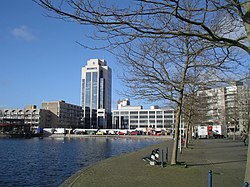
Lake Dobbe divides the old town from the new city centre, with the medieval village centre on one side of the lake and the modern high-rise and skyscrapers on the other side.

Neighbourhoods[9]

[edit]

Zoetermeer is divided into 6 neighbourhoods (wijken),[10] which cover most of the municipality's territory, with the remainder being the commercial area in the east and the mostly green and undeveloped Buitengebied in the west. Every neighbourhood has at least one (smaller) shopping mall and (except for Noordhove) a tram stop. Each neighbourhood consists of one or more wijken, each of which has a separate postcode with differing last two digits following "27", from within Zoetermeer's 2710-2729 assigned postcodes (2700, 2701 and 2702 are used for post-office boxes and the rest are not used as of 2012)

These neighbourhoods have the following names (in brackets the year the neighbourhood was designated, although some of the neighbourhood already existed before designation):

Aerial view of Zoetermeer.

Meerzicht (1969) [11]

[edit]

Literally meaning "lake view", Meerzicht is divided by the RandstadRail light rail tracks into Meerzicht-Oost (postcode 2715), with taller block of flats, and Meerzicht-West (postcode 2716) with low-rise residential development. Further to the west is the water-rich, 280-hectare urban park and recreation area Westerpark.

Buytenwegh de Leyens (1974) [12]

[edit]

The development of this area marked the shift to the development of single-family homes with private gardens more popular with Dutch families of that and coming decades, and encompasses the much older settlements of Buytenwegh (postcode 2717) and De Leyens (postcode 2725), and an area called "Buytenwegh de Leyens" per se (postcode 2726).

Centrum (1978) [13]

[edit]

The construction of a new centre of Zoetermeer actually started only in 1981, to serve as a shopping and administrative heart of the city. It followed modern urban planning principles, placing parking garages, some storage facilities and a RandstadRail station on the ground level, which is covered by pedestrian- and bicycle-only area with shops on the lower floors and apartments above them, to ensure the centre does not die out outside of the business hours.

The centre was completed in phases, the last one being the Cadenza residential development in 2017. The Stadscentrum has two RandstadRail stations. The Centrum-West station is the terminus of RandstadRail line 3 and is the locations of Zoetermeer's busiest bus station. The Stadscentrum includes the modern town hall of Zoetermeer and the local police station. A small lake called Grote Dobbe is placed directly in between Stadscentrum and Dorp, with the promenades and bicycle paths along the lake connecting the old and the new centres of Zoetermeer. The postcode for Stadscentrum is 2711.

Noordhove & Seghwaert (1986) [14]

[edit]

Noordhove (postcode 2728) is located between Seghwaert to the south and the artificial lake known as 'Zoetermeerse Plas' to the north. Unlike the other wijken, it has no dedicated RandstadRail station, as both RandstadRail track branches run to the south of it.

Rokkeveen (1987) [15]

[edit]

Rokkeveen is separated from the other wijken by the A12 motorway and the Den Haag-Gouda railway line. As such, it enjoys direct access to Zoetermeer's railway stations and features numerous crossings under or over both transport corridors to allow access to the rest of Zoetermeer. Rokkeveen is further divided into Rokkeveen-Oost and Rokkeveen-West. A significant turning point in the development of this part of town was the Floriade 1992, which took place there.

Rokkeveen-Oost (postcode 2718) extends between the railway stations Zoetermeer-Oost and Zoetermeer. The Mandelabrug (Nelson Mandela bridge) was built over the latter for the Floriade (replacing an earlier smaller bridge, deemed insufficient for the increased traffic) as a covered bicycle and pedestrian passage over the railway, motorway and the RandstadRail, which adjoins it at this point from the North. The Mandelabrug connects the train station, the Randstadrail station Driemanspolder and the wijken of Rokkeveen-Oost and Driemanspolder. Next to the Mandelabrug runs a road crossing - a bridge between Afrikaweg on the northern side and Zuidweg in Rokkeveen.

The other crossing are the road, pedestrian and bicycle tunnels between Tweede and Eerste Stationsstraat next to Zoetermeer-Oost train station, connecting Rokkeveen-Oost with Dorp. The historic water tower De Tien Gemeenten is also now located in Rokkeveen-Oost.

Rokkeveen-West (postcode 2719) mainly encompasses newer development on the grounds of the former Floriade-park, which includes both residential and office buildings.

Oosterheem (1999) [16]

[edit]

Oosterheem is the newest district of Zoetermeer, a Vinex-location and the source of Zoetermeer's most recent and continuing growth, which allowed it to become the third most populous municipality in South Holland. The districts development was not without problematic issues and delays, stemming first from the concerns over the environmental impacts of such development, and later from the planning and construction of HSL-Zuid, which now forms the district's and municipality's eastern border. An enduring concern is an old pipeline, now used for the transportation of pressurized CO2, which runs through Oosterheem.

Oosterheem is served by three stations on RandstadRail line 4, whose tracks branch out from the original RandstadRail loop in Seghwaert. It is further divided into Oosterheem-Oost (postcode 2721) and Oosterheem-West (postcode 2729).

Wijkposten

[edit]

Zoetermeer has a network of "wijkposten" ("neighbourhood stations"), which provide more direct contacts between the municipality and the inhabitants of the neighbourhoods. The wijkposten employ personnel to deal with housing issues and provide space for local police officers. There are six wijkposten throughout Zoetermeer. Buytenwegh de Leyens, Meerzicht, Oosterheem and Rokkeveen have a wijkpost each, while Noordhove and Seghwaert share a common station and Wijkpost Center serves Dorp, Driemanspolder, Palenstein and Stadscentrum, which are for some purposes also lumped together as "Zoetermeer Centrum".[17]

Other Former Neighbourhoods

[edit]

Dorp (1962)

[edit]

Literally meaning "village", this wijk covers mostly the territory of the pre-existing village of Zoetermeer, with the central Dorpstraat (village street) with historic buildings serving as a shopping and recreation area. The area also features the historic De Hoop windmill, which unlike many other windmills in the area used for drainage, has always been used as a flourmill. The postcode for Zoetermeer-Dorp is 2712.

Driemanspolder (1965)

[edit]

Driemanspolder (postcode 2713) was the first area to be developed as part of modern Zoetermeer, and contains mostly large multi-apartment buildings characteristic of the era. It is next to the A12 motorway, which forms the southern border of the wijk, and directly north of the Zoetermeer railway station (which is on the other side of A12).

Palenstein (1966)

[edit]

Palenstein (postcode 2722) is north of the Dorp, deriving its name from the former Castle of Palenstein, which used to be there. It mainly consists of highrise residential development. A rejuvenation project was started in Palenstein in 2006, providing for the renovation of some and demolition of other older buildings.

Seghwaert (1975)

[edit]

Seghwaert was formed around what was the former village of Zegwaart (or Zegwaard), which fused with Zoetermeer in 1935, using the archaic spelling of the locale's name. The old Zegwaart was a ribbon development along what remains until today as Zegwaartseweg, which is perpendicular to Dorpstraat. It is further divided into Seghwaert-Oost (postcode 2723), -Midden (postcode 2724) and -Noord (postcode 2727).

Economy

[edit]
former wind turbine with observation deck at Siemens factory in Zoetermeer

Zoetermeer's economy is primarily dependent and revolving around Information technology. With modern infrastructure, a highly digitised centre called 'het Forum' that houses city hall, the central library and numerous other organisations, and many schools that offer IT-related education, it also is a major software development centre, with many software developers based here. There are a large number of IT companies with branches in Zoetermeer, like Siemens, which has its Dutch Tech Campus in Zoetermeer, and Toshiba Medical Systems Europe BV. 20% of the population of Zoetermeer has an IT-related job. The local government designates a comparatively large part of the budget to computers for schools.

To stress the IT tradition of Zoetermeer, the city is the first in the world to have a city hall in Second Life.

Transport

[edit]

Light rail

[edit]

The former Zoetermeer Stadslijn urban railway was rebuilt as light rail in 2006/2007. The stadslijn was the only urban railway in The Netherlands. It had 12 stations in Zoetermeer and ran to and from The Hague Central Station.

The new light rail system is part of the RandstadRail network between The Hague, Rotterdam and Zoetermeer. Besides the rebuilt original Stadslijn, which now has 13 stations, the added Oosterheemlijn leads to the new suburb Oosterheem. The Oosterheemlijn has five stations and ends at the heavy rail Station Lansingerland-Zoetermeer.

Heavy rail

[edit]

Zoetermeer has three stations on the main railway between The Hague and Utrecht. Zoetermeer-Zegwaard, built when the city was connected by railway in 1868, burnt down in 1906. Later the station reopened 1965 on the same location as Zoetermeer-Oost. The main station, Zoetermeer station, was opened in 1973. Lastly, the newest station, Station Lansingerland-Zoetermeer, was completed in May 2019.

The HSL-Zuid high speed line from Amsterdam to Paris passes Zoetermeer on its eastern side. Although there have been proposals to open a station on the line, this seems highly unlikely this will be realized.[18]

Motorway

[edit]

Zoetermeer is next to the A12 motorway, connecting The Hague with Utrecht, Arnhem and Germany.

Religion

[edit]

Zoetermeer is the only place in the Netherlands with a temple of the Church of Jesus Christ of Latter-day Saints. It is situated near the old village centre.[19][20]

Entertainment and recreation

[edit]

This former new town used to be a satellite city of The Hague, as many residents worked, shopped and were entertained in The Hague. With the growth of Zoetermeer came a large theatre, mega cinema, and other entertainment such as go-karts, laser gaming, survival centre, and a golf centre.

Museums

[edit]

The city has two museums, Museum deVoorde and the National Videogame Museum. In 2022, subsidy for Museum deVoorde was stopped by the local government because of low visitor numbers after the COVID19-pandemic.

SnowWorld

[edit]
SnowWorld indoor ski slope

SnowWorld was the first indoor ski slope made of real snow in Europe, opened in 1996. It now has three slopes, of which the 200-metre (660-foot) slope is the longest. Plans are being made to extend this to 300 metres (980 feet). Open since December 2016, SnowWorld attracts over a million visitors each year, making it the most important tourist attraction in Zoetermeer.

Dutch Water Dreams

[edit]

Dutch Water Dreams (DWD) was an artificial Olympic wild water rafting circuit. It was a copy of the one built in China for the 2008 Olympic Games and was mainly used for training by European rafting teams, and also for team building and recreation. DWD also had an indoor Flowrider centre. Dutch Water Dreams closed in 2015.[21]

Silverdome

[edit]

Silverdome is an indoor ice skating track and convention centre. It is also home to the only curling rink in the Netherlands.[citation needed] Outside the skating season it is used as a convention centre and concert hall and for large raves.

Parks

[edit]

Zoetermeer has many parks, the biggest being the "Westerpark" on the west side of town. It is almost as large as Central Park in New York. Other notable parks are the "Buytenpark", the "Aldo van Eyckpark", the "Binnenpark", the "Van Tuyllpark (with Dutch Water Dreams and Aquapark Keerpunt), the "Hoekstrapark", the "Wilhelminapark", the "floriade park", the "Seghwaertse Hout" and the "Seghwaertpark".

At the north side there is a lake, the "Zoetermeerse Plas", often called "Noord Aa" because it is in the Noord Aa Recreational Area. There is a beach along one side of the lake and a marina on the other. Wind- and kite surfing, sailing and fishing are the most popular activities on the lake.

On both the west and east side of the city forests are being planted, called "Balijbos" (west side) and Bentwoud (east side). These forests are intended to form a "natural" barrier between The Hague and Zoetermeer.


International relations

[edit]

Twin towns – Sister cities

[edit]

Zoetermeer is twinned with:

Notable people

[edit]
Dick Schoof, 2024
Antonius van den Broek, 1903
Sandro Silva, 2014
Monique Bolleboom, 1978

Public thinking & public service

[edit]

The arts

[edit]
  • Dennis Princewell Stehr (born 1984 in Zoetermeer) stage name Mr Probz, Dutch singer-songwriter, rapper, producer and actor
  • San Holo (born 1990 in Zoetermeer) a Dutch DJ, musician, record producer and composer
  • Shandro Jahangier (born 1992 in Zoetermeer) stage name Sandro Silva, a Dutch DJ and record producer
  • Romee Strijd (born 1995 in Zoetermeer) a Dutch model [22]

Sport

[edit]

Panorama

[edit]
Zoetermeer Wikivoyage Banner

References

[edit]
[edit]
Revisions and contributorsEdit on WikipediaRead on Wikipedia
from Grokipedia
Zoetermeer is a and planned city in the province of , in the western , situated between and within the conurbation. Covering a total area of 37.05 km², of which 2.50 km² is water, it had approximately 125,000 inhabitants as of recent estimates. Historically a small rural village with around 4,500 residents in 1945, Zoetermeer experienced rapid population growth through deliberate post-war initiatives, transforming into a and growth center by the late , reaching over 127,000 inhabitants by early 2023. The city features a modern emphasizing green spaces, lakes, and efficient infrastructure, including a high density of roundabouts, while its economy centers on high-technology industries, particularly , with about 20% of the workforce in IT-related roles—higher than the national average—and a concentration of security and innovation firms.

Geography

Location and Topography

Zoetermeer is situated in the province of in the western , at coordinates 52°3'27"N, 4°29'35"E. The city lies approximately 10 kilometers east of and 15 kilometers north of , positioning it as a key node in the densely populated western region. This strategic placement facilitates efficient commuter access to these major urban centers via road and rail networks. The of Zoetermeer is characteristically flat, emblematic of the Dutch lowlands, with average elevations around -3 meters relative to . Much of the municipality occupies reclaimed land, which lacks significant natural elevation variations and is protected by an extensive system of dikes, canals, and pumping stations to manage water levels and prevent flooding. in the area incorporates these hydraulic features, with elevated infrastructure and green buffers integrated to mitigate risks inherent to the soft soils. Zoetermeer's location within the broader urban conurbation—encompassing the ring of major cities around the central Green Heart—underscores its function as a town, unhindered by topographic barriers that would otherwise impede connectivity. The absence of hills or rivers as dividers supports seamless integration into the regional transport grid, enabling rapid daily commutes to employment hubs in and .

Climate and Environment

Zoetermeer features a temperate (Köppen Cfb), with mild winters and cool summers influenced by its proximity to the . Average temperatures in range from a low of 1.7°C to a high of 5.6°C, while July averages 13.9°C lows and 21.1°C highs. Annual averages approximately 800 mm, distributed relatively evenly but with winter peaks, such as 61 mm in ; the area experiences frequent westerly winds, with gusts averaging 24.8 km/h. Urban planning incorporates green spaces, including the Buytenpark, which preserves remnants of historical buyten (country estates) from the surrounding rural , now integrated into recreational and ecological zones on formerly reclaimed land. These areas support some native and , but the underlying soils—predominantly drained and clay—constrain , as drainage and reduce habitat diversity relative to undrained wetlands or dunes, favoring agricultural monocultures over complex ecosystems. The municipality's low elevation (much below ) exposes it to sea-level rise and risks, with rates around 1 cm per year in comparable Dutch regions due to oxidation and compaction from drainage. Flood protection relies on dikes managed by the Hoogheemraadschap van Rijnland, contributing to national maintenance expenditures exceeding €1 billion annually for dikes and dunes to counter these threats.

History

Pre-Modern Origins

The first documented evidence of Zoetermeer appears in 1269, when Count Floris V of granted a share of the settlement's tax revenues as , signifying its status as a minor fiefdom within the feudal structure of medieval . This reference confirms the presence of a rudimentary agrarian community amid the extensive marshes of the -Utrecht lowlands, where inhabitants subsisted through small-scale farming, in local waters, and extraction for and improvement. Such activities reflected the pragmatic adaptation to a waterlogged environment, devoid of the engineered grandeur later associated with Dutch hydraulic feats but reliant on incremental drainage to carve out habitable land from wetlands. Reclamation efforts, initiated as early as the 10th to 12th centuries, involved diking and draining boggy terrains to create meadows for and arable plots, a process that expanded cultivable area but triggered through the aerobic of desiccated layers. This causal mechanism—water removal exposing organic soils to oxidation—contrasts with narratives emphasizing romantic harmony with water, as it introduced persistent risks of land lowering and flooding vulnerability, necessitating ongoing maintenance absent in pre-modern scales. Peat digging, central to local economy, further exacerbated shrinkage, with extraction pits evolving into meren (lakes) that dotted the landscape and limited settlement density. Throughout the pre-modern era, Zoetermeer's scale remained constrained, functioning as an unremarkable rural outpost with populations likely numbering in the low thousands by the , centered on and turf production rather than or industry. Its obscurity underscores engineered necessity over intrinsic charm, as growth hinged on laborious, hazard-prone modifications to peat-dominated terrain rather than natural endowments or early urban impulses.

20th-Century Expansion as a Planned City

In 1962, Zoetermeer was designated by the Dutch national government as a groeikern (growth nucleus), or new town, to address acute housing shortages in the overcrowded conurbation, functioning as an overspill destination primarily for residents and workers from nearby . This state-directed initiative transformed the locality from a rural commuter village into a planned urban center, with an initial target capacity of 100,000 inhabitants to relieve pressures in established cities. The policy aligned with broader Dutch efforts to decentralize growth from the western urban ring, leveraging Zoetermeer's location for large-scale greenfield development. Population expansion accelerated under this framework, rising from approximately 4,500 residents in 1945 to around 8,000 by , before surging through coordinated housing phases that delivered tens of thousands of units by the late 1980s. Early development from to 1972 emphasized high-rise apartments in districts like Palenstein and Driemanspolder, enabling density to accommodate rapid influxes; subsequent phases from 1972 to 1988 shifted to low-rise, neighborhood-scale projects in areas such as Buytenwegh, De Leyens, and Seghwaert, incorporating more varied housing types. By the end of the 1980s, these efforts had propelled the beyond 90,000, approaching the planned threshold and demonstrating efficient scaling via prefabricated construction and centralized land allocation. Infrastructure rollout supported this growth, with the Zoetermeerlijn railway—Netherlands' first major post-World War II line—operationalized by 1973 as a looped connection to , facilitating commuter flows and reducing reliance on for daily access. Concurrently, the A12 extension, featuring innovative lanes as the world's first of its kind, linked Zoetermeer to the national network by the early , enabling swift material delivery for construction and . These investments yielded tangible efficiencies, providing affordable family housing amid national shortages—units often subsidized and priced below urban market rates—while containing sprawl through compact zoning. However, the top-down model drew critiques for prioritizing volume over resident engagement in the initial decades, with decisions made largely by municipal and national authorities until participatory shifts in the . Architectural outcomes reflected economic constraints, particularly during the recession, resulting in functional but uniform designs in later quadrants, which some observers noted as monotonous compared to organic urban evolution. Early districts leaned toward car-accommodating layouts with segregated traffic, fostering partial dependency on personal vehicles for intra-city mobility despite rail provisions, though later adjustments emphasized paths and transit-oriented nodes to mitigate this. Empirically, the model succeeded in delivery—absorbing overspill without proportional overload—but fell short in cultivating spontaneous social fabrics, as evidenced by phased, blueprint-driven neighborhoods that lacked historical cores for anchoring.

Post-2000 Developments and Redevelopment

Zoetermeer marked the 60th anniversary of its designation as a new town in 2022, prompting renewed municipal efforts to densify its urban fabric and retrofit aging infrastructure from the mid-20th-century expansion phase. These initiatives emphasized mixed-use developments, particularly through brownfield redevelopment, where shifts from commercial to residential uses addressed underutilized sites and promoted sustainable urban growth. Public leadership played a central role, coordinating with private developers to integrate housing, retail, and green spaces, as seen in projects like the Bredewater district transformation into a mixed-use green urban area. By 2023, Zoetermeer's had reached 126,998, reflecting steady growth amid broader Dutch trends of urban fringe densification to accommodate demand while curbing sprawl. Sustainable retrofits gained prominence, incorporating energy-efficient upgrades and enhanced links to mitigate the environmental footprint of its suburban layout. These measures aligned with national policies favoring compact, resilient cities, though empirical data on long-term carbon reductions remains tied to ongoing monitoring. Public-private partnerships have driven vacancy reductions in commercial zones, converting obsolete office spaces into vibrant mixed-use hubs and stabilizing local markets post-2008 financial downturn. Success metrics include improved occupancy rates through targeted incentives, contrasting with earlier critiques of the city's uniform, car-oriented aesthetics that persist in peripheral neighborhoods. Despite these advances, challenges like balancing densification with resident preferences for green buffers highlight the trade-offs in maturing planned communities.

Demographics

Population Dynamics

Zoetermeer's population surged from around 10,000 residents in the early 1960s to 105,009 by 1995, driven primarily by national policies designating it a groeikern (growth core) in 1962 to absorb urban overspill from overcrowded Randstad cities like The Hague and Rotterdam. This planned expansion facilitated large-scale housing construction, attracting families and workers through subsidized development and infrastructure investments, resulting in an average annual growth rate exceeding 4% during peak decades of the 1970s and 1980s. By 2025, the population reached an estimated 129,862, reflecting a cumulative increase of over 1,200% since the mid-20th century. Population density stands at approximately 3,772 inhabitants per square kilometer as of 2025, calculated over the municipality's land area of 34.43 km², underscoring the compact urban form resulting from sequential neighborhood builds on former land. This density supports efficient public services but amplifies strains from rapid influx, including demands and tied to commuter reliance. A significant portion of the —estimated at over 60%—travels daily to employment centers in (10 km west) or (20 km south), with rail connections via the RandstadRail network handling peak-hour flows of thousands. Such patterns stem from Zoetermeer's positioning as a dormitory , where local job growth has lagged behind residential expansion. Demographic aging mirrors broader Dutch trends, with an average resident age of 41.5 years, influenced by low birth rates (around 1.5 children per woman, aligning with national ) and net in-migration of working-age adults in prior decades now tapering. Projections indicate stabilization, with household numbers holding steady through 2040 as family units plateau and smaller, elderly households rise, constrained by limited capacity and national population growth deceleration to under 0.5% annually. This shift reflects policy limits on further greenfield development, redirecting growth pressures elsewhere in .

Ethnic and Socioeconomic Composition

As of January 1, 2023, approximately 23% of Zoetermeer's had a non-Western migration background, compared to the national average of around 14%, with major groups originating from (primarily under the category), , , and other African and Asian countries. This includes both first- and second-generation migrants, totaling about 28,000 individuals out of a of roughly 126,000, with Western migration backgrounds accounting for an additional 11%. Certain districts, such as Buytenwegh and parts of Oosterheem, exhibit concentrations exceeding 30% non-Western backgrounds, contributing to localized ethnic clustering beyond the municipal average. Socioeconomically, Zoetermeer displays significant variance, with an overall status score reflecting middle-class dominance driven by proximity to tech and sectors attracting skilled professionals, yet offset by lower- enclaves in older districts like Buytenwegh and Driemanspolder, where socioeconomic performance indicators lag national medians by 10-20% on metrics including and levels. In these areas, rates are elevated, with social assistance recipients comprising up to 15% of residents versus under 5% in higher-status neighborhoods like Rokkeveen, correlating with higher proportions of non-Western backgrounds and persistent gaps. Integration challenges are evident in and data: non-Western background residents face rates roughly double the native Dutch average (around 8-10% versus 4%), with Surinamese, Moroccan, and Turkish groups showing the widest disparities due to skill mismatches and limited Dutch proficiency. proficiency gaps persist, with only about 60% of non-Western adults achieving functional Dutch levels (B1 or higher) within five years of arrival, hindering labor market entry and contributing to overrepresentation in low-wage sectors or benefits reliance compared to Western migrants or natives. These metrics underscore causal factors like differences and network effects in enclave formation, rather than uniform progress narratives.

Government and Politics

Municipal Structure

Zoetermeer is administered through a standard Dutch municipal framework, comprising a municipal council (gemeenteraad) of 35 seats as the legislative body elected by residents every four years, a appointed by the on the recommendation of the Minister of the Interior and Kingdom Relations, and aldermen (wethouders) appointed by the council to form the executive board, known as the van burgemeester en wethouders (B&W). The current is Michel Bezuijen, with six aldermen handling portfolios such as , spatial development, and . As a within the province of , Zoetermeer coordinates on regional matters like water management while retaining local autonomy in core functions. The college of B&W manages day-to-day operations, including budget approval subject to oversight, with meetings held weekly to decide on policies and expenditures. priorities include to support the city's planned layout, reflected in programmatic allocations for physical development and . In 2024, the budgeted contributions at €2.97 per inhabitant for specified local programs, contributing to balanced finances amid measures totaling €25 million for 2026 onward. Local powers extend to and land-use decisions under the Environment and Planning Act (Omgevingswet), implemented nationwide on January 1, , which consolidates rules for the physical environment and devolves planning authority to municipalities while requiring alignment with provincial and national frameworks. This enables tailored responses to urban needs but operates within the ' consensual governance tradition, necessitating stakeholder consultations that have historically prolonged decision timelines in complex projects. In the 2022 municipal elections held on March 16, in Zoetermeer reached 52.3%, with the VVD obtaining 13% of the vote and 5 seats, tying for the largest bloc alongside the local conservative Lijst Hilbrand Nawijn (LHN) at 12% and 5 seats. secured 4 seats with 9%, matched by the local Partij Democratie voor Zoetermeer (PDvZ), while the national PVV gained entry with 6.2% and 2 seats, signaling rising support for platforms emphasizing stricter controls and local priorities akin to national shifts. These outcomes reflect a fragmentation favoring pragmatic center-right and local parties over traditional left-leaning ones, with the VVD losing ground from prior cycles but retaining influence amid broader Dutch electoral realignments. Post-2023 national elections, where anti-immigration sentiments propelled right-wing parties like the PVV to prominence, Zoetermeer's local trends have emphasized pragmatic responses to pressures and asylum inflows. Municipal policies under the Woonvisie framework coordinate regional plans to boost density, targeting 400-700 additional units through efficient land utilization while upholding standards via subsidies for roofs and nature-inclusive designs. The Duurzaam en Groen program prioritizes preserving spaces against over-development, though critics argue regulatory hurdles, including environmental impact assessments, delay private-sector initiatives and exacerbate shortages. Asylum-related policies face empirical strains, with the municipality obligated to house status holders amid national dispersal quotas, leading to extensions of emergency facilities like the former opvang until at least 2029. Incidents of violence and rising tensions in centers, including a 2025 injuring two and assaults on police, underscore causal pressures from and integration challenges, prompting calls for stricter national controls mirrored locally. Despite these, Zoetermeer's administration has sustained balanced operational budgets through 2024, prioritizing fiscal restraint amid competing demands for infrastructure and welfare.

Economy

Key Industries and Employment

Zoetermeer's economy centers on information and communication technology (ICT), logistics, and professional services, sectors that have driven sustained job growth since the 1990s through targeted development of innovation clusters rather than broad government subsidies. These areas account for a significant portion of local employment, with ICT firms leveraging proximity to the Randstad region's infrastructure for efficient operations and knowledge spillovers. The shift from earlier manufacturing dependencies to high-value knowledge-intensive activities has empirically boosted productivity, as evidenced by the establishment of specialized campuses fostering collaboration among tech enterprises. Multinational presence, including and , underscores the appeal of Zoetermeer's business environment for advanced engineering and digital services, generating thousands of skilled jobs in , , and . maintains operational facilities supporting integration with local tech ecosystems. This corporate footprint contributes to the city's role in the broader economy, which produces over 50% of the ' GDP, with Zoetermeer's and ICT outputs enhancing regional value chains through efficient distribution and digital innovation. Employment levels remain robust, with an rate of approximately 3-4% in recent years, outperforming the national average amid a tight labor market favoring skilled workers in tech and services. Post-1990s expansions in roles have added over 10,000 positions in ICT and related fields, validating the efficacy of cluster-based strategies in creating stable, high-wage opportunities without overreliance on expansion.

Business Parks and Innovation Hubs

The Dutch Innovation Park in Zoetermeer functions as the city's principal innovation hub, concentrating on applied IT solutions in e-health, cybersecurity, , and smart mobility. Established to integrate , research, and business, it houses over 25 ICT firms within the Dutch Innovation Factory, including multinationals like and , alongside startups and scale-ups focused on software development and data analytics. This co-location with approximately 800 IT students from The Hague University of Applied Sciences and mboRijnland fosters direct knowledge spillovers and collaborative projects, evidenced by partnerships such as the Innovation Hub for joint research initiatives. Incubators like the Dutch Innovation Factory provide physical and operational support for small and medium-sized enterprises (SMEs), offering flex workspaces, networking events, and access to university resources to accelerate prototyping and commercialization of tech innovations. While specific survival metrics for Zoetermeer-based firms remain undocumented in public data, the ecosystem's design—emphasizing proximity to talent and —aligns with broader that such clustered incubators enhance startup persistence through reduced isolation and shared R&D costs, though outcomes depend on market fit and external . These hubs, primarily along the A12 highway corridor in areas like Bleiswijkseweg, prioritize accessibility via major roads and rail links to and , hosting logistics-adjacent tech firms that benefit from high-speed connectivity. However, their peripheral positioning relative to Zoetermeer's center encourages automobile dependency for daily commutes, with limited emphasis on walkable or bike-integrated pathways, reflecting the planned city's mid-20th-century that separated commercial zones from residential cores to minimize urban congestion but at the expense of multimodal integration.

Urban Planning

Design Principles and Phases

Zoetermeer's adhered to principles of radial expansion, with neighborhoods configured as radiating "petals" around a central urban core to optimize and connectivity while integrating green spaces as wedges to align with the national Groene Hart , which aimed to preserve the central green heart of the by channeling growth into designated nuclei. The 1968 Structure Plan formalized this compact, functional layout, emphasizing efficient housing density, separated traffic flows, and localized amenities within self-sufficient units to mitigate sprawl and support a transition from to . Development unfolded in distinct phases driven by national housing shortages and policy shifts. From , Zoetermeer was designated a groeikern (growth nucleus) under strict oversight, evolving from a of 8,000 residents in to a planned self-contained targeting 100,000 inhabitants by 1988, with the revised 1972 plan incorporating neighborhood-scale functionality inspired by 1970s small-scale movements that prioritized resident participation in design. Post-1988 extensions, including Noordhove (3,800 homes) and Rokkeveen (9,000 homes) by 1995, and the Vinex-era Oosterheem (8,500 homes) from 1995 onward, further embedded Groene Hart containment by directing radial growth along transport corridors while preserving peripheral green facets. While achieving efficient scale—accommodating over 127,000 residents by 2023 through standardized and —the design's systematic uniformity yielded monotonous across neighborhoods, diverging from the organic variety of evolved cities and contributing to social segregation, as evidenced in areas like Palenstein where concentrated low-income fostered isolation. High upfront costs, including the elevated A12 motorway and dedicated Zoetermeerlijn rail, reflected state-directed intervention's emphasis on functionality over incremental market adaptation, though empirical outcomes showed elevated social disconnection rates relative to unplanned urban centers due to rigid that limited spontaneous community formation.

Neighbourhoods and Districts

Zoetermeer's districts developed sequentially as part of its designation as a growth nucleus in 1962, expanding from the historic Dorp core to accommodate overflow from , with phases emphasizing high-rise in the 1960s followed by low-rise suburban designs. The municipality planned these areas to reach 100,000 inhabitants by integrating , green spaces, and amenities, resulting in varied densities: early averaged higher densities via apartments, while later ones prioritized single-family homes on larger plots. Dorp, the medieval village nucleus merged with Zegwaart in 1935, retains low-density historical structures around the Oude Kerk, fostering a compact, amenity-rich environment with shops and eateries distinct from surrounding post-war expansions. Palenstein, initiated in 1966, pioneered high-rise construction (up to 12 floors) using prefabricated systems like and MUWI, covering initial suburban plots east of the core. Driemanspolder followed in the late 1960s, similarly featuring system-built apartments amid green buffers. Meerzicht, constructed from 1969 in the phase, divides into eastern high-rises and western low-rise homes bordering Westerpark, with a total of 15,715 reflecting medium . Buytenwegh-de Leyens, built across the and on former farmland, shifted to low-rise family-oriented layouts with deck houses and participation-based planning, incorporating parks like Buitenpark and waterways near Noord-Aa for suburban appeal. Seghwaert-Noordhove, developed from 1985 using the SAR weaving method, combines residential variety with Noordhove's commercial emphasis, including shopping centers and reaching 6,389 residents by 1991. Rokkeveen, starting in 1987 with neorationalist designs and the Three Track Method, spans 9,000 planned homes and houses 20,690 people, focusing on integrated neighborhoods south of the A12. Oosterheem, a Vinex in the reclaimed Binnenwegsche , began construction around 2000 with 8,500 homes in primarily suburban form, contributing to ongoing expansion and supporting 24,475 residents, the largest by population. These areas exhibit density gradients, with early high-rises at 100-200 dwellings per versus later suburbs at 20-50, tailored to era-specific needs without uniform livability metrics overriding empirical variations in amenities like parks and transit access.

Transportation

Rail and Light Rail Systems

Zoetermeer's primary heavy rail connections are provided by (NS) services on the Gouda–Den Haag Centraal line, with stations including Zoetermeer, De Leyens, Driemansbuizen, and Zoetermeer Oost. These links enable direct Sprinter trains to Centraal in approximately 25 minutes and to Centraal via Gouda in under an hour, facilitating commuter access to major hubs. The RandstadRail network, operational since October 2006, integrates Zoetermeer with via HTM-operated lines 3 and 4, which run on dedicated elevated and at-grade tracks through the city's districts to terminus points like Zoetermeer Centrum-West and Javalaan. Line 3 connects from Loosduinen in , while line 4 extends service to outer neighborhoods such as Oosterheem, with frequencies up to every 10 minutes during peak hours. This system replaced earlier NS diesel services on the Zoetermeerlijn, transitioning to electric low-floor trams for improved capacity and urban compatibility. The network carries approximately 125,000 passengers daily across its routes, with Zoetermeer's lines accounting for a substantial share due to the city's role as a dormitory suburb for The Hague and Rotterdam employment centers. Integration with HTM's urban trams in The Hague Centraal and use of the unified OV-chipkaart system supports modal shifts from private vehicles, particularly in Zoetermeer's compact core where rail stations anchor residential and commercial development. NS heavy rail punctuality stood at 89.7% in 2023, defined as arrivals within three minutes of schedule, though passengers reported frequent disruptions from , signaling faults, and shortages, contributing to a fifth consecutive annual loss for the operator. RandstadRail has implemented real-time control measures, such as driver displays for adjustments, yielding improvements in departure reliability, but street-level segments in remain prone to traffic-induced delays. These factors underscore ongoing challenges in maintaining consistent service amid high demand and infrastructure constraints.

Road Networks and Cycling

Zoetermeer's road network centers on its integration with the A12 motorway, a primary east-west corridor connecting the city to approximately 10 kilometers west and further east, with dedicated exits including Zoetermeer-Centrum accessible primarily from the western direction. This infrastructure supports high-volume traffic, as the A12 ranks among the ' busiest routes, handling substantial commuter flows through the region. Local roads, characterized by straight alignments across reclaimed land, facilitate regional connectivity but experience heightened congestion during peak periods, particularly when motorway disruptions reroute vehicles onto municipal arterials. For instance, A12 bridge maintenance in 2022 led to notable increases in local road usage, prompting temporary adjustments. To mitigate such bottlenecks, the municipality has pursued targeted infrastructure enhancements, including the redevelopment of routes like the Afrikaweg into slower-speed urban streets with reduced through-traffic capacity to prioritize local access over transit flows. Broader investments emphasize sustainable and , exemplified by the N470 corridor linking Zoetermeer to , which incorporates a closed-loop energy setup for generating, storing, and utilizing power locally to support traffic operations. These efforts align with national strategies for , though empirical outcomes remain constrained by persistent peak-hour demands in suburban settings. Cycling infrastructure complements the road system with an extensive grid of dedicated paths, including segregated lanes on bridges like the Burgemeester Waaijerbrug and specialized overpasses spanning landscapes to minimize intersections with motorized traffic. Such features enable safe, continuous routes connecting neighborhoods to employment centers, reflecting Dutch engineering priorities for multimodal separation. However, suburban sprawl and inter-district distances contribute to a modal split favoring s for many commutes; national data indicate bicycles account for 28% of all trips but only 8% of total distance traveled, with s dominating longer journeys typical in planned expansions like Zoetermeer's. This reliance persists despite investments, as dispersed development patterns elevate automobile use for efficiency over short-haul alternatives. Road safety metrics highlight effective baseline protections, with the recording 684 total traffic fatalities in 2023, down from prior years, though cyclists comprised 270 of these, underscoring vulnerabilities at higher speeds or in mixed environments. Local analyses in comparable southern municipalities report over 92% of bicycle incidents as minor or injury-free, yet rising cyclist deaths nationally—up 60% for seniors since 2013—signal limits to idealized safety narratives amid growing volumes. Zoetermeer's roads, while open, demand vigilant enforcement of speed limits and path segregation to sustain these relative gains.

Culture and Religion

Religious Landscape

Zoetermeer reflects the broader observed across the , where and modernization have contributed to declining religious affiliation and practice. National data from the Centraal Bureau voor de Statistiek (CBS) indicate that by 2022, 51 percent of the population aged 15 and older reported no religious affiliation, up from previous decades, with limited to about 12 percent participating at least monthly. In suburban growth cities like Zoetermeer, these patterns are amplified, as post-war development attracted mobile populations less tied to traditional institutions, resulting in lower empirical engagement with compared to rural areas. Historically rooted in , with remnants of Catholic presence from surrounding regions, Zoetermeer's Christian base has eroded significantly. Protestant denominations, including Reformed and Dutch Reformed churches, maintain several congregations, such as the Gereformeerde Kerk and Vredekerk, but active membership and attendance mirror national declines to around 13-14 percent Protestant identification overall. Catholic affiliation stands at approximately 18 percent nationally, though local practice is minimal, evidenced by sparse attendance data. The city's sole temple of The Church of Jesus Christ of Latter-day Saints, dedicated in 2002, serves a small community but highlights limited non-traditional Christian presence amid pervasive . A growing Muslim population, estimated at 6 percent nationally but likely higher in Zoetermeer due to from , , and other Muslim-majority countries, is supported by five , including Al Qibla and the recently approved Oosterheem facility in 2022. This segment retains higher , with sustaining mosque attendance contrary to native secular trends. Other faiths, including or smaller groups, constitute negligible shares, underscoring a landscape dominated by , estimated at over 60 percent locally based on urban demographic patterns.

Cultural Institutions and Events

The Stadstheater Zoetermeer functions as the principal venue for , hosting theater productions, concerts, and shows that serve the city and surrounding region. Opened in the late amid the city's expansion, it emphasizes professional and amateur performances, with programming tailored to contemporary Dutch audiences. Zoetermeer maintains a municipal collection of 180 public artworks, including sculptures and installations distributed across urban areas, accessible via four designated art routes designed for self-guided exploration. These routes integrate art into everyday public spaces, promoting interaction with modern pieces rather than relying on historical artifacts, consistent with the city's post-1960s planned development. The Centrum Kunst en Cultuur (CKC) Zoetermeer offers courses, workshops, and exhibitions in , music, , and theater, functioning as a hub for community-based cultural education and events. It supports amateur artists and youth programs, contributing to local creative output without large-scale attendance metrics publicly detailed. Annual events include the Rastaplas Festival, held at Noord AA lake since the early 2000s, featuring , , and cultural performances that draw regional participants for two days each July. Reflecting Zoetermeer's modern profile as a growth city rather than a historical center, cultural institutions prioritize accessible, output-oriented activities over preserved heritage sites, which remain sparse due to extensive postwar reconstruction and reclamation.

Education and Research

Schools and Higher Education

Zoetermeer maintains a comprehensive spanning primary, secondary, and vocational levels, integrated into the city's planned urban framework to facilitate access for its approximately 130,000 residents. , mandatory from age 5 but often starting at 4, is provided through around 30 public and private schools, including Protestant and Catholic institutions, emphasizing foundational skills in , , and . Secondary education serves students aged 12-18 across five main schools, offering tracks from preparatory vocational (vmbo) to pre-university (vwo/gymnasium) levels, with both public and Protestant-Christian options; these include comprehensive institutions covering all pathways to accommodate diverse aptitudes. Vocational training at the intermediate level (MBO) is prominent, with mboRijnland's Zoetermeer campus emphasizing technology-oriented programs such as IT, , and , supported by small class sizes and personalized guidance to align with local high-tech industries. The city's proximity to innovation hubs like the Dutch Innovation Factory enhances practical training opportunities. National data indicate low dropout rates in Dutch secondary and MBO education, at 0.5% and 5.1% respectively for 2017-2018, reflecting effective support systems that likely extend to Zoetermeer's structured environment. Higher education lacks a full within Zoetermeer but includes a campus of The Hague University of Applied Sciences (THUAS), offering bachelor's programs in Business IT & Management, Applied Data Science & Artificial Intelligence, and Commercial Modern Logistics Management, housed in the Innovation Factory for industry collaboration. Students often commute to nearby (10 km away) or (20 km), with efficient rail links supporting enrollment; centers provide in languages and professional skills. Performance metrics align with national 2022 results, where Dutch 15-year-olds scored 493 in mathematics (above average of 472), 459 in reading (below average), and 488 in science (near average), underscoring strengths in quantitative fields relevant to Zoetermeer's tech focus. , with schools distributed across districts like Stadshart and Seghwaert, minimizes travel barriers and correlates with high attendance, though specific local graduation rates mirror national highs of over 90% in upper secondary completion.

Technological and Scientific Contributions

Zoetermeer serves as a hub for applied information and communication technology (ICT) through the Dutch Innovation Park, which concentrates on sectors including e-health, cybersecurity, , and smart mobility. This ecosystem integrates over 25 ICT companies at the Dutch Innovation Factory, alongside startups and scale-ups, to facilitate knowledge sharing and practical innovations via specialized facilities such as the Big Data Innovation Hub, IoT-Lab, Human Behaviour Lab, and SoftwareLab. Collaborations within the park link industry with academic institutions like The Hague University of Applied Sciences and universities in and , enabling triple-helix partnerships that advance , data analytics, and related technologies through proximity-based R&D interactions. Approximately 800 ICT students from nearby programs contribute to this environment, supporting talent pipelines for tech firms without direct claims of proprietary patent leadership. The adjacent Dutch Tech Campus, built on the former Siemens complex, hosts multinational tenants such as , , TKH Security, Yunex Traffic, and , emphasizing in ICT infrastructure, cybersecurity applications, and smart systems integration. These efforts promote cross-sectoral advancements in communication technologies, though measurable impacts like patent filings are embedded in national Dutch ICT outputs rather than isolated to Zoetermeer-specific metrics. TNO, the Netherlands Organisation for Applied Scientific Research, established a presence at the Dutch Tech Campus via a long-term , bolstering local R&D by applying rigorous scientific methodologies to industry challenges in cybersecurity, , and mobility solutions, thereby enhancing causal pathways from to deployable technologies. This integration strengthens Zoetermeer's role in regional through high-skilled employment in tech sectors, distinct from broader educational outputs.

Recreation and Entertainment

Major Attractions

SnowWorld Zoetermeer, operational since 1998, features an indoor and facility with real snow across three slopes totaling 800 meters in length, supported by multiple lifts including t-bars and magic carpets for beginners. The complex maintains a constant of -5°C and attracts participants year-round, contributing to the SnowWorld group's overall annual visitor figure exceeding 4 million across its European locations. The SilverDome functions as a versatile events venue in Zoetermeer, accommodating concerts, trade shows, and recreational activities such as during winter months when its rink opens to clubs and public sessions. It hosts diverse programming, including music festivals and corporate events, with configurable spaces for up to theater-style seating for large audiences. Zoetermeer's offerings, while providing regional appeal through facilities like SnowWorld and SilverDome, generate limited compared to national hubs; recorded nearly 10 million tourist arrivals in 2023, whereas Zoetermeer primarily serves local and domestic day-trippers without comparable international draw data.

Parks and Sports Facilities

Zoetermeer's emphasizes integrated green spaces, with parks forming a key element of its post-1960s development as a growth center. The Balijbos, a young forest area developed in anticipation of the Floriade 1992 international horticultural exposition, encompasses forests, swamp woodlands, extensive walking and paths totaling several kilometers, a dedicated children's play forest for activities like and den-building, and the Stadsboerderij De Balijhoeve urban farm offering experiences and education. Covering parts of the broader Buytenhout recreational zone, it provides accessible amid a suburban setting, including free-roaming areas for dogs and routes suitable for events starting in 2025. Other prominent parks include the Westerpark, spanning 369 acres with features such as interconnected waterways, bridges, a sheep , nature gardens, a dog swimming , and a fee-based adventure playground equipped for family-oriented play. The Floriadepark, a direct legacy of the Floriade event that occupied 168 acres near Zoetermeer, retains 13.2 acres of landscaped grounds designed for walking, picnics, and light family activities, reflecting the exposition's focus on horticultural innovation and environmental themes. Additional spaces like Buytenpark, Van Tuyllpark, and Wilhelminapark contribute to a network of district-level greens, with ongoing redevelopment efforts—such as rendering Van Tuyllpark car-free by relocating parking to its edges—aimed at enhancing pedestrian access and event hosting. Sports facilities support active lifestyles through municipal infrastructure and club-based programs distributed across neighborhoods. The city operates two indoor swimming pools, supplemented by natural swimming in the Noord Aa waterway, catering to recreational and competitive needs. Gymworld, opened as Zoetermeer's latest multi-sport venue, accommodates training and events for over 4,000 athletes in fields including , with specialized halls for high-level practice. District sports clubs, vital to local engagement, benefit from policies revising facility rental rates for fairness and subsidies promoting community involvement, alongside free introductory activities in football, , and to encourage broader participation. Historical municipal targets sought to elevate resident from 52% in 2007 to 70% by 2016, aligning with the ' national rate exceeding 70% in organized or recreational sports, though specific current Zoetermeer metrics remain tied to club vitality rather than comprehensive surveys. While these amenities integrate with planning to promote , the suburban, car-reliant layout in peripheral districts can reduce walkable access to parks and fields, potentially contributing to uneven usage patterns observed in similar Dutch new towns, where proximity influences spontaneous over structured visits.

Social Challenges

Urban Planning Criticisms

Zoetermeer's post-war planning as a groeikern emphasized low-density, car-oriented suburban expansion, fostering significant vehicle dependency among residents, particularly in fringe districts such as Rokkeveen, where longer commutes and limited public transit options elevate per capita emissions compared to denser Randstad cores. This radial structure, with dispersed neighborhoods radiating from polycentric hubs, has been linked to suboptimal transport efficiency, as evidenced by broader Dutch suburban patterns showing rising car use in non-urban zones amid stagnant rail integration. Critics have highlighted the architectural monotony stemming from standardized modernist blocks and functionalist designs prevalent in 1960s-1980s developments, resulting in visually uniform streetscapes that lack historical or aesthetic variety, as seen in monotonous linear housing along streets like Brusselstraat. Such uniformity contributed to Zoetermeer's designation as the ' ugliest city in public polls, epitomized by the infamous Mandela Bridge—a derided for its stark, uninspired form that symbolizes broader failures in creating distinctive urban identity. Redevelopment initiatives to address these legacies, including brownfield revitalization and downtown densification, have incurred elevated costs and implementation hurdles, with residential property values lagging 10-15% behind comparable Hague-region locales due to persistent perceptions of placelessness. Existing capacity-building frameworks proved inadequate for these retrofits, exacerbating fiscal strains on municipal budgets without fully mitigating isolation effects in car-reliant layouts that studies associate with reduced neighborhood cohesion in similar Dutch new towns.

Integration and Community Issues

Zoetermeer has undergone rapid demographic shifts since the 1990s, with non-Western immigrants comprising around 20% of the population by 2023, primarily from , , , and more recently and , contributing to increased cultural diversity but also social frictions. These changes have led to integration challenges, evidenced by lower proficiency among non-Western groups—only 60% of second-generation non-Western migrants achieve functional fluency compared to 95% of native Dutch—resulting in higher rates, with 25% of non-Western households relying on benefits versus 5% for natives. gaps persist, as non-Western migrants face barriers including and skill mismatches, with among Moroccan and Turkish-origin residents at 15-20%, double the city average. In diverse neighborhoods like Buytenwegh and Seghwaert, petty crimes such as and have risen, with police recording 1,680 thefts per 1,000 inhabitants in areas like Zoetermeerseplas in 2024, correlating with higher concentrations of non-integrated migrant youth. National data from indicates that suspects with non-Western backgrounds are overrepresented in such offenses by a factor of 3-4 relative to their share, a observable locally where community reports link incidents to failed assimilation rather than socioeconomic factors alone. These issues stem causally from cultural mismatches and inadequate enforcement of integration requirements, exacerbating resident concerns over . School segregation adds to tensions, with parental preferences leading to ethnic clustering despite Zoetermeer's moderate overall levels compared to ; in some primary schools, non-Western students exceed 70%, prompting native Dutch "white flight" and reduced social cohesion. Local policies emphasize voluntary and civic courses, but participation remains low at under 50% for recent arrivals, lagging national efforts under the 2024 government to mandate stricter integration contracts amid rising public opposition to unchecked inflows. Community dialogues, such as those organized by Piezo Zoetermeer, highlight persistent divides, with native residents citing noise, litter, and youth loitering as symptoms of unaddressed assimilation failures.

Notable People

Public Service and Politics

Hilbrand Nawijn, a Dutch and born in 1948, served as State Secretary for Immigration and Integration in the first Balkenende cabinet from July 2002 to May 2003, during which he implemented policies aimed at reducing asylum inflows and tightening integration requirements, measures that supporters credited with addressing overburdened systems but critics argued were overly restrictive and contributed to . Following the collapse of the Lijst Pim Fortuyn party amid internal strife, Nawijn shifted to local politics in Zoetermeer, founding the Lijst Hilbrand Nawijn (LHN) in 2006; the party secured five council seats in its debut election and has maintained representation since, emphasizing practical governance on issues like public safety, , and opposition to expansive urban development. Nawijn led as faction chair until May 2025, when he announced his retirement after over two decades in politics, citing a desire for personal pursuits while reflecting on his role in sustaining a viable local alternative to national parties. Margot Kraneveldt-van der Veen, born in 1967 and a former and , represented Zoetermeer as a member of the from 2003 to 2006, initially with the Lijst before defecting to the Labour Party (PvdA) in a move that highlighted factional instability within the LPF and drew accusations of opportunism from former colleagues. Post-nationally, she returned to local service as a PvdA council member and faction chair in Zoetermeer starting in 2014, focusing on social provisions, housing, and sustainability, with the party holding steady but minority influence in municipal elections through 2022.

Arts and Media

Zoetermeer's contributions to contemporary music include several electronic and hip-hop artists who have achieved international recognition through specific productions. Dennis Princewell Stehr, professionally known as Mr. Probz, was born in Zoetermeer on May 15, 1984, and rose to prominence with his soulful track "Waves," originally released in 2013, which topped charts worldwide after a deep house remix by Robin Schulz in 2014. Sander van Dijck, performing as San Holo, was born in Zoetermeer on November 26, 1990, and has built a career in future bass and electronic music, highlighted by his debut album album1 in September 2016, featuring singles like "Light" that amassed millions of streams. Shandro Jahangier, known as Sandro Silva, was born in Zoetermeer on February 19, 1992, and gained early acclaim with the big room house track "Epic" released in 2011, which peaked at number one on Beatport's charts and influenced subsequent EDM productions.

Sports and Science

Michelle Dekker, born March 18, 1996, in Zoetermeer, is a snowboarder specializing in alpine events. She represented the at the 2014, 2018, and , competing in parallel and slalom. Dekker won a in the parallel at the 2023 in Bakuriani, Georgia, marking the second medal for the Dutch team in that competition's history. Zoë Sedney, born December 15, 2001, in Zoetermeer, is a sprinter and hurdler. She competed for the at the 2020 Tokyo Olympics in the women's 100 m hurdles, finishing in the preliminary heats. Earlier, Sedney secured two gold medals at the 2017 European Youth Summer Olympic Festival in the 100 m hurdles and 4x100 m relay. Monique Bolleboom, born August 11, 1962, in Zoetermeer, was an artistic gymnast who participated in the 1976 Montreal Olympics, competing in all events and placing 11th in the team all-around. Antonius van den Broek (May 4, 1870 – October 25, 1926), born in Zoetermeer, was a and who in 1911 proposed that the sequential order of elements in the periodic table corresponds to the positive charge of their atomic nuclei, effectively identifying as the fundamental ordering principle. This insight preceded Henry Moseley's experimental confirmation in 1913 and contributed to the modern understanding of atomic structure.

International Relations

Twin Towns and Partnerships

Zoetermeer maintains a partnership with in , established to facilitate cultural and educational exchanges, including youth programs and municipal cooperation. The city previously held a long-standing relationship with Jinotega in , formalized in 1982, which emphasized practical development aid such as funding for school construction and community projects through a dedicated foundation; however, active collaboration diminished after 2018 amid political tensions in , leading to formal termination in December 2024. Additionally, Zoetermeer sustains a friendship association with in , initiated around 2005, centered on economic ties, student visits between local schools, and trade promotion to leverage Xiamen's role as a . No empirical data indicates substantial business gains from these links beyond occasional delegations, with exchanges often limited to symbolic visits rather than measurable economic outcomes. A citylink cooperation with Hamm in dates to 1975, oriented toward industrial and trade networking, though it functions more as informal business facilitation than a full twinning agreement.

References

Add your contribution
Related Hubs
User Avatar
No comments yet.