Hubbry Logo
MachadodorpMachadodorpMain
Open search
Machadodorp
Community hub
Machadodorp
logo
8 pages, 0 posts
0 subscribers
Be the first to start a discussion here.
Machadodorp
Machadodorp
from Wikipedia

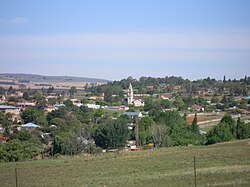
Machadodorp, also known by its official name eNtokozweni, is a small town situated on the N4 national highway, near the edge of the escarpment in the Mpumalanga province of South Africa. The Elands River runs through the town. There is a natural radioactive spring here that is reputed to have powerful healing qualities.[citation needed]

Key Information

History

[edit]

The town grew around a station originally named Geluk, after the sheep farm it was built on, but in 1894 the name was changed to honour the Portuguese Major Joachim Machado, an engineer who had surveyed the land for the proposed Nelspruit-Delagoa Bay railway line through the Crocodile River gorge.

The settlement became a capital for a few months from 5 June 1900, but was only declared a municipal town in 1904. This quirk in history happened during the Second Boer War when the Transvaal Volksraad made the town their temporary seat, using railway carriages as their offices and mint after they had to evacuate Pretoria in the face of a British invasion.

A quick-thinking station master rescued a consignment of dying trout by dumping the fish in the Elands River, which formed the start of the town's subsequent role in Mpumalanga's trout tourism industry. With the demise of passenger trains in South Africa, the once-postcard-pretty station closed in 2001 and it is now a derelict ruin.

In the 21st century, Machadodorp's residents either work for the industries feeding a chrome smelter, or the logging industries based on the pine plantations surrounding the town. A large contingent of contract workers employed at the Nkomati mine about an hour's drive out of town also reside in Machadodorp, contributing a large part of the town's economy.

The Komati Gorge, notable for its considerable biodiversity and bluff habitats, forms a backdrop to the town.[2]

Name change

[edit]

In early 2010 the town (along with Nelspruit and Waterval Boven) had its name officially changed. The town was renamed from Machadodorp to eNtokozweni, meaning Place of Happiness. It is often still referred to as Machadodorp despite the name change.

baKoni ruins

[edit]

The hills around the town are terraced with thousands of stone walls which form part of a vast complex of settlements, fields and roads. Some tour guides describe these as South Africa's "real" lost city.[3] South of Machadodorp, on the lands of the farm Rietvlei lies the former Bokoni capital Moxomatsi.

Archaeologists and historians have described the ruins as settlements of the baKoni people. Oral records and historical evidence trace the baKoni to at least the early 18th century. The ongoing 500 Year Initiative to rewrite South Africa's history continues to deliver new insights into the extent and complexity of these settlements.[4] An international group of researchers have placed the baKoni settlements in the context of numerous other cases of agricultural intensification, that took place in the precolonial era in different parts of Africa.[5]

Infrastructure

[edit]

Rail

[edit]

This town has a railway station for the loading and unloading of passengers and cargo on the Pretoria–Maputo railway.[6][7]

Roads

[edit]

eNtokozweni lies just off the N4 between Mbombela to the east and eMalahleni to the west. It can be accessed from the N4 by turning off the R36 S to Carolina.

Tolling

[edit]

The N4, managed by Trans African Concessions (TRAC), involves payment of toll: Motorists heading on the N4 E (the direction of Mbombela) and N4 W (the direction of eMalahleni) must pass through the Machado Toll Plaza, approximately 7 km north of eNtokozweni.[8]

References

[edit]
[edit]
Revisions and contributorsEdit on WikipediaRead on Wikipedia
from Grokipedia
Machadodorp, officially renamed eNtokozweni in 2010, is a small in province, , located along the N4 national highway near the edge of the . The town was established in 1895 on the farm Geluk to support the construction of the –Delagoa Bay railway line, named after engineer Joaquim Machado who surveyed the route. The Elands River flows through Machadodorp, enhancing its natural features including a scenic and pool that attract visitors. As of the 2011 census, the population stood at 8,941 residents across an area of 58.78 square kilometers. Historically significant for its role in regional transportation infrastructure, the town today functions as a for and rail traffic between and the Lowveld, with tourism centered on its proximity to outdoor activities and landscapes.

Geography

Location and environmental features


Machadodorp is located above the escarpment in province, , at coordinates 25°40′S 30°15′E, within the and the Highlands Meander tourism region. The town originated on the farm Geluk in 1895, with its layout shaped by the terrain's elevation and the bisecting Elands River, which originates nearby and supports riverine ecosystems amid the surrounding landscape.
Positioned along the N4 national highway, known as the Corridor, Machadodorp facilitates connectivity between and the port of in , while serving as an intermediate point on routes from to via . The escarpment's rugged features influence local accessibility, with passes and trails enhancing the area's appeal for exploration.
Environmental elements include grasslands characteristic of the and diverse habitats along the Elands River, contributing to in riverine zones. Nearby Wathaba Hiking Trails, located along the Skurweberg Pass approximately 20 km from the town, provide access to scenic waterfalls, pools, and viewpoints, underscoring the region's natural topography.

Climate and natural resources

Machadodorp features a temperate highland with distinct seasonal variations, typical of the Mpumalanga escarpment region. Summer months ( to ) see average daytime highs of 24-26°C and nighttime lows of 12-15°C, while winter ( to ) brings cooler conditions with highs of 16-18°C and lows occasionally dipping to 0-5°C. Annual mean temperatures hover around 17-18°C, with occasional in winter but rare extremes below freezing. Precipitation averages 684 mm annually, concentrated in summer thunderstorms from to , peaking at 127 mm in and negligible in June (0 mm). This pattern drives wet-dry cycles, with rainfall variability leading to droughts in low-precipitation years, as evidenced by historical data showing intra-annual fluctuations up to 50% deviation from norms. The area's primary natural resources center on water from the Elands River, which originates near Machadodorp and flows through the town, providing reliable surface flows for potential and generation, supplemented by aquifers. Soils consist mainly of freely drained red and yellow apedal types on gentle slopes, offering moderate fertility suitable for rain-fed production and extensive grazing, though erosion risks arise on steeper terrain. Conservation efforts in adjacent grasslands help sustain , but resource extraction remains limited compared to broader mineral deposits.

History

Pre-colonial Bokoni settlements

The , or BaKoni, established extensive settlements in the escarpment region, encompassing areas near modern Machadodorp, characterized by dry-stone walls enclosing homesteads and agricultural terraces from roughly the early 16th to early 19th centuries. These structures supported an agro-pastoral with on sloped terrains, where terraced fields facilitated crop production and , enabling sustained habitation across over 10,000 km². Archaeological surveys reveal homestead clusters often positioned on hilltops for natural defense, with walls averaging 1-2 meters high, reflecting organized labor without evidence of centralized palaces or monuments indicative of stratified hierarchies. Agricultural practices centered on cultivating drought-resistant grains such as and in terraced plots, augmented by herding for , , and manure fertilization, which underpinned population densities estimated at 20-50 people per km²—exceeding those of typical 18th-century European farms in marginal lands. Ironworking for tools and weapons occurred locally, evidenced by deposits, while networks exchanged , ivory, and metals with neighboring groups, fostering economic interdependence rather than isolation. Social organization emphasized kinship-based units with shared resource access, as inferred from uniform homestead sizes and lack of differential , challenging assumptions of pre-colonial technological stasis. Radiocarbon dating of charcoal from terraces and ceramics from homesteads confirms peak occupation and productivity until circa 1820, after which sites were largely abandoned. Decline stemmed primarily from cascading effects of the —disruptive migrations and raids initiated by Zulu expansions northward—compounded by internal conflicts over succession and resource strain from , rather than inherent societal fragility or solely climatic factors. Excavations yield no signs of gradual decay but abrupt depopulation, with post-1820 reoccupation minimal until colonial inflows.

Establishment during railway expansion

Machadodorp originated in 1895 on the farm Geluk, a property in the Zuid-Afrikaansche Republiek (ZAR), directly resulting from the extension of the Zuid-Afrikaansche Spoorweg-Maatschappij (NZASM) Delagoa Bay railway line from to the Mozambican port of Delagoa Bay. The line's construction necessitated a station at this strategic midpoint along the , prompting the subdivision of Geluk into plots to support emerging needs and worker housing. This development was driven by the ZAR's imperative for an independent export route to bypass British-dominated and Natal ports, enabling efficient transport of inland goods like coal and agricultural produce to international markets. The town's naming commemorates Major Joaquim Machado, a military engineer commissioned in 1883 by Portuguese authorities to survey a viable rail corridor linking Mozambique's systems to the Transvaal interior. Machado's route, finalized after traversing rugged terrain including the Crocodile River gorge and , overcame significant engineering challenges such as steep gradients and river crossings through innovative grading and bridging techniques, paving the way for the Pretoria-Komatipoort segment's completion by October 1894. These feats, executed under NZASM auspices from 1889 onward, exemplified late-19th-century rail expansion's causal role in regional transformation, with the full line opening to traffic in July 1895 under President . As a designated stopover, the station at Geluk—renamed Machadodorp by 1894—drew transient rail laborers, including Portuguese and local crews involved in track-laying and maintenance, alongside permanent settlers like farmers exploiting the railway's economic pull for timber, livestock, and crop shipments. This influx established the town as a logistical node, fostering ancillary services such as supply depots and lodging that capitalized on the line's capacity to handle up to 20 trains daily by the mid-1890s, thereby anchoring settlement patterns to transportation causality rather than prior agrarian isolation.

Involvement in Anglo-Boer Wars and early 20th century

During the Second Anglo-Boer War, Machadodorp assumed strategic significance due to its location along the Delagoa Bay Railway, a critical supply route for Boer forces. Following the British capture of on 5 June 1900, the government of the relocated its capital to Machadodorp, where President established a temporary administration amid retreating commandos. The town functioned as a logistical hub, supporting Boer defenses against the advancing under Lord Roberts. British forces pressed eastward, engaging Boer troops in the (also called the Battle of Belfast) from 21 to 27 1900, approximately 15 km southeast of Machadodorp. There, an estimated 8,000 British soldiers overwhelmed about 6,000 Boers under General , who held elevated positions but withdrew to avoid encirclement, abandoning Machadodorp. British troops occupied the town on 28 1900, securing the railway and liberating around 2,000 British prisoners from a nearby Boer camp; the site had served as a supply depot, storing ammunition and provisions vital to Boer operations. This capture facilitated British dominance over the eastern Transvaal, though Boer commandos continued guerrilla tactics until the war's end with the on 31 May 1902. In the early 1900s, post-war reconstruction emphasized railway repairs and expansion, restoring Machadodorp's role as a transport node. The town was formally proclaimed a village on 28 August 1904, enabling structured settlement and administration under British colonial oversight. Agricultural expansion followed, with maize and wheat cultivation intensifying on surrounding Highveld farms as returning Afrikaner burghers and laborers repopulated the district, leveraging fertile soils and rail access for markets. Upon the formation of the Union of South Africa on 31 May 1910, Machadodorp integrated into the Transvaal Province of the new dominion, marking the transition from republican outpost to unified territorial entity.

Post-apartheid developments and name changes

Following the end of apartheid in 1994, Machadodorp was incorporated into the newly delineated Emakhazeni Local Municipality as part of South Africa's municipal restructuring under the Local Government Transition Act of 1993 and subsequent legislation, which aimed to consolidate fragmented apartheid-era administrations into democratic local governance frameworks. This placed the town within the in Province, facilitating coordinated service delivery and development planning aligned with national priorities like poverty alleviation and infrastructure equity. In line with post-apartheid policies to address historical naming legacies, Machadodorp was officially renamed eNtokozweni—isiZulu for "Place of Happiness"—in by the South African Geographical Names Council, as part of a broader renaming initiative that included places like to eMakhazeni. Despite the policy directive, the original name persists in common usage among residents and travelers due to entrenched familiarity and practical convenience, with dual references evident in local signage, businesses, and media even into the . Land restitution claims in the area have been limited, with no major adjudicated disputes directly impacting the town center, though nearby farms like Geluk 348 JT—on which Machadodorp originated—saw lodged claims under the Restitution of Land Rights Act of 1994, processed without widespread conflict or disruption to urban functions. Infrastructure developments included upgrades to the N4 national highway, such as the R400-million Machadodorp Interchange completed in 2021, enhancing connectivity between Emakhazeni and surrounding regions as part of ongoing post-apartheid investments in transport corridors. These improvements, including pavement rehabilitation and lane expansions on the Belfast-Machadodorp section initiated around 2021, supported regional economic integration without significant local opposition.

Demographics

According to the , Machadodorp had a of 8,941 residents. The racial composition was dominated by Africans, comprising approximately 89.5% of the , with Whites accounting for about 8%, 1.4%, and Indian/Asians 0.7%; these figures reflect official population group classifications used in the . First home languages showed isiZulu as the most prevalent, spoken by around 2,060 individuals, followed by (784 speakers) and English (470 speakers); had 214 speakers, indicating a linguistic mix influenced by both Nguni (isiZulu) and Sotho-Tswana groups, alongside European settler languages among the White minority. This distribution aligns with broader patterns in the Nkangala District, where predominate due to historical migrations and absorptions of earlier BaKoni (-related) communities into surrounding ethnic groups. Population trends indicate rapid expansion between the 2001 and 2011 censuses, with an annual growth rate of 4.8%, likely driven by boundary expansions or influxes into peri-urban areas. However, growth has since moderated; the encompassing Emakhazeni Local Municipality recorded an average annual increase of 0.51% from 2011 to recent estimates, reaching 50,165 residents by 2022, reflecting net out-migration to larger centers like Mbombela for employment and services. Household sizes in the municipality averaged around 3.5 persons, consistent with national rural-urban fringe patterns but showing gradual increases amid slower overall population gains.

Socioeconomic indicators

In the eMakhazeni Local Municipality, which includes Machadodorp, income inequality is pronounced, with a of 0.64 reported in 2019 data, reflecting disparities driven by limited economic diversification and rural-urban divides common in . Indigent households, qualifying for subsidized services due to , comprised 17.4% of the total in 2019. The stood at 0.709, below the national average, underscoring challenges in multidimensional well-being. Educational attainment remains moderate, with an average of 8.0 years of schooling among adults and a rate of 71.9% as of recent assessments. Enrollment rates for children aged 5-17 were high at 96% per the 2016 Survey, though progression to higher education levels is constrained by socioeconomic factors. Health indicators reveal vulnerabilities, including a life expectancy of 65.8 years and maternal mortality at 86 per 100,000 live births in 2019. HIV prevalence aligns with provincial trends in , which recorded 17.4% among adults in 2022 per the South African National HIV Prevalence, Incidence, and Behaviour Survey, though earlier local estimates reached 45.5% in 2013 antenatal data from the Department of Health. Access to basic services is relatively strong: 93.9% of households had access to in recent profiles, with 78.8% featuring piped supply inside dwellings, while 94.2% reported access in the 2023/2024 municipal annual report. Sanitation coverage lagged at 72.2%. These metrics, drawn from and municipal reports, highlight progress in infrastructure amid persistent inequality.

Economy

Agriculture and primary industries

Agriculture in the Emakhazeni Local Municipality, encompassing Machadodorp, dominates the land use, with farming activities occupying the largest share of the physical area and supporting both subsistence and commercial operations. Crop production centers on and other summer cereals such as soya beans, canola, and sunflower, typical of the region, alongside and fruits where topography and permit. Livestock farming, including , sheep, , poultry, and game, supplements crop activities, particularly in western areas with extensive grazing potential. Subsistence prevails in the north-western parts, integrating crops and for local consumption amid rural settlements. Commercial contributes to through extensive plantations adjacent to Machadodorp, including a 14,500-hectare tract acquired by Forests in 2020, of which 9,400 hectares are dedicated to timber. Mining forms another key primary sector, representing 28.7% of the local as of recent assessments, though operations near Machadodorp focus on smaller-scale extraction rather than large deposits.

Tourism and service sector contributions

The sector in Machadodorp centers on nature-based activities, including hiking trails and , which draw visitors to the town's proximity to the escarpment and river systems. The Wathaba Hiking Trails, located along the Skurweberg Pass, feature well-marked paths ranging from 4 km to 10 km, with scenic waterfalls, pools, and moderate challenges suitable for day trips or overnight stays. Fishing enthusiasts frequent sites such as the Doornkop Fish and Wildlife Resort and the Machado Flyfishing Club, where in stocked waters supports specialized outings. These attractions integrate with the broader service sector by sustaining hospitality operations, including lodges like Elands River Lodge and self-catering cottages, which provide accommodation and on-site amenities for transient visitors. Guiding services for trails and , along with ancillary retail for outdoor gear, generate local employment and revenue, particularly in a where tourism efforts seek to supplement agriculture-dominated income streams. Leisure pursuits constitute the primary draw for tourists in the Emakhazeni Local , encompassing Machadodorp, with business-related visits accounting for about 20% of recorded purposes. Eco-tourism elements, such as low-density trail access and viewing at resorts, promote sustainable visitor impacts while leveraging the area's grasslands and rivers for minimal infrastructure demands. Nonetheless, the sector exhibits tied to favorable for outdoor pursuits and faces constraints from N4 highway tolls, which deter pass-through traffic and amplify dependence on regional promotion via routes like the . Municipal strategies emphasize diversification to bolster service-oriented growth, though quantitative contributions remain modest relative to primary industries.

Infrastructure

Rail and road networks

Machadodorp functions as a railway junction on the Pretoria-Maputo line, originally constructed to connect the Transvaal interior to Delagoa Bay (now ). The railhead extended to the site on July 10, 1894, enabling freight transport critical to regional . A secondary arterial route from Machadodorp to Breyten opened in 1908, linking to the Ermelo line and enhancing connectivity for and general cargo. The local station primarily handles freight loading and unloading, with passenger services minimal since the early , reflecting a shift toward bulk commodity transport post-1895. The town's road infrastructure centers on the N4 national route, a 630 km toll concession from to that passes through Machadodorp, facilitating high-volume east-west traffic. Toll revenues fund maintenance and upgrades, including extensive rehabilitation between and Machadodorp completed in phases through , improving pavement and safety. However, user toll costs—varying by vehicle class and distance—have drawn criticism for burdening commuters and freight operators, despite benefits like reduced congestion and reliable access to ports. The R36 provincial route co-aligns with the N4 for approximately 8 km east of Machadodorp, including a tollgate, before diverging southward. Eastbound, the N4 splits near Machadodorp into parallel corridors via Waterval Boven and Carolina, offering redundancy but exposing the network to weather-related disruptions in the terrain.

Public utilities and development challenges

Electricity provision in eMakhazeni Local Municipality, encompassing Machadodorp, depends on the national grid, with local distribution serving 18,466 households or 94% of the total as of the 2023/2024 , leaving a 6% backlog primarily in rural and farm areas. Ongoing challenges include aging infrastructure, cable theft, and national load-shedding events, which disrupt supply and necessitate 88 new household connections in extensions like Siyathuthuka and Madala during the year. Recent initiatives include the completion of a 132/11kV substation in and plans for installations with solar backups across 2,878 single-phase and 21 three-phase connections to enhance reliability. Water supply reaches 99% of households (19,441 connections), supported by upgrades to the Machadodorp Water Treatment Works, including generator installations to counter power outages, and provision of infrastructure to three farms like Farrefontein. Rural alternatives include developments, though backlogs persist at 1% due to leakages, aging pipes, and intermittent supply disruptions from load shedding at pump stations lacking backups. coverage stands at 93% for 18,243 households, with recent completions of works in Emgwenya and sewer lines in Madala and Emthonjeni, but a 7% rural backlog remains, relying on ventilated improved pit latrines where flush systems are unfeasible. Solid waste management provides weekly refuse removal to 84.7% of households (17,534), up from prior years, with efforts to clean illegal dumping sites and conduct awareness campaigns, though the Machadodorp landfill site was closed due to an expired license, shifting to alternative rural disposal methods. Broader development hurdles involve financial constraints limiting maintenance to 4.4% of budgets (below the 8% norm), revenue shortfalls, and persistent rural service gaps despite 100% expenditure of Municipal Infrastructure Grant (R18.5 million) and Water Services Infrastructure Grant (R29 million) funds for upgrades. These issues exacerbate vulnerabilities in informal and farm settlements, where access lags urban centers like Machadodorp.

Cultural and historical heritage

BaKoni ruins and archaeological significance

The BaKoni ruins, also known as stone ruins, comprise an extensive archaeological landscape of dry-stone walls, circular enclosures, and terraced slopes scattered across hillsides in the region, including areas near Machadodorp. These features, numbering in the thousands of individual structures, primarily represent homestead compounds with radiating stone circles delineating family living spaces and central kraals, alongside linear walls forming agricultural terraces for retention and management. Archaeological consensus attributes these ruins to the BaKoni, a Bantu-speaking agro-pastoral society that developed intensive mixed farming systems, evidenced by the high density of settlements—up to 50-60 sites per square kilometer in core areas—and associated artifacts like iron tools and grinding stones indicating crop processing. The terraces facilitated sloped cultivation of sorghum and other grains, while enclosures supported livestock herding, enabling sustained productivity in a challenging highland environment. Peak population estimates for the broader Bokoni settlements range from 19,000 to 57,000 individuals, reflecting a hierarchical yet kin-based social organization capable of mobilizing labor for large-scale construction. Dating relies on optically stimulated luminescence (OSL) analysis of buried sands, on pottery sherds, and stratigraphic correlations with regional ceramics, placing primary construction and occupation between the early 15th and early 19th centuries AD, with the most intensive phase from circa 1500 to 1820. This timeline contradicts fringe theories positing prehistoric origins (e.g., tens or hundreds of thousands of years old), which lack supporting from excavation or material analysis and often stem from unsubstantiated alignments with distant megalithic sites. The BaKoni system's collapse correlates with disruptions from 19th-century invasions, including raids, which depopulated the region and abandoned the structures.

Local traditions and preservation efforts

Local communities in Machadodorp, known locally as eNtokozweni, sustain cultural continuity through festivals that integrate traditional practices with contemporary expression. The annual Ummemo cultural festival, organized by Inkhosi KJ Malaza and held on , emphasizes Swati and Ndebele heritage by facilitating from elders to , including performances of customary dances, music, and rituals that reinforce communal identity and historical narratives. This event counters cultural erosion by prioritizing oral traditions and participatory engagement over formalized documentation. The My Body My Space arts festival, reaching its tenth edition in March 2025, transforms eNtokozweni's streets into venues for free public access to indigenous dance forms, , and , blending local customs with themes of and bodily autonomy to engage diverse participants. These gatherings highlight Ndzundza-Ndebele influences prevalent in the region, where participants perform ancestral songs and movements tied to agrarian and spiritual practices. Preservation initiatives remain predominantly community-led, with limited direct intervention from 's provincial heritage authorities, which focus on broader like the annual Provincial Heritage Day without tailored programs for Machadodorp's sites. The Ebhudlweni Arts Centre, situated on a rural near the town, supports ongoing efforts by offering residencies and workshops that draw on the surrounding landscape to revive traditional crafts and performances, fostering economic viability through tourism-linked cultural activities. Grassroots groups, such as Mpumalanga Heritage, conduct guided tours of local historic landmarks to educate residents and visitors, compensating for gaps in official funding and maintenance. Challenges persist due to constraints and development pressures, with advocates noting insufficient provincial allocation for vernacular sites amid competing priorities, though local festivals demonstrate resilience in maintaining practices independent of state oversight.

References

Add your contribution
Related Hubs
User Avatar
No comments yet.