


Community hub
Recent from talks
Contribute something
Nothing was collected or created yet.
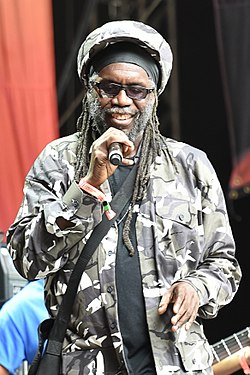
Macka B
View on Wikipedia
Key Information


Christopher MacFarlane, better known as Macka B, (born 1966) is a British-born Jamaican reggae artist, performer and activist with a career spanning thirty years and one of Britain's most influential dancehall DJs.[1]
As a practicing Rastaman, Macka B's music is based around the political and spiritual message of the religion, with an often light and humorous touch. Working with the Mad Professor, he combined dancehall and dub styles of reggae, although he has avoided a more commercial crossover approach. He takes his name from the Judean rebels against the Greeks, the Maccabees.
Life
[edit]Born in Wolverhampton to Jamaican parents,[2] as a child Macka B was first impressed by the reggae of the Lord Barley sound-system playing at a blues party next to his parents' house, but also played violin and sang in the choir at school.[1][3] He went on to take a technical apprenticeship at the Ever Ready factory. When the factory closed and he was laid off, he began to devote more time to practising his toasting skills, influenced by earlier Jamaican toasters U-Roy, I-Roy, Big Youth, and especially Prince Far I.[1]
Soon Macka B formed the Exodus sound system with friends and became a Rasta.[1][4] His 1982 trip to Jamaica galvanised his commitment to toasting and the following year he won a DJing competition.[1][3] After this Macka B began to feature on the radio as well as perform with local band Pre-Wax, who had a hit with "Maggie's Letter".[1][3] He became a regular performer on Birmingham's Jah Wasifa sound system.[5] He had a weekly slot on the television programme Ebony in 1984.[4] He approached Neil "The Mad Professor" Frasier with a view to recording and after submitting a tape of his work, the producer agreed to produce his first album, beginning a long association.[3][6] Around the same time, a tape of his performance in a sound-system battle between the Jah Wasifa sound system and Saxon Studio International ended up with Fashion Records in London. The record label gave Macka B the opportunity to record his first solo single, "Bible Reader", which was released in 1985, the first of three singles for the label.[1][4]
Macka B's first album, Sign of the Times, was released in 1986 on Mad Professor's Ariwa label.[1] The album was well received and reached the top of the UK reggae album charts.[1][4][7] Further television exposure followed on the ITV programme Club Mix.[5] His next few albums were similarly acclaimed: We've Had Enough (1987), Looks Are Deceiving (1988). In 1988 Macka B visited Jamaica, where he worked with producer Black Scorpio on the tracks "Love It in Jamaica" and "Slow Down Driver".
Buppie Culture in 1989 produced the hit "Dread a Who She Love", a duet with female singer Kofi.[1][2] Likewise, "Proud of Mandela" from Natural Suntan (1990) produced another reggae singles chart topper.[1][3][8] In 1990 he appeared at the 'Solidarity' concert in Poland, along with the Twinkle Brothers.[4]
Macka B won British Best Male DJ awards in 1991 and 1992. His 1993 record, Roots Ragga was a live album. Here Comes Trouble (1994) produced the international hit "Squeeze Me".[1] "Road Rage" from the Suspicious album was popular on Australian youth radio station Triple J in 1998/9. He again worked with Mad Professor on Discrimination (1995).[9] Roots & Culture (1999) mixed Macka B's hits with previously unreleased material.[10] In 2004 he signed to the Jet Star label (Charm) label.
He also became the first Reggae artist to tour the former Yugoslavia (Slovenia, Croatia, Serbia).[citation needed] In 2012, he appeared as a special guest star on the track Jadna ja (Poor me) by the Serbian folk-world music-rock band Zlatopis.
He has toured and performed around the world since the 1980s alone and with other reggae stars such as Burning Spear, U-Roy, The Wailers, Lee Perry and many others.[4]
Personal life
[edit]Macka B follows the Rastafari ital diet, and is also a vegan.[11] In 2012 he became a patron of The Vegan Society.[12] He runs a YouTube channel where he regularly posts short toasts about the benefits of healthy eating.[13]
Discography
[edit]- Sign of the Times (1986), Ariwa
- We've Had Enough (1987), Ariwa
- Looks Are Deceiving (1988), RAS
- Buppie Culture (1989), Ariwa
- Natural Suntan (1990), Ariwa
- Peace Cup (1991), Ariwa
- Roots Ragga (live) (1992), Fotofon/Ar
- Jamaica, No Problem (1992), RAS
- Roots Ragga (live) (1993), Ariwa
- Here Comes Trouble (1994), Ariwa
- Discrimination (1995), Ariwa
- Hold on to Your Culture (1995), Ariwa
- Suspicious (1998), Ariwa
- Roots & Culture (1999), Ariwa
- Global Messenger (2000), Ariwa
- Roots Ragga, Vol. 2 (2002), Ariwa
- By Royal Command (2003), Jet Star
- Word, Sound & Power (2004), Charm
- Who Likes Macka B Music? (2005), Pony Canyon
- Live Tour 2007
- More Knowledge (2008), Humal
- Change The World (2012), Chinelo
- Never Played a 45 (2015), VP
- Health Is Wealth (2017), Greensleeves
- Warrior Style (2020), Ariwa
Compilations
[edit]- Yemisi Riddim (2015), Oneness Records
References
[edit]- ^ a b c d e f g h i j k l Huey, Steve. "Biography: Macka B". AllMusic. Retrieved 26 May 2010.
- ^ a b Campbell, Howard (2014) "Medical Marijuana from Macka B", Jamaica Observer, 10 June 2014. Retrieved 13 June 2014
- ^ a b c d e Moskowitz, David V. (2006) Caribbean Popular Music: an Encyclopedia of Reggae, Mento, Ska, Rock Steady, and Dancehall, Greenwood Press, ISBN 0-313-33158-8, p. 184
- ^ a b c d e f Henry, William, "Macka B", in Donnell, Alison (ed.) (2013) Companion to Contemporary Black British Culture, Routledge, ISBN 978-0415862509
- ^ a b Larkin, Colin (1998) The Virgin Encyclopedia of Reggae, Virgin Books, ISBN 0-7535-0242-9, p. 177
- ^ Broughton, Simon et al. (eds.) (2000) The Rough Guide to World Music, Volume 2, Rough Guides, ISBN 978-1858286365, p. 460
- ^ Stanley, Leo "Sign of the Times Review", AllMusic. Retrieved 20 June 2014
- ^ Gilroy, Paul (1993) The Black Atlantic – Modernity and Double Consciousness, Verso, ISBN 978-0860916758, p. 95
- ^ Wartofsky, Alona (1995) "Angry Macka B., Propulsive Professor", The Washington Post, 14 April 1995.
- ^ "Macka B Roots & Culture", CMJ New Music Report, 13 September 1999, p. 66. Retrieved 20 June 2014
- ^ Ital/Vegan: The Official Macka B Website Archived 19 February 2009 at the Wayback Machine, accessed 27 February 2009.
- ^ "Macka B", Huffington Post. Retrieved 19 June 2014
- ^ "This Viral YouTube Singer Wants You to Eat More Veggies". Cooking Light. Archived from the original on 27 May 2022. Retrieved 1 June 2022.
External links
[edit]
| International | |
|---|---|
| National | |
| Artists | |
| Other | |

Macka B
View on GrokipediaEarly Life
Childhood and Family Background
Christopher MacFarlane, professionally known as Macka B, was born on 2 February 1966 in Wolverhampton, West Midlands, England, to parents who had immigrated from Hanover, Jamaica, as part of the post-World War II Caribbean migration wave.[7][8] His family exemplified the experiences of many Jamaican households in the region, with his mother functioning as a housewife while his parents navigated life far from their rural Jamaican origins.[7] Raised in a typical Jamaican immigrant family within Wolverhampton's industrial landscape, MacFarlane grew up amid factories and cold weather that starkly contrasted the hilly terrain of Hanover his parents had left behind.[7] The West Midlands hosted a growing Caribbean diaspora community during the 1960s and 1970s, where families like his maintained cultural ties to Jamaica through language, food, and traditions, fostering an environment steeped in heritage despite economic pressures of working-class life.[8][7] This upbringing in a modest, family-oriented setting provided the foundational personal context for MacFarlane's early years, emphasizing resilience and cultural continuity in an urban British setting before his teenage interests developed further.[7]Introduction to Reggae and Soundsystems
Macka B, born Christopher MacFarlane in Wolverhampton, England, in 1966, grew up immersed in the vibrant UK reggae scene of the late 1970s and early 1980s, where Jamaican-influenced soundsystems dominated local parties and community events.[1] From a young age, he was captivated by heavyweight soundsystems such as Lord Barley, which played at informal blues parties, fostering his early appreciation for reggae's live energy and dub-heavy rhythms rooted in Jamaican traditions.[1] This exposure aligned with the thriving West Midlands reggae culture, where bands like Capital Letters performed alongside touring acts such as Aswad, blending local talent with imported Jamaican roots reggae and dancehall styles.[9] By the early 1980s, as a teenager, Macka B transitioned into active participation by becoming a regular performer on Birmingham's Jah Wasifa soundsystem, initially honing skills in selection and MCing (toasting) over instrumental dub plates and riddims.[10] Soundsystem culture emphasized hands-on learning through competitive clashes, audience interaction, and technical mastery of equipment, drawing from Jamaican pioneers who migrated to the UK and adapted the format for multicultural urban communities facing social challenges like racism and economic hardship.[9] His involvement built practical expertise in live performance dynamics, where toasters engaged crowds with rhythmic patois delivery, call-and-response techniques, and improvisational lyrics, prioritizing energy and cultural resonance over studio polish.[1] A pivotal 1982 trip to Jamaica further deepened his connection to reggae's origins, exposing him to authentic yard styles and inspiring refined toasting techniques upon return.[10] This culminated in 1983 when he won a DJ competition at Bilston's Rising Star club, outperforming competitors including Pato Banton and Ranking Ann, securing a radio slot on Birmingham's WM station and signaling a shift toward individual aspirations amid the collective soundsystem ethos.[7] These formative experiences in the UK scene's communal apprenticeship phase equipped him with the performance acumen essential for later solo endeavors, distinct from the era's group-oriented jamming sessions.[9]Musical Career
Debut and Rise in the 1980s
Macka B entered the recording scene in the mid-1980s after gaining local prominence as a toaster on Birmingham's Wassifa sound system, leading to his debut single "Bible Reader" released on Fashion Records in 1985.[11] This track marked his initial foray into vinyl releases, blending dancehall-style toasting with Rastafarian-influenced lyrics on social and spiritual themes, setting him apart from the lighter pop-reggae prevalent in the UK at the time.[11] In 1986, Macka B signed with Mad Professor's Ariwa label, which specialized in roots reggae and dub productions, and released his debut album Sign of the Times that same year.[12] The album, featuring tracks like "Wet Look Crazy" and "Invasion," emphasized conscious messaging on issues such as cultural identity and resistance to Western materialism, achieving immediate success by topping the UK reggae charts.[4] This breakthrough established his style of politically aware toasting over Ariwa's heavy, echo-laden rhythms, resonating with audiences in the Midlands and London who sought alternatives to commercialized reggae acts.[12] Building on this momentum, Macka B issued the single "Don't Judge Me" in late 1986 and followed with his second album We've Had Enough in 1987, both on Ariwa, which further solidified his presence in the UK reggae underground.[13] He performed at the 1986 Reggae Sunsplash festival at Wembley Arena and appeared on Channel 4's Club Mix program, expanding his visibility within the British scene.[14] Early international exposure came via a successful tour of Germany in January 1987 alongside the Ariwa Posse, helping cultivate a growing European fanbase while maintaining strong regional support in the UK through club and sound system circuits.[13]Peak Achievements in the 1990s
Macka B's prominence in the UK reggae scene peaked in the early 1990s with consecutive wins of the British Reggae Industry Best Male DJ award in 1991 and 1992, recognizing his influence amid a resurgence of roots reggae and dancehall styles.[1][15] These accolades coincided with the release of albums Peace Cup in 1991 and Jamaica, No Problem in 1992, both produced under his longstanding partnership with the Ariwa label, which emphasized conscious lyrics over commercial pop-reggae trends.[16] Commercial milestones included the 1990 single "Proud of Mandela," which celebrated Nelson Mandela's release from prison and immediately topped the UK reggae singles chart, reflecting Macka B's ability to blend topical activism with chart appeal.[1] His album Natural Suntan, also from 1990, ranked fifth on the Jetstar Reggae year-end album chart, driven by tracks that resonated in specialist stores and soundsystem circuits rather than mainstream outlets.[17] These successes underscored a period of sustained output, with Macka B recording extensively for Ariwa throughout the decade, prioritizing artistic control over major-label distribution.[4][18] The 1993 live album Roots Ragga, recorded during energetic performances, captured his ragga-toasting prowess and band dynamics, featuring extended versions of staples like "Sex Machine" and "Revelation Time" that highlighted improvisational flair in front of live audiences.[19][20] This was followed by Here Comes Trouble in 1994, an Ariwa release with tracks such as the title song and "Do the Butterfly" that expanded his reach to international markets through export sales and festival appearances.[21][22] Tours in regions like Australia during the mid-1990s positioned him as one of the earliest British reggae acts to perform there extensively, fostering a global fanbase amid reggae's diaspora-driven growth.[23]Evolution and Later Works (2000s–Present)
In the 2000s, Macka B sustained his career through consistent album releases that blended roots reggae with live instrumentation, exemplified by Global Messenger in 2000 and Live Again!! / Roots Ragga 2 in 2002, which highlighted a return to fuller band arrangements amid the digital shift in music production.[16][24] This period marked an adaptation from earlier solo toaster styles toward emphasizing collaborative live performances, aligning with a broader renaissance in roots reggae ensembles post the dominance of digital riddims.[16] Entering the 2010s and 2020s, Macka B maintained prolific output with albums such as Rasta Soldier (2012), Never Played a 45 (2015), Health Is Wealth (2017), and Warrior Style (2020), alongside singles like "Gentrification" (2020) and the Mi Nuh Normal EP (2024).[25][16] Recent singles including "We Nah Done" and "Sitting In The Sun (Sipping Coconut Water)" in 2024–2025 demonstrate ongoing evolution in production while preserving conscious lyrical foundations.[26][27] He integrated modern platforms for promotion, leveraging YouTube for official music videos and an active website for announcements, facilitating direct fan engagement without relying on traditional label structures.[28][29] Touring remained central, with over three decades of global performances culminating in a full-band resurgence via the Roots Ragga Band, as seen in scheduled 2025 dates like February European shows and the One Fest appearance in West Bromwich near Birmingham on August 23.[30][29] This adaptability underscores Macka B's endurance in live roots reggae circuits, prioritizing authentic band dynamics over transient digital trends.[16]Artistic Style and Themes
Musical Influences and Genre Contributions
Macka B developed his toasting technique primarily through the influence of Jamaican deejays U-Roy, I-Roy, Big Youth, and Prince Far I, whom he emulated while practicing at home in Wolverhampton during the late 1970s and early 1980s.[31][32] These early reggae DJs shaped his rhythmic delivery and improvisational style over instrumental versions, adapting the Jamaican sound system tradition to the UK urban environment.[4] Additional roots reggae inspirations from musicians like Burning Spear, Bob Marley, and Peter Tosh informed his emphasis on conscious rhythms and live energy in performances.[4][33] In blending dancehall toasting with roots reggae and dub elements, Macka B contributed to the evolution of UK reggae by prioritizing authentic, non-commercial production methods, particularly through collaborations with Mad Professor at Ariwa Records starting in the mid-1980s.[32] This partnership highlighted analog recording techniques and heavy basslines, fostering a gritty, echo-laden sound that distinguished British reggae from Jamaican originals while preserving Rastafarian sonic aesthetics.[32] His approach avoided crossover pop dilutions, instead amplifying deejay-led tracks with layered effects and live band dynamics, as evident in releases like his 1986 debut Word, Sound & Power.[32] Macka B's innovations extended the toasting genre's reach in Europe by integrating UK-specific cultural references into traditional Jamaican frameworks, promoting a hybrid style that influenced subsequent British and continental reggae acts through tours and sound system clashes from the 1990s onward.[34] This technical fusion—characterized by precise patois phrasing over skanking guitars and one-drop rhythms—helped solidify roots reggae's presence outside Jamaica, emphasizing communal live sessions over studio polish.[32]
Core Lyrical Content
Macka B's lyrics recurrently emphasize self-empowerment through personal resilience and agency, as seen in tracks like "Free Your Mind," where he urges listeners to "free your mind" from mental constraints to achieve inner strength.[35] This motif extends to calls for individual action against adversity, exemplified in "Step Up," which encourages proactive steps toward improvement amid challenges.[36] Such content draws from observable patterns of human endurance, prioritizing practical mindset shifts over external dependencies. Anti-system critiques form another core element, targeting institutional hypocrisy and societal structures, particularly in "Rastaman," where lines describe "Babylon society's full of hypocrisy / Full of thief, red tape, full of bureaucracy."[37] These lyrics highlight inconsistencies in authority, such as unequal power dynamics where a "little minority a rule the majority," reflecting direct observations of governance flaws without broader ideological endorsements.[37] In "Gentrification," he addresses economic displacement, critiquing how urban policies erode community stability for profit-driven changes.[38] Cultural pride permeates his work, often invoking Rastafarian heritage and African roots for communal identity, as in "Garvey Story," which recounts Marcus Garvey's message of racial self-reliance: "Up mighty race, him seh come outta the ghetto."[39] This balances individual agency with collective Rastafarian unity, evident in "Rasta Rise Again," affirming enduring communal spirit: "Rastafari can never die / Living for-I-ver and I-ver."[40] Tracks like "Hold On to Your Culture" reinforce preservation of traditions against dilution, weighing benefits of ancestral wisdom against modern dilutions without unsubstantiated idealization.[41]Advocacy and Beliefs
Rastafarianism and Ital Principles
Macka B embraced Rastafarianism during his youth in Birmingham, United Kingdom, influenced by Jamaican immigrant culture, reggae music, and community discussions, with his commitment solidified by a 1982 trip to Jamaica that deepened his dedication to the faith.[1][4] Rastafari serves as the foundational framework for his personal identity, centering on livity—a commitment to righteous, natural living aligned with divine order—and the repudiation of Babylon, symbolizing the exploitative Western materialist system and its cultural impositions.[42] This worldview informs his rejection of processed consumerism and emphasis on self-reliance, viewing Rastafari as a path to higher consciousness and resistance against systemic oppression.[42] Central to Macka B's Rastafarian practice are Ital principles, derived from the Amharic term for "vital," promoting a diet of unprocessed, earth-derived foods to sustain life force and spiritual purity—a practice traceable to early Rastafari movements in Jamaica during the 1930s.[43] He has embodied Ital livity through decades of plant-focused eating, ceasing meat consumption at age 16 and advancing to strict veganism by approximately 1997, prioritizing raw or minimally cooked vegetables, fruits, and herbs over industrialized products.[42] While traditional Rastafari interpretations often permit small fish in Ital diets as compatible with natural sustenance, Macka B adheres to a more rigorous exclusion of all animal products, aligning with interpretations that prioritize absolute life-affirmation and avoidance of death-linked foods.[42][43] This approach reflects his personal evolution within Rastafari, emphasizing empirical benefits of purity over permissive allowances.[42]Health, Veganism, and Natural Living
Macka B adopted a vegan diet over 30 years ago, transitioning in his adulthood after a childhood affinity for animals, and has since integrated it into his advocacy for natural living through whole, unprocessed plant foods akin to Ital principles.[44][45] He promotes these practices via music and videos, including the 2017 track "Health is Wealth," which lyrically asserts "vegan we vegan, plant based we plant based" while urging avoidance of reliance on external health interventions in favor of dietary self-reliance.[46][47] Macka B critiques processed foods and meat consumption for their causal contributions to health deterioration, such as inflammation and metabolic disorders, drawing on observable patterns where high intake correlates with elevated risks of obesity, type 2 diabetes, and cardiovascular events.[42] Empirical evidence supports this stance: meta-analyses of prospective cohorts show vegan diets associated with 15-24% lower relative risk of cardiovascular disease incidence compared to omnivorous patterns, attributed to reduced saturated fats, higher fiber, and anti-inflammatory phytochemicals from plants.[48][49][50] His "Wha Me Eat" video series exemplifies this by detailing nutritional profiles of fruits and vegetables—like cucumbers' hydrating and detoxifying effects—to encourage empirical evaluation of plant-based options over industrially processed alternatives.[51] Notwithstanding these benefits, veganism's nutritional completeness remains debated, as plant-exclusive diets inherently lack bioavailable sources of certain micronutrients without fortification or supplementation; for instance, vitamin B12 deficiency affects up to 92% of unsupplemented vegans, risking anemia, fatigue, and irreversible nerve damage due to its absence in flora.[52][53] Similar concerns apply to omega-3 fatty acids, iron, and zinc, where absorption inefficiencies in plants can exacerbate shortfalls absent targeted interventions, underscoring the need for evidence-based planning to mitigate subclinical deficiencies observed in population studies.[54][55] Macka B's emphasis on natural, abundant plant variety aligns with strategies to address some gaps organically but does not fully obviate supplementation for optimal outcomes.[56]Views on Cannabis and Medicine
Macka B has long advocated for cannabis, known as ganja in Rastafarian tradition, as a sacrament central to spiritual practice, viewing it as "the healing of the nation" predating modern legalization efforts.[57] As a Rastafari adherent, he incorporates ganja into his lyrical themes, emphasizing its role in meditation and divine connection, as seen in tracks like "Legalize the Herb" from his discography, where he critiques criminalization for turning "decent folk" into offenders over personal use.[58] This stance reflects Rastafarian doctrine, where ganja facilitates reasoning sessions and aligns with biblical interpretations of herbs for healing, a position he has promoted since the 1980s amid strict UK prohibitions that risked arrests for possession.[59] In the 2010s, Macka B extended his advocacy to medical applications, releasing "Medical Marijuana" in 2014 and "Medical Marijuana Card" in 2015, the latter inspired by a real incident in California where a companion's legal card averted police issues during a traffic stop.[60] These songs highlight ganja's therapeutic potential over pharmaceutical alternatives, promoting self-reliance and critiquing systemic overreach, as he performed "Medical Marijuana" live in Malaysia in 2019 despite capital penalties for offenses there.[61] His support aligns with global reforms, such as the UK's 2018 legalization of medical cannabis for conditions like chronic pain, where empirical studies validate benefits such as analgesia in epilepsy and multiple sclerosis, though debates persist on risks including dependency and cognitive effects in heavy users. Macka B maintains a balanced perspective, acknowledging moderation in a 2021 podcast discussion on ital living, where he addressed marijuana alongside addictions like salt and sugar, framing it as a tool for consciousness rather than excess.[62] This evolves his early-career calls for decriminalization—spanning over 30 years by 2014—into endorsements of regulated medical access, prioritizing natural remedies amid evidence of cannabis's anti-inflammatory properties while cautioning against abuse.[57]Personal Life
Family and Relationships
Macka B has cultivated a close-knit family environment that provides ongoing support for his career and public activities. His adult children, who were in their twenties as of 2017, actively assist with his social media management, including the development and promotion of educational content series.[63] He shares a long-term relationship with his wife, who forms part of this supportive family foundation alongside their children and grandchildren.[63][7] This relational stability underscores the personal dynamics enabling his sustained output in music and advocacy over decades.[64]Lifestyle Practices
Macka B sustains a rigorous touring schedule spanning more than three decades, with performances across continents including Europe, Africa, and beyond, such as a 2017 vegan cruise from the UK to Norway and stops in Sierra Leone, Gambia, Senegal, Botswana, South Africa, and Egypt.[42] This endurance stems from disciplined habits, including viewing exercise as "medicine" to maintain physical capability for high-energy stage shows where he "run up and down like a little youth."[42] His routine emphasizes early rising followed by meditation and giving thanks, paired with a daily morning smoothie of moringa, baobab, flax seeds, hemp seeds, cherries, and blueberries, integrating Ital vegan principles for consistent energy.[42] Favoring 80% raw foods alongside 20% cooked, he attributes this plant-based approach—adopted fully around 1997—to vitality that supports ongoing output without documented major health disruptions.[42] Macka B practices avoidance of excesses by abstaining from meat since age 16, extending to fish and dairy later, framing health as personal accountability: "A lot of diseases can be attributed to what you’re eating, what you’re putting into your temple."[42] This self-reliant ethos aligns with his sustained professional longevity, prioritizing moderation to preserve performance readiness.[42]Discography
Studio Albums
Macka B's debut studio album, Sign of the Times, released in 1986 on Ariwa Records and produced by Mad Professor, introduced his digital dancehall style rooted in Jah Shaka sound system influences, emphasizing social commentary on urban life and inequality. Subsequent early releases, including We've Had Enough (1987, Ariwa) and Buppie Culture (1989, Ariwa), maintained this production approach with sparse, electronic rhythms and deejay vocals critiquing materialism and racial tensions, distinguishing them from analog roots efforts of the era.[65] Looks Are Deceiving (1988, RAS Records) marked a brief shift to U.S. distribution while retaining Ariwa's digital blueprint.[66]| Year | Title | Label | Notes |
|---|---|---|---|
| 1990 | Natural Suntan | Ariwa | Continued digital reggae focus with themes of cultural identity. |
| 1991 | Peace Cup | Ariwa | Incorporated more live instrumentation, bridging to roots evolution. |
| 1992 | Roots Ragga | VP Records | Blended ragga elements with traditional nyabinghi drumming. |
| 1994 | Hold On to Your Culture | Jet Star | Emphasized preservation of African heritage amid globalization.[65] |