Hubbry Logo
Madam SatanMadam SatanMain
Open search
Madam Satan
Community hub
Madam Satan
logo
8 pages, 0 posts
0 subscribers
Be the first to start a discussion here.
Contribute something
Madam Satan
Madam Satan
from Wikipedia

Madam Satan
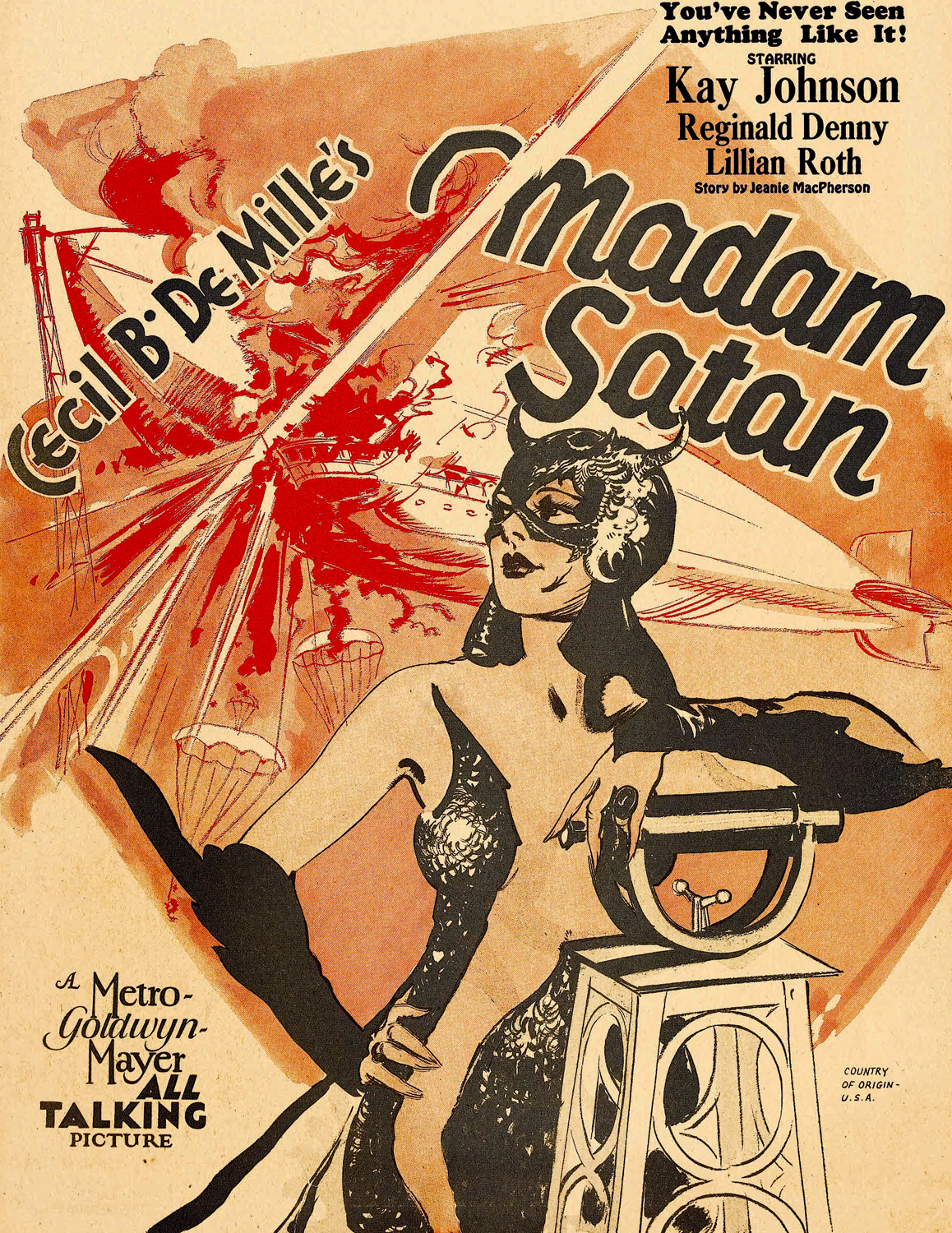
Theatrical release poster
Directed byCecil B. DeMille
Written byDialogue:[1]
Gladys Unger
Elsie Janis
Screenplay byJeanie MacPherson
Produced byCecil B. DeMille
StarringKay Johnson
Reginald Denny
Lillian Roth
Roland Young
CinematographyHarold Rosson
Edited byAnne Bauchens
Music by(see "Music" below)
Production
company
Distributed byLoew's Inc.
Release date
  • September 20, 1930 (1930-09-20) (US)
Running time
116 minutes
CountryUnited States
LanguageEnglish

Madam Satan or Madame Satan is a 1930 American pre-Code musical comedy film in black and white with Multicolor sequences. It was produced and directed by Cecil B. DeMille and starred Kay Johnson, Reginald Denny, Lillian Roth, and Roland Young.

Madam Satan has been called one of the oddest films DeMille made and certainly one of the oddest MGM made during Hollywood's "golden age".[2] Thematically, this marked an attempt by DeMille to return to the boudoir comedies genre that had brought him financial success about 10 years earlier.[3]

Plot

[edit]
Madam Satan (1930)

The first 50 minutes present four characters' relationships, with the next 1 hour and 10 minutes set on a Zeppelin trip.[4]

One morning after awakening to discover her husband Bob (Reginald Denny) never returned home last night, socialite Angela Brooks (Kay Johnson) reads in the newspaper that Bob and a woman named "Mrs. Brooks" were in night court together along with Bob's best friend Jimmy Wade (Roland Young). The woman is actually a showgirl Bob has been seeing named Trixie (Lillian Roth), but Bob claims that Trixie is Jimmy's new wife.

Angela is more amused than angered by the clumsy lies, but it soon becomes clear that Bob has lost interest in their marriage, as he feels Angela has become staid and cold. They each declare that they are moving out and leaving the other, but Angela instantly repents. Her maid encourages her to fight for her happiness.

Angela tells Jimmy that she has left home and will spend the night at the apartment he shares with his supposed wife Trixie. Trixie doesn't know about Bob's lie, so Jimmy rushes to her apartment to warn her. Trixie is displeased because she wants Bob all to herself. But when Angela arrives they reluctantly pretend to be married while Angela tries to trick them into revealing the truth. The scene becomes more farcical when Bob arrives as well, while Trixie is hiding; Jimmy conceals Angela under a blanket and says she is his girlfriend, a married woman whose name he will not reveal. Trixie reenters so that Bob will know the woman is not her.

After the men leave, Trixie observes that Angela was caught in her own trap. She says that the difference between them is that Trixie understands the things that a man wants in a woman, and as long as she gives them to Bob, he will stay with her. Angela takes that as a challenge and says she can outdo whatever Trixie is capable of doing.

An elaborate masquerade ball is to be held by Jimmy aboard a moored rigid airship, the Zeppelin CB-P-55. To win back her husband's affections, Angela decides to attend the soiree as a mysterious devil woman with a French accent, "Madam Satan", to "vamp" him. Now hidden behind her mask and wrapped in an alluring gown that reveals more than it covers, Angela finds her errant husband and begins teaching him a lesson.

To Trixie's dismay, Bob is indeed bewitched by Angela in her devil woman persona, nothing like the demure spouse he left at home. During the ball, several exotic musical numbers are performed. A severe thunderstorm quickly moves in, and the airship is damaged and breaks free and now in danger of breaking apart. Everyone begins to panic as they are told to abandon ship and parachute to the ground.

Angela (Kay Johnson) in her zeppelin party costume as Madam Satan.

By that time Angela has unmasked and made herself known to Bob, who quickly resents her deception. He gives her his parachute harness and goes to find another harness for Trixie after she is unable to find one; Angela extorts a promise from Trixie to leave Bob alone in return for her own parachute harness. When Bob returns, he gives Angela his, and she parachutes safely into the open jump seat of a convertible car in which a couple are making out. Bob rides down a portion of the now broken apart zeppelin, diving at the last minute into the city reservoir just before impact. Jimmy ends up in a tree in the middle of the lion enclosure at the city zoo. Trixie parachutes through the roof of a Turkish bath full of toweled men who immediately scramble to cover themselves.

The next day, Angela, who is unharmed, and Bob, who has his arm in a sling, reconcile after a visit from a heavily bandaged Jimmy.

Cast

[edit]

The cast of Madam Satan is listed by the American Film Institute.[1]

Katherine DeMille, DeMille's daughter, was an uncredited "Zeppelin Reveler".[6]

Cecil B. DeMille voices an uncredited Radio Newscaster

Music

[edit]

Songs

  • "Live and Love Today", sung by Elsa Petersen and Kay Johnson, words by Elsie Janis, music by Jack King[1]
  • "All I Know Is You're in My Arms", sung by Reginald Denny and Kay Johnson
  • "This Is Love", sung by Reginald Denny and Kay Johnson (Missing from extant prints (see below); words by Clifford Grey, music by Herbert Stothart[1]
  • "Meet Madam", sung by Kay Johnson, by Grey and Stothhart[1]
  • "Low Down", sung by Lillian Roth
  • "The Cat Walk", sung by Wallace MacDonald, by Grey and Stothhart[1]
  • "We're Going Somewhere"[1]
  • "Ballet Mecanique", uncredited

Soundtrack
Abe Lyman, who can be seen in Madam Satan, was hired to play the music. He recorded two numbers from the film for Brunswick Records. "Live And Love Today" and "This Is Love" were released on Brunswick's popular 10-inch series as record number 4804. Regal label in Australia also released a version of "Live And Love To-Day" by the Rhythmic Troubadours, record number G20999, in 1930.

Choreography
Theodore Kosloff, a DeMille regular who was better known as a dance director, was originally hired by DeMille to do the film's choreography, but MGM insisted on Leroy Prinz. However, some dance experts believe that Kosloff did choreograph the "Ballet Mechanicique", as it seems more representative of his work than that of Prinz.[7]

Production

[edit]
Theatrical release lobby card

The Zeppelin sequences were originally filmed in Multicolor.[8] The color sequences were praised by reviewers for their richness and beauty.[9] These color sequences survive only in a black and white copy today.

DeMille originally wanted writer Dorothy Parker to augment Jeanie MacPherson's original script. Learning that Parker was living in France, and that this would make collaboration too difficult, DeMille then sought vaudeville writer Elsie Janis.[10] She agreed to work on the project, but left amicably on March 24, 1930, due to creative differences. Janis reportedly did not like the direction the script was going.[11]

Hollywood censor Jason Joy worked with DeMille to minimize censorable elements in the potentially objectionable script. "They agreed to put less revealing costumes on the girls at the masquerade party. Body stockings, larger fig leaves and translucent fishnets took care of most of the nudity. The drinking scenes were toned down ...", Angela's "Madam Satan" costume also was made less revealing. An entire scene in which Angela confronts Trixie, and Trixie is shown wearing a sheer nightgown because she "has nothing to hide" was deleted.[12] The collaboration ended up being agreeable to both men. The notoriously finicky Ohio censor board passed the film without cuts.[13]

Thomas Meighan was sought for the lead role of Bob Brooks before Reginald Denny was cast on January 9, 1930.[10] DeMille wanted Gloria Swanson for the role of Angela, but her lover and business partner Joseph P. Kennedy reportedly persuaded her not to accept the role. Swanson still was trying to salvage her disastrous venture in Queen Kelly (1929) and was advised to appear in films only made by her own production company.[11] Although originally scheduled to be shot in 70 days, it took 59, with principal photography commencing on March 3 and ending on May 2, 1930.[10][14] Madam Satan was the most expensive film made by Metro in 1930, and would remain its most expensive musical until The Merry Widow (1934).[15]

Reception

[edit]

Madam Satan was released at a time when American theaters had become saturated with musicals, and as a result, it was a financial failure,[10][15][16] eventually resulting in a net loss of $390,000.[14]

In his review for The New York Times, film critic Mordaunt Hall described Madam Satan as "an inept story with touches of comedy that are more tedious than laughable." He further noted the film "is a strange conglomeration of unreal incidents that are sometimes set forth with no little technical skill. It begins with the flash of a bird bath and closes with the parachuting of passengers from a giant dirigible that is struck by lightning. This production, in which occasional songs are rendered, boasts of no fewer than 46 listed characters besides Abe Lyman and his band."[17]

A similar review by Edwin Schallert in the Los Angeles Times noted: "The general impression of the DeMille picture is that it is too much in one key. The superabundance of sound palls, and leaves one weary. Besides, there is a staginess about the whole result that casts anything approaching convictions to one side."[18] The Film Daily, a trade paper widely read by theater owners in 1930, also highlighted in its review the production's alleged excesses, including its extravagant production values and the frequent use of "risque lines" in its dialogue.[19] The paper in its October 5 issue summarizes the film in all-capital letters as a "TYPICAL DE MILLE ORGY OF SPECTACULAR SETTINGS AND COSTUMES WITH 'HOT' LINES THAT KILL IT FOR FAMILY TRADE."[19]

E. B. White in The New Yorker, 11 October 1930, wrote:"it contrives some of the most ludicrous moments ever flung on screen".[20]

"probably the wackiest semi-musical-comedy/romance/drama/disaster film you're likely to encounter in this lifetime"[21]

Today, a reassessment is taking place; though some only regard the film as an amusing oddity and an exercise in DeMille using "too much of everything just because he can."[22]

Preservation

[edit]

The current print of Madam Satan has all of the color sequences in black-and-white and is missing at least one musical number. According to film reviews of 1930, Kay Johnson and Reginald Denny originally sang "This Is Love," but in the currently circulating print, this song is only heard playing in the background during a scene in which Johnson is speaking to her maid.[23]

Home media

[edit]

The original Multicolor sequences of Madam Satan exist only in black-and-white. The film was released for home viewing on VHS[22] and, as of November 9, 2010, was released on DVD via the Warner Archive Collection made-to-order process.[24] The film is televised by Turner Classic Movies as part of the channel's standard programming rotation.[25]

See also

[edit]

References

[edit]

Sources

[edit]
  • Barrios, Richard (1995) A Song in the Dark: The Birth of the Musical Film. New York: Oxford University Press. ISBN 0-19-516729-5.
  • Birchard, Robert S. (2004) Cecil B. DeMille's Hollywood. Lexington, Kentucky: University of Kentucky Press. ISBN 978-0-8131-2324-0.
  • Black, Gregory D. (1994) Hollywood Censored: Morality Codes, Catholics, and the Movies. New York: Cambridge University Press. ISBN 978-0-5215-6592-9.
  • Eyman, Scott (2010) Empire of Dreams New York: Simon & Schuster. ISBN 978-0743289559.
  • Higashi, Sumiko (1994) Cecil B. DeMille and American Culture: The Silent Era. Berkeley, California: University of California Press. ISBN 0-520-08557-4.
  • Ringgold, Gene and Bodeen (1969) The Films of Cecil B. DeMille. Secaucus, New Jersey: Citadel Press, ISBN 978-0-8065-0216-8.
[edit]
Revisions and contributorsEdit on WikipediaRead on Wikipedia
from Grokipedia
Madam Satan is a fictional supervillainess in the Archie Comics universe, originally introduced as a demonic agent of Satan who seduces men into moral corruption to claim their souls for Hell. First appearing on the cover of Pep Comics #15 in May 1941, she was created by writer-editor Abner Sundell and artist Harry Lucey for MLJ Comics, the predecessor to Archie Comics. Her origin depicts her as a former mortal woman named Tyra, who murdered her fiancé's parents for their wealth, only to be killed by her fiancé in revenge; upon dying, she descended to Hell and rose as Satan's consort, adopting a seductive persona clad in a revealing gown and heavy makeup (later retconned as Iola in some sources). In her debut run, Madam Satan headlined a supernatural horror feature in Pep Comics from issue #16 (June 1941) to #21 (November 1941), where she frequently battled the heroic exorcist Brother Sunshine, a friar-like figure from revived to combat evil. The series emphasized her manipulative schemes and infernal powers, such as shape-shifting and soul-binding, but was short-lived, ending to make space for the debut of amid shifts in comics publishing during . Later stories in the original era, possibly scripted by Joe Blair, reinforced her role as a recurring temptress, though she faded from prominence until the . The character experienced a revival in 2015 within ' mature Chilling Adventures of Sabrina series, where she was reimagined as a vengeful targeting the Spellman family, expanding on her backstory as the Queen of Hell resentful of her subordinate position to the . This iteration positioned her as a major to , drawing from her roots while amplifying her ambition and supernatural abilities, including portal manipulation and hellfire summoning. She was further adapted in the series (2018–2020) as , portrayed by , serving as a key before allying with the protagonists. Since then, Madam Satan has starred in multiple standalone one-shots under the Archie Horror imprint, such as Chilling Adventures of Sabrina Presents: Madam Satan (2020), where she challenges infernal hierarchy, and Madam Satan: Hell on Earth (2023), depicting her as a fugitive evading Lucifer's forces while atoning for past sins in Greendale. These modern stories have integrated her into a shared Horror universe, crossing over with titles like The Cursed Library (2024), where she allies with characters such as Holliday and Danni Malloy against greater threats, solidifying her evolution from a one-note villainess to a complex anti-heroine navigating redemption and power struggles in Hell. Her enduring appeal lies in blending campy horror with contemporary dark fantasy, making her a notable figure in Archie's expanding mature lineup.

Background and Development

Historical Context

The pre-Code era in Hollywood, spanning from 1929 to , was characterized by relaxed enforcement of the Motion Picture Production Code, allowing filmmakers to explore risqué themes such as infidelity, sexual innuendo, and moral ambiguity that would later be curtailed. This period coincided with the transition to sound films, enabling more explicit dialogue and scenarios that reflected the era's social upheavals, including the onset of the . In 1930 musicals and comedies, examples included bold depictions of seduction and marital discord, as seen in Paramount's , where Marlene Dietrich's character kisses another woman and performs in male attire, pushing boundaries on gender and sexuality without repercussions. Cecil B. DeMille, renowned for silent epics like The King of Kings (1927), faced significant challenges adapting to the sound era, including technical limitations of early talkies such as cumbersome microphones and static camera setups that restricted movement. Seeking to reinvent himself amid financial pressures and the need for commercial viability, DeMille transitioned to sound with Dynamite (1929) before directing Madam Satan (1930), his only musical comedy, at the behest of MGM producer Louis B. Mayer, who demanded a genre shift to capitalize on the musical trend despite DeMille's reluctance. This move represented DeMille's exploration of lighter, more contemporary fare to appeal to audiences weary of his biblical spectacles. The early marked a boom in Hollywood musicals, with over 100 released in 1930 alone, driven by the success of films like MGM's (1929), though many quickly flopped due to oversaturation and high production costs. This surge included experiments with two-strip , a process that added vibrant hues to select sequences in musical revues such as Universal's King of Jazz (1930), enhancing visual spectacle amid the grayscale of early sound films. Zeppelin motifs in cinema, like the lavish airborne masquerade in Madam Satan, drew from the real-world popularity of rigid airships for transatlantic luxury travel, exemplified by the Graf 's 1929 world tour, which captivated public imagination before the 1937 ended the era. Amid the Great Depression's economic turmoil following the 1929 stock market crash—which led to widespread theater closures and reduced attendance—MGM aggressively pursued lavish musicals as escapist entertainment to draw audiences seeking relief from hardship. The studio invested heavily in star-studded productions like , featuring elaborate sets and numbers to project opulence, even as the industry grappled with budget constraints and the shift from silent films. This strategy underscored Hollywood's role in providing fantasy during crisis, though it contributed to the genre's rapid decline by 1931.

Pre-production

The screenplay for Madam Satan was penned by Jeanie Macpherson, Cecil B. DeMille's longtime collaborator, who adapted the story as a blend of and impending disaster, incorporating operetta-inspired musical interludes and tropes to heighten the dramatic tension. Dialogue was provided by Gladys Unger and Elsie Janis, with DeMille originally considering contributions from to refine the script's witty exchanges. Budget planning emphasized DeMille's lavish production style, resulting in a final cost of $979,933.07—approaching $1 million and establishing it as MGM's most expensive musical release of 1930, a record it held until 1934. This escalation from initial estimates supported ambitious elements like custom sets and a large ensemble, reflecting DeMille's aim to merge spectacle with narrative innovation during the early sound era. Casting deliberations focused on performers who could balance drama, comedy, and musical demands. DeMille selected for the dual role of Angela Brooks/Madam Satan, valuing her dramatic versatility shown in his prior film (1929). Reginald Denny was chosen as Bob Brooks for his proven comedic timing in lighthearted roles, while early considerations highlighted Lillian Roth's experience and vocal prowess for the part of Trixie, the vivacious . Set scouting prioritized studio control, leading to the construction of zeppelin interiors entirely on MGM's Culver City lots, a decision aligned with DeMille's preference for enclosed environments that allowed meticulous oversight of lighting, effects, and . This approach, detailed in contemporary trade reports, facilitated the film's intricate disaster sequence without on-location challenges.

Cast and Filming

Principal Creators

The character Madam Satan was created by writer-editor Abner Sundell and artist Harry Lucey for MLJ Comics, debuting on the cover of #15 in May 1941. Sundell, a key figure in early MLJ publications, scripted her supernatural horror feature, while Lucey's artwork emphasized her seductive, demonic design in a revealing gown and heavy makeup. In modern revivals, such as the 2015 series, artist Robert Hack illustrated her reimagined form as the Queen of , amplifying her vengeful and ambitious traits. Writer expanded her role as a major antagonist to . For standalone one-shots like Presents: Madam Satan (2020), artists including Adam Gorham and Kelly Fitzpatrick contributed to her portrayal as a challenger to infernal hierarchy. In Madam Satan: Hell on Earth (2023), writer/illustrator Buccellato depicted her as a seeking redemption in Greendale.

Production Process

Madam Satan's original feature in #16–22 (June 1941–February 1942) was produced amid wartime shifts in comics, emphasizing her battles with Brother Sunlight. The short run accommodated the launch of the title, with possible scripting by Joe Blair in later appearances. The 21st-century revival under Archie Horror involved collaborative production at , integrating her into a with crossovers in The Cursed Library (2024), where she allies with characters like Jinx Malloy. These stories blend horror with , produced with input from writers and artists to evolve her from villainess to anti-heroine.

Music and Design

Musical Numbers

The musical numbers in Madam Satan serve as pivotal elements in advancing the plot, particularly during the elaborate masquerade party aboard a dirigible, where they fuse traditions with the exuberant conventions of early Hollywood sound musicals. These sequences underscore themes of romance, , and , with songs integrated into the narrative to heighten emotional stakes and reveal character motivations. A standout number is "Live and Love Today," composed with music by Jack King and by Elsie Janis, performed by Elsa Petersen as the Brooks family's and as Angela Brooks. This upbeat song urges Angela to seize the day and confront her marital troubles, setting the stage for her transformative disguise as Madam Satan. Another key performance is Lillian Roth's rendition of "Low Down," a spirited jazz-inflected tune that captures the flirtatious energy of her character, Trixie, and exemplifies the film's pre-Code musical flair. The romantic duet "All I Know Is You're in My Arms," sung by and Reginald Denny as the estranged couple Angela and Bob Brooks, provides an intimate moment of reconnection amid the party's chaos, reinforcing the film's comedic exploration of and . Additional party numbers, such as "We're Going Somewhere" and "The Cat Walk"—both with music by and lyrics by Clifford Grey—feature ensemble performances by guests, building the festive, surreal atmosphere of the dirigible gathering. The film's soundtrack credits and Jack King as primary composers, alongside lyricists Clifford Grey and Elsie Janis, creating a score that blends lighthearted melodies with dramatic underscoring. Abe Lyman's orchestra supplies the throughout, with recordings made live during production to capture the era's authentic big-band sound. Surviving prints of Madam Satan omit the "This Is Love" sequence, originally composed with music by and lyrics by Clifford Grey, which was intended as a vibrant highlight during the masquerade. This absence underscores challenges in preserving early musical s, where color processes and extended numbers were often lost or cut post-release.

Art Direction and Technical Innovations

The art direction for Madam Satan was led by , MGM's chief , in collaboration with , who crafted opulent sets emblematic of the style that defined late 1920s luxury and modernity. The film's centerpiece, the zeppelin's multi-level interior, featured sleek staircases, arched doorways, exposed guide-wires, and geometric motifs inspired by architectural landmarks like the Chrysler Building's spire, creating a floating palace that blended opulence with futuristic aviation themes. These designs not only enhanced the film's high-society masquerade but also underscored the era's fascination with technological progress, as seen in the zeppelin's mooring tower depicted in . Costume designer Adrian, renowned for his innovative 1930s fashions at MGM, created over 100 elaborate garments for the production, emphasizing the film's themes of seduction and reinvention through bold, pre-Code extravagance. The titular Madam Satan's devilish outfit, worn by , consisted of a slinky black velvet gown adorned with flame-patterned sequins and a red-lined cape, symbolizing the protagonist's transformation from neglected wife to alluring temptress at the zeppelin party. Other costumes highlighted the hedonistic excess of the era's culture while incorporating elements like shimmering metallics and asymmetrical lines. Technically, Madam Satan pioneered MGM's early adoption of for select party sequences, including the "Electric Ballet" musical number, as announced in pre-release coverage; however, due to limitations in filming miniatures at high speeds and the medium's instability, usage was limited, and no color elements survive in extant prints, which have faded to black-and-white. The film's climax, the zeppelin crash, showcased innovative through a large-scale miniature model filmed at accelerated speeds to simulate motion, combined with practical elements like wind machines for storm sequences, controlled explosions for the on the mooring tower, and composited parachute escapes to depict the passengers' dramatic descent. These techniques, part of the film's record $980,000 budget—the highest for any production that year—demonstrated DeMille's ambition to merge spectacle with emerging sound-era visuals.

Release and Reception

Premiere and Publication

Madam Satan first appeared on the cover of #15 in May 1941, published by MLJ Comics (later ). The character's feature ran in from issue #16 (June 1941) to #22 (February 1942). The series was part of the of comics during , with distribution through newsstands and subscriptions targeting young readers interested in supernatural horror. No specific sales figures for individual issues are widely documented, but circulated in the hundreds of thousands monthly during this period, amid a boom in and horror titles.

Critical and Commercial Response

The original run received limited contemporary critical attention, typical for anthology comics of the era, but was noted for its campy horror elements and the character's seductive villainy. Later retrospective analyses praised its pre-Code-like boldness in a post-Code environment, though the short run reflected wartime paper shortages and shifts toward patriotic content. The character's revival in The #2 (April 2015) garnered positive reviews for reimagining her as a complex . Critics highlighted her expanded and rivalry with Sabrina, with sites like Women Write About Comics calling it a "deliciously wicked" addition to the horror lineup. Standalone titles like Presents: Madam Satan (2020) and Madam Satan: Hell on Earth (2023) achieved modest commercial success within the Archie Horror imprint, benefiting from the Netflix Sabrina adaptation's popularity. Hell on Earth received acclaim for evolving her into an anti-heroine, with noting its "gripping redemption arc" as of its release. As of November 2025, no major new releases have been announced, but crossovers in The Cursed Library (2024) have sustained interest. Audience reception has grown with the mature Archie Horror universe, blending nostalgia for villainy with modern , positioning Madam Satan as a fan-favorite in ongoing comic discussions.

Legacy and Preservation

Cultural Impact

Madam Satan represents an outlier in Cecil B. DeMille's , diverging from his signature epic biblical spectacles toward a bizarre hybrid of musical, , and elements during his brief stint at . Often described as one of DeMille's most unusual works, the film's extravagant sequence and avant-garde flourishes like the set it apart from his later grand-scale productions. As a quintessential production released just before the enforcement of the Motion Picture Production Code in , Madam Satan exemplifies the era's risqué depictions of sexuality and marital , featuring witty sexual loucheness and portrayals of liberated women that subverted traditional roles. Modern audiences appreciate its bold exploration of female empowerment through disguise and seduction, contrasting sharply with the moral constraints imposed on films post-Hays Code. The has garnered a dedicated , celebrated as a "so-bad-it's-good" classic for its campy excess, elaborate costumes by , and sheer audacity, often screened at film festivals and inspiring fashion designers with its sequined glamour. Its oddball status has cemented its place in discussions of Hollywood's eccentric early sound era curiosities. In broader film history, Madam Satan holds significance as an early musical-disaster hybrid, blending operetta-style numbers with a catastrophic crash that prefigures genre fusions in cinema, though it initially flopped commercially.

Restoration and Availability

The surviving prints of Madam Satan derive from 35mm black-and-white elements preserved in the MGM/UA collection, with the original Multicolor sequences for the party—intended to enhance the film's musical —lost and unavailable in any known copy. These prints also omit at least one musical number, "This Is Love," originally composed by with lyrics by Clifford Grey and performed by leads and Reginald Denny. No comprehensive color restoration has been undertaken as of 2025, leaving the film accessible only in monochrome despite its experimental early elements. The most notable home video release came in 2010 from , offering a remastered black-and-white DVD-R edition sourced from the best available elements, which improves upon prior transfers with brighter visuals and clearer audio, though primitive sound recording limits lyric intelligibility. This edition includes no supplemental features beyond basic packaging artwork. No new digital remaster or 4K upgrade has been announced by 2025. Recent theatrical presentations underscore the film's rarity, with 35mm screenings held at AFI Silver Theatre on April 26, 2025, as part of an celebration co-presented with the Society of Washington, and at on November 10, 2025, introduced by authors Kim Luperi and Danny Reid. For home viewing, the 2010 Warner Archive DVD remains the primary option, supplemented by occasional broadcasts on , though the film is absent from subscription-based major streaming services like or Disney+ in 2025 and instead available for free on ad-supported or for rent/purchase on platforms such as and Apple TV. Its cult following among pre-Code enthusiasts has sustained interest in these limited access points.

References

Add your contribution
Related Hubs
Contribute something
User Avatar
No comments yet.