


Community hub
Recent from talks
Contribute something
Nothing was collected or created yet.
Airship
View on Wikipedia


An airship, dirigible balloon or dirigible is a type of aerostat (lighter-than-air) aircraft that can navigate through the air flying under its own power.[1] Aerostats use buoyancy from a lifting gas that is less dense than the surrounding air to achieve the lift needed to stay airborne.
In early dirigibles, the lifting gas used was hydrogen, due to its high lifting capacity and ready availability, but the inherent flammability led to several fatal accidents that rendered hydrogen airships obsolete. The alternative lifting gas, helium, is not flammable, but is rare and relatively expensive. Significant amounts were first discovered in the United States and for a while helium was only available for airship usage in North America.[2] Most airships built since the 1960s have used helium, though some have used hot air.[a]
The bulk of an airship consists of the lighter-than air envelope, which may either form the gasbag itself or contain a number of gas-filled cells. The engines, crew, and payload capacity necessary for the function of the airship are instead housed in the gondola, one or more enclosed platforms suspended below the envelope.
The main types of airship are non-rigid, semi-rigid and rigid airships.[3] Non-rigid airships, often called "blimps", rely solely on internal gas pressure to maintain the envelope shape. Semi-rigid airships maintain their shape by internal pressure, but have some form of supporting structure, such as a fixed keel, attached to it. Rigid airships have an outer structural framework that maintains the shape and carries all structural loads, while the lifting gas is contained in one or more internal gasbags or cells.[4] Rigid airships were first flown by Count Ferdinand von Zeppelin and the vast majority of rigid airships built were manufactured by the firm he founded, Luftschiffbau Zeppelin. As a result, rigid airships are often called zeppelins.[5]
Airships were the first aircraft capable of controlled powered flight, and were most commonly used before the 1940s; their use decreased as their capabilities were surpassed by those of aeroplanes. Their decline was accelerated by a series of high-profile accidents, including the 1930 crash and burning of the British R101 in France, the 1933 and 1935 storm-related crashes of the twin airborne aircraft carrier U.S. Navy helium-filled rigids, the USS Akron and USS Macon respectively, and the 1937 burning of the German hydrogen-filled Hindenburg. From the 1960s, helium airships have been used where the ability to hover for a long time outweighs the need for speed and manoeuvrability, such as advertising, tourism, camera platforms, geological surveys and aerial observation.
Terminology
[edit]
Airship
[edit]During the pioneer years of aeronautics, terms such as "airship", "air-ship", "air ship" and "ship of the air" meant any kind of navigable or dirigible flying machine.[6][7][8][9][10][11] In 1919 Frederick Handley Page was reported as referring to "ships of the air", with smaller passenger types as "air yachts".[12] In the 1930s, large intercontinental flying boats were also sometimes referred to as "ships of the air" or "flying-ships".[13][14] Nowadays the term "airship" is used only for powered, dirigible balloons, with sub-types being classified as rigid, semi-rigid or non-rigid.[3] Semi-rigid architecture is the more recent, following advances in deformable structures and the exigency of reducing weight and volume of the airships. They have a minimal structure that keeps the shape jointly with overpressure of the gas envelope.[15][16]
Aerostat
[edit]An aerostat is an aircraft that remains aloft using buoyancy or static lift, as opposed to the aerodyne, which obtains lift by moving through the air. Airships are a type of aerostat.[3] The term aerostat has also been used to indicate a tethered or moored balloon as opposed to a free-floating balloon.[17] Aerostats today are capable of lifting a payload of 3,000 pounds (1,400 kg) to an altitude of more than 4.5 kilometres (2.8 mi) above sea level.[18] They can also stay in the air for extended periods of time, particularly when powered by an on-board generator or if the tether contains electrical conductors.[18] Due to this capability, aerostats can be used as platforms for telecommunication services. For instance, Platform Wireless International Corporation announced in 2001 that it would use a tethered 1,250 pounds (570 kg) airborne payload to deliver cellular phone service to a 140 miles (230 km) region in Brazil.[19][20] The European Union's ABSOLUTE project was also reportedly exploring the use of tethered aerostat stations to provide telecommunications during disaster response.[21]
Blimp
[edit]A blimp is a non-rigid aerostat.[22] In British usage it refers to any non-rigid aerostat, including barrage balloons and other kite balloons, having a streamlined shape and stabilising tail fins.[23] Some blimps may be powered dirigibles, as in early versions of the Goodyear Blimp. Later Goodyear dirigibles, though technically semi-rigid airships, have still been called "blimps" by the company.[24]
Zeppelin
[edit]The term zeppelin originally referred to airships manufactured by the German Zeppelin Company, which built and operated the first rigid airships in the early years of the twentieth century. The initials LZ, for Luftschiff Zeppelin (German for "Zeppelin airship"), usually prefixed their craft's serial identifiers.
Streamlined rigid (or semi-rigid)[25] airships are often referred to as "Zeppelins", because of the fame that this company acquired due to the number of airships it produced,[26][27] although its early rival was the Parseval semi-rigid design.
Hybrid airship
[edit]Hybrid airships fly with a positive aerostatic contribution, usually equal to the empty weight of the system, and the variable payload is sustained by propulsion or aerodynamic contribution.[28][29]
Classification
[edit]Airships are classified according to their method of construction into rigid, semi-rigid and non-rigid types.[3]
Rigid
[edit]A rigid airship has a rigid framework covered by an outer skin or envelope. The interior contains one or more gasbags, cells or balloons to provide lift. Rigid airships are typically unpressurised and can be made to virtually any size. Most, but not all, of the German Zeppelin airships have been of this type.
Semi-rigid
[edit]A semi-rigid airship has some kind of supporting structure but the main envelope is held in shape by the internal pressure of the lifting gas. Typically the airship has an extended, usually articulated keel running along the bottom of the envelope to stop it kinking in the middle by distributing suspension loads into the envelope, while also allowing lower envelope pressures.
Non-rigid
[edit]Non-rigid airships are often called "blimps". Most, but not all, of the American Goodyear airships have been blimps.
A non-rigid airship relies entirely on internal gas pressure to retain its shape during flight. Unlike the rigid design, the non-rigid airship's gas envelope has no compartments. However, it still typically has smaller internal bags containing air (ballonets). As altitude is increased, the lifting gas expands and air from the ballonets is expelled through valves to maintain the hull's shape. To return to sea level, the process is reversed: air is forced back into the ballonets by scooping air from the engine exhaust and using auxiliary blowers.
Construction
[edit].jpg)
Envelope
[edit]The envelope is the structure which contains the buoyant gas. Envelopes in the early 19th century were made from goldbeater's skin, selected for its low weight, relatively high strength, and impermeability compared to paper or linen. By the 1920s, natural rubber treated with cotton became the predominant elastomer used in envelope construction. The natural rubber was succeeded by neoprene in the 1930s and Nylon and PET in the 1950s. A few airships have been metal-clad.[30] The most successful of which is the Detroit ZMC-2, which logged 2265 hours of flight time from 1929 to 1941 before being scrapped, as it was considered too small for operational use on anti-submarine patrols.[31]
The problem of the exact determination of the pressure on an airship envelope is still problematic and has fascinated major scientists such as Theodor Von Karman.[32]
The envelope may contain ballonets (see below), allowing adjustment of the density of the buoyant gas by adding or subtracting envelope volume.
Ballonet
[edit]
A ballonet is an air bag inside the outer envelope of an airship which, when inflated, reduces the volume available for the lifting gas, making it more dense. Because air is also denser than the lifting gas, inflating the ballonet reduces the overall lift, while deflating it increases lift. In this way, the ballonet can be used to adjust the lift as required by controlling the buoyancy. By inflating or deflating ballonets strategically, the pilot can control the airship's altitude and attitude.
Ballonets may typically be used in non-rigid or semi-rigid airships, commonly with multiple ballonets located both fore and aft to maintain balance and to control the pitch of the airship.
Lifting gas
[edit]Lifting gas is generally hydrogen, helium or hot air.
Hydrogen gives the highest lift 1.1 kg/m3 (0.069 lb/cu ft) and is inexpensive and easily obtained, but is highly flammable and can detonate if mixed with air. Helium is completely non flammable, but gives lower performance-1.02 kg/m3 (0.064 lb/cu ft) and is a rare element[33] and much more expensive.[34]
Thermal airships use a heated lifting gas, usually air, in a fashion similar to hot air balloons. The first to do so was flown in 1973 by the British company Cameron Balloons.[35]
Gondola
[edit]
Propulsion and control
[edit] | This section needs to be updated. (December 2019) |
Small airships carry their engine(s) in their gondola. Where there were multiple engines on larger airships, these were placed in separate nacelles, termed power cars or engine cars.[36] To allow asymmetric thrust to be applied for maneuvering, these power cars were mounted towards the sides of the envelope, away from the centre line gondola. This also raised them above the ground, reducing the risk of a propeller strike when landing. Widely spaced power cars were also termed wing cars, from the use of "wing" to mean being on the side of something, as in a theater, rather than the aerodynamic device.[36] These engine cars carried a crew during flight who maintained the engines as needed, but who also worked the engine controls, throttle etc., mounted directly on the engine. Instructions were relayed to them from the pilot's station by a telegraph system, as on a ship.[36]
If fuel is burnt for propulsion, then progressive reduction in the airship's overall weight occurs. In hydrogen airships, this is usually dealt with by simply venting cheap hydrogen lifting gas. In helium airships water is often condensed from the exhaust and stored as ballast.[37]
Fins and rudders
[edit]To control the airship's direction and stability, it is equipped with fins and rudders. Fins are typically located on the tail section and provide stability and resistance to rolling. Rudders are movable surfaces on the tail that allow the pilot to steer the airship left or right.
Empennage
[edit]The empennage refers to the tail section of the airship, which includes the fins, rudders, and other aerodynamic surfaces. It plays a crucial role in maintaining stability and controlling the airship's attitude.
Fuel and power systems
[edit]Airships require a source of power to operate their propulsion systems. This includes engines, generators, or batteries, depending on the type of airship and its design. Fuel tanks or batteries are typically located within the envelope or gondola.
Navigation and communication equipment
[edit]To navigate safely and communicate with ground control or other aircraft, airships are equipped with a range of instruments, including GPS systems, radios, radar, and navigation lights.
Landing gear
[edit]Some airships have landing gear that allows them to land on runways or other surfaces. This landing gear may include wheels, skids, or landing pads.
Performance
[edit]Efficiency
[edit]The main advantage of airships with respect to any other vehicle is that they require less energy to remain in flight, compared to other air vehicles.[38][39] The proposed Varialift airship, powered by a mixture of solar-powered engines and conventional jet engines, would use only an estimated 8 percent of the fuel required by jet aircraft.[40][41] Furthermore, utilizing the jet stream could allow for a faster and more energy-efficient cargo transport alternative to maritime shipping.[42] This is one of the reasons why China has embraced their use recently.[43]
History
[edit]Early pioneers
[edit]


17th–18th century
[edit]In 1670, the Jesuit Father Francesco Lana de Terzi, sometimes referred to as the "Father of Aeronautics",[44] published a description of an "Aerial Ship" supported by four copper spheres from which the air was evacuated. Although the basic principle is sound, such a craft was unrealizable then and remains so to the present day, since external air pressure would cause the spheres to collapse unless their thickness was such as to make them too heavy to be buoyant.[45] A hypothetical craft constructed using this principle is known as a vacuum airship.
In 1709, the Brazilian-Portuguese Jesuit priest Bartolomeu de Gusmão made a hot air balloon, the Passarola, ascend to the skies, before an astonished Portuguese court. It would have been on August 8, 1709, when Father Bartolomeu de Gusmão held, in the courtyard of the Casa da Índia, in the city of Lisbon, the first Passarola demonstration.[46][47] The balloon caught fire without leaving the ground, but, in a second demonstration, it rose to 95 meters in height. It was a small balloon of thick brown paper, filled with hot air, produced by the "fire of material contained in a clay bowl embedded in the base of a waxed wooden tray". The event was witnessed by King John V of Portugal and the future Pope Innocent XIII.[48]
A more practical dirigible airship was described by Lieutenant Jean Baptiste Marie Meusnier in a paper entitled "Mémoire sur l'équilibre des machines aérostatiques" (Memorandum on the equilibrium of aerostatic machines) presented to the French Academy on 3 December 1783. The 16 water-color drawings published the following year depict a 260-foot-long (79 m) streamlined envelope with internal ballonets that could be used for regulating lift: this was attached to a long carriage that could be used as a boat if the vehicle was forced to land in water. The airship was designed to be driven by three propellers and steered with a sail-like aft rudder. In 1784, Jean-Pierre Blanchard fitted a hand-powered propeller to a balloon, the first recorded means of propulsion carried aloft. In 1785, he crossed the English Channel in a balloon equipped with flapping wings for propulsion and a birdlike tail for steering.[49]
19th century
[edit]
The 19th century saw continued attempts to add methods of propulsion to balloons. Rufus Porter built and flew scale models of his "Aerial Locomotive", but never a successful full-size implementation.[50] The Australian William Bland sent designs for his "Atmotic airship" to the Great Exhibition held in London in 1851, where a model was displayed. This was an elongated balloon with a steam engine driving twin propellers suspended underneath. The lift of the balloon was estimated as 5 tons and the car with the fuel as weighing 3.5 tons, giving a payload of 1.5 tons.[51][52] Bland believed that the machine could be driven at 80 km/h (50 mph) and could fly from Sydney to London in less than a week.
In 1852, Henri Giffard became the first person to make an engine-powered flight when he flew 27 km (17 mi) in a steam-powered airship.[53] Airships would develop considerably over the next two decades. In 1863, Solomon Andrews flew his aereon design, an unpowered, controllable dirigible in Perth Amboy, New Jersey and offered the device to the U.S. Military during the Civil War.[54] He flew a later design in 1866 around New York City and as far as Oyster Bay, New York. This concept used changes in lift to provide propulsive force, and did not need a powerplant. In 1872, the French naval architect Dupuy de Lome launched a large navigable balloon, which was driven by a large propeller turned by eight men.[55] It was developed during the Franco-Prussian war and was intended as an improvement to the balloons used for communications between Paris and the countryside during the siege of Paris, but was completed only after the end of the war.
In 1872, Paul Haenlein flew an airship with an internal combustion engine running on the coal gas used to inflate the envelope, the first use of such an engine to power an aircraft.[56][57] Charles F. Ritchel made a public demonstration flight in 1878 of his hand-powered one-man rigid airship, and went on to build and sell five of his aircraft.[57]

In 1874, Micajah Clark Dyer filed U.S. Patent 154,654 "Apparatus for Navigating the Air".[58][59][60] It is believed successful trial flights were made between 1872 and 1874, but detailed dates are not available.[61] The apparatus used a combination of wings and paddle wheels for navigation and propulsion.
In operating the machinery the wings receive an upward and downward motion, in the manner of the wings of a bird, the outer ends yielding as they are raised, but opening out and then remaining rigid while being depressed. The wings, if desired, may be set at an angle so as to propel forward as well as to raise the machine in the air. The paddle-wheels are intended to be used for propelling the machine, in the same way that a vessel is propelled in water. An instrument answering to a rudder is attached for guiding the machine. A balloon is to be used for elevating the flying ship, after which it is to be guided and controlled at the pleasure of its occupants.[62]
More details can be found in the book about his life.[63]
In 1883, the first electric-powered flight was made by Gaston Tissandier, who fitted a 1.5 hp (1.1 kW) Siemens electric motor to an airship.
The first fully controllable free flight was made in 1884 by Charles Renard and Arthur Constantin Krebs in the French Army airship La France. La France made the first flight of an airship that landed where it took off; the 170 ft (52 m) long, 66,000 cu ft (1,900 m3) airship covered 8 km (5.0 mi) in 23 minutes with the aid of an 8.5 hp (6.3 kW) electric motor,[64] and a 435 kg (959 lb) battery. It made seven flights in 1884 and 1885.[57]
In 1888, the design of the Campbell Air Ship, designed by Professor Peter C. Campbell, was built by the Novelty Air Ship Company. It was lost at sea in 1889 while being flown by Professor Hogan during an exhibition flight.[65]
From 1888 to 1897, Friedrich Wölfert built three airships powered by Daimler Motoren Gesellschaft-built petrol engines, the last of which, Deutschland, caught fire in flight and killed both occupants in 1897.[66] The 1888 version used a 2 hp (1.5 kW) single cylinder Daimler engine and flew 10 km (6 mi) from Canstatt to Kornwestheim.[67][68]

In 1897, an airship with an aluminum envelope was built by the Hungarian-Croatian engineer David Schwarz. It made its first flight at Tempelhof field in Berlin after Schwarz had died. His widow, Melanie Schwarz, was paid 15,000 marks by Count Ferdinand von Zeppelin to release the industrialist Carl Berg from his exclusive contract to supply Schwartz with aluminium.[69]
From 1897 to 1899, Konstantin Danilewsky, medical doctor and inventor from Kharkov, built four muscle-powered airships, of gas volume 150–180 m3 (5,300–6,400 cu ft). About 200 ascents were made within a framework of experimental flight program, at two locations, with no significant incidents.[70][71]
Early 20th century
[edit]
In July 1900, the Luftschiff Zeppelin LZ1 made its first flight. This led to the most successful airships of all time: the Zeppelins, named after Count Ferdinand von Zeppelin who began working on rigid airship designs in the 1890s, leading to the flawed LZ1 in 1900 and the more successful LZ2 in 1906. The Zeppelin airships had a framework composed of triangular lattice girders covered with fabric that contained separate gas cells. At first multiplane tail surfaces were used for control and stability: later designs had simpler cruciform tail surfaces. The engines and crew were accommodated in "gondolas" hung beneath the hull driving propellers attached to the sides of the frame by means of long drive shafts. Additionally, there was a passenger compartment (later a bomb bay) located halfway between the two engine compartments.
Alberto Santos-Dumont was a wealthy young Brazilian who lived in France and had a passion for flying. He designed 18 balloons and dirigibles before turning his attention to fixed-winged aircraft.[72] On 19 October 1901 he flew his airship Number 6, from the Parc Saint Cloud to and around the Eiffel Tower and back in under thirty minutes.[73] This feat earned him the Deutsch de la Meurthe prize of 100,000 francs. Many inventors were inspired by Santos-Dumont's small airships. Many airship pioneers, such as the American Thomas Scott Baldwin, financed their activities through passenger flights and public demonstration flights. Stanley Spencer built the first British airship with funds from advertising baby food on the sides of the envelope.[74] Others, such as Walter Wellman and Melvin Vaniman, set their sights on loftier goals, attempting two polar flights in 1907 and 1909, and two trans-Atlantic flights in 1910 and 1912.[75]

In 1902 the Spanish engineer Leonardo Torres Quevedo published details of an innovative airship design in Spain and France titled "Perfectionnements aux aerostats dirigibles" ("Improvements in dirigible aerostats").[76][77] With a non-rigid body and internal bracing wires, it overcame the flaws of these types of aircraft as regards both rigid structure (zeppelin type) and flexibility, providing the airships with more stability during flight, and the capability of using heavier engines and a greater passenger load. A system called "auto-rigid". In 1905, helped by Captain A. Kindelán, he built the airship "Torres Quevedo" at the Guadalajara military base.[78] In 1909 he patented an improved design that he offered to the French Astra company, who started mass-producing it in 1911 as the Astra-Torres airship.[79] This type of envelope was employed in the United Kingdom in the Coastal, C Star, and North Sea airships.[80] The distinctive three-lobed design was widely used during the Great War by the Entente powers for diverse tasks, principally convoy protection and anti-submarine warfare. The success during the war even drew the attention of the Imperial Japanese Navy, who acquired a model in 1922.[81] Torres also drew up designs of a 'docking station' and made alterations to airship designs, to find a resolution to the slew of problems faced by airship engineers to dock dirigibles. In 1910, he proposed the idea of attaching an airships nose to a mooring mast and allowing the airship to weathervane with changes of wind direction. The use of a metal column erected on the ground, the top of which the bow or stem would be directly attached to (by a cable) would allow a dirigible to be moored at any time, in the open, regardless of wind speeds. Additionally, Torres' design called for the improvement and accessibility of temporary landing sites, where airships were to be moored for the purpose of disembarkation of passengers. The final patent was presented in February 1911 in Belgium, and later to France and the United Kingdom in 1912, under the title "Improvements in Mooring Arrangements for Airships".[82][83][84]
Other airship builders were also active before the war: from 1902 the French company Lebaudy Frères specialized in semirigid airships such as the Patrie and the République, designed by their engineer Henri Julliot, who later worked for the American company Goodrich; the German firm Schütte-Lanz built the wooden-framed SL series from 1911, introducing important technical innovations; another German firm Luft-Fahrzeug-Gesellschaft built the Parseval-Luftschiff (PL) series from 1909,[85] and Italian Enrico Forlanini's firm had built and flown the first two Forlanini airships.[86]
On May 12, 1902, the inventor and Brazilian aeronaut Augusto Severo de Albuquerque Maranhao and his French mechanic, Georges Saché, died when they were flying over Paris in the airship called Pax. A marble plaque at number 81 of the Avenue du Maine in Paris, commemorates the location of Augusto Severo accident.[87][88] The Catastrophe of the Balloon "Le Pax" is a 1902 short silent film recreation of the catastrophe, directed by Georges Méliès.
In Britain, the Army built their first dirigible, the Nulli Secundus, in 1907. The Navy ordered the construction of an experimental rigid in 1908. Officially known as His Majesty's Airship No. 1 and nicknamed the Mayfly, it broke its back in 1911 before making a single flight. Work on a successor did not start until 1913.
German airship passenger service known as DELAG (Deutsche-Luftschiffahrts AG) was established in 1910.
In 1910 Walter Wellman unsuccessfully attempted an aerial crossing of the Atlantic Ocean in the airship America.
World War I
[edit]

The prospect of airships as bombers had been recognized in Europe well before the airships were up to the task. H. G. Wells' The War in the Air (1908) described the obliteration of entire fleets and cities by airship attack. The Italian forces became the first to use dirigibles for a military purpose during the Italo–Turkish War, the first bombing mission being flown on 10 March 1912.[89] World War I marked the airship's real debut as a weapon. The Germans, French, and Italians all used airships for scouting and tactical bombing roles early in the war, and all learned that the airship was too vulnerable for operations over the front. The decision to end operations in direct support of armies was made by all in 1917.[90][91]
Many in the German military believed they had found the ideal weapon with which to counteract British naval superiority and strike at Britain itself, while more realistic airship advocates believed the zeppelin's value was as a long range scout/attack craft for naval operations. Raids on England began in January 1915 and peaked in 1916: following losses to the British defenses only a few raids were made in 1917–18, the last in August 1918.[92] Zeppelins proved to be terrifying but inaccurate weapons. Navigation, target selection and bomb-aiming proved to be difficult under the best of conditions, and the cloud cover that was frequently encountered by the airships reduced accuracy even further. The physical damage done by airships over the course of the war was insignificant, and the deaths that they caused amounted to a few hundred.[93] Nevertheless, the raid caused a significant diversion of British resources to defense efforts. The airships were initially immune to attack by aircraft and anti-aircraft guns: as the pressure in their envelopes was only just higher than ambient air, holes had little effect. But following the introduction of a combination of incendiary and explosive ammunition in 1916, their flammable hydrogen lifting gas made them vulnerable to the defending aeroplanes. Several were shot down in flames by British defenders, and many others destroyed in accidents. New designs capable of reaching greater altitude were developed, but although this made them immune from attack it made their bombing accuracy even worse.
Countermeasures by the British included sound detection equipment, searchlights and anti-aircraft artillery, followed by night fighters in 1915. One tactic used early in the war, when their limited range meant the airships had to fly from forward bases and the only zeppelin production facilities were in Friedrichshafen, was the bombing of airship sheds by the British Royal Naval Air Service. Later in the war, the development of the aircraft carrier led to the first successful carrier-based air strike in history: on the morning of 19 July 1918, seven Sopwith 2F.1 Camels were launched from HMS Furious and struck the airship base at Tønder, destroying zeppelins L 54 and L 60.[94]


The British Army had abandoned airship development in favour of aeroplanes before the start of the war, but the Royal Navy had recognized the need for small airships to counteract the submarine and mine threat in coastal waters.[95] Beginning in February 1915, they began to develop the SS (Sea Scout) class of blimp. These had a small envelope of 1,699–1,982 m3 (60,000–70,000 cu ft) and at first used aircraft fuselages without the wing and tail surfaces as control cars. Later, more advanced blimps with purpose-built gondolas were used. The NS class (North Sea) were the largest and most effective non-rigid airships in British service, with a gas capacity of 10,200 m3 (360,000 cu ft), a crew of 10 and an endurance of 24 hours. Six 230 lb (100 kg) bombs were carried, as well as three to five machine guns. British blimps were used for scouting, mine clearance, and convoy patrol duties. During the war, the British operated over 200 non-rigid airships.[96] Several were sold to Russia, France, the United States, and Italy. The large number of trained crews, low attrition rate and constant experimentation in handling techniques meant that at the war's end Britain was the world leader in non-rigid airship technology.
The Royal Navy continued development of rigid airships until the end of the war. Eight rigid airships had been completed by the armistice, (No. 9r, four 23 Class, two R23X Class and one R31 Class), although several more were in an advanced state of completion by the war's end.[97] Both France and Italy continued to use airships throughout the war. France preferred the non-rigid type, whereas Italy flew 49 semi-rigid airships in both the scouting and bombing roles.[98]
Aeroplanes had almost entirely replaced airships as bombers by the end of the war, and Germany's remaining zeppelins were destroyed by their crews, scrapped or handed over to the Allied powers as war reparations. The British rigid airship program, which had mainly been a reaction to the potential threat of the German airships, was wound down.
The interwar period
[edit]


Britain, the United States and Germany built rigid airships between the two world wars. Italy and France made limited use of Zeppelins handed over as war reparations. Italy, the Soviet Union, the United States and Japan mainly operated semi-rigid airships.
Under the terms of the Treaty of Versailles, Germany was not allowed to build airships of greater capacity than a million cubic feet. Two small passenger airships, LZ 120 Bodensee and its sister ship LZ 121 Nordstern, were built immediately after the war but were confiscated following the sabotage of the wartime Zeppelins that were to have been handed over as war reparations: Bodensee was given to Italy and Nordstern to France. On May 12, 1926, the Italian built semi-rigid airship Norge was the first aircraft to fly over the North Pole.
The British R33 and R34 were improved versions of the German L 33, which had come down almost intact in Yorkshire on 24 September 1916.[99][100] Despite being almost three years out of date by the time they were launched in 1919, they became two of the most successful airships in British service. The creation of the Royal Air Force (RAF) in early 1918 created a hybrid British airship program. The RAF was not interested in airships while the Admiralty was, so a deal was made where the Admiralty would design any future military airships and the RAF would handle manpower, facilities and operations.[101] On 2 July 1919, R34 began the first crossing of the Atlantic by a passenger aircraft.[102] It landed at Mineola, Long Island on 6 July after 108 hours in the air; the return crossing began on 8 July and took 75 hours. This feat failed to generate enthusiasm for continued airship development, and the British airship program was rapidly wound down.
During World War I, the U.S. Navy acquired its first airship, the DH-1,[103] but it was destroyed while being inflated shortly after delivery to the Navy. After the war, the U.S. Navy contracted to buy the R 38, which was being built in Britain, but before it was handed over it was destroyed because of a structural failure during a test flight.[104]


America then started constructing the USS Shenandoah, designed by the Bureau of Aeronautics and based on the Zeppelin L 49.[105] Assembled in Hangar No. 1 and first flown on 4 September 1923[106] at Lakehurst, New Jersey, it was the first airship to be inflated with the noble gas helium, which was then so scarce that the Shenandoah contained most of the world's supply. A second airship, USS Los Angeles, was built by the Zeppelin company as compensation for the airships that should have been handed over as war reparations according to the terms of the Versailles Treaty but had been sabotaged by their crews. This construction order saved the Zeppelin works from the threat of closure. The success of the Los Angeles, which was flown successfully for eight years, encouraged the U.S. Navy to invest in its own, larger airships. When the Los Angeles was delivered, the two airships had to share the limited supply of helium, and thus alternated operating and overhauls.[107]
In 1922, Sir Dennistoun Burney suggested a plan for a subsidised air service throughout the British Empire using airships (the Burney Scheme).[101] Following the coming to power of Ramsay MacDonald's Labour government in 1924, the scheme was transformed into the Imperial Airship Scheme, under which two airships were built, one by a private company and the other by the Royal Airship Works under Air Ministry control. The two designs were radically different. The "capitalist" ship, the R100, was more conventional, while the "socialist" ship, the R101, had many innovative design features. Construction of both took longer than expected, and the airships did not fly until 1929. Neither airship was capable of the service intended, though the R100 did complete a proving flight to Canada and back in 1930.[108] On 5 October 1930, the R101, which had not been thoroughly tested after major modifications, crashed on its maiden voyage to India at Beauvais in France killing 48 of the 54 people aboard. Among the dead were the craft's chief designer and the Secretary of State for Air. The disaster ended British interest in airships.
In 1925 the Zeppelin company started construction of the Graf Zeppelin (LZ 127), the largest airship that could be built in the company's existing shed, and intended to stimulate interest in passenger airships. The Graf Zeppelin burned blau gas, similar to propane, stored in large gas bags below the hydrogen cells, as fuel. Since its density was similar to that of air, it avoided the weight change as fuel was used, and thus the need to valve hydrogen. The Graf Zeppelin had an impressive safety record, flying over 1,600,000 km (990,000 mi) (including the first circumnavigation of the globe by airship) without a single passenger injury.[109]

The U.S. Navy experimented with the use of airships as airborne aircraft carriers, developing an idea pioneered by the British. The USS Los Angeles was used for initial experiments, and the USS Akron and Macon, the world's largest at the time, were used to test the principle in naval operations. Each carried four F9C Sparrowhawk fighters in its hangar, and could carry a fifth on the trapeze. The idea had mixed results. By the time the Navy started to develop a sound doctrine for using the ZRS-type airships, the last of the two built, USS Macon, had been wrecked. Meanwhile, the seaplane had become more capable, and was considered a better investment.[110]
Eventually, the U.S. Navy lost all three U.S.-built rigid airships to accidents.[33] USS Shenandoah flew into a severe thunderstorm over Noble County, Ohio while on a poorly planned publicity flight on 3 September 1925. It broke into pieces, killing 14 of its crew. USS Akron was caught in a severe storm and flown into the surface of the sea off the shore of New Jersey on 3 April 1933. It carried no life boats and few life vests, so 73 of its crew of 76 died from drowning or hypothermia. USS Macon was lost after suffering a structural failure offshore near Point Sur Lighthouse on 12 February 1935. The failure caused a loss of gas, which was made much worse when the aircraft was driven over pressure height causing it to lose too much helium to maintain flight.[111] Only two of its crew of 83 died in the crash thanks to the inclusion of life jackets and inflatable rafts after the Akron disaster.
The Empire State Building was completed in 1931 with a dirigible mast, in anticipation of future passenger airship service, but no airship ever used the mast. Various entrepreneurs experimented with commuting and shipping freight via airship.[112]
In the 1930s, the German Zeppelins successfully competed with other means of transport. They could carry significantly more passengers than other contemporary aircraft while providing amenities similar to those on ocean liners, such as private cabins, observation decks, and dining rooms. Less importantly, the technology was potentially more energy-efficient than heavier-than-air designs. Zeppelins were also faster than ocean liners. On the other hand, operating airships was quite involved. Often the crew would outnumber passengers, and on the ground large teams were necessary to assist mooring and very large hangars were required at airports.

By the mid-1930s, only Germany still pursued airship development. The Zeppelin company continued to operate the Graf Zeppelin on passenger service between Frankfurt and Recife in Brazil, taking 68 hours. Even with the small Graf Zeppelin, the operation was almost profitable.[113] In the mid-1930s, work began on an airship designed specifically to operate a passenger service across the Atlantic.[114] The Hindenburg (LZ 129) completed a successful 1936 season, carrying passengers between Lakehurst, New Jersey and Germany. The year 1937 started with the most spectacular and widely remembered airship accident. Approaching the Lakehurst mooring mast minutes before landing on 6 May 1937, the Hindenburg suddenly burst into flames and crashed to the ground. Of the 97 people aboard, 35 died: 13 passengers, 22 aircrew, along with one American ground-crewman. The disaster happened before a large crowd, was filmed and a radio news reporter was recording the arrival. This was a disaster that theater goers could see and hear in newsreels. The Hindenburg disaster shattered public confidence in airships, and brought a definitive end to their "golden age". The day after the Hindenburg disaster, the Graf Zeppelin landed safely in Germany after its return flight from Brazil. This was the last international passenger airship flight.
Hindenburg's identical sister ship, the Graf Zeppelin II (LZ 130), could not carry commercial passengers without helium, which the United States refused to sell to Germany. The Graf Zeppelin made several test flights and conducted some electronic espionage until 1939 when it was grounded due to the beginning of the war. The two Graf Zeppelins were scrapped in April, 1940.
Development of airships continued only in the United States, and to a lesser extent, the Soviet Union. The Soviet Union had several semi-rigid and non-rigid airships. The semi-rigid dirigible SSSR-V6 OSOAVIAKhIM was among the largest of these craft, and it set the longest endurance flight at the time of over 130 hours. It crashed into a mountain in 1938, killing 13 of the 19 people on board. While this was a severe blow to the Soviet airship program, they continued to operate non-rigid airships until 1950.
World War II
[edit]While Germany determined that airships were obsolete for military purposes in the coming war and concentrated on the development of aeroplanes, the United States pursued a program of military airship construction even though it had not developed a clear military doctrine for airship use. When the Japanese attacked Pearl Harbor on 7 December 1941, bringing the United States into World War II, the U.S. Navy had 10 nonrigid airships:
- 4 K-class: K-2, K-3, K-4 and K-5 designed as patrol ships, all built in 1938.
- 3 L-class: L-1, L-2 and L-3 as small training ships, produced in 1938.
- 1 G-class, built in 1936 for training.
- 2 TC-class that were older patrol airships designed for land forces, built in 1933. The U.S. Navy acquired both from the United States Army in 1938.
_Puritan_(2834542477).jpg)
Only K- and TC-class airships were suitable for combat and they were quickly pressed into service against Japanese and German submarines, which were then sinking American shipping within visual range of the American coast. U.S. Navy command, remembering airship's anti-submarine success in World War I, immediately requested new modern antisubmarine airships and on 2 January 1942 formed the ZP-12 patrol unit based in Lakehurst from the four K airships. The ZP-32 patrol unit was formed from two TC and two L airships a month later, based at NAS Moffett Field in Sunnyvale, California. An airship training base was created there as well. The status of submarine-hunting Goodyear airships in the early days of World War II has created significant confusion. Although various accounts refer to airships Resolute and Volunteer as operating as "privateers" under a Letter of Marque, Congress never authorized a commission, nor did the President sign one.[115]

In the years 1942–44, approximately 1,400 airship pilots and 3,000 support crew members were trained in the military airship crew training program and the airship military personnel grew from 430 to 12,400. The U.S. airships were produced by the Goodyear factory in Akron, Ohio. From 1942 till 1945, 154 airships were built for the U.S. Navy (133 K-class, 10 L-class, seven G-class, four M-class) and five L-class for civilian customers (serial numbers L-4 to L-8).
The primary airship tasks were patrol and convoy escort near the American coastline. They also served as an organization centre for the convoys to direct ship movements, and were used in naval search and rescue operations. Rarer duties of the airships included aerophoto reconnaissance, naval mine-laying and mine-sweeping, parachute unit transport and deployment, cargo and personnel transportation. They were deemed quite successful in their duties with the highest combat readiness factor in the entire U.S. air force (87%).
During the war, some 532 ships without airship escort were sunk near the U.S. coast by enemy submarines. Only one ship, the tanker Persephone, of the 89,000 or so in convoys escorted by blimps was sunk by the enemy.[116] Airships engaged submarines with depth charges and, less frequently, with other on-board weapons. They were excellent at driving submarines down, where their limited speed and range prevented them from attacking convoys. The weapons available to airships were so limited that until the advent of the homing torpedo they had little chance of sinking a submarine.[117]
Only one airship was ever destroyed by U-boat: on the night of 18/19 July 1943, the K-74 from ZP-21 division was patrolling the coastline near Florida. Using radar, the airship located a surfaced German submarine. The K-74 made her attack run but the U-boat opened fire first. K-74's depth charges did not release as she crossed the U-boat and the K-74 received serious damage, losing gas pressure and an engine but landing in the water without loss of life. The crew was rescued by patrol boats in the morning, but one crewman, Aviation Machinist's Mate Second Class Isadore Stessel, died from a shark attack. The U-boat, submarine U-134, was slightly damaged and the next day or so was attacked by aircraft, sustaining damage that forced it to return to base. It was finally sunk on 24 August 1943 by a British Vickers Wellington near Vigo, Spain.[118][119]
Fleet Airship Wing One operated from Lakehurst, New Jersey, Glynco, Georgia, Weeksville, North Carolina, South Weymouth NAS Massachusetts, Brunswick NAS and Bar Harbor Maine, Yarmouth, Nova Scotia, and Argentia, Newfoundland.

Some Navy blimps saw action in the European war theater. In 1944–45, the U.S. Navy moved an entire squadron of eight Goodyear K class blimps (K-89, K-101, K-109, K-112, K-114, K-123, K-130, & K-134) with flight and maintenance crews from Weeksville Naval Air Station in North Carolina to Naval Air Station Port Lyautey, French Morocco.[120] Their mission was to locate and destroy German U-boats in the relatively shallow waters around the Strait of Gibraltar where magnetic anomaly detection (MAD) was viable. PBY aircraft had been searching these waters but MAD required low altitude flying that was dangerous at night for these aircraft. The blimps were considered a perfect solution to establish a 24/7 MAD barrier (fence) at the Straits of Gibraltar with the PBYs flying the day shift and the blimps flying the night shift. The first two blimps (K-123 & K-130) left South Weymouth NAS on 28 May 1944 and flew to Argentia, Newfoundland, the Azores, and finally to Port Lyautey where they completed the first transatlantic crossing by nonrigid airships on 1 June 1944. The blimps of USN Blimp Squadron ZP-14 (Blimpron 14, aka The Africa Squadron) also conducted mine-spotting and mine-sweeping operations in key Mediterranean ports and various escorts including the convoy carrying United States President Franklin D. Roosevelt and British Prime Minister Winston Churchill to the Yalta Conference in 1945. Airships from the ZP-12 unit took part in the sinking of the last U-boat before German capitulation, sinking the U-881 on 6 May 1945 together with destroyers USS Atherton and USS Moberly.
Other airships patrolled the Caribbean, Fleet Airship Wing Two, Headquartered at Naval Air Station Richmond, covered the Gulf of Mexico from Richmond and Key West, Florida, Houma, Louisiana, as well as Hitchcock and Brownsville, Texas. FAW 2 also patrolled the northern Caribbean from San Julian,[clarification needed] the Isle of Pines (now called Isla de la Juventud) and Guantánamo Bay, Cuba as well as Vernam Field, Jamaica.

Navy blimps of Fleet Airship Wing Five, (ZP-51) operated from bases in Trinidad, British Guiana and Paramaribo, Suriname. Fleet Airship Wing Four operated along the coast of Brazil. Two squadrons, VP-41 and VP-42 flew from bases at Amapá, Igarapé-Açu, São Luís Fortaleza, Fernando de Noronha, Recife, Maceió, Ipitanga (near Salvador, Bahia), Caravelas, Vitória and the hangar built for the Graf Zeppelin at Santa Cruz, Rio de Janeiro.
Fleet Airship Wing Three operated squadrons, ZP-32 from Moffett Field, ZP-31 at NAS Santa Ana, and ZP-33 at NAS Tillamook, Oregon. Auxiliary fields were at Del Mar, Lompoc, Watsonville and Eureka, California, North Bend and Astoria, Oregon, as well as Shelton and Quillayute in Washington.
From 2 January 1942 until the end of war airship operations in the Atlantic, the blimps of the Atlantic fleet made 37,554 flights and flew 378,237 hours. Of the over 70,000 ships in convoys protected by blimps, only one was sunk by a submarine while under blimp escort.[117]
The Soviet Union flew a single airship during the war. The USSR-V1 (also known as the SSSR-V1 or the CCCP-B1), originally built in 1932.[121] and rebuilt in 1942 as the USSR-V12.[122] The V12 entered service in 1942 for hydrogen delivery, paratrooper training, and equipment transport. It made 1432 flights with 300 metric tons of cargo until 1945[citation needed]. In 1947, the V12 crashed into shed doors and caught fire. It was re-built and re-commissioned, as the USSR-V12bis Patriot, in the same year.
On 1 February 1945, the Soviets commissioned a second airship, Pobyeda (Victory). The Pobyeda was used for mine-sweeping and wreckage clearing in the Black Sea, crashing on 29 January 1947.[122]
Postwar period
[edit]
Although airships are no longer used for major cargo and passenger transport, they are still used for other purposes such as advertising, sightseeing, surveillance, research and advocacy.
There were several studies and proposals for nuclear-powered airships, starting with a 1954 study by F.W. Locke Jr for US Navy.[123] In 1957 Edwin J. Kirschner published the book The Zeppelin in the Atomic Age,[124] which promoted the use of atomic airships. In 1959 Goodyear presented a plan for nuclear-powered airship for both military and commercial use. Several other proposals and papers were published during the next decades.[125]
In the 1980s, Per Lindstrand and his team introduced the GA-42 airship, the first airship to use fly-by-wire flight control, which considerably reduced the pilot's workload.
An airship was prominently featured in the James Bond film A View to a Kill, released in 1985. The Skyship 500 had the livery of Zorin Industries.[126]
The world's largest thermal airship (300,000 cubic feet; 8,500 cubic metres) was constructed by the Per Lindstrand company for French botanists in 1993. The AS-300 carried an underslung raft, which was positioned by the airship on top of tree canopies in the rain forest, allowing the botanists to carry out their treetop research without significant damage to the rainforest. When research was finished at a given location, the airship returned to pick up and relocate the raft.[127]
In June 1987, the U.S. Navy awarded a US$168.9 million contract to Westinghouse Electric and Airship Industries of the UK to find out whether an airship could be used as an airborne platform to detect the threat of sea-skimming missiles, such as the Exocet.[128] At 2.5 million cubic feet, the Westinghouse/Airship Industries Sentinel 5000 (Redesignated YEZ-2A by the U.S. Navy) prototype design was to have been the largest blimp ever constructed.[129] Additional funding for the Naval Airship Program was killed in 1995 and development was discontinued.
The SVAM CA-80 airship, which was produced in 2000 by Shanghai Vantage Airship Manufacture Co., Ltd., had a successful trial flight in September 2001. This was designed for advertisement and propagation, air-photo, scientific test, tour and surveillance duties. It was certified as a grade-A Hi-Tech introduction program (No. 20000186) in Shanghai. The CAAC authority granted a type design approval and certificate of airworthiness for the airship.[130]
In the 1990s the Zeppelin company returned to the airship business. Their new model, designated the Zeppelin NT, made its maiden flight on 18 September 1997. As of 2009[update] there were four NT aircraft flying, a fifth was completed in March 2009 and an expanded NT-14 (14,000 cubic meters of helium, capable of carrying 19 passengers) was under construction. One was sold to a Japanese company, and was planned to be flown to Japan in the summer of 2004. Due to delays getting permission from the Russian government, the company decided to transport the airship to Japan by sea. One of the four NT craft is in South Africa carrying diamond detection equipment from De Beers, an application at which the very stable low vibration NT platform excels. The project included design adaptations for high temperature operation and desert climate, as well as a separate mooring mast and a very heavy mooring truck. NT-4 belonged to Airship Ventures of Moffett Field, Mountain View in the San Francisco Bay Area, and provided sight-seeing tours.
Blimps are used for advertising and as TV camera platforms at major sporting events. The most iconic of these are the Goodyear Blimps. Goodyear operates three blimps in the United States, and The Lightship Group, now The AirSign Airship Group,[131] operates up to 19 advertising blimps around the world. Airship Management Services owns and operates three Skyship 600 blimps. Two operate as advertising and security ships in North America and the Caribbean. Airship Ventures operated a Zeppelin NT for advertising, passenger service and special mission projects. They were the only airship operator in the U.S. authorized to fly commercial passengers, until closing their doors in 2012.
Skycruise Switzerland AG owns and operates two Skyship 600 blimps. One operates regularly over Switzerland used on sightseeing tours.

The Switzerland-based Skyship 600 has also played other roles over the years. For example, it was flown over Athens during the 2004 Summer Olympics as a security measure. In November 2006, it carried advertising calling it The Spirit of Dubai as it began a publicity tour from London to Dubai, UAE on behalf of The Palm Islands, the world's largest man-made islands created as a residential complex.
Los Angeles-based Worldwide Aeros Corp. produces FAA Type Certified Aeros 40D Sky Dragon airships.[132]
In May 2006, the U.S. Navy began to fly airships again after a hiatus of nearly 44 years. The program uses a single American Blimp Company A-170 nonrigid airship, with designation MZ-3A. Operations focus on crew training and research, and the platform integrator is Northrop Grumman. The program is directed by the Naval Air Systems Command and is being carried out at NAES Lakehurst, the original centre of U.S. Navy lighter-than-air operations in previous decades.
In November 2006 the U.S. Army bought an A380+ airship from American Blimp Corporation through a Systems level contract with Northrop Grumman and Booz Allen Hamilton. The airship started flight tests in late 2007, with a primary goal of carrying 2,500 lb (1,100 kg) of payload to an altitude of 15,000 ft (4,600 m) under remote control and autonomous waypoint navigation. The program will also demonstrate carrying 1,000 lb (450 kg) of payload to 20,000 ft (6,100 m) The platform could be used for intelligence collection. In 2008, the CA-150 airship was launched by Vantage Airship. This is an improved modification of model CA-120 and completed manufacturing in 2008. With larger volume and increased passenger capacity, it is the largest manned nonrigid airship in China at present.[133]
In late June 2014 the Electronic Frontier Foundation flew the GEFA-FLUG AS 105 GD/4[134] blimp AE Bates (owned by, and in conjunction with, Greenpeace) over the NSA's Bluffdale Utah Data Center in protest.[135]
Postwar projects
[edit]Hybrid designs such as the Heli-Stat airship/helicopter, the Aereon aerostatic/aerodynamic craft, and the CycloCrane (a hybrid aerostatic/rotorcraft), struggled to take flight. The Cyclocrane was also interesting in that the airship's envelope rotated along its longitudinal axis.
In 2005, a short-lived project of the U.S. Defense Advanced Research Projects Agency (DARPA) was Walrus HULA, which explored the potential for using airships as long-distance, heavy lift craft.[136][137] The primary goal of the research program was to determine the feasibility of building an airship capable of carrying 500 short tons (450 t) of payload a distance of 12,000 mi (19,000 km) and land on an unimproved location without the use of external ballast or ground equipment (such as masts). In 2005, two contractors, Lockheed Martin and US Aeros Airships were each awarded approximately $3 million to do feasibility studies of designs for WALRUS. Congress removed funding for Walrus HULA in 2006.[138]
Modern airships
[edit] | This section needs additional citations for verification. (July 2010) |
Military
[edit]In 2010, the U.S. Army awarded a $517 million (£350.6 million) contract to Northrop Grumman and partner Hybrid Air Vehicles to develop a Long Endurance Multi-Intelligence Vehicle (LEMV) system, in the form of three HAV 304s.[139][140][141] The project was cancelled in February 2012 due to it being behind schedule and over budget; also the forthcoming U.S. withdrawal from Afghanistan where it was intended to be deployed.[142] Following this the Hybrid Air Vehicles HAV 304 Airlander 10 was repurchased by Hybrid Air Vehicles then modified and reassembled in Bedford, UK, and renamed the Airlander 10.[143] As of 2018, it was being tested in readiness for its UK flight test programme.[144]
A-NSE, a French company, manufactures and operates airships and aerostats. For 2 years, A-NSE has been testing its airships for the French Army. Airships and aerostats are operated to provide intelligence, surveillance, and reconnaissance (ISR) support. Their airships include many innovative features such as water ballast take-off and landing systems, variable geometry envelopes and thrust–vectoring systems.

The U.S. government has funded two major projects in the high altitude arena. The Composite Hull High Altitude Powered Platform (CHHAPP) is sponsored by U.S. Army Space and Missile Defense Command. This aircraft is also sometimes called HiSentinel High-Altitude Airship. This prototype ship made a five-hour test flight in September 2005. The second project, the high-altitude airship (HAA), is sponsored by DARPA. In 2005, DARPA awarded a contract for nearly $150 million to Lockheed Martin for prototype development. First flight of the HAA was planned for 2008 but suffered programmatic and funding delays. The HAA project evolved into the High Altitude Long Endurance-Demonstrator (HALE-D). The U.S. Army and Lockheed Martin launched the first-of-its kind HALE-D on July 27, 2011.[146] After attaining an altitude of 32,000 ft (9,800 m), due to an anomaly, the company decided to abort the mission. The airship made a controlled descent in an unpopulated area of southwest Pennsylvania.[147][148][149]
On 31 January 2006 Lockheed Martin made the first flight of their secretly built hybrid airship designated the P-791. The design is very similar to the SkyCat, unsuccessfully promoted for many years by the British company Advanced Technologies Group (ATG).
Dirigibles have been used in the War in Afghanistan for reconnaissance purposes, as they allow for constant monitoring of a specific area through cameras mounted on the airships.[150]
Passenger transport
[edit]

In the 1990s, the successor of the original Zeppelin company in Friedrichshafen, the Zeppelin Luftschifftechnik GmbH, reengaged in airship construction. The first experimental craft (later christened Friedrichshafen) of the type "Zeppelin NT" flew in September 1997. Though larger than common blimps, the Neue Technologie (New Technology) zeppelins are much smaller than their giant ancestors and not actually Zeppelin-types in the classical sense. They are sophisticated semirigids. Apart from the greater payload, their main advantages compared to blimps are higher speed and excellent maneuverability. Meanwhile, several Zeppelin NT have been produced and operated profitably in joyrides, research flights and similar applications.
In June 2004, a Zeppelin NT was sold for the first time to a Japanese company, Nippon Airship Corporation, for tourism and advertising mainly around Tokyo. It was also given a role at the 2005 Expo in Aichi. The aircraft began a flight from Friedrichshafen to Japan, stopping at Geneva, Paris, Rotterdam, Munich, Berlin, Stockholm and other European cities to carry passengers on short legs of the flight. Russian authorities denied overflight permission, so the airship had to be dismantled and shipped to Japan rather than following the historic Graf Zeppelin flight from Germany to Japan.
In 2008, Airship Ventures Inc. began operations from Moffett Federal Airfield near Mountain View, California and until November 2012 offered tours of the San Francisco Bay Area for up to 12 passengers.
Exploration
[edit]In November 2005, De Beers, a diamond mining company, launched an airship exploration program over the remote Kalahari Desert. A Zeppelin NT, equipped with a Bell Geospace gravity gradiometer, was used to find potential diamond mines by scanning the local geography for low-density rock formations, known as kimberlite pipes. On 21 September 2007, the airship was severely damaged by a whirlwind while in Botswana. One crew member, who was on watch aboard the moored craft, was slightly injured but released after overnight observation in hospital.
Thermal
[edit]
Several companies, such as Cameron Balloons in Bristol, United Kingdom, build hot-air airships. These combine the structures of both hot-air balloons and small airships. The envelope is the normal cigar shape, complete with tail fins, but is inflated with hot air instead of helium to provide the lifting force. A small gondola, carrying the pilot and passengers, a small engine, and the burners to provide the hot air are suspended below the envelope, beneath an opening through which the burners protrude.
Hot-air airships typically cost less to buy and maintain than modern helium-based blimps, and can be quickly deflated after flights. This makes them easy to carry in trailers or trucks and inexpensive to store. They are usually very slow moving, with a typical top speed of 25–30 km/h (16–19 mph; 6.9–8.3 m/s). They are mainly used for advertising, but at least one has been used in rainforests for wildlife observation, as they can be easily transported to remote areas.
Unmanned remote
[edit]Remote-controlled (RC) airships, a type of unmanned aerial system (UAS), are sometimes used for commercial purposes such as advertising and aerial video and photography as well as recreational purposes. They are particularly common as an advertising mechanism at indoor stadiums. While RC airships are sometimes flown outdoors, doing so for commercial purposes is illegal in the US.[151] Commercial use of an unmanned airship must be certified under part 121.[clarification needed]
Adventures
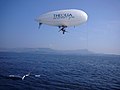
[edit]In 2008, French adventurer Stephane Rousson attempted to cross the English Channel with a muscular pedal powered airship.[152][153][154]
Stephane Rousson also flies the Aérosail, a sky sailing yacht.[155][156][157]
-
 Aerosail
 -
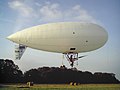 Mlle Louise pedal Airship by Stephane Rousson
 -
 Zeppy 3 by Stephane Rousson
 -
 Zeppy One


Current design projects
[edit] | This section needs additional citations for verification. (June 2008) |

Today, with large, fast, and more cost-efficient fixed-wing aircraft and helicopters, it is unknown whether huge airships can operate profitably in regular passenger transport though, as energy costs rise, attention is once again returning to these lighter-than-air vessels as a possible alternative. At the very least, the idea of comparatively slow, "majestic" cruising at relatively low altitudes and in comfortable atmosphere certainly has retained some appeal. There have been some niches for airships in and after World War II, such as long-duration observations, antisubmarine patrol, platforms for TV camera crews, and advertising; these generally require only small and flexible craft, and have thus generally been better fitted for cheaper (non-passenger) blimps.
Heavy lifting and buoyancy compensation
[edit]
It has periodically been suggested that airships could be employed for cargo transport, especially delivering extremely heavy loads to areas with poor infrastructure over great distances. This has also been called roadless trucking.[158] Also, airships could be used for heavy lifting over short distances (e.g. on construction sites); this is described as heavy-lift, short-haul.[159] In both cases, the airships would be heavy haulers.
The old Zeppelins already faced the challenge of gaining buoyancy when large amounts of fuel were burnt on long trips, often intercontinental. Letting go lifting gas would be an expensive option. Another idea was to pick up water as ballast, from the sea, or from exhaust fumes. A third was using a kind of lift gas that could be burnt, like Blau gas, as a Buoyancy compensator (aviation). The matter is even worse when heavy freight is delivered.
One recent (1996 to 2002) enterprise of this sort was the German Cargolifter project, in which a hybrid (thus not entirely Zeppelin-type) airship even larger than Hindenburg was projected. Around 2000, CargoLifter AG built the world's largest self-supporting hall, measuring 360 m (1,180 ft) long, 210 m (690 ft) wide and 107 m (351 ft) high about 60 km (37 mi) south of Berlin. In May 2002, the project was stopped for financial reasons; the company had to file bankruptcy. The enormous CargoLifter hangar was later converted to house the Tropical Islands Resort.[160] Cargolifter had intended to replace its cargo upon delivery with water-filled containers of the same weight.
Although no rigid airships are currently used for heavy lifting, hybrid airships are being developed for such purposes. AEREON 26, tested in 1971, was described in John McPhee's The Deltoid Pumpkin Seed. Flying Whales is a French aeronautic start-up developing an airship for transporting heavy loads.
An impediment to the large-scale development of airships as heavy haulers has been figuring out how they can be used in a cost-efficient way. In order to have a significant economic advantage over ocean transport, cargo airships must be able to deliver their payload faster than ocean carriers but more cheaply than airplanes. William Crowder, a fellow at the Logistics Management Institute, has calculated that cargo airships are only economical when they can transport 500 to 1,000 tons, approximately the same as a super-jumbo aircraft.[160] The large initial investment required to build such a large airship has been a hindrance to production, especially given the risk inherent in a new technology. The chief commercial officer of the company hoping to sell the LMH-1, a cargo airship currently being developed by Lockheed Martin, believes that airships can be economical in hard-to-reach locations such as mining operations in northern Canada that currently require ice roads.[160]
Metal-clad airships
[edit]A metal-clad airship has a very thin metal envelope, rather than the usual fabric. The shell may be either internally braced or monocoque as in the ZMC-2, which flew many times in the 1920s, the only example ever to do so. The shell may be gas-tight as in a non-rigid blimp, or the design may employ internal gas bags as in a rigid airship. Compared to a fabric envelope the metal cladding is expected to be more durable.
Hybrid airships
[edit]A hybrid airship is a general term for an aircraft that combines characteristics of heavier-than-air (aeroplane or helicopter) and lighter-than-air technology. Examples include helicopter/airship hybrids intended for heavy lift applications and dynamic lift airships intended for long-range cruising. Most airships, when fully loaded with cargo and fuel, are usually ballasted to be heavier than air, and thus must use their propulsion system and shape to create aerodynamic lift, necessary to stay aloft. All airships can be operated to be slightly heavier than air at periods during flight (descent). Accordingly, the term "hybrid airship" refers to craft that obtain a significant portion of their lift from aerodynamic lift or other kinetic means.
For example, the Aeroscraft is a buoyancy assisted air vehicle that generates lift through a combination of aerodynamics, thrust vectoring and gas buoyancy generation and management, and for much of the time will fly heavier than air. Aeroscraft is Worldwide Aeros Corporation's continuation of DARPA's now cancelled Walrus HULA (Hybrid Ultra Large Aircraft) project.[161]
The Patroller P3 hybrid airship developed by Advanced Hybrid Aircraft Ltd, BC, Canada, is a relatively small (85,000 cu ft / 2,400 m3) buoyant craft, manned by the crew of five and with the endurance of up to 72 hours. The flight-tests with the 40% RC scale model proved that such a craft can be launched and landed without a large team of strong ground-handlers.[162] Design features a special "winglet" for aerodynamic lift control.[163]
Airships in space exploration
[edit]
Airships have been proposed as a potential cheap alternative to surface rocket launches for achieving Earth orbit. JP Aerospace have proposed the Airship to Orbit project, which intends to float a multi-stage airship up to mesospheric altitudes of 55 km (180,000 ft) and then use ion propulsion to accelerate to orbital speed.[164] At these heights, air resistance would not be a significant problem for achieving such speeds. The company has not yet built any of the three stages.
NASA has proposed the High Altitude Venus Operational Concept, which comprises a series of five missions including crewed missions to the atmosphere of Venus in airships.[165][166][167][168] Pressures on the surface of the planet are too high for human habitation, but at a specific altitude the pressure is equal to that found on Earth and this makes Venus a potential target for human colonization.
Hypothetically, there could be an airship lifted by a vacuum—that is, by material that can contain nothing at all inside but withstand the atmospheric pressure from the outside. It is, at this point, science fiction, although NASA has posited that some kind of vacuum airship could eventually be used to explore the surface of Mars.[169]
Cruiser feeder transport airship
[edit]EU FP7 MAAT Project[170] has studied an innovative cruiser/feeder airship system,[171] for the stratosphere with a cruiser remaining airborne for a long time and feeders connecting it to the ground and flying as piloted balloons.[172]
Airships for humanitarian and cargo transport
[edit]Google co-founder Sergey Brin founded LTA Research in 2015 to develop airships for humanitarian and cargo transport. The company's 124-meter-long airship Pathfinder 1 received from the FAA a special airworthiness certificate for the helium-filled airship in September 2023.[173][174]
The certificate allowed the largest airship since the ill-fated Hindenburg to begin flight tests at Moffett Field, a joint civil-military airport in Silicon Valley.
Comparison with heavier-than-air aircraft
[edit]The advantage of airships over aeroplanes is that static lift sufficient for flight is generated by the lifting gas and requires no engine power. This was an immense advantage before the middle of World War I and remained an advantage for long-distance or long-duration operations until World War II. Modern concepts for high-altitude airships include photovoltaic cells to reduce the need to land to refuel, thus they can remain in the air until consumables expire. This similarly reduces or eliminates the need to consider variable fuel weight in buoyancy calculations.
The disadvantages are that an airship has a very large reference area and comparatively large drag coefficient, thus a larger drag force compared to that of aeroplanes and even helicopters. Given the large frontal area and wetted surface of an airship, a practical limit is reached around 130–160 kilometres per hour (80–100 mph), only about one-third the typical airspeed of a modern commercial airplane. Thus, airships are used where speed is not critical.
The lift capability of an airship is equal to the buoyant force minus the weight of the airship. This assumes standard air-temperature and pressure conditions. Corrections are usually made for water vapor and impurity of lifting gas, as well as percentage of inflation of the gas cells at liftoff.[175] Based on specific lift (lifting force per unit volume of gas), the greatest static lift is provided by hydrogen (11.15 N/m3 or 71 lbf/1000 cu ft) with helium (10.37 N/m3 or 66 lbf/1000 cu ft) a close second.[176]
In addition to static lift, an airship can obtain a certain amount of dynamic lift from its engines. Dynamic lift in past airships has been about 10% of the static lift. Dynamic lift allows an airship to "take off heavy" from a runway similar to fixed-wing and rotary-wing aircraft. This requires additional weight in engines, fuel, and landing gear, negating some of the static lift capacity.
The altitude at which an airship can fly largely depends on how much lifting gas it can lose due to expansion before stasis is reached. The ultimate altitude record for a rigid airship was set in 1917 by the L-55 under the command of Hans-Kurt Flemming when he forced the airship to 7,300 m (24,000 ft) attempting to cross France after the "Silent Raid" on London. The L-55 lost lift during the descent to lower altitudes over Germany and crashed due to loss of lift.[177] While such waste of gas was necessary for the survival of airships in the later years of World War I, it was impractical for commercial operations, or operations of helium-filled military airships. The highest flight made by a hydrogen-filled passenger airship was 1,700 m (5,500 ft) on the Graf Zeppelin's around-the-world flight.[178]
The greatest disadvantage of the airship is size, which is essential to increasing performance. As size increases, the problems of ground handling increase geometrically.[179] As the German Navy changed from the P class of 1915 with a volume of over 31,000 m3 (1,100,000 cu ft) to the larger Q class of 1916, the R class of 1917, and finally the W class of 1918, at almost 62,000 m3 (2,200,000 cu ft) ground handling problems reduced the number of days the Zeppelins were able to make patrol flights. This availability declined from 34% in 1915, to 24.3% in 1916 and finally 17.5% in 1918.[180]
So long as the power-to-weight ratios of aircraft engines remained low and specific fuel consumption high, the airship had an edge for long-range or -duration operations. As those figures changed, the balance shifted rapidly in the aeroplane's favour. By mid-1917, the airship could no longer survive in a combat situation where the threat was aeroplanes. By the late 1930s, the airship barely had an advantage over the aeroplane on intercontinental over-water flights, and that advantage had vanished by the end of World War II.
This is in face-to-face tactical situations. Currently, a high-altitude airship project is planned to survey hundreds of kilometres as their operation radius, often much farther than the normal engagement range of a military aeroplane.[clarification needed] For example, a radar mounted on a vessel platform 30 m (100 ft) high has radio horizon at 20 km (12 mi) range, while a radar at 18,000 m (59,000 ft) altitude has radio horizon at 480 km (300 mi) range. This is significantly important for detecting low-flying cruise missiles or fighter-bombers.
Safety
[edit]The most commonly used lifting gas, helium, is inert and therefore presents no fire risk.[181] A series of vulnerability tests were done by the UK Defence Evaluation and Research Agency DERA on a Skyship 600. Since the internal gas pressure was maintained at only 1–2% above the surrounding air pressure, the vehicle proved highly tolerant to physical damage or to attack by small-arms fire or missiles. Several hundred high-velocity bullets were fired through the hull, and even two hours later the vehicle would have been able to return to base. Ordnance passed through the envelope without causing critical helium loss. The results and related mathematical model have presented in the hypothesis of considering a Zeppelin NT size airship.[182] In all instances of light armament fire evaluated under both test and live conditions, the airship was able to complete its mission and return to base.[183]
Licensing
[edit]In the United Kingdom, the basic pilot licence for airships is the PPL(As), or private pilot licence, which requires a minimum of 35 hours instruction on airships.[184] To fly commercially, a Commercial Pilot Licence (Airships) is required.
See also
[edit]
- Airborne aircraft carrier
- Aircruise
- Airship hangar
- Barrage balloon
- Conrad Airship CA 80 (1975–1977)
- Evolutionary Air and Space Global Laser Engagement
- High-altitude platform station
- Hyperion, fictional airship type.
- List of airship accidents
- List of British airships
- List of current airships in the United States
- List of Zeppelins
- Mystery airship
- SVAM CA-80
- Worldwide Aeros Corp
- Zeppelin mail
Notes
[edit]- ^ A few airships after World War II still used hydrogen. The first British airship to use helium was the Chitty Bang Bang of 1967.
References
[edit]Citations
[edit]- ^ "Definition of AIRSHIP". merriam-webster.com. Retrieved 4 October 2016.
- ^ "Discovery of Helium in Natural Gas at the University of Kansas". National Historic Chemical Landmarks. American Chemical Society. Retrieved 2014-02-21.
- ^ a b c d Ege (1973).
- ^ Mowthorpe, C. E. S. Battlebags, British Airships of the First World War, Phoenix Mill, United Kingdom. Alan Sutton Publishing, 1995, p. xx. ISBN 0-7509-0989-7.
- ^ "Online Etymology Dictionary". EtymOnline.com. Retrieved 2016-09-04.
- ^ US patent 467069 "Air-ship" referring to a compound aerostat/rotorcraft.
- ^ Ezekiel Airship (1902) wright-brothers.orgaltereddimensions.net Archived 2014-02-22 at the Wayback Machine "airship" – referring to an HTA aeroplane.
- ^ The Bridgeport Herald, August 18, 1901 Archived August 3, 2013, at the Wayback Machine – "air ship" referring to Whitehead's aeroplane.
- ^ Cooley Airship of 1910, also called the Cooley monoplane.[1]"Round Aircraft Designs". Archived from the original on 2012-04-02. Retrieved 2011-09-07. – a heavier-than-air monoplane.
- ^ Frater, A.; The Balloon Factory, Picador (2009), p. 163 – Wright brothers' "airship".
- ^ George Griffith, The angel of the Revolution, 1893 Archived 2014-02-22 at the Wayback Machine – "air-ship", "vessel" referring to a VTOL compound rotorcraft (not clear from the reference if it might be an aerostat hybrid).
- ^ Auckland Star, 24 February 1919 "Ships of the air", "Air yachts" – passenger landplanes large and small
- ^ The Sydney Morning Herald, Monday 11 April 1938 – "ship of the airs", "flying-ship", referring to a large flying-boat.
- ^ Smithsonian, America by air Archived 2014-01-18 at the Wayback Machine "Ships of the Air" referring to Pan Am's Boeing Clipper flying-boat fleet.
- ^ Liao, L., & Pasternak, I. (2009). "A review of airship structural research and development". Progress in Aerospace Sciences, 45(4), 83–96.
- ^ Tuckerman, Louis Bryant Jr. (January 1, 1926). "Inertia Factors of Ellipsoids for Use in Airship Design" (PDF). National Advisory Committee for Aeronautics – via ntrs.nasa.gov.
- ^ "Home: Oxford English Dictionary". Retrieved 2018-01-18.
- ^ a b Ince, A. Nejat; Topuz, Ercan; Panayirci, Erdal (1998). Principles of Integrated Maritime Surveillance Systems. New York: Springer Science + Business Media, LLC. pp. 204. ISBN 978-1-4613-7404-6.
- ^ Brewin, Bob. "Giant Aerostats Developed For Rural Cell Phone Service". Computerworld. Retrieved 2018-08-29.
- ^ Ryan, Michael; Frater, Michael (2002). Tactical Communications for the Digitized Battlefield. Boston, Massachusetts: Artech House. pp. 315. ISBN 978-1-58053-323-2.
- ^ Handwerk, Brian (2013-06-18). "Google's Loon Project Puts Balloon Technology in Spotlight". Archived from the original on June 20, 2013. Retrieved 2018-08-29.
- ^ El-Sayed, Ahmed F. (2016). Fundamentals of Aircraft and Rocket Propulsion. Springer. ISBN 978-1-4471-6796-9.
- ^ Wragg, D; Historical Dictionary of Aviation, History Press (2008) p. 27.
- ^ Mackinnon, Jim, "Piece by piece, Goodyear's new airship arrives at Wingfoot hangar", September 6, 2012, updated September 7, 2012, Akron Beacon Journal, Akron, Ohio (Goodyear blimps' base), retrieved June 28, 2021
- ^ Cf. Zeppelin NT.
- ^ de Syon, Guillaume (2002). Zeppelin!: Germany and the airship, 1900–1939. JHU Press. ISBN 978-0-8018-8634-8.
- ^ Hartcup, Guy (1974). The Achievement of the Airship: A History of the Development of Rigid, Semi-rigid, and Non-rigid Airships. David & Charles. ISBN 978-0-7153-6551-9.
- ^ Buerge, B. T. (2009). "The Suitability of Hybrid vs. Conventional Airships for Persistent Surveillance Missions" (PDF). Unpublished report from Dr. Charles Perkins. Archived from the original (PDF) on 2016-09-24. Retrieved 2016-09-24.
- ^ Prentice, B. E.; Beilock, R. E.; Phillips, A. J.; Thomson, J. (October 2010). "The Rebirth of Airships". Journal of the Transportation Research Forum. 44 (1).
- ^ Brooks, Peter (1992). Zeppelin: Rigid Airships, 1893-1940.
- ^ NAS Grosse Ile Archived 2011-07-09 at the Wayback Machine, NASGIVM. 2006.
- ^ "Von Karman, Theodor. "Calculation of pressure distribution on airship hulls." (1930)" (PDF).
- ^ a b Wilkinson, Stephen; Gerth, Florian (2024). "A Review of the Sustainability of Helium: An Assessment of Its Past, Present and a Zero-Carbon Future". Regional Science and Environmental Economics. 1 (1): 78–103. doi:10.3390/rsee1010006. ISSN 3042-4658.
- ^ Freudenrich, Craig. "How Blimps Work". HowStuffWorks. Retrieved 2023-10-18.
- ^ "Jane's All the World's Aircraft 1980–81", pp. 609–610
- ^ a b c Brew, Alec (1998). Sunbeam Aero-engines. Airlife. pp. 41, 43, 92. ISBN 1-84037-023-8.
- ^ "Hydrogen and Helium in Airship Operations".
- ^ Colozza, Anthony; Dolce, James (December 1, 2003). Initial Feasibility Assessment of a High Altitude Long Endurance Airship (PDF) (Contractor Report NASA/CR—2003-212724). National Aeronautics and Space Administration Glenn Research Center – via ntrs.nasa.gov.
- ^ Miller, Gerry D.; Stoia, Tina R.; Harmala, Devin A.; Atreya, Shailesh (2005-09-26). Operational Capability of High Altitude Solar Powered Airships. AIAA 5th ATIO and 16th Lighter-Than-Air Systems Tech. and Balloon Systems Conferences. Vol. AIAA Paper, 7487. American Institute of Aeronautics and Astronautics. doi:10.2514/6.2005-7487. ISBN 978-1-62410-067-3.
- ^ "Solar-powered Future: Airships are making a comeback". Big Think. 2019-10-16. Retrieved 2019-12-08.
- ^ Dormehl, Luke (8 October 2019). "Zeppelins could make a comeback with this solar-powered airship cargo mover". Retrieved 13 October 2021.
- ^ Hunt, Julian David; Byers, Edward; Balogun, Abdul-Lateef; Leal Filho, Walter; Colling, Angeli Viviani; Nascimento, Andreas; Wada, Yoshihide (2019-09-01). "Using the jet stream for sustainable airship and balloon transportation of cargo and hydrogen". Energy Conversion and Management: X. 3 100016. Bibcode:2019ECMX....300016H. doi:10.1016/j.ecmx.2019.100016. ISSN 2590-1745.
- ^ "Filling the Friendly Skies With Hot Air". Bloomberg.com. 10 March 2019. Retrieved 2019-12-08.
- ^ "Francesco Lana-Terzi, S.J. (1631–1687); The Father of Aeronautics". Archived from the original on 24 April 2021. Retrieved 24 July 2010.
- ^ "Would a balloon filled with vacuum instead of helium float?". April 2000. Retrieved 24 July 2010.
- ^ "Chronology of Aviation History from 1700 to 1799". www.skytamer.com. Retrieved 2021-02-20.
- ^ "Science Source Stock Photos & Video – Passarola, Bartolomeu de Gusmao's Airship, 1709". www.sciencesource.com. Retrieved 2021-02-20.
- ^ Louro, F.V.; Melo De Sousa, Joao M. (2014-01-10). Father Bartholomeu Lourenço de Gusmão: a Charlatan or the First Practical Pioneer of Aeronautics in History. 52nd Aerospace Sciences Meeting. Reston, Virginia: American Institute of Aeronautics and Astronautics. doi:10.2514/6.2014-0282. ISBN 978-1-62410-256-1. OCLC 1237189987.
- ^ Winter & Degner (1933), pp. 26–27.
- ^ McPherson, Gregg (2010) Rufus Porter and the Dream of Flight Technology Almanac
- ^ "Airship Honours for Australia. – Bland's Remarkable Invention More Than 70 Years Ago. – The Argus (Melbourne, Vic.: 1848–1957) – 13 Sep 1924". nla.gov.au. 13 September 1924. Retrieved 4 October 2016.
- ^ "Visions of a flying machine". National – smh.com.au. 11 May 2006. Retrieved 4 October 2016.
- ^ Winter & Degner (1933), p. 36.
- ^ Glazer, Stephen D. "Rutgers in the Civil War", Journal of the Rutgers University Libraries Vol. 66 (2014), p. 102
- ^ Brooks 1992 p. 19.
- ^ Winter & Degner (1933), p. 44.
- ^ a b c Bento S. Mattos, Short History of Brazilian Aeronautics Archived 2013-07-26 at the Wayback Machine (PDF), 44th AIAA Aerospace Sciences Meeting and Exhibit, Reno, Nevada, 9–12 January 2006.
- ^ Hendrick, Bill (August 11, 2012). "First in flight – a case for Georgian". The Atlanta Journal-Constitution. Retrieved December 29, 2020.
- ^ "Patent Images". uspto.gov. Retrieved 4 October 2016.
- ^ "Micajah dyee". google.com. Retrieved 4 October 2016.
- ^ "Georgia: First in Flight?". therevivalist.info. 9 March 2014. Retrieved 4 October 2016.
- ^ July 31, 1875 article in the Gainesville (Georgia) Eagle
- ^ "Georgia's Pioneer Aviator, Micajah Clark Dyer – From A Leading Self Publishing Company". yourbook.com. Retrieved 4 October 2016.
- ^ Winter & Degner (1933), pp. 49–50.
- ^ "Scientific American – 27 July 1889". Archived from the original on May 12, 2011.
- ^ Brooks 1992 p. 20.
- ^ Mercedes-Benz Museum (Trip II): The beginning, gminsidenews.com, 2007.
- ^ Member's Circular Letter February 2008, Archived February 27, 2012, at the Wayback Machine zeppelin-tourismus.de.
- ^ Brooks 1992 pp. 27–31.
- ^ Bill Welker. Airships of Konstantin Danilewsky. Then-and-Now project, publication January 2018
- ^ (2019) AirBike...1897. Ed. by A. B. Akimov and W. J. Welker. Sapphire Publications, US, 342 p. ISBN 978-1-62374-015-3 (Digital edition) Free download. Late 1800s work of Dr. Konstantin Dalilewsky to solve the problem of human flight presented for the first time in English. Including reproduction of the original Russian and German 1900 editions.
- ^ Niccoli, R. The Book of Flight: From the flying machines of Leonardo da Vinci to the conquest of space, New York, Friedman/Fairfax, 2002, p. 24. ISBN 978-1-58663-716-3
- ^ Toland (1957), pp. 25–37.
- ^ Papers Past – Christchurch Star, 31 December 1903, Ways of Airships (p. 2)
- ^ Toland (1957), pp. 49–51.
- ^ "La dirección de globos y un inventor español". La Época. 1902.
- ^ Francisco A. González Redondo. Leonardo Torres Quevedo, 1902–1908. The Foundations for 100 years of Airship designs In book: Proceedings of the 7th International Airship Convention, pp. 1–12, Publisher: German Society for Aeronautics and Astronautics (DGLR), October 2008.
- ^ Francisco A. González Redondo (2019). "Leonardo Torres Quevedo: Ingeniero, Matemático, Inventor" (PDF). Revista de la Asociación Española de Ensayos No Destructivos.
- ^ Ambrose Talbot, Frederick Arthur (2020). "Airships of War". Aeroplanes and Dirigibles of War. Prabhat Prakashan. pp. 30–32. ISBN 978-81-8430-501-2.
- ^ Whale, George (2013). "Airship design". British Airships – Past, Present And Future. Read Books Ltd. ISBN 978-1-4733-9152-9.
- ^ Starkings, Peter. "Japanese Military Airships 1910–1945". Retrieved 8 September 2015.
- ^ Francisco A. González Redondo. The Mooring Mast: History and Controversy, pp. 12–17, The Airship Heritage Trust (1753-2175): No. 69, 2013.
- ^ González-Redondo, F.; Camplin, G. (2015). The Controversial Origins of the Mooring Mast for Airships: An Historical Overview of a Neglected Branch of Aeronautical Technology that has Great Potential for Future Use. International Committee for the History of Technology. pp. 81–108.
- ^ (see Fig.1)
- ^ Lueger 1920, pp. 404–412, Luftschiff
- ^ Ligugnana, Sandro
- ^ "Death of the aeronaut Auguste Severo and his mechanic George Sache". lookandlearn.com. Retrieved 4 October 2016.
- ^ "La belle époque. 1890–1905". e-monsite.com. Archived from the original on 5 October 2016. Retrieved 4 October 2016.
- ^ With the Dirigibles at TripoliFlight 30 March 1912
- ^ Ventry & Koesnik (1982), p. 85.
- ^ Robinson (1973), pp. 126–127.
- ^ Robinson 1994, p. 360.
- ^ Cole, Christopher and Cheesman, E. F. The Air Defence of Great Britain 1914–1918. London: Putnam, 1984. ISBN 0-370-30538-8. p. 449
- ^ Robinson (1994), pp. 340–341.
- ^ Higham (1961), p. 111.
- ^ Mowthorpe, Ces, Battlebags, Stroud, Gloucs, Allan Sutton Publishing, 1995, p. xxiii.
- ^ Patrick Abbott and Nick Walmsley, British Airships in Pictures: An Illustrated History, House of Lochar 1998, ISBN 1-899863-48-6 (pp. 59–69)
- ^ Ventry & Koesnik (1982), p. 97.
- ^ Higham (1961), p. 138.
- ^ "Rigid Airships". U.S. Naval Institute. 1921-10-01. Retrieved 2025-07-07.
British talent has contributed a number of advancements to the art
- ^ a b Higham (1961), p. 176.
- ^ Hitchens, Frank (2023). Pioneer Aviators: ...and the Planes They Flew. Andrews UK Limited. p. 272. ISBN 978-1-83791-189-9.
- ^ "Navy's First Dirigible Meets Disaster". Popular Mechanics. Vol. 25, no. 6. June 1916. p. 819. Retrieved 4 October 2016 – via Google Books.
- ^ Higham 1961, pp. 222–223.
- ^ Swanborough, G. and Bowyers, P. M. United States Navy Aircraft Since 1912. London: Putnam, 1976 (2nd ed.) ISBN 0851778380, p. 586
- ^ Althoff, William F., USS Los Angeles, Washington DC, Brassey's, 2004, p. 48, ISBN 1-57488-620-7
- ^ Countryman, Barry, R100 in Canada, Erin, Ontario, Boston Mills, 1982, ISBN 0-919822-36-3
- ^ Botting, Douglas, Dr. Eckener's Dream Machine. New York: Henry Hold, 2001. ISBN 0-8050-6458-3
- ^ Smith (1965), pp. 171–174.
- ^ Smith (1965), pp. 157–161.
- ^ Lienhard, John H. (2010). "Intercity Dirigible Service". The Engines of Our Ingenuity (Podcast). No. 2571.
- ^ Botting, Douglas, Dr. Eckener's Dream Machine. New York, Henry Hold, 2001, p. 235, ISBN 0-8050-6458-3
- ^ Dick, Harold G., with Robinson, Douglas H., Graf Zeppelin & Hindenburg, Washington DC, Smithsonian Institution Press, 1985, p. 83, ISBN 0-87474-364-8
- ^ Theodore Richard, Reconsidering the Letter of Marque: Utilizing Private Security Providers Against Piracy (April 1, 2010). Public Contract Law Journal, Vol. 39, No. 3, pp. 411–464 at 429 n. 121, Spring 2010. Available at SSRN
- ^ Vaeth (1992), pp. 20–21.
- ^ a b Vaeth, J. Gordon (1992). Blimps & U-Boats. Annapolis, Maryland: U.S. Naval Institute Press. ISBN 1-55750-876-3.
- ^ U.S. Navy LTA history.
- ^ U-134 history, Uboat.net.
- ^ Kaiser, Don (2011). "K-Ships Across the Atlantic" (PDF). Naval Aviation News. Vol. 93, no. 2. pp. 20–23. Archived from the original (PDF) on 2015-02-17. Retrieved 2013-06-19.
- ^ "The Journal of the Airship Heritage Trust - Dirigible" (PDF). Airship Heritage Trust. p. 15.
- ^ a b "The Journal of the Airship Heritage Trust - Dirigible" (PDF). Airship Heritage Trust. p. 17.
- ^ Atomic Airships by John J. Geoghegan. Originally published in the January 2013 issue of Aviation History magazine.
- ^ The Zeppelin in the Atomic Age: The Past, Present, and Future of the Rigid Lighter-Than-Air Aircraft, Kirschner, Edwin J. Published by University of Illinois Press (1957)
- ^ Jurich, Leo (1 January 1960). "The Nuclear Powered Airship". SAE Mobilus. SAE Technical Paper Series. 1 600278. SAE International. doi:10.4271/600278.
- ^ "IMDb". IMDb.
- ^ Thermal Airships Archived October 3, 2013, at the Wayback Machine, Lindstrand Technologies.
- ^ "Navy Awards Blimp Order". The New York Times. Reuters. 6 June 1987. Archived from the original on 15 December 2007. Retrieved 6 November 2007.
- ^ Lambert, Mark, ed. (1992). Jane's All the World's Aircraft 1992–93. Janes Information Group. ISBN 0-7106-0987-6.
- ^ "Model CA-80 Non-rigid Airship". Shanghai Vantage Airship Manufacture Co., Ltd. 2000. Archived from the original on 2016-03-03.
- ^ "Aerial Advertising & Airplane Banner Towing". www.airsign.com.
- ^ "Worldwide Aeros Corp".
- ^ "CA-150 型软式载人飞艇" [CA-150 Non-rigid Manned Airship]. Shanghai Vantage Airship Manufacture Co., Ltd.
- ^ "Protesters Launch a 135-Foot Blimp Over the NSA's Utah Data Center". slashdot.org. 27 June 2014. Retrieved 4 October 2016.
- ^ Greenberg, Andy. "Protestors Launch a 135-Foot Blimp Over the NSA's Utah Data Center". wired.com. Retrieved 4 October 2016.
- ^ "Contractors for Walrus Program announced" Archived 2016-02-06 at the Wayback Machine, press release, Defense Advanced Research Projects Agency, 26 August 2005.
- ^ "US CBO Gives OK to HULA Airships for Airlift", Defense Industry Daily, 21 October 2005.
- ^ WALRUS Hunted to Extinction By Congress, DARPA?, Defense Industry Daily, 4 April 2006
- ^ "The Difference Engine: Not all hot air", The Economist, July 29, 2010
- ^ "Photo Release – Northrop Grumman Awarded $517 Million Agreement for US Army Airship With Unblinking Eye" Archived June 23, 2010, at the Wayback Machine, Northrop Grumman, June 14, 2010, access date July 29, 2010
- ^ "250-Foot Long Hybrid Airship Will Spy Over Afghanistan Battlefields in 2011". Gizmodo. 2009-09-23. Archived from the original on 2010-11-11. Retrieved 2010-07-29.
- ^ "InsideDefense.com – February 13, 2013: Army Deflates LEMV Airship; Cost And Schedule Cited". Archived from the original on March 20, 2013.
- ^ "Massive new Airship to enter commercial service at British dirigible base". The Register.
- ^ "Longest aircraft in crash repair tests". BBC News. 4 February 2017.
- ^ "Vers un retour du dirigeable pour les missions de surveillance maritime?" (in French). Mer et Marine. 2011-10-17. Retrieved 2012-11-15.
- ^ "HALE-D Short B-Roll". YouTube. 2011-07-27. Archived from the original on 2011-08-04. Retrieved 2012-11-15.
- ^ "Lockheed Martin's HALE-D airship learns to fly, makes a crash landing". Engadget. 28 July 2011. Retrieved 2012-11-15.
- ^ "Lockheed Martin blimp goes down". WEWS NewsChannel5. 2011-07-27. Archived from the original on 2021-10-31. Retrieved 2012-11-15.
- ^ "Lockheed Martin High Altitude Airship's Maiden Voyage Aborted". The Lighter Than Air Society. Retrieved 2014-04-06.
- ^ Bowley, Graham (2012-05-12). "In Afghanistan, Spy Balloons Now Part of Landscape". The New York Times. ISSN 0362-4331. Retrieved 2019-12-09.
- ^ FAA Docket FAA-2006-25714 Archived June 20, 2007, at the Wayback Machine, Federal Aviation Authority.
- ^ "Pedal-power Channel pioneer is beaten by a breeze". TheGuardian.com. 28 September 2008.
- ^ Smyth, Chris. "Stephane Rousson fails in attempt at first channel crossing by pedal powered airship".
- ^ "French cyclist to attempt channel crossing on pedal-powered airship". May 2008.
- ^ "Stéphane Rousson: Aerosail: motorless zeppelin *photos*". Redbull.com. 2 August 2016. Retrieved 2022-02-28.
- ^ "Stéphane Rousson, ce " merveilleux fou volant dans ses drôles de machines " entre ciel et mer". 9 July 2019.
- ^ "Le Niçois Stéphane Rousson prêt à faire décoller l'aerosail de Monaco". 27 March 2015.
- ^ "Roadless trucking" Archived May 23, 2009, at the Wayback Machine, Dynalifter.
- ^ "Boeing and SkyHook International to Build JHL-40 Heavy-Lift Rotorcraft", press release, 8 July 2008.
- ^ a b c Laskas, Jeanne Marie (2016-02-29). "Helium Dreams". The New Yorker. ISSN 0028-792X. Retrieved 2016-03-08.
- ^ "Aeroscraft.com". Retrieved 24 July 2010.
- ^ Vollrath, Jurgen. [2] From the Hindenburg airship to the Goodyear Blimp – and now Hybrid Aircraft. Exponential Technology Counsel, Episode 39, 2016
- ^ Blake, Bruce. [3] Patroller 3 hybrid aircraft. Onboard System specifications. AHA Ltd web-publication. January, 2017
- ^ "Airship to Orbit" (PDF).
- ^ "HAVOC". 14 June 2022.
- ^ "A way to explore Venus". YouTube. 10 October 2014. Archived from the original on 2021-10-31.
- ^ "NASA concept would send astronauts to Venus". 20 December 2014.
- ^ "NASA's floating 'habitat' above Venus?". CNN.
- ^ Ling, Justin (12 January 2024). "The Age of the Airship May Be Dawning Again".
- ^ "Multibody Advanced Airship for Transport | MAAT | Project | Fact Sheet | FP7". CORDIS | European Commission.
- ^ Dumas A, Trancossi M, Madonia M, Giuliani I. Multibody advanced airship for transport. SAE Technical Paper; 2011 Oct 18. https://www.researchgate.net/profile/Michele_Trancossi/publication/257333742_Multibody_Advanced_Airship_for_Transport/links/55d44d6708ae7fb244f5b3ac/Multibody-Advanced-Airship-for-Transport.pdf
- ^ Trancossi M, Dumas A, Cimarelli A, Pascoa J. MAAT cruiser/feeder airship design: Intrinsic stability and energetic flight model. In ASME IMECE 2015 Nov 13 (Vol. 57342, p. V001T01A011). https://www.researchgate.net/profile/Michele_Trancossi/publication/311131309_MAAT_CruiserFeeder_Airship_Design_Intrinsic_Stability_and_Energetic_Flight_Model/links/583ea40408ae8e63e617b3f9/MAAT-Cruiser-Feeder-Airship-Design-Intrinsic-Stability-and-Energetic-Flight-Model.pdf
- ^ Harris, Mark (25 October 2023). "EXCLUSIVE: Google Founder's Airship Gets FAA Clearance Sergey Brin's Pathfinder 1 can now take to the skies". IEEE Spectrum. Retrieved 26 October 2023.
- ^ Hall, Laura (13 December 2024). "Could the airship be the answer to sustainable air travel". BBC. Retrieved 15 December 2024.
- ^ Ausrotas, R. A., "Basic Relationships for LTA Technical Analysis", MIT Flight Transportation Library, 1975
- ^ Layton, D. M., Basic Aerostatics – A Tutorial, 1985
- ^ Robinson (1994), p. 294.
- ^ "Honors to Dr. Hugo Eckener: The First Airship Flight Around the World", National Geographic, Vol. LVII, No. 6, June 1930, p. 679.
- ^ Brooks 1992 pp. 7–8
- ^ Robinson (1994), p. 373.
- ^ Stwertka, Albert, Guide to the Elements: Revised Edition. New York; Oxford University Press, 1998, p. 24. ISBN 0-19-512708-0
- ^ Trancossi M, Pascoa J, Cannistraro G. "Safety Analysis of an Airship Which Loses Lifting Gas from the Hull". SAE Technical Paper; 2018 October 30.
- ^ High Safety Level (p. 5) and Structural Vulnerability Tests (p. 7). World Skycat. Retrieved 25 April 2008.
- ^ "PPL (As) requirements". CAA.co.uk. United Kingdom Civil Aviation Authority. Retrieved 14 May 2023.
Bibliography
[edit]- Althoff, William F., USS Los Angeles: The Navy's Venerable Airship and Aviation Technology, 2003, ISBN 1-57488-620-7
- Ausrotas, R. A., "Basic Relationships for LTA Technical Analysis," Proceedings of the Interagency Workshop on Lighter-Than-Air Vehicles, Massachusetts Institute of Technology Flight Transportation Library, 1975
- Archbold, Rich and Ken Marshall, Hindenburg, an Illustrated History, 1994 ISBN 0-446-51784-4
- Bailey, D. B., and Rappoport, H. K., Maritime Patrol Airship Study, Naval Air Development Center, 1980
- Botting, Douglas, Dr. Eckener's Dream Machine. New York Henry Hold and Company, 2001, ISBN 0-8050-6458-3
- Brooks, Peter W. (1992). Zeppelin: Rigid Airships 1893–1940. Washington: Smithsonian Institution Press. ISBN 1-56098-228-4.
- Brooks, Peter W. (2004). Zeppelin: Rigid Airships 1893–1940. Putnam Aeronautical Books. ISBN 0-85177-845-3.
- Burgess, Charles P., Airship Design, (1927) 2004 ISBN 1-4102-1173-8
- Cross, Wilbur, Disaster at the Pole, 2002 ISBN 1-58574-496-4
- Dick, Harold G., with Robinson, Douglas H., Graf Zeppelin & Hindenburg, Washington, D.C., Smithsonian Institution Press, 1985, ISBN
- Dooley, Sean C (2004). "Part II: Appendices" (PDF). The Development of Material-Adapted Structural Form (PDF) (PhD). VD, CH: École Polytechnique Fédérale de Lausanne. Archived from the original (PDF) on 2008-06-25.
- Ege, L.; Balloons and Airships, Blandford (1973).
- Frederick, Arthur, et al., Airship saga: The history of airships seen through the eyes of the men who designed, built, and flew them, 1982, ISBN 0-7137-1001-2
- Griehl, Manfred and Joachim Dressel, Zeppelin! The German Airship Story, 1990, ISBN 1-85409-045-3
- Higham, Robin, The British Rigid Airship, 1908–1931: A study in weapons policy, London, G. T. Foulis, 1961, OCLC 830820
- Keirns, Aaron J, "America's Forgotten Airship Disaster: The Crash of the USS Shenandoah", Howard, Little River Publishing, 1998, ISBN 978-0-9647800-5-7.
- Khoury, Gabriel Alexander (Editor), Airship Technology (Cambridge Aerospace Series), 2004, ISBN 0-521-60753-1
- Leasor, James (2001) [1957]. The Millionth Chance: The Story of the R.101. London: Stratus Books. ISBN 978-0-7551-0048-4.
- Ligugnana, Sandro The History — Enrico Formanini and the Officine Leonardo da Vinci, LPVC S.p.A. retrieved on 30 June 2008
- Lueger, Otto (1920). Lexikon der gesamten Technik und ihrer Hilfswissenschaften (in German). Bd1 Stuttgart, Leipzig.
- McKee, Alexander, Ice crash, 1980, ISBN 0-312-40382-8
- Meiklejohn, Bernard (December 1906). "The Conquest of the Air". The World's Work: A History of Our Time. XIII: 8283–10. Retrieved 10 July 2009.
- Morgala, Andrzej, Sterowce w II Wojnie Światowej (Airships in the Second World War), Lotnictwo, 1992 (in Polish)
- Mowthorpe, Ces, Battlebags: British Airships of the First World War, 1995 ISBN 0-905778-13-8
- Nabben, Han (2011). Lichter dan Lucht, los van de aarde. Barneveld, Netherlands: BDU Boeken. ISBN 978-90-8788-151-1. Archived from the original on 2015-09-04.
- Robinson, Douglas H., Giants in the Sky, University of Washington Press, 1973, ISBN 0-295-95249-0
- Robinson, Douglas H., The Zeppelin in Combat: A history of the German Naval Airship Division, 1912–1918, Atglen, PA, Shiffer Publications, 1994, ISBN 0-88740-510-X
- Smith, Richard K. The Airships Akron & Macon: flying aircraft carriers of the United States Navy, Annapolis MD, US Naval Institute Press, 1965, ISBN 978-0-87021-065-5
- Shock, James R., Smith, David R., The Goodyear Airships, Bloomington, Illinois, Airship International Press, 2002, ISBN 0-9711637-0-7
- Sprigg, C., The Airship: Its design, history, operation and future, London 1931, Samson Low, Marston and Company.
- Squier, George Owen (1908). "The Present Status of Military Aeronautics". Annual Report of the Board of Regents of the Smithsonian Institution: 143–144. Retrieved 7 August 2009.
- Toland, John, Ships in the Sky, New York, Henry Hold; London, Muller, 1957, OCLC 2905721
- Vaeth, J. Gordon, Blimps & U-Boats, Annapolis, Maryland, US Naval Institute Press, 1992, ISBN 1-55750-876-3
- Ventry, Lord; Kolesnik, Eugene, Jane's Pocket Book 7: Airship Development, 1976 ISBN 0-356-04656-7
- Ventry, Lord; Koesnik, Eugene M., Airship Saga, Poole, Dorset, Blandford Press, 1982, p. 97 ISBN 0-7137-1001-2
- Winter, Lumen; Degner, Glenn, Minute Epics of Flight, New York, Grosset & Dunlap, 1933. OCLC 738688
- US War Department, Airship Aerodynamics: Technical Manual, (1941) 2003, ISBN 1-4102-0614-9
External links
[edit]

- Should Airships Make a Comeback? – Veritasium YouTube channel
| International | |
|---|---|
| National | |
| Other | |

Airship
View on GrokipediaTerminology
Core Definitions
An airship is a powered, steerable lighter-than-air aircraft that achieves flight through buoyancy provided by a gas lighter than air, such as helium or hydrogen.[1] Unlike unpowered balloons, airships incorporate propulsion and control systems to enable directed navigation, distinguishing them from other aerostats that drift with wind currents.[7] The fundamental principle enabling airship flight is buoyancy, governed by Archimedes' principle, which states that the upward buoyant force on an immersed object equals the weight of the fluid displaced by that object.[8] In airships, this translates to the lift generated by an envelope filled with lighter-than-air gas displacing a volume of surrounding air; the net static lift is thus the weight of the displaced air minus the combined weight of the gas and the airship's structure.[1] Mathematically, this buoyant force can be expressed as: where is the density of ambient air, is the density of the lifting gas, is the acceleration due to gravity, and is the volume of the envelope.[1] This static lift provides the primary means of achieving and maintaining altitude without reliance on forward motion.[9] A key prerequisite for understanding airships is the distinction between static lift and dynamic lift: static lift arises solely from buoyancy and is independent of the vehicle's speed, whereas dynamic lift is aerodynamic, generated by airflow over surfaces like wings or the envelope during motion, as in airplanes.[1] Airships primarily depend on static lift for their operation, though dynamic lift may contribute secondarily at higher speeds or in hybrid designs.[10] The term "airship" originated in the 19th century as a shortening of "dirigible balloon," with "dirigible" derived from the French dirigeable, meaning "steerable," reflecting the evolution from passive balloons to controllable aircraft.[11] This nomenclature emerged during early experiments in powered aerial navigation, such as Henri Giffard's 1852 steam-powered balloon flight.[12]Common Variants
Common variants of airships encompass specialized subtypes distinguished by their structural, buoyancy, and operational characteristics, refining the broader terminology of lighter-than-air craft. These terms highlight adaptations in design that address specific applications, from surveillance to transportation, while relying on principles of buoyancy for lift.[1] A blimp refers to a non-rigid airship that maintains its envelope shape solely through the internal pressure of the lifting gas, such as helium, without an internal framework or keel. The envelope includes ballonets—internal air chambers—that adjust volume to control buoyancy and altitude by compensating for gas expansion or contraction due to temperature changes. Blimps often feature external bracing or cables to support engines and gondolas, enabling applications like advertising and aerial filming, as exemplified by the Goodyear GZ-20 series.[1][13] The term Zeppelin denotes a rigid airship characterized by an internal framework, typically of metal girders, that provides structural integrity and supports multiple gas cells within the envelope. This design allows for larger sizes and greater payload capacity compared to non-rigid types, with the envelope serving primarily as a protective cover rather than a shape-maintaining element. Named after the German inventor Ferdinand von Zeppelin, who pioneered the concept in the early 20th century, Zeppelins were historically used for passenger transport, such as the LZ 127 Graf Zeppelin for transatlantic flights.[1][13] An aerostat is a lighter-than-air craft that achieves lift through buoyancy from a gas lighter than air. This broad category includes unpowered balloons, tethered systems for stationary roles, and powered, steerable airships. For instance, the U.S. Tethered Aerostat Radar System (TARS) employs helium-filled aerostats for border monitoring at altitudes up to 15,000 feet.[1][10] Hybrid airships integrate buoyant lift from lighter-than-air gas with aerodynamic lift generated by the hull's shape or additional features like wings, reducing reliance on gas alone for total lift. This combination, often providing 20-50% of lift from aerodynamics during forward motion, enhances payload efficiency and enables vertical takeoff and landing capabilities similar to helicopters. Examples include the Lockheed Martin P-791 prototype, which uses a lifting-body hull for dynamic lift in cargo transport missions.[1][14][10] Thermal airships employ heated air as the primary lifting medium instead of inert gases like helium, achieving buoyancy through the lower density of hot air generated by onboard burners, typically using propane. This variant requires larger envelopes to compensate for the reduced lift per volume—about one-third that of helium—and lacks ballonets, relying on direct heating for control. They are suited for short-duration, low-altitude operations, with historical examples like the 1970s British Thermo-Skyship demonstrating propulsive capabilities in a Rozière-style hybrid configuration that separates heated and non-heated sections.[15]Classification
Structural Types
Airships are classified into three primary structural types based on their framework: rigid, semi-rigid, and non-rigid. These designs differ in how they maintain shape and support loads, influencing their size, stability, and operational suitability. Rigid airships feature a complete internal skeleton that bears the structural loads independently of the envelope, enabling larger scales and compartmentalized gas cells for safety. Semi-rigid airships incorporate a partial framework, typically a keel, to provide longitudinal support while relying partly on gas pressure. Non-rigid airships, conversely, depend entirely on internal gas pressure to sustain the envelope's form, lacking any rigid elements. Rigid airships utilize an internal framework, often constructed from lightweight materials like duralumin girders and rings, to support the outer envelope and internal components. This structure allows for multiple independent gas cells, which prevent total lift loss from a single puncture and facilitate larger overall dimensions. A prominent example is the LZ 127 Graf Zeppelin, completed in 1928, which employed a lattice girder framework enclosing 17 hydrogen gas cells for transatlantic voyages. The rigid design provides exceptional stability for long-duration flights but incurs higher construction complexity and weight. Semi-rigid airships combine elements of rigidity and flexibility through a keel or truss along the underside, which distributes weight and maintains the envelope's shape without a full internal frame. This approach reduces overall structural mass compared to fully rigid types while offering better load-bearing than purely pressure-dependent designs. Early Italian engineers pioneered this configuration, as seen in the Roma, a 410-foot airship built in 1920 with a reinforced keel for potential transatlantic service before its acquisition by the U.S. Army. The semi-rigid form was particularly favored in interwar Europe for military scouting due to its balance of durability and relative ease of assembly. Non-rigid airships, commonly known as blimps, maintain their aerodynamic shape solely through the pressure of the lifting gas within a single envelope, eliminating the need for any supporting framework. This simplicity makes them ideal for smaller, more maneuverable craft used in advertising, surveillance, and tourism today. Modern examples include helium-filled blimps like the Goodyear Blimp (Wingfoot One), which rely on envelope tension for form and can be deflated for compact storage. The structural types offer distinct trade-offs in performance and practicality. Rigid airships excel in large-scale stability and payload capacity, supporting extended missions but at the cost of heavier frameworks that limit them to major operations. Semi-rigid designs provide a compromise, enhancing rigidity for heavier loads without the full weight penalty, though the keel can offset some gas savings. Non-rigid airships prioritize cost-effectiveness and ease of maintenance, allowing rapid deployment and storage, but they are constrained to smaller sizes and lower speeds due to pressure limitations.Buoyancy and Hybrid Forms
Airships are classified by their primary lift mechanisms, which determine how they achieve and maintain buoyancy. Pure buoyant airships rely exclusively on aerostatic lift generated by displacing ambient air with a lighter gas, such as helium, within an enclosed envelope. This form of lift follows Archimedes' principle, where the upward buoyant force equals the weight of the displaced air minus the weight of the gas itself. The gross lift for such airships is calculated aswhere is the density of ambient air, is the density of the lifting gas, is the volume of the gas envelope, and is the acceleration due to gravity.[1] This equation highlights that lift depends on the density differential and envelope volume, with helium providing approximately 1.05 kg of lift per cubic meter at sea level due to its low density of about 0.1786 kg/m³ compared to air's 1.225 kg/m³.[1] Hybrid airships augment pure buoyancy with additional lift sources, such as aerodynamic lift from forward motion over a shaped hull or vectored thrust from propulsion systems, to improve efficiency and payload capacity. In these designs, helium buoyancy offsets a significant portion of the vehicle's weight—often up to 80%—while aerodynamic surfaces, like wing-like extensions on the hull, generate dynamic lift during flight. Vectored thrust, achieved by tilting engines or propellers, further aids in vertical takeoff, landing, and precise maneuvering without relying solely on runways. A prominent example is the Airlander 10, developed by Hybrid Air Vehicles, which integrates helium buoyancy with aerodynamic lift from its elongated, airfoil-shaped hull and four vectored turboprop engines, enabling it to carry up to 10 tonnes of payload over ranges exceeding 2,000 nautical miles (3,700 km) while producing 90% fewer emissions than equivalent fixed-wing aircraft.[16] As of October 2025, Hybrid Air Vehicles announced the first military reservation for three Airlander 10 aircraft, and in November 2025, partnered with ZeroAvia to develop hydrogen-electric propulsion for zero-emission operations.[17][18] Within buoyant airships, designs differ in pressure management, affecting how buoyancy is compensated for altitude changes. Pressure airships maintain a slight positive internal pressure relative to the atmosphere using reinforced envelopes, which helps preserve shape and allows for higher speeds without structural deformation. Non-pressure airships, typically non-rigid types, operate at near-atmospheric pressure and use internal ballonets—air-filled compartments—to adjust volume and maintain equilibrium. Buoyancy compensation in both types involves ballonets, which are inflated or deflated with ambient air to counteract lifting gas expansion or contraction due to altitude-induced pressure drops; as the airship ascends, external pressure decreases, causing the gas to expand and ballonets to contract, thereby controlling net buoyancy and enabling precise altitude adjustments without excessive ballast use.[7] Thermal variants of airships employ heated air for buoyancy, offering a simpler alternative to inert gases but with variable lift tied to temperature differentials. In these systems, ambient air is drawn into the envelope and heated—often via propane burners—to reduce its density, generating lift proportional to the temperature difference between the hot interior air and cooler surroundings. The lift equation mirrors the buoyant form but substitutes gas densities based on temperature:
where decreases inversely with temperature per the ideal gas law, requiring a larger envelope volume to achieve comparable lift since hot air provides only about 0.25–0.3 kg/m³ at typical operating differentials of 50–100°C.[1] This temperature-dependent buoyancy allows for dynamic control by adjusting heat input, though it demands continuous energy to sustain lift and is more susceptible to external temperature fluctuations.[1]