



Community hub
Maginoo
View on Wikipedia| Part of a series on the |
| Pre-colonial history of the Philippines |
|---|
 |
| See also: History of the Philippines |
The Tagalog maginoo, the Kapampangan ginu, and the Visayan tumao were the nobility social class among various cultures of the pre-colonial Philippines. Among the Visayans, the tumao were further distinguished from the immediate royal families, the kadatuan.
Tagalog
[edit]
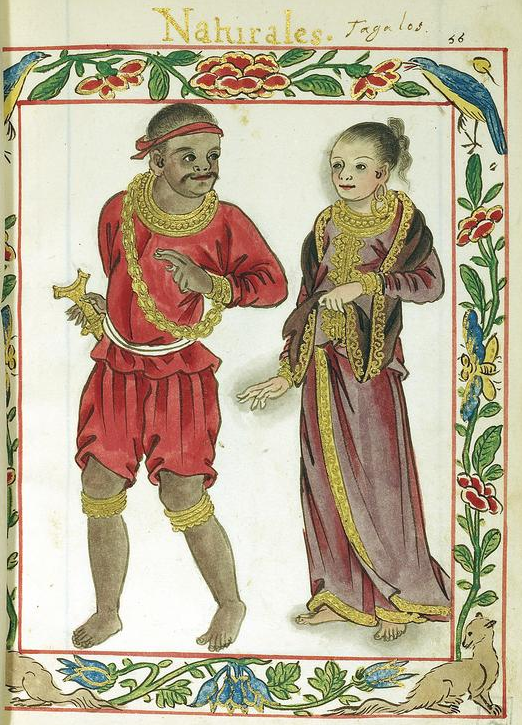
The Pilipino had a three-class social structure consisting of the maginoo (royalty), the maharlika (lit. freemen; warrior nobility), and the alipin (serfs and slaves). Only those who could claim royal descent were included in the maginoo class. Their prominence depended on the fame of their ancestors (bansag) or their wealth and bravery in battle (lingas). Generally, the closer a maginoo lineage was to the royal founder (puno) of a lineage (lalad), the higher their status.[1]
Members of the maginoo class were referred to as Ginoo. Proper names of the maginoo nobles were preceded by Gat (short for "pamagat" or "pamegat", originally meaning "lord" or "master", though it means "title" in modern Tagalog) for men and Dayang (lady) for women, denoting Lord and Lady respectively. The title Panginoon was reserved for particularly powerful maginoo who ruled over a large number of dependents and slaves, owned extensive property, and whose lineage was impeccable. Lower-status maginoo who gained prominence by newly acquired wealth were scornfully known as maygintawo (literally "person with a lot of gold"; nouveau riche). In Vocabulario de la lengua tagala (1613), the Spanish Franciscan missionary Pedro de San Buenaventura compared the maygintawo to "dark knights" who gain their status by gold and not by lineage.[1]
The Tagalog datu were maginoo who ruled over a community (a dulohan or barangay, literally "corner" and "balangay boat" respectively) or had a large enough following. These datu either ruled over a single community (a pook) or were part of a larger settlement (a bayan, "city-state"). They constituted a council (lipon, lupon, or pulong) and answered to a sovereign ruler, referred to as the lakan (or the Sanskrit title raja, "king"). After the Spanish conquest, these datu were given the Spanish title of Don and were treated as local chiefs.[1]
Visayas
[edit]In Visayas, the Visayans utilized a three-class social structure consisting of the ulipon (commoners, serfs, and slaves, also uripon in Waray), the timawa (warrior nobility), and at the top, the tumao (nobility). The tumao consisted of blood relatives of the datu (community leader) untainted by slavery, servitude, or witchcraft.[2] They were usually descendants of the children of a datu and secondary wives known as sandil. Various tumao supporters of the datu are collectively referred to as sandig sa datu ("beside the datu"). The tumao were also usually employed in the court of the datu in various positions (though these may sometimes be filled with timawa as well). The chief minister or privy counselor of the datu was known as the atubang sa datu (literally "facing the datu"). The steward who collected and recorded tributes and taxes and dispensed them among the household and dependents of the datu was known as the paragahin. The paragahin was also responsible for organizing public feasts and communal work. The bilanggo was the one responsible for maintaining law and order and whose own house served as the community jail (bilanggowan). Both tumao and timawa were obligated to serve as the military forces of the datu in times of war, at their own expense.[1]
_-_Philippines_(c.1668).jpg)
The immediate royal family of the Visayan datu were distinguished from the rest of the tumao as the kadatoan, which was both a political office and a social class. The purity of the lineage of the kadatoan was extremely important in claiming the right to rule, thus the kadatoan usually only married members of other royal families. The sons and daughters of the datu by his first wife were zealously guarded from the rest of the community.[1] The princesses were known as binokot or binukot (literally "the veiled ones" or "the wrapped ones"), due to the fact that they were usually transported by slaves in covered palanquins. Women of the kadatoan class were powerful and revered. The first wife of the datu and the binokot could command the same number of slaves and dependents.[3]

A datu who gained his status by marrying a princess is known as a sabali. A datu who is of pure royal lineage is known as potli or lubus nga datu, while a datu whose four grandparents are all of pure royal descent are known as kalibutan ("all around").[1]
The datu served as leaders and judges. Their proclamations (mantala) were delivered to the general populace by an ulipon serving as the town herald (the paratawag). They received tributes, taxes, and gifts from their subjects, among them were the himuka (gifts from timawa for permission to marry), bawbaw (gifts from the winning parties in a dispute settled by the ruling of the datu), and hikun (the greater share of property being redistributed). They had control of trade through honos (fee for anchoring a ship in the community harbor), bihit (tariffs), and lopig (discounts on local purchases). They also had the power to restrict access to communal property through decrees (balwang) and their crops and animals were distributed among his subjects to care for in a practice known as takay. The datu, however, were far from being a leisured aristocracy. They were often skilled craftsmen, hunters, blacksmiths, fishermen, and warriors in their own right, and their household produced the best commodities for trade.[1]
Visayan datu were loosely bound to each other in a federation (a chiefdom). Members of a chiefdom had a leading datu who had authority over other datu, usually simply referred to as the pangulo ("head" or "ruler"), kaponoan ("most sovereign", from the Visayan word for "root" or "origin", puno), or makaporos nga datu (unifying chief). The pangulo of seaports with frequent foreign traffic may sometimes take on Malay or Sanskrit titles like Rajah ("ruler"), Batara ("noble lord"), Sarripada (from Sanskrit Sri Paduka, "His Highness"; variants include Salip, Sipad, Paduka, and Salipada). However, they were not kings in the European sense. Their authority usually stems from favorable trade positions, military prowess, lineage, and wealth (bahandi) rather than royal rule. While they had limited power over other member datu of the chiefdom based on their renown, they had no direct control over the subjects or lands of the other datu.[1]
The historian William Henry Scott theorizes that this may have been Ferdinand Magellan's fatal error. Magellan assumed that Rajah Humabon was the king of the land and thus of Mactan as well. But the island of Mactan, the domain of Lapu-Lapu and another datu named Zula, was in a location that enabled them to intercept trade ships entering the harbor of Cebu, Humabon's domain. Thus it was more likely that Lapu-Lapu was actually more powerful than Humabon. Humabon himself was married to Lapu-Lapu's niece. When Magellan demanded that Lapu-Lapu submit as his "king" Humabon had done, Lapu-Lapu purportedly replied that "he was unwilling to come and do reverence to one whom he had been commanding for so long a time".[1]
Moro sultanates
[edit].png)
In the Muslim Sultanate of Sulu and Sultanate of Maguindanao, the supreme ruler was the sultan, an Arabic-derived title adopted after their conversion to Islam. The power of the sultan is counterpoised by a council of datu. Female nobility of these ranks were addressed as dayang ("princess"), with the sultan's daughters being known as dayang-dayang ("princess of the first degree"). All of these titles are strictly hereditary.[4]
Below the royal nobility are the provincial governors (panglima) as well as wealthy people (orang kaya).[4] Commoners can sometimes be promoted to nobility, known as datu sadja. Usually for outstanding feats or services in line of duty through display of bravery, heroism, and so on. Unlike true datu, the rank is only for the lifetime of the recipient and is not hereditary.[5]
Maranao
[edit]The Maranao people of the Lanao region differ from other Moro sultanates in that it is not centralized. Instead it is a confederation of several independent Maranao states each formed by multiple clans. The hereditary royal class of the Maranao society are collectively known as pidtaylan, and trace their descent from the first Sultan. These sultans rule independent states (pengampong), which are further divided into smaller communities (pulok) ruled by hereditary datu of the kadatuan class. Local government units are administered by panglima (governors) and maharajah.[6]
The highest position in female nobility is the bai-a-labi (most exalted queen). This is followed by potri maamor (princess), solotan a bai (kind queen), and bai a dalomangcob (queen). Noble women are referred to as bayi ("lady"), while non-noble wealthy women are known as bayi a gaos (rich lady).[6]
Confusion with maharlika
[edit]During the time of former president of the Philippines, Ferdinand Marcos, the term "maharlika" was mistakenly attributed to mean "royalty". As part of his drive at promoting the Bagong Lipunan (New Society), Marcos sponsored the research into pre-Hispanic culture of the Philippines. Apart from recommending changing the name of the Philippines into "Maharlika", Marcos was influential in making maharlika a trendy name for streets, edifices, banquet halls, villages and cultural organizations. Marcos himself utilized the word to christen a highway, a broadcasting corporation, and the reception area of the Malacañan Palace. Marcos' propagandistic utilization of the word started during World War II. Before being proven false in 1985, Marcos claimed that he had commanded a group of guerrillas known as the Maharlika Unit.[7] Marcos also used Maharlika as his personal nom de guerre, depicting himself as the most bemedalled anti-Japanese Filipino guerrilla soldier during World War II. During the martial law period in the Philippines, Marcos attempted to produce a film entitled Maharlika to present his "war exploits".[8]
One of the results of this trend was the distortion of the original meaning of maharlika. Maharlika does not actually refer to the "royalty" class as is claimed, but refers to the vassal warrior class. The maharlika were also more or less unique to the Tagalog caste system and that of its neighboring tribes.[7]
See also
[edit]References
[edit]- ^ a b c d e f g h i William Henry Scott (1994). Barangay: sixteenth-century Philippine culture and society. Ateneo de Manila University Press. ISBN 9789715501354.
- ^ José S. Arcilla (1998). An Introduction to Philippine History. Ateneo de Manila University Press. p. 14–16. ISBN 9789715502610.
- ^ Cristina Blanc-Szanton (1990). "Collision of Cultures: Historical Reformulations of Gender in the Lowland Visayas, Philippines". In Jane Monnig Atkinson & Shelly Errington (ed.). Power and Difference: Gender in Island Southeast Asia. Stanford University Press. ISBN 9780804717816.
- ^ a b Castro, Alex R. (27 April 2018). "Mindanao Royalty: In the Realm of Muslim Majesties". Town&Country. Archived from the original on 27 November 2018. Retrieved 29 November 2019.
- ^ Bruno, Juanito A (1973). The Social World of the Tausug. p. 146.
- ^ a b Ibañez-Nolasco, Liberty (2004). "The Traditional Maranaw Governance System: Descriptives, Issues and Imperatives for Philippine Public Administration" (PDF). Philippine Journal of Public Administration. 48 (1 & 2): 155–203. Archived from the original (PDF) on 2020-02-10. Retrieved 2019-11-29.
- ^ a b Paul Morrow (January 16, 2009). "Maharlika and the ancient class system". Pilipino Express. Retrieved July 18, 2012.
- ^ Quimpo, Nathan Gilbert. Filipino nationalism is a contradiction in terms, Colonial Name, Colonial Mentality and Ethnocentrism, Part One of Four, "Kasama" Vol. 17 No. 3 / July–August–September 2003 / Solidarity Philippines Australia Network, cpcabrisbance.org


Maginoo
View on GrokipediaDefinition and Etymology
Origins and Linguistic Meaning
The term maginoo derives from ancient Tagalog, where it denoted a gentleman of noble rank or a member of the hereditary ruling class, distinct from commoners and dependents.[4] Early Tagalog-Spanish lexicographical works, such as those drawing from 16th- and 18th-century vocabularies, equate maginoo with concepts of lordship or aristocracy, reflecting its use for individuals entitled to governance and tribute in barangay units.[1] Linguistically, it incorporates the Tagalog prefix ma-, which intensifies inherent qualities, combined with ginoo (synonymous with noble or master), yielding a sense of elevated gentility or principled authority rather than mere wealth or force.[4] The origins of maginoo as a social descriptor trace to pre-colonial lowland Philippine polities, particularly Tagalog communities, where it identified the kin-based elite who inherited chieftaincy (datu) roles and mediated alliances, warfare, and resource allocation.[1] This class emerged within decentralized barangays—kin groups of 30 to 100 households—sustained by prestige from descent, ritual expertise, and control over followers' labor and loyalty, as reconstructed from indigenous oral traditions transcribed by Spanish observers like Fray Juan de Plasencia in the 1580s.[4] Unlike later colonial reinterpretations, maginoo status was not strictly patrimonial but could extend to qualified freemen through marriage or merit, though primary evidence emphasizes bloodline primacy, with Spanish accounts potentially understating fluidities due to their hierarchical worldview.[1] No indigenous scripts survive to confirm the term's antiquity, rendering 16th-century ethnohistorical records the foundational, albeit observer-mediated, attestations.Distinction from Common Misinterpretations
The maginoo class is frequently conflated with the maharlika stratum in popular accounts, leading to the misconception that maharlika represented the highest nobility or a class of royal freemen unbound by obligations. In reality, historical records from Spanish chroniclers like Fray Martín de Rada indicate that maginoo occupied the apex of Tagalog society as hereditary nobles, while maharlika were dependent freemen or warriors who owed military service but lacked the privileges of land control and exemption from tribute that defined maginoo status.[4][5] This error often stems from mid-20th-century nationalist reinterpretations, such as those amplified during the Marcos era, which retroactively elevated maharlika to symbolize untainted indigenous sovereignty, despite primary evidence showing maginoo as the source of datus and communal authority.[5] Another common misinterpretation portrays maginoo as equivalent to the datu title, implying a monolithic ruling elite rather than a broader noble class. Sixteenth-century accounts, including those summarized in William Henry Scott's analysis of early colonial documents, clarify that datu denoted a specific maginoo who commanded a barangay of 30 to 100 households through personal influence and followers, not an inherent rank; not all maginoo held datu office, though datus were invariably drawn from maginoo lineages.[1][4] This distinction underscores the decentralized nature of authority, where maginoo power derived from kinship ties and consensus rather than absolute monarchy, countering views of pre-colonial polities as feudal kingdoms akin to European models. Claims of a classless or egalitarian pre-colonial society also misrepresent maginoo roles, ignoring stratified hierarchies evidenced in tribute systems and inheritance practices documented by observers like Juan de Plasencia in 1589. Maginoo enjoyed exemptions from labor and corvée, collecting buwis (tribute) from alipin and maharlika, which refutes assertions of uniform communalism; social mobility existed through wealth accumulation or marriage, but birthright nobility persisted as a core feature.[4][6] Such egalitarian narratives, often promoted in modern educational materials, overlook causal factors like resource scarcity in island barangays that incentivized elite control over surplus and defense.[1]Pre-Colonial Social Context
Hierarchical Structure of Philippine Societies
Pre-colonial Philippine societies were organized into barangays, kinship-based sociopolitical units typically comprising 30 to 100 households clustered around a riverine or coastal settlement for access to water and trade routes.[7] Each barangay functioned as an autonomous community governed by a datu, a chief selected from the noble class based on personal prowess in warfare, wealth accumulation through trade or raids, and reputation as a "maengel" or brave leader, rather than strictly hereditary divine right.[7] The datu's residence served as the communal hub for decision-making, rituals, and dispute resolution, with authority extending to military mobilization, resource allocation, and justice, often enforced through customary laws like the Tagalog Batas ng Bayan or Visayan tumao codes.[7] Social stratification divided the population into three primary classes, forming an economic hierarchy where higher classes derived support from tribute and labor of lower ones, though mobility existed via debt repayment, marriage, or manumission.[1] The noble class, known as maginoo (Tagalog) or tumao (Visayan), occupied the apex, encompassing datus and their kin who enjoyed exemptions from tribute, ornate gold regalia symbolizing status (e.g., up to four taels of gold per person in some accounts), and privileges like larger multi-room houses elevated on posts.[7] Below them were freemen such as timawa (freed or vassal commoners) and maharlika (warrior elites in Tagalog regions), who bore arms, participated in raids sharing spoils, and rendered occasional buhis (tribute in kind, like rice or cloth) but retained personal autonomy and property rights.[1] The base consisted of alipin (dependents), subdivided into namamahay (semi-autonomous householders owing half their harvest) and sa gigilid (fully attached servants living in master's homes), often entering status through war captivity, unpaid debts, or inheritance, yet redeemable through labor or payment equivalent to purchase price.[7]| Class | Key Characteristics | Obligations and Rights | Acquisition of Status |
|---|---|---|---|
| Maginoo/Tumao | Nobles including datus; marked by gold ornaments, leadership roles | Exempt from tribute; judicial, military authority; could own multiple dependents | Birth into chiefly lineage or elevation via wealth/war feats[7] |
| Timawa/Maharlika | Freemen warriors; armed retainers of datus | Paid buhis tribute; right to own land, marry freely, bear arms | Birth to freeman parents or manumission from alipin status[1] |
| Alipin | Dependents/slaves; 1/3 to 1/2 of population in some areas | Labor/tribute to masters (half crops for namamahay); inheritable but dilutable by marriage | Debt bondage, war capture, or parental status; redeemable via payment[7] |