Hubbry Logo
LakanLakanMain
Open search
Lakan
Community hub
Lakan
logo
8 pages, 0 posts
0 subscribers
Be the first to start a discussion here.
Lakan
Lakan
from Wikipedia

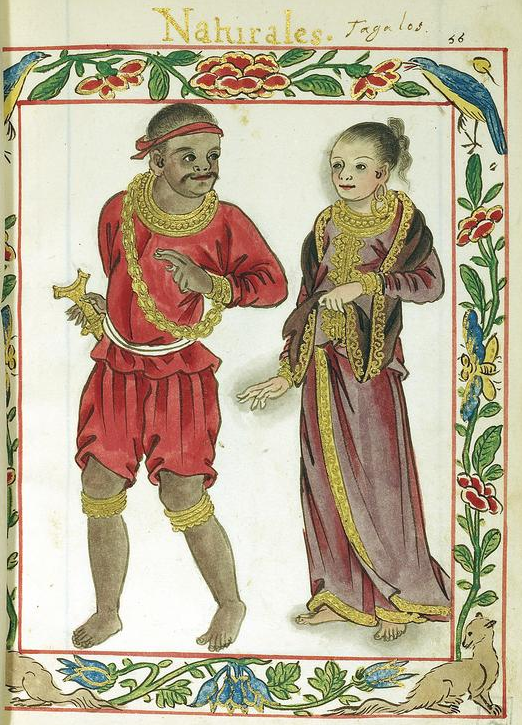
"Naturales" (natives) depicted in the Boxer Codex, specifically marked and identified as Tagalogs.

In early Philippine history, the rank of lakan denoted a "paramount ruler" (or more specifically, "paramount datu") of one of the large coastal barangays (known as a "bayan") on the central and southern regions of the island of Luzon.[1]

Overview

[edit]

The lakan was democratically selected by other ruling datus from among themselves to serve as their "pangulo" (head).[2] Writers such as William Henry Scott have suggested that this rank is equivalent to that of rajah, and that different ethnic groups either used one term or the other, or used the two words interchangeably.[3][4] But other writers such as Nick Joaquin have suggested that the usage of the term "rajah" specifically indicates leadership of a bayan or barangay which has extensive trade relations with Muslim traders.[2][5] Equivalent terms for this rank include the term "sultan" in the Muslim polities of Mindanao, and the term "datu" as used by various polities in the Visayas and in some areas of Mindanao.[6]

Orthography

[edit]

There is no particular legal or academic prescription of orthography for the title of lakan. Thus it may be spelled separate from the person's name (e.g. "Lakan Dula"), or be incorporated with the name to form a single word (e.g. "Lakandula").

Rajah and lakan: It is sometimes argued that since the titles "rajah" and "lakan" are roughly equivalent, the two should not be used together. Thus, referring to Lakandula as Rajah Lakandula is said to be the result of mistaking Lakandula to be the full proper name of the said king.[4]

In his book, Tagalog Borrowings and Cognates (2024), linguist Jean-Paul Potet lists the word 'laka' as the possible earlier form of the title; the added 'n' is a shortened '-ng', a descriptive linker that is a contraction of the word 'nang/ng'. The man Dula is described as a 'laka' in the phrase, "laka na Dula", which becomes "Lakang Dula" contracted further to 'Lakandula", meaning the Chief who is Dula. The cognate identified for 'laka' is the Javanese word 'raka', which means 'lord', "the highest-ranking ruler of a region comprising several communities" in pre-Hinduist Java. Hindi influences brought the title 'raja' to the Philippines. Perhaps from the Spanish colonists' lack of knowledge and/or interpretation of Tagalog,'lakan' was believed to be the word for highest chief starting from the Spanish period. This probable 'mistake' is akin to the contemporary use of the word 'barong' instead of the grammatically correct 'baro', as an abbreviation of the phrase 'barong Tagalog'; the latter is a contraction of the descriptive phrase, 'baro na Tagalog', which means 'shirt that is Tagalog (or worn by the Tagalogs)'. The proper word for shirt is 'baro', but the use of the word 'barong' as if it were a stand-alone noun has become widespread and mainstream.

Prominent lakans

[edit]

Users of the title lakan that figure in 16th- and 17th-century Spanish colonial accounts of Philippine history include:

  • Lakandula (later christened as Don Carlos Lacandola), ruler of Tondo when the Spanish conquest of Luzon began.
  • Lakan Tagkan, ruler of Namayan.[7]

Present-day usage

[edit]

In present-day culture, the term is still occasionally used to mean "nobleman", but has mostly been adapted to other uses.

The name of Malacañan Palace, the official residence of the president of the Republic of the Philippines, is traditionally attributed to the phrase may lakan diyan, or "the king [or head] resides there".[8]

In Filipino Martial Arts, lakan denotes an equivalent to the black belt rank.[9] Also, beauty contests in the Philippines have taken to referring to the winner as "lakambini", the female equivalent of lakan. In such cases, the contestant's assigned escort can be referred to as a lakan. More often, a male pageant winner is named a lakan.[10]

Philippine National Police Academy graduates are called lakan (male) and lakambini (female)

See also

[edit]

Sources

[edit]
  1. ^ "Pre-colonial Manila". Malacañang Presidential Museum and Library. Malacañang Presidential Museum and Library Araw ng Maynila Briefers. Presidential Communications Development and Strategic Planning Office. 23 June 2015. Archived from the original on 9 March 2016. Retrieved 27 April 2017.
  2. ^ a b Jocano, F. Landa (2001). Filipino Prehistory: Rediscovering Precolonial Heritage. Quezon City: Punlad Research House, Inc. ISBN 971-622-006-5.
  3. ^ Scott, William Henry, Barangay: Sixteenth-Century Philippine Culture and Society, Quezon City: Ateneo de Manila University Press, 1994.
  4. ^ a b Laput, Ernesto J. (2004-08-16). "PINAS: Buhay Sa Nayon". Mga Kasaysayan Ng PINAS: A Web of Philippine Histories. Archived from the original on 2004-08-16. Retrieved 2017-06-29.(in Tagalog)
  5. ^ Joaquin, Nick (1990). Manila, My Manila: A History for the Young. City of Manila: Anvil Publishing, Inc. ISBN 978-971-569-313-4.
  6. ^ Junker, Laura Lee (1998). "Integrating History and Archaeology in the Study of Contact Period Philippine Chiefdoms". International Journal of Historical Archaeology. 2 (4): 291–320. doi:10.1023/A:1022611908759. S2CID 141415414.
  7. ^ Huerta, Felix, de (1865). Estado Geografico, Topografico, Estadistico, Historico-Religioso de la Santa y Apostolica Provincia de San Gregorio Magno. Binondo: Imprenta de M. Sanchez y Compañia.{{cite book}}: CS1 maint: multiple names: authors list (link)
  8. ^ Ocampo, Ambeth (1995). "Inside Malacañang". Bonifacio's Bolo. Pasig: Anvil Publishing Inc. p. 122. ISBN 971-27-0418-1.
  9. ^ "Lakan Definition". martialedge.net.[permanent dead link]
  10. ^ "Art & Culture". oroquietacity.com. 1 May 2013. Archived from the original on 17 April 2017. Retrieved 19 May 2023.
Revisions and contributorsEdit on WikipediaRead on Wikipedia
from Grokipedia
Lakan (Baybayin: ᜎᜃᜈ᜔) was a hereditary title in pre-Hispanic Philippine society, particularly among the Tagalog people of Luzon, denoting a paramount ruler or noble leader of a principal coastal barangay or bayan. The term, as interpreted by historian William Henry Scott from sixteenth-century accounts, referred to a democratically selected head among ruling datus, overseeing trade, governance, and community affairs in polities like Tondo. Notable bearers included Lakan Dula (also known as Bunao Dula or Lakandula), the last independent ruler of the Kingdom of Tondo, who submitted to Spanish authority in 1571 following the arrival of Miguel López de Legazpi but later faced execution for alleged involvement in a conspiracy against colonial rule in 1575. The title reflects the stratified social structure of pre-colonial barangay states, where lakans held authority over freemen (timawa or maharlikas) and dependents, facilitating maritime commerce across Southeast Asia prior to European colonization. Historical knowledge of lakan derives primarily from Spanish chronicles and archaeological evidence, with interpretations varying due to limited indigenous written records and potential biases in colonial documentation.

Definition and Historical Context

Meaning and Hierarchical Rank

Lakan denoted a paramount ruler or supreme chieftain in pre-colonial Tagalog society, particularly in the coastal polities of central and southern , where it signified authority over larger territorial units known as bayan comprising multiple barangays. This title was reserved for nobles of the class who exercised overarching governance, often selected from among subordinate datus to lead as a head or principal figure. Historical accounts from Spanish colonial encounters, such as those involving the of in 1571, portray lakan holders like Lakan Dula as sovereigns capable of negotiating alliances and surrendering territories on behalf of their domains, underscoring their elevated status beyond local barangay leadership. In the social hierarchy, the lakan occupied the apex of Tagalog nobility, superior to the datu—who managed individual barangays of 30 to 100 families—and the broader maginoo warrior elite, forming the ruling tumao that controlled , , and tribute collection. Unlike the more localized datu, a lakan commanded fealty from multiple datus, functioning as a confederation head with quasi-divine attributes in some traditions, akin to a "lord of the palace" or divine descendant. This rank paralleled titles like rajah in other Philippine regions but was distinctly Tagalog, with no fixed numerical superiority documented; influence derived from alliances, military prowess, and networks rather than a rigid pyramid. Primary evidence from early Spanish chronicles, though filtered through colonial lenses, consistently elevates lakan as the preeminent authority in polities like Tondo, where it outranked datus in diplomatic and martial affairs.

Comparison to Other Pre-Colonial Titles

The Lakan title, prevalent in Tagalog polities of northern Luzon such as Tondo, denoted a paramount ruler who coordinated multiple barangays into a larger polity, paralleling the Rajah title used in Visayan and eastern Mindanaon societies. Both Lakan and Rajah signified leaders with overarching authority derived from alliances of local chiefs, facilitating regional trade networks and defense against external threats, as evidenced by interactions with Chinese traders and Spanish explorers in the 16th century. In contrast, the Datu—a term widespread across the archipelago—typically referred to the head of a single barangay, responsible for internal governance, justice, and resource allocation within a smaller community scale. While Lakan and Rajah holders often commanded tribute and labor from subordinate datus, the Datu operated with more autonomy in isolated settlements, lacking the confederative scope unless elevated through or . Spanish chroniclers, such as those documenting the 1570 of , treated figures like Lakan Dula as equivalent to monarchs, underscoring the Lakan's elevated status over local datus like , yet primary indigenous sources reveal fluid hierarchies based on personal wealth and alliances rather than hereditary absolutism. Regional variations existed; for instance, in , titles like Gat served analogous high-status roles, but Lakan specifically connoted Tagalog nobility's maritime and mercantile orientation. This comparative structure highlights pre-colonial Philippine leadership as decentralized yet scalable, with Lakan and Rajah embodying apex positions in polities engaging inter-island commerce, distinct from the Datu's foundational community role.

Etymology and Linguistic Evidence

Proposed Origins and Debates

The term lakan first appears in 16th-century Spanish colonial accounts, such as those compiled in The Philippine Islands, 1493–1898, where it describes high-ranking Tagalog leaders equivalent to paramount rulers or princes overseeing coastal barangays or bayan. These early records, including reports from explorers like Miguel López de Legazpi's expeditions in 1570–1571, portray lakan as a title held by figures like the ruler of Tondo, without providing explicit explanations, suggesting it was a native designation understood locally. Scholarly consensus, as articulated by historian William Henry Scott in analyses of pre-colonial social structures, views lakan as an indigenous Austronesian term rooted in Tagalog linguistic traditions, denoting nobility or supreme authority within kinship-based polities rather than a borrowed foreign word. Scott's reconstruction from primary sources emphasizes its role in hierarchical systems where lakan outranked common datu but operated within decentralized barangay governance, with no evidence of non-local derivation disrupting its phonetic or semantic fit in proto-Tagalog. This interpretation aligns with broader Austronesian patterns of titles evolving from kinship and leadership concepts, as seen in cognates for authority across Philippine languages, though lakan appears uniquely concentrated in central Luzon dialects. Debates arise from speculative proposals linking lakan to regional trade influences, particularly a possible adaptation from Malay rekan ("companion" or "ally"), posited in informal linguistic discussions due to phonetic similarity and pre-colonial maritime contacts between Tagalog polities and Malay-speaking networks. However, this lacks comparative linguistic support, as rekan carries connotations of partnership rather than rulership, and often substitutes /l/ for /r/ independently (e.g., from rentaka), undermining direct borrowing claims. Alternative suggestions, such as derivation from -influenced terms like Lakhan (a Hindu ), are rejected for semantic mismatch—lakan signifies earthly , not divinity—and absence of broader Indian patterns in core Tagalog vocabulary, despite acknowledged elements in other titles like rajah. Further contention involves potential internal Tagalog roots, with some analyses proposing composition from prefixes like la- (intensifier) and kan (possessive or "owned," as in ancient dialects denoting controlled territories or followers), reflecting causal ties to land-based in riverine societies. Yet, without reconstructed proto-forms from Austronesian databases or epigraphic evidence predating Spanish contact, these remain hypothetical, highlighting the challenges of etymologizing oral traditions preserved only through colonial filters. The term's into modern Tagalog lakan ("gentleman" or "nobleman") supports endogenous development, as colonial suppression of native hierarchies preserved it in diluted form rather than supplanting it entirely. Overall, empirical priority favors the indigenous model, given the paucity of verifiable foreign etyma amid robust historical attestation of lakan in Tagalog contexts.

Orthography in Baybayin

The orthography of "Lakan" in , the pre-colonial script primarily associated with Tagalog speakers in , follows the phonetic structure of the term as /la.kän/, rendered as ᜎᜃᜈ᜔. This representation breaks down into ᜎ for the initial syllable "la," ᜃ for "ka," and ᜈ᜔ for the final consonant "n" with a (pamudpod, indicated by ᜔) to eliminate the inherent /a/ that characters default to, ensuring the word terminates without an extraneous sound. Baybayin orthography operates on consonant-vowel (CV) principles, with 17 basic characters modified by diacritics: a kudlit dot above for /i/, below for /e/, or none for /a/. For "Lakan," no kudlit is required, as the vowels are /a/, but the trailing —historically a crossbar or paired dots beneath the character—addresses Baybayin's limitation in denoting consonant clusters or finals, a feature inconsistently applied in surviving artifacts but standardized in linguistic reconstructions. This rendering aligns with , where intervocalic /k/ and final nasals like /n/ are preserved without aspiration or alteration. Direct attestations of "Lakan" in ancient inscriptions remain absent, as the few surviving examples—such as those on bamboo tubes, pottery, or metal from the 15th–16th centuries—primarily record personal names, , or commercial notes rather than titles, with most documentation deriving from Spanish colonial observations by figures like Pedro Chirino (1604) and Francisco Ignacio Alcina (1668). Modern orthographic consensus, drawn from these accounts and comparative Austronesian linguistics, treats ᜎᜃᜈ᜔ as the standard form, though regional variations in Visayan or other scripts (e.g., for similar titles) might substitute kudlit positions or omit the in informal usage, reflecting Baybayin's adaptive but non-phonemic precision for finals.

Role in Pre-Colonial Society

Governance and Social Functions

The lakan functioned as a paramount ruler in pre-colonial Tagalog society, governing larger chiefdoms that encompassed multiple , particularly in coastal polities such as Tondo and , where they coordinated administration across subordinate local datus. These rulers managed public projects, convened councils known as pulong for community decisions, and collected tributes in goods like , textiles, and , which sustained their and redistributed resources to foster loyalty among followers. Unlike local datus who led smaller units of 30 to 100 households, lakans exercised influence over trade duties from foreign ships and mediated inter-barangay disputes, drawing on kinship networks and prestige symbols like gongs and red turbans to maintain order. In judicial matters, the lakan acted as a high arbiter, resolving civil and criminal cases that escalated beyond local datus, imposing fines in valuable items such as porcelain jars or gold, and authorizing penalties including debt bondage or execution for offenses like witchcraft or taboo violations. Authority in these functions relied on sworn testimonies and customary law, with the lakan's decisions reinforced by the threat of supernatural sanctions and the integration of babaylan priests in proceedings. Spanish chroniclers noted that such rulings preserved social cohesion by addressing vendettas and property claims, though appeals could extend to external mediators in complex kinship conflicts. Socially, lakans upheld hierarchical structures as heads of the nobility, hosting feasts with betel nut, wine, and sacrificial animals to display wealth and solidify alliances through marriages within elite lineages. They led rituals invoking ancestors and spirits, often in collaboration with babaylans, to sanctify community events like weddings and harvests, thereby legitimizing their prestige derived from accumulated bahandi—heirlooms of gold, slaves, and imported wares. This role extended to hospitality toward traders and kin, fostering reciprocity and reputation as generous patrons, which Spanish accounts from the 1570s describe as central to the lakan's influence in polities like Tondo under figures such as Bunao Dula.

Economic and Military Responsibilities

In pre-colonial Tagalog polities such as Tondo, the lakan functioned as the central economic authority, overseeing the barangay's agrarian and extractive activities, including rice cultivation, , and , which formed the backbone of subsistence and surplus production. Tributes, known as buhis, were collected from dependents and freemen in the form of produce, woven goods, or precious metals, which the lakan redistributed through feasts and gifts to reinforce alliances and social cohesion among followers. This system emphasized communal labor mobilization for communal fields or , with the lakan arbitrating resource disputes to maintain productivity; failure in such oversight could erode authority, as wealth in people and land underscored a leader's prestige over mere accumulation. External trade amplified the lakan's economic role, particularly in coastal hubs like Tondo, where rulers facilitated exchanges of local , deerskins, and for Chinese , silks, and iron goods via intermediary networks with and . Control over and maritime routes enabled polities under lakan leadership to participate in regional entrepôts, generating wealth that supported dependent warriors and artisans, though this often involved tributary obligations to paramount lakans from subordinate datus. Militarily, the lakan commanded irregular forces comprising timawa (noble retainers) and alipin warriors, organizing small-scale raids for captives, slaves, or resources, which served as both economic acquisition and status assertion in inter-barangay conflicts. Warfare emphasized ambushes and edged-weapon combat over pitched battles, with lakans leading expeditions to defend against pirate incursions or rival polities, while maintaining coastal watches (tanod) for vigilance against external threats like Moro raiders from the south. In larger confederations, such as Tondo's alliances, the lakan coordinated multi-barangay levies for punitive campaigns, exemplified by historical defenses against Bruneian incursions circa the 14th-15th centuries, underscoring a causal link between military prowess and sustained economic tribute flows. These duties blurred with governance, as victorious raids bolstered the lakan's capacity to reward followers, perpetuating a cycle of loyalty through demonstrated martial efficacy.

Notable Figures and Polities

Lakan Dula and the Tondo Polity

The Tondo polity, centered in the northern delta of the Pasig River in present-day Manila, functioned as a key trading hub in pre-colonial Luzon, facilitating commerce with Chinese merchants and regional polities. Chinese Ming dynasty records from 1373 document envoys from "Lusong" (likely Tondo) presenting tribute, indicating established diplomatic and trade ties by the 14th century. Archaeological excavations in the area have uncovered Song and Ming dynasty porcelain, supporting Tondo's role in entrepôt trade. The polity comprised a loose confederation of barangays, kinship-based units led by datus, under the paramount authority of a lakan who coordinated defense, tribute collection, and external relations. Lakan Bunao Dula, the final lakan of Tondo during the Spanish incursion, ruled circa 1565–1575 and maintained the polity's commercial prominence, including hosting Chinese refugees fleeing persecution as noted in Augustinian missionary accounts. In May 1571, following the Spanish conquest of nearby Maynila, Dula submitted to without battle, negotiating terms that preserved his family's status; he was baptized as Don Carlos Lacandola and received exemptions from certain tributes. This diplomatic approach contrasted with the resistance mounted by his nephew or kin, of Maynila, who was defeated in the 1570 Battle of Manila. Spanish records portray Dula as a pragmatic leader prioritizing stability over open conflict, though familial ties linked Tondo to subsequent unrest, including a 1574 involving Japanese traders and local elites suppressed by authorities. Dula's death around 1575 marked the effective end of independent Tondo governance, with the polity integrated into Spanish colonial structures via the encomienda system. Dula's lineage persisted as principalía, hereditary elites, with descendants like son Dionisio Kapulong documented selling land in 1620 under pre-Hispanic tenure concepts adapted to colonial law. The Lacandola Documents, preserved in Spanish archives, authenticate these genealogies, tracing over 20 principal lines from Dula despite colonial disruptions. These records, compiled from legal deeds and ecclesiastical registers, provide primary evidence of Tondo's elite continuity, countering narratives of total subjugation by highlighting negotiated accommodations. Primary Spanish sources, while biased toward portraying submission as loyalty, align with archaeological and Chinese evidence of Tondo's pre-existing sophistication, underscoring Dula's role in a transitional era rather than mythic defiance.

Lakan in Other Regions like Lawan

The title lakan, denoting a paramount ruler or noble leader in pre-colonial Tagalog society, appears primarily in historical records from Luzon polities like Tondo, with limited verifiable evidence of its adoption elsewhere. Claims of lakan usage in other regions often stem from oral traditions, genealogical accounts, and secondary interpretations rather than primary sources such as inscriptions or early foreign chronicles, which focus on Luzon. These extra-Luzon assertions, frequently tied to modern descent narratives, warrant scrutiny due to their reliance on unverified lineages and potential conflation with local titles like datu in the Visayas or sultan in Mindanao polities. One such claim involves the purported Lakanate of Lawan, described in certain historical compilations as an ancient polity in (), allegedly ruled by lakans and dating to as early as 1800 BCE. Proponents assert it functioned as a maritime center with influences extending to Polynesian migrations and Hebrew-descended natives, positioning lakan as the governing title for overseeing trade and warfare. However, no archaeological artifacts, copperplate inscriptions, or Spanish-era documents from the onward substantiate this polity's existence or the title's application there; accounts derive from 20th- and 21st-century blogs and family histories linking it to Tondo's ruling lines, such as the Dulay or Dula clans. In broader Visayan contexts, lakan occasionally surfaces in interpretive histories as a superior rank over datu for rulers controlling extensive territories, potentially reflecting cultural exchanges via trade or alliances with . For instance, some narratives suggest Tondo's influence reached and , disseminating titles like lakan among allied chieftains during the 15th–16th centuries. Yet, contemporary evidence, including Pigafetta's 1521 accounts of Visayan leaders or the 900 CE Laguna Copperplate (a artifact), consistently employs regional variants without confirming lakan's extraterritorial prevalence. sources similarly omit it, favoring Islamic-influenced hierarchies post-14th century. These regional disparities highlight lakan's Tagalog specificity, with "like Lawan" examples underscoring how later romanticizations may amplify unproven extensions.

Interactions with Foreign Powers and Decline

Pre-Spanish Trade and Contacts

The , dated to May 10, 900 CE, provides the earliest documentary evidence of structured trade and administrative contacts involving the Tondo polity under its lakan rulers, recording a debt remission of approximately 926.4 grams of gold involving officials from Tundun (Tondo) and references to the Medang kingdom in , indicating ties to Srivijaya's regional network through Old Malay script infused with terms. This artifact, unearthed near , underscores Tondo's integration into circuits by the , with lakan Jayadewa acting as a signatory authority in inter-polity financial settlements. Chinese historical records from the Song and Yuan dynasties document regular maritime exchanges with Philippine polities, including Luzon entities like Tondo, involving exports of beeswax, pearls, tortoise shells, and betel nuts in return for silk, porcelain, and ironware, with archaeological recoveries of Yuan ceramics in Manila Bay sites confirming active 13th-14th century commerce. By the Ming dynasty, Tondo established formal tributary relations, dispatching an envoy to the imperial court in 1373, which facilitated privileged access to Fuzhou ports despite China's haijin sea bans, positioning lakan-governed Tondo as a redistribution hub for Chinese goods across Southeast Asia. Archaeological evidence from excavations reveals diverse tradewares—Chinese , Thai sawankhalok, Vietnamese blue-and-white, and Burmese storage jars—dating to the 14th-15th centuries, attesting to Tondo's role in trade networks linking insular , with lakan oversight likely enforcing monopolies on high-value items like and slaves exchanged with Bornean and Javanese merchants. These contacts, evidenced by over 7,000 shards and artifacts, highlight competitive maritime polities in the region, where Tondo's strategic location enabled control over intra-archipelagic redistribution without direct overland dependencies. Such interactions persisted until Spanish arrival disrupted indigenous networks, though primary sources like Ming emphasize economic over in these exchanges.

Spanish Conquest and Subjugation

The Spanish expedition under Miguel López de Legazpi reached Manila Bay on May 19, 1571, where Lakan Dula of Tondo met the fleet and submitted to Spanish sovereignty without armed resistance, establishing an alliance that facilitated the conquest of neighboring Maynila. This pact enabled Lakan Dula's warriors to join Spanish forces in the Battle of Bangkusay on June 3, 1571, defeating Rajah Sulayman III and consolidating Spanish authority over the Pasig River delta. The arrangement preserved Lakan Dula's position as a tributary ally, with Tondo providing supplies and labor while retaining internal governance. Tensions escalated due to Spanish demands for in kind, forced labor, and , culminating in the Manila Revolt of November 1574, led by Lakan Dula alongside relatives of the defeated . The rebels aimed to drive out the colonizers but lacked coordinated support and were overwhelmed by Spanish reinforcements, resulting in Lakan Dula's capture and subsequent upon renewed submission. He died circa 1575, reportedly of natural causes, after which his heirs were integrated into the colonial as principales. Spanish chronicles, such as those by Legazpi's chroniclers, emphasize the rebels' defeat to justify pacification policies, though archaeological of fortified settlements underscores the strategic resistance potential foregone. Full subjugation of the lakanate occurred through the Tondo Conspiracy of 1587–1588, orchestrated by Lakan Dula's nephew Agustín de Legazpi, son-in-law Magat Salamat, and allied datus from Tondo, Bulacan, Pampanga, and Laguna, numbering over 20 chieftains. The plot envisioned a multi-region uprising backed by Japanese traders to overthrow Spanish rule and restore pre-colonial polities, but it unraveled when a Japanese merchant informant revealed details to Governor-General Santiago de Vera in late 1587. Trials ensued, with 17 leaders, including Agustín de Legazpi and Magat Salamat, executed by garrote on January 5, 1588, effectively dismantling autonomous native leadership structures. This suppression, documented in Spanish judicial records, shifted lakan descendants to supervised roles within the reduccion system, ending the title's independent authority by the early 1590s.

Modern Usage and Cultural Legacy

Revival in Filipino Martial Arts

In the mid-20th century, as such as , eskrima, and underwent revival following colonial suppression, the pre-colonial title Lakan was adapted into modern ranking systems to denote advanced proficiency, equivalent to a black belt for male practitioners. This integration, prominent in Remy Presas's system established in the , used Lakan (with female counterpart Dayang) to evoke historical warrior leadership while standardizing instruction amid growing international interest. Higher degrees, such as Lakan Isa (first degree) to Lakan Sampu (tenth degree), structured progression in techniques emphasizing sticks, blades, and empty-hand combat. The title's employment extended beyond to organizations like Kombatan Arnis, where masters hold ranks up to Lakan Sampu in and weaponry, and Filipino Combat Systems, defining Lakan as an instructor-level black belt. This revivalist approach, driven by figures like Presas who trained thousands globally before his death in , countered the arts' near-extinction by linking contemporary practice to indigenous and heritage. Federations such as the World Kali Eskrima Federation, founded in 1987, amplified this by promoting standardized terminology in tournaments and , culminating in arnis's designation as the ' national martial art in 2009, which boosted domestic clubs and the ritualistic use of titles like Lakan in ceremonies. Such adaptations, while not unbroken lineages, prioritize empirical skill verification over legend, as evidenced by rank awards based on demonstrated mastery in disarms, footwork (langka), and strikes.

Political and Heritage Claims

Various Filipino families and political figures have claimed descent from Lakan Dula to bolster claims of noble heritage, often invoking this lineage in local elections and cultural advocacy. In , for instance, candidates from families asserting Lakan Dula ancestry secured multiple positions in recent elections, using the association to appeal to voters' sense of historical continuity and prestige. These assertions contribute to in regions with strong pre-colonial narratives, though they frequently rely on oral traditions rather than documented genealogies. The "Sumpa ni Lakan Dula," interpreted as a curse uttered by Lakan Dula against betrayers of communal trust—stemming from alleged Spanish duplicity—has entered modern political rhetoric as a symbolic critique of leadership failures. Critics have applied it to presidents including Joseph Estrada, Gloria Macapagal Arroyo, and Benigno Aquino III, attributing their political downfalls or scandals to ancestral retribution for perceived corruption or policy betrayals. This folkloric device persists in public discourse, amplified on social media and blogs, to frame governance accountability through pre-colonial symbolism rather than institutional mechanisms. Prominent dynasties have faced over specific heritage assertions; the Macapagal family's link to Lakan Dula, traced through surnames like Lacandola, has been dismissed by some researchers as fabricated narratives promoted by Diosdado Macapagal's father without primary . Similarly, blogs affiliated with descendant groups allege ties to the Marcos lineage via intermarriages, positioning it within broader efforts to rehabilitate historical prestige amid political controversies. Organizations such as the House of Dula, under figures like Sofronio Dulay—who claims direct descent—advocate for Lakan heritage preservation, influencing cultural policies and local influence without formal political power. Such claims, while culturally resonant, often prioritize narrative appeal over verifiable records, reflecting a pattern of selective ancestry in Philippine elite identity.

Scholarly Debates and Verifiable Evidence

Disputes on Descent and Authenticity

Claims of direct descent from Lakan Dula, the 16th-century ruler of the Tondo polity, have been advanced by numerous Filipino families, including political figures such as the Macapagals, often citing oral traditions or secondary genealogies to assert noble heritage. These assertions typically trace lineages through purported grandchildren like those baptized under Spanish oversight in 1572, but lack corroboration from unaltered primary documents, as colonial record-keeping prioritized integration over precise native genealogies. Historians note that while Spanish pacts granted privileges to Lakan Dula's immediate kin, subsequent intermarriages and name changes eroded traceable lines, rendering most modern claims unverifiable without DNA evidence or intact archives, which were largely destroyed or suppressed during conquest. A central point of contention is the Will of Fernando Malang Balagtas (also known as the Will of Pansomun), dated March 25, 1589, which allegedly details exemptions and lands for Lakan Dula's descendants as compensation for allegiance. Discovered in the early and studied by figures like Luther Parker, the document has been criticized for anachronistic language, improbable timelines—such as referencing events post-dating the purported —and inconsistencies with known Spanish-native pacts. Gregorio argued its authenticity is not definitively established, while classifies it among forged or exaggerated claims used to bolster post-colonial status, a pattern seen in other disputed Philippine historical artifacts. Particular genealogical links, such as Dionisio Capulong's alleged status as Lakan Dula's son, are disputed due to chronological mismatches; Capulong's documented role aiding Spanish forces in around 1570 aligns him as a contemporary peer rather than offspring, with no baptismal or pact records confirming paternity. Broader scholarly scrutiny highlights overreliance on 19th-20th century reconstructions, like the "Lacandola Documents," which aggregate fragmented colonial files but fail to resolve ambiguities in progeny beyond Lakan Dula's known sons, such as . While a 1758 Gremio de Lakandulas recognized some Kapampangan claimants for privileges, this reflected pragmatic Spanish concessions rather than verified descent, underscoring how authenticity hinges on cross-verified 16th-century sources like Legazpi's dispatches over later embellishments. The historical authenticity of Lakan Dula as a titleholder is affirmed by contemporaneous Spanish accounts, including those from Miguel López de Legazpi's 1571 expedition, portraying him as a paramount lakan negotiating tribute and alliances. However, debates persist on the extent of his autonomy versus tributary obligations to Brunei, with some analyses questioning romanticized portrayals of unified pre-colonial kingship as projections of later nationalist narratives rather than empirical polities evidenced by archaeological trade goods and ethnohistoric linguistics. Empirical data, such as Chinese ceramics from Tondo sites dated to the 14th-16th centuries, support a hierarchical structure fitting the lakan title, but causal reconstructions caution against assuming unbroken dynastic continuity amid fluid alliances and revolts like the 1587-1588 Lakans' uprising.

Primary Sources versus Legendary Accounts

Primary sources for Lakan Dula derive exclusively from Spanish colonial records of the 1570s conquest, as no contemporaneous indigenous written documents survive due to the perishable nature of local writing materials and traditions. Miguel López de Legazpi's official reports and the accounts of Martín de Goiti's expeditions detail Lakan Dula—identified as the elderly paramount ruler ("lakan") of Tondo—as entering a and submitting to Spanish authority on May 8, 1571, alongside of Maynila. These documents emphasize his , which spared Tondo from the violent subjugation faced by resistant polities like Maynila under , in return for exemptions from certain tributes and retention of local governance. Subsequent Spanish administrative records, including the Lacandola Documents preserved in the Philippine National Archives, corroborate Lakan Dula's status through petitions by his descendants seeking enforcement of Legazpi's 1571 concessions, such as noble titles and land rights granted up to the early 1600s. These sources portray him as a Muslim-influenced chieftain with trade ties to Brunei and China, but without evidence of widespread imperial dominion or fierce opposition to the Spaniards. Legendary accounts, proliferating in 19th-century and 20th-century nationalist writings, contrast sharply by embellishing Lakan Dula as a defiant warrior-king leading guerrilla resistance or possessing mythical lineages linking to ancient Southeast Asian empires, often unsubstantiated by primary . Such narratives, influenced by anti-colonial revivalism, ignore the documented peaceful pact and instead amplify unverified oral traditions of betrayal by descendants or foresight, reflecting over historical fidelity rather than causal chains from contemporary testimonies. These later interpretations frequently underpin modern genealogical claims by heirs, which rely on anecdotal family lore absent archival validation beyond the initial post-conquest privileges.

References

Add your contribution
Related Hubs
User Avatar
No comments yet.