


Community hub
Recent from talks
Contribute something
Nothing was collected or created yet.
| Part of a series on the |
| Pre-colonial history of the Philippines |
|---|
 |
| See also: History of the Philippines |

Datu is a title which denotes the rulers (variously described in historical accounts as chiefs, sovereign princes, and monarchs) of numerous indigenous peoples throughout the Philippine archipelago.[1] The title is still used today, though not as much as early Philippine history. It is a cognate of datuk, dato, and ratu in several other Austronesian languages.
Overview
[edit]In early Philippine history, datus and a small group of their close relatives formed the "apex stratum" of the traditional three-tier social hierarchy of lowland Philippine societies.[2] Only a member of this birthright aristocracy (called maginoo, nobleza, maharlika, or timagua by various early chroniclers) could become a datu; members of this elite could hope to become a datu by demonstrating prowess in war or exceptional leadership.[2][3][4]
In large coastal polities such as those in Maynila, Tondo, Pangasinan, Cebu, Panay, Bohol, Butuan, Cotabato, Lanao, and Sulu,[2] several datus brought their loyalty-groups, referred to as barangays or dulohan, into compact settlements which allowed greater degrees of cooperation and economic specialization. In such cases, datus of these barangays selected the most senior or most respected among them to serve as what scholars referred to as a paramount leader or paramount datu.[3][4] The titles used by such paramount datu varied, but some of the most prominent examples were: sultan in the most Islamized areas of Mindanao; lakan among the Tagalog people; thimuay among the Subanen people; rajah in polities which traded extensively with Indonesia and Malaysia; or simply datu in some areas of Mindanao and the Visayas.[5]
Proof of Filipino royalty and nobility (dugóng bugháw) could only be demonstrated by clear blood descent from ancient native royal blood,[6][7] and in some cases adoption into a royal family.[clarification needed]
Terminology
[edit]Datu is the title for chiefs, sovereign princes, and monarchs throughout the Philippine archipelago.[1] The title is still used today, especially in Mindanao, Sulu and Palawan, but it was used more extensively in early Philippine history, particularly in central and southern Luzon, the Visayas and Mindanao.[8][4][2][3][9] Other titles still used today are lakan in Luzon, apo in central and northern Luzon,[10] and sultan and rajah, especially in Mindanao, Sulu and Palawan.[11] Depending upon the prestige of the sovereign royal family, the title of datu could be equated to royal princes, European dukes, marquesses and counts.[12] In large ancient barangays, which had contacts with other Southeast Asian cultures through trade, some datus took the title of rajah or sultan.[13]
The oldest historical records mentioning datus are the 7th-century Srivijayan inscriptions such as Telaga Batu to describe lesser kings or vassalized kings.[14] The word datu is a cognate of the Malay terms dato or datuk and to the Fijian title of ratu.[15]
History
[edit]In pre-Islamic times, the political leadership office was vested in a rajahship in Manila and a datuship elsewhere in the Philippines.[16]
Datu in Moro and Lumad societies in Mindanao
[edit]In the later part of the 1500s, the Spaniards took possession of most of Luzon and the Visayas, converting the lowland population to Christianity from their local Indigenous religion. Although Spain eventually established footholds in northern and eastern Mindanao and the Zamboanga Peninsula, its armies failed to colonize the rest of Mindanao. This area was populated by Islamized peoples (Moros to the Spaniards) and by non-Muslim Indigenous groups now known as Lumad peoples.[17]
The Moro societies of Mindanao and Sulu
[edit].png)
In the traditional structure of Moro societies, the sultans were the highest authority followed by the datus or rajah, with their rule being sanctioned by the Quran, though both titles predate the coming of Islam. These titles were assimilated into the new structure under Islam. Datus were supported by their tribes, and in return for tribute and labor, the datu provided aid in emergencies and advocacy in disputes with other communities, and warfare through the Agama and Maratabat laws.
The Lumad societies of Mindanao
[edit]
At the beginning of the 20th century, the Lumad peoples controlled an area that now covers 17 of Mindanao's 24 provinces – but by the 1980 census, they constituted less than 6% of the population of Mindanao and Sulu. Heavy migration to Mindanao of Visayans, who have settled in the Island for centuries, spurred by government-sponsored resettlement programmes, turned the Lumads into minorities. The Bukidnon province population grew from 63,470 in 1948 to 194,368 in 1960 and 414,762 in 1970, with the proportion of Indigenous Bukidnons falling from 64% to 33%, and then 14%.[17]
There are 18 Lumad ethnolinguistic groups: Ata people, Bagobo, Banwaon, B'laan, Bukidnon, Dibabawon, Higaonon, Mamanwa, Mandaya, Manguwangan, Manobo, Mansaka, Subanon, Tagakaolo, Tasaday, Tboli, Teduray and Ubo.[17]
Lumad datus have protected their homeland forests from illegal loggers in previous decades;[when?] some joined the New People's Army.[18]
Datus continue to act as the community leaders in their respective tribes among a variety of indigenous peoples in Mindanao today. Moros, Lumads and Visayans now share with new settlers a homeland in Mindanao.[19]
Datu in pre-colonial principalities in the Visayas
[edit]
In more affluent and powerful territorial jurisdictions and principalities in the Visayas, such as Panay,[a][20][21] Cebu and Leyte[22][23](which were never conquered by Spain but were accomplished as vassals using pacts, peace treaties, and reciprocal alliances),[24] the datu class was at the top of a divinely sanctioned and stable social order in a sakop or kinadatuan (kadatuan in ancient Malay; kedaton in Javanese; and kedatuan in many parts of modern Southeast Asia), which is elsewhere commonly referred to also as a barangay.[25] This social order was divided into three classes. The kadatuan (members of the Visayan datu class) were compared by the Boxer Codex to the titled lords (señores de titulo) in Spain.[26] As agalon or amo (lords),[27] the datus enjoyed an ascribed right to respect, obedience, and support from their oripun (commoner) or followers belonging to the third order. These datus had acquired rights to the same advantages from their legal Timawa or vassals (second-order), who bind themselves to the datu as his seafaring warriors. The Timawa did not pay tribute or perform agricultural labor. The Boxer Codex calls them knights and hidalgos. The Spanish conquistador, Miguel de Loarca, described them as "free men, neither chiefs nor slaves". In the late 1600s, the Spanish Jesuit priest Francisco Ignatio Alcina classified them as the third rank of nobility (nobleza).[28]
To maintain the purity of bloodline, datus marry only among their kind, often seeking high ranking brides in other Barangays, abducting them, or contracting brideprices in gold, slaves and jewelry. Meanwhile, datus kept their daughters secluded for protection and prestige.[29] These well-guarded and protected highborn women were called binokot,[30] the datus of pure descent (four generations) were called "potli nga datu" or "lubus nga datu",[31] while a woman of noble lineage (especially the elderly) are addressed by Panay inhabitants as uray (meaning: pure as gold).[32]
Datu in pre-colonial principalities in the Tagalog region
[edit]
The different type of culture prevalent in Luzon gave a less stable and more complex social structure to the pre-colonial Tagalog barangays of Manila, Pampanga and Laguna. The Tagalog people enjoyed a more extensive commerce than those in Visayas, having the influence of Bornean political contacts, and engaging in farming wet rice for a living. They were described by the Spanish Augustinian friar Martin de Rada as traders more than warriors.[33]
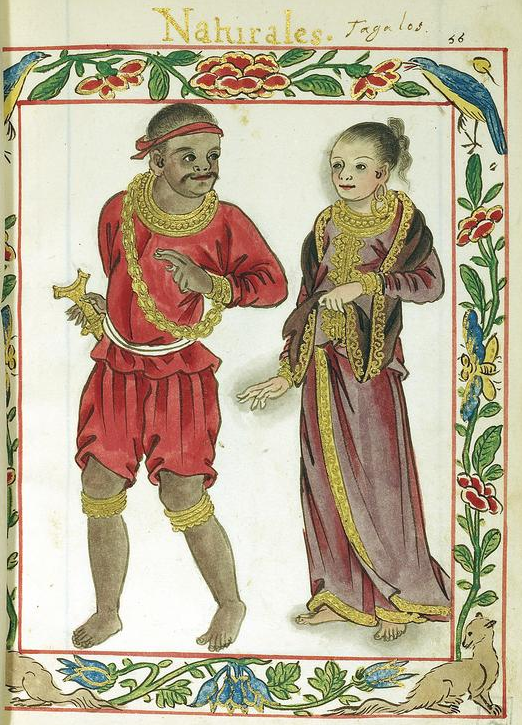
The more complex social structure of the Tagalog people was less stable during the Spaniards' arrival because it was still differentiating. In this society, the term datu, lakan, or apo refers to the chief, but the noble class (to which the datu belonged or could come from) was the maginoo class. One could be born as part of the maginoo, but could also become a datu through personal achievement.[34]
Datu during the Spanish period
[edit]The datu class (first estate) of the four echelons of Filipino society at the time of contact with the Europeans (as described by Juan de Plasencia), was referred to by the Spaniards as the principalía. Loarca,[35] and the canon lawyer Antonio de Morga, who classified the society into three estates (ruler, ruled, slave), also affirmed the usage of this term and also spoke about the preeminence of the principales.[36] All members of the datu class were principales,[37] whether they ruled or not.[38] San Buenaventura's 1613 Dictionary of the Tagalog Language defines three terms that clarify the concept of the principalía:[36]
- Poón or punò (chief, leader) – principal or head of a lineage.
- Ginoó – a noble by lineage and parentage, family and descent.
- Maginoo – principal in lineage or parentage.
The Spanish term seňor (lord) is equated with all these terms, which are distinguished from the nouveau riche imitators scornfully called maygintao (man with gold or hidalgo by gold, and not by lineage).[39]
Upon the Christianization of most parts of the Philippine archipelago, the datus retained their right to govern their territory under the Spanish Empire.[40] King Philip II of Spain, signed a law on June 11, 1594,[41] which commanded the Spanish colonial officials in the archipelago that these native royalties and nobilities be given the same respect, and privileges that they had enjoyed before their conversion. Their domains became self-ruled tributary barangays of the Spanish Empire.

The Filipino royals and nobles formed part of the principalía (noble class) of the Philippines. It was the class that constituted a birthright aristocracy with claims to respect, obedience, and support from those of subordinate status.[39]
With the recognition of the Spanish monarchs came the privilege of being addressed as Don or Doña.[42] – a mark of esteem and distinction in Europe reserved for a person of noble or royal status during the colonial period. Other honors and high regard were also accorded to the Christianized datus by the Spanish Empire. For example, the gobernadorcillos (elected leader of the cabezas de barangay or the Christianized datus) and Filipino officials of justice received the greatest consideration from the Spanish Crown officials. The colonial officials were under obligation to show them the honor corresponding to their respective duties. They were allowed to sit in the houses of the Spanish provincial governors, and in any other places. They were not left to remain standing. Spanish parish priests were forbidden from treating Filipino nobles with less consideration.[43]
The gobernadorcillos exercised the command of the towns, and were port captains in coastal towns.[44] Their office corresponded to the alcaldes' and municipal judges' of the Iberian Peninsula, and performed the duties of both judges and notaries with defined powers.[45] They also had the rights and powers to elect assistants and several lieutenants and alguaciles, proportionate in number to the inhabitants of the town.[45]
By the end of the 16th century, any claim to Filipino royalty, nobility, or hidalguía had disappeared into a homogenized, hispanized and Christianized nobility through the principalía.[46] This remnant of the pre-colonial royal and noble families continued to rule their traditional domain until the end of the Spanish regime. However, there were cases when succession in leadership was also done through the election of new leaders (i.e., cabezas de barangay), especially in provinces near the central colonial government in Manila where the ancient ruling families lost their prestige and role. Perhaps proximity to the central power diminished their significance. However, in distant territories, where the central authority had less control and where order could be maintained without using coercive measures, hereditary succession was still enforced until Spain lost the archipelago to the Americans. These distant territories remained patriarchal societies, where people retained great respect for the principalía.[47]
The principalía was larger and more influential than the pre-conquest Indigenous nobility. It helped create and perpetuate an oligarchic system in the Spanish colony for over three hundred years.[48][49] The Spanish colonial government's prohibition for foreigners to own land in the Philippines contributed to the evolution of this form of oligarchy. In some Philippine provinces, many Spaniards and foreign merchants married the rich and received Austronesian local nobilities. From these unions, a new cultural group was formed: the mestizo class.[50] Their descendants emerged later to become an influential part of the government and the principalía.[51]
Political functions
[edit]Anthropologist Laura Lee Junker's comparative analysis of historical accounts from cultures throughout the archipelago, depicts datus functioning as primary political authorities, war leaders, legal adjudicators, the de facto owners of agricultural products and sea resources within a district, the primary supporters of attached craft specialists, the overseers of intra-district and external trade, and the pivotal centers of regional resource mobilization systems.[5]
Anthropologists like F. Landa Jocano[3] and Junker,[5] historians, and historiographers like William Henry Scott[4] distinguish between the nobility and aristocratic nature of the datus against the exercise of sovereign political authority. Although the datus and paramount datus of early Philippine polities were a "birthright aristocracy" and were widely recognized "aristocratic" or "noble", which were comparable to the nobles and royals of the Spanish colonizers, the nature of their relationship with the members of their barangay was less asymmetrical than monarchic political systems in other parts of the world.[3][52][53][5] Their control over territory was a function of their leadership of the barangay and, in some local pre-colonial societies (mostly in Luzon), the concept of ruling was not a "divine right".[5] Furthermore, their position was dependent on the common consent of the members of the barangay's aristocratic Maginoo-class.[3] Although the position of datu could be inherited, the maginoo could choose someone else to follow within their own class if that person proved to be a more capable war leader or political administrator.[3] Even paramount datus such as lakans or rajahs exercised only a limited degree of influence over the less-senior datus they led, which did not include claims over the barangays and territories.[3] Antonio de Morga, in his work Sucesos de las Islas Filipinas, expounds on the degree to which early Philippine datus could exercise their authority:
There were no kings or lords throughout these islands who ruled over them as in the manner of our kingdoms and provinces; but in every island, and in each province of it, many chiefs were recognized by the natives themselves. Some were more powerful than others, and each one had his followers and subjects, by districts and families; and these obeyed and respected the chief. Some chiefs had friendship and communication with others, and at times wars and quarrels... When any of these chiefs was more courageous than others in war and upon other occasions, such a one enjoyed more followers and men; and the others were under his leadership, even if they were chiefs. These latter retained to themselves the lordship and particular government of their own following, which is called barangay among them. They had datos and other special leaders [mandadores] who attended to the interests of the barangay.[54]
Paramount datus
[edit]The term paramount datu or paramount ruler is a term applied by historians to describe the highest ranking political authorities in the largest lowland polities or inter-polity alliance groups in early Philippine history,[55] such as those in Maynila, Tondo, the Confederation of Madja-as in Panay, Pangasinan, Cebu, Bohol, Butuan, Cotabato, and Sulu.[2][4]
Different cultures on the Philippine archipelago referred to the most senior datu using different titles:[4] In Muslim polities such as Sulu and Cotabato, the paramount ruler was called a sultan;[4]in Tagalog communities, the equivalent title was lakan;[4] in communities which historically had strong political or trade connections with Indianized polities in Indonesia and Malaysia,[56] the paramount ruler was called a rajah;[56][4] among the Subanon people of the Zamboanga Peninsula, the most senior thimuay is referred to as the thimuay labi,[57] or sulotan in more Islamized Subanon communities.[58] In some other portions of the Visayas and Mindanao, there was no separate name for the most senior ruler, so the paramount ruler was called a datu,[56][4] although one datu was identifiable as the most senior.[3][59]
Nobility
[edit]The noble or aristocratic nature of datus and their relatives is asserted in folk origin myths,[28] was widely acknowledged by foreigners who visited the Philippine archipelago, and is upheld by modern scholarship.[5] Succession to the position of datu was often (although not always) hereditary,[5][3] and datus received their mandate to lead from their membership in an aristocratic class.[4] Records of Chinese traders and Spanish colonizers[56] describe datus or paramount datus as sovereign princes and principals. Travellers who came to the Philippine archipelago from kingdoms or empires such as Song and Ming dynasty China, or 16th-century Spain, even initially referred to datus or paramount datus as "kings", even though they later discovered that datus did not exercise absolute sovereignty over the members of their barangays.[5][3]
Indigenous conceptions of nobility and aristocracy
[edit]

The Filipino worldview has had a conception of the self or individual being deeply and holistically connected to a larger community, expressed in the language of Filipino psychology as kapwa.[60] This Indigenous conception of self strongly defined the roles and obligations played by individuals within their society.[61]
This differentiation of roles and obligations is more broadly characteristic of Malayo-Polynesian[5] and Austronesian[62] cultures where, as Mulder explains:[61]
...Social life is rooted in the immediate experience of a hierarchically ordered social arrangement based on the essential inequality of individuals and their mutual obligations to each other.
This "essential inequality of individuals and their mutual obligations to each other" informed the reciprocal relationships (expressed in the Filipino value of utang na loob) that defined the three-tiered social structure typical among early Philippine peoples.
In some cases, such as the more developed sakop or kinadatuan in the Visayas (e.g., Panay, Bohol and Cebu), origin myths and other folk narratives placed the datu and the aristocratic class at the top of a divinely sanctioned and stable social order.[63] These folk narratives portrayed the ancestors of datus and other nobles as being created by an almighty deity, just like other human beings, but the behavior of these creations determined the social position of their descendants.[64]
This conception of social organization continues to shape Philippine society today despite the introduction of western, externally democratic structures.[61]
Membership in the aristocratic class
[edit]The "authority, power, and influence" of the datu came primarily from his recognized status within the noble class.[3]
A datu's political legitimacy was not only determined by birth, but was also dependent on one's "personal charisma, prowess in war, and wealth".[3]
Hereditary succession
[edit]The office of datu was normally passed on through heredity,[5] and even in cases where it was not passed on through direct descent, only a fellow member of the aristocratic class could ascend to the position.[5] In large settlements where several datus and their barangays lived in close proximity, paramount datus were chosen by datus from amongst themselves more democratically, but even this position as most senior among datus was often passed on through heredity.[3]
In Sucesos de las Islas Filipinas, Antonio de Morga noted this succession through heredity:
These principalities and lordships were inherited in the male line and by succession of father and son and their descendants. If these were lacking, then their brothers and collateral relatives succeeded... When any of these chiefs was more courageous than others in war and upon other occasions, such a one enjoyed more followers and men; and the others were under his leadership, even if they were chiefs. These latter retained to themselves the lordship and particular government of their own following, which is called barangay among them. They had datos and other special leaders [mandadores] who attended to the interests of the barangay.[54]
Material affluence
[edit]Since the culture of the pre-colonial societies in the Visayas, northern Mindanao, and Luzon were largely influenced by Hindu and Buddhist cultures, the datus who ruled these principalities (such as Butuan Calinan, Ranau Gandamatu, Maguindanao Polangi, Cebu, Bohol, Panay, Mindoro and Manila) also shared many customs of royalties and nobles in Southeast Asian territories, especially in the way they used to dress and adorn themselves with gold and silk. The measure of the prince's possession of gold and slaves was proportionate to his greatness and nobility.[65] The first Western travellers, who came to the archipelago, observed that there was hardly any "Indian" who did not possess chains and other articles of gold.[66]
Foreign recognition of nobility
[edit]The Spanish colonizers who came in the 1500s acknowledged the nobility of the aristocratic class within early Philippine societies.[8] De Morga, for example, referred to them as principalities.[47]
Once the Spanish colonial government had been established, the Spanish continued to recognize the descendants of pre-colonial datus as nobles, assigning them positions such as Cabeza de Barangay.[40] Spanish monarchs recognized their noble nature and origin.[67]
Popular portrayal as "monarchs"
[edit]Early misidentifications of pre-colonial polities in Luzon
[edit]When travelers came to the Philippines from cultures which were under a sovereign monarch, these travelers often initially referred to the rulers of Philippine polities as monarchs, implying recognition of their powers as sovereigns.[4]
Some early examples were the Song dynasty traders who came to the Philippines and referred to the ruler of Ma-i as a huang, meaning king[56] – an appellation later adopted by the Ming dynasty courts when dealing with the Philippine archipelago cultures of their own time, such as Botuan and Luzon.[56]
The Spanish expeditions of Ferdinand Magellan in the 1520s and Miguel López de Legazpi in the 1570s initially referred to paramount datus (lakans, rajahs, sultans, etc.) as kings, though the Spanish stopped using this term when those under the command of Martin de Goiti first travelled to the polities in Bulacan and Pampanga in late 1571[68] and realized that the Kapampanan datus had the choice to not obey the wishes of the paramount datus of Tondo (Lakandula) and Maynila (Rajahs Matanda and Sulayman), leading Lakandula and Sulayman to explain that there was "no single king over these lands",[68][4] and that the influence of Tondo and Maynila over the Kapampangan polities did not include either territorial claim or absolute command.[4]
Junker and Scott note that this misconception was natural, because both the Chinese and the Spanish came from cultures which had autocratic and imperial political structures. It was a function of language, since their respective sinocentric and hispanocentric vocabularies were organized around worldviews that asserted the divine right of monarchs. As a result, they tended to project their beliefs into the peoples they encountered during trade and conquest.[5][4][69]
The concept of a sovereign monarchy was not unknown among the various early polities of the Philippine archipelago, since many of these settlements had rich maritime cultures and traditions and traveled widely as sailors and traders. The Tagalogs, for example had the word "hari" to describe a monarch. As noted by Fray San Buenaventura (1613, as cited by Junker, 1990 and Scott, 1994), however, the Tagalogs only applied hari (king) to foreign monarchs, such as those of the Javanese Madjapahit kingdoms, rather than to their own leaders. "Datu", "rajah", "lakan", etc., were distinct unique words to describe the powers and privilege of indigenous or local rulers and paramount rulers.[4]
Reappropriation of "royalty" in popular literature
[edit]Although early Philippine datus, lakans, rajahs, sultans, etc., were not sovereign in the political or military sense, they later came to be referred to as such due to the introduction of European literature during the Spanish colonial period.[70]
Because of the cultural and political discontinuities that came with colonization, playwrights of Spanish-era Philippine literature such as comedias and zarzuelas did not have precise terminologies to describe former Philippine rulership structures, and began appropriating European concepts, such as king or queen to describe them.[70] Because most Filipinos, even during precolonial times, related with political power structures as outsiders,[61] this new interpretation of royalty was accepted in the broadest sense, and the distinction between monarchy as a political structure versus membership in a hereditary noble line or dynasty was lost.[70]
The much-broader popular conception of monarchy built on Filipino experiences of "great men" being socially separate from ordinary people[61] rather than the hierarchical technicalities of monarchies in the political sense, persists today. Common Filipino experience does not usually draw distinctions between aristocracy and nobility vis a vis sovereignty and monarchy. Datus, lakans, rajahs, and sultans are referred to as kings or monarchs in this non-technical sense, particularly in 20th-century Philippine textbooks.[5]
The technical distinction between these concepts have been highlighted again by ethnohistorians, historiographers, and anthropologists belonging to the critical scholarship tradition.[5]
Honorary datus
[edit]The title of "honorary datu" has been conferred to foreigners and non-tribe members by the heads of local tribes and principalities. During the colonial period, some of these titles carried legal privileges. For example, on January 22, 1878, Sultan Jamalul A'Lam of Sulu appointed the Baron de Overbeck (an Austrian who was then the Austro-Hungarian Empire's consul-general in Hong Kong) as Datu Bendahara and as rajah of Sandakan, with the fullest power of life and death over all the inhabitants.[71] On the other hand, in the Philippines, the Spaniards did not grant honorary titles; instead, they created nobiliary titles over conquered territories in the archipelago to reward high Spanish colonial officials. These nobiliary titles are still used in Spain by the descendants of the original holders, such as the Count of Jolo.[72][73][74]
The various tribes and claimants to the royal titles of Indigenous peoples in the Philippines have their own particular customs in conferring local honorary titles, which correspond to the specific and traditional social structures of some Indigenous peoples in the country.[75]
In unhispanized, unchristianized and unislamized parts of the Philippines, there exist other structures of society, which do not have hierarchical classes.[20][76]
Present-day datus
[edit]
The present-day claimants of the precolonial royal or noble title and rank of datu are of two types: the descendants of Islamic precolonial polity rulers in Mindanao, and the descendants of the Christianized datus. This second group are those that live in the predominantly Catholic mainstream Filipino society. They are:
- The descendants of datus and sultans of historical and influential precolonial polities that were not totally subjected to Spanish rule, e.g., the Sultanate of Jolo, Sultanate of Maguindnao, who still claim at least the titles of their ancestors.
- The descendants of the principalía or the Christianized precolonial datus and rajahs, whose status and prerogatives as nobles and former sovereigns were recognized and confirmed by the Spanish Empire. (e.g., descendants of the Christianized last datus of the Cuyonon tribes of Palawan and the precolonial Datus of Panay, Samar, Leyte, Mindoro, Pampanga, Bulacan, Laguna, Bicol Region, etc.; descendants of the Christianized rajahs of Cebu, Butuan and Manila; descendants of Christianized chiefs of precolonial tribes of the Cordilleras and northern Luzon.)[77]
Heirs to the precolonial rank of datu in the Catholic parts of the Philippines
[edit]In the mainstream Philippine society that is predominantly Catholic, the descendants of the principalities are the rightful claimants of the ancient sovereign royal and noble ranks of the pre-conquest kingdoms, principalities, and barangays of their ancestors (such as the realm of the Christianized last datu of the Cuyonon tribes). These descendants of the ancient ruling class are now among the landed aristocracy, intellectual elite, merchants, and politicians in the contemporary Filipino society, and have ancestors that held the titles of Don or Doña, which were used by Spanish royalties and nobilities during the Spanish colonial period, and is still in use.[42][78]
Philippine Constitution and the Law on Indigenous Minorities on the contemporary usage of the title datu
[edit]
Article VI, Section 31 of the 1987 Constitution explicitly forbids the creation, granting, and use of new royal or noble titles. Titles of honorary datu conferred by various ethnic groups to certain foreigners and non-tribe members by local chieftains are only forms of local award or appreciation for some goods or services done to a local tribe or to the person of the chieftain, and are not legally binding. Any contrary claim is otherwise unconstitutional under Philippine law.[79]
Through the Indigenous Peoples' Rights Act of 1997, the republic also protects the peculiar situation of tribal minorities and their traditional Indigenous social structures. It allows members of Indigenous minority tribes to be conferred with traditional leadership titles, including the title datu, in a manner specified under the law's implementing rules and guidelines (Administrative Order No. 1, Series of 1998, of the National Commission on Indigenous Peoples specifically under Rule IV, Part I, Section 2, a-c), which reads:[80]
- a) Right to Confer Leadership Titles. The ICCs/IPs concerned, in accordance with their customary laws and practices, Indigenous peoples shall have the sole right to vest titles of leadership such as, but not limited to, Bae, Datu, Baylan, Timuay, Likid and such other titles to their members.
- b) Recognition of Leadership Titles. To forestall undue conferment of leadership titles and misrepresentations, the ICCs/IPs concerned, may, at their option, submit a list of their recognized traditional socio-political leaders with their corresponding titles to the NCIP. The NCIP through its field offices, shall conduct a field validation of said list and shall maintain a national directory thereof.
- c) Issuance of Certificates of Tribal Membership. Only the recognized registered leaders are authorized to issue certificates of tribal membership to their members. Such certificates shall be confirmed by the NCIP based on its census and records and shall have effect only for the purpose for which it was issued.
From the above-mentioned ordinance of the National Commission on Indigenous Peoples, the current usage of the title datu for newly created offices of leadership of tribal minorities does not accord nobility, which is forbidden by the Constitution of the republican state.[79]
Precolonial polities and fons honorum
[edit]Heads of dynasties belong to one of the three kinds of sovereignty. The other two are heads of states and traditional heads of the Church (both Roman Catholic and Orthodox). The authority that emanates from this last type is transmitted through an authentic apostolic succession,[81] i.e., direct lineage of ordination and succession of office from the Apostles (from St. Peter, in the case of the supreme pontiff of the Roman Catholic Church – the pope).[82][83]
See also
[edit]- Hinduism in the Philippines
- History of the Philippines (before 1521)
- Rajahnate of Maynila
- Namayan
- Datuk, Malay honorary title
- Tondo (historical polity)
- Malay styles and titles
- Rajahnate of Butuan
- Rajahnate of Cebu
- Recorded list of Datus in the Philippines
- Sultanate of Maguindanao
- Sultanate of Sulu
- Taytay, Palawan
- Non-sovereign monarchy
- Federal monarchy
- Philippine shamans
- Maharlika
- Bagani
Notes
[edit]- ^ Historians classify four types of unhispanized societies in the Philippines, some of which still survive in remote and isolated parts of the Country:
- Classless societies
- Warrior societies, characterized by a distinct warrior class, in which membership is won by personal achievement, entails privilege, duty, and prescribed norms of conduct, and is requisite for community leadership
- Petty plutocracies dominated socially and politically by a recognized class of rich men who attain membership through birthright, property, and by performing specified ceremonies. They are "petty" because their authority is localized, being extended by neither absentee landlordism nor territorial subjugation
- Principalities: Scott's book mostly mentions examples in Mindanao, however, this form of society was predominant on the plains of the Visayan Islands and Luzon, during the pre-conquest era. Cf. William Henry Scott, Cracks in the Parchment Curtain, Quezon City: 1998, p. 139.
References
[edit]- ^ a b For more information about the social system of the Indigenous Philippine society before the Spanish colonization see Barangay in Enciclopedia Universal Ilustrada Europea-Americana, Madrid: Espasa-Calpe, S. A., 1991, Vol. VII, p.624: Los nobles de un barangay eran los más ricos ó los más fuertes, formándose por este sistema los dattos ó maguinoos, principes á quienes heredaban los hijos mayores, las hijas á falta de éstos, ó los parientes más próximos si no tenían descendencia directa; pero siempre teniendo en cuenta las condiciones de fuerza ó de dinero.
- ^ a b c d e Junker, Laura Lee (1998). "Integrating History and Archaeology in the Study of Contact Period Philippine Chiefdoms". International Journal of Historical Archaeology. 2 (4): 291–320. doi:10.1023/A:1022611908759. S2CID 141415414.
- ^ a b c d e f g h i j k l m n Jocano, F. Landa (2001). Filipino Prehistory: Rediscovering Precolonial Heritage. Quezon City: Punlad Research House, Inc. ISBN 971-622-006-5.
- ^ a b c d e f g h i j k l m n o p Scott, William Henry (1994). Barangay: Sixteenth Century Philippine Culture and Society. Quezon City: Ateneo de Manila University Press. ISBN 971-550-135-4.
- ^ a b c d e f g h i j k l m n Junker, Laura Lee (1990). "The Organization of IntraRegional and LongDistance Trade in PreHispanic Philippine Complex Societies". Asian Perspectives. 29 (2): 167–209.
- ^ Cf. Vicente de Cadenas y Vicent, "Las Pruebas de Nobleza y Genealogia en Filipinas y Los Archivios en Donde se Pueden Encontrar Antecedentes de Ellas" in "Heraldica, Genealogia y Nobleza en los Editoriales de «Hidalguia»", Madrid: 1993, Graficas Ariás Montano, S.A.-MONTOLES, pp. 232–235.
- ^ By the end of the 16th century, any claim to Filipino royalty, nobility, or hidalguía had disappeared into a homogenized, hispanized, and Christianized nobility – the Principalía. Cf. William Henry Scott, Cracks in the Parchment Curtain, Quezon City: 1998, pp. 117–118. Cf. Also this article's section on Datu during the Spanish Regime and also the section on Prohibition of New Royal and Noble Titles in the Philippine Constitution.
- ^ a b Por otra parte, mientras en las Indias la cultura precolombiana había alcanzado un alto nivel, en Filipinas la civilización isleña continuaba manifestándose en sus estados más primitivos. Sin embargo, esas sociedades primitivas, independientes totalmente las unas de las otras, estaban en cierta manera estructuradas y se apreciaba en ellas una organización jerárquica embrionaria y local, performance and Botuo digna de ser atendida. Precisamente en esa organización local es, como siempre, de donde nace la nobleza. El indio aborigen, jefe de tribu, es reconocido como noble y las pruebas irrefutables de su nobleza se encuentran principalmente en las Hojas de Servicios de los militares de origen filipino que abrazaron la carrera de las Armas, cuando para hacerlo necesariamente era preciso demostrar el origen nobiliario del individuo. (On the other hand, while in the Indies pre-Columbian culture had reached a high level, in the Philippines the island civilization continued to manifest itself in its most primitive states. However, these primitive societies, totally independent of each other, were in some way structured and had an embryonic and local hierarchical organization in them, but it was worthy of being attended to. Precisely in career, when in order to do de Caidenas y Vicent, Vicente, Las Pruebas de Nobleza y Genealogia en Filipinde Ellas in Heraldica, Genealogia y Nobleza en los Editoriales de Hidalguia, (1953–1993: 40 años de un pensamiento). Madrid: 1993, HIDALGUIA, p. 232.
- ^ "También fundó convento el Padre Fray Martin de Rada en Araut- que ahora se llama el convento de Dumangas- con la advocación de nuestro Padre San Agustín...Está fundado este pueblo casi a los fines del río de Halaur, que naciendo en unos altos montes en el centro de esta isla (Panay)...Es el pueblo muy hermoso, ameno y muy lleno de palmares de cocos. Antiguamente era el emporio y corte de la más lucida nobleza de toda aquella isla...Hay en dicho pueblo algunos buenos I know jnnu jnbu nuj ni I mean mo 9mkk k9k9 9kIcristianos...Las visitas que tiene son ocho: tres en el monte, dos en el río y tres en el mar...Las que están al mar son: Santa Ana de Anilao, San Juan Evangelista de Bobog, y otra visita más en el monte, entitulada Santa Rosa de Hapitan." Gaspar de San Agustin, O.S.A., Conquistas de las Islas Filipinas (1565–1615), Manuel Merino, O.S.A., ed., Consejo Superior de Investigaciones Cientificas: Madrid 1975, pp. 374–375.
- ^ The Olongapo Story Archived February 19, 2020, at the Wayback Machine, July 28, 1953 – Bamboo Breeze – Vol.6, No.3
- ^ In Mindanao, there have been several sultanates. The Sultanate of Maguindanao, Sultanate of Sulu, and Confederation of Sultanates in Lanao are among those more known in history. Cf. "Royal Society Dignitaries Priority Honorable Members". Archived from the original on March 25, 2012. Retrieved February 13, 2012.
- ^ "There were no kings or lords throughout these islands who ruled over them as in the manner of our kingdoms and provinces; but in every island, and in each province of it, many chiefs were recognized by the natives themselves. Some were more powerful than others, and each one had his followers and subjects, by districts and families; and these obeyed and respected the chief. Some chiefs had friendship and communication with others, and at times wars and quarrels. These principalities and lordships were inherited in the male line and by succession of father and son and their descendants. If these were lacking, then their brothers and collateral relatives succeeded... When any of these chiefs was more courageous than others in war and upon other occasions, such a one enjoyed more followers and men; and the others were under his leadership, even if they were chiefs. These latter retained to themselves the lordship and particular government of their own following, which is called barangay among them. They had datos and other special leaders [mandadores] who attended to the interests of the barangay." Antonio de Morga, The Project Gutenberg EBook of History of the Philippine Islands, Vols. 1 and 2, Chapter VIII.
- ^ Examples of Datus who took the title Rajah were Rajah Soliman, Rajah Matanda, and Rajah Humabon. Cf. Landa Jocano, Filipino Prehistory, Manila: 2001, p.160.
- ^ Casparis, J.G., (1956), Prasasti Indonesia II: Selected Inscriptions from the 7th to the 9th Century A.D., Dinas Purbakala Republik Indonesia, Bandung: Masa Baru.
- ^ "Austronesian Comparative Dictionary: Datu". Retrieved June 15, 2020.
- ^ Tan, Samuel K. (2008). A History of the Philippines. UP Press. pp. 36–37. ISBN 978-971-542-568-1.
- ^ a b c Mindanao Land of Promise (archived from the original Archived October 28, 2008, at the Wayback Machine on October 28, 2008)
- ^ "Lumad chieftain abandons rebel movement in Agusan". Manila Bulletin. April 22, 2009.
- ^ Chieftains
- ^ a b Cf. William Henry Scott, Cracks in the Parchment Curtain, Quezon City: 1998, pp. 127–147.
- ^ During the early part of the Spanish colonization of the Philippines the Spanish Augustinian Friar, Gaspar de San Agustín, O.S.A., describes Iloilo and Panay as one of the most populated islands in the archipelago and the most fertile of all the islands of the Philippines. He also talks about Iloilo, particularly the ancient settlement of Halaur, as the site of a progressive trading post and a court of illustrious nobilities. The friar says: Es la isla de Panay muy parecida a la de Sicilia, así por su forma triangular come por su fertilidad y abundancia de bastimentos... Es la isla más poblada, después de Manila y Mindanao, y una de las mayores, por bojear más de cien leguas. En fertilidad y abundancia es en todas la primera... El otro corre al oeste con el nombre de Alaguer [Halaur], desembocando en el mar a dos leguas de distancia de Dumangas...Es el pueblo muy hermoso, ameno y muy lleno de palmares de cocos. Antiguamente era el emporio y corte de la más lucida nobleza de toda aquella isla...Mamuel Merino, O.S.A., ed., Conquistas de las Islas Filipinas (1565–1615), Madrid: Consejo Superior de Investigaciones Cientificas, 1975, pp. 374–376.
- ^ The encomienda of 1604 shows that many coastal barangays in Panay, Leyte, Bohol, and Cebu were flourishing trading centers. Some of these barangays had large populations. In Panay, some barangays had 20,000 inhabitants; in Leyte (Baybay) 15,000 inhabitants; and in Cebu, 3,500 residents. There were smaller barangays with fewer people. But these were generally inland communities; or if they were coastal, they were not located in areas good for business pursuits. Cf. F. Landa Jocano, Filipino Prehistory: Rediscovering Precolonial Heritage (1998), pp. 157–158, 164
- ^ Leyte and Cebu, Pampanga, Pangasinan, Pasig, Laguna, and Cagayan River were flourishing trading centers. Some of these barangays had large populations. In Panay, some barangays had 20,000 inhabitants; in Leyte (Baybay), 15,000 inhabitants; in Cebu, 3,500 residents; in Vitis (Pampanga), 7,000 inhabitants; Pangasinan, 4,000 residents. There were smaller barangays with fewer people. But these were generally inland communities; or if they were coastal, they were not located in areas good for business pursuits. Cf. F. Landa Jocano, Filipino Prehistory: Rediscovering Precolonial Heritage (1998), pp. 157–158, 164
- ^ Cf. William Henry Scott, Cracks in the Parchment Curtain, Quezon City: 1998, p. 4. Also cf. Antonio Morga, Sucessos de las Islas Filipinas, 2nd ed., Paris: 1890, p. xxxiii.
- ^ The word "sakop" means "jurisdiction", and "Kinadatuan" refers to the realm of the Datu – his principality.
- ^ William Henry Scott, Cracks in the Parchment Curtain, Quezon City: 1998, pp. 102 and 112
- ^ In Panay, even at present, the landed descendants of the Principales are still referred to as Agalon or Amo by their tenants. However, the tenants are no longer called Oripon (in Karay-a, i.e., the Ilonggo sub-dialect) or Olipun (in Sinâ, i.e., Ilonggo spoken in the lowlands and cities). Instead, the tenants are now commonly referred to as Tinawo (subjects)
- ^ a b William Henry Scott, Cracks in the Parchment Curtain, Quezon City: 1998, pp. 112- 118.
- ^ "Archived copy". Archived from the original on June 19, 2011. Retrieved July 22, 2011.
{{cite web}}: CS1 maint: archived copy as title (link) Seclusion and Veiling of Women: A Historical and Cultural Approach - ^ Cf. Emma Helen Blair and James Alexander Robertson, The Philippine Islands (1493–1898), Cleveland: The A.H. Clark Company, 1903, Vol. XXIX, pp. 290–291.
- ^ William Henry Scott, Cracks in the Parchment Curtain, Quezon City: 1998, p. 113.
- ^ Cf. Emma Helen Blair and James Alexander Robertson, The Philippine Islands (1493–1898), Cleveland: The A.H. Clark Company, 1903, Vol. XXIX, p. 292.
- ^ Cf. William Henry Scott, Cracks in the Parchment Curtain, Quezon City: 1998, pp. 124–125.
- ^ Cf. William Henry Scott, Cracks in the Parchment Curtain, Quezon City: 1998, p. 125.
- ^ Cf. Emma Helen Blair and James Alexander Robertson, The Philippine Islands (1493–1898), Cleveland: The A.H. Clark Company, 1903, Vol. V, p. 155.
- ^ a b Cf. William Henry Scott, Cracks in the Parchment Curtain, Quezon City: 1998, p. 99.
- ^ Tous les descendants de ces chefs étaient regardés comme nobles et exempts des corvées et autres services auxquels étaient assujettis les roturiers que l on appelait "timaguas". Les femmes étaient nobles comme les hommes.J. Mallat, Les Philippines, histoire, geographie, moeurs, agriculture, industrie et commerce des Colonies espagnoles dans l'oceanie, Paris: 1846, p. 53.
- ^ The Real Academia Espaňola defines Principal as a "person or thing that holds first place in value or importance, and is given precedence and preference before others". This Spanish term best describes the Datu class of the society in the Archipelago, which the Europeans came in contact with. Cf. William Henry Scott, Cracks in the Parchment Curtain, Quezon City: 1998, p. 99.
- ^ a b Cf. William Henry Scott, Cracks in the Parchment Curtain, Quezon City: 1998, p. 100.
- ^ a b L'institution des chefs de barangay a été empruntée aux Indiens chez qui on l a trouvée établie lors de la conquête des Philippines; ils formaient, à cette époque une espèce de noblesse héréditaire. L'hérédité leur a été conservée aujourd hui: quand une de ces places devient vacante, la nomination du successeur est faite par le surintendant des finances dans les pueblos qui environnent la capitale, et, dans les provinces éloignées, par l alcalde, sur la proposition du gobernadorcillo et la présentation des autres membres du barangay; il en est de même pour les nouvelles créations que nécessite de temps à autre l augmentation de la population. Le cabeza, sa femme et l aîné de ses enfants sont exempts du tributo; après trois ans de service bien fait, on leur accorde le titre de "don" et celui de "pasado"; et ils demeurent exempts de tout service personnel; ils peuvent être élus gobernadorcillos. Les votes sont pris au scrutin secret et la moindre infraction aux règlements entraîne la nullité de l'élection. (The institution of the Chefs de Barangay was borrowed from the Indians with whom it was found established during the conquest of the Philippines; At that time they formed a kind of hereditary nobility. Heredity has been preserved to them to-day; when one of these places becomes vacant, the appointment of the successor is made by the superintendent of finance in the pueblos which surround the capital, and in the distant provinces by the alcalde, The proposal of the gobernadorcillo and the presentation of the other members of the barangay; It is the same for the new creations that the population needs from time to time. The cabeza, his wife and the eldest of his children are exempt from tributo. After three years of good service, they are granted the title of "don" and that of "pasado"; and they remain free from any personal service; they can be elected gobernadorcillos. Votes are taken by secret ballot and the slightest violation of the regulations results in the nullity of the election.) MALLAT de BASSILAU, Jean (1846). Les Philippines: Histoire, géographie, moeurs. Agriculture, industrie et commerce des Colonies espagnoles dans l'Océanie (2 vols) (in French). Paris: Arthus Bertrand Éd. ISBN 978-1143901140. OCLC 23424678, p. 356.
- ^ "It is not right that the Indian chiefs of Filipinas be in a worse condition after conversion; rather they should have such treatment that would gain their affection and keep them loyal, so that with the spiritual blessings that God has communicated to them by calling them to His true knowledge, the temporal blessings may be added and they may live contentedly and comfortably. Therefore, we order the governors of those islands to show them good treatment and entrust them, in our name, with the government of the Indians, of whom they were formerly lords. In all else the governors shall see that the chiefs are benefited justly, and the Indians shall pay them something as a recognition, as they did during the period of their paganism, provided it be without prejudice to the tributes that are to be paid us, or prejudicial to that which pertains to their encomenderos." Felipe II, Ley de Junio 11, 1594 in Recapilación de leyes, lib. vi, tit. VII, ley xvi. Also cf. Emma Helen Blair and James Alexander Robertson, The Philippine Islands (1493–1898), Cleveland: The A.H. Clark Company, 1903, Vol. XVI, pp. 155–156.The original text in Spanish (Recapilación de leyes) says: No es justo, que los Indios Principales de Filipinas sean de peor condición, después de haberse convertido, ántes de les debe hacer tratamiento, que los aficione, y mantenga en felicidad, para que con los bienes espirituales, que Dios les ha comunicado llamándolos a su verdadero conocimiento, se junten los temporales, y vivan con gusto y conveniencia. Por lo qua mandamos a los Gobernadores de aquellas Islas, que les hagan buen tratamiento, y encomienden en nuestro nombre el gobierno de los Indios, de que eran Señores, y en todo lo demás procuren, que justamente se aprovechen haciéndoles los Indios algún reconocimiento en la forma que corría el tiempo de su Gentilidad, con que esto sin perjuicio de los tributos, que á Nos han de pagar, ni de lo que á sus Encomenderos. Juan de Ariztia, ed., Recapilación de leyes, Madrid (1723), lib. vi, tit. VII, ley xvi. This reference can be found at the library of the Estudio Teologico Agustiniano de Valladolid in Spain.
- ^ a b Cf. Emma Helen Blair and James Alexander Robertson, The Philippine Islands (1493–1898), Cleveland: The A.H. Clark Company, 1903, Vol. XL, p. 218.
- ^ Emma Helen Blair and James Alexander Robertson, The Philippine Islands (1493–1898), Cleveland: The A.H. Clark Company, 1903, Vol. XXVII, pp. 296–297.
- ^ Gobernadorcillo in Encyclopedia Universal Ilustrada Europeo-Américana, Madrid: Espasa-Calpe, S.A.,1991, Vol. XLVII, p. 410
- ^ a b Cf. Emma Helen Blair and James Alexander Robertson, The Philippine Islands (1493–1898), Cleveland: The A.H. Clark Company, 1903, Vol. XVII, p. 329.
- ^ William Henry Scott, Cracks in the Parchment Curtain, Quezon City: 1998, pp. 117–118.
- ^ a b Esta institucion (Cabecería de Barangay), mucho más antigua que la sujecion de las islas al Gobierno, ha merecido siempre las mayores atencion. En un principio eran las cabecerías hereditarias, y constituian la verdadera hidalguía del país; mas del dia, si bien en algunas provincias todavía se tramiten por sucesion hereditaria, las hay tambien eleccion, particularmente en las provincias más inmediatas á Manila, en donde han perdido su prestigio y son una verdadera carga. En las provincias distantes todavía se hacen respetar, y allí es precisamente en donde la autoridad tiene ménos que hacer, y el órden se conserva sin necesidad de medidas coercitivas; porque todavía existe en ellas el gobierno patriarcal, por el gran respeto que la plebe conserva aún á lo que llaman aquí principalía. (This institution (Cabecería de Barangay), much older than the subjection of the islands to the Government, has always deserved the greatest attention. In the beginning were the hereditary headings, and constituted the true hidalguía of the country; But in the provinces, although they are still processed by hereditary succession, there are also elections, particularly in the provinces closest to Manila, where they have lost their prestige and are a real burden. In the distant provinces they are still respected, and that is precisely where authority has less to do, and the order is preserved without the need for coercive measures; Because the patriarchal government still exists in them, because of the great respect which the plebs still hold to what they call here "principal") FERRANDO, Fr Juan & FONSECA OSA, Fr Joaquin (1870–1872). Historia de los PP. Dominicos en las Islas Filipinas y en las Misiones del Japon, China, Tung-kin y Formosa (Vol. 1 of 6 vols) (in Spanish). Madrid: Imprenta y esteriotipia de M Rivadeneyra. OCLC 9362749.
- ^ Cf. footnote n.3.
- ^ Cf. Emma Helen Blair and James Alexander Robertson, The Philippine Islands (1493–1898), Cleveland: The A.H. Clark Company, 1903, Vol. XVII, p. 331; Ibid., Vol. XL, p. 218.
- ^ Cf. also Encomienda; Hacienda.
- ^ Cf. The Impact of Spanish Rule in the Philippines in www.seasite.niu.edu."The Impacts of Spanish Rule in the Philippines". Archived from the original on October 1, 2007. Retrieved October 1, 2007.
- ^ McCoy, Alfred W. (1983) An Anarchy of Families: State and Family in the Philippines.
- ^ Anderson,Benedict. (1983) Imagined Communities: Reflections on the Origin and Spread of Nationalism.
- ^ a b Morga, Antonio de (1609). Succesos de las Islas Filipinas.
- ^ "Pre-colonial Manila". Malacañang Presidential Museum and Library. Malacañang Presidential Museum and Library Araw ng Maynila Briefers. Presidential Communications Development and Strategic Planning Office. June 23, 2015. Archived from the original on March 9, 2016. Retrieved April 27, 2017.
- ^ a b c d e f Scott, William Henry (1984). Prehispanic Source Materials for the Study of Philippine History. Quezon City: New Day Publishers. ISBN 978-9711002268.
- ^ Imbing, Thimuay Mangura Vicente L.; Viernes-Enriquez, Joy (1990). "A Legend of the Subanen "Buklog"". Asian Folklore Studies. 49 (1): 109–123. doi:10.2307/1177951. JSTOR 1177951.
- ^ Buendia, Rizal; Mendoza, Lorelei; Guiam, Rufa; Sambeli, Luisa (2006). Mapping and Analysis of Indigenous Governance Practices in the Philippines and Proposal for Establishing an Indicative Framework for Indigenous People's Governance: Towards a Broader and Inclusive Process of Governance in the Philippines (PDF). Bangkok: United Nations Development Programme.
- ^ Scott, William Henry (1992). Looking for the Prehispanic Filipino and Other Essays in the Philippine History. Quezon City: New Day Publishers. ISBN 971-10-0524-7.
- ^ de Guia, Katrin (2005). Kapwa: The Self in the Other: Worldviews and Lifestyles of Filipino Culture-Bearers. Pasig: Anvil Publishing, Inc. p. 378. ISBN 971271490X.
- ^ a b c d e Mulder, Niels (2013). "Filipino Identity: The Haunting Question". Journal of Current Southeast Asian Affairs. 32 (1): 66–80. doi:10.1177/186810341303200103. ISSN 1868-1034.
For most Southeast Asians, social life is rooted in the immediate experience of a hierarchically ordered social arrangement based on the essential inequality of individuals and their mutual obligations to each other. This tangible world blends into the surrounding (not morally obliging) space of nature and wider society that appears as the property of others – be they religious figures, politicians, officials, landlords and/or economic powerholders. Whereas this area may be seen as a "public in itself", it is not experienced as "of the public" or "for itself". It is the vast territory where "men of prowess" (Wolters 1999: 18–19) compete for power, the highly admired social good (King 2008: 177). Accordingly, society is reduced to an aggregate of person-to-person bonds that are supposedly in good order if everybody lives up to his or her ethics of place.
- ^ Benitez-Johannot, Purissima, ed. (September 16, 2011). Paths Of Origins: The Austronesian Heritage In The Collections Of The National Museum Of The Philippines, The Museum Nasional Of Indonesia, And The Netherlands Rijksmuseum Voor Volkenkunde. Makati City, Philippines: Artpostasia Pte Ltd. ISBN 9789719429203.
- ^ SCOTT, William Henry (1982). Cracks in the Parchment Curtain, and Other Essays in Philippine History. Quezon City: New Day Publishers. ISBN 978-9711000004. OCLC 925966, p. 4.
- ^ Demetrio, Francisco R.; Cordero-Fernando, Gilda; Nakpil-Zialcita, Roberto B.; Feleo, Fernando (1991). The Soul Book: Introduction to Philippine Pagan Religion. GCF Books, Quezon City. ASIN B007FR4S8G.
- ^ Cf. Report of the Franciscan Fray Letona to Fray Diego Zapata, high Official of the Franciscan Order and of the Inquisition in Emma Helen Blair and James Alexander Robertson, The Philippine Islands (1493–1898), Cleveland: The A.H. Clark Company, 1903, Vol. XXIX, p. 281.
- ^ Cf. Emma Helen Blair and James Alexander Robertson, The Philippine Islands (1493–1898), Cleveland: The A.H. Clark Company, 1905, Vol. XXXVI, p. 201.
- ^ En el Título VII, del Libro VI, de la Recopilación de las leyes de los reynos de Las Indias, dedicado a los caciques, podemos encontrar tres leyes muy interesantes en tanto en cuanto determinaron el papel que los caciques iban a desempeñar en el nuevo ordenamiento social indiano. Con ellas, la Corona reconocía oficialmente los derechos de origen prehispánico de estos principales. Concretamente, nos estamos refiriendo a las Leyes 1, 2, dedicadas al espacio americano . Y a la Ley 16, instituida por Felipe II el 11 de junio de 1594 -a similitud de las anteriores-, con la finalidad de que los indios principales de las islas Filipinas fuesen bien tratados y se les encargase alguna tarea de gobierno. Igualmente, esta disposición hacía extensible a los caciques filipinos toda la doctrina vigente en relación con los caciques indianos...Los principales pasaron así a formar parte del sistema político-administrativo indiano, sirviendo de nexo de unión entre las autoridades españolas y la población indígena. Para una mejor administración de la precitada población, se crearon los «pueblos de indios» -donde se redujo a la anteriormente dispersa población aborigen- (In Title VII, Book VI, of the Compilation of the laws of the kingdoms of the Indies, dedicated to the caciques, we can find three very interesting laws insofar as they determined the role that the caciques were going to play in the new order Social background. With them, the Crown officially recognized the rights of pre-Hispanic origin of these principals. Specifically, we are referring to Laws 1, 2, dedicated to American space. And to Law 16, instituted by Philip II on June 11, 1594 – the similarity of the previous ones – in order that the principal Indians of the Philippine Islands be treated well and be entrusted with some task of government. Likewise, this provision extended to the Filipino caciques all the doctrine in force in relation to the Indian chieftains ... The principal thus became part of the Indian political-administrative system, serving as a link between the Spanish authorities and the indigenous population . For a better administration of the aforementioned population, the "pueblos de indios" – where it was reduced to the previously dispersed Aboriginal population -) Luque Talaván, Miguel, ed. (2002). Análisis Histórico-Jurídico de la Nobleza Indiana de Origen Prehispánico (Conferencia en la Escuela "Marqués de Aviles" de Genealogía, Heráldica y Nobiliaria de la "Asociación de Diplomados en Genealogía, Heráldica y Nobiliaria") (pdf) (in Spanish), p. 22.
- ^ a b Blair, Emma Helen; Robertson, James Alexander, eds. (1903). Relation of the Conquest of the Island of Luzon. Vol. 3. Ohio, Cleveland: Arthur H. Clark Company. p. 145.
{{cite book}}:|work=ignored (help) - ^ Junker, Laura Lee (1999). Raiding, Trading, and Feasting: The Political Economy of Philippine Chiefdoms. University of Hawaii Press. p. 77. ISBN 978-0-8248-2035-0.
- ^ a b c Rafael, Vicente L. (2005) The Promise of the Foreign: Nationalism and the Technics of Translation in the Spanish Philippines.
- ^ Commission from Sultan of Sulu appointing Baron de Overbeck (an Austrian who was then the Austro-Hungarian Empire's Consul-General in Hong Kong) Dato Bendahara and Rajah of Sandakan. Dated January 22, 1878, The National Archives (United Kingdom).
- ^ Conde de Jolo, List of Spanish Nobility.
- ^ Visconde de Mindanao, List of Spanish Nobility.
- ^ Marques de Camarines, List of Spanish Nobility.
- ^ "Welcome to the official website of the Royal House of Sulu". Archived from the original on June 26, 2011. Retrieved August 3, 2011.
- ^ Historians classify four types of unhispanized societies in the Philippines, some of which still survive in remote and isolated parts of the Country: 1.) Classless societies; 2.) Warrior societies, characterized by a distinct warrior class, in which membership is won by personal achievement, entails privilege, duty and prescribed norms of conduct, and is requisite for community leadership; 3.) Petty Plutocracies, which are dominated socially and politically by a recognized class of rich men who attain membership through birthright, property and the performance of specified ceremonies. They are "petty" because their authority is localized, being extended by neither absentee landlordism nor territorial subjugation; and 4.) Principalities. Although in his book, Scot mentioned mostly examples found in Mindanao, however, this form of society was predominant on the plains of Visayan Islands, as well as in Luzon, during the pre-conquest era. Cf. William Henry Scott, Cracks in the Parchment Curtain, Quezon City: 1998, p. 139.
- ^ FERRANDO, Fr Juan & FONSECA OSA, Fr Joaquin (1870–1872). Historia de los PP. Dominicos en las Islas Filipinas y en las Misiones del Japon, China, Tung-kin y Formosa (Vol. 1 of 6 vols) (in Spanish). Madrid: Imprenta y esteriotipia de M Rivadeneyra. OCLC 9362749, p. 146.
- ^ Cf. Barangay in Enciclopedia Universal Ilustrada Europea-Americana, Madrid: Espasa-Calpe, S. A., 1991, Vol. VII, p.624. The article says: Los nobles de un barangay eran los más ricos ó los más fuertes, formándose por este sistema los dattos ó maguinoos, principes á quienes heredaban los hijos mayores, las hijas á falta de éstos, ó los parientes más próximos si no tenían descendencia directa; pero siempre teniendo en cuenta las condiciones de fuerza ó de dinero...Los vassalos plebeyos tenían que remar en los barcos del maguinoo, cultivar sus campos y pelear en la guerra. Los siervos, que formaban el término medio entre los esclavos y los hombres libres, podían tener propriedad individual, mujer, campos, casa y esclavos; pero los tagalos debían pagar una cantidad en polvo de oro equivalente á una parte de sus cosechas, los de los barangayes bisayas estaban obligados á trabajar en las tieras del señor cinco días al mes, pagarle un tributo anual en arroz y hacerle un presente en las fiestas. Durante la dominación española, el cacique, jefe de un barangay, ejercía funciones judiciales y administrativas. A los tres años tenía el tratamiento de don y se reconocía capacidad para ser gobernadorcillo, con facultades para nombrarse un auxiliar llamado primogenito, siendo hereditario el cargo de jefe. It should also be noted that the more popular and official term used to refer to the leaders of the district or to the cacique during the Spanish period was Cabeza de Barangay.
- ^ a b Philippine Constitution, Article VI, Section 31.
- ^ "Administrative Order No. 1 of National Commission on Indigenous Peoples, Series of 1998: Rules and Regulations Implementing Republic Act No. 8371, otherwise known as the Indigenous Peoples' Rights Act of 1997, Philippines, WIPO Lex". www.wipo.int. Retrieved June 19, 2024.
- ^ Annuario Pontificio 2012 (Libreria Editrice Vaticana 2012 ISBN 978-88-209-8722-0), p. 12.
- ^ Cf. Vatican Council II, Dogmatic Constitution on the Church Lumen gentium, n. 8.
External links
[edit]- Impact of Spanish Colonialization in the Philippines
- Encyclopædia Britannica – Datu (Filipino chieftain)
- The official website of the Royal Sultanate of Sulu Archived June 26, 2011, at the Wayback Machine


Definition and Terminology
Etymology and Regional Variations
The term datu derives from Proto-Malayo-Polynesian *datu, denoting a "lineage priest," a role associated with ancestral or ritual leadership in early Austronesian societies.[5] This etymon appears as a cognate across Austronesian languages, including Malay datuk and Indonesian datuk, typically signifying chiefs, elders, or guardians of traditional law.[5] In Philippine contexts, reflexes of *datu evolved to emphasize political authority, as seen in Cebuano dátuʔ for a chief or wealthy leader, Tagalog dátoʔ for a pre-Christian tribal chief or high priest, and Tboli datuʔ for a hereditary traditional leader.[5] Pre-colonial usage of datu varied by region, with the title most prominently denoting autonomous barangay rulers in the Visayas and Mindanao, where datus held judicial, military, and economic sway over 30 to 100 families.[6] In Visayan society, datus formed the apex of a stratified hierarchy including timawa (freemen) and alipin (dependents), reflecting a system of hereditary nobility tied to wealth and influence.[6] Northern reflexes, such as Pangasinan dátu for a tribal group leader or Ilokano dato for a Muslim ruler, indicate broader application, though Luzon polities like those of the Tagalogs favored lakan for paramount chiefs, reserving datu-like terms for subordinate or ritual roles.[5] In Mindanao among non-Islamized Lumad groups, datu retained indigenous connotations of consensus-based leadership, distinct from the hierarchical sultanates of Moro societies where datus served as vassals under sultans.[7] Indianized influences introduced rajah for overlords commanding multiple datus in confederated polities across regions, creating a tiered distinction: local datu for barangay heads versus rajah for expansive rulers, as evidenced in 16th-century accounts of Cebu and Butuan.[7] These variations underscore datu's adaptability within Austronesian kinship systems, prioritizing lineage and communal authority over centralized monarchy.[5]Equivalent Titles and Distinctions from Other Rulers
In pre-colonial Philippine societies, the datu functioned as the primary ruler of a barangay, a kinship-based community typically comprising 100 to 500 individuals, distinguishing it from higher-tier titles like rajah or sultan that denoted paramount authority over confederations of multiple barangays. The rajah, influenced by Indianized trade networks, represented a superior chieftain whose sway extended across allied datus, as exemplified in the Rajahnate of Cebu (c. 1400–1565), a key entrepôt linking Southeast Asian sultanates.[8] In contrast, the datu's domain was more localized, emphasizing direct governance through consensus and customary law rather than expansive hierarchies.[1] Within Islamic polities of Mindanao and Sulu, such as the Sultanate of Buayan (established c. 1590s), the sultan held sovereign status as the ultimate arbiter and religious head, while datus operated as subordinate nobles, regional administrators, or military vassals bound by oaths of fealty, often formalized through marriages or pacts with the sultanate.[9] This structure reflected a feudal-like layering absent in non-Muslim barangay systems, where datus exercised near-absolute personal authority without an overlying monarch.[10] Etymologically and culturally, datu shares roots with the Old Malay dātu, denoting chieftains or regional elders in Austronesian societies across Maritime Southeast Asia, evolving into modern honorifics like Malaysian datuk for nobility but historically signifying autonomous local sovereigns akin to Javanese or Minangkabau headmen.[11] Unlike centralized monarchs in continental empires, these titles emphasized hereditary leadership tied to ancestral claims and community welfare, with prestige varying by polity size—equating to European dukes or princes only analogously in domains of limited territorial scope.[12]Pre-Colonial Functions and Society
Political and Judicial Authority
In pre-colonial Philippine society, the datu served as the paramount leader of the barangay, the fundamental socio-political unit comprising 30 to 100 families. As chief executive, the datu wielded broad political authority, directing community governance, declaring war or peace, forging alliances and treaties, and overseeing communal welfare, often in consultation with a council of elders known as the maginoo or uripon leaders.[13] This authority derived from personal attributes such as wisdom, prowess, wealth, or hereditary succession, enabling the datu to maintain order and represent the barangay in inter-community relations.[13] Judicially, the datu functioned as the primary arbiter, adjudicating civil and criminal disputes within the barangay based on customary laws that emphasized restitution and social harmony over punitive measures.[14] Trials were conducted publicly, with the datu presiding as judge and elders assisting as a jury; litigants presented their own cases, witnesses testified under oath, and in ambiguous criminal matters, trial by ordeal—such as immersion in boiling water or walking over hot coals—was employed to invoke divine judgment.[13] Customary laws, primarily oral traditions governing property, inheritance, contracts, and offenses like theft or homicide, were supplemented in some regions by purported written codes, including the Maragtas Code attributed to Datu Sumakwel around 1200–1212 AD and the Code of Kalantiaw from 1433 AD, though the authenticity of these codes remains debated among historians due to limited archaeological corroboration.[14][13] Inter-barangay or inter-datu disputes were resolved through arbitration by neutral datus or elders to avert escalation into feuds or warfare, reflecting a pragmatic approach to conflict resolution rooted in kinship ties and mutual deterrence.[13] Punishments under customary law often involved fines, blood money (e.g., diyang for homicide), or enslavement of offenders or their kin, calibrated to the offender's status and the offense's gravity, thereby reinforcing the datu's role in upholding hierarchical social structures while preserving communal stability.[14] This system prioritized consensus and elder input, mitigating the datu's potentially absolute power through collective decision-making.[13]Economic Control and Resource Management
The datu held primary authority over economic resources in the pre-colonial barangay, the fundamental socio-economic unit comprising typically a few hundred individuals engaged in subsistence agriculture, fishing, and trade. As administrator of communal lands, the datu allocated swidden fields, forests, and coastal areas for exploitation, though private ownership was limited and land rights derived from occupancy and kinship rather than fee simple title. This system emphasized collective use, with the datu mediating disputes over resources and occasionally alienating territory on behalf of the community or converting usage rights into regular payments from subjects.[15][1] Tribute, known as buhis or handug, formed the core of resource redistribution, exacted from commoner dependents called oripun in exchange for protection and adjudication. These obligations included agricultural labor, such as rice cultivation on datu-controlled plots, or equivalents in produce like 15 cavans of rice annually for less indebted tumataban oripun (equating to about five days' monthly labor) and 30 cavans for more bound tumaranpok oripun (four days' weekly labor). Warriors known as timawa, bound by personal allegiance rather than debt, owed no tribute but contributed to economic ventures through seafaring raids and trade expeditions, from which the datu claimed up to 50% of booty or profits after ritual shares.[15][16] The datu also directed inter-barangay and external trade, leveraging surpluses from late Neolithic irrigation-enabled wet rice farming and natural resources like gold and cotton to exchange for porcelains, marine goods, and metals with regional networks, as evidenced in Butuan's tribute missions to Song China around 1001 CE. Control extended to taxation on inheritance—such as 20% on conquered property—and war spoils, reinforcing the datu's wealth, which was ultimately measured not in hoarded land or gold but in the number and productivity of followers sustaining the polity's resilience.[16][17]Military and Defensive Roles
The datu functioned as the paramount military authority within the pre-colonial barangay, a kinship-based polity typically comprising 30 to 100 households, where leadership derived from demonstrated prowess in combat rather than hereditary entitlement alone. The primary duty of the datu was to lead expeditions of warfare, known variably as mangubat (general warfare), mangayaw (raiding for slaves or goods), or magahat (targeted assaults often involving head-taking for prestige), which blurred lines between defense, economic acquisition, and intertribal rivalry. These operations emphasized small-scale, opportunistic tactics such as ambushes and sea-borne raids using outrigger canoes (balangay), with the datu personally commanding fleets and claiming a share of booty—often half in joint ventures—while performing pre-departure rituals, including sacrifices of slaves to ensure success.[1] Defensive responsibilities centered on safeguarding vassals from external threats, with the datu's effectiveness in repelling raids or ransoming captives reinforcing communal loyalty and his status; failure in protection could erode authority, prompting challenges from rival warriors. Timawa, freemen comprising the warrior class, formed the core fighting force, serving as vassals who rowed vessels, bore arms at personal cost, and acted as bodyguards—testing food and wine for poisons—while sharing risks and spoils under the datu's command. This structure incentivized datu to cultivate personal bonds and alliances with peer leaders for larger coalitions, as individual barangays lacked standing armies and relied on mobilized kin and followers for both offensive ventures and territorial defense against neighboring polities.[1][18]Historical Contexts by Region
Datu in Mindanao (Moro and Lumad Groups)
In pre-colonial Mindanao, the datu functioned as a paramount leader within barangay-like polities among both Moro (Muslim) and Lumad (non-Muslim indigenous) groups, wielding authority over political, judicial, economic, and military affairs tailored to their respective societies. Among Moro communities, such as the Tausug, Maranao, and Maguindanao, datus operated within hierarchical sultanates influenced by Islam, serving as nobles under the sultan and enforcing sharia law in governance and dispute resolution.[19] In contrast, Lumad datus, as seen in groups like the Bagobo and Manobo, led more decentralized tribal structures based on personal charisma, prowess in warfare, and ritual expertise, without the overlay of Islamic sultanates.[20] Moro datus held specialized roles within sultanates like those of Sulu and Maguindanao, where they commanded military expeditions, administered territories, and maintained alliances through kinship and Islamic legitimacy. For instance, in the Sultanate of Sulu, independent datus often acted as warlords, resisting external control and asserting autonomy even against the sultan, as evidenced by their refusal to submit to a Spanish-influenced sultan in the late 19th century.[4] In Maguindanao, datus formed a royal class interacting with the sultan in a system of polite but competitive kinship ties, managing resources and leading defenses against intruders.[21] Their authority derived from descent lines, such as that of Datu Mapūti in historical Moro genealogies, blending pre-Islamic chiefly traditions with Quranic support.[22] Lumad datus exemplified leadership through demonstrated ability rather than rigid heredity, often as "men of prowess" who built followings via alliances, wealth redistribution, and feats in hunting or combat. Among the Bagobo, the datu of Cibolan oversaw minor datus in districts, exercising powers including adjudication and warfare direction, supported by communal tribute in rice, cloth, and labor.[20] In Manobo societies, datus emerged from skilled individuals fostering loyalties across villages, guiding migrations, rituals, and conflicts with neighboring groups.[23] Historical figures like Datu Balingan of the Mansaka and Mandaya exemplified defensive roles against Spanish incursions in the 19th century, prioritizing territorial sovereignty.[24] These distinctions reflect causal adaptations: Moro datus integrated Islamic hierarchies for larger-scale polities and trade networks post-14th century arrivals, while Lumad structures preserved animist, kin-based systems suited to upland terrains and smaller communities, enabling resilience against both internal rivals and colonial pressures.[25] Despite variations, datus in both contexts relied on reciprocal obligations—tributes for protection and justice—sustaining social order amid Mindanao's diverse ethnic landscapes.Datu in Visayan Polities
In pre-colonial Visayan polities, the datu was the paramount leader of the barangay, a decentralized unit typically comprising 30 to 100 households bound by voluntary allegiance rather than strict territorial control. These barangays, also termed sakop, haop, or dolohan, emphasized personal loyalty from timawa (freemen and warriors who served as vassals and kin) and oversight of oripun (dependents providing labor in exchange for protection and sustenance).[15] The datu's authority derived from birthright aristocracy, with succession contested among eligible sons, often limited by practices such as selective abortion to preserve lineage purity.[15] Politically, datus governed through consensus with elders and timawa, forging alliances or overlordships for raids, defense, and trade in goods like cotton cloth, porcelain, and forest products; for instance, one datu named Si Dumager enforced a 20% tax on inheritances within his domain.[15] Judicially, they adjudicated disputes under customary law, imposing fines or servitude for offenses like murder, while acting as judge and executioner in matters touching their personal honor.[15] Economically, datus directed communal labor via oripun (categorized as ayuey for light debtors or tumataban for war captives) for tasks such as weaving or agriculture, and profited from maritime expeditions yielding slaves and tribute.[15] Socially, datus maintained exclusivity through endogamous marriages within the noble datu or tumao (lesser nobility) classes, sequestering highborn daughters as binokot to ensure purity and eligibility.[15] No overarching "king" (hadi) title existed; instead, hierarchies emerged via confederations, as in the Kedatuan of Madja-as on Panay Island, a maritime alliance of multiple datus established around the 13th century, oriented toward Srivijayan trade networks and resisting external threats like Moro incursions.[26] Similarly, the Rajahnate of Cebu featured paramount datus titled rajah, who coordinated seafaring polities focused on Indian Ocean commerce, exemplified by rulers engaging Chinese and Malay traders prior to 1521.[27] These structures, documented by 16th-century Spanish observers like Miguel de Loarca in 1582, reflect adaptive kinship-based governance suited to archipelagic raiding and exchange, though accounts postdate initial European contacts and may emphasize hierarchy to parallel Iberian models.[15]Datu in Luzon and Northern Regions
In pre-colonial Luzon, particularly among Tagalog and Kapampangan societies, the term datu denoted the ruler of a barangay, a kinship-based political unit typically comprising 30 to 100 households engaged in wet-rice agriculture and trade. These datus held authority over governance, dispute resolution, and warfare within their domains, drawing legitimacy from birthright nobility known as maginoo or principales. Spanish chroniclers, such as Fray Juan de Plasencia in his 1582 Relación de las Costumbres de los Indios de las Islas Filipinas, documented datus as local leaders who collected tributes in kind, such as four cavanes of rice annually from dependents (alipin namamahay), while maintaining alliances through marriage and raids for slaves to bolster followers.[1] In larger coastal polities like Tondo and Manila, paramount rulers elevated above ordinary datus bore the title lakan, as evidenced by historical accounts of Lakan Dula's submission to Spanish forces in 1571, reflecting a hierarchical structure where lakans oversaw multiple barangays and facilitated trade with Bornean and Chinese merchants.[1] Kapampangan and Ilocano communities in central and northern Luzon lowlands mirrored this barangay system, with datus exercising judicial powers based on customary laws, including fines in gold or labor for offenses like theft or adultery. Plasencia's observations, informed by over a decade of residence, highlight regional variations such as Pampanga's emphasis on communal irrigation (zanjeras) managed under datu oversight, underscoring economic control tied to fertile river deltas like the Rio Grande de la Pampanga. These leaders' power derived causally from personal alliances and demonstrated prowess rather than fixed territorial sovereignty, allowing fluid shifts in allegiance among freemen (timawa or maharlika) who provided military service.[1] In contrast, northern highland regions such as the Cordillera, inhabited by Igorot groups like Ifugao, Bontoc, and Kalinga, did not employ the term datu, favoring indigenous titles reflective of elder-based consensus and ritual authority. Leadership centered on mambunong (priest-leaders who mediated through animist rituals and feuds) or apo (elders denoting seniority in age and status), as detailed in ethnographic studies of pre-colonial governance among these rice-terracing societies. Authority here emphasized communal defense against lowland raiders and ritual efficacy for harvests, with no centralized barangay-style chieftaincy; instead, village councils (dap-ay in Ifugao) distributed power to prevent dominance by any single figure, differing fundamentally from Luzon's more stratified, tribute-oriented systems due to geographic isolation and subsistence economies. This variation highlights how ecological and migratory factors shaped leadership, with highland structures prioritizing collective ritual over hierarchical command.Encounters with External Powers Pre-Spanish
Trade and Diplomatic Interactions
Pre-colonial Philippine polities, governed by datus, actively participated in maritime trade networks across the South China Sea and beyond, exchanging local commodities such as beeswax, pearls, tortoise shells, betel nuts, and cotton for Chinese porcelain, silk, ironware, and glassware. Archaeological excavations at sites including Butuan in Mindanao, Cebu, and Calatagan in Batangas have uncovered thousands of Song (960–1279) and Yuan (1279–1368) dynasty ceramics, coins, and metal artifacts, confirming sustained imports from as early as the 9th–10th centuries.[28][29] These finds indicate that datus, as local rulers, controlled port access and derived economic power from regulating foreign exchanges, often hosting Chinese junks at designated harbors under their authority.[30] The 13th-century Chinese text Zhufan Zhi by Zhao Rugua provides one of the earliest detailed accounts of these interactions, describing the polity of Ma-i (likely referring to Mindoro or a confederation of southern Luzon-Visayan islands) where the "chief of the country"—a figure equivalent to a datu—dispatched agents to oversee transactions with arriving vessels, ensuring orderly commerce without formal taxation but with implicit tolls benefiting the elite.[31] Trade extended to Indian and Southeast Asian sources via intermediaries, with datus in polities like Tondo and Butuan facilitating the import of spices, textiles, and religious icons, as evidenced by Indian glass beads and Hindu-Buddhist artifacts in burial sites.[28] Diplomatic engagements were pragmatic and trade-oriented, often manifesting as tributary missions to the Chinese court to secure imperial patents for safe passage and monopoly privileges against pirates. Song dynasty annals record envoys from Butuan arriving in China between 1001 and 1011 CE, presenting local products as tribute under the authority of its ruling datu, marking the earliest documented such mission from the archipelago.[32] Similarly, Ming records note missions from Luzon polities, such as one in 1373 from Sulu and another around 1409 from Pangasinan led by a local chieftain, which blended homage with commercial negotiation rather than implying subordination.[33] These interactions with imperial China and earlier ties to Srivijayan networks in Sumatra—reflected in shared titles and maritime terminology—allowed datus to bolster their prestige and resources without ceding sovereignty.[34]Influence from Malay and Islamic Polities
The datu system in pre-colonial Philippines absorbed elements from Malay polities through extensive maritime trade networks spanning the Srivijaya Empire (circa 7th–13th centuries) and later Majapahit, which facilitated the exchange of governance models, kinship structures, and terminology. Archaeological and inscriptional evidence, such as the Laguna Copperplate Inscription dated 900 CE, indicates Javanese-Malay linguistic and cultural penetration into Luzon, where local chiefs adopted Sanskrit-derived titles akin to datu, reflecting hierarchical polities influenced by thalassocratic Malay states that emphasized maritime lordship and tributary relations.[35] Trade in goods like porcelain, spices, and metals from these polities elevated datus' roles as intermediaries, fostering wealth accumulation and alliances that mirrored Malay radja (raja) systems, though without full centralization.[36] Islamic influences, arriving via Malay traders from Borneo and the Malacca Sultanate in the late 14th century, profoundly reshaped datu authority in Mindanao and Sulu by integrating it into sultanate frameworks. Sharif ul-Hashim, an Arab-Malay scholar from Johor, established the Sulu Sultanate around 1450 after marrying a local datu's daughter and converting elites, prompting datus to pledge fealty while preserving territorial autonomy.[37] Subsequent Sultan Abu Bakr formalized this via the tartih agreement, allowing datus to retain customary rule over communities in exchange for loyalty, thus blending Islamic shura (consultation) with indigenous kinship-based leadership.[38] In the Sultanate of Maguindanao, established circa 1520 under Sharif Kabungsuwan (another Johor-linked figure), datus functioned as provincial governors (panglima) enforcing sharia-infused justice alongside adat customs, enhancing their prestige through titles like datu sadja (noble datu).[39] This synthesis introduced stratified datu ranks—such as datu susultanun (royal lineage holders) in Sulu—drawing from Malay-Islamic nobility models, where datus balanced local legitimacy with obligations to sultans, including tribute and jihad against external threats.[40] Unlike northern Visayan and Luzon datus, who retained more animist-Malay hybrid traits from earlier Hindu-Buddhist contacts, southern counterparts adopted Islamic marital alliances and dispute resolution, solidifying polities resistant to later colonization.[41] These adaptations, while empowering datus economically via pearl and slave trades, subordinated their sovereignty to caliphal legitimacy claims, a dynamic absent in non-Islamic regions.[42]Spanish Colonial Era Transformations
Initial Resistance and Alliances
The first significant Spanish encounter with Philippine datus occurred during Ferdinand Magellan's expedition in 1521, when his forces allied with Datu Humabon of Cebu through a blood compact and facilitated mass baptisms of over 2,200 locals on April 14, but faced resistance from Datu Lapu-Lapu of Mactan, who refused tribute demands. On April 27, 1521, Lapu-Lapu's warriors defeated Magellan's landing party in the Battle of Mactan, killing Magellan and eight Spaniards amid shallow-water combat where native forces numbering around 1,500 overwhelmed the intruders using spears, shields, and fire-hardened weapons. This event, detailed in chronicler Antonio Pigafetta's eyewitness account, marked an early instance of datu-led resistance to external imposition, though no permanent Spanish presence resulted.[43][44] Subsequent exploratory voyages, such as Álvaro de Saavedra's in 1527–1529 and Ruy López de Villalobos's in 1542–1546, probed Mindanao and nearby areas but encountered datu opposition tied to food demands and prior Portuguese enslavement, yielding no alliances or conquests beyond brief barters, like freeing captives in Sarangani via trade goods.[43] The onset of colonization under Miguel López de Legazpi in 1565 began with strategic alliances: on March 16, Legazpi performed a blood compact with Datu Sikatuna and Datu Higala of Bohol to secure a foothold against Cebu rivals, symbolizing mutual non-aggression and enabling Spanish provisioning. Upon arriving in Cebu on April 27, 1565, Legazpi faced initial resistance from Rajah Tupas, whose forces withheld supplies and prepared for conflict; Spanish bombardment of native vessels and settlements prompted negotiations, culminating in a treaty on June 4, 1565, under which Tupas submitted, ceded sovereignty, and underwent baptism as Don Carlos.[43] This pattern—initial datu defiance subdued by superior firepower and diplomacy—facilitated early Visayan footholds, though Mindanao datus maintained firmer resistance in later probes, viewing Spanish overtures as threats to Islamic polities.[43]Adaptation to Colonial Hierarchy
In regions of Luzon and the Visayas where Spanish conquest led to Christianization, pre-colonial datus adapted to the colonial hierarchy by evolving into the principalia, a class of local elites who served as intermediaries in the Spanish administrative system. This integration preserved vestiges of their traditional authority while subordinating it to colonial oversight, with former datus often appointed as cabezas de barangay responsible for tribute collection, labor mobilization, and enforcement of laws within their communities.[45][46] The Spanish employed indirect rule, co-opting datus through positions such as cabeza de barangay or gobernadorcillo, where they managed local governance using personal resources and acted as buffers between friars and the populace. A Royal Decree issued by Philip II on June 11, 1594, formalized privileges for these elites, exempting them from tribute payments and conferring honorific titles like "Don" or "Doña" to acknowledge their noble lineage.[46] In exchange, principalia supported ecclesiastical activities, facilitated pacification, and upheld Spanish policies, thereby maintaining social influence amid diminished sovereignty.[45] This adaptation extended to economic spheres, as datus leveraged the Spanish introduction of absolute private land ownership to claim large estates, converting communal usufruct arrangements into titled properties often encompassing lands previously cultivated by dependents.[45] Hereditary claims were no longer automatic but subject to Spanish validation, transforming datu leadership from autonomous rule to appointed collaboration, which sustained elite status for many families through the colonial period.[47] While effective in Christianized areas, such accommodation was less prevalent in Muslim-dominated Mindanao, where datus more frequently resisted integration until later pacification efforts.[48]Decline of Traditional Datu Authority
The arrival of Spanish forces under Miguel López de Legazpi in 1565 initiated a process of subordinating traditional datu authority to colonial oversight, primarily through co-optation and structural reorganization. Many datus, such as Rajah Tupas of Cebu who submitted and was baptized in 1566, allied with the Spanish to secure survival, but this entailed ceding sovereignty in exchange for limited local roles as intermediaries. These chieftains were recast as cabezas de barangay, tasked with administering Spanish directives like tribute collection (tributo), forced labor (polo y servicios), and compulsory sales (vandala), while losing the ability to independently shape policy.[49][50] The encomienda system exacerbated this decline by vesting tribute and labor rights in Spanish grantees (encomenderos), who supervised or supplanted datu functions in assigned territories. By 1576, 143 encomiendas had been established, expanding to 270 by 1591 encompassing roughly 668,000 indigenous subjects, which fragmented barangay autonomy into taxable units under external control.[49] Datus within the emerging principalia class gained exemptions from personal tribute and retained social prestige tied to pre-colonial economic leverage, yet their positions increasingly required Spanish appointment rather than pure heredity, and failures in quota fulfillment invited fines or replacement.[50] Judicial and military powers, once central to datu rule, were progressively usurped by Spanish alcaldes mayores, the Real Audiencia, and Catholic friars who dominated through the reducción policy—compelling resettlement into compact pueblos by around 1700 to facilitate surveillance and conversion. This shift rendered datus as extensions of colonial enforcement rather than autonomous leaders, with over 250-400 friars overseeing some 600,000 natives in these nucleated settlements.[49] Periodic revolts, such as the 1739 uprising against Jesuit land grabs led by aggrieved principalia, underscored the resultant frictions, though successful resistance remained localized and ultimately reinforced Spanish consolidation.[50] In Christianized lowlands, traditional authority thus atrophied into administrative subservience, contrasting with more resilient datu structures in unconquered Moro territories where Spanish incursions met sustained opposition.Nobility, Succession, and Social Hierarchy
Criteria for Attaining Datu Status
![A family belonging to the Principalia][./assets/A_family_belonging_to_the_Principalia.JPG][float-right] Attainment of datu status in pre-colonial Philippine polities required eligibility through birth into the maginoo class, the hereditary nobility comprising ruling families and their kin, who held privileges such as exemption from tribute and claims to obedience from commoners.[1] This lineage-based prerequisite ensured that only those of noble descent could aspire to leadership, with status reckoned bilaterally but often transmitted through the male line from father to son or brother.[1] However, mere noble birth did not confer datu authority; as historian William Henry Scott notes, "A man has to be born a maginoo, but he can become a datu by personal achievement."[1][51] The core criteria for ascending to datu involved demonstrating exceptional martial prowess, leadership acumen, and resource accumulation, which enabled a maginoo to attract and retain followers. A datu's power derived not solely from lineage but from "his wealth, the number of his slaves and subjects, and his reputation for physical prowess," often proven through success in warfare, slave raids, or headhunting expeditions that earned prestige symbols like tattoos or legbands.[51] Wealth, manifested in heirlooms such as gold ornaments, porcelain, gongs, and slaves, facilitated alliances via dowries or displays of generosity, while the size of one's personal following—measured by households or dependents—signaled effective governance and protection capabilities.[51] In barangay society, maginoo with substantial personal followings were recognized as datus, reflecting a meritocratic element where competition among nobles determined primacy through coalitions and demonstrated superiority.[51] Social mobility beyond the maginoo was rare but documented in exceptional cases, where individuals from freeman or even dependent classes rose to datu status via unparalleled bravery or skill, underscoring the pragmatic basis of authority in fluid, kin-based communities.[51] Regional variations existed; for instance, among groups like the Suban-on, leadership emphasized merit over strict heredity, prioritizing those adept at conflict resolution or compensation payments.[51] Ultimately, datu status hinged on balancing inherited eligibility with the ability to command loyalty, as a leader's effectiveness was validated by community fealty rather than formal election or divine right.[1][51]Hereditary Lines vs. Merit-Based Ascension
In pre-colonial Philippine barangays, eligibility for datu status was largely hereditary, restricted to the maginoo class—nobles tracing descent from the community's founding ancestor or settler—who held privileged access to leadership roles through kinship ties. Succession within this class typically followed patrilineal lines, passing to eldest sons, brothers, or nephews upon the datu's death, thereby preserving alliances, land usufructs, and tribute networks essential for communal stability. This hereditary framework ensured continuity in small-scale societies where loyalty hinged on familial bonds, as evidenced in ethnohistorical reconstructions of Visayan and Tagalog polities where maginoo genealogies defined ruling eligibility.[52][53] However, strict primogeniture was rare; ascension demanded merit-based affirmation to secure follower allegiance, blending ascription with achievement in a dualistic system. Potential datus validated claims through prowess in warfare—such as leading successful raids that yielded slaves, gold, or prestige items—or by demonstrating generosity in redistributing spoils, diplomatic skill in forging inter-barangay pacts, and judiciousness in dispute resolution. Councils of elders (pule) or freemen warriors (timawa) often convened to acclaim or select leaders, overriding less capable heirs if a rival exhibited superior qualities, as leadership authority derived from personal respect rather than unchallengeable inheritance. William Henry Scott's analysis of sixteenth-century accounts underscores this, portraying the datu as the "most outstanding" among nobles, chosen for strength and sagacity amid fluid power dynamics driven by constant intertribal conflicts.[54][55] Regional differences highlighted this tension. In the Visayas, smaller barangays emphasized meritocratic selection via warrior assemblies, where oratory and raid successes could elevate non-eldest kin, reflecting adaptive needs in archipelago trade networks. Mindanao groups, prior to widespread Islamization around the fourteenth century, mirrored this hybrid but shifted toward formalized hereditary lines in emerging sultanates by the fifteenth century, with subordinate datus appointed for merit in military or tribute collection roles. Luzon societies, like those in the Tagalog region, balanced genealogy with feats, as datus rose by amassing followers through proven protection against raids. This interplay prevented stagnation, as ineffective hereditary claimants risked deposition, aligning leadership with survival imperatives in decentralized, kin-based polities.[56][4]Markers of Elite Status and Wealth
In pre-colonial Philippine polities, particularly in the Visayas and Mindanao, datus displayed elite status through possession of gold artifacts, which served as tangible symbols of authority and accumulated wealth derived from local mining and trade networks. Intricate gold ornaments such as chains, armbands (kalumbiga), earrings, pendants, and earplugs were worn by datus and their kin, with the size, weight, and craftsmanship of these items directly correlating to the wearer's rank and resources; men and women alike adorned themselves with such pieces, often layered for emphasis during rituals or assemblies.[57][58][59] Human dependents, especially slaves acquired via warfare, debt, or purchase, constituted the paramount indicator of a datu's power and prosperity, as followers amplified a leader's influence in labor, military capacity, and social prestige—outweighing even gold or land in perceived value. Slaves, valued at around 10 taels of gold or 80 pesos each in early accounts, resided within the datu's household and could be traded or gifted to forge alliances, with elite households maintaining dozens or more to sustain agricultural output and retinues.[17][60][15] Clothing and regalia further delineated status: datus favored fine woven cotton or imported silk garments dyed in distinctive colors, contrasting with the bark cloth (barko) of commoners, often complemented by heirloom items like porcelain jars or gongs in regions such as among the Subanun, which evoked ancestral potency and trade connections with China or Southeast Asia. Housing reflected hierarchy through elevated, multi-roomed structures housing extended kin, secluded noble daughters (binokot), and multiple spouses, underscoring control over family lines and resources.[15][58][61]These markers were not merely decorative but functional in signaling alliances and deterring rivals, as evidenced in sixteenth-century European observations of Visayan and Mindanaon societies where a datu's entourage size and finery directly influenced diplomatic leverage.[15][60]
Debates and Misconceptions
Chieftain vs. Monarch Interpretations
In pre-colonial Philippine societies, the datu served as the leader of the barangay, a basic political unit typically comprising 30 to 100 households, where authority derived from kinship ties, personal charisma, and consensus rather than absolute sovereignty or divine right.[1] This structure aligns with interpretations of the datu as a chieftain whose power was inherently limited and contingent on the fealty of freemen (timawa) and support from dependents, allowing subjects to shift allegiance or appeal disputes to external mediators if dissatisfied.[1] Unlike monarchs with centralized bureaucracies or standing armies, datu maintained rule through organizing raids, trade, and feasts, with no external institutions enforcing their decisions beyond the village level.[2] Historians such as William Henry Scott, drawing from sixteenth-century Spanish accounts, emphasize that barangays originated as extended kinship groups under a datu, expanding modestly through alliances but remaining decentralized and vulnerable to internal challenges, precluding monarchial consolidation over large territories.[15] Power hierarchies were "tenuous and shifting," as no overarching polity guaranteed the datu's position, contrasting sharply with European monarchies where authority was codified and hierarchical.[2] In this view, datu functioned akin to tribal chiefs or feudal lords, titled as "señores" by observers like Plasencia, but lacking the fiscal or judicial absolutism of kings, with decisions often requiring elder consultation and subject mobility limiting coercion.[1] Counterinterpretations portraying datu as monarchs stem from selective emphasis on larger polities, such as Tondo or Cebu, where paramount datu like Lakan Dula exerted influence over subordinate leaders through trade networks or military prowess, occasionally adopting Indic or Islamic titles.[62] However, even these were confederations of barangays rather than unitary states, with authority devolving upon the leader's death or defeat, as evidenced by fluid alliances and absence of monumental architecture or taxation systems indicative of kingship.[2] Nationalist historiography has at times inflated datu status to counter colonial narratives of primitivism, but primary ethnohistoric data—reconstructed from indigenous oral traditions and early European records—supports the chieftain model as more empirically grounded, given the archipelago's geographic fragmentation and reliance on personal followings over institutionalized rule.[1] Exceptions in Islamic sultanates, like Sulu, subordinated datu to sultans, further distinguishing routine chieftaincy from rare monarchial forms.[12]Realities of Pre-Colonial Hierarchies and Slavery
In pre-colonial Visayan society, social hierarchies were stratified, with the datu functioning as a paramount leader exercising authority over subordinate classes including timawa (freemen or dependent nobles without their own followers) and alipin (dependents or slaves).[15][1] The datu's power derived from the number and loyalty of followers, who provided tribute in goods, labor, and military service during raids or conflicts; this system enabled datus to consolidate influence through alliances, warfare, and debt enforcement rather than absolute monarchy.[15][63] Spanish chroniclers like Miguel de Loarca documented these structures in the late 16th century, noting that datus adjudicated disputes, led expeditions for captives, and redistributed wealth to maintain allegiance, though such accounts reflect European interpretations of indigenous kinship-based obligations.[1] Slavery, termed alipin status, was widespread and primarily resulted from indebtedness, capture in intertribal raids, or hereditary bondage, affecting up to two-thirds of the population in some barangays (communal units).[64][1] Alipin namamahay (householding dependents) retained significant autonomy, residing in their own dwellings, cultivating personal fields, marrying freely, and accumulating property or wages to redeem freedom through payment equivalent to their debt principal plus interest; in contrast, alipin sa gigilid (hearth-bound dependents) lacked these rights, living within the master's household, performing domestic or field labor, and being transferable as property upon the master's death or sale.[15][64] Acquisition via debt was causal: failure to repay loans—often for fines, weddings, or misfortunes—bound individuals or families indefinitely until satisfaction, with children inheriting fractional statuses (e.g., half-alipin from mixed unions).[1] War captives formed another key source of alipin, with victorious datus integrating them into households for labor or ransom, as evidenced by 16th-century records of raids yielding hundreds of slaves traded regionally or retained for status enhancement.[63][15] Unlike chattel systems emphasizing permanent alienation and racial hierarchy, pre-colonial bondage emphasized redeemability and integration: alipin participated in community rituals, could bear arms in defense, and ascent to timawa status occurred through valor or debt clearance, though coercion persisted via physical punishment for flight or resistance.[1][64] Tagalog variants mirrored Visayan forms, with maharlika as a rare freeman elite above timawa, but alipin comprised the base, underscoring hierarchies where datus leveraged dependents for economic surplus and military projection.[64] These structures, reconstructed from ethnohistoric texts like those of Plasencia and Chirino, reveal causal dynamics of power: hierarchical dependency fostered stability and expansion in resource-scarce islands but entrenched inequality, with datus deriving authority from coercive reciprocity rather than egalitarian consensus.[1][63] While some nationalist interpretations downplay coercion to emphasize kinship, primary evidence indicates slavery's role in fueling conflicts and wealth disparities, as raids for captives were routine for ambitious leaders.[15][1] Redemption rates varied, but persistent debt cycles perpetuated bondage across generations in the absence of formal abolition mechanisms.[64]Historical Fabrications and Nationalist Myths
The Code of Kalantiaw, purportedly a pre-colonial penal code enacted in 1433 by a chieftain named Datu Kalantiaw on the island of Negros, exemplifies a major fabrication in Philippine nationalist historiography.[65] This document, consisting of 18 harsh ordinances including punishments like drowning for minor offenses and live burial for adultery, was presented as evidence of sophisticated indigenous governance and legal sophistication predating Spanish arrival.[66] It gained traction in early 20th-century nationalist circles, appearing in school textbooks and historical narratives to counter colonial depictions of pre-Hispanic societies as primitive, thereby fostering a sense of pre-colonial grandeur.[66] The code originated as a hoax fabricated by Negros Occidental antiquarian Jose Marco, who submitted it to the Philippine Library and Museum in Manila around 1914 alongside other invented artifacts like the "Golden Tara" statue.[67] Marco's motive aligned with the era's indigenista movement, which sought to invent a glorious autochthonous past amid American colonial rule and post-independence nation-building efforts.[68] Linguistic analysis later revealed anachronistic Tagalog and Spanish influences absent in 15th-century Visayan dialects, while no corroborating archaeological or indigenous oral records supported its existence.[65] American historian William Henry Scott definitively debunked it in 1968, confirming Marco's authorship through inconsistencies in handwriting and content, leading Philippine education authorities to excise it from curricula by the 1970s.[66] Linked to the Maragtas legend, another nationalist construct involving Datu Puti and nine other Bornean datus fleeing tyranny to found Visayan polities around the 13th century, these narratives romanticize Datu as founders of unified, migration-based confederacies.[69] While serving as folkloric origin myths in Panay epic traditions like the Maragtas manuscript (itself a 1907 fabrication by Pedro Alcantara Monteclaro), they lack empirical backing from contemporary Chinese, Indian, or Arab trade records, which describe fragmented barangay units rather than large-scale Datu-led migrations or empires.[69] Such myths persist in cultural festivals and local historiography to assert ethnic continuity, despite primary sources like 16th-century Spanish chronicles indicating Datu authority confined to small, kin-based settlements of 30-100 families, not expansive sovereign realms.[43] Nationalist exaggerations often portray Datu as absolute monarchs wielding unchecked power, mirroring European feudal kings, to symbolize indigenous sovereignty against colonial narratives.[43] In reality, as detailed in early ethnographies, Datu influence was circumscribed by council consensus, customary law (pacto de sangre alliances), and dependence on freemen's tribute, with no evidence of centralized taxation, standing armies, or divine-right absolutism before Islamization in select Mindanao areas post-14th century.[43] These fabrications, amplified by figures like Marco amid anti-colonial fervor, reflect a broader pattern in post-independence scholarship prioritizing symbolic unity over fragmented archaeological data, such as limited gold trade artifacts indicating chiefly prestige economies rather than state-level bureaucracies.[68]Modern Continuity and Legal Recognition
Role in Indigenous Governance Today
In contemporary Philippine indigenous communities, particularly among Lumad groups in Mindanao and Visayas, datus function as customary leaders responsible for internal dispute resolution, ancestral domain management, and cultural preservation, often in coordination with the National Commission on Indigenous Peoples (NCIP). Under Republic Act No. 8371, the Indigenous Peoples' Rights Act (IPRA) of 1997, traditional governance structures including datu leadership are recognized to promote self-determination, allowing datus to adjudicate community matters based on customary laws while interfacing with state mechanisms for land titling and resource rights.[70] For instance, in the Higaonon-Talaandig communities around Mt. Kitanglad, multiple datus coordinated ancestral domain claims filed as early as 1995, leading to collective Certificates of Ancestral Domain Title issued by the NCIP.[71] NCIP certification validates select datus as authorized representatives, enabling them to issue tribal membership certificates that facilitate access to government services and legal protections, though such recognition requires community consensus and excludes self-proclaimed entities lacking verification.[72] In the Bangsamoro Autonomous Region in Muslim Mindanao (BARMM), established in 2019, datus from non-Moro indigenous groups like the Teduray and Lambangian engage with the Ministry of Indigenous Peoples' Affairs to integrate customary practices into local codes, addressing land disputes amid ongoing conflicts.[73] However, implementation gaps persist, with reports of sidelined genuine leaders in favor of politically aligned figures, exacerbating divisions in communities facing extractive development pressures.[74] Descendants of traditional datus frequently occupy elected positions in local government units, blending hereditary prestige with democratic processes, as observed in various Lumad polities where they advocate for IPRA compliance in barangay-level decision-making. This continuity underscores a hybrid model, yet NCIP advisories since 2019 have disavowed unauthorized "tribal governments" claiming datu authority to prevent fraud in land dealings and resource extraction.[75] Empirical data from NCIP regional operations indicate that recognized datus handled over 500 ancestral domain applications in Mindanao provinces between 2015 and 2022, primarily resolving intra-community conflicts through consensus rather than litigation.[71]Constitutional and Statutory Frameworks
The 1987 Constitution of the Philippines establishes the foundational recognition of indigenous peoples' rights, mandating the State to protect and promote the cultural integrity and ancestral domains of indigenous cultural communities (ICCs) and indigenous peoples (IPs). Article II, Section 22 explicitly states that "The State recognizes and promotes the rights of indigenous cultural communities within the framework of national unity and development," while Article XII, Section 5 directs Congress to provide mechanisms for the full demarcation, protection, and recognition of ancestral domains.[76][76] These provisions do not confer formal titles like datu but enable the preservation of customary governance structures, including traditional leadership roles, as integral to indigenous self-determination, provided they align with national laws.[77] Republic Act No. 8371, known as the Indigenous Peoples' Rights Act (IPRA) of October 29, 1997, operationalizes these constitutional mandates by affirming the rights of ICCs/IPs to self-governance and cultural leadership systems. Section 2 declares the State policy to recognize "all ownership and rights of ICCs/IPs" over ancestral domains and to ensure their "full development and full enjoyment" of human rights, including participation in decision-making through indigenous political structures.[78] Section 3(i) defines these structures as encompassing "organizational and cultural leadership systems, institutions... which are recognized, respected and promoted by ICCs/IPs," thereby accommodating roles such as datus as traditional elders or chieftains in community councils where customary laws govern internal affairs like dispute resolution and resource management.[78] Section 65 further institutionalizes Councils of Elders and Leaders, composed of traditional figures including datus, to deliberate on matters affecting ancestral domains, with decisions binding within the community subject to national legal supremacy.[79] The National Commission on Indigenous Peoples (NCIP), established under IPRA's Section 44 as the primary implementing agency, facilitates legal recognition through instruments like Certificates of Ancestral Domain Title (CADT) and Certificates of Ancestral Land Title (CALT), issued since 1998 guidelines.[80] These titles validate customary ownership and governance, allowing datus or equivalent leaders to exercise authority in delineated domains—covering over 5.7 million hectares approved by NCIP as of recent reports—provided practices do not contravene the Philippine penal code or human rights standards.[81] However, statutory frameworks limit recognition to verified ICC/IP communities meeting NCIP criteria for indigeneity, such as distinct customs and pre-conquest ties to territories; self-proclaimed datus outside these contexts lack formal legal status and cannot claim sovereign privileges.[74] Amendments and related laws, like the Bangsamoro Organic Law of 2018, extend similar protections in autonomous regions but subordinate customary authority to republican governance.[82]Contemporary Claims, Honors, and Cultural Revivals
In contemporary Philippines, claims to the datu title are primarily asserted through genealogical descent within Moro sultanates and indigenous tribal systems in Mindanao, though these lack sovereign legal authority under national law and function mainly in customary governance. For example, in the Royal Sultanate of Sulu, the title is granted exclusively by bloodline connection to the sultanate or formal adoption, preserving pre-colonial hierarchies amid modern state structures.[83] Such assertions often face scrutiny for authenticity, as historical records and oral traditions vary, but they sustain community leadership roles in areas like the Bangsamoro Autonomous Region in Muslim Mindanao (BARMM), where traditional structures inform local dispute resolution despite formal integration into republican frameworks.[82] Honorary conferments of the datu title occur sporadically, typically as cultural recognitions rather than inherited status. In 2015, the Sultan of Baloi awarded an honorary datu title to an individual, highlighting the persistence of royal pretensions in non-official capacities, though Philippine law accords no governmental privileges to such honors.[84] More broadly, the term "datu" inspires civic awards unrelated to lineage, such as Davao City's Datu Bago Awards, the city's highest honor established to commemorate the 19th-century resistance leader Datu Bago. In 2025, the 53rd iteration recognized contributors in leadership, arts, and community service at a ceremony on March 7, emphasizing exemplary citizenship over traditional nobility.[85] Cultural revivals of datu traditions manifest in regional festivals that reenact pre-colonial rituals, epics, and leadership symbols to foster ethnic identity and tourism. The Sagayan Festival in Maguindanao, held annually, features the sagayan war dance portraying Datu Bantugan's exploits from the Darangen epic, a UNESCO-recognized intangible heritage that underscores datu heroism in Moro lore.[86] Similarly, Bukidnon's Kaamulan Festival showcases indigenous chieftains, including datu figures from tribes like the Bagobo and Manobo, through parades and ceremonies that revive ancestral governance practices, drawing thousands to affirm cultural continuity amid modernization. The Hinaklaran Festival among the Talaandig people incorporates rituals of "the three datu," symbolizing spiritual and communal authority in harvest thanksgiving events. These events, while commercially oriented, preserve oral histories and attire but often romanticize hierarchies, with empirical evidence of their role limited to ethnographic observations rather than widespread political revival.[87]References
- https://en.wiktionary.org/wiki/datu