


Community hub
Recent from talks
Contribute something to knowledge base
Content stats: 0 posts, 0 articles, 1 media, 0 notes
Members stats: 0 subscribers, 0 contributors, 0 moderators, 0 supporters
Subscribers
Supporters
Contributors
Moderators
Hub AI
Magnolia AI simulator
(@Magnolia_simulator)
Hub AI
Magnolia AI simulator
(@Magnolia_simulator)
Magnolia
Magnolia is a large genus of about 210 to 340 flowering plant species in the subfamily Magnolioideae of the family Magnoliaceae. The natural range of Magnolia species is disjunct, with a main center in east, south and southeast Asia and a secondary center in eastern North America, Central America, the West Indies, and some species in South America.
Magnolias are evergreen or deciduous trees or shrubs known for their large, fragrant, bowl- or star-shaped flowers with numerous spirally arranged reproductive parts, producing cone-like fruits in autumn that open to reveal seeds. The genus Magnolia was first named in 1703 by Charles Plumier, honoring Pierre Magnol, with early taxonomy refined by Linnaeus in the 18th century based on American and later Asian species. Modern molecular phylogenetic studies have revealed complex relationships leading to taxonomic debates about merging related genera like Michelia with Magnolia. Magnolia species are valued horticulturally for their early and showy flowering, used culinarily in various edible forms, employed in traditional medicine for their bioactive compounds like magnolol and honokiol, and harvested for timber, with hybridization enhancing desirable traits.
Magnolia is an ancient genus that dates back to the Cretaceous. Fossilized specimens of M. acuminata have been found dating to 20 million years ago (mya), and fossils of plants identifiably belonging to the Magnoliaceae date to 95 mya. They are theorized to have evolved to encourage pollination by beetles as they existed prior to the evolution of bees. Another aspect of Magnolia considered to represent an ancestral state is that the flower bud is enclosed in a bract rather than in sepals; the perianth parts are undifferentiated and called tepals rather than distinct sepals and petals. Magnolia shares the tepal characteristic with several other flowering plants near the base of the flowering plant lineage, such as Amborella and Nymphaea (as well as with many more recently derived plants, such as Lilium).
Magnolias are culturally significant symbols, serving as official flowers and trees in various regions like Shanghai, Mississippi, Louisiana, North Korea, and Seoul, and are closely associated with the Southern United States. In the arts, magnolias symbolize both beauty and resilience, as seen in the play and film Steel Magnolias, while also evoking the contrasting brutality of lynching in the song "Strange Fruit" and Southern stereotypes in political commentary.
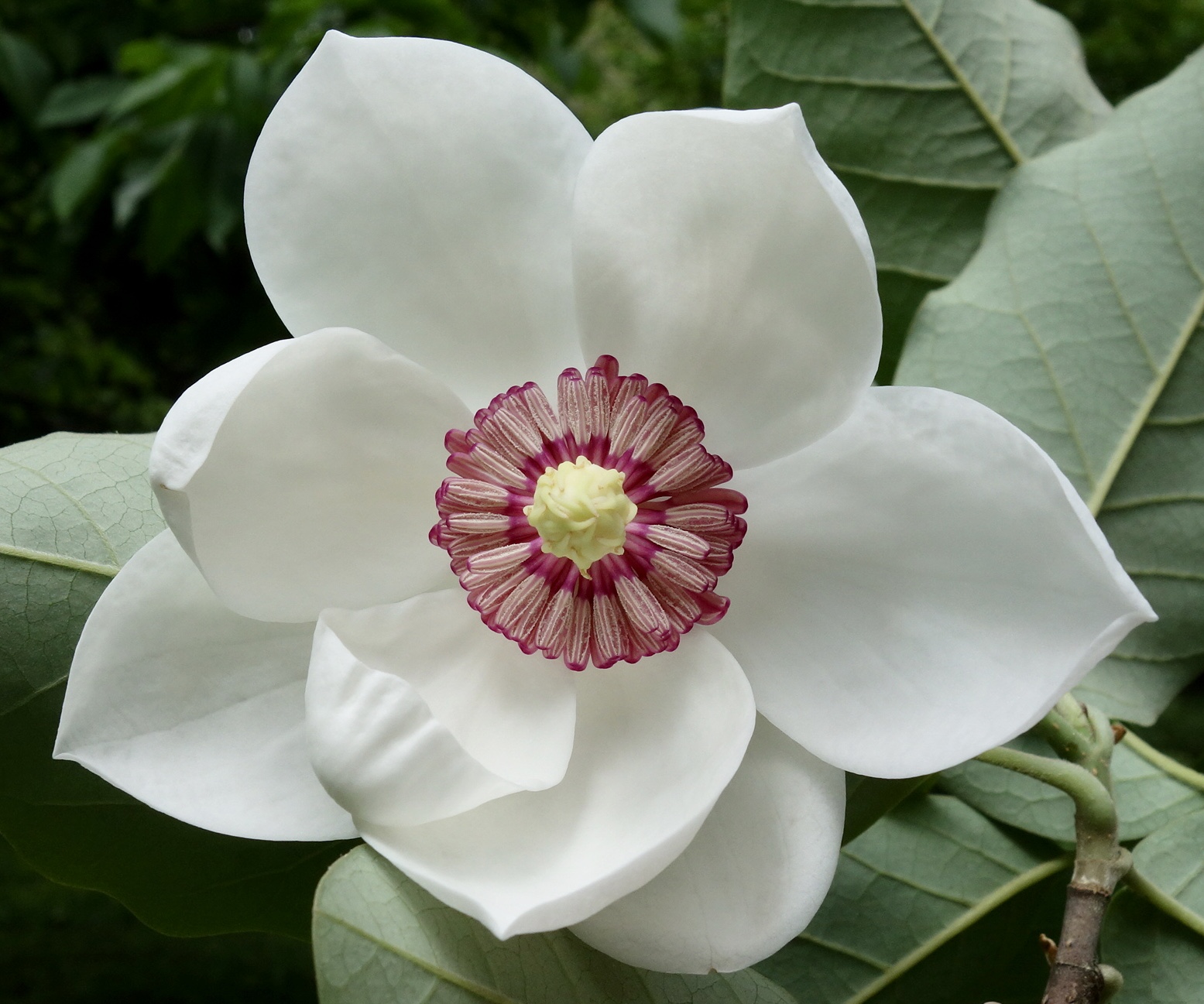
Magnolias are spreading evergreen or deciduous trees or shrubs characterised by large fragrant flowers, which may be bowl-shaped or star-shaped, in shades of white, pink, purple, green, or yellow. In deciduous species, the blooms often appear before the leaves in spring. Cone-like fruits are often produced in the autumn.
As with all Magnoliaceae, the perianth is undifferentiated, with 9–15 tepals in three or more whorls. The flowers are hermaphroditic, with numerous adnate carpels and stamens arranged in a spiral fashion on the elongated receptacle. The flowers' carpels are often damaged by pollinating beetles.
The fruit dehisces along the dorsal sutures of the carpels. The pollen is monocolpate, and the embryonic development is of the Polygonum type.[citation needed] Taxonomists, including James E. Dandy in 1927, have used differences in the fruits of Magnoliaceae as the basis for classification systems.
The name Magnolia first appeared in 1703 in the Genera written by French botanist Charles Plumier, for a flowering tree from the island of Martinique (talauma). It was named after French botanist Pierre Magnol. English botanist William Sherard, who studied botany in Paris under Joseph Pitton de Tournefort, a pupil of Magnol, was most probably the first after Plumier to adopt the genus name Magnolia. He was at least responsible for the taxonomic part of Johann Jacob Dillenius's Hortus Elthamensis and of Mark Catesby's Natural History of Carolina, Florida and the Bahama Islands. These were the first works after Plumier's Genera that used the name Magnolia, this time for some species of flowering trees from temperate North America. The species that Plumier originally named Magnolia was later described as Annona dodecapetala by Jean-Baptiste Lamarck and has since been named Magnolia plumieri and Talauma plumieri (among a number of other names), but is now known as Magnolia dodecapetala.
Magnolia
Magnolia is a large genus of about 210 to 340 flowering plant species in the subfamily Magnolioideae of the family Magnoliaceae. The natural range of Magnolia species is disjunct, with a main center in east, south and southeast Asia and a secondary center in eastern North America, Central America, the West Indies, and some species in South America.
Magnolias are evergreen or deciduous trees or shrubs known for their large, fragrant, bowl- or star-shaped flowers with numerous spirally arranged reproductive parts, producing cone-like fruits in autumn that open to reveal seeds. The genus Magnolia was first named in 1703 by Charles Plumier, honoring Pierre Magnol, with early taxonomy refined by Linnaeus in the 18th century based on American and later Asian species. Modern molecular phylogenetic studies have revealed complex relationships leading to taxonomic debates about merging related genera like Michelia with Magnolia. Magnolia species are valued horticulturally for their early and showy flowering, used culinarily in various edible forms, employed in traditional medicine for their bioactive compounds like magnolol and honokiol, and harvested for timber, with hybridization enhancing desirable traits.
Magnolia is an ancient genus that dates back to the Cretaceous. Fossilized specimens of M. acuminata have been found dating to 20 million years ago (mya), and fossils of plants identifiably belonging to the Magnoliaceae date to 95 mya. They are theorized to have evolved to encourage pollination by beetles as they existed prior to the evolution of bees. Another aspect of Magnolia considered to represent an ancestral state is that the flower bud is enclosed in a bract rather than in sepals; the perianth parts are undifferentiated and called tepals rather than distinct sepals and petals. Magnolia shares the tepal characteristic with several other flowering plants near the base of the flowering plant lineage, such as Amborella and Nymphaea (as well as with many more recently derived plants, such as Lilium).
Magnolias are culturally significant symbols, serving as official flowers and trees in various regions like Shanghai, Mississippi, Louisiana, North Korea, and Seoul, and are closely associated with the Southern United States. In the arts, magnolias symbolize both beauty and resilience, as seen in the play and film Steel Magnolias, while also evoking the contrasting brutality of lynching in the song "Strange Fruit" and Southern stereotypes in political commentary.
Magnolias are spreading evergreen or deciduous trees or shrubs characterised by large fragrant flowers, which may be bowl-shaped or star-shaped, in shades of white, pink, purple, green, or yellow. In deciduous species, the blooms often appear before the leaves in spring. Cone-like fruits are often produced in the autumn.
As with all Magnoliaceae, the perianth is undifferentiated, with 9–15 tepals in three or more whorls. The flowers are hermaphroditic, with numerous adnate carpels and stamens arranged in a spiral fashion on the elongated receptacle. The flowers' carpels are often damaged by pollinating beetles.
The fruit dehisces along the dorsal sutures of the carpels. The pollen is monocolpate, and the embryonic development is of the Polygonum type.[citation needed] Taxonomists, including James E. Dandy in 1927, have used differences in the fruits of Magnoliaceae as the basis for classification systems.
The name Magnolia first appeared in 1703 in the Genera written by French botanist Charles Plumier, for a flowering tree from the island of Martinique (talauma). It was named after French botanist Pierre Magnol. English botanist William Sherard, who studied botany in Paris under Joseph Pitton de Tournefort, a pupil of Magnol, was most probably the first after Plumier to adopt the genus name Magnolia. He was at least responsible for the taxonomic part of Johann Jacob Dillenius's Hortus Elthamensis and of Mark Catesby's Natural History of Carolina, Florida and the Bahama Islands. These were the first works after Plumier's Genera that used the name Magnolia, this time for some species of flowering trees from temperate North America. The species that Plumier originally named Magnolia was later described as Annona dodecapetala by Jean-Baptiste Lamarck and has since been named Magnolia plumieri and Talauma plumieri (among a number of other names), but is now known as Magnolia dodecapetala.
Recent media
Recent media