


Community hub
Recent from talks
Contribute something
Nothing was collected or created yet.
Strange Fruit
View on Wikipedia
| "Strange Fruit" | ||||
|---|---|---|---|---|
 | ||||
| Single by Billie Holiday | ||||
| B-side | "Fine and Mellow" | |||
| Released | 1939 | |||
| Recorded | April 20, 1939[1] | |||
| Genre | ||||
| Length | 3:02 | |||
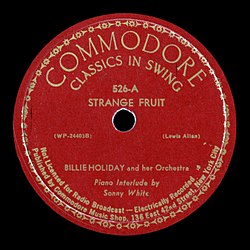
| Label | Commodore | |||
| Songwriter | Abel Meeropol | |||
| Producer | Milt Gabler | |||
| Billie Holiday singles chronology | ||||
| ||||
| Official audio | ||||
| "Strange Fruit" on YouTube | ||||
"Strange Fruit" is a song written and composed by Abel Meeropol (under his pseudonym Lewis Allan) and recorded by Billie Holiday in 1939. The lyrics were drawn from a poem by Meeropol, published in 1937.
The song protests the lynching of African Americans with lyrics that compare the victims to the fruit of trees. Such lynchings had reached a peak in the Southern United States at the turn of the 20th century, and most victims were African American.[2]: 561 The song was described as "a declaration of war" and "the beginning of the civil rights movement" by Atlantic Records co-founder Ahmet Ertegun.[3][4]
Meeropol set his lyrics to music with his wife Anne Shaffer and the singer Laura Duncan and performed it as a protest song in New York City venues in the late 1930s, including Madison Square Garden. Holiday's version was inducted into the Grammy Hall of Fame in 1978.[5] It was also included in the "Songs of the Century" list of the Recording Industry Association of America and the National Endowment for the Arts.[6] In 2002, "Strange Fruit" was selected for preservation in the National Recording Registry by the Library of Congress as being "culturally, historically or aesthetically significant".[7]
Poem and song
[edit]_(cropped).jpg)
"Strange Fruit" originated as a protest poem against lynchings.[9]: 25–27 [10] In the poem, Abel Meeropol expressed his horror at lynchings of African Americans, inspired by Lawrence Beitler's photograph of the 1930 lynching of Thomas Shipp and Abram Smith in Marion, Indiana.[11]
Meeropol published the poem under the title "Bitter Fruit" in January 1937 in The New York Teacher, a union magazine of the New York teachers union.[12][page needed] Though Meeropol had asked others (notably Earl Robinson) to set his poems to music, Meeropol set "Strange Fruit" to music himself. First performed by Meeropol's wife Anne Shaffer and their friends in social contexts,[13] his protest song gained a certain success in and around New York. Meeropol, Shaffer, and the Black vocalist Laura Duncan performed it at Madison Square Garden.[14]: 36-37
Billie Holiday's performances and recordings
[edit]One version of events claims that Barney Josephson, the founder of Café Society in Greenwich Village, New York's first integrated nightclub, heard the song and introduced it to Billie Holiday. Other reports say that Robert Gordon, who was directing Holiday's show at Café Society, heard the song at Madison Square Garden and introduced it to her.[12] Holiday first performed the song at Café Society in 1939. She said that singing it made her fearful of retaliation but, because its imagery reminded her of her father Clarence Halliday, she continued to sing the piece, making it a regular part of her live performances.[14]: 40–46 Because of the power of the song, Josephson drew up some rules: Holiday would close with it; the waiters would stop all service in advance; the room would be in darkness except for a spotlight on Holiday's face; and there would be no encore.[12] During the musical introduction to the song, Holiday stood with her eyes closed, as if she were evoking a prayer.

Holiday approached her recording label, Columbia, about the song, but the company feared reaction by record retailers in the South, as well as negative reaction from affiliates of its co-owned radio network, CBS.[14]: 61-62 When Holiday's producer John Hammond also refused to record it, she turned to her friend Milt Gabler, owner of the Commodore label.[15] Holiday sang "Strange Fruit" for him a cappella, and moved him to tears. Columbia gave Holiday a one-session release from her contract so she could record it; Frankie Newton's eight-piece Café Society Band was used for the session in an arrangement by Newton.[16] Because Gabler worried the song was too short, he asked pianist Sonny White to improvise an introduction. On the recording, Holiday starts singing after 70 seconds.[12] It was recorded on April 20, 1939.[17] Gabler worked out a special arrangement with Vocalion Records to record and distribute the song.[18]
Holiday recorded two major sessions of the song at Commodore, one in 1939 and one in 1944. The song was highly regarded; the 1939 recording eventually sold a million copies,[11] in time becoming the biggest-selling recording of Holiday's career.[19]
In her 1956 autobiography, Lady Sings the Blues, Holiday suggested that she, together with Meeropol, her accompanist Sonny White, and arranger Danny Mendelsohn, set the poem to music. The writers David Margolick and Hilton Als dismissed that claim in their work Strange Fruit: The Biography of a Song, writing that hers was "an account that may set a record for most misinformation per column inch". When challenged, Holiday—whose autobiography had been ghostwritten by William Dufty—claimed, "I ain't never read that book."[14]: 31–32
Holiday was so well known for her rendition of "Strange Fruit" that "she crafted a relationship to the song that would make them inseparable".[20] Holiday's 1939 version of the song was included in the National Recording Registry on January 27, 2003.[21]
In October 1939, Samuel Grafton of the New York Post said of "Strange Fruit", "If the anger of the exploited ever mounts high enough in the South, it now has its Marseillaise."[22] The anti-lynching movement adopted "Strange Fruit" as its anthem.[23] Since the 1930s several unsuccessful attempts were made in Congress to have lynching made a federal crime which were stymied by filibusters in the Senate by Southerners. In an attempt to achieve a two-thirds majority in the Senate that would break the filibusters by Southern senators, anti-racism activists were encouraged to mail copies of "Strange Fruit" to their senators.[14] : 77 [24][25]
Cover versions
[edit]Other notable cover versions of the song include the renditions of Nina Simone, UB 40, Siouxsie and the Banshees and Jeff Buckley. The Financial Times considered that Nina Simone "came close" to the original song "with her similarly bleak 1965 version". Journalist Fiona Sturges noted that "other interpreters have included Diana Ross, Jeff Buckley, Siouxsie and the Banshees, Cocteau Twins and Robert Wyatt", adding that "Kanye West revived interest in the song when he sampled Simone’s recording for his 2013 track 'Blood on the Leaves'."[26] The Times remarked that when West sampled it for a song, "about an ex-girlfriend, there was uproar." In contrast journalist Robert Dean noted that other covers "from acts as varied as UB40 and Siouxsie and the Banshees, have been highly respectful."[27] The New York Times wrote that "Josh White and Nina Simone were among the few artists to attempt it in the 1950s and 1960s. But [...] many other musicians—from Sting to Dee Dee Bridgewater to Tori Amos to Cassandra Wilson to UB40 to Siouxsie and the Banshees—have recorded "Strange Fruit," each cut an act of courage given Holiday's continuing hold over the song".[28]
Nina Simone initially recorded the song for her album Pastel Blues,[29] a recording described by journalist David Margolick in The New York Times as featuring a "plain and unsentimental voice".[28] The Los Angeles Times praised Siouxsie and the Banshees' version from the 1987 album Through the Looking Glass for "a solemn string section behind the vocals" and "a bridge of New Orleans funeral-march jazz" which highlighted the singer's "evocative interpretation".[30] The group's rendition was selected by Mojo magazine to be included on the compilation Music Is Love: 15 Tracks That Changed the World.[31] Jeff Buckley covered "Strange Fruit" after discovering it through Siouxsie and the Banshees' rendition.[32][33] Journalist Lara Pellegrinelli wrote that Buckley seemed to "meditate on the meaning of humanity the way Walt Whitman did, considering all of its glorious and horrifying possibilities".[34]
Awards and honors
[edit]In 1999 Time magazine named "Strange Fruit" as "Best Song of the Century" in its December 31, 1999, issue.[35] In 2002 the Library of Congress honored the song as one of 50 recordings chosen that year to add to the National Recording Registry.[36] In 2005 The Atlanta Journal-Constitution listed the song as Number One on "100 Songs of the South".[37] in 2010 the New Statesman listed it as one of the "Top 20 Political Songs".[38] In 2021: Rolling Stone listed it as the 21st best song on their "Top 500 Best Songs of All Time".[39] In 2025 Rolling Stone placed it at number 3 on its list of "The 100 Best Protest Songs of All Time."[40]
Bibliography
[edit]- Clarke, Donald (1995). Billie Holiday: Wishing on the Moon. München: Piper. ISBN 978-3-492-03756-3.
- Davis, Angela (1999) [1998]. ""Strange Fruit": Musical and Social Consciousness" (PDF). Blues Legacies and Black Feminism. Vintage Books. ISBN 0-679-77126-3. Retrieved October 28, 2024 – via Amherst.edu.
- Holiday, Billie; Dufty, William (1992). Lady Sings the Blues. Edition Nautilus. ISBN 978-3-89401-110-9.
- Margolick, David (2001). Strange Fruit: The Biography of a Song. Harper Collins. ISBN 978-0-060-95956-2.
References
[edit]- ^ "Billie Holiday recording sessions". Billieholidaysongs.com. Archived from the original on May 28, 2010. Retrieved April 20, 2011.
- ^ Myrdal, Gunnar (1944). An American Dilemma. Harper & Brothers.
- ^ Margolick, David (2000). "Chapter One". Strange Fruit: Billie Holiday, Café Society, and an Early Cry for Civil Rights. Running Press. ISBN 0-7624-0677-1 – via The New York Times.
Ahmet Ertegun, the legendary record producer, called 'Strange Fruit,' which Holiday first sang sixteen years before Rosa Parks refused to yield her seat on a Montgomery, Alabama bus, 'a declaration of war ... the beginning of the civil rights movement.'
- ^ Sonnenberg, Rhonda (September 29, 2023). "Artist collaborations with social justice organizations propel change". Southern Poverty Law Center. Archived from the original on June 16, 2024. Retrieved October 28, 2024.
- ^ Bessette Knight, Peg. "No Encore | The 100th Anniversary of Billie Holiday's Birth and the Legacy of "Strange Fruit"". ProQuest (Blog). Retrieved June 16, 2015.
- ^ "Songs of the Century". CNN. March 7, 2001. Archived from the original on September 13, 2024. Retrieved October 28, 2024.
- ^ Allen, Erin (April 16, 2015). "The Power of a Poem". Library of Congress (Blog). Retrieved June 18, 2021.
- ^ Richman, Joe; Diaz-Cortes, Anayansi; George, Deborah; Shapiro, Ben; Freemark, Samara; Baer, Annie (August 6, 2010). "Strange Fruit: Anniversary Of A Lynching". All Things Considered. NPR. Retrieved August 15, 2013.
- ^ Margolick, David (2000). Strange Fruit: Billie Holiday, Café Society, and an Early Cry for Civil Rights. Philadelphia, Pennsylvania: Running Press. ISBN 978-0762406777.
- ^ Blair, Elizabeth (September 5, 2012). "The Strange Story of the Man Behind 'Strange Fruit'". Morning Edition. NPR.
- ^ a b Moore, Edwin (September 18, 2010). "Strange Fruit is still a song for today". The Guardian. Retrieved September 23, 2010.
- ^ a b c d Lynskey, Dorian (2011). 33 revolutions per minute: a history of protest songs (1. ed.). London: Faber and Faber. ISBN 978-0-571-24134-7.
- ^ Carvalho, John M. (2013). "'Strange Fruit': Music between Violence and Death". The Journal of Aesthetics and Art Criticism. 71 (1). Hoboken, New Jersey: Wiley-Blackwell: 111–119 at 111–112. doi:10.1111/j.1540-6245.2012.01547.x. ISSN 0021-8529. JSTOR 23597541.
- ^ a b c d e Margolick, David (2001). Strange fruit: the biography of a song (1st ed.). New York: Ecco Press. ISBN 978-0-06-095956-2.
- ^ Billy Crystal (2004). 700 Sundays. HBO. OCLC 112. 700 Sundays at IMDb.
- ^ "George Kleinsinger". WNYC. New York. Retrieved August 22, 2023.
- ^ Amoako, Aida (April 17, 2019). "Strange Fruit: The most shocking song of all time?". BBC. Archived from the original on October 7, 2024. Retrieved October 28, 2024.
- ^ Billy Crystal, 700 Sundays, pp. 46–47.
- ^ "Billie Holiday's "Strange Fruit" (1939)". Smithsonian Music. December 4, 2018. Retrieved October 29, 2024.
- ^ Perry, Samuel (2012). ""Strange Fruit," Ekphrasis, and the Lynching Scene". Rhetoric Society Quarterly. 43 (5): 449–474. doi:10.1080/02773945.2013.839822. S2CID 144222928. Retrieved October 28, 2024 – via Taylor & Francis.
- ^ Sottosanti, Karen (October 8, 2024). "Strange Fruit | Lynching, Billie Holiday, Abel Meeropol, & Facts | Britannica". Encyclopedia Britannica.
- ^ Lynskey, Dorian (February 15, 2011). "Strange Fruit: the first great protest song". The Guardian.
- ^ Katz, Joel (January 17, 2003). "Strange Fruit". ITVS. Retrieved March 30, 2020.
- ^ Carrillo, Karen Juanita (May 10, 2023). "How Billie Holiday's 'Strange Fruit' Confronted an Ugly Era of Lynchings". History Channel.
- ^ "The history behind lynching protest song, "Strange Fruit"". CBS News. April 24, 2021 – via Facebook.
- ^ Sturges, Fiona (November 14, 2017). "Billie Holiday's Strange Fruit — 'the first unmuted cry against racism'". The Financial Times. Archived from the original on August 11, 2025. Retrieved August 10, 2025.
- ^ Dean, Jonathan (February 28, 2021). "The United States Vs. Billie Holiday: how the FBI tried to stop the protest anthem Strange Fruit". The Times. Archived from the original on August 11, 2025. Retrieved August 10, 2025.
- ^ a b Margolick, David. "Strange Fruit – Billie Holiday, Café Society, and an Early Cry for Civil Rights". The New York Times. Archived from the original on April 27, 2013. Retrieved August 10, 2025.
- ^ Amoako, Aida (April 17, 2019). "Strange Fruit: The most shocking song of all time". BBC. Retrieved April 20, 2020.
- ^ Atkinson, Terry (March 15, 1987). "Siouxsie Looks Back". The Los Angeles Times. Archived from the original on July 11, 2019. Retrieved June 15, 2018.
- ^ "Music Is Love! (15 Tracks That Changed The World) CD". Mojo. June 2007.
- ^ Grosdemouge, Jean-Marc (June 2005). "Jeff Buckley l'Archange Dévoilé --[Stan Cuesta- interview]". Epiphanies-mag.com. Retrieved November 5, 2024.
- ^ Cuesta, Stan (2009). Jeff Buckley. Castor Music. ISBN 978-2859208073.
- ^ Pellegrinelli, Lara (June 22, 2009). "Evolution Of A Song: 'Strange Fruit'". NPR. Retrieved February 23, 2015.
- ^ Sanburn, Josh (October 21, 2011). "Is 'Strange Fruit' one of the All-TIME 100 Best Songs?". Time.com. Retrieved October 29, 2024.
- ^ "National Recording Registry 2002". loc.gov. Retrieved January 29, 2018.
- ^ "100 Songs of the South | accessAtlanta.com". Alt.coxnewsweb.com. Archived from the original on September 15, 2005. Retrieved April 20, 2011.
- ^ Smith, Ian K (March 25, 2010). "Top 20 Political Songs: Strange Fruit". New Statesman. Retrieved March 25, 2010.
- ^ "The 500 Greatest Songs of All Time". Rolling Stone. September 15, 2021. Retrieved July 19, 2022.
- ^ "The 100 Best Protest Songs of All Time". Rolling Stone. January 27, 2025. Retrieved January 28, 2025.
External links
[edit]- Text of poem "Strange Fruit."
- "Strange Fruit", 78rpm Record, Internet Archive
- Film of Billie Holiday singing "Strange Fruit" (1959) on YouTube
- "Strange Fruit". Documentary. News Reel. 2002. Archived from the original on April 23, 2004.
- "Strange Fruit". Documentary. Independent Lens. PBS. March 31, 2022 [2003].
- "Strange Fruit" Archived March 2, 2012, at the Wayback Machine, Shmoop, analysis of lyrics, historical and literary allusions - student & teaching guide
- "Strange Fruit" at MusicBrainz (information and list of recordings)
- BBC Radio 4 - Soul Music, Series 17, Strange Fruit
- "Strange Fruit: A protest song with enduring relevance"
- "Strange Fruit". Radio Diaries (Podcast). PRX. Retrieved September 4, 2015.


Strange Fruit
View on GrokipediaOrigins and Inspiration
The Poem's Creation
Abel Meeropol, a Jewish American high school English teacher in the Bronx, wrote the anti-lynching poem originally titled "Bitter Fruit" in 1936.[6] The work was prompted by Meeropol's horror upon viewing a photograph of the lynching of Thomas Shipp and Abram Smith, two Black teenagers hanged by a white mob in Marion, Indiana, on August 7, 1930.[6][7] The image, captured by photographer Lawrence Beitler and widely circulated as postcards, depicted the victims' bodies suspended from a tree amid a crowd of spectators following accusations of robbery, murder of a white factory worker named Claude Deeter, and assault on his companion Mary Ball.[7][8] Meeropol, who published under the pseudonym Lewis Allan, expressed in the poem the grotesque imagery of "black bodies swinging in the southern breeze" as "strange fruit" to condemn the persistence of racial terror in the United States.[1] The poem's creation reflected Meeropol's broader concerns with injustice, as he was known for activism against racism and antisemitism.[9] "Bitter Fruit" first appeared in print in 1937 in The New York Teacher, the magazine of the New York City teachers' union, and was reprinted that year in the leftist journal New Masses.[6] This publication marked the poem's initial dissemination among intellectual and activist circles, prior to its adaptation into music.[6]
Historical Lynching Context
Lynching in the United States involved extrajudicial executions, typically by hanging or other violent means, carried out by mobs without legal due process. Between 1882 and 1968, the Tuskegee Institute documented 4,743 lynchings, of which 3,446 victims were African American and 1,297 were white, with the majority occurring in Southern states during the post-Reconstruction and Jim Crow eras.[10] These acts peaked in the 1890s, with annual figures often exceeding 100, and served to enforce racial subordination by instilling fear among Black communities.[11] Racial terror lynchings, concentrated between 1877 and 1950, numbered over 4,000 in the South alone, according to the Equal Justice Initiative's examination of county records, newspapers, and other archives.[12] Perpetrated primarily by white mobs against African Americans, they frequently followed accusations of crimes such as murder or rape—though investigations often revealed fabricated or exaggerated charges—and extended to perceived economic threats, voting attempts, or social defiance under Jim Crow segregation laws.[13] Public spectacles drew crowds of thousands, with victims mutilated, burned, or displayed as warnings, and photographs sometimes sold as postcards to commemorate the events.[12] Although most prevalent in the South, lynchings occurred nationwide, including in Northern and Midwestern states like Indiana, where economic competition and rumors of interracial crime fueled mob violence.[14] The 1930 lynching of Thomas Shipp (18) and Abram Smith (19) in Marion, Indiana, exemplifies this pattern: on August 7, a mob of 10,000 to 15,000 white residents stormed the Grant County jail, battering down doors with crowbars and sledgehammers to seize the youths accused of murdering a white factory worker and raping his companion.[8] A third youth, James Cameron (16), was spared after mob members disputed his involvement; Shipp and Smith's bodies were hanged from a tree in the courthouse square, photographed by local studio owner Lawrence Beitler, whose image circulated widely and shocked national observers.[7] This incident, occurring amid declining but persistent lynching rates—down to 8 documented cases in 1933—highlighted ongoing racial tensions and the failure of federal anti-lynching legislation, despite repeated bills introduced from 1922 onward.[10]Abel Meeropol's Background and Motivations
Abel Meeropol was born on February 10, 1903, in the Bronx, New York City, to Jewish immigrant parents from Russia who had fled antisemitic pogroms shortly before his birth.[15] [16] He graduated from DeWitt Clinton High School in 1921, earned a Bachelor of Arts from City College of New York, and later obtained a Master of Arts from Harvard University.[9] [17] Following his education, Meeropol became an English literature instructor at DeWitt Clinton High School, where he taught for nearly two decades starting in the 1920s.[9] [18] Meeropol pursued writing as a poet, lyricist, and songwriter alongside his teaching career, often under the pseudonym Lewis Allan, adopted in memory of a stillborn son and a deceased nephew.[19] His family background and personal experiences fostered a commitment to social activism, particularly against injustice and violence; as the son of pogrom survivors, he drew parallels between antisemitic persecution and racial violence in America.[6] Politically, Meeropol aligned with left-wing causes, joining the Communist Party in the early 1930s—a common affiliation among New York educators of the era—and contributing artistically to groups like the Young Communist League while serving as artistic director at the Communist-affiliated Camp Unity summer resort in the late 1920s.[9] [20] [15] Though he later distanced himself from active party involvement, these sympathies shaped his focus on civil rights and opposition to systemic racism.[21] Meeropol's motivation for composing "Strange Fruit"—originally titled "Bitter Fruit"—stemmed directly from his visceral reaction to a 1930 photograph depicting the lynching of Thomas Shipp and Abram Smith, two Black teenagers, in Marion, Indiana.[6] [22] The image, which circulated widely and captured a crowd's indifference to the brutality, horrified him and prompted the poem's creation around 1937 as a protest against lynching and the racial injustices enabling it.[23] He explicitly stated that he wrote it out of hatred for lynching, injustice, and its perpetrators, reflecting a broader activist drive informed by his Jewish heritage's emphasis on combating prejudice and his leftist critique of American racial violence.[24] [6] This work aligned with interwar efforts by Communist and progressive circles to highlight Southern lynchings, though Meeropol's expression emphasized personal moral outrage over partisan ideology.[6]Composition and Early Performances
Adaptation to Music
Following the 1937 publication of his poem "Bitter Fruit" (later retitled "Strange Fruit") in The New York Teacher, a Teachers Union magazine, Abel Meeropol composed music for the lyrics under his pseudonym Lewis Allan, transforming it into a protest song.[25][23] The adaptation retained the poem's stark imagery of lynching while pairing it with a slow, minor-key melody emphasizing irony and dread, structured as three verses without a chorus or bridge to heighten its lyrical directness and emotional weight.[25] Meeropol completed this musical setting around late 1938, drawing on influences like contemporary protest songs to create a cabaret-style ballad suitable for live performances at rallies.[24] The song premiered in activist circles, with Meeropol's wife, Anne Meeropol, performing it accompanied by nylon-string guitar, followed by renditions from jazz singer Laura Duncan at venues including Madison Square Garden and union meetings.[26][25] These early outings, occurring in 1938 and early 1939, aimed to amplify anti-lynching advocacy amid ongoing racial violence, though the performances remained confined to progressive audiences before broader exposure.[23] The adaptation's sparse arrangement—typically featuring piano or guitar—prioritized vocal delivery to evoke horror without embellishment, aligning with Meeropol's intent to confront injustice through unflinching realism.[1]Initial Public Readings and Performances
The poem "Strange Fruit," originally titled "Bitter Fruit," was first published in January 1937 in The New York Teacher, the magazine of the New York City Teachers Union, where Abel Meeropol worked as an English teacher.[27] This publication marked its initial public dissemination as a written protest against lynching, circulated among union members and leftist educators.[9] Following Meeropol's adaptation of the poem to music in late 1938 under his pseudonym Lewis Allan, the song received its earliest public performances at small-scale left-wing gatherings and teachers' union rallies in New York City.[28] His wife, Anne Meeropol, was the first to perform it publicly, accompanying herself on guitar at events such as a 1939 rally in Madison Park organized by the Teachers Union.[29] These performances targeted activist audiences sympathetic to anti-lynching causes and labor organizing, with the song quickly becoming a recurring piece at similar progressive meetings before its broader exposure.[28][30] No commercial recordings preceded Billie Holiday's version, and early renditions remained confined to informal, ideologically aligned settings, reflecting Meeropol's affiliations with communist and union circles.[9] Attendance at these events was limited, often numbering in the dozens to low hundreds, and focused on raising awareness of racial violence in the American South amid the era's documented history of extrajudicial killings.[28]Billie Holiday's Recording and Performances
Debut and Club Performances
Billie Holiday first performed "Strange Fruit" at Café Society, New York's pioneering racially integrated nightclub in Greenwich Village, in early 1939, shortly after club owner Barney Josephson introduced the song to her in late 1938 or early 1939.[31] The venue, which opened on December 23, 1938, featured Holiday as a headliner alongside integrated audiences and performers, marking a deliberate contrast to the segregated entertainment norms of the era.[32] Josephson insisted on staging "Strange Fruit" as the finale of Holiday's nightly sets to maximize its dramatic impact, directing waiters to halt service, dimming the house lights except for a spotlight on the singer, and instructing Holiday to deliver the lyrics with minimal accompaniment—often a cappella or with sparse piano—followed by a stark silence before she exited the stage without encore.[1] This ritualistic presentation underscored the song's haunting anti-lynching message, evoking discomfort among patrons; Holiday later recounted in her autobiography that the performances left audiences in stunned quietude, with some weeping and others avoiding eye contact.[33] The number's intensity drew repeat crowds to Café Society over Holiday's extended residency, solidifying its role as her signature piece amid the club's bohemian, progressive atmosphere.[23] Holiday continued these club renditions through spring 1939, refining her interpretive style—characterized by elongated phrasing, emotional restraint, and a gravelly timbre—to heighten the lyrics' visceral imagery of Southern lynchings, before transitioning to a studio recording later that month.[25] Contemporary accounts from the venue noted the performances' polarizing effect, with acclaim from intellectuals and jazz enthusiasts contrasting unease from those unaccustomed to overt civil rights commentary in entertainment.Studio Recording Details
Billie Holiday recorded "Strange Fruit" on April 20, 1939, at the World Broadcasting Studio at 711 Fifth Avenue in New York City.[34][1] The session was arranged for Commodore Records after Holiday's primary label, Columbia, refused to record the controversial song due to its subject matter.[35] Producer Milt Gabler, who founded the independent Commodore label specializing in alternative jazz, oversaw the recording after Holiday performed the song a cappella for him, moving him to tears.[31] The track featured Holiday on vocals, backed by an octet from Frank Newton and his Café Society Orchestra: Frankie Newton on trumpet, Talmadge "Tab" Smith on alto saxophone, Stanley Payne and Kenneth Hollon on tenor saxophones, Joe Sullivan on piano, John Collins on guitar, Elmer James on bass, and Cozy Cole on drums.[36] Gabler, concerned the song was too short at around three minutes, directed pianist Sonny White to add a stealthy piano introduction to extend it.[28] The session produced the master take of "Strange Fruit," along with an alternate take, as well as recordings of "Yesterdays," "Fine and Mellow," and "I Gotta Right to Sing the Blues."[37][38] The arrangement emphasized Holiday's a cappella-style delivery with minimal instrumentation to heighten the song's haunting impact, recorded in a single focused effort reflecting the era's small-group jazz sessions.[36]Immediate Reception and Censorship Attempts
Billie Holiday's live performances of "Strange Fruit" at Café Society in New York City beginning in late 1938 elicited intense and polarized responses from audiences, with many patrons falling into stunned silence during the rendition, followed by either thunderous applause or abrupt departures from the venue.[23] The club's owner, Barney Josephson, enforced a ritual for the song's delivery as the final number each night: service halted, lights dimmed to near darkness except for a spotlight on Holiday, and no encores or applause until she exited the stage, underscoring the piece's visceral impact on listeners confronting its graphic depiction of lynching.[39] These reactions highlighted the song's role in forcing confrontation with racial violence, though some white audience members expressed discomfort or outrage at its unflinching content.[25] Following the studio recording on April 20, 1939, for Commodore Records—after Columbia Records declined due to its provocative nature—the track faced swift backlash upon release later that year.[23] Numerous American radio stations banned airplay, classifying the song as excessively radical or inflammatory for broadcast standards of the era.[40] Contemporary press accounts described it as propaganda, with outlets like the white-owned newspapers criticizing its direct challenge to Southern racial norms.[41] Some nightclubs also restricted or prohibited performances, fearing alienating patrons or authorities amid heightened sensitivities to anti-lynching advocacy.[42] These censorship efforts reflected broader institutional resistance to the song's unsparing critique of lynching, a practice documented in over 4,000 cases against African Americans between 1877 and 1950, yet rarely addressed in mainstream media without euphemism.[43] Despite such barriers, the recording sold 1 million copies within 20 years, indicating grassroots resonance that outpaced official suppression.[44]Broader Recordings and Covers
Pre-Holiday and Contemporary Versions
Prior to Billie Holiday's 1939 recording, "Strange Fruit" existed primarily as live performances following Abel Meeropol's adaptation of his 1937 poem into music around 1938. The earliest documented musical rendition occurred at a New York City Teachers Union rally, where Meeropol, his wife Anne Shaffer, and Black vocalist Laura Duncan performed the song.[31] Duncan specifically delivered a performance at Madison Square Garden in 1938, marking one of the first public musical interpretations aimed at protesting lynching within leftist and union circles. These appearances were non-commercial, confined to activist venues, and lacked the widespread dissemination achieved later, reflecting the song's origins in ideological gatherings rather than mainstream entertainment.[25] No commercial recordings preceded Holiday's April 20, 1939, session for Commodore Records, which sold over a million copies despite initial resistance from labels.[1] Early versions emphasized stark, unaccompanied delivery to underscore the lyrics' horror, differing from Holiday's jazz-inflected arrangement but sharing the intent to evoke revulsion at Southern lynchings, which averaged 30-40 annually in the 1930s per Tuskegee Institute data.[45] In contemporary interpretations, artists have revisited "Strange Fruit" to address ongoing racial violence and historical memory, often amplifying its blues roots or industrial edge. In 2020, Bettye LaVette released a raw, guitar-driven cover on her album Blackbirds, produced by Steve Jordan, framing it as a mournful blues lament amid Black Lives Matter protests following George Floyd's death on May 25, 2020.[46] Singer-songwriter Jensen McRae offered a minimalist acoustic version the same year, collaborating with producer Rahki to highlight lyrical intimacy for modern audiences grappling with police brutality statistics, such as the 1,127 deaths by law enforcement in 2020 per Mapping Police Violence.[47] Slovenian industrial group Laibach issued a stark, mechanized rendition as a single on November 5, 2024, part of their ongoing covers series, intensifying the original's dread through synthesized dissonance to critique persistent authoritarianism and racial injustice.[48] These versions maintain the song's core imagery— "blood on the leaves and blood at the root"—while adapting to digital distribution, amassing millions of streams on platforms like Spotify, yet they provoke debate over whether reinterpretations dilute the 1930s context of over 4,000 documented lynchings since Reconstruction.[49]Post-1939 Covers and Adaptations
Following Billie Holiday's 1939 recording, "Strange Fruit" inspired numerous covers across genres, reflecting its persistent resonance as an anti-lynching protest anthem. Josh White's stripped-down acoustic rendition, recorded in 1944 for Keynote Records, emphasized folk-blues elements with minimal instrumentation, capturing the song's raw horror through vocal delivery and guitar accompaniment.[50][51] Nina Simone's interpretation, released in 1965 on her album Pastel Blues, stands as one of the most acclaimed post-Holiday versions, infusing the lyrics with intense emotional depth and piano-driven tension that amplified the original's indictment of racial violence.[52][53] Simone's cover gained further prominence through sampling, notably by Kanye West in "Blood on the Leaves" from his 2013 album Yeezus, where the opening bars of her rendition underpin a critique of modern public shaming and media scrutiny of Black celebrities, juxtaposed with trap beats and auto-tuned vocals.[54][55] The song's adaptability extended to reggae, rock, and other styles in later decades. UB40's dub-infused version appeared on their 1980 debut album Signing Off, transforming the protest into a rhythmic, echo-laden track that echoed the band's anti-racist themes.[56][55] Siouxsie and the Banshees offered a gothic rock reinterpretation in 1987 on Through the Looking Glass, featuring ethereal vocals and atmospheric instrumentation that evoked a haunting, otherworldly dread.[57][58]| Artist | Year | Album/Release | Notes/Genre |
|---|---|---|---|
| Josh White | 1944 | Keynote K-125 | Acoustic folk-blues |
| Nina Simone | 1965 | Pastel Blues | Jazz with piano focus |
| UB40 | 1980 | Signing Off | Reggae/dub |
| Siouxsie and the Banshees | 1987 | Through the Looking Glass | Gothic rock |
| Kanye West (sample) | 2013 | Yeezus ("Blood on the Leaves") | Hip-hop/trap adaptation |