Hubbry Logo
Maha Vir ChakraMaha Vir ChakraMain
Open search
Maha Vir Chakra
Community hub
Maha Vir Chakra
logo
8 pages, 0 posts
0 subscribers
Be the first to start a discussion here.
Maha Vir Chakra
Maha Vir Chakra
from Wikipedia

Maha Vir Chakra
Mahavir-chakra

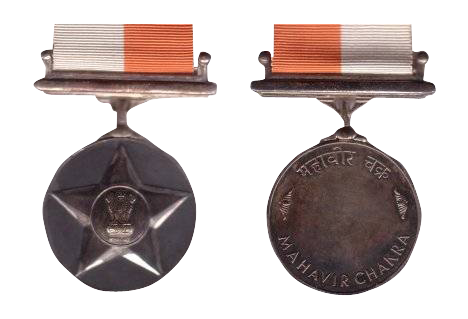
Maha Vir Chakra medal and ribbon
TypeMedal
Awarded for"... acts of gallantry in the presence of the enemy on land, at sea or in the air."[1]
CountryIndia Republic of India
Presented byIndia Republic of India
EligibilityMilitary personnel
StatusCurrently awarded
Established26 January 1950; 76 years ago (26 January 1950)
First award1947
Final award2023
Total awarded posthumously74
Total recipients213 (as of 2023)[2][3]
Precedence
Next (higher) Param Vishisht Seva Medal[4]
Equivalent Kirti Chakra[a][4]
Next (lower) Padma Shri[4]

The Maha Vir Chakra (MVC) (lit.'Medal for Great Bravery') is the second highest military decoration in India, after the Param Vir Chakra, and is awarded for acts of conspicuous gallantry in the presence of the enemy, whether on land, at sea or in the air. It replaced the British Distinguished Service Order (DSO). The medal may be awarded posthumously.

Appearance

[edit]

The medal is made of standard silver and is circular in shape. Embossed on the obverse is a five pointed heraldic star with circular center-piece bearing the gilded state emblem of India in the center. The words "Mahavira Chakra" are embossed in Hindi and English on the reverse with two lotus flowers in the middle. The decoration is worn on the left chest with a half-white and half-orange riband about 3.2 cm in width, the orange being near the left shoulder.[5]

History

[edit]

More than 218 acts of bravery and selfless courage have been recognized since the inception of the medal. The most MVCs awarded in a single conflict was in the Indo-Pakistani War of 1971, when eleven were given to the Indian Air Force.

Bar to MVC

[edit]

Provision was made for the award of a bar for a second award of the Maha Vir Chakra, the first two being awarded in 1965. To date, there are six known awards of a first bar:

S. No. Rank Name Branch Date of First Award Date of Second Award
1 Wing Commander Jag Mohan Nath  Indian Air Force 1 January 1962 1 September 1965
2 Major General Rajinder Singh Sparrow  Indian Army 19 March 1948 6 September 1965
3 General Arun Shridhar Vaidya  Indian Army 16 September 1965 5 December 1971
4 Wing Commander Padmanabha Gautam  Indian Air Force 6 September 1965 5 December 1971
5 Colonel Chewang Rinchen  Indian Army 1 July 1948 8 December 1971
6 Brigadier Sant Singh  Indian Army 2 November 1965 2 January 1972

No second bars have been awarded. Award of the decoration carries with it the right to use MVC as a post-nominal abbreviation.

List of recipients

[edit]

The Mahavir Chakra awardees include:[6][7]

Key
Indicates posthumous honour
S. No. Rank Name Branch Operation/War Date of Award
1 Lieutenant Colonel Dewan Ranjit Rai  Indian Army 1947 Indo-Pakistan War[8] 27-Oct-1947
2 Sepoy Dewan Singh  Indian Army 1947 Indo-Pakistan War[9] 03-Nov-1947
3 Naik Chand Singh  Indian Army 1947 Indo-Pakistan War[10] 22-Nov-1947
4 Subedar Bishan Singh  Indian Army 1947 Indo-Pakistan War[11] 12-Dec-1947
5 Jemadar Nand Singh  Indian Army 1947 Indo-Pakistan War[12] 12-Dec-1947
6 Colonel Thakur Prithi Chand  Indian Army 1947 Indo-Pakistan War[13] 15-Aug-1948
7 Civilian Ram Chandar Civilian 1947 Indo-Pakistan War[14] 26-Jan-1950
8 Major Yadunath Singh  Indian Army 1947 Indo-Pakistan War[15] 26-Jan-1950
9 Lieutenant Colonel Inder Jit Singh Butalia  Indian Army 1947 Indo-Pakistan War[16] 26-Jan-1950
10 Lieutenant Colonel Khushal Chand  Indian Army 1947 Indo-Pakistan War[17] 26-Jan-1950
11 Brigadier Mohammad Usman  Indian Army 1947 Indo-Pakistan War[18] 26-Jan-1950
12 Lieutenant Colonel Man Mohan Khanna  Indian Army 1947 Indo-Pakistan War[19] 26-Jan-1950
13 Brigadier Rajinder Singh  Indian Army 1947 Indo-Pakistan War[20] 26-Jan-1950
14 Major Annavi K Ramaswamy  Indian Army 1947 Indo-Pakistan War[21] 26-Jan-1950
15 Sepoy Man Singh  Indian Army 1947 Indo-Pakistan War[22] 26-Jan-1950
16 Havildar Daya Ram  Indian Army 1947 Indo-Pakistan War[23] 26-Jan-1950
17 Colonel Kishan Singh Rathor  Indian Army 1947 Indo-Pakistan War[24] 26-Jan-1950
18 Subedar Major Krishna Sonawane  Indian Army 1947 Indo-Pakistan War[25] 26-Jan-1950
19 Major Sardar Malkit Singh Brar  Indian Army 1947 Indo-Pakistan War[26] 26-Jan-1950
20 Major Satyapal Chopra  Indian Army 1947 Indo-Pakistan War[27] 26-Jan-1950
21 Lieutenant Colonel Hari Chand  Indian Army 1947 Indo-Pakistan War[28] 26-Jan-1950
22 Sepoy Hari Singh  Indian Army 1948 Operation Polo[29] 17-Mar-1948
23 Subedar Gurdial Singh  Indian Army 1947 Indo-Pakistan War[30] 26-Jan-1950
24 Major General Rajinder Singh Sparrow  Indian Army 1947 Indo-Pakistan War[31] 26-Jan-1950
25 Brigadier Arvind Nilkanth Jatar  Indian Army 1947 Indo-Pakistan War[32] 26-Jan-1950
26 Naik Shishpal Singh  Indian Army 1947 Indo-Pakistan War[33] 26-Jan-1950
27 Rifleman Dhonkal Singh  Indian Army 1947 Indo-Pakistan War[34] 26-Jan-1950
28 Lieutenant Colonel Kaman Singh  Indian Army 1947 Indo-Pakistan War[35] 26-Jan-1950
29 Jemadar Lal Bahadur Khattri  Indian Army 1947 Indo-Pakistan War[36] 26-Jan-1952
30 Jemadar Hardev Singh  Indian Army 1947 Indo-Pakistan War[37] 26-Jan-1950
31 Naik Nar Singh  Indian Army 1947 Indo-Pakistan War[38] 26-Jan-1950
32 Naik Raju  Indian Army 1947 Indo-Pakistan War[39] 26-Jan-1950
33 Subedar Chuni Ram  Indian Army 1947 Indo-Pakistan War[40] 26-Jan-1950
34 Civilian Porter Mohd Ismail Civilian 1947 Indo-Pakistan War[41] 26-Jan-1950
35 Sepoy Amar Singh  Indian Army 1947 Indo-Pakistan War[42] 26-Jan-1950
36 Major Chewang Rinchen  Indian Army 1947 Indo-Pakistan War[43] 01-Jul-1948
37 Naik Pritam Singh  Indian Army 1947 Indo-Pakistan War[44] 26-Jan-1950
38 Jemadar Sampooran Singh  Indian Army 1947 Indo-Pakistan War[45] 26-Jan-1950
39 Brigadier Sher Jung Thapa  Indian Army 1947 Indo-Pakistan War[46] 26-Jan-1950
40 Subedar Fateh Singh  Indian Army 1947 Indo-Pakistan War[47] 26-Jan-1950
41 Lieutenant Colonel Harbans Singh Virk  Indian Army 1947 Indo-Pakistan War[48] 26-Jan-1950
42 Lieutenant General Anil Krishna Barat  Indian Army 1947 Indo-Pakistan War[49] 26-Jan-1950
43 Lance Naik Rabi Lal Thapa  Indian Army 1947 Indo-Pakistan War[50] 26-Jan-1950
44 Lieutenant Colonel Dharam Singh  Indian Army 1947 Indo-Pakistan War[51] 26-Jan-1950
45 Major General Anant Singh Pathania  Indian Army 1947 Indo-Pakistan War[52] 26-Jan-1950
46 Havildar Ram Parsad Gurung  Indian Army 1947 Indo-Pakistan War[53] 26-Jan-1950
47 Jemadar Lal Singh  Indian Army 1948 Operation Polo[54] 15-Nov-1948
48 Brigadier Kanhya Lal Atal  Indian Army 1947 Indo-Pakistan War[55] 26-Jan-1950
49 Captain Dara Dinshaw Mistry  Indian Army 1947 Indo-Pakistan War[56] 26-Jan-1950
50 Air Commodore Mehar Singh  Indian Air Force 1947 Indo-Pakistan War[57] 26-Jan-1950
51 Air Marshal Minoo Merwan Engineer  Indian Air Force 1947 Indo-Pakistan War[58] 26-Jan-1950
52 Wing Commander Sidney Basil Norohna  Indian Air Force 1947 Indo-Pakistan War[59] 26-Jan-1950
53 Lieutenant Colonel AG Rangaraj  Indian Army 1951 Operation Tomahawk[60] 24-Mar-1951
54 Colonel Nirod Baran Banerjee  Indian Army 1951 Operation Tomahawk[61] March-1951
55 Air Chief Marshal Hrushikesh Moolgavkar  Indian Air Force 1961 Operation Vijay: Goa[62] 08-Dec-1951
56 Lance Naik Ran Bahadur Gurung  Indian Army 1961 UN Operation: Congo[63] 06-Dec-1961
57 Naik Mahabir Thapa  Indian Army 1962 UN Operation: Congo[64] 16-Dec-1961
58 Wing Commander Jag Mohan Nath  Indian Air Force 1962 Operation Leg Horn[65] 01-Jan-1962
59 Naik Chain Singh  Indian Army 1962 Operation Leg Horn[66] 10-Oct-1962
60 Subedar Kanshi Ram  Indian Army 1962 Operation Leg Horn[67] 10-Oct-1962
61 Havildar Sarup Singh  Indian Army 1962 Operation Leg Horn[68] 19-Oct-1962
62 Lieutenant Colonel Bhagwan Dutt Dogra  Indian Army 1962 Indo-China War[69] 20-Oct-1962
63 Second lieutenant GKV Prasanna Rao  Indian Army 1962 Indo-China War[70] 20-Oct-1962
64 Lieutenant Colonel Gurdial Singh  Indian Army 1962 Indo-China War[71] 20-Oct-1962
65 Captain Mahabir Prasad  Indian Army 1962 Indo-China War[72] 20-Oct-1962
66 Major Mahander Singh Chaudhary  Indian Army 1962 Indo-China War[73] 20-Oct-1962
67 Lieutenant Colonel Sardul Singh Randhawa  Indian Army 1962 Indo-China War[74] 20-Oct-1962
68 Brigadier Sher Pratap Singh Shrikent  Indian Army 1962 Indo-China War[75] 20-Oct-1962
69 Subedar Sonam Stopdhan  Indian Army 1962 Indo-China War[76] 20-Oct-1962
70 General Tapishwar Narain Raina  Indian Army 1962 Indo-China War[77] 20-Oct-1962
71 Naib Subedar Rabi Lal Thapa  Indian Army 1962 Indo-China War[78] 21-Oct-1962
72 Colonel Ajit Singh  Indian Army 1962 Indo-China War[79] 22-Oct-1962
73 Major General Bejoy Mohan Bhattacharjea  Indian Army 1962 Indo-China War[80] 25-Oct-1962
74 Sepoy Kewal Singh  Indian Army 1962 Indo-China War[81] 26-Oct-1962
75 Havildar Satigian Phunchok  Indian Army 1962 Indo-China War[82] 27-Oct-1962
76 Jemadar Isht Tundup  Indian Army 1962 Indo-China War[83] 27-Oct-1962
77 Rifleman Jaswant Singh Rawat  Indian Army 1962 Indo-China War[84] 17-Nov-1962
78 Major Shyamal Dev Goswami  Indian Army 1962 Indo-China War[85] 18-Nov-1962
79 Lieutenant Ved Prakash Trehan  Indian Army Congo Crisis[86] 29-Dec-1962
80 Major General Sushil Kumar Mathur  Indian Army 1965 Operation Ablaze[87] 15-Apr-1965
81 Major Baljit Singh Randhawa  Indian Army 1965 Operation Ablaze[88] 17-May-1965
82 Captain Chander Narain Singh  Indian Army 1965 Operation Ablaze[89] 05-Aug-1965
83 Major General Swarup Singh Kalaan  Indian Army 1965 Operation Ablaze[90] 05-Aug-1965
84 Lieutenant General Ram Dharam Dass Hira  Indian Army 1965 Operation Ablaze[91] 05-Aug-1965
85 Lieutenant General Zorawar Chand Bakshi  Indian Army 1965 Operation Ablaze[92] 05-Aug-1965
86 Colonel Gurbans Singh Sangha  Indian Army 1965 Operation Riddle[93] 15-Aug-1965
87 Lieutenant General Ranjit Singh Dayal  Indian Army 1965 Operation Riddle[94] 25-Aug-1965
88 Major Bhaskar Roy  Indian Army 1965 Operation Riddle[95] 01-Sep-1965
89 Wing Commander Jag Mohan Nath  Indian Air Force 1965 Operation Riddle[65] 01-Sep-1965
90 Air Commodore William MacDonald Goodman  Indian Air Force 1965 Operation Riddle[96] 01-Sep-1965
91 Subedar Ajit Singh  Indian Army 1965 Operation Riddle[97] 06-Sep-1965
92 Brigadier Desmond Hayde  Indian Army 1965 Operation Riddle[98] 06-Sep-1965
93 Major General Gurbaksh Singh  Indian Army 1965 Operation Riddle[99] 06-Sep-1965
94 Major General Rajinder Singh Sparrow  Indian Army 1965 Operation Riddle[31] 06-Sep-1965
95 Lieutenant General Har Krishen Sibal  Indian Army 1965 Operation Riddle[100] 06-Sep-1965
96 Lieutenant General Khem Karan Singh  Indian Army 1965 Operation Riddle[101] 06-Sep-1965
97 Lieutenant Colonel Narindra Nath Khanna  Indian Army 1965 Operation Riddle[102] 06-Sep-1965
98 Wing Commander Padmanabha Gautam  Indian Air Force 1965 Operation Riddle[103] 06-Sep-1965
99 Air Marshal Prem Pal Singh  Indian Air Force 1965 Operation Riddle[104] 06-Sep-1965
100 Brigadier Raghubir Singh  Indian Army 1965 Operation Riddle[105] 07-Sep-1965
101 Lieutenant Colonel Harbans Lal Mehta  Indian Army 1965 Operation Riddle[106] 08-Sep-1965
102 Naib Subedar Naubat Ram  Indian Army 1965 Operation Riddle[107] 08-Sep-1965
103 Brigadier Thomas Krishnan Theogaraj  Indian Army 1965 Operation Riddle[108] 08-Sep-1965
104 Major General Mohindar Singh  Indian Army 1965 Operation Riddle[109] 09-Sep-1965
105 Brigadier Sampuran Singh  Indian Army 1965 Operation Ablaze[110] 09-Sep-1965
106 Major General Salim Caleb  Indian Army 1965 Operation Riddle[111] 10-Sep-1965
107 Major General Madan Mohan Singh Bakshi  Indian Army 1965 Operation Riddle[112] 11-Sep-1965
108 General Arun Shridhar Vaidya  Indian Army 1965 Operation Riddle[113] 16-Sep-1965
109 Major Asa Ram Tyagi  Indian Army 1965 Operation Ablaze[114] 21-Sep-1965
110 Captain Kapil Singh Thapa  Indian Army 1965 Operation Riddle[115] 21-Sep-1965
111 Brigadier Pagadala K Nandagopal  Indian Army 1965 Operation Riddle[116] 28-Sep-1965
112 Subedar Tika Bahadur Thapa  Indian Army 1965 Operation Riddle[117] 30-Sep-1965
113 Major Bhupinder Singh  Indian Army 1965 Operation Riddle[118] 11-Oct-1965
114 Naik Darshan Singh  Indian Army 1965 Operation Riddle[119] 02-Nov-1965
115 Captain Gautam Mubayi  Indian Army 1965 Operation Riddle[120] 02-Nov-1965
116 Brigadier Sant Singh  Indian Army 1965 Operation Riddle[121] 02-Nov-1965
117 Major Harbhajan Singh  Indian Army 1967 Indo-China War[122] 11-Sep-1967
118 Brigadier Rai Singh Yadav  Indian Army 1967 Indo-China War[123] 11-Sep-1967
119 Lieutenant Colonel Mahatam Singh  Indian Army 1967 Indo-China War[124] 01-Oct-1967
120 Lieutenant General Anand Sarup  Indian Army 1971 Indo-Pakistan War[125] 01-Jan-1971
121 Brigadier Arun Bhimrao Harolikar  Indian Army 1971 Indo-Pakistan War[126] 01-Jan-1971
122 Major General Anthony Harold Edward Michigan  Indian Army 1971 Indo-Pakistan War[127] 01-Jan-1971
123 Major General Hardev Singh Kler  Indian Army 1971 Indo-Pakistan War[128] 01-Jan-1971
124 Captain Mohan Narayan Rao Samant  Indian Navy 1971 Indo-Pakistan War[129] 01-Jan-1971
125 Brigadier Rajkumar Singh  Indian Army 1971 Indo-Pakistan War[130] 01-Jan-1971
126 Lieutenant Colonel Surinder Kapur  Indian Army 1971 Indo-Pakistan War[131] 01-Jan-1971
127 Lance Naik Ram Ugrah Pandey  Indian Army 1971 Indo-Pakistan War[132] 24-Nov-1971
128 Sepoy Ansuya Prasad  Indian Army 1971 Indo-Pakistan War[133] 30-Nov-1971
129 Rifleman Pati Ram Gurung  Indian Army 1971 Indo-Pakistan War[134] 30-Nov-1971
130 Lieutenant Colonel Shamsher Singh  Indian Army 1971 Indo-Pakistan War[135] 01-Dec-1971
131 Vice Admiral Swaraj Parkash  Indian Navy 1971 Indo-Pakistan War[136] 01-Dec-1971
132 Major Anup Singh Gahlaut  Indian Army 1971 Indo-Pakistan War[137] 03-Dec-1971
133 Brigadier Basdev Singh Mankotia  Indian Army 1971 Indo-Pakistan War[138] 03-Dec-1971
134 Major General Anant Vishwanath Natu  Indian Army 1971 Indo-Pakistan War[139] 03-Dec-1971
135 Major General Kashmiri Lal Rattan  Indian Army 1971 Indo-Pakistan War[140] 03-Dec-1971
136 Major General Prem Kumar Khanna  Indian Army 1971 Indo-Pakistan War[141] 03-Dec-1971
137 Lieutenant Colonel Jaivir Singh  Indian Army 1971 Indo-Pakistan War[142] 03-Dec-1971
138 Air Vice-Marshal Vidya Bhushan Vasisht  Indian Air Force 1971 Indo-Pakistan War[143] 03-Dec-1971
139 Group Captain Allan Albert D’Costa  Indian Air Force 1971 Indo-Pakistan War[144] 04-Dec-1971
140 Subedar Major Bir Bahadur Pun  Indian Army 1971 Indo-Pakistan War[145] 04-Dec-1971
141 Commodore Kasargod Patnashetti Gopal Rao  Indian Navy 1971 Operation Trident[146] 04-Dec-1971
142 Brigadier K Gowrishankar  Indian Army 1971 Indo-Pakistan War[113] 05-Dec-1971
143 Brigadier Hardev Singh Kler  Indian Army 1971 Indo-Pakistan War[103] ---Dec-1971
144 General Arun Shridhar Vaidya  Indian Army 1971 Indo-Pakistan War[113] 05-Dec-1971
145 Commodore Babru Bhan Yadav  Indian Navy 1971 Operation Trident[147] 05-Dec-1971
146 Captain Devinder Singh Ahlawat  Indian Army 1971 Indo-Pakistan War[148] 05-Dec-1971
147 Lieutenant General Krishnaswamy Gowri Shankar  Indian Army 1971 Indo-Pakistan War[149] 05-Dec-1971
148 Brigadier Kuldip Singh Chandpuri  Indian Army 1971 Indo-Pakistan War[150] 05-Dec-1971
149 Brigadier Narinder Singh Sandhu  Indian Army 1971 Indo-Pakistan War[151] 05-Dec-1971
150 Wing Commander Padmanabha Gautam  Indian Air Force 1971 Indo-Pakistan War[103] 05-Dec-1971
151 Air Marshal Ravinder Nath Bhardwaj  Indian Air Force 1971 Indo-Pakistan War[152] 05-Dec-1971
152 Lieutenant Colonel Sawai Bhawani Singh  Indian Army 1971 Indo-Pakistan War[153] 05-Dec-1971
153 Lieutenant General Joginder Singh Gharaya  Indian Army 1971 Indo-Pakistan War[154] 06-Dec-1971
154 Brigadier Kailash Prasad Pande  Indian Army 1971 Indo-Pakistan War[155] 06-Dec-1971
155 Brigadier Mohindar Lal Whig  Indian Army 1971 Indo-Pakistan War[156] 06-Dec-1971
156 Sepoy Pandurang Salunkhe  Indian Army 1971 Indo-Pakistan War[157] 06-Dec-1971
157 Air Vice-Marshal Chandan Singh  Indian Air Force 1971 Indo-Pakistan War[158] 07-Dec-1971
158 Lieutenant Colonel Chittoor Venugopal  Indian Army 1971 Indo-Pakistan War[159] 07-Dec-1971
159 Lieutenant General Joginder Singh Bakshi  Indian Army 1971 Indo-Pakistan War[160] 07-Dec-1971
160 Subedar Major Mohinder Singh  Indian Army 1971 Indo-Pakistan War[161] 07-Dec-1971
161 Major Chewang Rinchen  Indian Army 1971 Indo-Pakistan War[43] 08-Dec-1971
162 Petty Officer Chiman Singh  Indian Navy 1971 Indo-Pakistan War[162] 08-Dec-1971
163 Commander Joseph Pius Alfred Noronha  Indian Navy 1971 Indo-Pakistan War[163] 08-Dec-1971
164 Brigadier Udai Singh Bhati  Indian Army 1971 Indo-Pakistan War[164] 08-Dec-1971
165 Captain Mahendra Nath Mulla  Indian Navy 1971 Indo-Pakistan War[165] 09-Dec-1971
166 Naik Sugan Singh  Indian Army 1971 Indo-Pakistan War[166] 09-Dec-1971
167 Brigadier Rattan Nath Sharma  Indian Army 1971 Indo-Pakistan War[167] 10-Dec-1971
168 Lieutenant Colonel Harish Chandra Pathak  Indian Army 1971 Indo-Pakistan War[168] 11-Dec-1971
169 Major Kulwant Singh Pannu  Indian Army 1971 Indo-Pakistan War[169] 11-Dec-1971
170 Brigadier Sukhjit Singh  Indian Army 1971 Indo-Pakistan War[170] 11-Dec-1971
171 Major Vijay Rattan Choudhry  Indian Army 1971 Indo-Pakistan War[171] 11-Dec-1971
172 Lance Naik Drig Pal Singh  Indian Army 1971 Indo-Pakistan War[172] 13-Dec-1971
173 Captain Pradip Kumar Gour  Indian Army 1971 Indo-Pakistan War[173] 14-Dec-1971
174 Brigadier Amarjit Singh Bal  Indian Army 1971 Indo-Pakistan War[174] 15-Dec-1971
175 Havildar Thomas Philipose  Indian Army 1971 Indo-Pakistan War[175] 15-Dec-1971
176 Lieutenant Colonel Ved Prakash Ghai  Indian Army 1971 Indo-Pakistan War[176] 15-Dec-1971
177 Lieutenant General Hanut Singh  Indian Army 1971 Indo-Pakistan War[177] 16-Dec-1971
178 Lieutenant General Raj Mohan Vohra  Indian Army 1971 Indo-Pakistan War[178] 16-Dec-1971
179 Captain Shankar Shankhapan Walkar  Indian Army 1971 Indo-Pakistan War[179] 16-Dec-1971
180 Air Vice-Marshal Cecil Vivian Parker  Indian Air Force 1971 Indo-Pakistan War[180] 17-Dec-1971
181 Air Commodore Harcharan Singh Manget  Indian Air Force 1971 Indo-Pakistan War[181] 17-Dec-1971
182 Air Vice-Marshal Madhavendra Banerji  Indian Air Force 1971 Indo-Pakistan War[182] 17-Dec-1971
183 Subedar Malkiat Singh  Indian Army 1971 Indo-Pakistan War[183] 17-Dec-1971
184 Group Captain Man Mohan Bir Singh Talwar  Indian Air Force 1971 Indo-Pakistan War[184] 17-Dec-1971
185 Air Commodore Ramesh Sakharam Benegal  Indian Air Force 1971 Indo-Pakistan War[185] 17-Dec-1971
186 Second Lieutenant Shamsher Singh Samra  Indian Army 1971 Indo-Pakistan War[186] 17-Dec-1971
187 Lance Naik Shanghara Singh  Indian Army 1971 Indo-Pakistan War[187] 17-Dec-1971
188 Lance Havildar Dil Bahadur Chettri  Indian Army 1971 Indo-Pakistan War[188] 21-Dec-1971
189 Rear Admiral Santosh Kumar Gupta  Indian Navy 1971 Indo-Pakistan War[189] 21-Dec-1971
190 Brigadier Vijay Kumar Berry  Indian Army 1971 Indo-Pakistan War[190] 28-Dec-1971
191 Air Chief Marshal S. K. Kaul  Indian Air Force 1971 Indo-Pakistan War[191] 30-Dec-1971
192 Subedar Nar Bahadur Chhetri  Indian Army 1971 Indo-Pakistan War[192] 31-Dec-1971
193 Colonel Dharam Vir Singh  Indian Army 1971 Indo-Pakistan War[193] 01-Jan-1972
194 Brigadier Sant Singh  Indian Army 1971 Indo-Pakistan War[121] 02-Jan-1972
195 Major Daljit Singh Narang  Indian Army 1971 Indo-Pakistan War[194] 20-Jan-1972
196 Lieutenant General Ved Prakash Airy  Indian Army 1971 Indo-Pakistan War[195] 20-Jan-1972
197 Assistant commandant Ram Krishna Wadhwa BSF 1971 Indo-Pakistan War[196] 10-Dec-1972
198 Lieutenant Colonel Puttichanda Somaiah Ganapathi  Indian Army 1987 Operation Pawan[197] 16-Oct-1987
199 Brigadier Manjit Singh  Indian Army 1987 Operation Pawan[198] 19-Oct-1987
200 Lieutenant Arvind Singh  Indian Navy 1987 Operation Pawan[199] 22-Jan-1988
201 Squadron Leader Ajjamada B. Devaiah  Indian Air Force 1965 Operation Ablaze[200] 26-Jan-1988
202 Colonel Krishna Gopal Chatterjee  Indian Army 1987 Operation Rajiv[201] 26-Jan-1988
203 Lance Havildar Nar Bahadur Ale  Indian Army 1987 Operation Rajiv[202] 26-Jan-1988
204 Naik Prem Bahadur Gurung  Indian Army 1987 Operation Rajiv[203] 26-Jan-1988
205 Subedar Sansar Chand  Indian Army 1987 Operation Rajiv[204] 26-Jan-1988
206 Lieutenant Colonel Inder Bal Singh Bawa  Indian Army 1987 Operation Pawan[205] 02-Apr-1988
207 Captain Pratap Singh  Indian Army 1984 Operation Meghdoot[206] 25-May-1988
208 Second Lieutenant Rajeev Sandhu  Indian Army 1987 Operation Pawan[207] 19-Jul-1988
209 Colonel Vijay Kumar Bakshi  Indian Army 1989 Operation Pawan[208] 29-Mar-1989
210 Captain Anuj Nayyar  Indian Army 1999 Operation Vijay[209] 15-Aug-1999
211 Major Balwan Singh  Indian Army 1999 Operation Vijay[210] 15-Aug-1999
212 Major Rajesh Singh Adhikari  Indian Army 1999 Operation Vijay[211] 15-Aug-1999
213 Lieutenant Colonel Sonam Wangchuk  Indian Army 1999 Operation Vijay[212] 15-Aug-1999
214 Captain Keishing Clifford Nongrun  Indian Army 1999 Operation Vijay[213] 15-Aug-1999
215 Naik Digendra Kumar  Indian Army 1999 Operation Vijay[214] 15-Aug-1999
216 Captain Neikezhakuo Kengurüse  Indian Army 1999 Operation Vijay[215] 15-Aug-1999
217 Major Padmapani Acharya  Indian Army 1999 Operation Vijay[216] 15-Aug-1999
218 Major Vivek Gupta  Indian Army 1999 Operation Vijay[217] 15-Aug-1999
219 Sepoy Imliakum Ao  Indian Army 1999 Operation Vijay[218] 26-Jan-2000
220 Captain Gurjinder Singh Suri  Indian Army 1999 Operation Vijay[219] 01-Jan-2001
221 Colonel B. Santosh Babu  Indian Army 2020 Operation Snow Leopard[220] 26-Jan-2021

Notes

[edit]

References

[edit]
[edit]
Revisions and contributorsEdit on WikipediaRead on Wikipedia
from Grokipedia
The Maha Vir Chakra (MVC) is the second-highest military decoration in , awarded for acts of conspicuous gallantry in the presence of the enemy whether on land, at sea, or in the air. Instituted by the on 26 January 1950 as part of the initial post-independence gallantry awards alongside the and , it recognizes exceptional valor displayed by personnel of the during wartime operations, irrespective of rank, and can be conferred posthumously. The award consists of a bronze medal featuring a lotus flower emblem suspended from a plain swiveling suspenders via a straight horizontal bar, with a purple ribbon one-and-a-half inches wide bearing stripes of red, orange, yellow, and green. As of the latest records, 213 MVCs have been awarded since its inception, primarily during major conflicts such as the Indo-Pakistani Wars of 1947, 1965, and 1971, as well as the Sino-Indian War of 1962 and the Kargil conflict of 1999. Recipients include notable figures from the Indian Army, Navy, and Air Force, underscoring the award's role in honoring battlefield heroism that falls short only of the supreme sacrifice recognized by the Param Vir Chakra.

Establishment and Criteria

Historical Institution

The Maha Vir Chakra was instituted on 26 January 1950 by the through Gazette of India Notification No. 1-Pres/50, establishing it as a peacetime gallantry award for acts of conspicuous bravery in the presence of the enemy. This marked the formalization of 's post-independence military honors system, alongside the and , to replace British-era decorations like the and . The award's statutes emphasized recognition of exceptional valor by personnel of the , including all ranks and branches, during wartime operations or combat scenarios. Though established in 1950, the Maha Vir Chakra was designed to apply retroactively to gallant actions from 15 , India's independence date, enabling honors for conflicts such as the Indo-Pakistani War of 1947–1948. The first awards were conferred posthumously to recipients from that war, underscoring the institution's role in honoring early post-colonial defense efforts amid partition-related hostilities. Over subsequent decades, the award has been conferred sporadically, with 200 recipients as of recent records, reflecting its selective nature tied to verified battlefield heroism rather than routine commendations. Administered by the , the Maha Vir Chakra operates under presidential authority, with nominations vetted through service headquarters and the to ensure empirical validation of claims via eyewitness accounts, operational logs, and after-action reports. This institutional framework prioritizes causal evidence of individual impact on combat outcomes, distinguishing it from peacetime awards like the series introduced later in 1952. The award's enduring criteria have remained unchanged, adapting only in procedural refinements to counter potential biases in reporting from field units.

Award Criteria and Eligibility

The Maha Vir Chakra is awarded for acts of conspicuous gallantry displayed in the presence of the enemy, whether on land, at sea, or in the air. This distinguishes it from lower gallantry awards like the , which recognize acts of gallantry that may not rise to the same level of conspicuousness, and from peacetime equivalents such as the , which apply to non-combat scenarios. The award emphasizes exceptional bravery that contributes significantly to military objectives, often involving personal risk beyond normal duty, as evidenced by citations for recipients who led assaults, defended positions against superior forces, or performed rescues under fire during conflicts. Eligibility extends to officers, men, and women of all ranks serving in the , , , reserve forces, Territorial Army, militia, and other lawfully constituted armed forces. While primarily intended for personnel in wartime operations, the criteria do not explicitly exclude central forces or other personnel if their actions meet the gallantry threshold in enemy presence, though historical awards have overwhelmingly gone to regular armed forces members. The award may be conferred posthumously, with a substantial portion of recipients—such as over 150 out of approximately 230 total awards as of recent records—having received it after death in action. No restrictions based on service branch or gender apply, ensuring tri-service applicability across operational domains.

Comparison to Param Vir Chakra

The Param Vir Chakra (PVC) is India's preeminent wartime gallantry decoration, awarded for the highest degree of valour or self-sacrifice, or most conspicuous bravery, in the presence of the enemy, whether on land, at sea, or in the air. In contrast, the Maha Vir Chakra (MVC) recognizes acts of conspicuous gallantry in the face of the enemy under similar conditions, but at a tier below the exceptional threshold required for the PVC. This distinction in degree of valour—paramount for the PVC versus notable but not supreme for the MVC—ensures the PVC is reserved for rare, pre-eminent feats, while the MVC acknowledges a broader spectrum of heroic conduct. Both awards share identical eligibility: officers, warrant officers, non-commissioned officers, and other ranks of the , , and , including posthumous conferral, with nominations originating from wartime operations. In the overall among gallantry awards, the PVC holds the apex position, followed by the peacetime , with the MVC ranking third. Since their institution on 26 January 1950, only 21 PVCs have been bestowed—14 posthumously—underscoring its exclusivity, whereas over 150 MVCs have been awarded across major conflicts, indicating greater frequency for qualifying acts.

Design and Appearance

Medal and Insignia

The Maha Vir Chakra medal is circular in shape, struck in standard silver, and measures one and three-eighth inches (35 mm) in diameter. The obverse bears an embossed five-pointed heraldic star, with the points extending to touch the rim; the center features a circular panel with the gilded , depicting the Ashoka Lion Capital including the motto "." The reverse side is embossed with the words "Maha Vir Chakra" inscribed in both Hindi (महावीर चक्र) and English, positioned above and below two lotus flowers symbolizing purity and enlightenment. The medal is polished for the star and gilt for the central emblem, ensuring a distinctive appearance that highlights its prestige. It is suspended from a straight horizontal bar via a ring, facilitating attachment to the ribbon for wear on uniforms during ceremonies or formal occasions. The design elements draw from Indian heraldry, emphasizing valor and national symbols without additional enamel or colored inlays.

Ribbon and Method of Wear

The of the Maha Vir Chakra measures 32 mm in width and is divided equally into a dark blue portion and a (kesari) portion, symbolizing the colors associated with the and national valor. It is suspended from a straight horizontal riband bar and on the left breast of the recipient's uniform during ceremonial and formal occasions, positioned according to the prescribed order of precedence among gallantry awards, immediately below the . The medal itself is attached to the for full , while the alone is used in undress uniform.

Awarding Process

Nomination and Review

Nominations for the Maha Vir Chakra begin at the unit level within the , where commanding officers identify and recommend personnel for acts of conspicuous gallantry in the face of the enemy. The recommendation must detail the specific actions, circumstances, and evidence supporting the nomination, including eyewitness accounts and operational records, and is required to be submitted as early as possible after the act to facilitate timely processing. These unit-level recommendations are forwarded through successive echelons of command, including formation headquarters (such as divisions or ), for endorsement and additional scrutiny before reaching the respective service headquarters (, , or ). Service headquarters conduct a preliminary review to verify the facts, assess the degree of gallantry against established criteria, and ensure no prior awards conflict, often involving cross-verification with intelligence reports and survivor testimonies. The Ministry of Defence then invites consolidated recommendations twice annually from the Armed Forces, integrating them into a centralized selection process that emphasizes rigorous vetting to distinguish exceptional valor from standard duty performance. This review phase includes inter-service consultation where necessary and prioritizes over anecdotal claims, resulting in a low approval rate that underscores the award's prestige. Final nominations are prepared in a standardized format for presidential consideration, though the process for wartime awards like the Maha Vir Chakra may accelerate during active conflicts to honor immediate heroism.

Approval and Presentation Ceremony

The Maha Vir Chakra is approved by the , acting as the Supreme Commander of the Armed Forces, following recommendations submitted by the respective service headquarters through the after initial scrutiny at unit and command levels. This process ensures validation of acts of conspicuous gallantry in combat, with awards gazetted in the official notifications of the . Presentation of the award takes place during Defence Investiture Ceremonies, formal events organized by the where the President personally confers the medal on recipients or their in cases of posthumous honors. These ceremonies, often held at in , recognize multiple gallantry awards collectively and are attended by senior military and government officials. For instance, on November 23, 2021, President Ram Nath presented the Maha Vir Chakra posthumously to Colonel Bikumalla Santosh Babu for actions in the Galwan Valley clash. Posthumous presentations follow the same protocol, with family members receiving the on behalf of the deceased, emphasizing the award's role in honoring sacrifice. Delays between announcement—typically on or Independence Day—and can occur due to operational or administrative factors, but the upholds and public recognition.

Awards by Conflict

Indo-Pakistani War of 1947–1948

During the , triggered by a tribal invasion of Jammu and Kashmir on October 22, 1947, supported by Pakistani regulars, Indian forces earned the inaugural Maha Vir Chakra awards, instituted on January 26, 1950, but retroactively applicable from August 15, 1947. These honors recognized acts of exceptional bravery amid operations to secure , , Uri, and later sectors like Zojila and Poonch, where troops faced numerically superior foes in harsh terrain. and personnel demonstrated leadership and resilience, delaying enemy advances and enabling reinforcements via airlifts, with awards gazetted in notifications such as that of January 26, 1952. Brigadier Rajinder Singh Jamwal of the Jammu and Kashmir State Forces, serving as Director of Military Operations, led a small force to block raiders at Uri from October 23 to 27, 1947, destroying bridges and inflicting casualties despite being outnumbered, buying critical time for n intervention before his death in action; he received the MVC posthumously as the first such awardee of independent . Similarly, Dewan Ranjit Rai, commanding 1st Battalion, The , on October 27, 1947, advanced to counter enemy thrusts near , personally engaging in close combat and rallying troops under heavy fire until killed, securing the Srinagar airfield route; awarded MVC posthumously, his action exemplified early defensive resolve. Air Commodore Mehar Singh of the Royal Indian Air Force conducted daring supply drops and landings, including the first at Srinagar's unprepared strip on October 27, 1947, and at Leh's high-altitude airfield in May 1948 despite no aids, sustaining operations in isolated areas; his MVC acknowledged precision flying under threat. Other recipients included Dharam Singh of 1st Parachute Battalion, , for a November 8, 1948, night assault in Zojila, and Fateh Singh of 3rd Battalion, , for rescuing comrades under fire on September 14, 1948. These awards, drawn from official records, highlight tactical ingenuity against tactics.
RecipientRank and UnitKey Action DateSummary of Gallantry
Rajinder Singh JamwalBrigadier, J&K State ForcesOct 23–27, 1947Delayed raider advance at Uri with demolitions and ambushes.
Dewan Ranjit RaiLt Col, 1 SikhOct 27, 1947Led counterattack near , holding line until fatal wounds.
Mehar SinghAir Cdre, RIAFOct 1947–May 1948Pioneered risky airlifts to and .
Dharam SinghLt Col, 1 Para Bn, Kumaon RegtNov 8, 1948Directed night capture of enemy feature in Zojila.

Sino-Indian War of 1962

During the of 1962, which began with Chinese offensives on 20 October 1962 along the disputed border in and the (NEFA), the Maha Vir Chakra recognized acts of conspicuous gallantry by Indian personnel facing numerically superior forces. Awards were conferred for leadership in holding defensive positions, reconnaissance under fire, and individual combat actions that delayed enemy advances despite logistical disadvantages and harsh terrain. Rifleman Jaswant Singh Rawat of the 4th Battalion, Garhwal Rifles, received a posthumous Maha Vir Chakra for his stand on 17 November 1962 at Nuranang Gap in the Kameng sector of NEFA, where, after his platoon was overrun, he fought solo with rifles, grenades, and captured weapons, inflicting casualties on advancing Chinese troops until killed. Major Mahander Singh Chaudhary earned a posthumous award for commanding troops in intense fighting on 10 October 1962, displaying resolute leadership against enemy assaults early in the conflict. A of the 14 Jammu and Kashmir Militia (predecessor to the ) was awarded for gallantry on 20 , coinciding with the initial Chinese incursion in the sector. In the , Jag Mohan Nath received the Maha Vir Chakra for executing multiple low-level reconnaissance sorties over Chinese-occupied and , evading anti-aircraft fire to gather vital intelligence on enemy dispositions and movements. Naik Rabi Lal Thapa of the 1/8 Gorkha Rifles was honored for actions on 21 in the sector, where he repeatedly exposed himself to enemy fire to evacuate wounded comrades from exposed positions under heavy artillery and small-arms attack. Bejoy Mohan Bhattacharjee, commanding a in NEFA, earned the award for orchestrating a stubborn defense that inflicted significant losses on Chinese forces advancing through difficult mountainous terrain.

Indo-Pakistani Wars of 1965 and 1971

During the , sparked by Pakistan's infiltration operations in starting August 5, 1965, and escalating to armored clashes in and until a on September 23, 1965, the Maha Vir Chakra recognized exceptional gallantry by Indian forces against numerically superior Pakistani units in battles such as Phillora and Chawinda. The awarded four MVCs for air superiority missions, including to William MacDonald Goodman for leading strikes that neutralized Pakistani armor and airfields despite intense anti-aircraft fire; Prem Pal Singh for commanding fighter operations; Jag Mohan Nath, receiving a bar to his prior MVC from the 1962 , for downing multiple enemy aircraft on September 1, 1965; and Padmanabha Gautam for and combat roles. Ground forces recipients included Lieutenant Colonel for directing tank assaults that repelled Pakistani advances. The , initiated by Pakistani preemptive strikes on Indian airfields on December 3, 1971, amid the Liberation struggle, concluded with the surrender of over 90,000 Pakistani troops in on December 16, 1971, yielding 's independence. Indian forces earned around 600 gallantry awards, with 76 Maha Vir Chakras bestowed for valor across western (e.g., ) and eastern fronts, where rapid advances overwhelmed Pakistani defenses. The received four MVCs, to Wing Commander Ramesh Sakharam Benegal for deep-strike missions disrupting Pakistani logistics; Wing Commander Vidya Bhushan Vasisht for bomber command in adverse weather; Wing Commander Harcharan Singh Manget for squadron leadership in airfield attacks; and Madhabendra for fighter sweeps. awards highlighted and armored actions, such as those enabling the encirclement of Pakistani positions in the east.

Kargil War of 1999 and Subsequent Operations

During the , fought between May and July 1999 under Operation Vijay, Pakistani forces and militants had infiltrated high-altitude positions across the in the Kargil sector of Jammu and Kashmir, prompting Indian counteroffensives to reclaim occupied peaks. Nine Maha Vir Chakras were awarded to personnel for displaying exceptional bravery in combat against numerically superior and well-entrenched enemy positions, often under extreme weather and logistical challenges at elevations exceeding 16,000 feet. These honors, announced on August 15, 1999, recognized actions that turned the tide in key battles such as the captures of Tololing, Tiger Hill, and Point 4875. The recipients, all from the Indian Army, were as follows:
RankNameUnitStatus
Major2 Posthumous
CaptainNeikezhakuo Kenguruse2 Posthumous
MajorVivek Gupta2 Posthumous
Naik2 -
Major18 GrenadiersPosthumous
Lieutenant18 Grenadiers-
Captain17 J&K RiflesPosthumous
LieutenantK. Clifford Nongrum12 J&K Light InfantryPosthumous
Major-
Notable among these was Lieutenant , who, despite severe wounds, led his platoon in assaulting machine-gun posts on Tiger Hill on July 4, 1999, enabling its capture after intense close-quarters fighting. Similarly, Naik exhibited raw courage during the Tololing assault on May 29, 1999, by charging enemy bunkers with grenades after his section leader's death, killing multiple intruders and securing the objective. No Maha Vir Chakras were recorded for subsequent post-Kargil operations, as the awards pertained exclusively to the 1999 intrusions and eviction efforts.

Multiple Awards and Bars

Bar Mechanism

The bar mechanism for the Maha Vir Chakra enables recognition of repeated acts of conspicuous gallantry by the same individual through the addition of a bar to the medal's , rather than issuing a duplicate . This provision, established under the statutes of Indian gallantry awards, stipulates that upon a subsequent award for equivalent valor, the authorizes a bar—a small, rectangular typically crafted to match the 's colors ( and dark blue)—to be affixed to the riband suspending the original . On uniforms, the bar is represented by a corresponding device pinned to the ribbon bar, signifying each additional honor without altering the core design. This system mirrors practices in other high gallantry decorations, ensuring cumulative service is visibly denoted while maintaining the award's prestige. The bar is gazetted alongside the citation detailing the qualifying action, and its attachment follows official protocols for wear during ceremonies and daily uniform standards, as outlined in service regulations. No modifications to the original medal are required, preserving its integrity as the primary emblem of the first award.

Known Recipients of Bars

Six individuals in the have received a bar to the Maha Vir Chakra, signifying a second award for acts of conspicuous gallantry in the presence of the enemy. These awards were conferred across multiple conflicts, primarily the Indo-Pakistani Wars, with no instances of a second bar (third award) recorded. The recipients, spanning the Army and , demonstrated repeated valor in high-stakes operations, often involving leadership in , armored, or aerial missions.
RecipientRankFirst MVC (Year/Conflict)Bar to MVC (Year/Conflict)Key Actions
Chewang RinchenColonel1948 (Indo-Pakistani War of 1947–1948)1971 (Indo-Pakistani War of 1971)Led Nubra Guards volunteers at age 17 in high-altitude defense of Ladakh, repelling Pakistani incursions; in 1971, commanded capture of Chalunka and Turtuk, securing strategic positions near Siachen.
Rajinder SinghMajor General1948 (Indo-Pakistani War of 1947–1948)1965 (Indo-Pakistani War of 1965)Directed tank advances in Operation Bison to relieve Leh; in 1965, commanded 1st Armoured Division in the Battle of Phillora, destroying Pakistani armor.
Jag Mohan NathWing Commander1962 (Sino-Indian War)1965 (Indo-Pakistani War of 1965)Flew reconnaissance sorties over Tibet despite mechanical failures and enemy fire, providing critical intelligence; in 1965, detected Pakistani infiltrations during Operation Gibraltar via low-level flights.
Arun Shridhar VaidyaGeneral1965 (Indo-Pakistani War of 1965)1971 (Indo-Pakistani War of 1971)Led 17 Horse regiment in tank battles near Gadra Road; in 1971, commanded an armored brigade that repelled Pakistani counterattacks in the Shakargarh sector.
Padmanabha GautamWing Commander1965 (Indo-Pakistani War of 1965)1971 (Indo-Pakistani War of 1971)Executed close air support missions amid intense anti-aircraft fire; in 1971, led strikes on Mianwali airfield, destroying enemy aircraft.
Sant SinghBrigadier1965 (Indo-Pakistani War of 1965)1971 (Indo-Pakistani War of 1971)Captured OP Hill in Jammu despite heavy casualties; in 1971, trained Mukti Bahini guerrillas and advanced into Dhaka during the liberation of East Pakistan.
These awards highlight exceptional repeated service, with recipients often rising through ranks due to their leadership. Official gazette notifications and records confirm the citations, underscoring the rarity of bars given the medal's high threshold for gallantry.

Significance and Controversies

Overall Impact and Statistics

The Maha Vir Chakra has been conferred 213 times since its institution on January 26, 1950, primarily for wartime gallantry though eligible for peacetime operations as well. These awards recognize acts of exceptional bravery that often involved significant personal risk and direct with the enemy, with recipients spanning all ranks and services of the . The majority have gone to personnel of the , reflecting its predominant role in ground engagements, while the Indian Air Force has received 21 awards, concentrated in aerial operations during major conflicts. No confirmed awards to the Indian Navy appear in official tallies, underscoring the award's association with land and air domains. Distribution by conflict highlights peaks during intense warfare: initial awards in the numbered in the single digits, escalating to dozens in the Indo-Pakistani Wars of 1965 and 1971, where 11 were given to officers in 1971 alone for pivotal air strikes. Later conflicts like the of 1962 and of 1999 yielded fewer, emphasizing the award's responsiveness to scale of enemy confrontation rather than routine duties. Approximately 38 have been posthumous, indicating the high casualty rates among qualifying acts. In terms of broader impact, the MVC has reinforced a culture of valor within the by publicly honoring deeds that exemplify tactical initiative and , thereby sustaining and amid adversarial threats. Its rarity—far below the 1,336 Vir Chakras—elevates recipients as exemplars, influencing doctrines to prioritize audacious , as seen in post-award analyses of operations where MVC actions shifted battle outcomes. This prestige also extends civilian recognition, with financial emoluments including a monthly of ₹10,000 for recipients regardless of rank or other income, perpetuating the award's motivational legacy.

Debates on Award Decisions and Recipient Treatment

One prominent case challenging award decisions arose in 2018 when a war widow petitioned the to upgrade her husband's posthumous gallantry recognition to the Maha Vir Chakra for actions during the 1965 Indo-Pakistani War, arguing overlooked contributions; the court upheld the Indian Army's policy on the finality of such awards after 45 years, emphasizing procedural timelines and evidentiary standards. Post-award treatment of recipients has generated significant contention, particularly regarding pensions and . Havildar Digendra Kumar, awarded the Maha Vir Chakra for capturing a strategic peak during the 1999 despite sustaining gunshot wounds, was deemed 80% disabled by an Army medical board in 2013 but denied corresponding and medical facilities, prompting accusations of bureaucratic neglect and a protracted legal battle that continued into the 2010s. In a parallel instance, (Retd) Keshav Chandra Verma, who received the Maha Vir Chakra in 1972 for diving operations and training commandos during the 1971 Indo-Pakistani War—resulting in spinal injuries from untreated Pakistani captivity—sought a special family pension in 2024, underscoring delays exceeding 50 years in addressing war-induced health impairments. Disparities in ex-gratia payments to families of deceased recipients have fueled debates on equitable recognition. As of 2024, provided only ₹10 to next-of-kin of personnel killed in operations, compared to ₹1 in , ₹50 in and , and higher amounts in , highlighting uneven fiscal support across states despite uniform national award criteria. These issues reflect broader critiques of administrative hurdles in delivering statutory benefits under the Pensions Regulations for the (2008), which mandate enhanced entitlements for gallantry awardees, yet enforcement varies due to interpretive disputes and resource allocation.

References

Add your contribution
Related Hubs
User Avatar
No comments yet.