Recent from talks
Nothing was collected or created yet.
Majorette
View on WikipediaThis article has multiple issues. Please help improve it or discuss these issues on the talk page. (Learn how and when to remove these messages)
|
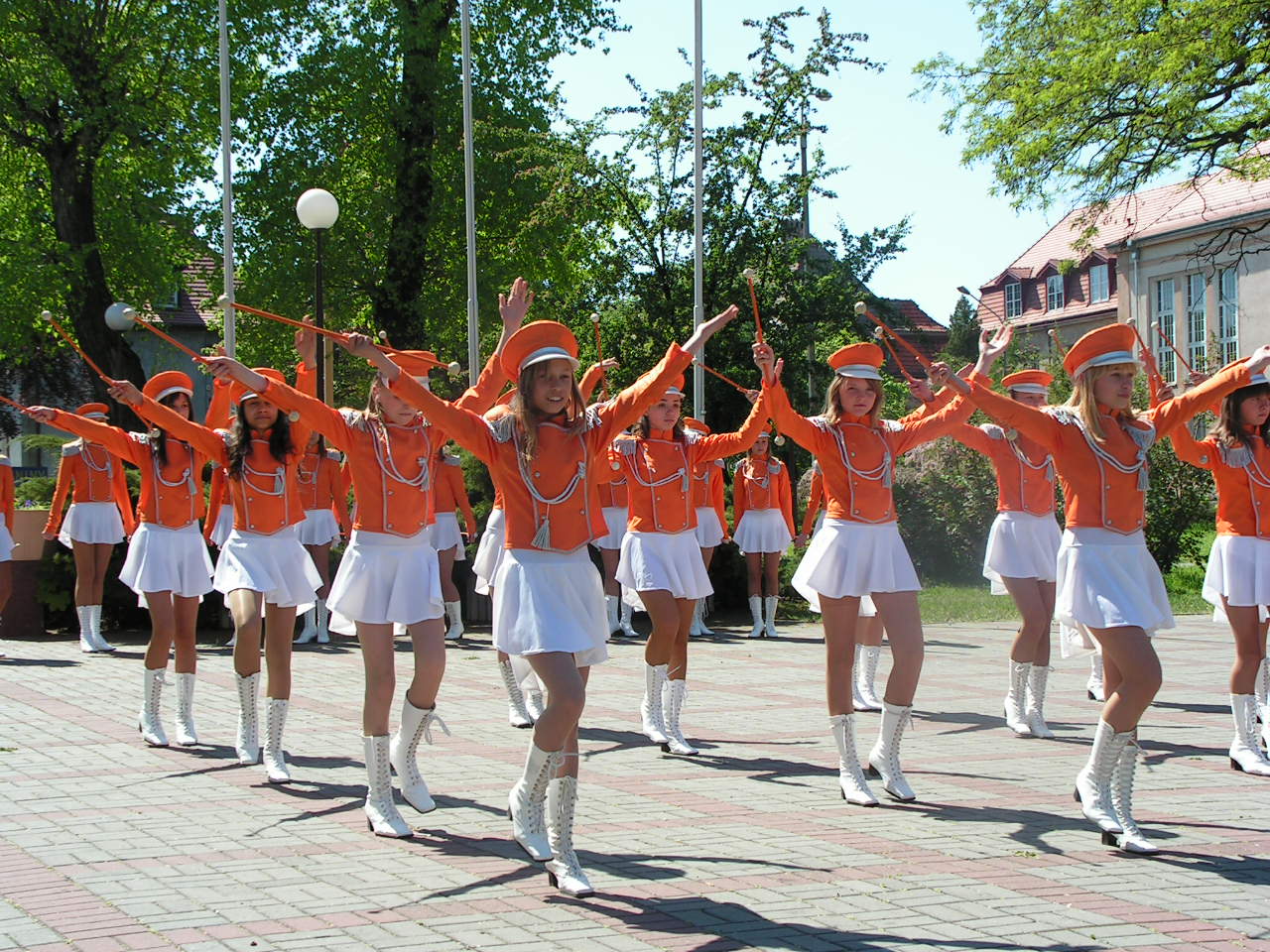
Majorettes of the Brass Band of the "Głogów Copper Smelter", Poland | |
| Occupation | |
|---|---|
| Names | Majorette |
Activity sectors | Entertainment, dance |
| Description | |
| Competencies | Hand–eye coordination, physical fitness |
Fields of employment | Marching bands, parades |
Related jobs | Cheerleader, dancer |
A majorette is a female performer who combines baton twirling with dance movements, primarily associated with marching bands during parades. Majorettes may alternatively spin flags, fire batons, maces, or rifles. Some performers incorporate cartwheels and flips, while others may twirl multiple batons at once.[1]
Majorettes are typically distinguished from cheerleaders, while baton twirling is closely related to rhythmic gymnastics.
Origin and development
[edit]
Majorettes originally performed a typical carnival dance originating in the Rhineland, where the young women who perform this dance are called Tanzmariechen (Dance Marys) in German or Dansmarietjes in Dutch.
During the carnival, the normal form of government was parodied. Also the army and defense forces were traditionally parodied as a way of protesting against the Prussian occupation of the Rhenish area at the time. In Cologne, these imitations arose in particular to make Prussian militarism look ridiculous.
The Tanzmariechen show clear origins in the camp followers in the 18th and 19th century, and have a vibrant and eventful past. Around this time, Germany had a large number of armies, and in each regiment there were women and girls selling and providing food and drink and taking on chores like washing clothes. Many also offered themselves as prostitutes.
Around 1800, more regulations began to emerge in the armies, which were gradually applied to the camp followers as well. Increasingly, camp followers were women married to corporals or privates, with tasks like washing the linen. They became no longer typical army prostitutes but also not proper married women. Besides caring for the soldiers, they could still continue entertaining them in various ways.
In the carnival mockery, both officers and camp followers were depicted: the officer as an effeminate, wig-wearing, conceited fool, and the camp followers as women who were militarily but provocatively costumed, and also clearly recognizable as a man: the Tanzmarie.
In the late 19th century, the carnival associations found further inspiration in the revue girls performing in theaters at the time. They were scantily clad young women, accompanied by military attributes like peak helmets and military backpacks, dancing provocatively in small groups. The revue girls became nightclub-like stars. It cannot be denied that the carnival with its Tanzmariechen has popularized and even parodied the sparkling shows that could otherwise be enjoyed only in the major European cities.
During the post-war carnival, young women and girls again took on the role of Tanzmariechen instead of men and performed in parades. A show element was added to carnival, partly because of rapidly evolving ballet education. Majorettes or Tanzmariechen increasingly began to act in groups. Some parts of the Prussian military background are sometimes still reflected today in the majorettes' movements, music, or clothing.
The somewhat slovenly camp followers who accompanied the troops have evolved into a show dance group, but still inspired by the Prussian army. This metamorphosis went through the intermediate step of the role performed by men as Tanzmarie. Although current majorettes have their roots in the carnival scene, majorette associations widely break these historical ties, appearing more as sports or dance clubs.[2]
Fictional majorettes
[edit]- Jetta Handover (Kath Soucie) from the TV series Clifford the Big Red Dog.
- Adrian Lee (Francia Raisa) from the TV series The Secret Life of the American Teenager.
- Vicky from the horror movie The Majorettes.
- Sakura Kinomoto from the anime series Cardcaptor Sakura.
- Bunty Carmichael (Catherine Tate) from the TV series The Catherine Tate Show.
- Aqua (Willa Holland) from the video game Kingdom Hearts: Birth By Sleep performs a baton twirling routine with her Keyblade when she uses the "Break Time" command. In the version that appears in Kingdom Hearts HD 2.5 Remix (based on the "Final Mix" version), doing this results in earning the "Majorette" trophy.
- Haruna Morikawa (森川 はるな, Morikawa Haruna)/Pink Turbo (ピンクターボ, Pinku Tābo) from Kousoku Sentai Turboranger.
- Frankie Bergstein from Grace and Frankie. Mentioned in Season 2 Episode 4.
-
Majorettes in Trujillo city are called ‘’Guaripolas’’ during Spring Festival
-
Majorettes or Guaripolas in a show in Víctor Larco
HBCU Majorette dance
[edit]Historically black college or university (HBCU) majorette dance first started in 1968. The first performance was introduced at the orange blossom classic by a majorette dance team named The Golden Girls. The Alcorn State university golden girls took majorette dance to a different level. The team had a mixture of jazz, ballet, and later hip hop all in one.[3] The performance had a great outcome and made an impact on majorette dance forever. Today they are known for their bright outfits, kick lines, tricks, and song selections. [4] HBCU majorette dance is now a huge tradition to HBCU culture and even black culture. Almost 55 years after that December 1968 game, majorette culture has grown in popularity from Tik-Tok trends to being featured in Vice President Kamala Harris inauguration procession. [5]
See also
[edit]References
[edit]- ^ ""Twirl/Majorette info"". Archived from the original on March 28, 2009. Retrieved October 12, 2008.
- ^ "Wat is carnaval? | Fen Vlaanderen". Fenvlaanderen.be. Retrieved October 15, 2019.
- ^ Peebles, Nyah (March 8, 2023). "Top HBCU Dance Teams 2023". hbcubuzz.com.
- ^ "Sass and Shimmer: The Dazzling History of Black Majorettes and Dance Lines". November 2, 2022.
- ^ "The rich history of HBCU majorette teams". ABC News.
External links
[edit]Majorette
View on GrokipediaDefinition and Core Characteristics
Historical Definition
The term majorette originated in 1938 in the United States as a feminine form of drum major, specifically denoting a female baton twirler who led marching bands or parades through synchronized twirling, marching, and dance routines.[7] This role emphasized showmanship, with performers described in contemporary accounts as extroverted figures engaging crowds with precise baton manipulations, often in formation ahead of the band.[7] The practice predated the term by several years, with baton twirling documented in American parades around 1932, evolving from military drill traditions into a spectator-focused performance art combining athleticism and visual appeal.[7] Rooted in European carnival customs, particularly in the Rhineland and Dutch-influenced regions, early majorette-like performers—termed Dansmarietjes (dance Marys)—were young women who twirled batons during festive processions to punctuate rhythms and add flair to group dances.[3][4] Historically, majorettes distinguished themselves from male drum majors by forgoing conducting implements like maces in favor of lightweight metal batons, enabling complex tosses, spins, and body-integrated movements that highlighted grace and coordination over directive signals.[7] Uniforms typically featured short skirts, boots, and shakos for a militaristic yet feminine aesthetic, reinforcing the performer's role as both leader and entertainer in civic events, school bands, and competitions by the 1940s.[7]Performance Elements
Majorette performances center on synchronized routines combining precise marching with baton manipulation, executed in formation to musical accompaniment. Core elements include marching techniques such as high-stepping and continuous foot motion, which maintain momentum during parades and field shows.[5] These are integrated with baton twirling skills like thumb tosses, finger spins, and rolls, performed while advancing or turning to create dynamic visual patterns.[5] Choreography emphasizes drill design, staging, and maneuvering, with performers aligning movements to the tempo, rhythm, and phrases of the music. Synchronization among team members is critical, ensuring seamless transitions between formations and baton work without disrupting the overall flow.[5] In traditional contexts, such as marching bands, majorettes often serve as feature performers, executing advanced tosses and body positions that demand hand-eye coordination, balance, and core strength.[8] Performance quality hinges on technique execution, including posture, precision in baton handling, and showmanship through energetic presence and eye contact with audiences. Judging in competitive settings prioritizes these aspects, alongside creativity in choreography while adhering to proper marching form.[5] Accessories like flags or rifles may supplement baton work in some routines, enhancing complexity without altering the foundational marching emphasis.[5]Distinctions from Baton Twirling and Drum Majorette
Majorettes perform as auxiliary units within marching bands or parades, integrating baton twirling with synchronized marching and dance to enhance visual appeal and maintain formation with the ensemble, whereas baton twirling as a standalone discipline emphasizes individual or small-group competitive routines judged on technical execution, such as high tosses, body spirals, and illusion maneuvers, often without marching elements.[9][10] Baton twirling competitions, regulated by bodies like the United States Twirling Association since 1970, incorporate rhythmic gymnastics standards, including apparatus handling with multiple batons or flags, and prioritize artistic scoring over band synchronization. In majorette routines, baton work supports the band's musical progression, typically using a single standard baton (approximately 24-28 inches long, weighing 8-12 ounces) for accessible throws and spins that align with parade tempos around 120-140 beats per minute. Drum majorettes specifically fulfill a leadership role, akin to a female counterpart to the drum major, employing baton signals—such as vertical tosses for attention or horizontal spins for direction changes—to conduct the band's tempo, volume, and formations during marches, a practice tracing to military mace-bearing traditions adapted for civilian bands by the early 20th century.[11] This contrasts with general majorettes, who operate as non-conducting feature performers in squads of 4-12, focusing on choreographed sequences ahead or beside the band to draw spectator focus rather than issue commands, often in high-stepping boots and sequined uniforms designed for visibility in outdoor settings.[12] While overlapping in skill requirements, drum majorettes prioritize authoritative signaling over elaborate flourishes, with historical examples from 1930s American drum corps showing batons used interchangeably with maces for precision cues in ensembles of 50-200 musicians.[10] These distinctions reflect functional roles: majorette performances enhance ensemble cohesion and entertainment in processional contexts, baton twirling advances athletic virtuosity in judged events, and drum majorette leadership ensures disciplined execution, with minimal crossover in modern competitive circuits where baton twirlers rarely march in full bands post-1970s specialization.[9]Origins and Early History
European Carnival Roots
The European roots of majorettes lie in the carnival traditions of the Rhineland region in Germany, particularly in cities like Cologne, where performers known as Tanzmariechen (dance Maries) have executed choreographed routines during Karneval (Fasching) celebrations for nearly two centuries. These dances originated as satirical performances by men in the early 19th century, mimicking military drills with high kicks, precise marches, and props resembling batons or rifles, often in exaggerated uniforms to lampoon authority figures.[13] Over time, the routines incorporated elements of baton manipulation, evolving into a staple of pre-Lenten parades that emphasized synchronization and acrobatics.[14] By the mid-19th century, women increasingly assumed the roles, transforming the Tanzmariechen into formalized female dance groups; for example, in Cologne, dedicated Tanzmariechen troupes emerged as structured ensembles by 1869, performing alongside marching bands in annual events like the Rose Monday procession.[15] This shift aligned with broader carnival customs rooted in Catholic festivities and Germanic pagan influences, where such groups added visual spectacle to parades featuring floats, costumes, and music. The Rhineland style, characterized by short skirts, feathered headdresses, and energetic footwork, directly influenced the development of majorette performances across Europe.[13] The tradition spread to adjacent regions, including the Netherlands, Belgium, and France, adapting to local marching band cultures while retaining core elements of baton twirling and parade marching. In Belgium, majorette groups proliferated in the 1960s and 1970s, typically attached to village brass or drum bands, participating in carnivals and processions that echoed Rhineland influences.[16] Similarly, in the Netherlands, dansmarietjes performed comparable routines in carnaval settings, tracing their lineage to 18th- and 19th-century camp followers and German prototypes.[17] These continental practices prioritized discipline, uniformity, and flair, predating and shaping the baton-centric majorette archetype seen in later adaptations.Introduction and Adaptation in the United States
The European tradition of majorette performances, originating as baton-twirling carnival dancers known as dansmarietjes, reached the United States in the early 20th century through immigrant influences and traveling shows, where it began adapting to the structured format of American marching bands.[18] Initially, baton twirling in the U.S. featured predominantly male performers using heavy maces derived from military signaling devices, integrated into parades and early band routines as early as the 1890s in some Southern institutions like Millsaps College.[19] By the 1920s, as marching bands grew in popularity alongside the rise of organized American football, twirling elements gained traction for enhancing visual spectacle during halftime shows and processions.[20] In the late 1930s, the modern female majorette emerged as band directors sought to boost audience engagement by incorporating women twirlers at the front of formations, marking a shift toward lighter batons and more acrobatic, feminine presentations tailored to high school and college ensembles.[21] This adaptation emphasized synchronized routines with band music, precise marching formations, and halftime field shows on football grids, contrasting the freer, parade-focused European carnival style by prioritizing militaristic discipline and competitive appeal.[20] The debut of female majorettes coincided with broader cultural trends in youth activities, where shorter, aluminum batons enabled complex tosses, spins, and dance integrations, solidifying their role in American band culture by the onset of World War II.[22] This U.S. evolution formalized in the postwar era with organizations like Drum Majorettes of America (founded 1947), which standardized competitions and training, further embedding majorettes as a staple of civic parades, state fairs, and educational bands across the Midwest and South.[23] Unlike European counterparts, American majorettes often incorporated patriotic themes and cheerleading influences, reflecting the nation's emphasis on community boosterism and spectator sports entertainment.[21]Development in Traditional Marching Bands
Early 20th-Century Integration
In the early decades of the 20th century, marching bands in the United States primarily featured male drum majors who performed baton twirling with heavy maces, a practice rooted in military traditions where the mace served both as a leadership symbol and a tool for signaling formations.[24] These performances emphasized precision and authority rather than elaborate routines, with twirling limited by the weight of the equipment, which restricted participation largely to men and boys.[25] By the 1920s, isolated groups of female twirlers began appearing in parades and non-band contexts, as evidenced by early photographic records of majorette-style troops, marking initial steps toward broader adoption.[26] The pivotal integration of female majorettes into formal marching bands occurred in the late 1930s, when band directors strategically added baton twirlers to enhance visual spectacle and audience draw during parades and halftime shows.[21][25] This shift coincided with the development of lighter, shorter batons better suited to intricate spins, tosses, and dance-integrated routines, enabling women to perform with greater agility and artistry compared to the cumbersome maces of prior eras.[21] High school and college bands, seeking to differentiate from purely musical ensembles, incorporated solo majorettes or small corps positioned at the front or flanks, where their synchronized twirling added rhythmic flair and feminine aesthetics to the proceedings.[25] This early integration laid the groundwork for majorettes' prominence, with early performers often serving as drum majorettes—solo figures leading parades and evoking envy among spectators, which spurred further recruitment of young women.[25] By the onset of World War II, the practice had spread across American educational institutions, though wartime constraints temporarily limited expansion; post-1940 examples include the appointment of the first majorette at Western Michigan University around this period.[27] The emphasis remained on competitive precision and parade utility, distinguishing these traditional majorettes from later stylistic evolutions.[21]Mid-Century Popularization and Standardization
In the years following World War II, majorette units proliferated in high school and college marching bands across the United States, transforming from novelty additions into standard features designed to heighten visual spectacle at football halftime shows, parades, and community events. Band directors increasingly recruited female twirlers to draw larger crowds, capitalizing on the post-war economic boom and expanded school music programs that emphasized showmanship alongside musical precision. By the 1950s, thousands of girls participated nationwide, with troops often comprising 4 to 12 performers per band, performing synchronized routines that integrated baton manipulation with high-knee marches.[25][28] This expansion prompted adaptations in equipment and technique to suit predominantly female participants, including the widespread adoption of shorter, lighter aluminum batons—typically 20 to 24 inches long and weighing under 12 ounces—replacing heavier military-style maces for enhanced agility in spins, tosses, and illusionary passes. Routines standardized around core elements such as finger twirls, horizontal rotations, and vertical tosses synchronized to marching tempos of 120 to 140 beats per minute, often choreographed to complement band formations like blocks, arcs, and serpentine patterns.[25][19] Formal standardization accelerated with the establishment of governing bodies, including Drum Majorettes of America in 1947, which organized contests and codified judging criteria focused on execution, difficulty, and creativity. The inaugural National Majorette Contest in 1951 further entrenched uniform performance benchmarks, evaluating twirlers on metrics like baton control (40% weight), marching precision (30%), and showmanship (30%), while promoting safety protocols such as non-slip grips and regulated toss heights.[29][19] Uniforms evolved into regimented ensembles emphasizing cohesion and militaristic flair, featuring tailored wool or satin jackets with epaulets, knee-length pleated skirts, white boots, and tall bearskin shakos or plumed hats adorned with band insignia. These designs, often custom-ordered from suppliers like DeMoulin Bros., prioritized modesty, durability, and synchronized appearance, with white gloves and sequined accents becoming near-universal by the late 1950s to amplify stage presence under stadium lights.[30][31] Evolution of HBCU Majorette Dance
Emergence in the 1960s and 1970s
The emergence of HBCU majorette dance in the 1960s marked a shift from traditional baton twirling toward synchronized, high-energy performances integrated with marching band music, emphasizing expressive body movements over rigid military precision.[4] This style drew from jazz, ballet, and emerging African American dance traditions, adapting European majorette influences to create routines that highlighted athleticism, precision, and cultural flair during halftime shows and band exhibitions.[4] By the late 1960s, these teams began performing in formation with live HBCU bands, distinguishing themselves through dynamic footwork and hip isolations that synchronized with brass-heavy arrangements.[3] A pivotal moment occurred on October 12, 1968, at the Orange Blossom Classic in Miami, Florida, where Alcorn State University's Golden Girls delivered the first documented synchronized majorette dance performance alongside an HBCU marching band.[3] Led by director Bertha Palmer, the 12-member squad executed routines featuring baton tosses combined with percussive steps, captivating audiences and setting a template for future teams by blending technical twirling with interpretive dance.[4] This event, broadcast on national television, elevated majorette visibility within HBCU culture and inspired replication at other institutions.[32] In 1969, Southern University formalized its Dancing Dolls squad under coach Gracie Perkins and band director Isaac Greggs, institutionalizing the format with 20 dancers who incorporated soul-influenced choreography to complement the Human Jukebox band's innovative shows.[33] Perkins, drawing from her dance background, emphasized high kicks, turns, and group formations that responded to the band's improvisational style, fostering a performative synergy that became emblematic of HBCU halftime traditions.[4] These early teams typically numbered 10-20 members, selected for agility and rhythm, and performed in sequined uniforms that accentuated movement.[4] The 1970s saw further innovation, particularly with Jackson State University's Prancing J-Settes, who in the early decade popularized "J-setting"—a percussive, angular style featuring sharp isolations and fan-like arm extensions synchronized to funk and early disco beats.[34] Founded around 1970 under advisor Nar Pearl Easley, the J-Settes performed with 16-18 dancers, influencing regional bands through competitive circuits and emphasizing endurance in routines lasting 5-7 minutes.[34] Grambling State University's Tigerette dancers also contributed by mid-decade, integrating similar elements into their World Famed Band appearances, though documentation of exact founding dates remains sparse compared to Alcorn and Southern.[33] By 1975, over a dozen HBCU programs had adopted majorette squads, with annual battles of the bands amplifying their role in fostering school spirit and cultural identity.[4]Key Teams and Innovations
The Golden Girls of Alcorn State University, formed in the early 1970s, represented a pivotal innovation by becoming the first Black majorette team to perform synchronized dances alongside an HBCU marching band's live music, shifting emphasis from individual baton routines to collective, high-energy group formations that integrated jazz and African-inspired movements.[4][34] This approach emphasized precision footwork, including high kicks and prancing steps, which influenced subsequent HBCU teams by prioritizing visual spectacle and band synchronization over traditional twirling.[35] Southern University's Fabulous Dancing Dolls, established in 1969 as an auxiliary to the Human Jukebox marching band, advanced HBCU majorette styles through the incorporation of balletic port de bras (arm extensions) and jazz elements into their routines, evolving from basic high-stepping to more intricate choreography performed in signature white gloves and coordinated uniforms.[36][33] By the 1970s, their performances featured complex formations and expressive gestures that blended European ballet influences with Africanist rhythms, setting a standard for grace and technical diversity in majorette dance.[36] Jackson State University's Prancing J-Settes, an auxiliary to the Sonic Boom of the South band since the 1970s, originated the J-Setting style—a high-energy, strut-based dance characterized by sharp isolations, hip rolls, and fan-like arm movements inspired by vogueing and West African dance—transforming majorette performances into a culturally resonant form that emphasized attitude and individuality within group synergy.[37][38] This innovation, formalized in the late 1970s, popularized hip-hop fusions in HBCU routines and extended majorette influence beyond campuses, inspiring independent teams and mainstream adaptations.[33][6] These teams collectively drove mid-20th-century innovations, such as the late-1960s formalization of hip-hop majoretting through rhythmic layering of jazz, cabaret kicks, and African-derived polyrhythms, which prioritized athleticism and cultural expression over baton-centric drills, fostering a distinct HBCU aesthetic that endures in competitions.[39][33][3]Techniques and Styles
Baton Twirling Mechanics
Baton twirling relies on precise manipulation of a rigid, cylindrical implement, typically 18 to 24 inches (46 to 61 cm) in length and weighing 10 to 16 ounces (280 to 450 g), constructed from aluminum or similar lightweight metal with rubberized ends for grip and safety.[40] The mechanics center on generating rotational motion through wrist torque while maintaining baton stability via conservation of angular momentum, where the baton's moment of inertia about its center of mass dictates spin persistence once initiated.[41] Twirlers exploit the baton's low mass and elongated shape to achieve high angular velocities, often exceeding 10 revolutions per second in advanced spins, by applying impulsive forces perpendicular to the shaft.[42] Fundamental grips include the pencil grip, where the baton is held at the ball end with fingers extended as if grasping a writing utensil, allowing fluid wrist pivots, and the palm grip for horizontal holds, positioning the shaft flat across the palm facing downward.[43][40] Basic horizontal twirls commence with the arm extended forward at shoulder height, followed by a sharp wrist snap downward to impart torque, rotating the baton end-over-end in a vertical plane while the performer's elbow remains relatively fixed to minimize translational interference.[44] This motion adheres to Newton's second law for rotation, where torque (from wrist flexor and extensor muscles) equals the rate of change of angular momentum, enabling sustained spins without continuous input once velocity is established.[45] Tosses introduce vertical translation coupled with spin, achieved by thrusting the baton upward with an initial velocity determined by arm extension force, typically reaching heights of 10 to 20 feet (3 to 6 m) in competitive routines, during which the baton completes multiple revolutions due to preserved angular momentum in free flight.[46][41] Catch mechanics demand precise timing, with the twirler tracking the baton's parabolic trajectory—governed by gravitational acceleration of 9.8 m/s²—and aligning the catching hand via proprioceptive feedback from shoulder and wrist proprioceptors to intercept at the descending apex.[47] Rolls, such as underarm or elbow variants, involve sliding the baton along the body using centrifugal force to maintain contact, transitioning spin from hand to limb surfaces for illusory continuity.[46] Biomechanically, effective twirling requires core stabilization to counter rotational torques, with elite performers exhibiting wrist angular accelerations up to 5000°/s² through coordinated agonist-antagonist muscle pairings, reducing injury risk from repetitive strain.[48] Posture alignment—upright torso, engaged shoulders—prevents compensatory sway, ensuring balance via vestibular and visual inputs amid high-speed manipulations that challenge equilibrium.[44] Variations like figure-8 patterns integrate multi-planar rotations, demanding asynchronous bilateral coordination to sustain momentum across intersecting loops.[44]Dance Components Across Variants
Across variants of majorette performance, core dance components include synchronized footwork, rhythmic body isolations, and formations that integrate marching precision with expressive movements, often synchronized to band music or drum beats.[5][49] Uniformity in arm extensions, turns, and spacing emphasizes group cohesion, while baton handling—such as tosses, spins, and rolls—serves as both a prop and focal point, requiring coordination between upper and lower body.[5] These elements adapt to variant-specific emphases, balancing military drill influences with cultural dance infusions. In European carnival traditions, such as those originating in Germany's Rhineland with groups like Tanzmariechen, dance components prioritize parade marching with high-knee steps, geometric formations, and rapid maneuvers over extended solos, reflecting military parade aesthetics adapted for festive processions.[50] Choreography features step-by-beat synchronization and staging for visual impact in linear routes, with less incorporation of acrobatic flourishes compared to American styles; instead, emphasis falls on endurance during prolonged marches, often 2 minutes per segment.[5][51] Traditional U.S. marching band majorettes, integrated since the early 20th century, incorporate disciplined high-step marching, precise baton-integrated turns, and balletic extensions, drawing from military drill to maintain straight lines and sharp angles during field shows or parades.[52] Routines stress execution of tosses amid controlled leaps and pivots, with dance elements limited to supportive flourishes like kicks and waves that enhance band synchronization rather than dominate, prioritizing overall unit cohesion over individual flair.[53] HBCU majorette styles, evolving from the 1960s, diverge by fusing high-energy hip-hop isolations, jazz syncopations, and West African-derived undulations with baton work, often featuring "j-setting" techniques like angular arm snaps and hip pops popularized by Jackson State University's Prancing J-Settes in the early 1970s.[6][34] Bucking—exaggerated, rhythmic body waves—and kick lines blend with contemporary floorwork, emphasizing creativity, rhythm variation, and audience engagement over rigid marching, as seen in teams like Southern University's Dancing Dolls.[33][3] This variant reduces baton centrality in favor of dance-driven narratives, incorporating burlesque-inspired struts and ballet extensions for dynamic field performances.[35]Variations Between Traditional and HBCU Styles
Traditional majorette styles, rooted in early 20th-century American marching bands and European carnival traditions, prioritize precise baton manipulation, synchronized twirling routines, and military-inspired marching formations with crisp jazz footwork.[54][35] Performers maintain uniform postures and execute rhythmic gymnastics elements, such as high tosses and spins, often in lockstep alongside the band to emphasize visual symmetry and technical baton control.[55] This approach aligns with broader marching band standards, where majorettes serve as auxiliary units enhancing the band's disciplined presentation rather than leading independent dance sequences.[53] HBCU majorette styles, pioneered by teams like the Alcorn State University Golden Girls in 1968, shift emphasis from baton-centric routines to high-energy, choreographed dance performances synchronized to live marching band music.[6][56] These routines integrate elements of jazz, hip-hop, buck dancing, West African rhythms, stunting, and body isolations, creating expressive, acrobatic field shows with continuous stand battles and halftime spectacles that prioritize crowd engagement over strict uniformity.[3][33] Baton use is minimal or stylized as props, allowing for bawdy, lyrical movements that reflect African American cultural traditions and high-stepping band dynamics.[4][18] Key variations manifest in several core aspects, as outlined below:| Aspect | Traditional Style | HBCU Style |
|---|---|---|
| Primary Focus | Baton twirling and rhythmic gymnastics with marching precision.[54] | Choreographed dance blending jazz, hip-hop, and stunts for expressive performance.[3][39] |
| Movements | Clean, crisp jazz technique; uniform formations and tosses.[55] | High-energy bucking, isolations, kick lines, and acrobatics; less rigid synchronization.[33][4] |
| Role in Band | Auxiliary to band's march, integrated in formations.[53] | Featured squad with independent routines, often "stand battles" during games.[3] |
| Costumes/Appearance | Practical uniforms emphasizing uniformity; minimal flair.[57] | Flashy, form-fitting outfits with boots, big hair, and rhinestone accents for visual impact.[58][4] |
| Cultural Emphasis | Military discipline and technical skill from European/American band traditions.[35] | Black cultural expression, incorporating Africanist aesthetics and community energy.[6][34] |