
Recent from talks
Maladera formosae
Knowledge base stats:
Talk channels stats:
Members stats:
Maladera formosae
Maladera formosae, commonly known as the Asiatic garden beetle and formerly known as Maladera castanea, is a species of beetle in the family Scarabaeidae. It is native to Japan, China, Taiwan, South Korea, North Korea, and Russia but was introduced to North America in the 1920s where it is considered a pest of turfs, gardens, and crop fields. Adults are active in the summer during which they can be found feeding on leaves and flowers or gathering around light sources at night.
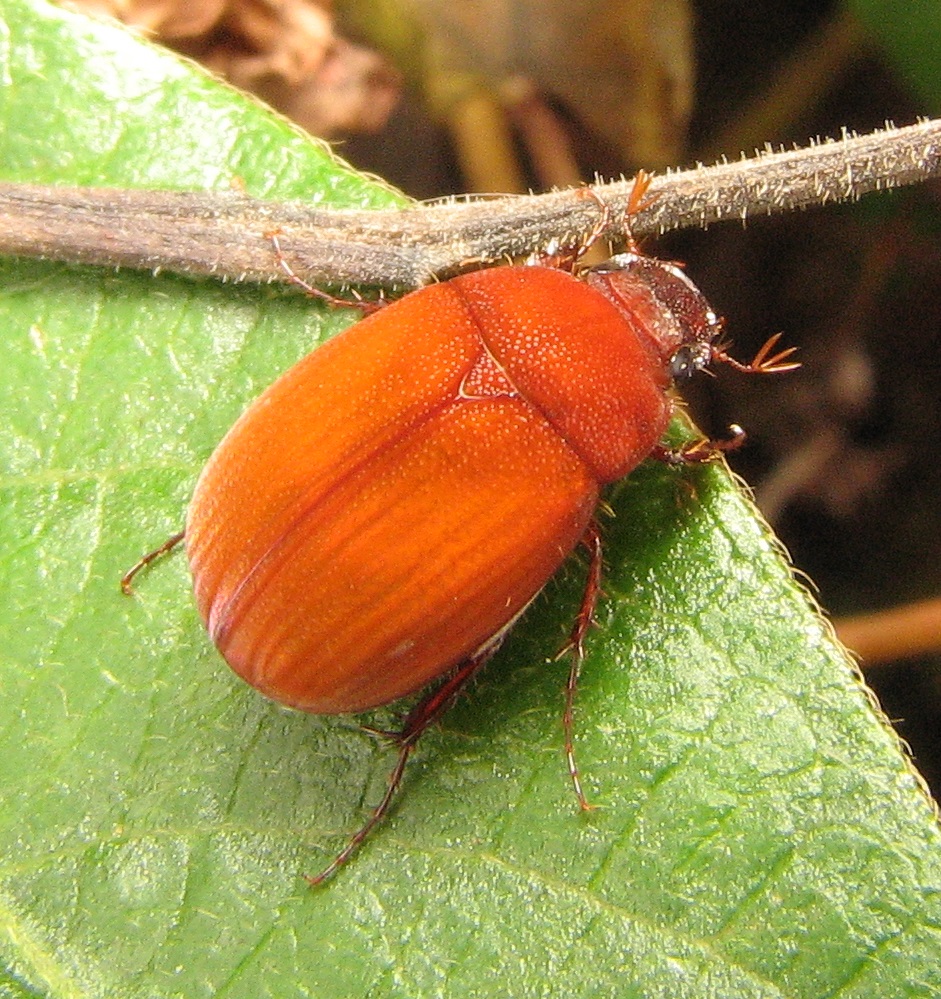
Adults range in length from 8-9mm and are reddish-brown in color with an iridescent sheen. Larvae, similarly to larvae of other species in the family Scarabaeidae, are referred to as white grubs. M. formosae grubs grow from approximately 1.4 mm to 19 mm in length as they feed on plant roots and decaying plant material.
Maladera formosae are frequently mistaken for other species of scarab beetles. However, adults can be distinguished by their sturdy bodies, reddish-brown hue with an iridescent shine, concealed labrum, antenna with 10 segments, flat rear tibia featuring apical spurs separated by tarsal articulations, and elongated male genitalia with sizable, movable apical hooks.
Larvae have C-shaped bodies, are predominantly white, and have brownish-orange white heads. M. formosae larvae can be distinguished from other white grub larvae by their prominent maxillary stipes, aggressive behavior, and unique chevron-shaped raster pattern underneath their Y-shaped anal slits.
Maladera formosae is native to East Asia. Aside from the type locality Taiwan (formerly known as Formosa), it was also native to China, Japan, North Korea, South Korea, and eastern Russia. It has also become established in the United States as an invasive species. M. formosae was first discovered in North America in the United States, specifically in New Jersey in 1921. In its first decade in the United States, M. formosae spread throughout the East Coast. By 1933, M. formosae was recorded within 10 states and 1 district consisting of Connecticut, Delaware, Maryland, Massachusetts, New Jersey, New York, Pennsylvania, Rhode Island, South Carolina, Virginia, and Washington, D.C. It then spread southward and westward, leading to it being found by 2009 in at least 11 additional states, including Alabama, Georgia, Illinois, Indiana, Maine, Michigan, New Hampshire, North Carolina, Ohio, Vermont, and West Virginia with possible identification in Kansas and Missouri. The most recent state in which M. formosae was newly reported is Florida in 2012. M. formosae has also been identified in the two Canadian provinces of Quebec in 1996 and Nova Scotia in 2003. In total, M. formosae is now found in the United States in at least 24 states and Canada in 2 provinces.
Adult beetles feed most actively during the night. Their diet consists predominantly of the foliage and flowers of various plants totaling over 100 different species. They also feed sparingly on blades of grass. Foliage consumption typically progresses inwards and, when beetles are abundant, only the midvein of the leaf will remains. This damage is often not attributed to M. formosae—their nighttime feeding means they are rarely observed in the act.
Adults prefer eating flowers like asters, chrysanthemums, dahlias, goldenrods, roses, strawflowers, sunflowers, and zinnias. Grubs act as pests for various ornamentals, turfs, and gardens along with field crops, such as sweet potatoes, soybeans, and corn. They typically feed on plant roots and decaying plant material. Field and laboratory experiments have been performed assessing adult beetle preference for different host plants. Field experiments found that basil was preferred compared to beet, carrot, eggplant, hot pepper, kohlrabi, parsnip, sweet pepper, and turnip. Laboratory experiments found that basil was preferred when compared to American sweetgum, arrowwood viburnum, elderberry, green ash, red maple, and sugar maple, but equally preferred when compared to beets and kohlrabi.
Maladera formosae undergoes a similar life cycle to other white grub pests like Japanese beetles and masked chafers. It undergoes a complete metamorphosis with one generation each year, though the exact timing of its life stages depends on temperature and humidity. Research has, however, suggested that multiple generations can be produced each year, granted a sufficiently warm and moist environment is provided.
Hub AI
Maladera formosae AI simulator
(@Maladera formosae_simulator)
Maladera formosae
Maladera formosae, commonly known as the Asiatic garden beetle and formerly known as Maladera castanea, is a species of beetle in the family Scarabaeidae. It is native to Japan, China, Taiwan, South Korea, North Korea, and Russia but was introduced to North America in the 1920s where it is considered a pest of turfs, gardens, and crop fields. Adults are active in the summer during which they can be found feeding on leaves and flowers or gathering around light sources at night.
Adults range in length from 8-9mm and are reddish-brown in color with an iridescent sheen. Larvae, similarly to larvae of other species in the family Scarabaeidae, are referred to as white grubs. M. formosae grubs grow from approximately 1.4 mm to 19 mm in length as they feed on plant roots and decaying plant material.
Maladera formosae are frequently mistaken for other species of scarab beetles. However, adults can be distinguished by their sturdy bodies, reddish-brown hue with an iridescent shine, concealed labrum, antenna with 10 segments, flat rear tibia featuring apical spurs separated by tarsal articulations, and elongated male genitalia with sizable, movable apical hooks.
Larvae have C-shaped bodies, are predominantly white, and have brownish-orange white heads. M. formosae larvae can be distinguished from other white grub larvae by their prominent maxillary stipes, aggressive behavior, and unique chevron-shaped raster pattern underneath their Y-shaped anal slits.
Maladera formosae is native to East Asia. Aside from the type locality Taiwan (formerly known as Formosa), it was also native to China, Japan, North Korea, South Korea, and eastern Russia. It has also become established in the United States as an invasive species. M. formosae was first discovered in North America in the United States, specifically in New Jersey in 1921. In its first decade in the United States, M. formosae spread throughout the East Coast. By 1933, M. formosae was recorded within 10 states and 1 district consisting of Connecticut, Delaware, Maryland, Massachusetts, New Jersey, New York, Pennsylvania, Rhode Island, South Carolina, Virginia, and Washington, D.C. It then spread southward and westward, leading to it being found by 2009 in at least 11 additional states, including Alabama, Georgia, Illinois, Indiana, Maine, Michigan, New Hampshire, North Carolina, Ohio, Vermont, and West Virginia with possible identification in Kansas and Missouri. The most recent state in which M. formosae was newly reported is Florida in 2012. M. formosae has also been identified in the two Canadian provinces of Quebec in 1996 and Nova Scotia in 2003. In total, M. formosae is now found in the United States in at least 24 states and Canada in 2 provinces.
Adult beetles feed most actively during the night. Their diet consists predominantly of the foliage and flowers of various plants totaling over 100 different species. They also feed sparingly on blades of grass. Foliage consumption typically progresses inwards and, when beetles are abundant, only the midvein of the leaf will remains. This damage is often not attributed to M. formosae—their nighttime feeding means they are rarely observed in the act.
Adults prefer eating flowers like asters, chrysanthemums, dahlias, goldenrods, roses, strawflowers, sunflowers, and zinnias. Grubs act as pests for various ornamentals, turfs, and gardens along with field crops, such as sweet potatoes, soybeans, and corn. They typically feed on plant roots and decaying plant material. Field and laboratory experiments have been performed assessing adult beetle preference for different host plants. Field experiments found that basil was preferred compared to beet, carrot, eggplant, hot pepper, kohlrabi, parsnip, sweet pepper, and turnip. Laboratory experiments found that basil was preferred when compared to American sweetgum, arrowwood viburnum, elderberry, green ash, red maple, and sugar maple, but equally preferred when compared to beets and kohlrabi.
Maladera formosae undergoes a similar life cycle to other white grub pests like Japanese beetles and masked chafers. It undergoes a complete metamorphosis with one generation each year, though the exact timing of its life stages depends on temperature and humidity. Research has, however, suggested that multiple generations can be produced each year, granted a sufficiently warm and moist environment is provided.
Recent media