Hubbry Logo
Dryopteris filix-masDryopteris filix-masMain
Open search
Dryopteris filix-mas
Community hub
Dryopteris filix-mas
logo
8 pages, 0 posts
0 subscribers
Be the first to start a discussion here.
Dryopteris filix-mas
from Wikipedia

Dryopteris filix-mas
Secure
Secure  (NatureServe)
Scientific classification Edit this classification
Kingdom: Plantae
Clade: Tracheophytes
Division: Polypodiophyta
Class: Polypodiopsida
Order: Polypodiales
Suborder: Polypodiineae
Family: Dryopteridaceae
Genus: Dryopteris
Species:
D. filix-mas
Binomial name
Dryopteris filix-mas

Dryopteris filix-mas, the male fern,[1] is a common fern of the temperate Northern Hemisphere, native to much of Europe, Asia, and North America. It favours damp shaded areas in the understory of woodlands, but also shady places on hedge-banks, and rocks, and screes. Near the northern limit of its distribution it prefers sunny, well-drained sites. It is much less abundant in North America than in Europe.[citation needed]

Description

[edit]
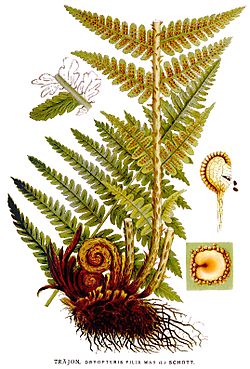
19th century illustration

The semi-evergreen leaves have an upright habit and reach a maximum length of 150 cm (59 in), with a single crown on each rootstock. The bipinnate leaves consist of 20–35 pinnae on each side of the rachis. The leaves taper at both ends, with the basal pinnae about half the length of the middle pinnae. The pinules are rather blunt and equally lobed all around. The stalks are covered with orange-brown scales. On the abaxial surface of the mature blade five or six sori develop in two rows. When the spores ripen in August to November, the indusium starts to shrivel, leading to the release of the spores.

This species hybridises easily with Dryopteris affinis (scaly male fern) and Dryopteris oreades (mountain male fern).[citation needed]

Names

[edit]

The plant is sometimes referred to in ancient literature as worm fern, reflecting its former use against tapeworm.[citation needed]

Unrolling leaf of a Dryopteris filix-mas.

Its specific epithet filix-mas means "male fern" (filix "fern", mas "male"), as the plant was thought to be the male version of the common lady fern Athyrium filix-femina.[2] being robust in appearance and vigorous in growth.[3]

The Finnish name kivikkoalvejuuri refers to the anti-cestoda (tapeworm) medical use it has had (see Culture section), as alve is an old word for cestoda.[4]

Cultivation and uses

[edit]

Numerous cultivars have been selected for garden use. The following have gained the Royal Horticultural Society's Award of Garden Merit:[5]

  • D. filix-mas[6]
  • 'Crispa Cristata'[7]
  • 'Cristata'[8]
  • 'Grandiceps Wills'[9]
  • 'Linearis Polydactyla'[10]

Culture

[edit]

D. filix-mas is culturally named the title plant of Nurmijärvi, the municipality in Uusimaa, Finland. The reason is that the plant is related to the first Finnish pharmaceutical factory located in Nurmijärvi in 1899–1964. The pharmaceutical factory founded by the pharmacist Albin Koponen made Diphyllobothrium latum and cestoda medicines called Filisin and Filicon, the raw material of which was the rhizome of D. filix-mas. The rhizomes were still collected in the locality in the 1960s.[11] The medicine was also used to treat liver fluke in sheep in Finland.[4]

Toxicity

[edit]

The rhizomes of D. filix-mas are toxic. Doses too big can cause serious poisoning, blindness and even death.[4]

References

[edit]
[edit]
Revisions and contributorsEdit on WikipediaRead on Wikipedia
from Grokipedia
Dryopteris filix-mas, commonly known as the male or male wood , is a in the family Dryopteridaceae. It features short-creeping or erect rhizomes that produce clusters of monomorphic, deciduous fronds up to 120 cm long and 30 cm wide, with petioles comprising less than one-quarter of the total leaf length and bearing two types of scales—broad and hairlike. The blade is green, ovate-lanceolate, and pinnate-pinnatifid to bipinnate, with serrate to lobed margins on the pinnules and sori located midway between the midvein and margin, protected by glandless indusia; the species has a chromosome number of 2n = 164. Taxonomically, Dryopteris filix-mas was originally described as Polypodium filix-mas by Carl Linnaeus in 1753 and later reclassified in the genus Dryopteris by Heinrich Wilhelm Schott in 1834. The taxonomy remains complex due to polyploidy and hybridization, potentially involving auto- and allopolyploid forms related to crosses like D. caucasica × D. oreades in Europe. In North America, it includes subspecies such as D. f. ssp. brittonii. This exhibits a circumboreal distribution across the , spanning and eastern , , and disjunct populations in —from the western mountains (including , , ) to regions around the and the and (such as , , , , and ). It thrives in elevations from 200 to 2500 m, favoring dense woodlands, talus slopes, rocky crevices, and mesic forests with rich, moist soils, often on in the northeast or and igneous rocks in the . Ecologically, it occupies sheltered sites in mixed northern hardwood or coniferous forests, hybridizes with species like D. clintoniana and D. marginalis, and is considered secure globally but rare or threatened in parts of (e.g., endangered in and ). Historically, the rhizomes of Dryopteris filix-mas have been employed in as an for treating tapeworm infections, owing to phloroglucinol compounds such as aspidin and filixic acid, though the extract is highly toxic and its use has been discontinued in modern practice. Today, it is primarily valued as an in for its robust fronds and , and it contributes to forest understory by stabilizing in moist, rocky habitats.

Taxonomy and nomenclature

Classification

Dryopteris filix-mas is classified within the kingdom Plantae, Tracheophyta, class Polypodiopsida, order Polypodiales, family Dryopteridaceae, genus Dryopteris, and species D. filix-mas. In phylogenetic analyses, D. filix-mas is placed within the Dryopteridaceae family, part of the diverse order, sharing evolutionary affinities with other leptosporangiate ferns such as those in the genus Polystichum (also Dryopteridaceae) and Athyrium (Athyriaceae). The taxonomy of D. filix-mas is complex due to its polyploid nature (2n = 164) and frequent hybridization, which may involve both auto- and allopolyploid origins. In , it potentially derives from crosses such as D. caucasica × D. oreades. In , plants are often treated as the subspecies D. f. ssp. brittonii, though this classification is disputed and not universally accepted. Historical synonyms for D. filix-mas include Nephrodium filix-mas (L.) Rich. and Lastrea filix-mas (L.) C. Presl, reflecting earlier taxonomic groupings before the modern circumscription of Dryopteris. The basionym is Polypodium filix-mas L. The species was originally described by in his in 1753 as Polypodium filix-mas, with lectotypes designated from European specimens including those labeled as Lastrea filix-mas at the Kew Herbarium (K001080985, K001080986, K001080987).

Etymology and common names

The genus name Dryopteris derives from the Ancient Greek words δρῦς (drûs), meaning "oak tree," and πτερίς (pterís), meaning "fern," alluding to the habitat of many species in oak woodlands or their resemblance to tree-like growth. The specific epithet filix-mas comes from the Latin filix, meaning "fern," and mas, meaning "male," a designation based on the plant's robust and larger fronds in comparison to the more delicate fronds of the female fern (Athyrium filix-femina). Common names for Dryopteris filix-mas reflect its prominence in temperate regions and historical associations, including "male fern" in English, "Wurmfarn" (worm fern) in German due to past medicinal uses against parasites, and "fougère mâle" (male fern) in French. The binomial name was first formally adopted by in his (1753) under the basionym Polypodium filix-mas, reflecting early classifications within the broad family. It was later transferred to the genus Dryopteris by Heinrich Wilhelm Schott in 1834, aligning with refined taxonomy that eventually placed it in the segregated Dryopteridaceae family by the late , based on sorus and indusium characteristics.

Description

Morphology

Dryopteris filix-mas is a clump-forming with an erect, stout up to 2.5 cm in diameter, which is short to moderately long, vertical, long-lived, and often becomes massive over time, producing a single crown of fronds. The is covered with persistent remnants of old stipe bases and pale brown to straw-colored scales. Fronds emerge as tightly coiled croziers in late winter or early spring, unfurling to form arching clusters that create a shuttlecock-like ; the plant is typically , with fronds dying back in winter, though it can be semi-evergreen in milder climates. Overall height reaches 50-150 cm, with fronds 28-120 cm long and 10-30 cm wide. The fronds are monomorphic, lacking strong differentiation between sterile and fertile forms, though fertile pinnae may appear slightly narrower. The stipe is straw-brown, grooved, and comprises one-sixth to one-quarter of the frond length, densely covered at the base with two distinct types of brown scales: broad, ovate-lanceolate ones and narrow, hairlike ones—a diagnostic feature unique to this species. Scales become sparser and paler along the green rachis. The blade is ovate-lanceolate to narrowly elliptic, tapering to both ends and widest near the middle, pinnate-pinnatifid to bipinnate (twice pinnate at the base), firm but herbaceous to slightly leathery in texture, and lacking glands. It bears 16-40 pairs of lanceolate to ovate-lanceolate pinnae, with the basal pair reduced in size; pinnules are short, rounded, and finely serrate to lobed along the margins, with free, forked veins converging toward the margins. Growth occurs in dense clumps, with fronds arching outward and upward for an elegant, vase-shaped form; the medium to dark green blades provide a soft, feathery appearance, turning coppery in autumn before . Diagnostic vegetative traits include the equal length of basal basiscopic and acroscopic pinnules, the non-glandular indument, and the overall robust structure adapted for shaded understories.

Reproduction

_Dryopteris filix-mas reproduces primarily through s borne on the undersides of its fertile fronds in structures known as sori, which consist of clusters of sporangia located midway between the midvein and margin of the pinnules and protected by a kidney-shaped indusium. As the indusium withers in late summer, the sporangia dehisce, releasing monolete, ellipsoidal s approximately 40 micrometers long. In temperate zones, release typically occurs from to , spanning about two months and enabling seasonal synchronization with favorable conditions. These spores are primarily wind-dispersed, with mechanisms like sporangial catapulting allowing for potential long-distance travel, though most land within a few meters of the parent plant; this dispersal strategy supports colonization of new habitats over distances up to several kilometers in open environments. viability remains high for up to several years, with averages around three years under suitable storage, facilitating delayed in variable ecological conditions. The exhibits a typical life cycle of , featuring a dominant diploid phase and a free-living haploid known as the prothallus. Upon in moist, shaded , spores develop into heart-shaped, hermaphroditic prothalli that produce both archegonia and antheridia; antheridiogens released by maturing archegonia promote gametangia development on nearby prothalli, favoring cross-fertilization. Fertilization by swimming leads to the growth of a young , which eventually detaches and matures. is predominantly sexual via meiotic spore production, though apogamy—direct formation from gametophytic tissue without gamete fusion—occurs rarely in some populations, and has been noted occasionally in hybrids with related .

Distribution and habitat

Geographic range

Dryopteris filix-mas is native to the temperate regions of the , exhibiting a circumboreal distribution that encompasses much of , , , and . In , it is widespread across the continent, from the and in the north to the Mediterranean fringes in the south, thriving in diverse temperate forests and woodlands. In , its range extends westward through , the , , , and the region, often in montane and forest habitats. In , populations are most abundant in and the , extending southward to states like and , with disjunct occurrences around the and in the western mountains, including the Rockies and , where it is less common. The species has occasionally been introduced and naturalized outside its native range through ornamental trade, particularly in southern hemisphere regions such as , where it was first recorded as naturalized in and has since established in forested and scrubby areas under introduced trees. Similar sporadic naturalization occurs in other temperate zones beyond its core distribution, though it does not typically form invasive populations. Historically, Dryopteris filix-mas recolonized northern latitudes following the through post-glacial migration patterns, with genetic evidence indicating dispersal from southern refugia in and into previously glaciated areas. Fossil records of the genus , including forms attributable to this , date back to the epoch, suggesting a long evolutionary history in temperate ecosystems. Its current range covers a vast area across the , with population trends generally stable and the species considered globally secure due to its broad distribution and adaptability.

Habitat preferences

Dryopteris filix-mas thrives in moist, humus-rich soils that are well-drained and organically enriched, often tolerating rocky substrates such as those found in talus slopes or crevices. It prefers acidic to neutral levels, typically ranging from less than 6.0 to 8.0, though it shows adaptability to conditions in certain regions like . The species is sensitive to and requires consistent to prevent , making it ill-suited to arid environments. This is highly shade-tolerant, favoring the of woodlands with partial to full shade, where light levels are low and humidity is elevated. It commonly occurs in cool, moist, rocky woods and can adapt to partial sun exposure, particularly at the periphery of its range or in open woodland settings. Protection from strong winds is essential, as exposure can lead to damage in its natural habitats. Dryopteris filix-mas is frequently associated with mixed forests, including those dominated by oaks and beeches in northern ecosystems, as well as coniferous forests at higher elevations. It occupies a broad elevational range from to approximately 2,500 meters, appearing in damp shaded areas like ravines, banks, and montane woodlands. The species favors cool temperate climates with adequate annual to maintain , rendering it vulnerable in drier microhabitats.

Ecology

Interactions with other organisms

_Dryopteris filix-mas lacks flowers and relies on anemochory for dispersal, with lightweight s carried by wind over considerable distances to facilitate colonization of new sites. The gametophytes of this form mycorrhizal-like associations with generalist fungi, such as those in the Glomeromycota, which enhance nutrient uptake, particularly , in nutrient-poor forest soils. Although generally resistant to heavy browsing, fronds of Dryopteris filix-mas may occasionally be grazed by deer in forested habitats where alternative forage is limited. Slugs, such as species in the genus , can feed on young fronds and rhizomes, particularly in damp conditions. Fungal pathogens, including the rust Milesina dieteliana, infect fronds sporadically, producing uredinia that cause minor discoloration and reduced photosynthetic capacity without typically leading to plant mortality. In shaded woodland environments, Dryopteris filix-mas competes with other ferns like for light and space, often dominating in areas with moderate moisture where its robust rhizomes allow it to outcompete less aggressive species. It thrives under the canopy of trees, such as or , which provide dappled shade and moderate soil moisture, reducing competition from sun-loving plants. The dense fronds of Dryopteris filix-mas offer microhabitat and shelter for , including spiders, ground beetles, and small arthropods, supporting local in forest floors. Its extensive rhizomatous growth helps stabilize on slopes and talus, preventing in rocky, humid terrains by binding substrates and retaining moisture.

Hybridization

Dryopteris filix-mas frequently hybridizes with D. affinis, resulting in the tetraploid or pentaploid hybrid D. × complexa, which exhibits intermediate morphological traits such as structure and scale coloration between the parents. This hybrid is characterized by 35-75% abortion, reflecting partial sterility due to differences, with D. affinis like subsp. affinis (tetraploid) producing tetraploid hybrids and subsp. borreri or cambrensis (triploid) yielding pentaploid forms. Similarly, D. filix-mas crosses with the diploid D. oreades to form the triploid hybrid D. × mantoniae, displaying blended features like size and indusium , though such occurrences are rarer and often solitary. These hybrids are prevalent in hybrid zones across , particularly in Britain and , where overlapping distributions of parental species facilitate frequent interbreeding in and habitats. In these zones, polyploid hybrids integrate into apomictic complexes like D. affinis, sometimes forming fertile lineages through or recurrent polyploidization, enhancing within populations. Identification of these hybrids poses significant challenges due to extensive morphological overlap with parental and related taxa, often necessitating cytological examination or molecular analysis for confirmation. For instance, counts reveal D. filix-mas as tetraploid (2n=164), while hybrids like D. × complexa show 2n=164 (tetraploid) or 2n=205 (pentaploid), and high spore abortion rates (≥60%) serve as key indicators of . DNA-based methods, such as allozyme or , further distinguish intermediates from pure species in ambiguous cases. Hybrids involving D. filix-mas play a crucial role in the evolutionary dynamics of the genus, promoting through reticulate , allopolyploidy, and the generation of novel genetic combinations that can lead to stabilized polyploid lineages. This process has contributed to the genus's diversity, with D. filix-mas itself originating as an ancient allotetraploid hybrid, underscoring ongoing hybridization as a driver of adaptation and radiation in temperate regions.

Cultivation

Growing conditions

Dryopteris filix-mas thrives in partial to full shade, mirroring the dappled light of its native habitats, and should be protected from strong winds to prevent damage. It is hardy in USDA zones 4 to 8, tolerating temperatures down to approximately -30°C, making it suitable for temperate garden settings. For soil preparation, select or amend sites with moist, well-drained, humus-rich soil that is slightly acidic to neutral ( 5.5-7.5); incorporate leaf mold, , or to enhance and acidity if needed. Apply a 2-3 inch layer of organic mulch, such as shredded bark or leaf litter, around the base to conserve moisture, suppress weeds, and maintain cool soil conditions. Watering requires consistent moisture to prevent the from drying out, particularly during establishment and dry spells, while ensuring good drainage to avoid . Maintenance is low, with sparing fertilization using a balanced, slow-release product in spring if growth is sluggish, though mulching with well-rotted often suffices to provide nutrients. In garden settings, D. filix-mas can be susceptible to slugs, which feed on tender fronds in moist shade, and fern rust (caused by fungi like Milesina spp.), leading to orange-brown spots on foliage. Organic controls, such as beer traps or diatomaceous earth for slugs and improved air circulation for rust prevention, are recommended to manage these issues without chemicals.

Propagation and cultivars

Dryopteris filix-mas can be propagated vegetatively by division of its rhizomes, which is the most straightforward method for gardeners. In spring, established clumps are carefully lifted and separated into sections, each with viable and crowns, then replanted immediately in prepared soil to ensure quick re-establishment. This approach maintains the genetic identity of selected forms and allows for rapid multiplication without the need for specialized equipment. Propagation from spores involves sowing them as soon as they are ripe, typically in late summer or autumn, onto a sterile medium such as a peat-perlite mix in a controlled environment. Spores germinate within 1-3 months at temperatures of 15-20°C, forming heart-shaped that require high humidity and indirect light; fertilization occurs on these prothalli, leading to development. However, establishment is slow, often taking 6-12 months for young fronds to emerge fully, making this method more suitable for commercial or experimental settings rather than home cultivation. For hybrids or rare variants, techniques using explants in nutrient media supplemented with cytokinins promote efficient regeneration under sterile conditions. Several cultivars of Dryopteris filix-mas have been developed for ornamental use, prized for their distinctive shapes and compact habits that enhance borders and gardens. Notable examples include 'Barnesii', a narrow, erect form with long, slender s reaching up to 3 feet, ideal for tight spaces; 'Cristata', featuring crested tips on the s for added texture; and 'Linearis Congesta', a dwarf variant with linear, densely packed pinnae that maintains a tidy, low-growing profile. Many of these, such as 'Crispa Cristata' and 'Linearis Polydactyla', have received the Royal Horticultural Society's for their reliability and performance in temperate gardens. Selection often prioritizes aesthetic appeal and ease of sourcing from specialized nurseries, with these cultivars thriving in shaded, moist sites similar to the species.

Uses

Medicinal applications

Dryopteris filix-mas, commonly known as male fern, has a long history of use in primarily for its properties. The extracts were employed as a treatment against tapeworms and other intestinal parasites, with documentation in European pharmacopeias such as the until the mid-20th century. The active agent responsible for this effect is filicin, a mixture of derivatives including filixic acid, which paralyzes the muscles of cestodes, facilitating their expulsion. Preparations typically involved oleoresin extracted from dried s, often administered as a single dose of 4 to 8 grams of powdered rhizome for adults, followed by a purgative like or to aid elimination and prevent absorption of the toxic compounds. This regimen was recognized by early Greek and Roman physicians and persisted in folk medicine, though it required careful administration on an empty stomach to minimize risks. In modern medicine, the use of D. filix-mas as an is obsolete due to its high , including potential for severe side effects such as , convulsions, and organ damage, and has been replaced by safer synthetic alternatives like . Despite this, limited contemporary interest exists in its potential properties, particularly from leaf extracts, though no clinical trials have supported therapeutic applications since the . Early studies on filixic acid confirmed its mechanism through neuromuscular blockade in worms, but further research has not advanced to human trials.

Other historical uses

Extracts from the rhizomes were historically employed as a vermifuge in to treat parasitic infections in , particularly in Nordic regions where the plant is widespread. This application leveraged the plant's natural compounds for animals, though its use declined with the advent of synthetic alternatives.

Cultural significance

Symbolism and folklore

In Celtic folklore, Dryopteris filix-mas, known as the male fern, was regarded as a powerful protective plant, with its fronds used in rituals to ward off evil spirits. Uncurled fronds were traditionally gathered at , dried, and carried as charms for good luck and protection, a belief tied to the plant's robust, "male" designation symbolizing strength in herbal traditions. This protective quality extended to modern pagan practices inspired by Druidic traditions in Britain, where ferns like the male fern were incorporated into midsummer balefire rituals to create amulets against malevolent forces. The male fern's magical properties appear in literary works, notably William Shakespeare's Henry IV, Part 1, where characters reference "fern-seed" enabling : "We have the receipt of fern-seed, we walk invisible," alluding to the of its spores granting concealment from enemies or threats. In Victorian floriography, ferns symbolized , fascination, and secret bonds of love, reflecting the era's fascination with the plant's enduring, resilient form as a for quiet strength and secret bonds.

Modern cultural references

In contemporary botanical art, Dryopteris filix-mas serves as a subject for detailed illustrations in 21st-century field guides and artistic renderings that highlight its frond structure and ecological role. For instance, modern depictions appear in regional flora resources, emphasizing its adaptability in shaded woodlands. The male fern has gained prominence in European conservation efforts through organizations focused on fern diversity and habitat preservation. It is assessed in the IUCN's European Red List of Lycopods and Ferns, where its widespread distribution underscores its value in monitoring broader pteridophyte conservation amid habitat fragmentation. Additionally, dedicated conservation assessments evaluate its status in forested ecosystems, supporting initiatives by wildlife trusts to protect understory species in the UK. In popular media, Dryopteris filix-mas has been showcased in gardening programs, such as a 2013 episode of BBC's , where horticulturist selected it alongside related species to enhance shady garden paths at Longmeadow. Its appearance in such broadcasts promotes its use in sustainable landscaping, reflecting growing interest in native ferns for ornamental purposes. During the , the plant has been recognized in climate adaptation studies as a shade-tolerant species likely to persist in temperate broadleaved forests under projected warming scenarios. Modeling research indicates that D. filix-mas will remain among dominant ground flora even with tree species loss, aiding predictions for forest resilience. This role extends to eco-art installations, such as those in the 2018–2019 "Occupy Earth" exhibition at , where it symbolizes vulnerability to environmental shifts in interdisciplinary works.

Toxicity

Toxic compounds

The primary toxic compounds in Dryopteris filix-mas are derivatives concentrated in the , including filicin (a mixture primarily comprising filixic acid), filmarone, and aspidin. These compounds constitute the fraction, with filicin levels ranging from 1.5% to 3% of the dry weight, depending on extraction methods and variability. Filicin acts as the main agent but imparts significant toxicity at higher doses, while filmarone and aspidin contribute to paralytic effects on parasites and potential irritancy in mammals. Other secondary metabolites, such as (approximately 10% in rhizomes) and volatile oils (including sesquiterpenes like (E)-), may exacerbate irritancy through and inflammatory properties, though they are present at lower levels than s. In contrast, spores contain negligible amounts of these toxins, as the derivatives are primarily localized in rhizomal glandular hairs. These derivatives are biosynthesized as secondary metabolites, serving as chemical defenses against herbivores by disrupting neuromuscular function and inhibiting feeding. They remain stable in dried rhizomes, retaining bioactivity for medicinal extraction without significant degradation over time. Historically, detection relied on color reactions, such as red staining with for oleoresins or ferric chloride tests yielding characteristic colors for phloroglucinols in crude extracts. Modern methods employ (HPLC) with UV detection at 254 nm on C18 columns, enabling precise quantification of individual derivatives like filixic acid PBP (retention time ~4 min, linearity r² > 0.99).

Health effects and treatment

Ingestion of small amounts, approximately 1-2 grams of Dryopteris filix-mas rhizomes, can induce acute poisoning characterized by nausea, vomiting, abdominal pain, and dizziness in humans. Severe cases may progress to vision disturbances, convulsions, coma, and potentially death, with an oral LD50 of 550 mg/kg observed in mice. These effects stem primarily from phloroglucinol derivatives present in the rhizomes. Historical overdoses have also resulted in blindness, often temporary but occasionally permanent, due to optic nerve demyelination. Children and pets are particularly vulnerable to poisoning from ornamental plantings of D. filix-mas, as smaller body sizes increase susceptibility to even minor ingestions. Due to its toxicity, internal use is prohibited in some jurisdictions; for example, in , male fern products must be labeled for external use only. There is no specific antidote for D. filix-mas poisoning; treatment focuses on immediate decontamination via gastric lavage and administration of activated charcoal to adsorb toxins, followed by supportive care for symptoms such as hydration, antiemetics, and monitoring for neurological effects. Case reports from the 19th and 20th centuries document these interventions in human and veterinary overdoses, emphasizing prompt action to mitigate outcomes.

References

Add your contribution
Related Hubs
User Avatar
No comments yet.