Hubbry Logo
search
logo
Manacor
Manacor
current hub
2060357

Manacor

logo
Community Hub0 Subscribers
Read side by side
from Wikipedia

Manacor (Balearic Catalan: [mənəˈkɔ]) is a town and municipality on the island of Mallorca, part of the Spanish autonomous community of the Balearic Islands. It is the second-largest town in Mallorca, after the capital of Palma. The municipality features tourist attractions such as Porto Cristo, site of the famous Caves of Drach, and Cales de Mallorca. Manacor has one of the busiest street markets on the island, held every Monday morning. Manacor is famous for high-quality wood furniture manufacturing and artificial pearls.[2]

Key Information

History

[edit]

The first indications of human occupation in the area of Manacor go back to 2000-1200 BC. Of this period are the artificial coves as burial places (cova de s'Homonet at Son Ribot, Mitjà de ses Beies at Sa Sínia Nova, etc.), and a type of construction similar to the naveta, either isolated or grouped in villages, which were used as living spaces (sa Marineta, s'Hospitalet Vell, etc.)

Of the megalithic Talaiot culture, the most outstanding constructions are s'Hospitalet Vell, es Boc, Bellver, as well as the constructions of Bendrís, Son Sureda and Sa Gruta.

The origin of the town of Manacor goes back to the times before the Islamic dominance. In Porto Cristo, the submarine discoveries of objects show that it was a Roman port. The remains of the basilicas of sa Carrotja and son Peretó prove the existence of well-established Christian communities.

After the invasion launched by James I of Aragon, Nuño Sánchez received from him the land of Manacor. In 1300, James II granted Manacor a statute of municipality. The Torre del Palau and the fortification of some rural houses like the Torre de ses Puntes and the Torre dels Enagistes have been preserved from the beginnings of town planning at Manacor.

Although the etymology of the word Manacor seems to be Amazighe, the coat of arms (hand holding a heart) is originated by the phonetic approximation in the Catalan language, like other coats of arms around the island.

A native of Manacor, Simó Tort, was a character in medieval social conflicts.

Saint Vincent Ferrer came to Manacor in 1414. In 1576 the convent dedicated to the saint was founded, and after this the construction of the baroque church began. At the beginning of the following century the construction of the cloister began.

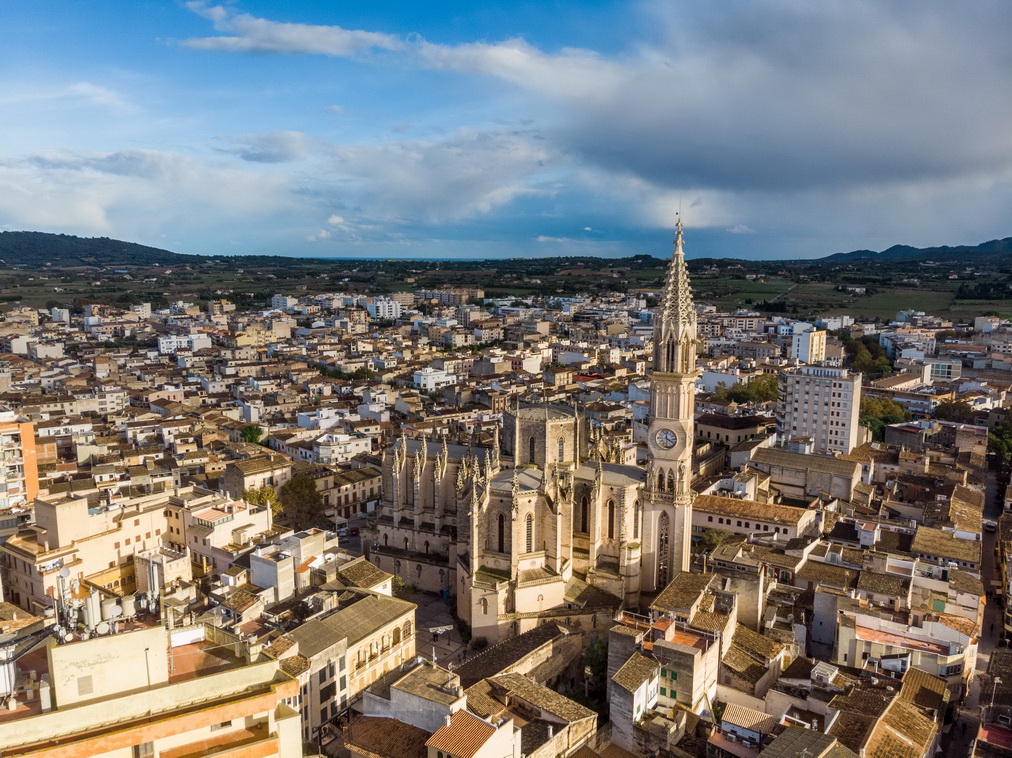
In 1879 the railroad line from Inca to Manacor was opened. About 1890 the construction of the new parish church Nostra Senyora dels Dolors began, located on the same place as the former churches. The most ancient of them had been documented in 1232 and had possibly been built upon an Arab mosque. The bell tower of the present church, an emblem of the town, measures 75 metres. In 1897 the first factory of artificial pearls, the famous Majorica, was founded. So Manacor became the business and industrial centre of Llevant. In 1912 Manacor received the title of town.

In 1936, during the Spanish Civil War, there was an attempted landing of republican forces in the shores of Porto Cristo that was repelled by the fascist forces. The mayor of Manacor, Antoni Amer Llodrà "Garanya", was assassinated by the fascists.

Geography

[edit]

The relief is not very pronounced. It takes in three areas: the flat region of the Pla, where the town of Manacor stands; the Serra de Llevant, characterised by its soft relief; and the Marina, which is formed by white gritty stone and inclines down to the sea. These limestone karsts have favoured the appearance of caves. The most outstanding for their beauty are the Dragon Caves and the Fishhook Caves. Near the coast, there is one of the longest underwater caves known in Europe : the Gleda-Camp des Pou system. It has more than 13 km in length.

Railway station
Bell tower of the church Nostra Senyora dels Dolors

A wide range of coves embellish the coast of Manacor: S'illot, Cala Morlanda, Cala Petita, Porto Cristo, Cala Anguila, Cala Mendia, s'Estany d'en Mas, Cala Falcó, Cala Varques, Cala Sequer, Cala Magraner, Cala Pilota, Cala Virgili, Cala Bota, Cala Antena, Cala Domingos and Cala Murada.

Cala Magraner

The climate is Mediterranean, with typically mild winters and hot summers. During the months of July and August, the weather is hot and sunny, boasting around 11 hours of sun daily. During the winter, the weather can get chilly, but mild.[3] The average annual temperature is between 16 and 17 °C.

The forest area represents little more than 20% of the whole area. Pine forest is found in the mountainous areas but there are hardly any survivals of the indigenous holm-oak woodlands.

The cultivated land represents 74% of the area. The agricultural landscape is characterized by almond trees, cereals, fig trees, carob trees and vineyard. The cultivation of vegetables is focused on melon, pepper and lettuce.

The town of Manacor is crossed by the Sa Cabana stream. This stream flows into the Na Borges stream, the most important of the municipality.

Demographics

[edit]
Cala Morlanda
Municipality Population
16th century 5,000 approx.
18th century 7,000 approx.
Beginning of 20th century 13,000 approx.
Centers Population 2005
Manacor 25,324
Porto Cristo 6,385
S'Illot-Cala Morlanda 1,576
Son Macià 839
Cales de Mallorca 725
Cala Murada 624
Cala Anguila-Cala Mendia 296
S'Estany den Mas 139
Total 35,908

Economy

[edit]

Until the 19th century the economy of Manacor was based on agriculture (cereals and vineyard) and livestock (sheep), although the textile and food sectors as well as pottery were important too. Although there are no longer the large estates that there were at that time, there are some that maintain their antique splendor, such as Santa Cirga and Es Fangar (the largest).

The 19th century marked the beginning of the transformation of the town. The industrial activities dedicated to the processing of agricultural product increased; windmills and a liquor distillery appeared. From the second half of the century on the production of furniture became one of the basic industries of Manacor. Pottery and the production of liquors and wines also continued.

The factory of artificial pearls was very important during the 20th century.

From the 1960s, tourism was added to the development of the economic activity of the municipality.

Construction is an important sector, as well as commerce.

Culture

[edit]

Sant Antoni

[edit]

The most popular celebration in Manacor. The ceremony begins with the exit of a group of disguised men of Saint Anthony, the greater Demon and several smaller demons, on the eve of the 17 of January. They cross the streets performing a dance that represents the temptations to which the saint was submitted. At night bonfires are ignited. The group visit the several bonfires of the municipality. People sing and dance, and eat "llangonisses" and "botifarrons" (typical pork products of the island).

On the following day are celebrated the "Beneïdes", a parade of floats and animals of all types. They are blessed because the saint is the patron of the animals.

Fairs

[edit]

The most important fairs are the Fires i Festes de Primavera. They are celebrated from the end of May to the beginning of June. During these days, there are many activities and exhibitions. The celebrations close with a parade of floats.

Other fairs : Fair of Saint James, patron of Manacor, the 25 July, and the September Fair.

Theatre

[edit]

Manacor has an important theatre season, the Fira de Teatre de Manacor, usually in September/October.

Moratons

[edit]

This is a ritual dance of uncertain origin. It seems that it was composed around the year 1855 for religious reasons, but it is possible that its origin goes back to 16th century. The clothes of the Moretons looked like those of Barbary pirates. When they dance, they hit wood pieces located in the hands, knees and abdomen.

Moratons

Els Moretons go out in May, by the Sant Domingo celebrations.

Cossiers

[edit]

There are documents about this ritual dance from 18th century. The cossiers are a group of men who dance around a woman known as "The Lady". They wear hats and coloured clothes.

Nowadays, they open the Fires i Festes de Primavera.

Vimer

[edit]

This has been a legend for more than 100 years. The vimer (Salix viminalis) is a willow located in S'Hort des Correu, a country house in the outskirts of the town of Manacor. The legend says that the tree can heal children with hernia. For this, they are passed through the branches of the tree, when the sun rises on the Saint John's Day, the 24th of June.

Industry

An industry for which Manacor is famous, and indeed Mallorca in general, is olive wood.[4] There are factories in Manacor that allow visits. Manacor is also known for its artificial pearl factories.

Gastronomy

[edit]

Typical products are Suspiros de Manacor, also known as Sospiros, sweet dry cookies often eaten with coffee or tea,[5] and the Pastís de Pobre (Poorman Cake).

Sports

[edit]

In addition to the main sports - football, basketball and volleyball - Manacor has horse racing fans and there are chariot races at the hippodrome. Manacor is also the birthplace and home town of former Spanish football international player Albert Riera and tennis legend Rafael Nadal.

Natives of Manacor

[edit]

References

[edit]
[edit]
Revisions and contributorsEdit on WikipediaRead on Wikipedia
from Grokipedia
Manacor is a municipality and the principal town located in the eastern interior of the island of Mallorca within Spain's Balearic Islands autonomous community. As of January 2024, it records a population of 47,777 residents, positioning it as the second most populous municipality on Mallorca after the capital, Palma.[1] Historically rooted in agriculture and livestock through the 19th century, Manacor's economy transitioned with industrial development, notably the establishment of its first artificial pearl factory in 1902 and expansion in furniture manufacturing, which remain central to its manufacturing sector alongside ceramics, textiles, and food processing.[2][3] The arrival of the railway in 1879 and tourism growth from the 1960s further spurred economic diversification, including coastal resorts like Porto Cristo, known for the Drach Caves.[2] Manacor gained international prominence as the birthplace of Rafael Nadal, the retired professional tennis player born there on 3 June 1986, who established the Rafael Nadal Academy in the town, enhancing its profile in sports and education.[4] The municipality preserves prehistoric and Roman archaeological sites, such as talayots and basilicas, reflecting continuous human settlement from around 2000 B.C.[2]

History

Prehistoric and Ancient Settlements

The earliest evidence of human settlement in the Manacor region dates to the Bronze Age, with archaeological findings at sites such as s'Hospitalet Vell indicating occupation from approximately 2000 BC through the Iron Age. This settlement, located in the southern part of Manacor's municipality near the coast toward Calas de Mallorca, features naviform structures—elongated, boat-shaped dwellings typical of the Naviforme culture—and later Talayotic elements, reflecting an agrarian society adapted to the island's limestone terrain for defense and resource management. Talayots, megalithic stone towers built without mortar, served as communal or defensive structures, with examples at s'Hospitalet Vell demonstrating construction techniques using local stone blocks, often exceeding 10 meters in height and incorporating central chambers.[5][6] The Talayotic culture, dominant from around 1300 BC to the 2nd century BC, left additional traces in Manacor, including settlements like those at es Boc, Bellver, and Bendrís, characterized by circular towers and associated dwellings that supported small-scale agriculture and pastoralism. These structures underscore a continuity of prehistoric habitation, with artifacts such as pottery and tools evidencing trade contacts and technological persistence amid environmental constraints like arid soils and seasonal water scarcity. Excavations reveal no evidence of large-scale urbanization, aligning with island-wide patterns of dispersed rural communities rather than centralized polities.[7] Following the Roman conquest of the Balearic Islands in 123 BC, Manacor saw the establishment of rural villas and agricultural estates exploiting the fertile plains for olive, grain, and wine production, as evidenced by mosaic floors, ceramics, and metalwork recovered from local sites. Ports like Porto Cristo facilitated maritime control and trade routes linking to Hispania Tarraconensis, with Roman adaptations including terraced farming that built on prehistoric foundations for sustained yield in the Mediterranean climate. These settlements persisted into the early centuries AD, transitioning amid provincial reorganizations without major disruptions noted in archaeological strata.[8][9] The Moorish arrival in 902 AD introduced hydraulic engineering, such as qanats and irrigation channels, enhancing agricultural output in Manacor's interior, as inferred from landscape modifications and ceramic evidence in museum collections. This period marked demographic influxes from North Africa, shifting settlement densities toward fortified alqueries, though direct archaeological links to prehistoric sites remain limited, suggesting overlay rather than erasure of earlier patterns.[10][11]

Medieval Conquest and Feudal Era

The Aragonese forces under King James I of Aragon initiated the conquest of Mallorca on September 8, 1229, with a landing at Santa Ponça, advancing rapidly to besiege Madina Mayurqa (present-day Palma), which capitulated on December 31, 1229. Muslim defenders, facing defeat in the capital, withdrew to fortified inland sites including Manacor, where they organized resistance against the invaders. James I mobilized troops to subdue these holdouts, capturing Manacor in early January 1230 after a short siege that involved direct royal oversight, as recounted in his autobiographical chronicle.[12] Post-conquest, the region underwent the repartiment, a formalized redistribution of lands and properties documented in the Llibre del Repartiment de Mallorca, which registered over 800 agricultural units island-wide. In the Manacor district, fertile alqueries (Muslim-era estates) and associated mills were granted to participating nobles, knights, and ecclesiastical bodies, with James I retaining crown domains encompassing key areas like the castle and surrounding fields to ensure fiscal control. This allocation entrenched feudal hierarchies, transforming Manacor into a seigneurial possession under lay lords who exacted rents and labor from subservient peasants, while the church received tithes and parcels to support repopulation and Christianization efforts.[13][14] Repopulation initiatives prioritized Catalan settlers, supplemented by Aragonese and Occitan immigrants incentivized through tax exemptions and land allotments, fostering demographic recovery from wartime devastation. Archival tallies from the mid-13th century reflect a gradual influx, with Manacor's population stabilizing as feudal manors organized labor around olive groves and vineyards seized from prior Muslim owners. Lingering Moorish resistance manifested in guerrilla actions and a major revolt in 1248, quelled by royal armies, which prompted enslavement or expulsion of holdouts and accelerated Christian settlement to secure loyalty and agricultural output.[15][16]

Industrialization and Modern Growth

The opening of the railway line from Inca to Manacor in 1879 enhanced connectivity and trade access, enabling a shift from predominantly agrarian activities toward manufacturing by reducing transport costs for goods and materials.[2] This infrastructure milestone spurred the development of furniture production as a core industry during the second half of the 19th century, leveraging local woodworking expertise and emerging demand for household goods.[2] The establishment of the first artificial pearl factory in Manacor in 1902 marked the onset of a significant manufacturing boom in imitation jewelry, drawing on innovative techniques adapted from European patents and capitalizing on the island's coastal resources for shell-based production.[2] This sector's expansion, alongside furniture and ancillary crafts like pottery and liquor distillation, solidified Manacor's role as the primary industrial center in eastern Mallorca's Llevant region.[2] In recognition of its population and economic ascent, Manacor received official town status in 1912, a designation that underscored the causal impact of these industrial advancements on local prosperity independent of later tourism dependencies.[2] From the 1960s, surging tourism inflows prompted urban expansions and shifts in daily customs, yet Manacor's entrenched manufacturing output in furniture and pearls maintained year-round employment stability, mitigating vulnerabilities from tourism's inherent seasonality.[2] This industrial resilience persisted into modern times, with furniture remaining a hallmark sector amid broader Balearic economic diversification.[17]

Geography and Environment

Location and Topography

Manacor occupies the eastern interior of Mallorca, the largest island in Spain's Balearic archipelago, positioned in the western Mediterranean Sea at coordinates approximately 39.57°N, 3.21°E.[18] The municipality covers 260.22 square kilometers, establishing it as the second-largest by land area on the island after Llucmajor.[2] Its territory extends from inland plains to coastal zones, incorporating the harbor town of Porto Cristo along the eastern shoreline.[19] Situated roughly 50 kilometers east of Palma de Mallorca via road, Manacor integrates into the island's central transport networks while maintaining a primarily rural and semi-urban character. The topography features undulating limestone plateaus and karst landscapes typical of the Balearic region's Miocene-era geology, with flat expanses in the interior facilitating agriculture such as olive and almond groves.[20] Prominent karst formations include subterranean cave systems near the coast, exemplified by the Drach Caves in Porto Cristo, formed through dissolution of soluble limestone bedrock.[21] These geological traits influence local hydrology and land use, channeling surface water into underground networks.

Climate and Natural Features

Manacor exhibits a Mediterranean climate, featuring mild winters with average temperatures ranging from 10°C to 15°C and hot, dry summers where highs often reach 25°C to 30°C.[22] The mean annual temperature stands at 17.6°C. Precipitation averages 443 mm annually, with most rainfall concentrated in the autumn and winter months from October to March, supporting episodic wet periods amid predominantly arid conditions.[23] The municipality's natural features include a diverse coastal landscape with rocky coves, cliffs, and subterranean cave systems such as the renowned Caves of Drach and Hams Caves, formed by karst processes in the limestone bedrock.[24] [25] Inland areas feature rolling hills and eco-trails like the Via Verde, fostering habitats for varied Mediterranean flora and fauna adapted to semi-arid environments.[26] These elements contribute to localized biodiversity, including endemic species resilient to water scarcity, though not within a formally designated park like the adjacent Parc Natural de la Península de Llevant.[24] Urbanization and agricultural intensification exert pressures on these features, notably through groundwater depletion via overpumping, which has historically exhausted local aquifers and induced seawater intrusion in coastal zones.[27] Hydrological analyses of Mallorca's eastern basins, including those near Manacor, link such declines to reduced recharge under variable precipitation and increased extraction demands, amplifying vulnerability to dry spells.[28][29]

Demographics

Population Dynamics

As of 1 January 2024, Manacor had a population of 47,777 inhabitants according to official municipal registry figures compiled by the Instituto Nacional de Estadística (INE).[1] This represents a 1.5% increase from 46,395 in 2023 and continues a pattern of steady annual growth averaging around 1-2% in recent years, with the population surpassing 40,000 by 2010 and 45,000 by 2022.[1] The municipality's population has expanded more than 2.5-fold since 1950, when it stood at 18,956, largely attributable to the establishment and persistence of manufacturing sectors such as furniture production and artificial pearl fabrication, which created sustained local employment and attracted internal migrants from rural Mallorca.[30] Earlier growth was modest; from 1900 to 1950, the population rose only from 12,408 to 18,956 amid limited economic diversification beyond agriculture.[30] Medieval estimates suggest even slower expansion, with approximately 2,000 residents around 1503, constrained by feudal structures and periodic plagues.[31] Acceleration began in the late 19th century following the extension of the Palma-Manacor railway line, completed in stages by 1879, which enhanced access to markets and spurred proto-industrial activity.[32]
YearPopulation
190012,408
195018,956
198124,153
200030,923
202447,777
Source: INE census and registry data.[30][1] Demographic metrics indicate a working-age dominated structure, with 66% of residents aged 18-65 as of 2024, a bulge sustained by manufacturing's demand for labor and lower out-migration compared to tourism-dependent coastal areas.[33] Urbanization within the municipality exceeds 80%, concentrated in the core town, reflecting industrial clustering rather than dispersed settlement.[34] Recent trends show relative stabilization in growth rates since the 2010s, with net inflows tempered by Balearic-wide housing pressures, though local industry continues to anchor retention over external emigration.[1]

Ethnic and Cultural Composition

Manacor's ethnic composition remains dominated by descendants of historical Catalan settlers, forming a homogeneous core population rooted in the island's medieval repopulation following the Reconquista. The native inhabitants primarily identify culturally as Mallorquín, with the local dialect of Catalan (Mallorquí) serving as the predominant language in daily and communal life.[3] This linguistic continuity reflects centuries of insular isolation and cultural preservation, distinct from mainland Spanish norms despite bilingual official status in the Balearic Islands. Immigration accelerated post-2000, transforming Manacor from a largely rural, homogeneous community into one with notable diversity, fueled by EU labor mobility and demand for workers in the furniture manufacturing sector, which constitutes a key economic pillar. As of the latest regional data, foreigners comprise 20.9% of the population, higher than historical baselines of around 11% in the early 2000s, with inflows causally linked to industrial expansion rather than tourism-driven settlement seen elsewhere on Mallorca.[35] [36] These migrants predominantly originate from Latin America (e.g., Ecuador, Bolivia, and Colombia for shared linguistic affinities aiding initial integration), North Africa (notably Morocco for low-skilled roles), and Eastern Europe (such as Romania), occupying economic niches in manufacturing and agriculture that locals have increasingly vacated due to higher education and service-sector shifts.[37] Religiously, the community is overwhelmingly Roman Catholic, aligning with broader Spanish and Balearic patterns where over 90% of residents nominally adhere to the faith, evidenced by the centrality of parish churches like Santa Maria in social cohesion.[38] Minority faiths among immigrants, such as Islam from Maghrebi groups, remain marginal but contribute to localized cultural enclaves, though empirical integration metrics highlight persistent barriers like non-fluency in Catalan, complicating access to public services and fostering parallel communities in industrial zones.[3] This shift underscores labor-driven multiculturalism without erasing the foundational Mallorquín identity, as native birth rates and endogamy sustain ethnic continuity amid exogenous pressures.

Economy

Traditional Industries

Manacor's economy has historically relied on manufacturing clusters in furniture and artificial pearls, which emerged in the 19th century as self-sustaining sectors independent of tourism. Furniture production, centered on wood processing and craftsmanship, became prominent from the mid-1800s, utilizing local timber to create high-quality pieces and establishing Manacor as a specialized hub known locally as the "City of Furniture."[39] This industry fostered employment in artisan workshops and factories, contributing to population growth through skilled labor demands before the 20th-century rise of mass tourism.[3] The pearl sector, epitomized by Majorica, originated in 1890 with the invention of a durable artificial pearl process using a core coated in mother-of-pearl essence and polymer layers, enabling global exports from its Manacor base.[40] The company's factory relocated to Manacor by 1902, employing primarily local women for hand-finishing tasks like luster application and drilling, which produced resilient simulants unaffected by common corrosives unlike natural pearls.[41] By the early 20th century, Majorica pearls gained international recognition for affordability and quality, supporting export-oriented trade that predated tourism dominance.[42] Complementing manufacturing, agriculture provided a foundational base with olives, almonds, cereals, and wine grapes cultivated traditionally for subsistence and local processing into oils, liqueurs, and varietals.[3] Cooperatives emerged to aggregate output, enabling exports of olive wood products and wines, though specific protected designation of origin (PDO) labels apply more broadly to Mallorcan varieties like Prensal Blanc grapes rather than Manacor-exclusive designations.[43] These sectors underscored an export focus, with pearls and furniture driving commerce to markets beyond the Balearics by the early 1900s.[44]

Tourism Development

Tourism development in Manacor accelerated in the 1960s, complementing the municipality's industrial base by leveraging its coastal and natural assets, particularly in the Porto Cristo area.[2] This period saw initial investments in hospitality infrastructure, including hotels and a marina in Porto Cristo accommodating approximately 450 berths, facilitating access to beaches and water-based activities.[45] Unlike more saturated Mallorca destinations, Manacor's tourism has remained relatively restrained, avoiding large-scale mass developments while focusing on niche attractions.[3] Principal draws include the Cuevas del Drach in Porto Cristo, renowned for their extensive stalactite formations, underground lake, and daily classical music performances, which position them as one of Mallorca's premier natural sites.[46] Beaches such as Cala Magraner and Cala Morlanda provide scenic coastal access, supporting recreational tourism. The Rafael Nadal Academy by Movistar, established in Manacor, has bolstered sports-oriented visitation; its integrated museum alone recorded 107,000 visitors over the 12 months ending August 2025, contributing to year-round interest beyond peak seasons.[47] Economically, tourism yields seasonal employment in hospitality, guiding, and related services, with multipliers evident in local crafts markets and cultural events that extend visitor spending into the town's artisanal sectors.[48] However, its role remains secondary to manufacturing for providing stable, year-round jobs, as tourism's influx primarily concentrates in summer months. This seasonality imposes strains on infrastructure, including traffic congestion around attractions and pressure on water resources, though Manacor's lower density mitigates broader environmental degradation seen elsewhere in Mallorca.[3]

Contemporary Challenges and Debates

In Manacor and the broader Balearic Islands, protests against mass tourism intensified in 2024 and continued into 2025, with local groups in Manacor convening in February 2025 to organize escalated actions under the theme of "regroup, double the effort," focusing on grievances like housing shortages and infrastructure strain.[49] These demonstrations, which drew thousands across Mallorca including beach occupations in June 2024, highlighted how tourism-driven demand has exacerbated housing crises, with the islands requiring an estimated 45,000 additional homes to avert economic collapse for residents.[50] Coastal areas near Manacor, such as Cala Morlanda and Cala Magraner, face amplified pressures from seasonal influxes, contributing to rental price surges that displace locals into substandard housing.[51] Water scarcity compounds these tensions, as Mallorca's groundwater reserves dropped to approximately 41% by September 2025, prompting restrictions on pool filling, irrigation, and car washing amid tourism's high consumption—hotels alone account for significant usage despite sustainability pledges.[52][53] Manacor's own potable water infrastructure improvements, aimed at addressing quality issues, were delayed until 2025, underscoring localized vulnerabilities tied to broader island resource limits.[54] Proponents of restrictions argue these measures are essential to preserve livability, yet critics emphasize tourism's outsized economic role, with foreign visitor spending reaching €20 billion in 2024 and driving 3.5% GDP growth, warning that curbs could trigger job losses in a sector underpinning much of the islands' employment.[55][56] Debates over policy responses include proposals to raise the Balearic sustainable tourism tax to €15 (about £13) per day during peak summer months from 2025, as advocated by trade unions to generate revenue for housing and infrastructure while deterring low-value mass tourism.[57][58] Current rates range from €0.50 to €4 daily, but hikes risk reducing visitor numbers—evident in 2025 declines in areas like Capdepera—potentially undermining the €22 billion in tourism expenditure recorded through November 2024.[59][60] Parallel challenges involve labor dynamics in Manacor's traditional sectors like manufacturing and agriculture, where immigrant workers fill seasonal shortages but face scrutiny for contributing to wage stagnation amid globalization's competitive pressures on local industries such as pearl production and furniture.[61] Diversification efforts are urged to mitigate reliance on EU funds and tourism volatility, as limited university-industry ties hinder innovation in non-service sectors, exposing the economy to external shocks like import competition.[61]

Governance and Infrastructure

Local Administration

The Ayuntamiento de Manacor serves as the primary local governing body, comprising a plenary assembly of elected councilors led by the alcalde, or mayor. As of October 2025, Miquel Oliver Gomila of the Més per Manacor-Esquerra Emociona't coalition holds the mayoralty, having assumed office on June 17, 2023, with support from allied parties including the PSOE and AIPC-SyS.[62] [63] This administration operates under Spain's municipal law framework, exercising authority over local services, fiscal policy, and development within the Balearic Islands' autonomous community structure, where regional parliament oversight applies to broader coordination.[64] Manacor's administrative scope encompasses an undivided municipality featuring a compact urban core alongside extensive rural zones dominated by fincas—traditional agricultural estates that anchor peripheral land management and zoning. The current government team, restructured in May 2025 to include seven councilors from Més-Esquerra, four from PSOE, and two from AIPC, delegates responsibilities across areas such as finance, urbanism, and economic promotion, with the first deputy mayor overseeing urban planning.[63] [65] While the prevailing left-leaning coalition prioritizes regional identity and social policies, opposition parties like PP and Vox emphasize local autonomy, critiquing central and EU interventions for eroding self-reliance; for instance, they have protested municipal decisions perceived as overstepping into linguistic impositions, advocating instead for streamlined administration favoring industry over regulatory expansion.[66] [67] Historically, pro-industry stances in Manacor have reflected conservative priorities, supporting sectors like manufacturing with budgets directed toward essential infrastructure to sustain economic independence rather than broad welfare dependencies. EU regional funds supplement local initiatives, yet right-leaning critiques highlight risks of fostering subsidy reliance, urging policies that bolster endogenous growth in agriculture and crafts over external aid.[68]

Transportation and Urban Planning

Manacor's primary road connection to Palma de Mallorca is via the Ma-15 highway, enabling efficient vehicular access for residents and visitors.[69] The Serveis Ferroviaris de Mallorca (SFM) T3 train line provides rail service from Palma Intermodal Station to Manacor, operating hourly from 6:24 to 22:24 and covering approximately 49 km in about one hour.[70][71] Transports de les Illes Balears (TIB) bus routes supplement this network, offering links to Palma and surrounding municipalities.[72] Palma de Mallorca Airport (PMI), situated 48 km northwest, is reachable by car in roughly 39 minutes, facilitating inbound tourism and logistics.[73] In the coastal district of Porto Cristo, the Port de Porto Cristo marina accommodates small craft with services for recreational boating and local fishing, though it lacks extensive commercial trade infrastructure.[74] The Pla General de Manacor, approved via Boletín Oficial de las Islas Baleares on January 1, 2022, directs urban development by delineating zones for industrial expansion and residential housing amid population growth pressures.[75] This master plan incorporates environmental constraints, such as limits on land consumption and protections for natural areas, to mitigate impacts from ongoing urbanization in the 2020s.[75]

Culture and Traditions

Festivals and Folklore

The Sant Antoni festival, celebrated annually on January 16 and 17, centers on bonfires, processions, and the blessing of animals, reflecting agrarian rituals to protect livestock from disease, a practice traceable to medieval Catholic integration of pre-Christian fire rites. In Manacor, these events feature communal fire-building and demon-chasing parades with masked figures symbolizing the triumph of good over evil, drawing participants in traditional attire for dances and glosses—improvised poetic songs—before the blessings at the parish church.[76][77][43] The Fira de Setembre, held in late September, and the Fira de Primavera in May serve as annual fairs emphasizing local crafts and folklore demonstrations, with stalls for artisanal goods and performances that maintain historical trades like pearl manufacturing alongside traditional music. These events preserve cultural continuity by integrating folk elements such as giant puppet parades (gegants) and hobby horse figures (cavallets), which enact medieval mock battles rooted in Reconquista narratives, countering tourist commercialization through community-led organization.[78][79] Central to Manacor's folklore are dances like the Ball dels Cossiers, performed during the Sant Domingo festivities in May, where costumed male dancers in kilts circle a central "Lady" figure, shielding her from a demon in a choreographed allegory of virtue prevailing, with origins in 13th-century ritual dramas documented in ecclesiastical records. Accompanying theater traditions include moros i cristians reenactments with moretons—devilish figures—and giants, staged at patronal feasts to evoke historical Christian-Muslim conflicts, ensuring transmission across generations despite urban pressures. Local preservation groups document these intangibles, aligning with broader Balearic efforts to safeguard against dilution, as evidenced by sustained participation rates exceeding 1,000 annually in core events.[80][81][82]

Crafts and Gastronomy

Manacor's artisanal heritage centers on pearl manufacturing and furniture production, both serving as significant cultural exports. The town hosts the Majorica pearl factory, a key producer of durable imitation pearls developed through extensive research and craftsmanship, which has earned international acclaim for withstanding environmental factors better than natural varieties.[83] [84] Factory tours spanning over 2,000 square meters allow public access to the production process, showcasing techniques refined since the early 20th century.[85] Complementing this, olive-wood artisans and furniture workshops, concentrated in the old town, maintain a tradition of handcrafted pieces, with small-scale operations along central streets contributing to the local economy through bespoke woodwork.[86] [87] Additional crafts such as willow weaving, known locally as vim, and leatherwork persist as part of Mallorca's broader artisanal legacy, though specific guild structures in Manacor emphasize individual workshops over formalized associations.[88] These practices highlight authentic techniques over mass-produced adaptations, with public-facing outlets preserving skills passed through generations. Gastronomically, Manacor features Mallorcan staples like sobrasada, a spiced cured pork sausage, and ensaimada, a coiled pastry, often adapted with local ingredients such as olive oil from surrounding groves.[43] These dishes underscore a reliance on regional produce, prioritizing farm-fresh elements in preparation.[89] Local events, including the Fair of Flavors, promote these traditions by featuring cheeses, wines, and authentic Mallorcan fare alongside diverse offerings, fostering direct connections between producers and consumers.[90] Farm-to-table initiatives like Terragust exemplify this ethos, rotating across seasonal farms for guided tours and tastings of hyper-local, organic products, emphasizing sustainability over tourist-oriented modifications.[91] Such experiences, often held on Fridays near the town, integrate rural agriculture with culinary output, drawing on Manacor's agricultural hinterland for ingredients like tomatoes and cured meats in dishes such as pa amb oli.[92]

Sports and Recreation

The Rafa Nadal Academy by Movistar, established in 2016 in Manacor, serves as a global hub for elite tennis training, emphasizing holistic development through intensive physical regimens, technical drills, and academic integration for aspiring professionals. This facility has elevated tennis as Manacor's signature sport, cultivating a ethos of perseverance and merit-based achievement amid the [Balearic Islands](/page/Balearic Islands)' prevalent focus on casual coastal leisure. Its expansion to 45 tennis courts, including indoor and clay surfaces, supports year-round programs that have produced competitive players on international circuits.[93][94] Football remains a community staple through CD Manacor, founded on June 23, 1923, which fields teams in Spain's Tercera Federación and has qualified for Copa del Rey preliminary rounds, such as in 2022. Local facilities, including municipal pitches and multi-use grounds at the academy, facilitate youth and amateur play, fostering grassroots participation. Cycling draws enthusiasts to Manacor's inland terrain, integrated into Mallorca's extensive network of group rides and routes averaging 20-30 km/h paces, with events coordinated via platforms like Chains & Coffee.[95][96][97] Outdoor recreation centers on hiking trails spanning Manacor's 260 km², with over 14 documented routes featuring coastal paths, cliffs, and access to karst formations like the Drach Caves in Porto Cristo—Europe's most visited cave system, where visitors traverse 1,200 meters of illuminated tunnels and underground lakes, combining exploration with moderate exertion. These activities promote ecotourism-linked fitness, distinct from tennis's structured intensity, and leverage the area's mild Mediterranean climate for sustained engagement.[98][99][100]

Notable Residents

Rafael Nadal, born on 3 June 1986 in Manacor, is a retired professional tennis player who secured 22 Grand Slam singles titles, including a record 14 at the French Open, two at the US Open, two at the Australian Open, and four at Wimbledon, alongside Olympic gold medals in singles (2008) and doubles (2016).[101] Starting training at age three under his uncle Toni Nadal without access to elite facilities initially, his ascent from local courts to global dominance highlights disciplined, merit-based achievement in a physically demanding sport.[102] In 2016, Nadal founded the Rafa Nadal Academy by Movistar in Manacor, a facility that trains over 200 young players annually from more than 60 countries, hosts international tournaments, and integrates education with sports development, boosting local youth opportunities and tourism-related revenue.[94][103] Toni Nadal, born 4 March 1961 in Manacor, served as Rafael's coach from 1990 to 2017, devising a high-intensity training philosophy emphasizing mental resilience and baseline play that contributed to 14 French Open victories and over 80 ATP titles. His methods, rooted in local family guidance rather than institutional privilege, extended to authoring books on sports psychology and coaching other professionals.[104] Miguel Ángel Nadal, born 28 July 1959 in Manacor, was a professional footballer who debuted for RCD Mallorca on 19 April 1987, later playing 127 La Liga matches for FC Barcelona (1989–1991) and earning nine caps for Spain's national team. His career, spanning over 300 club appearances, underscores hometown origins in producing competitive athletes across disciplines.[104]

References

User Avatar
No comments yet.