Hubbry Logo
Manimala RiverManimala RiverMain
Open search
Manimala River
Community hub
Manimala River
logo
8 pages, 0 posts
0 subscribers
Be the first to start a discussion here.
Manimala River
Manimala River
from Wikipedia

Manimala River
Pullakayar, Vallapuzha , Vallabhaipuzha
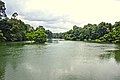
Manimala river near Cheruvally
Map
Native nameമണിമലയാർ (Malayalam)
Location
CountryIndia
StateKerala
DistrictsKottayam, Pathanamthitta, Alappuzha
CitiesPeermedu,Mundakayam, Manimala, Kanjirappally, Mallappally, Vennikkulam, Kallooppara, Kaviyoor, Vallamkulam Thiruvalla, Thalavadi, Kidangara, Pulinkunnu, Edathua, Champakulam etc.
Physical characteristics
Source 
 • locationMuthavara hills, Western Ghats
 • elevation2,500 ft (760 m)
Mouth 
 • location
[[Empties into Vembanad Lake at Kainakary through two branches which separates after Kidangara, one via Pulinkunnu, Mankompu second via Veliyanadu, Kavalam. A branch of Pamba splits at Kuthiathodu and joins Manimala river at Kallunkal flows together for nearly five Kilometers and branches out again at Nedumpuram and flows along Niranam, Thalavady, Edathua, Champakulam, Nedumudy, Chennamkary and joins Vembanad lake at Kainakary.]]
Length91.73 km (57.00 mi)
Basin size802.90 km2 (310.00 sq mi)
Basin features
LandmarksKallooppara Bhagavathy temple, Kaviyoor Mahadevar Temple, [[Nannoor Devi Temple]].

Manimala River, or Manimalayar, is a 92 km long river which flows through South and Central Kerala. The river used to be wrongly considered as a tributary of Pamba River before satellite maps became popular, but this was proved incorrect. Manimala does not flow into the Pamba, instead a distributary of the Pamba river flows into the Manimala river at Kallunkal, later branches out again from Manimala at Nedumpuram and flows through Niranam, Thalavady, Edathua, Changankary, Champakulam, Nedumudy, Chennamkary, and finally Kainakary and then empties into the Vembanad lake. This branch again links with the Manimala River at Chennankary in a short, but broad connection known as Munnattumukham.[citation needed]

Manimala is a separate independent river for all geographical purposes. It has its origin on the [Muthavara Hills] (1156 feet above main sea level) on the Western Ghats in Peermedu in Idukki district of Kerala, India. It has a length of about 90 km and flows through a catchment area of about 847 km2. The river passes through the districts of Idukki, Kottayam, Pathanamthitta and Alappuzha .[1] Yendayar, Koottickal, Mundakayam, Erumeli, Manimala, Kottangal, Kulathurmoozy, Vaipur, Mallappally, Keezhvaipur, Thuruthicad, Komalam/Kuranjoor Kadavu, Kallooppara, Vallamkulam, Kattode & Kuttoor (outskirts of Thiruvalla city), Pulikeezh, Nedumpuram, Neerattupuram, Amichakary, Muttar, Kidangara, Pulincunnoo, Veliyanadu, Ramankary, Mankompu lie on the banks of Manimala River. Manimala splits after Kidangara into two branches. Second branch flows via Kunnamkary, Kavalam and Kainakary to Vembanad lake. Its running length is estimated at 92 km. It empties itself into the Vembanad Lake. It is one of the four major rivers which do not have direct outlet to sea as these rivers (Meenachil, Pamba, Manimala, Achankovil) empty into the vast Vembanad lake. This huge lake has just two outlets, one at Thottappaly Spillway and second at Thannermukkom Bund, both man made barriers, built to prevent incoming seawater during high tides, which otherwise would render the low lying paddyfields (average 2.5 meters below sea level) uncultivable.[citation needed]

Niranam is historically known as an ancient inland port at the confluence of Manimala River and Pamba River. At Kaviyoor ancient rock-cut cave temples can still be seen.[citation needed]

Manimala River has been an important water way of Central Travancore. Rising in the hills of Kottayam-Idukki ranges, running westward, the river joins the plains at Manimala junction and then the flows through the midland plains and through the Kuttanad rice bowl area. Sand mining on the river bed has led to depletion of the water ways of the river. Pollution is a problem.[citation needed]

[edit]

References

[edit]
Revisions and contributorsEdit on WikipediaRead on Wikipedia
from Grokipedia
The Manimala River is a 90-kilometre-long river in the central and southern regions of , , originating from the Thattamalai (Tatamala) hills in the of at an elevation of 1,156 metres and flowing westward through midland plains before joining the at Muttar in . The river's basin covers approximately 847 square kilometres entirely within Kerala, spanning , , and districts, with an average annual rainfall of 3,300 millimetres contributing to a of about 1,561 million cubic metres. Its main tributaries include the Kokayar and Elakkalthodu rivers, which enhance its hydrological network and support the basin's tropical humid climate. As a vital waterway in central Travancore, the Manimala River is navigable for 54.4 kilometres and plays a crucial role in irrigation for wetland paddy cultivation (requiring 378 million cubic metres annually for three crops), garden lands (24 million cubic metres), domestic use (85.6 million cubic metres as of 2021), and industrial needs (90 million cubic metres as of 2021). It passes through key villages such as Manimala, Mallappally, Kaviyoor, Kalloppara, Thalavadi, Kozhimukku, Edathua, and Champakulam, fostering agriculture, fisheries, and local ecosystems in the ecologically sensitive Kuttanad region. The river is renowned for its scenic beauty, swift flows past rocky outcrops, and contributions to the biodiversity of the Western Ghats, though it faces challenges from soil erosion and pollution in its basin.

Geography

Origin and Course

The Manimala River originates from the Tatamala hills (also known as Muthavara or Mothavara hills) in the along the border of and Idukki districts, , at an elevation of 1,156 meters above mean . This source lies in the hilly terrain of the Kottayam-Idukki ranges, marking the river's emergence as a westward-flowing typical of Kerala's midland river systems. From its origin, the river initially courses southeast through the forested upper reaches of Idukki district's hilly landscape before turning west to traverse the midland plains of and districts. It passes key towns such as , , and Vazhoor in Kottayam, followed by and in the central stretch. The upper hilly sections feature swift flows amid rocky outcrops and dense vegetation, transitioning to broader alluvial plains in the middle course where the terrain flattens and the channel widens. The lower portions, entering at , become navigable for approximately 54 km, passing through villages like Edathua and Champakulam. Spanning a total length of about 90 km, the Manimala River ultimately confluences with the at the Manimala junction near Muttar in , after which the combined waters flow into the Lake. This endpoint integrates the river into the broader wetland system without a direct outlet to the .

Basin Characteristics

The Manimala River basin encompasses an area of 847 km², spanning the districts of Idukki, , , and in . It is delimited to the north by the basin, to the south by the basin, to the east by the escarpment, and to the west by the low-lying coastal plains of the . This configuration positions the basin within a dynamic topographic gradient, transitioning from highland elevations exceeding 1,000 m to near-sea-level lowlands. Geologically, the upper basin is underlain by crystalline rocks, including charnockites, gneisses, and metasediments, which form the rugged terrain of the . In contrast, the mid- and lower reaches feature lateritic soils derived from intense weathering of these crystalline formations, overlaid with alluvial deposits in the floodplains. Land use within the basin reflects its physiographic diversity, dominated by rubber plantations (approximately 67% of the area), particularly in the , with in the upper hilly regions (about 7.6%) providing watershed protection, and croplands including paddy fields in the lowlands (about 1.7%). Built-up areas are minimal (0.36%), concentrated along riverine corridors, while water bodies and wetlands account for about 1.1%, supporting local . The basin's climate is characterized by a tropical regime, receiving an average annual rainfall of 3,300 mm, predominantly during the southwest from to . This intense precipitation regime drives high , with minimal infiltration in the impermeable upper crystalline zones, enhancing the basin's erosional dynamics and . Hypsometric analysis reveals a mature stage of basin evolution, evidenced by a hypsometric of 0.50 and a concave-up curve, indicative of balanced relief and relative stability in geomorphic processes despite ongoing . This maturity suggests that the basin has progressed beyond youthful disequilibrium, with erosion and deposition achieving a quasi-steady state influenced by tectonic quiescence in the region.

Hydrology

Flow Regime

The flow regime of the Manimala River is characterized by pronounced seasonal variations typical of , with the majority of its discharge occurring during the . The average annual is 1560.74 million cubic meters (Mm³), primarily driven by heavy rainfall peaks from the southwest between June and September, extending into pre-monsoon (May) and post-monsoon (October) periods. During these months, high flows dominate due to intense precipitation in the , contributing over 80% of the annual volume, while base flows remain low in the dry winter season from December to February, supporting minimal perennial flow. Discharge rates exhibit significant fluctuations, contrasting sharply with dry-season base flows that sustain ecological functions but limit water availability. The river's is not significantly influenced by major releases, as there are no large dams on its course, allowing natural runoff to dictate the regime. Flooding is frequent in the lower basin, where the flat exacerbates inundation; for instance, the severely impacted the Manimala basin, causing widespread overflow and altering local hydrology, as did the 2021 floods which saw water levels rise by 7 meters in 5 hours in some areas. The river remains navigable for small boats up to 54.4 km from its mouth, facilitated by adequate depths during high-flow periods, though tidal influences are minimal owing to its indirect connection to the via the Lake rather than a direct . This regime supports limited but underscores the river's vulnerability to seasonal extremes, with tributary inputs further modulating downstream flows.

Tributaries and Drainage

The Manimala River is augmented by a network of major and minor tributaries that form its primary drainage system, primarily in the highland and midland regions of central . The key major tributaries are the Kokayar (also spelled Kokkayar), which originates from the eastern highlands and joins the main river near , and the Elakkalthodu, which flows from the northern slopes and confluences at Thondara, both contributing significantly to the upper basin flow. Minor tributaries include several seasonal streams, such as Pullaga (Pullaraar) and Kanjirappallythodu (also known as Chittar), which drain from local hills and integrate into the river's network in the highland areas. The overall drainage pattern exhibits a predominantly dendritic structure in the upper basin, resulting from the uniform geology dominated by charnockite, dolerite, and quartzite, which facilitates branching streams following the terrain slope; this shifts to a less pronounced trellis pattern in the southwestern plains where structural influences become more evident. These confluences, occurring primarily in the highland stretches, enhance the river's , with tributaries increasing the load during monsoons and supporting depositional features in the lower reaches near Lake. The influx from these streams also bolsters the overall discharge, particularly during peak flow periods.

Ecology and Environment

Biodiversity

The Manimala River sustains a rich aquatic , particularly in its populations, which form a cornerstone of the river's ecological dynamics. Surveys have documented 97 species across 11 orders, 33 families, and 57 genera, with Cypriniformes being the most diverse order at 39 species. Representative species include the pearl spot (Etroplus suratensis), a adapted to the brackish lower reaches, and the (Tor khudree), a threatened cyprinid favoring the oxygen-rich, fast-flowing upper streams. Riparian vegetation along the varies by elevation, reflecting the transition from upland forests to lowland marshes. Upper basin stretches feature riparian forests including species such as Hydnocarpus pentandra, Ficus exasperata, and Ochreinauclea missionis, which stabilize banks and support food webs. In the lower basin and estuary, reed beds (Phragmites karka) and marshy halophytes like Talipariti tiliaceum prevail, forming dense buffers against tidal influences, though true mangroves are sparsely distributed due to the river's limited brackish extent. These plant communities enhance habitat connectivity and filtration of runoff into the backwaters. Bird and mammal assemblages further underscore the river's ecological value, with forested riparian zones serving as corridors for terrestrial fauna. Avian diversity includes over 100 species in Kerala’s comparable river systems, featuring waders like (Ardea spp.) and piscivores such as (Alcedo atthis), which exploit the river's insect and fish resources. Floodplain ecosystems, characterized by seasonal and alluvial soils, amplify the river's by providing breeding grounds for migratory avifauna and supporting edaphic specialists. The Kaviyoor region emerges as a notable hotspot, where wetland mosaics foster high floral and faunal turnover during monsoons. is pronounced, with Kerala-restricted like the Labeo dussumieri and Horabagrus brachysoma in aquatic niches, and plants such as and in riparian understories. A 2018 assessment cataloged 398 plant across the riverine and areas, including 50 endemics, highlighting the basin's role in conservation.

Pollution and Conservation Efforts

The Manimala River faces significant from multiple anthropogenic sources, including domestic , agricultural runoff containing pesticides, activities, and generated during seasons. Untreated domestic and municipal discharge directly into the river, particularly in downstream urban stretches, contributing to organic loading. Agricultural runoff introduces fertilizers and pesticides from in the basin, exacerbating nutrient enrichment and chemical contamination. Indiscriminate along the riverbanks disrupts sediment balance and releases sediments laden with pollutants into the water column. Additionally, pilgrimage-related , including organic effluents from temple vicinities, increases during peak seasons like Sabarimala, adding to the organic load through untreated discharges into tributaries. These sources have led to elevated (BOD) levels in the lower stretches, indicating high organic . Key incidents have amplified concerns, notably the 2018 floods, which mobilized and accumulated pollutants, spreading contaminants across the basin and worsening . at nearby temples during periods further intensifies the organic load, with increased human activity leading to higher waste inputs. Water quality assessments reveal pH levels ranging from 6.2 to 7.9, generally within neutral to slightly alkaline ranges suitable for aquatic life. However, elevated fecal and total coliform counts, reaching up to 1200 MPN/100 mL and 2000 MPN/100 mL respectively near urban monitoring stations like Kallopara, indicate fecal contamination from sewage and waste sources. Studies estimate that non-biodegradable waste accumulation affects approximately 31% of the basin areas, highlighting widespread degradation. This pollution contributes to broader biodiversity loss in the river ecosystem, as toxic inputs disrupt habitats. Conservation efforts have been initiated to mitigate these issues, including projects by the State Biodiversity Board, such as the 2018 biodiversity assessment that evaluated ecological imbalances and recommended targeted interventions. The Pampa Parirakshana Samithy has organized river cleaning drives, integrating manual removal of invasives and waste with programs like MGNREGS, focusing on the Pamba basin including tributaries like the . Floodplain restoration plans emphasize native vegetation planting for bank stabilization and habitat recovery, particularly in vulnerable segments from Pulinkunnu to Kallopara. Persistent challenges include encroachments, which have reduced natural riparian habitats, with significant vegetation cover loss in various segments (e.g., up to 60% in some areas). Proposed eco-restoration initiatives for the aim to address these through eradication and riparian to enhance resilience. As of 2025, Kerala's Operational Framework for Integrated River Basin Conservation includes long-term and annual action plans for basins like Manimala. The connected is being included in the National River Conservation Plan.

Human Interactions

Economic Uses

The Manimala River plays a vital role in irrigation for agriculture in the Kottayam and Idukki districts of Kerala, supporting paddy cultivation and rubber plantations through natural flow and associated streams such as the Panayampalamthodu. It irrigates areas in panchayats including Anicadu, Mallapally, Kunnamthanam, Kaviyoor, and Kalloopara, contributing to Kottayam's wetland farming systems where paddy covers approximately 14,775 hectares district-wide, though specific attribution to the Manimala basin varies with seasonal runoff. Rubber plantations, dominant in the region with over 114,000 hectares in Kottayam, also benefit from the river's water for supplemental irrigation during dry spells. The river serves as a key source for domestic water supply, abstracted by the Kerala Water Authority (KWA) for drinking purposes in central . In the Kalloopara-Thondra stretch alone, it provides 3.5 million liters per day (MLD) at Kalloopara and 4 MLD at Kaviyoor, with total consumption reaching 40.5 MLD, supporting approximately 300,000 people assuming standard per capita usage rates. It also supplies water to municipalities like , where the river is the primary surface source for urban and rural households. Small hydropower potential exists along the river's course but remains largely untapped, with no major installations developed to date. Commercial fishing and aquaculture in the Manimala River focus on its and lower reaches, where the waterway joins the before entering the backwaters. The river supports a diverse ichthyofauna of 97 species across 11 orders and 33 families, including commercially important ones like (Catla catla), (Labeo rohita), and prawns, harvested using gill nets and cast nets by local communities. Fisheries are classified under propagation and wildlife categories, yielding contributions to Kerala's inland production, though exact annual figures for the Manimala-specific are integrated into broader backwater estimates of several thousand tons. Navigation along the Manimala facilitates traditional inland transport in the backwaters, with the river navigable for about 55 km of its 92 km length, enabling the movement of goods such as products from rural areas to markets in and districts. This historical role in local persists on a limited scale today, supplemented by the State Water Transport Department's operations in connected waterways, though modern mechanized use is constrained by shallow depths and silting. Sand mining from the Manimala River bed provides essential for regional development but has led to , including recession, riverbed lowering, and in the southwestern reaches. Extraction has been heavily regulated under the Kerala Protection of River Banks and Regulation of Removal of Sand Act (2001, amended 2013), with temporary bans imposed since 2010 following directives. A prolonged statewide ban on river lasted from 2016 to May 2025, after which operations resumed under stricter environmental clearances, auditing, and monitoring to curb illegal in vulnerable alluvial zones.

Cultural Significance

The Manimala River holds profound religious importance in the region, serving as a sacred lined with ancient temples that draw pilgrims from across . The Kallooppara Sree Bhagavathy Temple, dedicated to Goddess Bhagavathy, is situated directly on the river's banks in Kallooppara village, where devotees perform rituals invoking divine protection and prosperity. Similarly, the Kaviyoor Mahadevar Temple, an ancient shrine exemplifying early Kerala architecture, overlooks the serene flow of the Manimala, with its location enhancing the spiritual ambiance for worshippers. Traditional routes along the river connect these sites, facilitating processions and offerings that integrate the waterway into Hindu devotional practices. Festivals along the vividly illustrate its cultural , intertwining temple rituals with communal celebrations. At Kallooppara, features elaborate masked and processions honoring the , with the river providing a symbolic backdrop for purification rites. Kaviyoor's Thiruvutsavam, held in December-January, includes Utsavabali offerings and observances, where the river's proximity amplifies the rituals' sanctity. During , traditional boat races on the near Tiruvalla unite communities in , a vibrant display of prowess rooted in . In Hindu lore, the river is revered as a divine conduit, notably linked to legends of Lord Ayyappa's childhood along its banks, symbolizing protection and spiritual journey. Folklore surrounding the enriches its cultural tapestry, with local legends portraying it as a guardian waterway. The name "Manimala," derived from "mani mala" meaning a garland of gems, evokes its sparkling beauty and life-sustaining role, while tales of divine intervention credit the river with shielding nearby villages from calamities. These narratives, passed through oral traditions, underscore the river's mythical status as a path of benevolence in regional Hindu stories. The waterway also permeates socio-cultural life, inspiring depictions of riverside existence in and folk arts that capture agrarian rhythms and communal harmony. Community bathing ghats along its course serve as vital social spaces for daily rituals and gatherings, fostering intergenerational bonds. In contemporary times, the supports eco-tourism initiatives that blend its with natural allure, such as heritage trails linking temples and promoting responsible visitation to preserve traditions. Projects like the Manimala River Valley Heritage effort highlight sustainable exploration of its banks, connecting pilgrims and visitors to the river's enduring spiritual and communal legacy.

History and Development

Etymology and Early Records

The name "," also rendered as Manimalayar, derives from the language, where it signifies "black river," combining "mana" (black) and "imala" (river), possibly alluding to the dark sediment-laden waters characteristic of the region's rivers. In 18th-century administrative records, the is noted as a natural delineating taluks in central , underscoring its geopolitical importance amid the kingdom's territorial consolidations. During the colonial era, 19th-century British surveys documented the river as a navigable spanning approximately 90 kilometres (56 miles) from its origin in the Tatamala hills to its confluence with the , integral to local trade routes for transporting timber, spices, and agricultural produce from highland villages like Peruvanthanam and to lowland markets. The river played a role in the ancient pepper trade from central to coastal ports, with records from the first century CE. In 2025, the Manimala River Valley Heritage Project was initiated to connect and highlight historical sites along its banks, emphasizing its cultural and trade significance. Over time, the has standardized to "Manimalayar" in official and geographical contexts, reflecting linguistic adaptations in post-independence documentation.

Modern Infrastructure

The Manimala River lacks major reservoirs but features several minor s and weirs constructed primarily for and local water retention. For instance, a was built at Mazhuvancherry Kadavu near Poovappuzha in Eraviperoor grama panchayat to support agricultural needs in the surrounding areas. Investigations and proposals for additional check dams, such as a cum causeway at Valakayam in and Chirakkadavu panchayats, aim to augment and prevent bank erosion during low-flow periods. Two further check dams have been proposed in the upper reaches near to mitigate submergence risks without altering the river's natural flow regime. Key bridges and crossings facilitate transportation across the river, enhancing connectivity in and districts. The Puthoor Kadavu Bridge in Vazhoor block, spanning the Manimala River, supports road access along the Vazhoor-Puliyannoor route and intersects with National Highway alignments for regional traffic. In , the railway bridge at Kuttoor over the Manimala River forms part of the Ernakulam-Kollam line, accommodating train services through the region. These structures, including recent reconstructions like the Puthoor Kadavu project, have been prioritized to withstand seasonal flooding. Post-2018 flood initiatives have focused on structural reinforcements and monitoring along the Manimala River to address vulnerabilities exposed by the , which inundated banks up to 1.5 meters in low-lying areas. The Irrigation Department has constructed embankments and side protection works on vulnerable stretches, such as near Kunnathupuzha in Chirakkadavu, to contain overflow and stabilize banks. Early warning systems, integrated into statewide management frameworks, provide real-time alerts for the Manimala basin through hydrological monitoring stations, enabling timely evacuations in flood-prone panchayats. These measures build on the 2018 experience, where excess rainfall overwhelmed the river's capacity. The Irrigation Department's basin development schemes in the 2020s emphasize rejuvenation efforts for the River, including removal from tributaries like Vazhoor Valiyathodu and Chamampathal Thodu to restore flow efficiency. Ongoing projects under the Room for River initiative target the basin for desilting, vegetation clearance, and bank strengthening, with tenders issued as recently as 2025 for mud bank removal near Kuttoor. In , encroachment controls enforce riverbank protection under regulations, prohibiting land filling and illegal constructions to preserve the . Proposed enhancements, integrated into the 2025 Operational Framework for Integrated River Basin Conservation, include select stretches for improved and reduced , aligning with broader flood resilience goals.

References

Add your contribution
Related Hubs
User Avatar
No comments yet.