


Community hub
Recent from talks
Contribute something
Nothing was collected or created yet.
Mat District
View on Wikipedia | This article needs additional citations for verification. (December 2009) |
Mat District (Albanian: Rrethi i Matit) was one of the 36 districts of Albania, which were dissolved in July 2000 and replaced by 12 newly created counties. It had a population of 61,906 in 2001, and an area of 1,028 km2 (397 sq mi).[1] It was named after the river Mat, which flows through the district. Its capital was the town of Burrel. Its territory is now part of Dibër County: the municipalities of Mat and Klos.
Key Information


Administrative divisions
[edit]The district consisted of the following municipalities:[2]
History
[edit]Mat is believed to be one of the oldest Albanian settlements, most likely as old as the 2nd-5th century AD.[3] At the beginning of the 15th century the Lord of Matja was Gjon Kastrioti, father of Skanderbeg.[4] When Skanderbeg began his rebellion against Ottomans he also became the lord of Mat and some other territories as well.[5] A synod of Catholic archdiocese was held in Matja in 1462 by Pal Egnelli known for his baptismal formula.[6]
Notable locals
[edit]- Zog of Albania, King of the Albanians
- Tarhoncu Ahmed Pasha, Grand Vizier of the Ottoman Empire
Hereditary governors
[edit]| Name | Portrait | Birth and death | Reign started | Reign ended | Marriages | Succession right | |
|---|---|---|---|---|---|---|---|
| 1 | Zogu Pasha
[Zogu the Great] |
? | ? | ? | Unknown wife | ||
| 2 | 'Abdu'llah Bey Zogolli | ? | ? | ? | Unknown wife | son of
Zogu Pasha | |
| 3 | Ahmad Bey Zogolli | ? | ? | ? | Unknown wife | son of
'Abdu'llah Bey Zogolli | |
| 4 | Mahmud Pasha Zogolli | ? | ? | ? | Unknown wife
[4 childs] |
son of Ahmad Bey Zogolli | |
| 5 | Xhelal Pasha Zogolli | 
|
? | ? | ? | Ruhijé Hanem
[4 childs] |
son of Mahmud Pasha Zogolli |
| 6 | Riza Zogolli | 
|
? | ? | ? | Never married | son of Xhelal Pasha Zogolli |
| 7 | Xhemal Pasha Zogu | 
|
1860
– 1911 |
? | 1911 | Zenja Malika Khanum
1880 [1 child] 1887 [8 childs] |
brother of Riza Zogolli |
| 8 | Zog I |  |
8 October 1895
Burgajet Castle (Ottoman Empire) – 9 April 1961 (aged 65) |
1911 | 9 April 1961 | Countess Geraldine Apponyi de Nagy-Apponyi
April 1938 [1 child] |
Son of Xhemal Pasha Zogu |
| 9 | Leka I | 5 April 1939
– 30 November 2011 (aged 72) |
9 April 1961 | 30 November 2011 | Susan Cullen-Ward
1975 [1 child] |
Son of
Zog I | |
| 10 | Leka II | 26 March 1982
(age 34) |
30 November 2011 | Present | Elia Zaharia
2016 |
Son of
Leka I |
Gallery
[edit]-
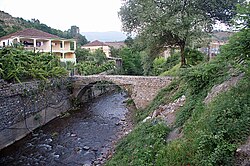 Ottoman Bridge in Klos
 -
 Klos, Mat
 -
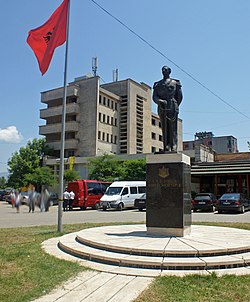 King Zog monument in Burrel
 -
 Lake of Shkopet


See also
[edit]References
[edit]- ^ Districts of Albania, statoids.com
- ^ "Portraits of poverty and inequality in Albania" (PDF). MM. Md ZOHANWorld Bank Group. 2016. pp. 33–40.
- ^ Anne., Schmitt, Oliver Jens, 1973- Frantz, Eva (2009). Albanische Geschichte : Stand und Perspektiven der Forschung. R. Oldenbourg Verlag. ISBN 978-3-486-58980-1. OCLC 895414194.
{{cite book}}: CS1 maint: multiple names: authors list (link) CS1 maint: numeric names: authors list (link) - ^ Franz Babinger (January 1992). Mehmed the Conqueror and His Time. Princeton University Press. p. 53. ISBN 978-0-691-01078-6. Retrieved 25 July 2013.
....his father, lord of the Matja district in Upper Albania...
- ^ John Musachi (2003). Early Albania: A Reader of Historical Texts, 11th-17th Centuries. Otto Harrassowitz Verlag. p. 53. ISBN 978-3-447-04783-8. Retrieved 26 July 2013.
Later, Lord Scanderbeg became not only Lord of Mat but also Lord of Kruja, of Dibra and of Birina, i.e. of Randisia, Tomorista, Misia and the Gjonem country down to the sea.
- ^ Robert Elsie (24 December 2012). A Biographical Dictionary of Albanian History. I.B.Tauris. p. 13. ISBN 978-1-78076-431-3. Retrieved 25 July 2013.
On his return to Durrës in 1462, Paulus Angelus held a synod in Matja to reorganise his archdiocese. In this connection he is remembered as the author of the baptismal formula he introduced in Albanian, one of the rare records of the Albanian
Districts in Albania were geographic divisions made up of cities, towns and villages. They were abolished in 2000. | |
| (36) | |

 | This article about a specific location in Dibër County, Albania, is a stub. You can help Wikipedia by adding missing information. |
Mat District
View on GrokipediaGeography
Location and Physical Features
The Mat region lies in north-central Albania, centered on the valley of the Mat River, which flows westward toward the Adriatic Sea. This area forms part of Albania's inland topography, positioned between the coastal lowlands to the west and higher eastern ranges. The region's core extends through what was formerly the Mat District, now integrated into Dibër County following administrative reforms in 2000.[5][7] Physically, the Mat landscape is predominantly hilly to mountainous, with deep valleys carved by the Mat River and its tributaries dominating the terrain. Flanked by mountain ranges to the east and west, the area exemplifies Albania's rugged geography, where elevations often exceed 200 meters across much of the national territory. The river's course creates gorges and supports reservoirs such as Lake Ulëz and the smaller Lake Shkopet, formed by dams for hydroelectric purposes.[5][8][9] The surrounding uplands feature karst formations and forested slopes, contributing to the region's isolation and scenic diversity, though human modifications like dams have altered natural flow patterns. These features underscore the Mat's role in Albania's hydrological and topographic framework, with the river basin influencing local erosion and sediment dynamics.[5][7]Hydrology and Climate
The Mat District is dominated hydrologically by the Mat River, which originates from Mount Kaptinës in the North Central Highlands and flows approximately 115 km northwest through the district toward the Adriatic Sea. This river recharges the intergranular alluvial aquifer in the Mat River Plain, supporting municipal water supplies via wellfields such as Fushë Kuqë, which yields up to 720 L/s.[10] [11] The aquifer exhibits high hydraulic conductivity due to its coarse gravel and sand composition, facilitating groundwater extraction for local communities.[12] Artificial reservoirs on the Mat River, including Shkopet Lake and Ulza Lake near Burrel, were constructed primarily for hydropower, with Shkopet Lake extending 11 km in length, 240 m in width, and reaching depths of 75 m following dam completion in the 1960s. These lakes mitigate seasonal flow variations exacerbated by the river's mountainous catchment, which experiences high winter discharges and lower summer flows. Ulza Dam, one of Albania's earliest hydropower facilities, has faced sedimentation reducing reservoir capacity over time.[13] [14] [15] Climatically, the district features a transitional Mediterranean-continental regime influenced by its valley location amid northern Albanian mountains, with hot, dry summers and cool, wet winters. Mean annual temperatures in the Mat River valley range from 12 to 14 °C, reflecting elevation and valley effects that moderate coastal warmth.[16] Precipitation averages approximately 1,500 mm annually, concentrated in autumn and winter, with mountainous uplands receiving higher totals up to 2,000 mm, contributing to the Mat River's runoff and flood risks during heavy rains.[17] Summer droughts occasionally strain water resources, though reservoir storage provides buffering.[15]History
Prehistoric and Ancient Settlements
The Mat region in north-central Albania preserves evidence of early human occupation primarily through cave sites in its karst landscape, reflecting hunter-gatherer adaptations during the late Upper Paleolithic and Mesolithic periods. Blazi Cave, located in the Mat District, yielded an in situ Epigravettian assemblage dating to approximately 15,000–12,000 years before present, featuring over 10,000 lithic artifacts, faunal remains indicative of big-game hunting (including red deer and aurochs), and radiocarbon-dated materials that confirm post-Last Glacial Maximum recolonization by mobile forager groups.[18] This represents the only securely dated Epigravettian site in Albania, highlighting technological continuity from backed bladelets and burins adapted to cold-steppe environments.[20] Adjacent to Blazi, Neziri Cave provides the earliest well-dated Mesolithic evidence in the region, with excavations by the German-Albanian Palaeolithic Programme uncovering stratified layers of microlithic tools, hearths, and organic remains from around 10,000–8,000 years before present, signaling a shift to forested exploitation and seasonal mobility in warming post-glacial conditions.[21] The site's in situ preservation distinguishes it from surface scatters elsewhere in Albania, offering insights into early Holocene cultural sequences absent in many Balkan Mesolithic records.[22] Both caves also contain later Bronze and Iron Age occupations, including pottery and metal artifacts, bridging prehistoric forager patterns to proto-urban developments.[23] By the Late Bronze Age (c. 1300 BCE), the Mat area aligned with the Glasinac-Mati cultural complex, characterized by tumulus burials and fortified hilltop sites reflecting emerging social hierarchies and metallurgical advancements shared across the western Balkans. Neolithic settlements along the Mat River banks indicate early agricultural expansion, though specific sites remain sparsely documented compared to coastal Albania.[24] In the Iron Age, the region formed part of broader Illyrian tribal territories, with evidence of hillforts and urbanizing centers in the Mat Valley suggesting defensive adaptations amid Hellenistic influences, though no major named Illyrian settlements like those in southern Illyria (e.g., Byllis) have been identified locally.[25] These patterns underscore Mat's role as a peripheral yet continuously occupied highland zone within ancient Illyria, transitioning from cave-based foraging to protohistoric agro-pastoral communities.[18]Medieval Period and Ottoman Resistance
The Mat region, situated in central northern Albania, emerged as a domain of Albanian nobility during the late Middle Ages amid the fragmentation of Byzantine and Serbian influences. Around 1328, following the death of the previous Angevin-aligned lord Guglielmo, control of territories between the Mat and Shkumbin rivers passed to the Thopia family, with Tanusio Thopia assuming the title of count of Mat and establishing a local power base in the hinterland of Durrës.[26] The Thopia, operating within the Angevin Kingdom of Albania, leveraged their position to navigate alliances against Serbian expansion under Stefan Dušan, maintaining feudal autonomy through military service and territorial holdings that included fortified sites in the Mat valley.[26] By the early 15th century, the Kastrioti family had gained dominance over Mat, with Gjon Kastrioti holding the title of lord (princeps Aemathiae) alongside territories in Dibra and beyond.[27] This shift reflected the rising influence of indigenous Albanian lords amid Ottoman incursions, as Gjon balanced vassalage to the Sultan with local governance, amassing wealth from timars near his paternal lands.[27] The onset of Ottoman expansion prompted organized resistance in Mat, catalyzed by Gjergj Kastrioti—known as Skanderbeg—who deserted Ottoman service in November 1443 and reclaimed his father's domains, including Mat, as a base for rebellion.[27] In 1444, Skanderbeg convened the League of Lezhë, uniting Mat and other principalities in a defensive confederation that repelled multiple Ottoman invasions, routing forces under Sultan Murad II in battles such as Torvioll in 1444 and sustaining guerrilla warfare leveraging the region's mountainous terrain.[28] Mat's strategic position facilitated ambushes and supply disruptions, contributing to over 20 years of effective defiance until Skanderbeg's death in 1468, after which fragmented uprisings persisted but Ottoman pressure intensified.[28] Following the fall of Krujë in 1478, Ottoman forces subdued Mat, incorporating it into the Sanjak of Albania by 1479, though local clans retained de facto autonomy through the blood feud system (kanun) and intermittent revolts against central taxation and islamization efforts into the 16th century.[29] This era solidified Mat's reputation for martial independence, rooted in tribal structures that prioritized kinship loyalty over imperial loyalty.[29]Modern Era: Independence, Monarchy, and Communism
The Mat region played a notable role in Albania's push for independence from the Ottoman Empire, culminating in the proclamation on November 28, 1912, amid the Balkan Wars and widespread uprisings.[30] Ahmet Zogu, born in 1895 in Burgajet within Mat to a prominent landowning family, emerged as a key figure representing the area's tribal interests during this period; by age 13, he had assumed leadership of the Mat province following his father's governorship.[31][32] Zogu's ascent to national power was rooted in Mat's tribal loyalties, which formed the backbone of his regime. After returning from studies abroad in 1912, he leveraged Mat's clans to consolidate influence amid post-independence chaos, serving as prime minister in 1922 before establishing a republic in 1925 and proclaiming himself King Zog I in 1928, with the Mat tribe exempted from broader disarmament efforts targeting other Albanian groups.[33] His monarchy, lasting until the 1939 Italian invasion, prioritized modernization through legal and infrastructural reforms, sustained by alliances with northern bajraktars including Mat leaders, though it faced revolts and deepening foreign dependencies.[34] Following World War II, the communist takeover in November 1944 under Enver Hoxha marked a sharp reversal for Mat, given its ties to the ousted monarchy. The regime targeted perceived class enemies, including landowners and Zog loyalists, enacting agricultural collectivization by 1945 and establishing labor camps that held an estimated 200,000 people nationwide by the regime's end in 1991.[35] In Mat specifically, symbols of Zog's heritage faced destruction, such as the demolition of his family castle in Burgajet, reflecting broader purges against regional elites associated with the pre-communist order.[36] Hoxha's isolationist policies, including breaks with Yugoslavia in 1948 and the Soviet Union in 1961, enforced strict ideological conformity, suppressing tribal structures in areas like Mat through surveillance by the Sigurimi secret police and enforced disappearances numbering over 6,000.[37]Post-Communist Reforms and Administrative Changes
The collapse of Albania's communist regime in early 1991 prompted immediate reforms in the Mat District, focusing on economic liberalization and the reversal of state-controlled agriculture. The Law on Agricultural Land, enacted on July 30, 1991, mandated the distribution of collectivized farmland to former owners and heads of households, privatizing roughly 670,000 hectares nationwide, including significant portions in rural Mat where collectives had dominated production of grains, livestock, and forage. This shift empowered smallholder farming but resulted in highly fragmented plots averaging 1.1 to 1.4 hectares per household, hindering mechanization and efficiency in the district's hilly terrain.[38][39] Local governance transitioned toward democratization with the adoption of the Law on Local Self-Governing Organs in 1992, which established elected municipal councils and mayors, replacing appointed communist-era committees. The inaugural local elections on October 26, 1992, extended this framework to Mat's communes, such as Burrel and Klos, fostering initial accountability though marred by low turnout and partisan disputes reflective of national instability. These bodies gained limited fiscal autonomy for basic services like roads and water, but central government oversight persisted, limiting devolution amid economic turmoil, including the 1997 pyramid scheme collapse that disrupted district-level stability.[40][39] Economic diversification efforts targeted Mat's chrome mining sector, a communist legacy asset, with initial privatization attempts under the 1993 Law on State-Owned Enterprises aiming to attract foreign investment to sites near Burrel. However, output declined sharply post-1991 due to outdated infrastructure and the 1997 anarchy, dropping from over 100,000 tons annually in the late communist period to minimal levels by decade's end, underscoring challenges in transitioning state monopolies. Broader public administration reforms, influenced by international aid, sought to professionalize district-level bureaucracy, though corruption and capacity gaps—exacerbated by Mat's isolation—impeded progress until constitutional changes in the late 1990s.[41][42]Administration and Governance
Historical Administrative Structure
During the Ottoman era, the Mat region operated under a semi-autonomous administrative structure centered on hereditary local governance by the Zogolli family, who held the title of Governor (Pasha or Bey) of Mat. This arrangement began in the late 15th century when Zogu Pasha, an early ancestor, migrated to the Mat area, converted to Islam, and received appointment as Governor of Seli-Mat from the Ottoman Sultan, establishing a lineage of familial control over the region.[43] The position was hereditary, passing through male descendants, with governors often balancing loyalty to the Sultan through tribute and military service while maintaining significant local autonomy amid the broader Ottoman provincial system of sanjaks and nahiyes.[43] [44] Notable governors included ‘Abdu’llah Bey Zogolli, killed in 1621 during efforts for regional independence; Ahmad Bey Zogolli, executed around 1633; and later figures such as Mahmud Pasha Zogolli and Jalal Pasha Zogolli in the 19th century, who participated in rebellions against central Ottoman authority.[43] Xhemal Pasha Zogolli, who died before 1904, was the father of Ahmet Zogu (later King Zog I), and upon his passing, young Ahmet assumed governance of Mat around 1908-1911, ahead of his elder brother Xhelal Bey, illustrating the family's entrenched dynastic control persisting into the early 20th century.[43] This beylik system reflected Ottoman reliance on local elites for administration in mountainous Albanian territories, where central control was often nominal due to geographic isolation and tribal structures.[45] Following Albania's declaration of independence from the Ottoman Empire in 1912, the Mat region transitioned to modern state administration as one of the initial districts (rrethe) established in the 1913 territorial reorganization under the provisional government. This district-level division persisted through the interwar period, including the monarchy proclaimed in 1928 under King Zog I, who leveraged his Mat origins to consolidate national authority while subordinating local beylik influences to centralized prefectures.[46] During the communist regime from 1944 to 1991, Mat District was integrated into the standardized 36-district framework, governed by appointed party secretaries and people's councils that emphasized ideological conformity over hereditary rule, though local traditions lingered informally.[47] This evolution marked a shift from feudal-hereditary to bureaucratic-centralized administration, aligning Mat with Albania's broader nation-building efforts.Hereditary Governance and Local Leadership
The Mat District was governed hereditarily by the Zogolli family, who held the title of Governor of Mati across multiple generations, a position that originated under Ottoman suzerainty and persisted into the early 20th century. This hereditary system provided centralized authority over the region's tribes, managing land distribution, dispute resolution under customary law, and defense against external threats. The Zogollis maintained influence through alliances with local clans and personal charisma, ensuring the position's transmission within the family lineage.[43] Mahmud Pasha Zogolli (1768–1823) exemplified early holders of this role, governing during a era marked by Albanian resistance to Ottoman centralization efforts. His descendants continued the tradition, with Xhemal Pasha Zogu (c. 1860–1911) serving as hereditary governor until his death on November 19, 1911, amid the weakening Ottoman control in the Balkans. Xhemal's administration focused on bolstering tribal loyalties in Mat, a strategic highland area prone to feuds and raids.[48][49] Upon Xhemal's death, his son Ahmet Zogu, aged 16, assumed the governorship, overriding his elder half-brother Xhelal Bey Zogolli through family consensus and demonstrated capability. This succession underscored the flexible yet familial nature of Mat's leadership, where primogeniture was not strictly enforced. Ahmet Zogu utilized the position to build a power base, raising private forces and engaging in regional politics that propelled him to national leadership by 1922. Local chieftains, often bajraktars heading sub-clans, operated under the governor's oversight, handling village-level governance and enforcing the Kanun's blood feud and honor codes.[50][51]Dissolution in 2000 and Current Municipal Status
In 2000, Albania undertook a significant administrative reform that abolished its 36 districts, including Mat District, to streamline governance and decentralize authority. This was enacted through Law No. 8653, dated 31 July 2000, titled "On the Administrative-Territorial Division of Local Government Units in the Republic of Albania," which eliminated districts as intermediate administrative layers between the central government and local units, replacing them with 12 counties (prefectures) while reorganizing the base level into 65 municipalities and 308 communes.[52][53] The reform aimed to enhance local autonomy and efficiency but initially resulted in fragmented small units, many with populations under 5,000, complicating service delivery.[54] The territory of the former Mat District was integrated into Dibër County following the dissolution. Prior to 2015, it was divided among several small municipalities and communes, such as Burrel, Lis, and Ulëz, which handled local affairs under the new county framework.[52] A further territorial and administrative reform in 2014–2015, governed by Law No. 115/2014, consolidated these units into larger municipalities to improve economies of scale and administrative capacity. The bulk of the former Mat District now falls under Mat Municipality (centered in Burrel, with an area of approximately 1,029 km² and population around 30,000 as of recent estimates), formed by merging former entities including Baz, Burrel, Derjan, Komsi, Lis, Macukull, Rukaj, and Ulëz; the southern portion constitutes Klos Municipality. These municipalities exercise competencies in areas like urban planning, local infrastructure, and primary services, subordinate to Dibër County for coordination and the central government for oversight.[55] Dibër County, with its prefecture in Peshkopi, encompasses six municipalities total, reflecting ongoing efforts to balance regional development amid Albania's EU integration aspirations.[54]Demographics and Society
Population Trends and Ethnicity
The former Mat District recorded a population of 61,906 in the 2001 census, prior to its administrative dissolution.[56] Subsequent reorganization into smaller units reflected broader rural depopulation trends in Albania, driven by economic emigration to urban centers and abroad, coupled with fertility rates below replacement levels.[57] The Mat Municipality, encompassing core areas of the former district along the Mat River valley, had 27,600 residents in the 2011 census.[58] By the 2023 census, this figure declined to 17,405, a reduction of 37% over 12 years, equivalent to an average annual decrease of 3.8%.[59] This sharp drop exceeds the national average of 15% over the same period, underscoring Mat's vulnerability as a mountainous, agriculture-dependent region with limited industrial opportunities and high out-migration, particularly among youth.[57] Ethnically, Mat's population is nearly homogeneous, consisting almost exclusively of Albanians from the Mat tribal fis (clan structure), a subgroup of the Gheg Albanians native to northern-central Albania.[60] Official censuses report no significant minorities in the area, unlike border regions with Greek, Macedonian, or other groups; the 2023 national data shows ethnic Albanians at 91% overall, but rural highland zones like Mat exhibit even higher uniformity due to historical isolation and endogamous tribal practices.[61] This composition has remained stable across censuses, with minimal external admixture documented.[62]Cultural and Religious Composition
The religious composition in the Mat region, historically a district and now integrated into Dibër County, is dominated by Islam, reflecting broader patterns in northern Albania. In the 2011 census for Dibër County, 81.4% of residents identified as Muslims (predominantly Sunni), 3.84% as Bektashi Muslims, 2.04% as Catholics, and 0.09% as Eastern Orthodox Christians, with smaller groups including Evangelicals (0.01%) and undeclared believers (4.36%).[63] These figures underscore a strong Islamic majority, with Christianity present in trace amounts, particularly in eastern fringes of the county beyond core Mat areas; Mat itself exhibits even higher Muslim adherence due to its central valley position away from Orthodox-influenced border zones. Religiosity remains largely cultural and nominal, shaped by Albania's communist-era suppression of faith (1967–1991), which enforced state atheism and demolished many religious sites, though post-1990 revival has seen mosque reconstructions without widespread orthodoxy.[64] Culturally, Mat's population embodies Gheg Albanian highland ethnography, marked by clan-based social structures, oral traditions, and adaptive material culture suited to rugged terrain. Villages preserve fortified stone towers (kullas) for defense against feuds, alongside simple woolen attire, leather opingas footwear, and communal customs like shared taverns and wells, as documented in ethnographic studies of sites like Guri Bardhë, an "ethnographic island" with unique habits diverging slightly from neighboring areas.[65] Traditions emphasize besa (sworn fidelity and hospitality), epic balladry recounting resistance, and seasonal festivals tied to agrarian cycles, fostering communal resilience amid isolation; these persist despite modernization, with ethnographic museums in Burrel showcasing artifacts like handwoven textiles and tools that highlight self-sufficiency and historical autonomy under hereditary leaders.[5]Social Structures and Traditions
The social structure of the Mat district, situated in northern Albania's rugged highlands, has historically centered on patrilineal clans and extended kinship groups, akin to the tribal systems prevalent among the Geg population. These clans, often organized into bajraks or sub-tribal units, emphasized collective land use and mutual defense, with authority residing in male elders who mediated disputes and alliances.[66] Property inheritance was strictly patrilineal, restricted to male descendants within the brotherhood or clan, reinforcing endogamous ties and excluding women from succession.[66] [67] Extended families, functioning as semi-autonomous economic and social units, formed the foundational building block, where the patriarch wielded decisive control over decisions affecting marriage, labor, and vendettas. This patriarchal framework promoted high fertility rates through social norms favoring early marriages, often arranged to consolidate clan strength and avert feuds, with peer networks transmitting these practices across generations.[68] [67] In Mat, as in adjacent northern regions, such structures persisted into the 20th century, adapting minimally under Ottoman and later state influences while prioritizing blood loyalty over centralized authority.[69] Traditions in Mat were deeply shaped by the Kanun, an unwritten customary code attributed to Lekë Dukagjini in the 15th century, which dictated norms for honor (nder), hospitality (mikpritje), and truce-keeping (besa). Hospitality mandated sheltering guests—regardless of origin—for up to three days and nights, under penalty of communal ostracism, fostering intertribal networks amid isolation.[66] The Kanun also formalized blood feuds (gjakmarrja), allowing retaliation for offenses like murder but prescribing mediation councils (dordhë) to limit cycles of violence, with exemptions for women and children.[66] Marriage rituals underscored clan continuity, involving bride-price negotiations and symbolic exchanges to affirm alliances, while post-communist surveys indicate lingering adherence to these codes in rural Mat enclaves despite legal reforms.[69] These practices, rooted in pre-Ottoman highland autonomy, prioritized causal deterrence through reputational costs over punitive institutions.[67]Economy and Development
Traditional Economic Activities
The traditional economy of the Mat District relied primarily on subsistence agriculture and pastoralism, characteristic of northern Albania's mountainous regions. Farmers cultivated cereals such as wheat and maize, along with potatoes and forage crops, on terraced slopes and valleys, with land allocation for agriculture reaching up to 76% in the district by the mid-1990s transition period. Livestock rearing, especially sheep and goats, formed a cornerstone, enabling transhumance practices where herds moved seasonally between highlands and lowlands for grazing, supporting dairy production, wool, and meat for local consumption.22/En/pdf) Forestry activities, including timber harvesting and wood processing for fuel and construction, complemented agrarian pursuits in the district's wooded areas, though overexploitation posed risks to sustainability. Mineral extraction, particularly chromium ore mining around Burrel, developed as a key resource-based activity from the early 20th century onward, leveraging local deposits that contributed to Albania's broader export-oriented mining tradition.[41] These activities sustained a largely self-reliant tribal society, with limited commercialization until mid-20th-century state interventions, reflecting the district's rugged topography and isolation from coastal trade routes.[70]Infrastructure and Modern Challenges
The Mat region's road network remains underdeveloped, with key bridges such as the Zogu Bridge—constructed in 1927 as a bowstring arch structure spanning the Mat River—facing preservation challenges due to structural deterioration, despite its recognition as a civil engineering landmark requiring urgent intervention to prevent collapse.[71][72] Similarly, the Milot road-rail bridge over the Mat River, measuring 788 meters, exhibits significant damage that compromises stability and safety, obstructing access to northern Albania and tourism flows as of August 2025.[73] Recent efforts include the improvement of the Qafshtamë-Burrel connection road and promises for the Burrel-Ulëz highway to enhance metropolitan integration, announced in May 2025.[74][75] Water supply infrastructure covers approximately 95% of households in the former district, with 77% connected to piped systems, though rural piped access often falls short of urban standards.[76] Projects like the 2022 construction of the Depo Lis delivery line in Burrel aim to bolster distribution, but hydropower developments along the Mat River cascade—exploiting the river's potential for electricity generation—pose risks to irrigation by diverting flows, prompting local resistance in villages such as Madhesh and others as of 2020-2025.[77][78][79] Electricity provision relies heavily on the Mat River's hydropower cascade, contributing to Albania's national capacity of over 2,000 MW from privatized plants, yet the system proves vulnerable to droughts, as seen in 2025 regional shortages impacting northern production.[80][81][82] Modern challenges include balancing energy extraction with agricultural needs, aging transport links that limit economic integration, and broader rural depopulation amid Albania's uneven growth, where productivity lags hinder inclusive development despite national GDP expansion of 3.9% in 2024.[83][84] Limited investment in facilities, such as the ongoing U.S.-funded Mat Fire Rescue Station replacement in 2025, underscores persistent gaps in public services.[85]Recent Developments and Potential
In recent years, the Municipality of Mat has seen targeted investments aimed at enhancing local infrastructure and public services. In April 2024, the modernization of the Palace of Culture in Burrel was completed as part of efforts to expand socio-economic opportunities and improve quality of life for residents.[86] Similarly, in September 2025, a 40 million lek rehabilitation project upgraded the waste disposal site to address environmental management challenges in the area.[87] The European Union for Municipalities program has also supported initiatives to boost Mat's overall socio-economic potential through capacity-building and development projects.[88] Transportation improvements are underway to connect Mat more effectively to surrounding regions. In May 2025, Albanian Prime Minister Edi Rama announced plans for the construction of the Burrel–Ulëz road during his fourth term, highlighting its role in unlocking the area's natural appeal and facilitating access for economic activities.[75] Additionally, a new fire rescue station in Mat was projected for completion in 2025, replacing outdated facilities and enhancing emergency response capabilities with three vehicle bays and staff accommodations.[85] Mat's future potential lies primarily in leveraging its largely undeveloped natural and cultural assets for sustainable rural tourism. Prime Minister Rama promoted the region's scenic landscapes on social media in recent years, positioning it as a must-visit destination to attract visitors.[89] Sites like Lake Ulza, traditional fortified villages, and the Guri i Bardhë area—integrated into the national "100 Villages" initiative—offer opportunities for eco-tourism and heritage experiences, remaining relatively untouched by mass tourism.[5] [90] While traditional sectors like agriculture and historical chromium mining persist, with the latter contributing to Albania's mineral exports, diversification into tourism could mitigate depopulation trends and stimulate local employment, contingent on improved road access and environmental safeguards.[91] Overall, Mat's inland mountainous terrain aligns with Albania's broader push for non-coastal tourism growth, projected to support national economic expansion at 3.1% in 2025.[92]Notable Figures and Events
Key Historical Figures
The Zogolli family, also known as the House of Zogu, held hereditary governorship over the Mat region for several centuries, emerging as the dominant clan following the Ottoman conquest in the late 15th century.[4] Their authority stemmed from feudal landownership and tribal leadership among the Mat highlanders, shaping the district's political landscape through loyalty to Ottoman sultans and later Albanian independence movements.[93] Xhelal Pasha Zogolli (died circa 1900) served as a key early modern governor of Mati, consolidating the family's beylik status and establishing the dynasty that would produce Albania's monarchy.[94] As head of one of northern Albania's principal clans, he navigated Ottoman provincial administration while maintaining tribal autonomy in the rugged Mat valley. His tenure exemplified the blend of Islamic pashalik privileges and local customary law (kanun) that defined Mat's governance. Xhemal Pasha Zogu (1860–1911), son of Xhelal Pasha, inherited the governorship of Mati and expanded family influence amid declining Ottoman control.[94] Born at Burgajet Castle, he managed estates and tribal militias, fostering alliances that positioned the Zogollis for post-Ottoman power. His death in 1911 elevated his young son to leadership during a period of revolutionary upheaval. Ahmet Zogu (1895–1961), born Ahmet Muhtar Zogolli at Burgajet in Mat, assumed the governorship at age 16 following his father's death.[95] Representing Mat at the Albanian Declaration of Independence in Vlorë on November 28, 1912, he defended the district against Serbian incursions during the Balkan Wars.[51] Rising nationally, Zogu served as Prime Minister (1922–1924), President (1925–1928), and King Zog I (1928–1939), centralizing Albania's state while drawing on Mat's tribal networks for legitimacy and military support.[43] Exiled after Italy's 1939 invasion, he remained a symbol of Mat's martial heritage until his death in France. A monument to King Zog stands in Burrel, Mat's administrative center, commemorating his origins.Significant Events and Legacy
The Mat region witnessed significant unrest during the Albanian uprising against Ottoman rule in 1912, where fighting between insurgents and Ottoman forces occurred frequently in Mat alongside nearby areas like Dibra.[96] Ahmet Zogu, born on October 8, 1895, in Burgajet within Mat, began his political career as governor of the district before ascending to Prime Minister in 1922, President in 1925, and King Zog I in 1928.[97][98] Under Zog's rule, infrastructure developments included the construction of the Zogu Bridge in 1927, an engineering feat featuring steel arches that spanned the Mat River to improve connectivity.[72] The legacy of Mat endures through its association with the Zogu family, which produced Albania's only monarch and contributed to the nation's early 20th-century state-building efforts.[5] Local pride in this heritage persists, evidenced by monuments such as the King Zog statue in Burrel, reflecting the region's role in Albanian royal history despite subsequent communist suppression of monarchist symbols.[34]References
- https://www.[researchgate](/page/ResearchGate).net/publication/319910760_Blazi_Cave_-_an_in_situ_Epigravettian_site_in_Albania