


Community hub
Recent from talks
Contribute something
Nothing was collected or created yet.
Azores High
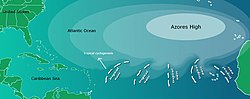
View on WikipediaThe Azores High also known as North Atlantic (Subtropical) High/Anticyclone or the Bermuda- High, is a large subtropical semi-permanent centre of high atmospheric pressure typically found south of the Azores in the Atlantic Ocean, at the Horse latitudes. It forms one pole of the North Atlantic oscillation, the other being the Icelandic Low. The system influences the weather and climatic patterns of vast areas of North Africa, Western Asia, Southern Europe, and to a lesser extent, eastern North America. The aridity of the Sahara Desert and the summer drought of the Mediterranean Basin is due to the large-scale subsidence and sinking motion of air in the system.
In its summer position, the high is centered near Bermuda, and often referred to as the Bermuda High. In the Northern Hemisphere summer, the Bermuda High often migrates in the area between Bermuda and the East Coast of the United States. When the Bermuda High moves closer to the United States, this creates a deep southwest flow of hot and humid tropical air toward the East Coast of the United States. In summer, the Azores-Bermuda High is strongest. The central pressure hovers around 1024 mbar (hPa) often between Bermuda and North Carolina. Seasonally, the Bermuda High exerts its influence on the eastern United States between late May and October.
This high-pressure block exhibits anticyclonic behaviour, circulating the air clockwise. Due to this direction of movement, African eastern waves are impelled along the southern periphery of the Azores High away from coastal West Africa towards the Caribbean, Central America, or the Bahamas, favouring tropical cyclogenesis, especially during the hurricane season.

Variations
[edit]Research into global warming suggests that it may be intensifying the Bermuda High in some years, independently of oscillations such as ENSO, leading to more precipitation extremes across the Southeastern United States. Latitudinal displacement of the ridge is also occurring, and computer models depict more westward expansion of the anticyclone in the future.[1][2] However, during the winter of 2009–2010, the Azores High was smaller, displaced to the northeast and weaker than usual, allowing sea surface temperatures in the Central Atlantic to increase quickly.[3]
See also
[edit]References
[edit]- ^ Lucas, Tim. "Variable southeast summer rainfall linked to climate change". Duke University. EurekAlert!. Archived from the original on 30 October 2010. Retrieved 29 October 2010.
- ^ Li, Wenhong; Laifang Li; Rong Fu; Yi Deng; Hui Wang (October 4, 2010). "Changes to the North Atlantic Subtropical High and Its Role in the Intensification of Summer Rainfall Variability in the Southeastern United States". Journal of Climate. 24 (5): 1499–1506. Bibcode:2011JCli...24.1499L. CiteSeerX 10.1.1.211.2720. doi:10.1175/2010JCLI3829.1. ISSN 1520-0442.
- ^ Publications, RMS. "2009 Atlantic Hurricane Season Review and 2010 Season Outlook" (PDF). Risk Management Solutions. RMS Catastrophe Response. Archived from the original (PDF) on 8 October 2010. Retrieved 29 October 2010.
- "The Azores High". WeatherOnline Weather facts. Retrieved 2006-11-19.
- "Azores high". Glossary of Meteorology. American Meteorological Society. Archived from the original on 26 October 2006. Retrieved 2006-11-19.
- "Bermuda high". Glossary of Meteorology. American Meteorological Society. Archived from the original on 19 October 2006. Retrieved 2006-11-19.
| Concepts | |||||||||||||||||||||||||||||||||||||||||||||||
|---|---|---|---|---|---|---|---|---|---|---|---|---|---|---|---|---|---|---|---|---|---|---|---|---|---|---|---|---|---|---|---|---|---|---|---|---|---|---|---|---|---|---|---|---|---|---|---|
| Anticyclone |
| ||||||||||||||||||||||||||||||||||||||||||||||
| Cyclone |
| ||||||||||||||||||||||||||||||||||||||||||||||


Azores High
View on GrokipediaPhysical Characteristics
Location and Extent
The Azores High, alternatively termed the North Atlantic Subtropical High or Bermuda High, constitutes a semi-permanent anticyclonic high-pressure system centered in the subtropical North Atlantic Ocean, generally between 25° N and 35° N latitude. Its core position fluctuates seasonally, shifting eastward toward the Azores archipelago (around 38° N, 28° W) during winter and early spring, when it anchors a clockwise circulation over the eastern basin, and westward to near Bermuda (approximately 32° N, 64° W) in summer, extending its ridge across the central Atlantic. [5] [6] This migration aligns with the horse latitudes, where subsiding air masses reinforce the high's stability. [2] The system's horizontal extent spans a broad oval-shaped domain over the North Atlantic, typically influencing surface weather from the eastern U.S. seaboard westward to the Azores and eastward into the Mediterranean during peak summer positioning, with the pressure anomaly often exceeding 1,020 hPa at its core. [7] [1] Vertically, it extends to upper tropospheric levels, interacting with the tropopause and contributing to the subtropical jet stream's positioning, though its precise boundaries vary with intensity and synoptic conditions. Observational data from reanalysis products indicate the high's ridge can stretch over 3,000–4,000 km longitudinally in intense phases, dominating the regional circulation and modulating trade winds. [1]Formation and Dynamics
The Azores High, a semi-permanent anticyclone in the North Atlantic subtropics, primarily forms through subsidence in the descending branch of the Northern Hemisphere Hadley circulation. Intense solar heating over the equatorial Intertropical Convergence Zone drives air ascent, with upper-tropospheric divergence promoting poleward outflow that cools and sinks around 20°–30°N latitude, generating surface convergence and high pressure at the base.[8] This process is modulated by Earth's rotation, which deflects the subsiding air into anticyclonic (clockwise in the Northern Hemisphere) flow via the Coriolis effect, establishing the characteristic ridge of high pressure extending from the Azores archipelago eastward toward Europe and westward toward the Caribbean.[9] Detailed analyses reveal that while Hadley cell dynamics provide a foundational zonally symmetric subsidence, they contribute only modestly to the summertime intensity of the Azores High, as seasonal weakening of the cell reduces expected descent. Instead, local land-sea thermal contrasts—cooler oceanic surfaces relative to warmer continental interiors—drive approximately 75% of the observed subsidence and associated northerly winds, enhancing the high's strength through thermally direct circulation.[9] Remote influences, including Rossby wave activity flux propagating from the North Pacific, further reinforce the system via upper-level divergence over the subtropical ridge, with observations showing subsidence accounting for about 75% of vertical descent in the core region.[9] Dynamically, the Azores High exhibits variability in position and amplitude tied to these mechanisms, with peak central pressures around 1024 hPa during summer when it extends westward as the Bermuda High component of the subtropical ridge. Adiabatic compression during descent warms the mid-troposphere, suppressing convection and promoting clear skies, which perpetuates the high through radiative cooling aloft and surface divergence. Interactions with midlatitude eddies provide additional forcing, though less dominantly than thermal and wave processes, leading to a three-dimensional structure featuring mid-tropospheric warming and upper-level anticyclonic vorticity.[9] Seasonal migration reflects hemispheric heating gradients, shifting equatorward in winter and poleward in summer, influencing trade wind strength and moisture transport.[2]Historical Observations
Early Recognition
The Azores High, a semi-permanent subtropical anticyclone, was first formally identified as a distinct center of atmospheric action in the late 19th century through systematic analysis of sea level pressure data. French meteorologist Léon Teisserenc de Bort pioneered this recognition in 1883, constructing maps of average monthly pressures that revealed persistent high-pressure maxima over the eastern North Atlantic, including the region near the Azores archipelago. These "centers of action," encompassing the Azores anticyclone alongside features like the Siberian high and Icelandic low, explained variations in seasonal weather and storm tracks across the hemisphere.[1][10] Teisserenc de Bort's work built on earlier 19th-century efforts to chart mean global pressures, such as those by Heinrich Wilhelm Dove, whose isobaric maps from the 1850s depicted subtropical ridges but did not yet isolate the Azores feature as a named entity. By classifying these pressure centers and linking their positions to winter severity—e.g., a southward-shifted Azores High correlating with milder European conditions—Teisserenc de Bort established a framework for long-range forecasting that emphasized their dynamical influence on mid-latitude circulation.[1] This identification underscored the Azores High's role in steering trade winds and blocking westerly storms, drawing from shipboard observations accumulated since the 18th century. Prior to these developments, the system's effects were evident in navigational records, as the northeasterly trades it sustained enabled reliable routes for Portuguese explorers discovering the Azores in the 1420s–1430s, though without explicit attribution to a high-pressure core. The 1883 delineation thus represented the transition from empirical seafaring knowledge to quantitative meteorology, enabling subsequent studies of its variability and teleconnections.[1]Key Milestones in Study
The Azores High was first systematically recognized as a persistent "center of action" in 1883 by French meteorologist Léon Teisserenc de Bort, who analyzed average monthly sea level pressure maps to delineate semi-permanent high-pressure systems in the subtropical North Atlantic.[1] This marked an early milestone in identifying its role within global circulation patterns, building on rudimentary ship-based observations but establishing it as a definable feature through averaged data.[1] Mid-20th-century research advanced understanding of its dynamics and tracks, with Klein's 1957 analysis of North Atlantic anticyclone frequencies and paths using gridded sea-level pressure data, highlighting seasonal variations in its extent and influence on regional weather.[1] In 1974, Angell and Korshover quantified positional shifts, reporting an eastward migration of its mean center and a significant decline in central pressure from 1899 to 1967 based on historical records, linking these changes to broader atmospheric trends.[1] Subsequent climatological syntheses refined temporal patterns; Sahsamanoglou's 1990 study of data from 1873 to 1980 delineated three epochs of intensity—elevated from 1903–1930, subdued from 1931–1967, and intensified post-1968—using coarse-resolution grids to track multi-decadal fluctuations.[1] A comprehensive 1997 climatology by Folland et al., drawing on daily sea-level pressure observations from 1899 to 1990, identified dominant spatial modes: a basin-wide summer pattern and a more variable winter configuration, emphasizing its anticyclonic dominance over the Atlantic.[1] These efforts underscored the system's variability and laid groundwork for modeling its interactions with oscillations like the North Atlantic Oscillation.Variability Patterns
Seasonal Cycles
The Azores High, a semi-permanent subtropical high-pressure system over the North Atlantic, exhibits pronounced seasonal variations in its intensity, areal extent, and position. During winter, the system is weaker and more confined to the eastern Atlantic near the Azores archipelago, with its oceanic center positioned farthest east around early January.[1] This configuration results from stronger mid-latitude westerlies and frequent interactions with transient cyclones, limiting its dominance.[1] In contrast, the system intensifies and expands westward during summer, reaching its peak extent and influence across the broader Atlantic basin, often extending toward the Bermuda region by midsummer.[1] This seasonal migration aligns with the northward shift of the Intertropical Convergence Zone and enhanced subsidence driven by solar heating, fostering persistent anticyclonic conditions with central pressures typically exceeding 1020 hPa.[11] The summer pattern promotes clockwise circulation that steers trade winds and suppresses storm formation over subtropical waters.[1] These cycles modulate hemispheric circulation, with the high's summer expansion contributing to drier conditions in the subtropics and influencing the positioning of the jet stream southward.[12] Inter-seasonal transitions occur gradually, with the system weakening from October onward as polar air masses encroach.[1]Interannual and Long-Term Fluctuations
The Azores High exhibits interannual variability in its intensity, latitudinal position, and zonal extent, which modulates regional weather patterns such as precipitation and storm tracks in the North Atlantic. These fluctuations are predominantly driven by the North Atlantic Oscillation (NAO), where positive NAO phases strengthen the Azores High relative to the Icelandic Low, enhancing subtropical subsidence and trade winds, while negative phases weaken it, allowing greater meridional moisture transport.[13][14] North-south shifts in the high's position specifically influence summer precipitation variability over northwest Europe, with northward displacements correlating with reduced rainfall due to diminished cyclonic activity.[15] In the Mediterranean, interannual changes in Azores High intensity explain a substantial portion of winter rainfall variance in Spain, with stronger highs linked to drier conditions via reinforced anticyclonic flow.[16] Over multidecadal and centennial scales, the Azores High has expanded in areal coverage and intensified, with twentieth-century growth unprecedented over the prior 1200 years as reconstructed from paleoclimate proxies like stomatal density in tree rings and historical sea-level pressure records.[4] This long-term trend, accelerating since approximately 1850, manifests as a poleward shift and broader spatial dominance, contributing to persistent high-pressure anomalies over western Europe and the Iberian Peninsula.[17] Such changes have amplified aridity in subtropical latitudes, with model attributions linking the expansion primarily to anthropogenic greenhouse gas forcing rather than internal variability alone, though natural multidecadal oscillations like the Atlantic Multidecadal Variability may modulate the signal.[18] Observations from reanalysis datasets confirm a roughly 10-15% increase in the high's summer intensity since the mid-twentieth century, influencing downstream oceanic currents like the Azores Current.[19]Interactions with Broader Circulation
Link to North Atlantic Oscillation
The North Atlantic Oscillation (NAO) constitutes a primary mode of atmospheric variability in the North Atlantic region, defined by the normalized sea-level pressure (SLP) difference between the subtropical Azores High and the subpolar Icelandic Low.[14] This oscillation captures the relative strength and positioning of these pressure centers, with the Azores High serving as the southern pole that anchors the subtropical ridge.[13] The NAO index, typically calculated from SLP anomalies at representative stations such as Lisbon (near the Azores High) and Reykjavik (near the Icelandic Low), quantifies phase shifts that influence mid-latitude circulation patterns.[20] In the positive NAO phase, the Azores High intensifies and expands northward, deepening the pressure gradient with the Icelandic Low and promoting stronger, more zonal westerly jet streams across the basin.[21] This configuration, observed prominently during winters like 1995–1996 when the NAO index exceeded 2 standard deviations, correlates with reduced storminess over northern Europe and milder conditions due to efficient heat transport.[14] Conversely, the negative phase weakens the Azores High, often shifting it eastward or southward, which diminishes the meridional pressure contrast and allows for amplified meanders in the jet stream, fostering colder, stormier winters in Europe as seen in episodes like 2009–2010.[13] Such phase transitions, with typical SLP anomalies of 5–10 hPa in the Azores High region, underscore its pivotal role in modulating the NAO's hemispheric teleconnections.[22] Empirical reconstructions from paleoclimate proxies, including tree rings and ice cores spanning the last millennium, reveal that Azores High variability has driven multidecadal NAO excursions, such as persistent positive phases during the Medieval Climate Anomaly (circa 950–1250 CE).[4] Instrumental records since 1865 further confirm that interannual fluctuations in Azores High central pressure, averaging 1020–1030 hPa in summer and 1015–1025 hPa in winter, account for up to 40% of explained NAO variance, independent of Icelandic Low dynamics.[23] These links highlight the Azores High not merely as a static feature but as a dynamic driver of NAO forcing, influencing downstream phenomena like Gulf Stream variability and European precipitation anomalies.[24]Influence on Storm and Jet Stream Paths
The Azores High steers mid-latitude cyclones by establishing ridges in the upper-level flow that guide extratropical storms along its flanks, with winter configurations often featuring dual pressure maxima—one near the southeastern United States and another near Morocco—directing cyclones northeastward or northward across the Atlantic. In summer, the high intensifies as a more singular feature centered over the central Atlantic, shifting storm tracks northward toward the British Isles along latitudes of approximately 45°–50°N. Variations in the high's intensity and position modulate the North Atlantic jet stream's latitude and waviness; a stronger, expanded Azores High enhances the pressure gradient with the Icelandic Low, shifting the jet stream northward and straightening its path, which facilitates efficient equator-to-pole energy transport and directs storms toward northern Europe.[13] Conversely, a weaker or retracted high promotes meridional (wavy) flow, weakening the jet stream's overall strength and enabling blocking patterns that divert the jet southward or split it, resulting in stalled storms and increased activity over southern Europe or the western Atlantic.[13] Empirical analysis of sea-level pressure grids (≥1020 mb) from 1899 to 1990 indicates that positive variability phases of the high correlate with extended cyclone families originating in the central Atlantic and progressing to the British Isles during winter, while negative phases suppress cyclone activity through dominant high-pressure blocking. These dynamics sustain westerly winds in summer via southwest-to-northeast flow but allow for jet stream displacements north or south of the high during periods of increased meridionality, influencing Rossby wave propagation and downstream storm intensification. Seasonal equatorward jet shifts, partly tied to subtropical high expansions like the Azores, have been linked to enhanced coastal storm frequencies along the U.S. East Coast, with wind speeds at 500 hPa increasing in affected regions.Regional Impacts
Effects on European Weather
The Azores High exerts a dominant influence on European weather by steering the North Atlantic storm track and modulating subsidence patterns, particularly through its seasonal position and intensity. In winter, a robust Azores High strengthens the meridional pressure gradient with the Icelandic Low, fostering a positive North Atlantic Oscillation (NAO) phase that channels westerly winds and storms across northwestern Europe, yielding milder temperatures and increased precipitation in regions like the British Isles and Scandinavia.[2] Conversely, a weakened or retracted Azores High promotes a negative NAO, diverting storms southward and inducing colder, drier conditions over northern and central Europe, with heightened risks of frost and reduced rainfall in the northwest.[2] During summer, the system shifts poleward to around 35°N, often extending a ridge over the Iberian Peninsula and into western Europe, which suppresses convective activity and promotes persistent anticyclonic weather. This configuration delivers clear skies, subsidence-driven warmth, and minimal precipitation, frequently culminating in heatwaves with temperatures surpassing 30°C across southern and central Europe, while amplifying drought risks in Mediterranean areas.[3] The ridge's eastward extension can block mid-latitude cyclones, leading to prolonged settled conditions and reduced cloud cover over France, Germany, and the British Isles.[26] The High's meridional shifts further dictate precipitation gradients: northward positions correlate with drier summers in northwestern Europe due to diminished moisture advection, whereas southward anomalies enhance rainfall there by facilitating Atlantic inflow.[15] Overall, its variability accounts for substantial interannual contrasts in European hydroclimate, with stronger influences on western margins where subsidence inhibits orographic lift and storm penetration.[27]Effects on North American and Tropical Regions
The Azores High influences North American weather primarily through its modulation of storm tracks and moisture transport. In summer, its southeasterly winds advect warm, humid tropical air into eastern North America, elevating temperatures and humidity levels across the region.[1] When the system extends westward as the Bermuda High, it strengthens the Great Plains low-level jet, enhancing southerly moisture flux that boosts precipitation in the Midwest by up to several millimeters per event through increased convective activity.[28] Conversely, subsidence beneath the high reduces rainfall in the Gulf States, fostering drier conditions and clear skies that amplify surface heating.[28] This westward extension also promotes persistent air stagnation over the eastern United States during summer, trapping pollutants and elevating ground-level ozone concentrations by approximately 13.5 ppb in coastal areas due to limited ventilation and stagnant flow.[28] The high's ridge position further shifts mid-latitude storm tracks northward in summer, reducing cyclone frequency over the central U.S. but steering systems toward the Northeast or Canada.[1] In tropical regions, the Azores High steers Atlantic tropical cyclones via its clockwise circulation, initially directing them westward under easterly trade winds before recurving them northward or poleward depending on ridge location.[29] A westward-positioned ridge increases landfall probabilities along the U.S. Gulf and East Coasts or Caribbean islands by guiding storms into these areas, as observed in historical tracks where strong highs correlate with higher continental impacts.[30] The system's northern trade winds delineate the subtropical boundary of the Intertropical Convergence Zone (ITCZ), influencing tropical Atlantic rainfall by modulating convergence zones and suppressing convection northward of the equator during its peak strength.[31] This dynamic contributes to variability in precipitation over the Caribbean and northern South America, with stronger highs linked to reduced convective activity in adjacent subtropics.[31]Recent Changes and Attribution
Observed Expansions and Shifts
Reanalysis data from the 20th Century Reanalysis (20CR) and HadSLP2 datasets indicate that the Azores High has undergone a notable expansion in its areal extent since the late 19th century, particularly during winter months. The frequency of winters featuring extremely large Azores High areas—defined as regions exceeding 1015 hPa sea-level pressure—rose to 15 occurrences in the 20th century, compared to an average of approximately 10 per century in pre-industrial reconstructions spanning the past 1,200 years derived from paleoclimate proxies such as stalagmite records from Portugal's Buraca Gloriosa cave.[27] In the period 1980–2005, such extreme expansions averaged 6.5 winters per 25-year interval, more than double the 2.6 average from other 25-year periods since 1850.[27] This expansion has primarily manifested over the eastern subtropical North Atlantic and into western Europe, effectively broadening the anticyclonic influence and altering the positioning of its western and southern boundaries. Positional shifts include a northeastward migration of the system's center during January, correlated with a statistically significant increase in central pressure, based on ERA-Interim reanalysis from 1948–2018.[32] Additionally, the associated Azores Front has exhibited a northward migration since the 1970s, with variability up to 2° latitude, as evidenced by long-term hydrographic and satellite altimetry data.[33] These changes align with a poleward shift in the North Atlantic storm track, inferred from increased anticyclone frequency at the Azores and reduced cyclone activity in adjacent sectors.[4]| Period | Extreme Large AH Winters (per 25 years) | Source |
|---|---|---|
| 1850–1879, 1900–1929, etc. (non-1980–2005) | 2.6 | HadSLP2 reanalysis[27] |
| 1980–2005 | 6.5 | HadSLP2 reanalysis[27] |
Climate Change Connections and Debates
The expansion of the Azores High during the 20th century, particularly since the early 1900s, has been attributed to anthropogenic greenhouse gas forcing, with speleothem proxy records from the Iberian Peninsula indicating an unprecedented areal increase exceeding natural variability over the preceding 1,200 years.[4] This expansion, estimated at about 6.4% per decade in recent analyses, correlates with a northward deflection of storm tracks, resulting in precipitation deficits of up to 35 mm per month during extreme events over the western Iberian coast and broader drying trends in southern Europe.[17] Climate models simulating elevated CO2 levels replicate this pattern, associating it with an intensified and poleward-expanded Hadley circulation that strengthens subtropical highs like the Azores system.[34] Attribution relies on the absence of comparable expansions in pre-industrial proxy data, such as oxygen isotope ratios in stalagmites sensitive to high-pressure blocking, alongside consistency with thermodynamic responses to warming that favor anticyclonic dominance in the subtropics.[18] However, debates arise over the signal-to-noise ratio, as internal atmospheric variability—manifest in modes like the North Atlantic Oscillation (NAO) and Atlantic Multidecadal Variability—can produce multidecadal swings in high-pressure extent that mimic or amplify forced trends, complicating isolation of anthropogenic effects in short observational records.[35] Model ensembles show robust summertime strengthening of the Azores High under high CO2 (e.g., 2–8 times preindustrial levels), yielding a more positive and less variable NAO phase, but winter responses diverge due to dynamical uncertainties and resolution limitations.[21] Projections indicate potential further northeastward shifts and intensification by 10–20° latitude under global warming scenarios, altering westerly flows and moisture transport, which could heighten drought risks in Iberia while redirecting storms northward—though these depend on unresolved feedbacks like stratospheric-tropospheric coupling.[36] Skepticism persists in some quarters regarding proxy fidelity, as dating errors and local hydrological influences may overestimate pre-industrial extremes, potentially overstating the uniqueness of recent changes; nonetheless, the multi-line convergence of evidence supports a causal role for human-induced warming over pure natural oscillation.[24]Modeling and Projections
Historical Model Developments
Early numerical models of the atmosphere in the 1950s, such as Jule Charney's barotropic vorticity equation implementations for weather prediction, captured basic large-scale wave dynamics but insufficiently represented the vertical structure and subsidence mechanisms essential to subtropical highs like the Azores High. These models treated the atmosphere as a single layer, limiting their ability to simulate descending motion in the subtropics driven by angular momentum conservation and radiative cooling.[37] A pivotal advance occurred in 1963 with Joseph Smagorinsky's general circulation experiment using primitive equations on a spherical grid, which integrated hydrostatic and continuity equations across multiple levels to simulate global mean flows. This model reproduced zonal-mean features including subtropical easterly trade winds and high-pressure ridges, attributable to Hadley cell dynamics, though regional details like the Azores High's position showed biases due to coarse resolution (approximately 3° latitude-longitude) and dry physics.[38] Incorporation of moist processes and radiative transfer in subsequent Geophysical Fluid Dynamics Laboratory (GFDL) models during the mid-1960s, as in Manabe and Smagorinsky's nine-level simulation with a hydrologic cycle, enhanced realism by generating precipitation maxima in the intertropical convergence zone and associated subtropical drying, strengthening simulated high-pressure belts.[39] These developments laid the groundwork for seasonal climatologies, where the Azores High emerged as a semi-permanent feature in northern summer, linked to land-sea thermal contrasts and hemispheric asymmetry.[38] By the 1970s, refinements including interactive clouds and surface fluxes in GFDL and other GCMs reduced errors in North Atlantic pressure patterns, enabling better hindcasts of interannual variability tied to the North Atlantic Oscillation.[38] Spectral methods introduced in the 1980s further improved dynamical cores, mitigating numerical artifacts and allowing higher-fidelity simulations of the Azores High's meridional shifts and intensity.[38] These evolutions shifted modeling from idealized experiments to coupled systems capable of attributing regional circulation to external forcings like solar variability or aerosols.Future Scenarios Under Warming
Climate models, including those from the Coupled Model Intercomparison Project Phase 6 (CMIP6), project an intensification of the Azores High under high-emissions scenarios such as Shared Socioeconomic Pathway 5-8.5 (SSP5-8.5), with central sea-level pressure increasing by approximately 0.1 hPa per decade from the present to the end of the 21st century (p < 0.03). This strengthening is attributed to enhanced radiative forcing and associated thermodynamic responses, including greater land-sea thermal contrasts that bolster subtropical anticyclonic circulation. Accompanying the intensification is a northward displacement of the high's center by about 0.25° latitude per decade (p < 0.02), consistent with the projected poleward expansion of the Hadley cell across all seasons in global warming simulations.[40][41] These projected changes are expected to expand the high's influence westward toward the southeastern United States and poleward into mid-latitudes, leading to increased subsidence, drier conditions, and reduced precipitation over southwestern Europe and the western Mediterranean. For instance, the enhanced Azores High is forecasted to homogenize and amplify coastal upwelling along the northern Western Iberian Peninsula by up to 35% by 2070–2099 relative to 1995–2024 baselines under SSP5-8.5, potentially altering marine ecosystems and fisheries. However, interannual variability in the high's position may rise, with more frequent westward migrations, introducing uncertainty in regional hydroclimatic impacts.[42][40] Under moderate-emissions scenarios like SSP2-4.5, projections indicate no statistically significant changes in the Azores High's intensity or position, suggesting that mitigation could limit further expansion. Model ensembles exhibit some biases, such as overly stable representations of North Atlantic circulation patterns, which may underestimate natural variability and affect the reliability of extreme event projections tied to the high. Nonetheless, the consensus across CMIP phases points to a robust response to anthropogenic forcing, extending observed 20th-century trends of expansion unprecedented over the past 1,200 years.[40][43][4]References
- https://doi.org/10.1175/1520-0442(1997)010<0728:TNASA>2.0.CO;2