Hubbry Logo
MeerbeckMeerbeckMain
Open search
Meerbeck
Community hub
Meerbeck
logo
8 pages, 0 posts
0 subscribers
Be the first to start a discussion here.
Meerbeck
Meerbeck
from Wikipedia

Meerbeck (German pronunciation: [ˈmeːɐ̯bɛk]) is a municipality in the district of Schaumburg, in Lower Saxony, Germany.

Key Information

References

[edit]
Revisions and contributorsEdit on WikipediaRead on Wikipedia
from Grokipedia
Meerbeck is a small rural municipality in the of , , belonging to the Samtgemeinde Niedernwöhren and encompassing the districts of Meerbeck, Volksdorf, and Kuckshagen. With origins tracing back to the , the settlement was likely founded between 750 and 800 AD and first documented as "Meribiki" in a 1013 donation to the , establishing it as one of the oldest communities in the Schaumburg region. The area later developed a notable seafaring tradition, with local residents engaging in maritime activities such as , particularly prominent in the within the broader Niedernwöhren community. Located at coordinates 52°21′N 9°9′E and an elevation of 66 meters above , Meerbeck covers an area of about 13 km² and had a population of 1,780 as of December 31, 2023. This distinguishes it from other German localities sharing the name, such as one in .

Geography

Location and terrain

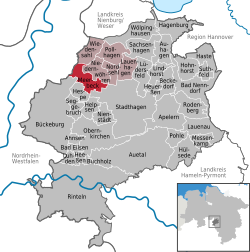
Meerbeck is situated in the Schaumburg district of , , at geographic coordinates 52°21′N 9°9′E, with an average elevation of 66 meters above sea level (NHN). The municipality lies approximately 5 km northwest of the town of Stadthagen, positioning it as a peripheral settlement in the region. The terrain of Meerbeck is characterized by its location in the foreland of the Bückeberge hills, south of the Schaumburger Wald forest. It occupies the watershed between the and rivers, known locally as the "Meerbecker Schwelle," which influences local and . Nearby, the Moorbeeke stream flows through the area and empties into the Gehle river, contributing to the marshy origins reflected in the place name. Additionally, the passes through the Volksdorf district, running along the southern edge of the Schaumburger Wald and providing a significant waterway feature in the southern part of the municipality. Meerbeck borders several neighboring municipalities, including Wiedensahl to the north, Niedernwöhren to the east, Nordsehl to the southeast, Stadthagen (with its Enzen and Hobbensen districts) to the south, Hespe (including Levesen) to the southwest, and in to the west. This positioning places Meerbeck at the interface between 's inland regions and adjacent areas, enhancing its role in the regional geographical context.

Administrative area and districts

Meerb eck covers a total area of 13.09 . The municipality is administratively integrated into the Samtgemeinde Niedernwöhren, to which it acceded on March 1, 1974, as part of the territorial and administrative reform in . Its official community key is 03 2 57 023. The for Meerbeck is 31715, the is 05721, and use the codes and . Meerb eck is subdivided into three districts: the main village of Meerbeck, Volksdorf, and Kuckshagen. Volksdorf was first mentioned in 1029 as Folchardesdorfa. Kuckshagen was first documented in 1247 as Luckeshagen. In the course of the 1974 reform, the districts of Volksdorf and Kuckshagen were incorporated into the municipality of Meerbeck.

History

Origins and early settlement

The origins of Meerbeck trace back to the , with its founding likely occurring between 750 and 800 AD as part of the broader in the region. This places Meerbeck among the earliest documented communities in the Schaumburg area, reflecting the gradual colonization and agricultural development following the . The first historical mention of Meerbeck appears on March 3, 1013, when it was recorded as "Meribiki" in a document detailing the transfer of properties to the by (975–1036). Bishop Meinwerk, a prominent figure in the region's ecclesiastical expansion, held hereditary estates in Meerbeck and subsequently donated them to the newly founded of St. Peter and Paul (Abdinghof) in . This act underscores Meerbeck's early integration into the and religious networks of . By 1031, Meerbeck is further evidenced as including a church, noted as "merebeke cum ecclesia" in the foundation charter of the Abdinghof monastery. Dedicated to St. Bartholomew, this church represents one of the earliest fixed village churches in the Schaumburg Land, highlighting Meerbeck's role as a key early ansiedlung with established religious and communal structures. The presence of such institutions by the early 11th century indicates a stable settlement with agricultural and manorial elements supporting the local population.

Medieval development and judicial role

During the over 700 years ago, Meerbeck served as the central hub of a Gogericht district, a traditional Germanic judicial assembly that handled legal matters for the surrounding area. The enclosed court site, surrounded by stones, was located southwest of the village and functioned as the primary venue for these proceedings until it was destroyed in 1921 during the construction of a railway line. The development of Meerbeck was closely tied to agricultural expansion and land clearance in the region. From the onward, the Dülwald forest east of Meerbeck underwent systematic clearing, with intensified efforts led by the Counts of Schaumburg starting around 1225; these activities facilitated the establishment of new settlements and contributed significantly to the founding of the nearby town of Stadthagen in 1222. This deforestation and reflected broader economic strategies in the Schaumburg region, promoting farming and population growth amid the of the time. Among Meerbeck's districts, Volksdorf holds one of the earliest documented mentions, appearing as Folchardesdorfa in a 1029 charter issued by in , which confirmed land and forest usage rights granted to the for the local Martinstift. This early reference underscores Volksdorf's integration into ecclesiastical and imperial administrative networks during the . In contrast, Kuckshagen's history is marked by later , though specific details on its early governance remain tied to regional lordships. A notable episode in Meerbeck's and judicial and social history was the peasant uprising known as the "Kuckshäger Krieg" in 1793, centered in the Kuckshagen district. Triggered by attempts to impose additional taxes since 1784, local farmers resisted and authorities, leading to clashes on March 15 and 16 near Volksdorf; the revolt was ultimately suppressed by troops under the command of Princess Juliane, resulting in arrests and the restoration of order. This event highlighted ongoing tensions between rural communities and centralizing fiscal policies in the region.

Modern era and World War II

In the , Meerbeck developed a notable tradition of and , particularly through Hollandgängerei, where local laborers traveled to the for temporary work such as mowing grass during the summer months. This practice, dating back to at least the , faced restrictions from local authorities, including a ban imposed by the count due to labor shortages in the region. By the 19th century, this evolved into broader involvement in , contributing to the economic life of the Schaumburg area as part of a regional pattern of maritime labor from the Middle Weser region. A small Jewish community had been present in Meerbeck since the , integrated into the local fabric until the Nazi era. One notable resident was Anna Frank, born in 1880 in Meerbeck, who was deported to in 1942 and later transferred to , where she perished. In remembrance of her and the community's fate, a memorial stone was erected on the cemetery in Meerbeck. During , Meerbeck became a strategic target due to the presence of the Rheinpreussen synthetic oil plant at Homberg/Meerbeck, a key facility for producing using the . The plant was subjected to repeated Allied bombing raids as part of the , including a significant daylight attack by on August 27, 1944, which aimed to disrupt German fuel production. These assaults, involving British forces, caused substantial destruction to the area and the facility.

Postwar period and recent history

Following the end of World War II, Meerbeck served as a from September 4, 1945, to September 1948, accommodating displaced persons, primarily Baltic refugees fleeing , as well as ex-soldiers, , and . In the immediate aftermath of the war, British military authorities expelled approximately 1,300 people from Meerbeck on May 8, 1945, including about 750 local inhabitants and 550 refugees, designating the area as a camp for these displaced groups to facilitate their processing and eventual or resettlement. This period marked a significant disruption for the local community but contributed to the region's broader postwar recovery efforts under . Administrative reforms in the 1970s further shaped Meerbeck's postwar development. In 1973, the local council decided to integrate Meerbeck into a larger administrative unit, leading to its formal incorporation into the Samtgemeinde Niedernwöhren on March 1, 1974, as part of Germany's territorial and administrative restructuring. This change consolidated services and governance across nearby municipalities, including the annexation of the districts Volksdorf and Kuckshagen to Meerbeck in 1974, enhancing regional cooperation in the . In recent decades, Meerbeck has experienced alongside efforts toward . The population peaked at 2,140 in 2001 but has since decreased steadily, reaching 1,791 by the end of 2024, reflecting broader demographic trends in rural such as and . These developments have been accompanied by infrastructure updates, including the renovation of the Seemannsdenkmal, a local sailors' monument, in 2017 to preserve its historical significance.

Demographics

Current population statistics

As of December 31, 2024, Meerbeck has a population of 1,791 inhabitants. The municipality covers an area of 13.09 km², resulting in a of approximately 137 inhabitants per km². These figures are estimates derived from data provided by the and . This represents a decline from earlier years, such as 2,140 inhabitants recorded on December 31, 2001, indicating ongoing demographic changes in the region. The historical population of Meerbeck has shown gradual growth from the through the early 20th century, followed by fluctuations influenced by economic shifts and migrations, before stabilizing at lower levels in recent decades. In 1766, the municipality recorded 222 inhabitants in Meerbeck proper, 245 in Volksdorf, and 60 in Kuckshagen, reflecting a modest rural base amid agricultural and early activities. By 1821, these figures had risen to 318, 289, and 79 respectively, with continued increases to 361, 311, and 77 by 1848, driven by post-Napoleonic stability and local farming. The late 19th century saw further expansion, reaching 406 in Meerbeck, 389 in Volksdorf, and 87 in Kuckshagen by 1885, and peaking at approximately 682 in Meerbeck, 421 in Volksdorf, and 87 in Kuckshagen around 1905. A notable snapshot from 1911 illustrates the demographic structure amid Meerbeck's peak, with a population of about 680 in Meerbeck proper, including 194 household heads (few of whom were women). Among working men, approximately 164 were seamen, , or , accounting for roughly 21% and highlighting the dominance of , while comprised about 13%. In Volksdorf, the population stood at around 450, with one-third engaged in and 14-15% in seafaring roles; Kuckshagen had 87 residents, similarly with one-third farmers. These figures underscore the zenith of and related trades, which supported population stability before broader economic transitions. Post-1911 trends reveal a slight dip followed by wartime and postwar surges, with 676 in Meerbeck, 479 in Volksdorf, and 84 in Kuckshagen by , then 697, 451, and 82 by . The mid-20th century marked a decline in seafaring involvement from the onward, as residents shifted to local industrial jobs, contributing to an overall population reduction; by , numbers had risen temporarily to 1,145 in Meerbeck, 706 in Volksdorf, and 158 in Kuckshagen due to refugee influxes, but seafaring waned, with the last local herring captain active until 1959. Key influences included ties to , which peaked in the early 1900s with numerous captains and fishermen, and seasonal migrations like Hollandgängerei—temporary work trips to the for mowing and other labor, noted as early as 1739 and causing local shortages—alongside emigrations to amid agricultural hardships. In more recent decades, the population has continued to decline from a 2001 peak of 2,140 to 1,791 as of December 31, 2024, reflecting broader trends in . This long-term pattern, from early growth fueled by and to adjustments and modern contraction, illustrates Meerbeck's adaptation to changing economic opportunities.

Government and administration

Local governance structure

The local governance of Meerbeck is structured around a municipal council () consisting of 11 members, who are elected for five-year terms in accordance with 's communal election regulations. In the most recent election held on September 12, 2021, the secured 8 seats, while the obtained 3 seats, reflecting the council's current partisan composition. Leadership of the municipality is provided by Mayor Sabine Druschke of the , who was directly elected and also serves as a council member. The administrative operations are overseen by Community Director Aileen Borschke, who handles executive duties for Meerbeck within the broader Samtgemeinde Niedernwöhren framework. The council members include representatives such as Thomas Bittner, Torsten Buhl, Georg Christ, Ernst Führing, Heidemarie Hanauske, Lukas Lange-Daake, Dietmar Mensching, Stefanie Opfermann, Maik Schommerloh, and Daniel Wilkening, with their affiliations aligning to the and majorities from the 2021 results. Meerbeck's integration into the Niedernwöhren dates back to a unanimous council decision on February 16, 1973, to join as a , effective March 1, 1974, which has shaped its ongoing administrative affiliations. The next council election is scheduled for 2026, maintaining the five-year cycle.

Administrative affiliations and services

Meerbeck is a member municipality within the Samtgemeinde Niedernwöhren, a collective municipality in the district of in the state of , . The Samtgemeinde Niedernwöhren serves as the administrative association for several municipalities, including Meerbeck, with its central administration located in the municipality of Niedernwöhren. The municipal office for the , which handles administrative services for Meerbeck, is situated at Hauptstraße 46, 31712 Niedernwöhren. This office provides various public administration functions, such as and , supporting the needs of residents across the member municipalities. The official website for Meerbeck is https://www.meerbeck.de/, offering information on local governance and community matters. Key public services in the area include the Polizeistation Niedernwöhren, which covers the entire Samtgemeinde Niedernwöhren, including Meerbeck, and operates from Hauptstraße 38, 31712 Niedernwöhren, typically staffed Monday to Friday from 07:30 to 16:00. For emergency and non-emergency police matters, residents can contact this station or the broader Polizeikommissariat Stadthagen outside regular hours. Additionally, the Freiwillige Feuerwehr Meerbeck-Niedernwöhren, a volunteer fire department, provides essential fire protection and emergency response services for Meerbeck and Niedernwöhren, based at Klosterstraße 79, 31712 Niedernwöhren, and has been operational for over 99 years with round-the-clock voluntary support.

Economy and infrastructure

Economic history and activities

Meerbcck's economic history is characterized by a reliance on and that defined its workforce for centuries. From the , Hollandgängerei emerged as a key activity, involving local men—often —who traveled to the during summer months for work such as mowing grass and other . This practice, documented as early as 1739, caused significant local , prompting the to issue a ban on it to retain workers for domestic needs. represented another cornerstone of the economy, peaking in the early 20th century when Meerbeck contributed substantially to regional crews, with many residents employed as fishermen and ship captains. By 1895, operations like those of the Bremen-Vegesacker Fischerei-Gesellschaft involved Meerbeck participants, who recorded notable catches, such as 988 Kantjes of herring by Captain Ernst Köpper in 1896 and 1,610 Kantjes by Wilhelm Sölter in 1898. In 1911, the seafaring workforce in Meerbeck included 27 herring fishermen and 9 captains, underscoring the village's deep ties to this industry and its role in broader maritime efforts. The mid-20th century brought a marked decline in these traditional pursuits, exacerbated by disruptions from —when British forces interned fishermen and seized vessels—and culminating in the amid rising local industrialization. The last Meerbeck herring fishing captain, Ernst Wilharm, operated until 1959 with the vessel Thüringen, landing 4,856 Kantjes over seven trips, after which the trade faded significantly. This period coincided with the expansion of coal mining in the , including sites like the Georgschacht, which employed many locals until its closure in 1960, leading to widespread unemployment as the industry ended in 1961. In , Meerbeck's economy has transitioned away from and —where about 30% of the population was engaged in 1951—toward employment in nearby industrial sectors and small-scale local businesses. Public facilities, including established in 1960 and various service-oriented enterprises like and opened in the late 2000s and 2010s, now support general employment and community commerce, reflecting a diversified and service-based foundation.

Transportation and utilities

Meerb eck's transportation network relies on regional roads that provide convenient access to nearby urban centers, including Hannover (50 km away), Hamelin (40 km), Minden (20 km), and Bückeburg (15 km), facilitating efficient travel within the Schaumburg district. Public bus services are operated by the Schaumburger Verkehrs-Gesellschaft (SVG), with line 2121 connecting key districts such as Meerbeck (including stops at Mühle and Kirche) and Abzw. Volksdorf to Niedernwöhren and Stadthagen, supporting local commuting and regional travel. The closest railway station is located in Stadthagen, offering direct hourly train services to (journey time approximately 39 minutes) and to , enabling broader connectivity for residents. is available via Hafen Wiehagen on the , situated within the Samtgemeinde Niedernwöhren and historically linked to industrial activities in Meerbeck, such as the Betonwerk Krömer und Möller facility. Utilities in Meerbeck include standard modern services, with the municipality benefiting from regional electricity, water, and heat supply systems as part of 's infrastructure planning efforts. The area also features expanded LTE mobile network coverage since 2019, enhancing telecommunications access.

Culture and society

Religious life and community organizations

In Meerbeck, the predominant religious affiliation is , with the local parish centered around the St. Bartholomäus Church, which serves as the focal point for the Luth. Kirchengemeinde Meerbeck. This parish, part of the , encompasses approximately 3,190 members as of 2018 and shares pastoral responsibilities with neighboring communities in the Bezirk West region to foster broader regional cooperation. The community engages in regular worship services, educational programs, and seasonal events, emphasizing spiritual and social cohesion among residents. Community organizations in Meerbeck play a vital role in promoting social interaction, physical activity, and cultural preservation, often integrating with religious life through joint events. The Tennisclub Meerbeck e.V., established over 40 years ago, operates three outdoor courts and a clubhouse at Schulstraße 10, welcoming members of all ages for recreational and competitive , thereby enhancing local fitness and camaraderie. Similarly, the Schützenverein Volksdorf e.V., based in the Volksdorf district at Gallhöfer Weide 10, focuses on including and training, with sessions held on Tuesdays and Fridays to build discipline and tradition among adults and youth. A key cultural group is the Volkstanz- und Trachtengruppe Meerbeck von 1982 e.V., located at Schulstraße 6, which preserves regional and heritage through performances and workshops that encourage and strengthen . These organizations collectively support local engagement by organizing festivals, training programs, and social gatherings that align with Meerbeck's emphasis on and .

Traditions and seafaring heritage

Meerbeck's seafaring legacy traces back to the , when many residents known as Hollandgänger migrated on foot to the in search of work due to economic hardship, eventually transitioning into herring fishermen on Dutch vessels operating in the . This tradition became a cornerstone of the local economy and culture, with approximately 80% of the male population in Meerbeck and nearby villages like Niedernwöhren engaging in herring fishing by the early 20th century. The dangers of this profession are commemorated through community stories and events, particularly the loss of 75 seamen at sea between 1901 and 1957, which underscores the profound sacrifices made and their enduring impact on community identity. Local exhibitions and lectures, such as those on the evolution from Hollandgänger to Heringsfänger, preserve these narratives and highlight the seafaring heritage's role in shaping Meerbeck's collective memory. In addition to seafaring customs, Meerbeck maintains its regional traditions through active folk dance groups, including the Volkstanz- und Trachtengruppe Meerbeck e.V., founded in 1982, which performs traditional dances and promotes cultural preservation tied to local heritage. These activities, often supported by , foster a sense of continuity with historical practices and strengthen social bonds within the municipality.

Sights and landmarks

Religious and historical sites

The Evangelical Lutheran St. Bartholomäus Church, located in the center of Meerbeck, serves as the municipality's primary religious and historical landmark, dedicated to . First documented in 1031 as "Merebeke cum ecclesia" in a foundation charter by , the church was part of an endowment to the Abdinghof Monastery, marking it as the oldest mentioned church in the region and reflecting Meerbeck's early settlement during the . Constructed during the , the church's architecture includes a west tower as its oldest surviving element, with later additions such as a and expansions that highlight its evolution over centuries as a central site for worship and community gatherings. Its association with the Paderborn monastery underscores Meerbeck's historical ties to ecclesiastical foundations in the region, contributing to its role in the spiritual and administrative life of the . Beyond the church, Meerbeck features remnants of an ancient judicial site, known as a Go-Gerichtsbezirk from , which functioned as a central assembly and legal venue southwest of the village, enclosed by large stone blocks. This site, emblematic of , was largely destroyed in 1895 during the construction of a railway line from to Stadthagen, leaving only fragmentary historical traces that attest to Meerbeck's significance as a regional judicial center.

Memorials and monuments

The Seemannsdenkmal, located on the cemetery in Meerbeck, serves as a memorial to victims of seafaring, particularly deceased from the local region. It was inaugurated on May 14, 1936, by the Seemannsverein Niedernwöhren und Umgebung, with a dedication ceremony led by Pastor Sturhan, who delivered a speech based on a biblical quote emphasizing divine aid. The monument features inscribed with 43 names of missing and deceased seamen from communities including Hespe, Meerbeck, Niedernwöhren, Nordsehl, Pollhagen, and Volksdorf. By 2016, the structure required renovation due to deterioration, highlighting ongoing efforts to preserve this site of local maritime heritage. Another significant memorial in Meerbeck is the Gedenkstein dedicated to Anna Frank, a local Jewish resident who was a 61-year-old deaf and mute woman deported during the . Anna Frank, daughter of Heine Frank, was arrested on July 28, 1942, from her home at house number 32 in Meerbeck and transported via to , despite protests from local citizens including the Schweer family. She was then deported from Münster to the on August 1, 1942, and later to on May 15, 1944 (transport DZ-2158), where she perished. The memorial stone, erected to commemorate her and the events of her deportation, was unveiled on July 27, 1997, northwest of the St. Bartholomew Church, with the Gemeinde Meerbeck funding up to 2,000 for its creation as decided on September 4, 1996.

References

Add your contribution
Related Hubs
User Avatar
No comments yet.