


Community hub
Recent from talks
Contribute something
Nothing was collected or created yet.
Meppen
View on WikipediaMeppen (German pronunciation: [ˈmɛpm̩] ⓘ; Northern Low Saxon: Möppen) is a town in and the seat of the Emsland district of Lower Saxony, Germany, at the confluence of the Ems, Hase, and Nordradde rivers and the Dortmund–Ems Canal (DEK). The name stems from the word Mappe, meaning "delta".
Key Information


As of 2023, the population of Meppen is 36,137.
Geography
[edit]The town is in the central part of the Emsland, at the mouth of the Hase River where it meets the Ems, between the cities of Lingen and Papenburg. About 20 kilometres (12 mi) from the Dutch border, Meppen has an area of 188.45 square kilometres (72.76 sq mi) and is 15 metres (49 ft) above sea level.
Districts of Meppen
[edit]|
|
1st Altstadt |

Villages in Meppen
[edit]In 1974, 13 independent, surrounding municipalities were integrated into Meppen.
|
|

History
[edit]
Meppen, formerly a fortified town, boasts 12 centuries of history. The first documented mention of Meppen dates from 834, in a deed of donation by Frankish emperor Louis the Pious, transferring a missionary establishment of that name to the abbey of Corvey.
- 945 — Emperor Otto the Great grants the town the rights to mint coins and collect tolls, followed in 946 by market rights.
- 1252 — Countess Jutta von Vechta-Ravensberg sells her possessions to the Bishop of Münster. Meppen becomes part of the Niederstift Münster (i.e. Lower Prince-Bishopric of Münster).
- 1360 — Meppen is granted the right to build city fortifications by Bishop Adolf of Münster, and thereby, town rights. Over the next three centuries until 1660, Meppen is built up as a fortified town.
- 1762 — at the end of the Seven Years' War, the fortifications are demolished. Some walls remain standing today, however.
- 1803 — Resolutions of the Reichsdeputationshauptschluss assign Meppen to Louis Engelbert, 6th Duke of Arenberg, to compensate for the loss of his possessions on the west bank of the Rhine. Meppen becomes the capital of the dukedom of Arenberg.
- 1811 — Meppen is incorporated into the First French Empire as a cantonal seat.
- 1813–1814 — Occupation by Prussia.
- 1814–1815 — Resolutions of the Congress of Vienna assign Meppen and the Duchy of Arenberg to the Kingdom of Hanover.
- 1855 — Meppen connected to the Hannoverschen Westbahn railway line upon its opening.
- 1866 — Hanover becomes a province of Prussia.
- 1871 — Part of the German Empire.
Mass grave of POWs of various nationalitiesMonument to local Jewish victims of the Kristallnacht
- 1938 — Kristallnacht: the German police and SA broke down into Jewish houses and carried out mass arrests, beatings and tortures of Jews. Germans burned down the synagogue and destroyed Jewish homes and enterprises. Some Jews were deported to the Oranienburg concentration camp.[3]
- 1939 — German prisoner-of-war camp Stalag VI-B established in Meppen-Versen, in which initially around 5,000 Polish prisoners of war were held after the German invasion of Poland, which started World War II, and then from 1940 to 1942 French, Belgian, Polish, Soviet and other POWs were held there.[4]
- 1943 — Italian prisoners of war brought by the Germans to the Stalag VI-B.[4]
- 1944 — Stalag VI-B converted into a subcamp of the Neuengamme concentration camp.[4][5] Over 1,700 men were imprisoned there and used as forced labour,[5] and over 20% of them died.[6]
- 1945 — Prisoners of the subcamp were evacuated by the Germans to Bremen, most in a death march, in which at least 50 prisoners died, sick ones by train, and then they were mostly transported to the Neuengamme concentration camp.[5][6]
- 1945 – The Argyll and Sutherland Highlanders of Canada (Princess Louise's) crossed the Ems River and captured the town on 8 April[7].
- 1946 — The state of Prussia is abolished after the World War II. Meppen becomes part of the newly created Land of Lower Saxony.
- 1977 — District reforms in Lower Saxony unite the former districts of Lingen, Meppen and Aschendorf-Hümmling in the district of Emsland, with Meppen as administrative seat.


Culture and sights
[edit]


Theatre
[edit]Between September and April the Meppen Theatre Group (Theatergemeinde Meppen) offers a comprehensive programme. Productions take place in the Meppen Theatre and Concert Hall, which was designed by Eberhard Kulenkampff and completed in 1959. It also acts as a school hall for the Windthorst Gymnasium. The programme includes both touring theatre productions as well as musical events of various genres.
From May to September, the Emsland Open Air Stage at Meppen (Emsländische Freilichtbühne Meppen) offers visitors a family musical and an evening event, mostly based on musical productions. More than 30,000 visitors come each year to the open air theatre in Esterfeld Forest to see large musical performances involving casts of up to 100.
Museums
[edit]- Town Museum in the Arenberg Rentei in Obergerichtsstraße, built by August Reinking
- Exhibition Centre for the Archaeology of the Emsland on Koppelschleuse street
- Art exhibitions in the arts centre on Koppelschleuse street
Buildings
[edit]- Around 1461–62 the Priory Church of St. Vitus was built as a three-aisled late Gothic hall church. Whilst there were only wooden churches in the surrounding area, at this sport there was already a simple stone building as early as the 9th century. This was expanded in the 11th century; the heart of the present tower being one of the additions. Further expansion in the 13th century resulting in the Bridle and North Portals being built.
- The Residenz, which today houses the council and the headmaster's office of the Windthorst Gymnasium, was built between 1726 and 1729. Later, in 1743–46, the Gymnasium Church was built onto the Residenz under the Pater Superior, Karl Immendorf.
- The town hall (Rathaus), today the symbol of the town, was constructed in 1408 from glacial erratics. From 1601 to 1605 it was considerably expanded and an additional brick storey added. In order to increase the floor area for the upper storey, an open arched hall was erected in front of the building. The stepped gable with its semi-circular elements was heavily based on Münster prototypes at (Rothenburg 44, built 1583, and the Krameramtshaus of 1589). At the start of the 19th century the building appears to have fallen considerably into disrepair, because the Arenberg architect, Josef Niehaus, was invited by the town submit an assessment for its renovation. He recommended that the ruined tower was demolished and the ornamentation of the gable removed, but initially that came to nought. In 1885 the ornamentation was finally removed and the gable end furnished with a plain triangular gable. In addition the turret of the staircase tower at the side, added in 1611 was demolished due to its poor condition. In 1909 it was decided to rebuild the tower and gable in their present form. Inside the building is a 1605 sandstone fireplace.
- The armoury (Zeughaus) was built in 1752 on the site of the former castle, the Paulsburg (residence of the seneschal or Drost, built in 1374) by order of Prince-Elector Clemens August. It was to act as a store room for weapons, munitions, uniforms and battle equipment for soldiers studying at Meppen Fortress. In the 19th century the building was used for commercial purposes and survives today as a private residence, albeit with a number of structural alterations.
- The history of the Herrenmühle, a water mill on the Nordradde stream, goes back to the 16th century. It is used today for cultural events.
- Residential houses By contrast with Lingen, just a few kilometres away, the centre of Meppen has hardly any historic buildings. The town houses mainly consist of new buildings with a few 19th century brick houses. Of national significance is the Arenberg Rentei (Arenbergische Rentei) at No. 7, Obergerichtsstraße. The two-storey classical building with pilasters and a mansard roof was built as a residence in 1805 by August Reinking for the merchant, Ferdindand Frye, and his wife, Josefine Mulert. From 1835, it was used as a finance office (Rentei), it now serves as a town museum. Four years later, based on plans by the same architect, the so-called Heyl'sche Haus was built at No. 3, Emsstraße. The owner was the Duchy of Arenberg's privy councillor (Kammerrat), Anton Heyl. While the house itself was demolished in 1977 in favour of a bank, the adjoining hall, with its remarkable ornamentation, was kept and restored. Next to the huge bank, it looks rather lost. The town community centre, built in 1816 by physician, Nicholas Vagedes, not far from the town hall, has housed the town council since 1936. Amongst the few remaining timber-framed buildings are the single-storey houses No. 24, Kuhstraße and No. 12, Im Sack. The former dates essentially to the 16th century and is one of the oldest buildings in the town. It has been expanded and extended several times. No. 12 Im Sack, by contrast, was built in 1797 and still has a gateway to the hall or threshing floor (Dielentor). Today, it houses the offices of the newspaper and the senior citizens' volunteer agency.
- The Koppelschleuse locks, built between 1826 and 1830, have survived in its original state as part of the old Ems–Hase Canal.
- The Hölting Mill (Höltingmühle), a smock mill, was probably built in 1639 near Bockhorn in the county of Friesland. The mill was bought by the Hölting Citizens Preservation Society and re-erected during the town's 600th anniversary celebrations in 1959–60 on the tongue of land between the Dortmund–Ems Canal and the River Hase. Inside the mill today is a café, which is open during summer weekends. Civil ceremonies also take place in the mill.
- On the 131-metre-high cooling tower of the now closed Meppen-Hüntel Peak Load Gasworks is, according to the Guinness Book of Records, is the largest map of the world in the world. It was painted by the Swiss artist, Christoph Rihs.
- The Meppener Högerhaus, a former administrative building for the county of Meppen, (built 1936–1937) was designed by architect, Fritz Höger. Today a police station is housed in the double-winged, brick building on Bahnhofstraße, with its hipped roof. The entrance staircase on the southwest side is dominated by an archway.
Parks
[edit]- The former counterscarp of Meppen Fortress has survived and forms part of a park area with trees.
Natural monuments
[edit]- In the parish of Borken is the Borkener Paradies Nature Reserve, a historic wood pasture.
Population statistics
[edit] |
The population figures in the table below include the villages belonging to the town of Meppen.
| Year | Inhabitants | Year | Inhabitants | Year | Inhabitants | Year | Inhabitants | Year | Inhabitants |
|---|---|---|---|---|---|---|---|---|---|
| 1821* | 4,815 | 1848* | 5,130 | 1905* | 7,687 | 1939* | 15,045 | 1950* | 19,141 |
| 1971* | 27,305 | 1990 | 30,508 | 2005 | 34,196 | 2010 | 34.944 | 2015 | 34,918 |
| 2020 | 35,313 | 2022 | 36,721 |
Transport
[edit]Air
[edit]The nearest airports are Münster Osnabrück Airport, located 109 km (68 mi) south east and Bremen Airport, located 155 km (96 mi) north east of Meppen.
Notable people
[edit]
- Levin Schücking (1814-1883), a German novelist.[8]
- Ferdinand Schöningh (1815-1883), German bookseller and publisher
- Karl Brandi (1868–1946), a German historian.
- Gerd Zacher (1929–2014), composer, organist and writer on music.
- Hermann Lause (1939-2005), film actor; appeared in more than seventy films
- Hermann Korte (1949-2020), academic specialising in German literature, language and linguistics.
- Richard Wiese (born 1953), German linguist who studies the phonology and morphology of German
Sport
[edit]- Maurits van Löben Sels (1876–1944), a Dutch épée, foil and sabre fencer; team bronze medallist at the 1906 Intercalated Games
- Alwin Schockemöhle (born 1937), former show-jumper, gold medallist at the 1976 Summer Olympics and team medallist at several other Olympics
- Thomas Bröker (born 1985), a retired footballer who played 349 games
- Jana Franziska Poll (born 1988), volleyball player, 87 caps with the Germany women's national volleyball team
- Nils Zumbeel (born 1990), footballer who played over 275 games
Sport clubs
[edit]- SV Meppen (football)
- SV Union Meppen (football, tennis, gymnastics, volleyball, table tennis, athletics)
Twin towns – sister cities
[edit]
Gallery
[edit]-
 Town hall
 -
 Gymnasium
 -
 A street in the town centre
 -
 Buildings in the town centre
 -
 Museum
 -
 Pedestrian zone on Bahnhofstraße
 -
 Meppen's old harbour
 -
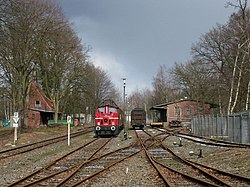 Vormeppen railway station
 -
 Ems River in Meppen
 -
 Installing the new lifting bridge in 2007


References
[edit]- ^ "Direktwahlen in Niedersachsen vom 12. September 2021" (PDF). Landesamt für Statistik Niedersachsen. 13 October 2021.
- ^ "Alle politisch selbständigen Gemeinden mit ausgewählten Merkmalen am 31.12.2023" (in German). Federal Statistical Office of Germany. 28 October 2024. Retrieved 16 November 2024.
- ^ "Meppen" (in German). Retrieved 11 September 2020.
- ^ a b c "Meppen-Versen" (in German). Retrieved 11 September 2020.
- ^ a b c "Meppen-Versen". KZ-Gedenkstätte Neuengamme. Retrieved 11 September 2020.
- ^ a b "Meppen-Versen" (in German). Retrieved 11 September 2020.
- ^ Stacey, Colonel Charles Perry (1960). Official History of the Canadian Army in the Second World War, Volume III, The Victory Campaign, The Operations in North-West Europe, 1944-1945. Ottawa: The Queen's Printer and Controller of Stationary. p. 557. Retrieved 31 December 2025.
- ^ . Encyclopædia Britannica. Vol. 24 (11th ed.). 1911. p. 382.
- ^ "Städtepartnerschaft Meppen - Ostroleka". meppen.de (in German). Meppen. Retrieved 2021-02-25.
External links
[edit]- Official website
 (in German)
 - Webcam (German)


| International | |
|---|---|
| National | |
| Geographic | |
| Other | |
Meppen
View on GrokipediaGeography
Location and physical features
Meppen is the administrative seat of the Emsland district in Lower Saxony, northwestern Germany.[10] The town is positioned at approximately 52°42′N 7°18′E, about 20 kilometres from the Dutch border.[11] It lies at the confluence of the Ems River with its tributaries, the Hase and Nordradde rivers.[11] The municipality spans an area of 188.5 square kilometres, with an average elevation of 15 to 19 metres above sea level.[10] [1] [12] The terrain consists of flat lowlands characteristic of the North German Plain, featuring river valleys, floodplains, and adjacent raised bogs in the Emsland region.[13]Administrative divisions and settlements
Meppen encompasses a central urban core and 13 incorporated Ortsteile (districts or settlements), which function as administrative subunits with their own local identities and councils.[14][15] These Ortsteile consist mainly of former independent villages in the surrounding Emsland countryside, integrated to streamline governance and services following Lower Saxony's territorial reforms.[14] The Ortsteile are: Apeldorn, Bokeloh, Borken, Groß Fullen, Helte, Hemsen, Holthausen, Hüntel, Klein Fullen, Rühle, Schwefingen, Teglingen, and Versen.[14][15] Most were annexed on 1 March 1974, during the second phase of communal restructuring under the Lower Saxony Municipal Code, which reduced the number of standalone municipalities to enhance administrative efficiency amid post-war population shifts and economic pressures.[16] Earlier, Vormeppen was incorporated in 1967.[17] The central town area, predating these mergers, includes traditional quarters like Altstadt (old town), Neustadt (new town), Esterfeld, and Orde, which retain historical zoning but lack separate administrative status equivalent to the Ortsteile.[18] These divisions reflect Meppen's evolution from a compact Hanseatic trading hub to a regional center spanning 188.02 square kilometers, with the Ortsteile contributing significant agricultural land and contributing to the city's total population of approximately 36,854 as of 31 December 2023.[19] For instance, Apeldorn covers 20.98 km², Bokeloh 4.45 km², and Borken 10.28 km², underscoring the rural character of many subunits.[15] Local governance involves Ortsbeiräte (local councils) for each Ortsteil, elected to advise on matters like infrastructure and community needs, while overarching decisions rest with the city council.[15]History
Early settlement and medieval period
Archaeological investigations in 2023 revealed remnants of a substantial early medieval settlement on Meppen's outskirts, dating to roughly 1600 years ago, indicative of organized habitation around the 5th century AD in the region.[20] Prior to Carolingian influence, the site hosted a Saxon agrarian complex termed the "Haupthof Meppen," comprising multiple farmsteads along the southern Hase River bank, reflecting typical early Germanic rural settlement patterns.[21] The earliest documentary evidence of Meppen emerges in 834 AD, when Emperor Louis the Pious conveyed the locale to Corvey Abbey as a missionary station amid efforts to Christianize Saxon territories.[7] This endowment underscores Meppen's strategic position near the Ems River, aiding ecclesiastical expansion in the post-Saxon Wars era. By 946 AD, Meppen obtained market privileges, enabling formalized commerce and signaling embryonic urban functions within the Ottonian framework.[7] These rights positioned the settlement as a nodal point for regional exchange, leveraging fluvial access for goods transport. In 1360, Bishop Adolf of Münster conferred comprehensive town privileges upon Meppen, explicitly authorizing rampart and moat constructions for defense, thereby formalizing its municipal status.[21] [4] Fortification works, integral to late medieval urban security amid feudal conflicts, progressed intermittently until 1660, with surviving elements attesting to earthen and masonry defenses encircling the core settlement.[4] Archaeological probes confirm these structures underpinned a densifying intra-mural layout, integrating market spaces and ecclesiastical sites by the period's close.[22]Hanseatic era and early modern developments
Meppen's association with the Hanseatic League during the medieval period is symbolized by the ship atop its town hall tower, reflecting the town's participation in the confederation's trade networks.[23] Strategically located at the confluence of the Hase and Ems rivers, Meppen facilitated commerce and transport, contributing to its recognition as a Hanseatic city with over 1,200 years of history.[2] The town hall's basement, constructed in 1408 using massive boulders, underscores the era's defensive and economic priorities.[23] In the transition to the early modern period, Meppen expanded its town hall in 1605 by adding two floors supported by columns and round arches, creating an open arcade for judicial proceedings, as depicted in the sandstone relief of the Judgment of Solomon above the central arch.[23] The town's fortifications, including surrounding ramparts, were maintained and utilized during conflicts such as the Thirty Years' War (1618–1648), preserving Meppen as a fortified settlement amid regional turmoil.[7] These developments highlight Meppen's reliance on waterways for sustained economic activity through the Hanseatic era into early modernity, with preserved structures like the city walls—unique in northwest Germany—evidencing its evolution as a defensive and trading hub.[2] Economic prosperity in the town is noted particularly in later phases, supported by its geographic advantages despite the challenges of warfare and shifting political landscapes in the Emsland region.[7]19th century industrialization and unification
As part of the Duchy of Arenberg-Meppen, incorporated into the Kingdom of Hanover following the Congress of Vienna, Meppen fell under Prussian control after Hanover's defeat in the Austro-Prussian War of 1866, during which Hanover allied with Austria against Prussia.[24] The annexation dissolved Hanoverian sovereignty over the region, integrating it into the Prussian Province of Hanover despite lingering Guelph loyalism among local Catholics and rural populations opposed to Prussian Protestant dominance.[25] This shift facilitated administrative centralization, with Meppen's governance reoriented toward Berlin's policies, including military conscription and tariff reforms under the Zollverein, which Hanover had joined in 1852. The Franco-Prussian War of 1870–1871 accelerated full unification, as Prussian victories prompted the North German Confederation—already encompassing annexed territories like Hanover—to expand southward, culminating in the German Empire's proclamation on January 18, 1871, at Versailles.[26] Meppen, now embedded in the Empire's northwestern periphery, benefited from imperial infrastructure investments but retained its conservative, agrarian character, with limited Kulturkampf tensions due to Bismarck's anti-Catholic measures clashing against the region's strong clerical influence.[27] Economic modernization in Meppen emphasized resource extraction over factory-based manufacturing, aligning with the Emsland's moor-dominated landscape. Peat (Torf) production intensified through organized moor colonization (Moorkolonisation), peaking from 1860 to 1880, as manual and emerging mechanical methods yielded fuel for households and industry while reclaiming wetlands for farming, boosting local employment and land availability.[28] This proto-industrial activity, sustained by the Ems River's navigation improvements like the 19th-century Koppelschleuse lock system, supported export of peat and agricultural goods but yielded modest growth compared to coal-driven regions. [29] Railway expansion marked a key infrastructural advance: the Hannoversche Westbahn reached Meppen in 1855, linking it to Osnabrück and enabling efficient transport of peat, timber, and rye, while the local Meppen-Haselünner Eisenbahn opened in 1894, extending connectivity to Oldenburg ports.[30] These developments spurred population influx via moor settlers but did not trigger rapid urbanization; by 1900, Meppen remained a market town with under 10,000 residents, its economy tethered to agriculture and extractive trades rather than machine-driven factories.[31] Local mills, such as water-powered facilities along the Hase, persisted for grain processing, underscoring continuity with pre-industrial patterns amid gradual mechanization.[32]World War II and post-war reconstruction
During World War II, the Meppen area hosted several forced labor sites, including satellite camps of the Neuengamme concentration camp at Meppen-Dalum and Meppen-Versen. In November 1944, over 2,500 prisoners, including many Danes, were transported to the Emsland region for fortification construction, such as the "Friesenwall" defensive line.[33] [34] At Meppen-Versen, prisoners were housed in a former POW camp starting November 16, 1944, and compelled to build anti-tank obstacles under harsh conditions.[34] Stalag VI-B, a POW camp east of Versen, held Allied prisoners, while the town itself faced Allied air raids, including a U.S. Army Air Forces bombing mission on January 11, 1944, targeting industrial sites.[35] As Allied forces advanced in early 1945, the SS evacuated the Meppen subcamps on March 25, forcing surviving prisoners on death marches toward Neuengamme, with many perishing en route.[33] [34] Meppen was captured by the Canadian 4th Armoured Division on April 6, 1945, following a Typhoon fighter-bomber raid on April 7 that damaged 10-15% of buildings.[36] [37] The Argyll and Sutherland Highlanders of Canada executed an assault crossing of the Ems River on April 8, securing the town with minimal resistance and capturing young German conscripts among the prisoners of war.[37] [38] Post-war, Meppen fell within the British occupation zone and became part of the newly formed state of Lower Saxony in 1946. The former Meppen-Versen camp site was repurposed as a prison, with wooden barracks replaced by permanent structures over time.[34] Regional reconstruction accelerated through the Emsland Plan, approved by the German Bundestag in 1950, which addressed post-war poverty and unproductive moorlands by funding drainage, agriculture, and infrastructure development across the Emsland district, including Meppen.[39] This initiative, the largest post-war reconstruction program in Germany at the time, transformed the area's economy from subsistence farming to modern industry and peat exploitation, fostering population growth and reducing emigration.[40] Memorial sites, such as the Gedenkstätte Meppen for camp victims, were later established to commemorate the era's atrocities.[41]Demographics
Population trends and statistics
The population of Meppen stood at 36,930 as of the 2024 estimate, reflecting continued growth in the Emsland district.[3] This figure marks an increase from the 2022 census count of 36,429.[42] With a municipal area of 188.4 km², the population density is approximately 196 inhabitants per square kilometer.[3] Historical trends indicate steady expansion, with the population rising by 25.7% between 1975 and 2015, from roughly 27,400 to 34,466.[43] This contrasts with broader stagnation or slight declines observed in parts of Lower Saxony and nationally since the mid-2000s, driven by net migration gains and economic vitality in the region rather than natural increase alone.[44][45]| Year | Population | Type | Source |
|---|---|---|---|
| 1975 | ~27,400 | Estimate | Derived from growth rate[43] |
| 2015 | 34,466 | Estimate | City facts data[43] |
| 2022 | 36,429 | Census | Official census[42] |
| 2024 | 36,930 | Estimate | Projection[3] |
Socioeconomic composition
Meppen maintains a stable socioeconomic structure dominated by a middle-class population, with low unemployment and moderate income levels reflective of the Emsland district's rural-industrial economy. As of 2022, 21,167 residents were employed in approximately 2,000 businesses, primarily in manufacturing, services, agriculture, and energy sectors.[46][19] The town's unemployment stood at 714 persons in 2023, equating to a district-wide rate of 3.2% in October of that year—below the national average of around 5-6%—indicating robust local labor market conditions.[19][47] Income distribution shows 40.2% of households classified as low-income, aligned with broader Lower Saxony trends but moderated by the region's economic resilience. Child poverty affects 6.5% of minors in Meppen, slightly above the district's 5% but indicative of limited severe deprivation compared to urban German centers.[48] The Emsland district's median gross monthly earnings hovered near or above the national figure of €3,806 in late 2023, supported by stable employment in non-precarious roles.[49] Education levels contribute to socioeconomic steadiness, with 49.5% of primary school graduates transitioning to Gymnasium (grammar school) in recent years—the highest rate among Emsland municipalities—fostering skilled labor pools. Single-person households comprise 40.1% of residences, higher than the district's 30%, reflecting aging demographics and urban-rural migration patterns. Foreign-born residents account for 17% of the population, integrated primarily through labor migration rather than welfare dependency.[50][51] Overall, Meppen's composition evinces low social stratification, with minimal indicators of acute inequality or exclusion.[52]Economy
Primary industries and agriculture
Agriculture forms a cornerstone of the primary sector in Meppen and the broader Emsland district, supporting rural employment and local processing industries despite a shift toward secondary and tertiary sectors in the town's economy. The Emsland district encompasses around 3,500 full-time agricultural operations, which collectively generate an annual turnover exceeding 1.5 billion euros and sustain approximately 5,000 jobs.[53] These farms utilize extensive arable land, with the district's agricultural structure emphasizing efficient, large-scale production adapted to the region's sandy soils and temperate climate.[54] Livestock rearing dominates, particularly pig farming, as northwestern Lower Saxony—including Emsland—accounts for major portions of the state's piglet production and fattening operations. Dairy farming also prevails, with notable examples like Milchhof Suer in Meppen-Teglingen, which earned the Goldene Olga award in 2024 for superior milk quality and sustainable practices among Lower Saxony's producers. Crop cultivation complements this, focusing on potatoes destined for starch processing; the nearby Emsland Group, headquartered in Emlichheim, sources from regional contract farmers to produce potato-based starches, holding a leading global market position.[55][56][57] Beyond agriculture, peat extraction represents a minor but traditional primary activity, leveraging the district's moorlands. Firms such as Over Torfhandel GmbH in Meppen engage in peat mining, processing, and related nonmetallic mineral activities, contributing to horticultural substrates amid ongoing environmental debates over moor drainage and carbon emissions.[58] While employment in the primary sector remains higher than the Lower Saxony average in the Ems-Achse region encompassing Emsland, it constitutes a shrinking share of Meppen's total workforce of over 21,000 in local businesses as of mid-2022.[59][19]Energy sector and infrastructure
The energy sector in Meppen emphasizes renewable integration and grid enhancements, following the decommissioning of fossil-based facilities. The Kraftwerk Meppen-Hüntel, a natural gas-fired peak-load steam power plant, operated until 2000 before closure.[60] Wind power constitutes a core component, exemplified by the Meppen wind farm's repowering initiative led by ENOVA Power GmbH. In March 2024, ENOVA secured an order for nine Vestas V172-7.2 MW turbines, set to replace 14 aging Enercon E-66 units and boost installed capacity from 25.6 MW to 65 MW, with development approvals secured by late 2024.[61][62] Emerging storage solutions include municipal plans for a 300 MWh battery facility, developed in partnership with a British renewable energy firm to support renewable intermittency and local grid resilience.[63] Meppen also supports the energy transition through industrial processing, hosting RE.LION.BAT Circular GmbH's lithium-ion battery recycling plant—Europe's largest by capacity—which began operations in August 2025 and processes up to 30,000 tonnes annually from electric vehicles and tools, recovering key materials for reuse.[64] Key infrastructure features the Umspannanlage Meppen substation, managed by transmission operator Amprion. In October 2025, Amprion commissioned Germany's only dual rotating phase shifter system there, costing 120 million euros, to regulate voltage, frequency, and power flows amid rising renewables.[65][66] This facility anchors the 380 kV Wesel-Meppen overhead line, spanning over 150 km to interconnect northern wind resources with consumption centers.[67] Local distribution falls under Westnetz GmbH, ensuring reliable supply across the Emsland region.[68]Recent economic developments
In 2024, ENOVA Community Energy received regulatory approval to repower the Meppen wind farm, replacing 14 older Enercon E-66 turbines with nine more efficient Vestas V172 models to enhance energy output and technological standards.[62] This project aligns with Germany's energy transition efforts, building on the site's established role in onshore wind production while addressing aging infrastructure.[69] The logistics sector also attracted investment in September 2024, when Duni Group announced plans for a new modern warehouse and facility in Meppen, aimed at improving operational efficiency and advancing long-term net-zero carbon emissions targets through sustainable design.[70] This development supports the town's position as a regional hub for distribution, complementing its approximately 2,000 businesses and over 21,000 social-insurance-covered employees recorded as of mid-2022.[19] Broader economic momentum in the Emsland district, where Meppen serves as the administrative center, has sustained growth in manufacturing and services, driven by a proactive business environment and historical policies like the Emsland Plan that transformed the region into a high-performing area post-World War II.[71] Local indicators reflect resilience amid national challenges, with the district maintaining competitive dynamics in mechanical engineering and related industries.[72]Government and politics
Local administration and governance
Meppen operates under the standard municipal governance framework of Lower Saxony, Germany, featuring a directly elected full-time mayor as the head of the executive branch and a city council (Rat der Stadt) as the legislative body. The mayor oversees the city administration, implements council decisions, represents the municipality, and manages day-to-day operations, while the council, comprising 39 members including the mayor, handles legislative matters such as budgeting, zoning, and local ordinances.[73] The current mayor, Helmut Knurbein, an independent, has held office since November 2014 and was re-elected in September 2021 for a term ending in 2026; he announced in September 2025 that he will not seek re-election. Knurbein chairs both the council and the executive, with responsibilities including economic development, infrastructure, and citizen services. Assisting in administrative leadership is the First Stadtrat (deputy), Matthias Funke, elected by the council in November 2022.[74][75] The city council consists of 38 elected members serving five-year terms, with the most recent election held on September 12, 2021. Composition includes the CDU with 16 seats, UWG/FDP alliance with 7, SPD with 8, Bündnis 90/Die Grünen with 6, and one independent AfD member. Council meetings and decisions are accessible via the official ratsinformation system.[76] As the seat of the Emsland district (Kreisstadt), Meppen hosts the district administration, which manages regional affairs including education, social services, and waste management across 15 municipalities, complementing the city's local governance without direct subordination. The city administration functions as a service-oriented entity, emphasizing digital access and citizen engagement through portals for council protocols and public consultations.[77]Twin towns and international relations
Meppen has one twin town partnership with Ostrołęka, a city in northeastern Poland with a population of approximately 52,000 as of 2023.[78] The official city-level agreement was formalized on September 15, 1994, building on an initial vocational school exchange initiated in 1991 between the Berufsbildende Schulen Meppen and Berufsschule Nr. 2 in Ostrołęka.[79][78] The partnership emphasizes cultural, educational, and civic exchanges, including annual student programs, youth delegations, and mutual support initiatives. For instance, in March 2024, a delegation from Meppen's vocational schools visited Ostrołęka for educational exchanges focused on German-Polish cooperation.[80] In 2022, local reservists from Meppen fulfilled requests from Ostrołęka for equipment and aid, coordinated through the Partnerschaftskomitee Meppen e.V.[81] The committee has also hosted Polish exchange students from Ostrołęka and provided assistance during regional challenges in Poland.[82] This relationship marks the primary international tie for Meppen, with no other formal twin towns documented. Activities promote cross-border understanding without broader diplomatic or economic treaties beyond local cooperation.[83] The 25th anniversary in 2019 featured joint celebrations highlighting sustained people-to-people ties.[79]Culture and heritage
Cultural institutions and events
The Emsländische Freilichtbühne Meppen, founded in 1951 and located in the Esterfelder Forst, operates as an amateur open-air theater staging musicals, plays, and family productions that draw significant audiences, with over 50,000 visitors recorded in recent seasons.[84][85] Its 2025 program includes La Cage aux Folles and Das Dschungelbuch, emphasizing music theater amid natural surroundings.[84] Theater Meppen serves as the primary indoor venue for professional and local performances, encompassing concerts, cabaret, and theater productions such as tributes to ABBA and holiday specials like Tom Gaebel's A Swinging Christmas in late 2025.[86] Subscription series for classical music, kleinkunst (cabaret), and school theater further support community engagement.[86] The Stadtmuseum Meppen, housed in the historic Arenbergische Rentei at the Koppelschleuse along the former Ems-Hase Canal, documents local history from prehistoric settlements to the town's fortress period across 800 square meters of exhibits, with admission at 4 euros for adults and 2 euros for children aged 6-16.[87] It hosts guided tours, lectures—such as on the 1633 city fortifications—and special events tied to archaeological finds.[87] The Exhibition Centre for the Archaeology of the Emsland complements these with year-round displays of regional prehistoric artifacts, offering guided tours and facilities for private events.[88] Meppen's cultural calendar features recurring events like the Meppener Maitage in spring, a major festival with markets and community activities, and the autumn Rathauskirmes fair centered around the town hall.[89] The Emsländischer Töpfermarkt, reaching its 33rd edition in recent years, highlights regional ceramics and crafts.[90] Additional fixtures include weekly markets in the city center, historical markets at the Koppelschleuse, and seasonal concerts or academies such as the Sculptor Summer Academy.[91][92] The city's culture management, led by manager Katja Lampe since April 2024, coordinates these alongside broader leisure programming.[93]Historic buildings and monuments
The Historic Town Hall serves as Meppen's central landmark, with its basement constructed in 1408 from large boulders forming a high medieval tower house.[94] In 1605, the structure was expanded by two upper stories, creating the current form topped by a ship weathervane symbolizing the town's medieval Hanseatic League connections.[23] Located on the market square, the building now houses a café while preserving its role as a symbol of municipal authority.[95] The Arenbergische Rentei, a neoclassical edifice built in 1805 for merchant Johann Ferdinand Frye, holds national architectural significance.[96] Acquired by the Ducal Arenberg Domain in 1835, it functioned as an administrative office and residence until repurposed as the town museum, which features exhibits on local history including a digital city model.[97] [2] Religious structures include the Gymnasialkirche, a late Baroque hall church erected between 1743 and 1746 by the Jesuit order for the adjacent Gymnasium founded in 1642.[98] Its interior boasts a decorative stucco ceiling, and the facade displays striking red and yellow tones.[99] The Propsteikirche St. Vitus, in late Gothic style, was constructed around 1661–1662 on a site with earlier medieval expansions dating to the 11th and 13th centuries.[100] Meppen's fortifications are represented by the Stadtwall, remnants of the 17th-century fortress built during the Thirty Years' War (1618–1648).[101] Today, this earthwork encircles the old town as a tree-lined promenade, forming the city's primary green belt and offering pedestrian paths amid preserved historical earthworks. Among industrial heritage sites, the Herrenmühle stands as a preserved watermill originally used for grain processing, with its turbine mechanism still operational despite ceased milling activities.[102] Located in the Nordradde area, it exemplifies traditional Emsland milling infrastructure.[103]Parks, natural sites, and recreation
Meppen is bordered by diverse natural landscapes, including nature reserves and parks that support hiking, cycling, and wildlife observation. The Borkener Paradies, a 34-hectare nature reserve established in 1937 northwest of the town, protects a historic huteland—a traditional cultural landscape of grazed woodlands and meadows encircled by an abandoned Ems River channel. Visitors access it via marked trails, with an observation platform at the former Versener Weir site offering views of the preserved ecosystem.[104][105] The Meppener Kuhweide nature reserve spans 65 hectares within an Ems River meander, conserving remnants of historical hudeland with alluvial meadows, hedgerows, and old pollard trees that sustain bird and insect populations. This area exemplifies flood-prone riverine habitats managed for biodiversity.[106] Adjoining Meppen, the Hümmling Nature Park covers rolling hills, forests, heathlands, and moors across 285 square kilometers, featuring over 500 kilometers of trails for walking and biking amid rare bird species and cultural heritage sites like ancient grave mounds. The Moor-Veenland Nature Park, an international protected area, includes raised bogs with boardwalks, viewing towers, and adventure paths for exploring peatlands and associated flora, such as sundews and cotton grasses.[107][108] Recreational pursuits emphasize low-impact activities: local trails rated from easy loops to moderate hikes, totaling dozens of routes within 20 kilometers of Meppen, often combining forest paths with moor edges for seasonal birdwatching. Cycling networks link these sites, while the nearby Geeste Reservoir enables angling, boating, and shoreline walks in a 180-hectare wetland biotope. These opportunities draw locals and tourists for sustainable nature engagement without motorized access in core reserves.[109][110][111]Sports
Major sports clubs
SV Meppen, officially Sportverein Meppen 1912 e.V., is the town's primary professional football club, founded on 29 November 1912 as Amisia Meppen before merging with a local gymnastics club in 1920.[112] The club fields men's and women's teams, with the senior men's side competing in the Regionalliga Nord, the fourth tier of German football, as of the 2024–25 season; it has approximately 2,050 members and plays home matches at the Hänsch-Arena, which holds 13,241 spectators.[113] Historically, SV Meppen achieved promotion to the 2. Bundesliga in 2017 but faced relegation challenges thereafter, emphasizing its role as a regional powerhouse in Lower Saxony's Emsland district.[114] Turnverein Meppen 1912 e.V., another longstanding multi-sport association established in the same year as SV Meppen, serves as the largest recreational sports club in the Emsland region with 1,335 members across 12 disciplines.[115] It promotes broad participation through offerings such as handball, judo, basketball, badminton, cheerleading, and fitness/rehabilitation programs like M-Fit and Reha-Sport, focusing on community health and youth development rather than elite competition.[116] The club's emphasis on inclusive, non-professional athletics distinguishes it from specialized outfits, supporting local events like city runs and children's gymnastics.[115] Other notable clubs include LAV Meppen e.V., dedicated to track and field athletics since 1991, which organizes regional meets and training for endurance and field events.[117] Smaller specialized groups, such as Tennis-Club Meppen von 1924 e.V. for racket sports and Schießsportverein Meppen e.V. for shooting disciplines, contribute to the town's diverse sporting landscape but lack the membership scale or competitive profile of the aforementioned associations.[118]Notable facilities and events
The Hänsch-Arena, located in Meppen's Neustadt district, serves as the primary football stadium with a capacity of 13,241 spectators.[119] Originally constructed in 1924 and expanded multiple times, including in 1996, it hosts home matches for SV Meppen in the Regionalliga Nord and has become one of the largest sports venues in the Emsland region.[120] The Leichtathletikstadion at Helter Damm, completed in 1997, is an open-air athletics facility designed to "Kampfbahntyp B" standards, featuring a natural grass track and accommodating up to 4,000 spectators for track and field events, endurance training, and regional competitions.[121][122] Circuit Meppen, built on the site of a former power plant, functions as a multi-purpose motorsport venue offering karting, quad biking, off-roading, and track days for cars, with regular events including drift sessions and racing cups.[123][124] SV Meppen's participation in the DFB-Pokal has drawn significant crowds, such as the first-round match against Hamburger SV on August 18, 2024, which ended 1–7 and highlighted the arena's role in hosting higher-tier opponents.[125] A landmark event occurred on August 3, 1982, when FC Barcelona, featuring Diego Maradona in his European debut, defeated SV Meppen 5–0 in a friendly attended by 18,000 fans, with Maradona scoring once.[126] Circuit Meppen hosts ongoing track days and motorsport cups, such as the PTC Racing Cup and MaxLease Cup, attracting enthusiasts for timed laps and corporate outings.[124]Notable people
Figures in politics and business
Markus Löning, born in Meppen in 1960, is a German politician and human rights advocate who studied political science and computer science before entering diplomacy and politics. He served as a member of the Bundestag for the Free Democratic Party (FDP) from 1994 to 2002 and later as Germany's Commissioner for Human Rights Policy and Humanitarian Assistance at the Federal Foreign Office from 2010 to 2014, focusing on international humanitarian efforts and policy advocacy. Hermann Friese (1911–1996), born in Meppen, was a Christian Democratic Union (CDU) politician who represented the constituency in the German Bundestag from 1957 to 1965, contributing to post-war reconstruction debates in agriculture and regional development. Ferdinand Schöningh (1815–1883), a publisher born in Meppen, founded the Ferdinand Schöningh Verlag in Paderborn in 1827, establishing a prominent Catholic publishing house that specialized in theological, historical, and educational texts, influencing German intellectual discourse in the 19th century. Walter Többens (1909–1954), an industrialist born in Meppen, built textile factories during World War II, including operations in occupied Warsaw where he employed forced Jewish labor under Nazi collaboration, amassing significant wartime profits before fleeing to Bremen post-war. His enterprises exemplified exploitative practices in the Nazi economic system, contrasting with rare cases of industrialists who protected workers.[127]Athletes and cultural personalities
Alwin Schockemöhle (born 29 May 1937), a leading German show jumper during the 1960s and 1970s, achieved Olympic team gold in 1960 and individual gold in 1976, alongside multiple European championships.[128][14] Jana-Franziska Poll (born 7 May 1988), a professional volleyball player, represented Germany internationally, starting her career at age eight with SV Union Meppen and competing at elite levels including the national team.[129] Carsten Schlangen (born 31 December 1980), a middle-distance runner specializing in the 1500 meters, participated in the Olympics and set national records in his event.[130] Holger Wehlage (born 3 July 1976), a midfielder, played 14 Bundesliga matches after developing through SV Meppen's youth system.[131] Levin Schücking (1814–1883), a novelist and journalist, authored works reflecting 19th-century German social themes after studying law in Munich and Göttingen.[132] Hermann Lause (1939–2005), a film actor, appeared in over 70 productions, including notable roles in Head-On (2004) and Schtonk! (1992).[133]References
- https://commons.wikimedia.org/wiki/Category:Naturschutzgebiet_Borkener_Paradies