Hubbry Logo
Stepped gableStepped gableMain
Open search
Stepped gable
Community hub
Stepped gable
logo
8 pages, 0 posts
0 subscribers
Be the first to start a discussion here.
Stepped gable
Stepped gable
from Wikipedia
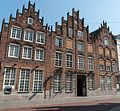
Crow-stepped gable on a house in Lüneburg, Germany
Buildings in Bruges, Belgium, with crow-stepped gables

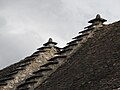
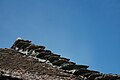
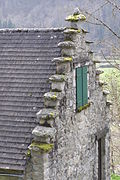
A stepped gable, crow-stepped gable, or corbie step[1] is a stairstep type of design at the top of the triangular gable-end of a building.[1][2] The top of the parapet wall projects above the roofline and the top of the brick or stone wall is stacked in a step pattern above the roof as a decoration and as a convenient way to finish the brick courses. A stepped parapet may appear on building facades with or without gable ends, and even upon a false front.

Geography

[edit]

The oldest examples can be seen in Ghent (Flanders, Belgium) and date from the 12th century, such as the house called Spijker on the Graslei, and some other Romanesque buildings in the city. From there, they spread to the whole of Northern Europe from the 13th century, in particular in cities of the Hanseatic League (with brick Gothic style), and then to Central Europe by the next century. These gables are numerous in Belgium, France (French Flanders, Eastern Normandy, Picardy and Alsace), the Netherlands, all Germany, Denmark, Sweden, Poland, and the Baltic States. They are also present but much rarer in the British Isles although the Old Elizabethan Library at Trinity Hall, Cambridge, dates to 1590. Crow-stepped gables are especially common on traditional Flemish and Dutch houses and on mediaeval Danish churches.

Crow-stepped gables were also used in Scotland as early as the 16th century.[3] Examples of Scottish crow-stepped gables can be seen at Muchalls Castle, Monboddo House, and the Stonehaven Tolbooth, all late 16th and early 17th century buildings.

Nineteenth-century examples are found in North America, and the step gable is also a feature of the northern-Renaissance Revival and Dutch Colonial Revival[4] styles.

Architecture

[edit]

In some regions of France, it's a utilitarian element in the architecture of thatched rural houses, where flat stones cover the load-bearing walls. In other regions, such as northern France (notably in the Soissonnais region), or Scotland, it is a purely decorative element in ashlar. Another version of the stepped gable with a purely decorative role is found in so-called noble or urban architecture, mainly in northern and central Europe, such as Germany, Flanders and the Netherlands.[5][6]

Rural architecture

[edit]
Stepped gables adorning the rural Östra Hoby Church, Sweden

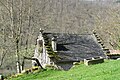
In the rural architecture of various regions of France, the crenellated gables still visible on dwellings and barns are generally linked to the former existence of thatch roofing on these buildings, replaced during the 19th century by slate or flat tile roofing.[7][8]

Usefulness

[edit]

The main advantages of the vertical projection of the gable slopes were to prevent the thatched roof from being “unplucked” in high winds, to facilitate access to the roof ridge[7] and to act as a firebreak.

In rural architecture, redents are generally covered with flat stones to protect them from the rain, prevent water infiltration into the load-bearing wall, and enable the roofer or road worker to place his tools.[9] These stones often (but not always) slope downwards to allow rainwater to drain away.

In the Campan valley (Hautes-Pyrénées), thatched roofs with overhanging gables can be found on temporary barns transformed into permanent farmhouses in the 19th century by family cadets, either by adding a single room (caouhadé or chauffoir) against a gable, or by creating a living space in the barn itself.[10]

Rhône-Alpes

[edit]

In the Rhône-Alpes region, they are typical of the architecture of eastern Nord-Isère (Morestel and Crémieu cantons) and neighboring southern Bugey (villages of Izieu, Prémeyzel, Lhuis, Brégnier-Cordon, Arbignieu, etc.). They are also widespread in the traditional habitat of the northern Vercors (Quatre Montagnes).[11]

In Frangy, Haute-Savoie, not far from the Bugey region, a rare example of this type of gabled roof can be found at the Bel-Air farm,[12] which is listed as a historic monument.

Central Pyrenees

[edit]

In the central Pyrenees, from Bigorre to Couserans, gabled roofs are a common feature of barn and sheepfold architecture.[13]

Jura department

[edit]

In the villages of the Jura and Franche-Comté vineyards, some traditional Jura houses are built with gabled roofs.[14]

Soissonnais

[edit]

Stepped gables, also known as sparrow-stepped gables, can be found in villages along the Aisne valley,[15] mainly in the Soissonnais region, where they are particularly numerous, if not widespread, and have characterized local rural architecture since the Middle Ages. They can be found on all types of buildings, mainly rural houses, but also manor houses, barns, town houses and church steeples. The term “crenellations” was formerly used to describe these steps. These are small steps, often consisting of a single ashlar course, not covered with flat stone. They have no credible utilitarian role. Their use is purely decorative or identity-related. Such gables are less common in other parts of northern France. Although Flanders is not far away, the gables of the Soissonnais are very different from those of Flanders in shape and structure, and the long history of this tradition in France makes it unlikely that the two are related.[16]

The gables at Château de Pierrefonds, on the other hand, were designed by Viollet-le-Duc in the neo-Gothic style of the 19th century, and are a cross between Soissonnais and Flanders.[17]

Urban architecture

[edit]

There's also a more monumental, urban version of cusped gables, found mainly in northern Europe, whose function is exclusively decorative or symbolic.[18]

Northern Europe

[edit]

In Belgian and French Flanders, stepped gables became widespread from the Middle Ages onwards. They are probably the result of adapting the crenellations of fortified walls to sloping gables. A symbol of seigneurial housing, they were taken up by the powerful bourgeoisie of free market towns, to demonstrate the power they had acquired. The redents then quickly became widespread and a simple decorative motif, adorning even modest buildings. Redents are also sometimes fitted with merlons.[19]

This type of gable, also known as “stepped gable” or “stepped gable”, is characteristic of many parts of Northern Europe. They can be found, with various local variations, in Flanders (in the broadest sense) and the Netherlands, but also throughout northern Germany, Poland, the Baltic states and Scandinavia, particularly in the former German Hanseatic towns, for which this type of gable is a striking architectural symbol, and where they spread at the same time as the backsteingotik (“brick Gothic”) style.[20] They have also spread to more southerly Germanic regions, such as Bavaria, Alsace and Switzerland.[21]

In Flanders and the Netherlands, their style is somewhat different (the steps are smaller and tend to be more numerous on each pitch, compared to the often large steps of northern Germany). They were a characteristic feature of urban construction where, by virtue of taxes on the width of houses, people came to build high and privilege this aspect of the facade. Horizontal divisions corresponding to storey heights often tended to be reduced in height, creating an optical effect of “false perspective” that accentuated the effect of height. From the Renaissance onwards, curves and scrolls began to appear, gradually eliminating the “stepped” appearance, although many were still preserved.[22]

From the early 19th century to the present day, neo-regionalist architecture has revived the use of crenellated gables in both Belgian and French Flanders: Tournai's Grand-Place, the reconstruction of Ypres and Bailleul after the First World War, buildings in Lille, and so on.

Construction

[edit]

Convenient access to the roof ridge motivated the crow-step design, along with the availability of squarish stones to accomplish this form of construction. The access would have been convenient for chimney sweeps and roofers in earlier times, where cranes were non-existent and tall ladders were not common.

With crow steps, the roofing slates (rarely tiles) do not reach the end of the building, so making for a special problem with keeping the roof watertight.[23] Many different schemes are found for overcoming this, some of which are described below. Terms currently used in Scotland are italicised.

  • Slates may be laid to the edge of the crow step, with the last slate raised by a wedge (tilting fillet). Then mortar (lime mortar or cement) would be laid over the edge of the slate to seal the gap. Other solutions involve working with lead.
  • A groove approximately 25 mm (1 inch) deep is cut into the inside edge of the steps. A lead abutment flashing is inserted into this groove, called a chase or a raggle. The lead is laid over the end slate, which is raised by a tilting fillet.
  • Leading is inserted into a raggle, and used to make a trough, or secret gutter, running down the inside edge of the steps. The far edge of the trough is raised over a triangular fillet. Slates are then laid resting on that trough edge and overlapping into the trough, which is open and runs directly down to gutters (roans).
  • Rather than forming a raggle, lead flashings may be placed into the joints between bricks as they are laid.

When lead is to be held into a raggle, small folded lead wedges called bats are inserted at intervals and hammered in so they expand. The raggle is then sealed with mortar. Crow steps are frequently made of sandstone, even on buildings otherwise of granite,[24] and it is said that the porous nature of sandstone leads to problems with water penetration. Because of this, crow steps are sometimes capped with lead or sealed with other materials.

Design variation

[edit]

There are a number of variations on the basic design. One such structure is Culross Palace built in 1597 which features a veiled woman on the crow steps. Roofs in Scotland are typically steeper than in the rest of the United Kingdom (possibly because it snows more) making for steeper and more step-like steps.[25]

Alternative terms

[edit]

The Nuttall Encyclopædia suggests this architectural feature is called corble steps.[26] Corbie steps (from the Scots language corbie: crow) is a more common version. Another term sometimes used is craw step. In Dutch, this design is termed trapgevel ("stair-step facade"), characteristic of many brick buildings in the Netherlands, Belgium, and in Dutch colonial settlements.

A similar form is found in traditional Chinese architecture called zh:馬頭牆 (pinyin: mǎtóu qiáng), which literally means "horse-head wall".

See also

[edit]

References

[edit]
[edit]
Revisions and contributorsEdit on WikipediaRead on Wikipedia
from Grokipedia
A stepped gable, also known as a crow-stepped gable or corbie step, is an architectural feature consisting of a series of horizontal steps forming the upper edge of a triangular end, typically used to conceal the sloping roof lines behind a decorative . This design creates a stairstep profile, often starting from the first floor. Originating in the 12th century in (modern-day ), the stepped gable first appeared in structures like the Spijker on in , evolving through medieval and periods as a hallmark of Northern European vernacular and civic architecture. It spread widely across the , including the , where it became iconic in buildings from around 1600 to 1655, alternating with simpler wooden facades in crowded urban settings like Amsterdam's canal district. The style also gained prominence in , , , , , , and , serving both practical purposes—such as disguising utilitarian roof forms—and aesthetic ones, evoking regional prosperity and trade influences. In the Americas, stepped gables arrived with Dutch and Flemish settlers, appearing in early colonial buildings like New Amsterdam's Stadt Huys (1641–1642) in New York and later in Romantic revivals such as Washington Irving's Sunnyside estate (1835) in . The feature experienced renewed popularity in the late 19th and early 20th centuries through Dutch/Flemish Revival and Dutch Colonial Revival styles, which emphasized steep, stepped profiles reminiscent of European prototypes to convey dignity and historical continuity in public and residential architecture. Notable examples include the Pearce-McAllister Cottage in Denver, (circa 1900–1925), and Philadelphia's Engine 46 firehouse (1894–1895), designed with stepped gables in red brick and terra-cotta. Today, stepped gables remain a defining element in preserved historic districts, illustrating the enduring legacy of transatlantic architectural exchange.

Definition and Origins

Definition

A stepped gable, also known as a crow-stepped gable or corbie-stepped gable, is a stairstep applied to the -end of a building, where the projects above the line in a series of horizontal offsets to terminate the brick or stone courses. This configuration forms a distinctive profile along the upper edge of the triangular , distinguishing it from plain gables that feature a smooth, straight, or simply triangular termination without such projections. The stepped profile typically consists of 3 to 7 steps, creating a rhythmic, staircase-like appearance that rises from the to the peak. The primary purposes of the stepped gable are both decorative and functional: it enhances the visual appeal of building facades by adding architectural interest and texture to otherwise plain walls, while also serving as a practical means to cap and weatherproof the gable-end structure. Functionally, the design terminates the masonry courses in a way that directs rainwater away from the wall core, preventing ingress and potential deterioration of the building fabric. Basic components of the stepped gable include the individual steps, each formed by corbelled or projecting horizontal courses of brick or stone that offset inward or outward to build the staircase effect. These steps are commonly finished at the top with sloping coping stones, which further aid in shedding water and protecting the underlying masonry from exposure.

Historical Origins

The earliest known examples of stepped gables appear in 12th-century in , , with the Spijker house (also known as the Korenstapelhuis or Het Spijker) dating to circa 1200 and recognized as one of the oldest surviving instances of this form on the quay. This Romanesque structure, originally a , exemplifies the initial use of stepped gables in Flemish urban settings, where the design facilitated practical rooftop access while providing a distinctive silhouette against the skyline. From , stepped gables spread through trade networks in the 13th century, particularly via the , which facilitated their dissemination to Northern European cities and brick-building traditions along Baltic and routes. By the , the form had reached , integrating into the architectural vocabulary of Hanseatic towns where it became a hallmark of mercantile prosperity. Closely associated with the Brick Gothic style prevalent in medieval from the 13th to 15th centuries, stepped gables characterized residential and commercial buildings, symbolizing the economic confidence of the in regions lacking abundant stone resources. During the period from the 1500s to 1600s, stepped gables evolved in Dutch designs from simple medieval steps into more ornate configurations, incorporating decorative scrolls and volutes to enhance aesthetic appeal and reflect classical influences. This elaboration aligned with the Dutch Golden Age's emphasis on symmetry and ornamentation in urban facades. The form was introduced to in the , primarily through Flemish trade and migration links, as seen in crow-stepped gables (a local variant) on buildings in and harbors, where expatriate Flemish masons adapted the style to local . In the , stepped gables experienced a revival within neo-regionalist movements, drawing on medieval precedents to evoke historical continuity amid industrialization. A notable instance occurred in post-World War I reconstructions in , , where a proliferating "Ypres style" incorporated variants of stepped gable silhouettes to restore the city's pre-war Flemish character and foster communal identity.

Geographical Distribution

Continental Europe

In and , stepped gables are widespread in medieval towns such as and , where they adorn bourgeois homes and as symbols of prosperity and trade . These features appear prominently on 15th- and 16th-century structures, including the Masons' Guild Hall in , which features a distinctive stepped gable topped with rotating dancer figures. In , they contribute to the iconic canal-side facades of historic houses, reflecting Flemish Renaissance influences. In , stepped gables, known locally as pignons en escalier or à redents, serve utilitarian purposes in rural architecture, particularly for supporting thatched roofs in regions like , the Central , Jura, and Soissonnais. In the Vercors area of , crow-stepped profiles on farmhouses date to the and were designed to resist strong winds while anchoring thatch. Similarly, in the , they appear on bigourdane houses and barns, where the stepped design, often called penàus or pas de moineau, protects thatched roofs from fire spread and wind, as seen in Ariège and Bigorre valleys. In , these gables integrate into farmsteads, enhancing the regional vernacular style. They are rarer in areas like and , where smoother gable forms predominate. In the Netherlands, stepped gables, or trapgevels, are iconic elements of Dutch Renaissance urban facades, often ornamented to display wealth and status. Exemplified by the Pageshuis in The Hague, built starting in 1625, these gables feature stepped profiles with decorative anchors and cornices along the Lange Voorhout. Amsterdam townhouses from the 17th century similarly showcase elaborate trapgevels, popular between 1620 and 1790 for their rhythmic, stair-like ascent that balanced aesthetics and structural needs. Across , , , , and the , stepped gables link to architecture, appearing on buildings from the 14th to 16th centuries to denote mercantile influence. In , , crow-stepped gables crown many medieval houses, emphasizing the work typical of northern Hanseatic towns. Sweden's Östra Hoby Church, dating to the early , features rural stepped gables that highlight Scandinavian adaptations of this form. In and the Baltic regions, they appear on trade-related structures, though less commonly than in core Hanseatic centers.

British Isles and Beyond

In the , stepped gables, known locally as corbie steps in , became a distinctive feature of from the 16th century onward, appearing in both rural and urban settings. This adoption was influenced by Flemish trade connections, which introduced continental styles to Scottish builders. In , corbie steps were commonly employed on townhouses, castles, and merchant dwellings, often with steeper profiles than their continental counterparts to facilitate practical access, such as for sweeps and roof maintenance. A prominent early example is Palace in , constructed starting in 1597 by Sir George Bruce, which features crow-stepped gables alongside pantiled roofs and harled walls, evoking the era's mercantile prosperity. Similarly, near , built in the early 1600s with elements dating to the 13th century, incorporates corbie steps in its L-plan design, highlighting their integration into fortified rural structures. In , stepped gables remained rare, primarily confined to academic and ecclesiastical contexts rather than widespread domestic use. One notable instance is the Old Elizabethan Library at , erected in the 1590s, which includes a Dutch-style stepped end-gable in red brick, marking it as an outlier in English architecture of the period. Occasional revivals appeared in the amid broader Gothic and interests, though these were sporadic and not emblematic of mainstream trends. Beyond the , stepped gables spread to in the through Dutch Colonial influences, particularly in farmhouses of New York and . These structures, often brick or frame with roofs, adopted stepped gables as a nod to 17th-century Dutch prototypes seen in urban buildings. A historicist revival emerged in the 1880s and 1890s on Manhattan's , dubbed the "School of the Stepped Gables" for its cluster of Dutch Renaissance Revival designs; examples include Grammar School No. 9 (1894–96) at 460–466 West End Avenue, with its prominent stepped gables and dormers, and the (1892–93), both reflecting a deliberate of 16th–17th-century Netherlandic forms to urban institutional needs. Elsewhere globally, stepped gables appear in rare modern revivals within neo-traditional , where architects draw on historical precedents for contextual harmony in new developments. A superficial similarity exists with the "horse-head wall" (mǎtóu qiáng) in traditional Chinese rural architecture, particularly in Huizhou-style residences, where stepped parapets rise above the roofline as firebreaks between adjacent buildings; however, this form evolved independently without direct European influence, shaped by local layouts and fire prevention practices.

Architectural Contexts

Rural Applications

In rural settings, stepped gables primarily served utilitarian purposes in agricultural structures, such as protecting thatched from wind uplift and providing anchor points for securing roof ties in timber-framed farmhouses. These features extended the gable walls above the roofline, acting as windbreakers to prevent gusts from lifting lightweight thatch materials, a common issue in exposed countryside environments. In timber-framed constructions, the stepped design offered stable projections that allowed roof timbers to be tied down securely, enhancing overall structural integrity against seasonal storms. In France, stepped gables adapted to regional rural needs, particularly in areas with steep terrains and variable roofing materials. In the Rhône-Alpes region, including the Vercors area, these gables originated in the 14th century on traditional farmhouses and longhouses, where tiered limestone steps shielded thatched roofs from wind while facilitating the layering of modern slate or shingle coverings on steep pitches. Further south, in the Central Pyrenees, stepped gables—known locally as pignons à redents or en escaliers—were integrated into stone bigourdane houses, providing stability on slopes by reinforcing the roof against wind and snow loads in pastoral valleys like those around Gavarnie and Sazos. These rural bigourdane structures, built with local schist and granite, retained the stepped form as a remnant of earlier thatched roofs, prioritizing endurance in mountainous agricultural contexts. In the Low Countries, similar stepped gables appeared on rural farmhouses, offering wind protection and maintenance access akin to Scottish examples. Scottish rural architecture similarly emphasized functionality, with crow-steps on longhouses and farmsteads offering practical access for roof maintenance. In farmsteads, these steps allowed workers to climb safely to the ridge for repairs on slated roofs, protecting the edges from in harsh northeastern climates. In alpine French rural zones like the Vercors, the steps further reduced snow accumulation by promoting shedding on steep gables, minimizing weight on underlying timbers during heavy winters. Unlike their more ornate urban counterparts, rural stepped gables adopted simpler, less decorative forms to emphasize and resistance in agrarian environments, where aesthetic embellishment yielded to the demands of farming life and material scarcity.

Urban Applications

In urban settings across , stepped gables served as prominent decorative elements on bourgeois residences and commercial structures, symbolizing the prosperity of the merchant class during the period. In Flemish and Dutch towns, these gables were integrated into facades of houses in , where they appeared as early as 1600 and remained common until around 1665, often alternating with wooden houses to create a rhythmic streetscape. These structures, built during the , housed merchants and traders whose wealth from East and West India Company ventures funded elaborate designs, with stepped gables enhancing the verticality and sophistication of narrow urban plots while concealing steep roofs used for storage. In Amsterdam's , such gables blended local motifs to project affluence amid dense city environments. Within Hanseatic cities, stepped gables contributed to a unified architectural identity on guildhalls, warehouses, and merchant homes, reflecting the league's trade dominance from the 14th to 17th centuries. In , the former Hanseatic capital, these gables featured on structures like the Schiffergesellschaft guildhall, where Gothic-Renaissance brick facades with stepped designs emphasized civic prestige and commercial uniformity along waterfronts. Similar applications appeared in , such as the Stadtwaage weighhouse and Gewerbehaus merchant building, where intricate stepped gables in red brick showcased Flemish influences and the economic might of the Hanseatic network, fostering a cohesive urban silhouette amid bustling trade hubs. This style extended to Scandinavian outposts, promoting visual harmony in warehouse districts that symbolized collective prosperity. In French urban contexts, stepped gables, known as pignons à gradins or pignons à redents, blended with local Gothic traditions in Soissonnais towns around , adorning civic buildings and townhouses to evoke regional heritage. These features, characterized by stone or brick steps forming "pas de moineaux" (sparrow steps), marked facades of structures like presbyteries and manors, integrating seamlessly with pointed arches and for a hybrid medieval-urban aesthetic. Such designs were less prevalent in Normandy's market towns, where simpler gable forms dominated commercial architecture, highlighting the Soissonnais' distinct stoneworking traditions tied to Gothic roots. The social significance of stepped gables in 16th- and 17th-century Northern European cities lay in their capacity to display intricate patterns, signaling prosperity and among the . In Hanseatic centers like , the stepped profiles allowed for ornamental brick motifs—such as glazed headers and Flemish bonds—that adorned merchant facades, visually broadcasting the wealth accumulated from Baltic commerce and reinforcing urban hierarchies. Unlike rural applications focused on utilitarian protection against weather, urban stepped gables prioritized aesthetic elaboration to convey economic success in competitive cityscapes. Modern urban revivals of stepped gables have emphasized in reconstructed historic districts, particularly after 20th-century conflicts. In , , post-World War I rebuilding adopted a "Ypres style" featuring stepped gables in neo-Gothic yellow-brick facades, as championed by Mayor René Colaert and architect Jules Coomans, to restore pre-war medieval charm and foster communal identity over purely functional design. This approach, blending original silhouettes with contemporary adaptations, transformed the city center into a heritage symbol, drawing visitors to sites like the Cloth Hall while prioritizing and .

Construction and Functionality

Building Techniques

Stepped gables are primarily constructed using brick or sandstone, particularly in continental European examples, where these materials provide the necessary durability and aesthetic appeal for the protruding steps. Coping elements at the top of the steps often incorporate slates, lead, or stone to protect against weathering, while lime mortar is traditionally used for joints to allow breathability and flexibility in masonry assemblies. In Scottish contexts, rougher rubble stone, including snecked variations with small filler stones between larger blocks, forms the basis of the structure, contributing to a more vernacular texture compared to finer continental brickwork. The core method involves corbelling, where successive courses of are projected outward progressively to form the stairstep profile, ensuring each layer supports the one above while distributing loads from the gable wall to the underlying roof trusses. Behind the visible steps, secret gutters—typically formed by lead linings inserted into grooves—channel rainwater away from the roof-wall junction, preventing infiltration into the structure. This integration with roof trusses allows the gable to act as a load-bearing , transferring vertical and lateral forces evenly across the building's frame. Regional techniques vary in execution; certain Dutch gable designs, such as bell gables (klokgevels), incorporate curved pediments alongside stepped profiles, achieved through molded brickwork in Flemish or Dutch bond patterns to enhance both stability and visual flow. Scottish versions, by contrast, utilize rougher rubble stone laid in irregular courses, often with steeper angles to accommodate local roofs and provide secure footing for maintenance access. Achieving watertightness relies on precise detailing at junctions: lead flashing is inserted into a groove about 25 mm deep along the inner edge of each step and at the roofline to direct water outward, while mortar joints are tooled with concave profiles to promote runoff and minimize water retention. These measures, combined with the inherent of materials like , ensure long-term resistance to moisture penetration. Construction evolved from medieval hand-laid , where individual courses were meticulously corbelled by skilled masons using small-scale , to 19th-century industrialized methods during revivals, incorporating mechanized production and standardized bonds for faster assembly in urban settings. This shift enabled wider adoption in revival styles, such as Scots Baronial, while maintaining the corbelling principle for structural integrity.

Practical Uses

Stepped gables provide practical advantages in roof maintenance, particularly in rural architectural traditions, where the stairstep projections function as built-in ladders for accessing and repairing thatched roofs. In , corbie steps— the local term for these features— allowed chimney sweeps and roofers to climb safely to the apex without additional , facilitating routine cleaning and thatch replacement in pre-industrial settings. Beyond access, stepped gables offer by mitigating weather-related damage to roofs. In windy alpine areas such as the French Vercors near the , the upward extension of the gable wall acts as a , deflecting gusts to prevent uplift and tearing of lightweight thatch coverings, a critical feature in 14th-century farmhouses exposed to harsh mountain winds. The stepped profile also aids in water management; the tiered courses channel rainwater downward along defined paths, minimizing absorption into the and reducing erosion or dampness that could compromise the structure over time. Structurally, stepped gables serve as robust vertical terminations for end walls, distributing the weight of sloping roofs evenly across supports and enhancing overall stability against lateral forces like .

Variations and Terminology

Design Variations

Stepped gables exhibit significant regional stylistic variations, reflecting local materials, climate, and cultural influences. In , corbie steps—also known as crow steps—often feature steeper and taller profiles compared to continental examples, with the steps rising prominently along the gable's slope to accommodate steeper roof pitches typical of the region's wetter weather. These can extend to multiple courses of stone, providing both and a distinctive silhouette, as seen in 16th- and 17th-century Scottish buildings influenced by trade connections with . In contrast, Dutch Renaissance designs favor shallower steps integrated into more ornate compositions, where the gable's edges incorporate volutes—spiral scrolls—and blind niches for decorative depth, blending Gothic stepping with emerging classical motifs to create a sense of rhythmic elegance. Ornamental enhancements further diversify stepped gable aesthetics across regions. Flemish-influenced examples in incorporate statues atop the steps, adding symbolic elements that elevate the gable from utilitarian to sculptural. In , stepped gables on rural churches echo medieval traditions, providing a pointed termination that harmonizes with the surrounding . These features not only serve aesthetic purposes but also underscore the 's role in regional identity, with Scottish and Swedish variants emphasizing verticality through simpler, robust adornments suited to stone construction. Scale adaptations highlight the versatility of stepped gables in different settings, from modest rural structures to prominent urban facades. On farmhouses, the design typically appears compact, with fewer steps that align with the building's smaller and practical needs for resistance. Urban applications, such as on warehouses or townhouses, employ elongated forms with additional steps to emphasize height and grandeur, allowing the to dominate streetscapes while facilitating ventilation in denser environments. In modern adaptations, stepped gables underwent simplification for broader appeal and structural efficiency. During the 19th-century Dutch Colonial Revival in America, the form was streamlined to promote , with fewer, more uniform steps integrated into roofs, evoking colonial heritage without the complexity of original European prototypes. Neo-Gothic revivals further modified the design by sharpening step edges into pointed profiles, merging the stepped motif with lancet-like pinnacles to evoke medieval verticality in 19th- and early 20th-century ecclesiastical and residential buildings. A key distinction in stepped gable evolution lies in the transition from plain, functional steps to hybrid forms, exemplified by Flemish gables that combine rectilinear stepping with curved at the apex, creating a fluid outline that softens the gable's severity while accommodating ornamental sculptures. This hybridization, prominent in Renaissance-era , influenced later variations by allowing greater flexibility in integrating classical elements like scrolls and entablatures.

Alternative Terms

Stepped gables are known by several regional synonyms, particularly in the and the , reflecting linguistic and cultural variations in architectural nomenclature. In Scottish and English contexts, the terms "corbie steps" or "crow-steps" are commonly used, deriving from the Scots word "corbie," meaning crow or , due to the resemblance of the protruding steps to perches where birds might alight. These terms describe the same stairstep profile on ends and have been documented in Scottish architectural glossaries as a traditional feature. A variant, "craw step," appears in Lowland Scots dialect, emphasizing the staircase-like form, as seen in entries for "crawstaps" referring to gable steps. In Dutch architecture, the equivalent term is "trapgevel," literally translating to "stair ," which highlights the stepped, ornamental facade typical of urban buildings in the . The English term "stepped gable" itself originates as a direct translation of such Dutch and Flemish descriptors like "trapgevel," distinguishing the feature from simpler, unadorned parapets. Related concepts include the Flemish gable, a curved variant with pedimented outlines rather than strict steps, prevalent in Belgian and northern European designs. Functionally analogous but culturally distinct is the Chinese "horse-head wall" (马头墙, mǎtóu qiáng) in architecture, a tiered wall rising above the roofline to prevent fire spread and block wind, without direct historical ties to European stepped gables.

References

Add your contribution
Related Hubs
User Avatar
No comments yet.