Hubbry Logo
Mina RashidMina RashidMain
Open search
Mina Rashid
Community hub
Mina Rashid
logo
8 pages, 0 posts
0 subscribers
Be the first to start a discussion here.
Mina Rashid
Mina Rashid
from Wikipedia

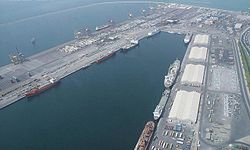
Mina Rashid (Arabic: ميناء راشد; mina'a rāšid), also referred to as Port Rashid, is a man-made cruise terminal in Dubai, United Arab Emirates. It was Dubai's first commercial port; in 2018 cargo operations moved to Jebel Ali Port. It is a seafront coastal destination, tourist cruise destination, and residential area.[2] It is the permanent home of Queen Elizabeth 2.

Key Information

History

[edit]

The port is named after Sheikh Rashid bin Saeed Al Maktoum and it was opened in 1972.[3][4] At the time the port only had two gantry cranes and a capacity of less than 100,000 TEUs.[4] In 1978, the port was expanded to include 35 berths (five of which were able to be used by the largest container ships at the time).[3] Later, the port [which has a depth of 13 metres (43 ft)] had 9 gantry cranes and a capacity of 1,500,000 TEUs.[4]

Mina Rashid provided berths for general cargo, RoRo and passenger vessels. In the early 1980s, Mina Rashid was supplemented by Port of Jebel Ali, which is further from the commercial centre of Dubai near the Abu Dhabi border.

Adjacent to the port are Dubai Drydocks and Dubai Maritime City. Both of these facilities were built due to Mina Rashid's proximity. But, in January 2008, it was announced that the port would be redeveloped.[5][6] All cargo operations will move to Jebel Ali Port by the end of March 2018.[5] Mina Rashid will turn into a cruise terminal.[5] Also, part of the port will be reclaimed by Nakheel Properties to create "a vibrant mixed-use urban waterfront" that will house 200,000 residents.[6]

In collaboration with DP world, top developer Emaar had announced an exclusive launch of a new project Sirdhana at Mina Rashid, which offers 1-3 Bedroom Apartments situated within a new maritime destination of Mina Rashid, Dubai.[7]

Queen Elizabeth 2

[edit]

Port Rashid is the current location of the former Cunard Ocean Liner Queen Elizabeth 2 (QE2) which arrived there on 26 November 2008 at the end of her final voyage for the company before being handed over to her new owners.[8] In March 2017, a Dubai-based construction company announced it had been contracted to refurbish the ship.[9] The restored QE2 opened as a floating hotel on 18 April 2018.[10]

References

[edit]
[edit]
Revisions and contributorsEdit on WikipediaRead on Wikipedia
from Grokipedia
Mina Rashid, also known as Port Rashid, is a man-made commercial seaport and cruise terminal in , .
Established in 1972 as Dubai's first modern port, it is named after Sheikh Rashid bin Saeed Al Maktoum, the former who played a key role in its development.
Operated by , the port primarily handles non-containerized cargo, including break-bulk and roll-on/roll-off (RoRo) shipments, while serving as a major hub for cruise passengers in the .
The port's creation positioned Dubai as a vital node in global trade, leveraging its location along traditional maritime routes to Iran, Iraq, Africa, and India.
In 1991, Mina Rashid merged with Port to form the Dubai Ports Authority, which later became part of , expanding its role in regional .
Over the decades, it has evolved from a general facility into a multifaceted terminal, supporting Dubai's growth as a logistics powerhouse.
Mina Rashid's facilities include the Hamdan bin Mohammed Cruise Terminal, the world's largest covered cruise facility, capable of handling 14,000 passengers per day and accommodating up to seven mega-cruise vessels or 25,000 passengers simultaneously.
Cargo operations feature 15 berths for general and RoRo with a 10.5-meter depth and 2,757 meters of quay length, plus five coastal berths at 5 meters depth for smaller vessels.
It has been recognized as the Middle East's Leading Cruise Port for eight consecutive years by the World Travel Awards and supports key exports like used vehicles.
Ongoing expansions at Mina Rashid include a new recreational area to showcase Dubai's and enhanced berthing for vessels up to 35 meters, solidifying its status as a premier waterfront destination.

Geography and Location

Site Description

Mina Rashid, also known as Port Rashid, is situated in the district of , , directly along the Arabian Gulf coastline and immediately adjacent to the southern shores of . This strategic positioning places it at the interface between the historic creek waterway and the open Gulf waters, spanning an expansive area of over 2 million square meters that encompasses harbor facilities, berths, and supporting infrastructure. The port's layout centers around a man-made harbor basin designed for sheltered maritime operations, featuring multiple berthing zones tailored to different vessel types. Key elements include 15 dedicated berths for general cargo and roll-on/ (RoRo) vessels, providing a total quay length of 2,757 meters, alongside five coastal berths extending 900 meters for smaller craft and passenger services. This configuration is in close proximity to prominent urban landmarks, such as the approximately 2 kilometers inland and the Historic District at the creek's mouth, integrating the site into Dubai's evolving coastal urban fabric. Environmentally, Mina Rashid benefits from its coastal orientation, which ensures efficient access to Gulf shipping lanes, with the harbor entrance measuring 190 meters wide and maintaining minimum depths of 13 meters along approach channels. Water depths within the basin vary from 10 to 13 meters in primary areas, accommodating large vessels while a shallower of 6 to 10 meters borders certain sections, contributing to the port's role in supporting Dubai's longstanding maritime trade heritage.

Accessibility and Connectivity

Mina Rashid benefits from excellent road connectivity through major arterial routes in , including direct access via Sheikh Rashid Road and Al Mina Road, which facilitate efficient movement for vehicles entering and exiting the port area. These roads link seamlessly to Sheikh Zayed Road, one of 's primary highways, allowing for broader regional access within approximately 25 minutes to central . The port's strategic positioning also places it about 10 kilometers from , enabling quick transfers for passengers and cargo via a short drive of around 12 minutes under normal traffic conditions. Public transportation options enhance accessibility for visitors and workers at Mina Rashid. The nearest Dubai Metro station is Al Ghubaiba on the Red Line, located approximately a 9-minute walk from the port, providing connections to key areas like and downtown districts. Complementing this, Dubai's Roads and Transport Authority (RTA) operates multiple bus routes serving the area, such as lines C1 from the airport, C3, and C5 from nearby stations like Al Ghubaiba Bus Station, with services running frequently from early morning until late night. Maritime connectivity positions Mina Rashid along established lanes, supporting its role in regional shipping networks for cruise, passenger, and specialized operations. As part of the portfolio, the port maintains strong links with nearby , where containerized operations were consolidated in 2018, enabling coordinated logistics across Dubai's dual-port system.

History

Construction and Early Development

The development of Mina Rashid, also known as Port Rashid, was initiated in 1970 under a by Sheikh Rashid bin Saeed Al Maktoum, the , who envisioned a modern deep-water port to bolster the emirate's trade infrastructure. To manage and operate the facility, Gray Mackenzie & Company was tasked with establishing Dubai Port Services, a dedicated entity responsible for commercial oversight and initial operations. This move aligned with 's rapid economic expansion, leveraging revenues from offshore oil discoveries to fund ambitious infrastructure projects. Construction milestones commenced with extensive operations to create a navigable deep-water channel, enabling access for larger vessels that could not previously enter . Dredged materials were repurposed to reclaim land and construct berths, starting with an initial plan for four berths that was swiftly expanded to fifteen due to surging trade demands. Engineering firm Sir William Halcrow & Partners oversaw the design, focusing on robust facilities for handling while prioritizing cost efficiency by eliminating non-essential features like a passenger terminal. These efforts transformed a coastal site near Shindagha into a functional capable of supporting Dubai's growing maritime needs. Mina Rashid was formally opened on October 5, 1972, by Sheikh Rashid, who unveiled a embedded in a large rock to symbolize his personal commitment to the project. From its inception, the port emphasized break-bulk and non-containerized cargo operations, handling general goods such as raw materials and consumer products to fuel Dubai's trade surge during the era. This focus positioned Mina Rashid as a vital gateway for regional , processing shipments primarily for re-export and local distribution without reliance on in its early years.

Operational Shifts and Modernization

In 1991, Mina Rashid merged with Jebel Ali Port to form the Dubai Ports Authority, which later became DP World in 2005, expanding its role in regional logistics. In the late 2000s, Mina Rashid underwent a significant operational pivot as Dubai Ports Authority (now DP World) announced the relocation of container handling activities to Jebel Ali Port to optimize logistics efficiency and capitalize on the larger facility's capacity. This shift, initiated in 2008, progressively reduced Mina Rashid's role as a primary cargo hub, with container terminal operations fully transferred by 2008, allowing the port to redirect resources toward passenger and specialized services. A further consolidation of general operations to Port was planned for 2018, marking a transition to greater focus on roll-on/ (Ro-Ro) vessels and cruise passenger services under DP World's management. However, as of 2025, general handling continues at Mina Rashid alongside these specialized operations. This evolution enabled the port to streamline its infrastructure for high-value, tourism-oriented maritime traffic, including Ro-Ro for vehicles and non-containerized goods, while reducing emphasis on handling. Modernization efforts at Mina Rashid have centered on enhancing facilities to accommodate larger cruise vessels and aligning the with Dubai's broader strategy. In 2011, expanded the cruise terminal to berth up to five ships simultaneously by the end of 2012, improving passenger throughput and amenities. This was followed by the 2014 inauguration of the Hamdan bin Mohammed Cruise Terminal 3, an ultra-modern facility spanning 28,000 square meters designed to handle mega-cruise ships and position as a premier regional cruise destination, with investments aimed at boosting tourist arrivals and economic diversification.

Facilities and Infrastructure

Terminals and Berths

Mina Rashid is equipped with two primary cruise terminals to support its role as a major hub for passenger vessels. The , recognized as the world's largest single-covered cruise facility, is designed for larger ships and has a daily passenger processing capacity of 14,000. The adjacent Terminal 2 serves smaller vessels. These terminals collectively offer seven dedicated berths for cruise ships. The port's broader berthing includes five coastal berths with a 900-meter quay length and depths of 5 meters, suitable for lighter maritime traffic. For and roll-on/roll-off (Ro-Ro) operations, there are 15 specialized berths (numbered 11-25) totaling 2,757 meters in quay length, with depths reaching 10.5 meters to handle ships up to that draft. Overall, the port's quays exceed 3.6 kilometers, enabling the simultaneous berthing of seven mega-cruise vessels or up to 25,000 passengers. Specialized facilities extend to yacht operations through the Mina Rashid , which provides approximately 430 berths for vessels up to 100 meters in length. All berthing areas, including cruise, cargo, Ro-Ro, and facilities, are managed by .

Supporting Amenities

Mina Rashid features the Dubai Yacht Club, a key facility catering to luxury enthusiasts by offering exclusive access to berthing alongside high-end services, including 24-hour assistance and proximity to waterfront leisure options. The yacht club's integration with the broader marina infrastructure supports seamless operations for owners, fostering a vibrant community for activities within the port's . Complementing the maritime focus, Mina Rashid includes extensive warehousing facilities designed for efficient cargo storage and handling, facilitating logistics support by enabling quick loading, unloading, and inventory management for diverse shipments. Adjacent repair yards, primarily through nearby Maritime City, provide essential maintenance services such as ship lifts, workshops, and refit capabilities for vessels up to 130 meters, ensuring operational reliability for port users. Administrative buildings within the port complex house operational offices, coordinating , protocols, and to streamline daily activities. To improve passenger experience, Mina Rashid integrates dedicated lounges, areas, and retail spaces directly into its terminals. Spacious passenger lounges offer comfortable waiting areas with amenities like free and seating for up to 14,000 daily visitors, promoting a welcoming environment during and disembarkation. On-site and zones ensure efficient processing with streamlined procedures, minimizing delays for travelers and arrivals alike. Retail spaces within the terminals provide premium shopping options, including duty-free outlets and dining venues, enhancing convenience and contributing to the port's role as a multifunctional hub. Ongoing expansions include enhanced yacht berthing for vessels up to 35 meters and a new recreational area to showcase 's cultural heritage, as of 2025.

Operations

Cruise and Passenger Services

Mina Rashid serves as a primary gateway for cruise passengers in , handling significant volumes from leading international operators. In the 2022–23 season, 's cruise ports including Mina Rashid managed over 900,000 passengers, including those from major lines such as Royal Caribbean and , which frequently schedule calls during their regional itineraries. The port's Hamdan bin Mohammed Cruise Terminal provides comprehensive passenger services to ensure efficient processing and enhanced experiences. These include streamlined and customs procedures, managed in coordination with Dubai authorities, allowing for rapid clearance even during high-volume arrivals. Baggage handling is similarly efficient, with Dubai Customs processing millions of bags each season to support seamless transfers. Additionally, the terminal coordinates shore excursions through partnerships with local tour operators, offering passengers access to 's attractions such as desert safaris, cultural tours, and city explorations. Activity peaks during the winter cruise season from to , when milder weather attracts a surge in vessel calls and passenger numbers, solidifying Mina Rashid's position as the Middle East's leading cruise hub. This period sees up to 150 port calls in a single season, with the terminal's capacity for 25,000 passengers simultaneously enabling it to accommodate multiple mega-ships at once. The infrastructure, including the world's largest covered cruise terminal, briefly referenced here for context, supports this role by facilitating quick and disembarkation. Mina Rashid has earned recognition as the Middle East's Leading Cruise Port for eight consecutive years and the World's Leading Cruise Port in 2024 at the World Travel Awards.

Cargo and Specialized Handling

Following the relocation of most containerized operations to Port in , Mina Rashid has concentrated on limited non-containerized freight, including project and break-bulk shipments targeted at traditional trading partners like , , , and . These operations leverage the port's historical role as Dubai's primary cargo hub prior to the shift, now emphasizing specialized handling over high-volume throughput. The port's general infrastructure includes 15 berths for break-bulk and , with a water depth of 10.5 meters and a combined quay length of 2,757 meters, enabling efficient processing of oversized or irregularly shaped goods. Adjacent Ro-Ro facilities support the and of and , featuring dedicated ramps and berths that connect directly to Dubai's prominent second-hand automotive markets for streamlined logistics. Mina Rashid also facilitates offshore industries through integrated support services at its Drydocks World , where vessel repairs, conversions, and supply operations occur, including pre-rigging of offshore chains and hybrid battery retrofits for marine craft serving oil and gas platforms. These capabilities underscore the port's role in sustaining regional maritime supply chains beyond passenger traffic.

Significance and Developments

Economic and Tourist Role

Mina Rashid plays a pivotal role in Dubai's by facilitating cruise and operations, contributing to the emirate's diversification away from dependency toward and sectors. As the Middle East's leading cruise , it supports the UAE's cruise market, which generated approximately USD 325 million (AED 1.2 billion) in revenue in 2024 through passenger spending, onboard services, and related activities. This influx bolsters local businesses, including , retail, and transportation, while generating thousands of direct and indirect jobs in operations, services, and supply chains across . In the first 11 months of 2024, Mina Rashid and nearby Harbour combined recorded 281,775 cruise guests and handled over 1.23 million bags. This volume underscores its significance in 's broader economic strategy, where now accounts for a substantial portion of GDP, reducing reliance on hydrocarbons and fostering sustainable growth through maritime trade routes connecting to regions like , , and the Gulf. The 2025-2026 cruise season is projected to feature over 300 sailings from , further enhancing its role in regional . Strategically located in , Mina Rashid integrates seamlessly with iconic nearby attractions such as the Gold Souk, enabling cruise visitors to explore Dubai's historic trading heritage via short rides or walks along the creek, enhancing the overall tourist experience. This connectivity aligns with Dubai's maritime tourism strategy, which emphasizes world-class to position the as a global hub for leisure voyages, as evidenced by expansions like enhanced berthing and recreational zones that blend cultural preservation with modern amenities. The presence of the iconic hotel further amplifies its appeal as a unique draw for luxury travelers.

Queen Elizabeth 2 and Cultural Attractions

The (QE2), a renowned built in 1967, arrived at Mina Rashid in on November 26, 2008, marking the end of its 40-year career with after departing on its final voyage. Acquired by the arm of , the vessel was retired from active transatlantic service and permanently docked at the port to preserve its legacy as a floating heritage site. Following extensive renovations, QE2 was converted into a luxury floating hotel, with a soft opening on April 18, 2018, and now operates under Accor's MGallery brand, featuring 13 decks and 447 rooms and suites. QE2 serves as a vital repository of at Mina Rashid, with much of its original interior preserved, including historic rooms, artifacts such as and memorabilia from its voyages, and curated exhibits that highlight British and ocean travel heritage. Guided heritage tours allow visitors to explore these elements, offering digital narratives and stories from former crew and passengers to evoke the ship's golden era. The onboard Travellers Cove museum further emphasizes this preservation, displaying items like portraits and coats of arms tied to the vessel's royal namesake and illustrious past. The ship hosts a variety of cultural and social events that celebrate its maritime roots, including live musical performances in preserved original spaces, heritage presentations, film screenings of documentaries about its history, and themed gatherings such as weddings and corporate functions. These activities draw on the QE2's 50-year legacy to foster appreciation for global seafaring traditions, with venues like the Lido Restaurant and events center accommodating diverse programs. Beyond QE2, Mina Rashid offers additional cultural attractions that enhance its appeal as a blend of and modernity, such as guided port tours via or cruises that showcase the waterfront and cruise operations. Nearby, the in the Al Fahidi Historic District provides exhibits on regional pearling, fishing, and trade heritage, complementing the port's nautical theme. The Emaar-developed Mina Rashid integrates luxury apartments and marinas around the historic port, creating a waterfront that merges preserved maritime elements with contemporary amenities like promenades and facilities.

References

Add your contribution
Related Hubs
User Avatar
No comments yet.