Hubbry Logo
MinibikeMinibikeMain
Open search
Minibike
Community hub
Minibike
logo
8 pages, 0 posts
0 subscribers
Be the first to start a discussion here.
Minibike
Minibike
from Wikipedia
1997 Suzuki PV 50, Finland

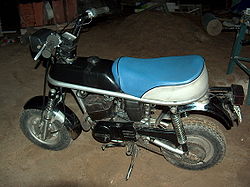
A minibike is a two-wheeled, motorized, off-highway recreational vehicle popularized in the 1960s and 1970s, but available continuously from a wide variety of manufacturers since 1959. Their off-highway nature and (in many countries) typically entirely off-road legal status differentiate minibikes from motorcycles and mopeds, and their miniature size differentiates them from dirt bikes.

Traditionally, minibikes have a four-stroke, horizontal crankshaft engine, single- or two-speed centrifugal clutch transmissions with chain final-drive, 100 or 150 mm (4 or 6 in) wheels and a low frame/seat height with elevated handlebars.[1] Commercially available minibikes are usually equipped with small engines commonly found elsewhere on utilitarian equipment such as garden tillers.

History

[edit]
A teen on a minibike in Thailand

While the minibike had precursors in machines such as the Doodle Bug and Cushman Scooters, which share smaller wheels, tubular-steel frames, and air-cooled, single-cylinder engines, those vehicles had larger seat heights and lighting that allow them to be registered for road use as scooters. In the 1950s, minibikes were hand-made by enthusiasts. These were first popularly used as pit bikes, for drag racers to travel in the staging-areas during races. One of these "Pit bikes" was received by brothers Ray, Larry and Regis Michrina in early 1959 from local car dealer and racer Troy Ruttman.[2]

1961 Honda 50 minibike, Honda Collection Hall transport museum, photographed in 2010

The Michrina Brothers would create the first commercial minibikes by drawing inspiration from this Pit Bike, delivering 3 prototypes to Troy Ruttman to sell through his dealership. The Michrina brothers are credited with creating the minibike but failed to patent the design or trademark the term when founding their Lil Indian brand in 1959.[3][full citation needed] Lil Indian would go on to manufacture tens-of-thousands of minibikes in their 40+ years. From the mid-1960s into the 1970s, the popularity of said machines would see over a hundred manufacturers attempt to market machines, an inexpensive venture due to the absence of patents. So popular and simple was the design, June 1967 Popular Mechanics magazine included an article with plans.[4]

As the market for minibikes developed, a variety of cottage and major industries offered models, including Arctic Cat, Rupp, Taco, Heath, Gilson, and Fox. Traditional motorcycle manufacturers also released models inspired by aspects of minibikes, most famously Honda with the Z50A,[5] though this style was nicknamed a Monkey Bike due to its monkey-like riding position.[6] Sales peaked in 1973, with 140,000 units between manufacturers.[7] By 1976 the bubble had burst and fewer than ten manufacturers continued to make minibikes. Popularity declined steadily, but leveled off in the early 1990s. Currently,[when?] machines can still be found at various retailers for less than $800.[8][full citation needed]

The wide availability of cheap, generic components manufactured in China has given rise to the popularity of home-assembled minibikes. These bikes typically have simple, boxy tube frames, small wheels, and are often built with some parts repurposed from Go-Karts, dirt bikes, or gas-powered tools. Bikes built this way can range from underpowered machines running on lawnmower motors up to extremely powerful ones capable of speeds up to 100 miles per hour. Despite not being road legal, recreational riding of these bikes, especially in large groups, has become popular in many cities in Southern California.[9]

Recently [when?] there has been a trend of adult sized electric minibikes.[10]

[edit]

In some jurisdictions, it is not legal to operate minibikes in certain places or without regulatory-specified special equipment.

Canada

[edit]

Minibikes can be classified as a competition vehicle if it is imported to Canada or restricted-use motorcycle that must have a Vehicle Identification Number.[11] Models for younger children are marked as ride on toys for they do not meet Transportation in Canada safety requirements. When caught ride a minibike on public roads you will be charged under the Highway Traffic Act (HTA) and the Compulsory Automobile Insurance Act (CAIA).[12]

UK

[edit]

It is not legal for Minibikes to be used on public roads or land unless it has passed a vehicle inspection (MOT) and subsequently been registered for road use. Further, it is not legal to use Minibikes on a property in proximity to a population if cited for noise pollution.[13][full citation needed]

US

[edit]

Whilst laws vary by state, Minibikes became unlawful for use on public through-ways[when?] due to lack of safety equipment, lights, and their diminutive size causing visibility issues.[14][full citation needed] In 1977, the CPSC was unsuccessfully lobbied[by whom?] to add federal regulation to Minibikes. By 1979 in the US, Minibikes could not be operated on public roads, they could still operate in areas legal for use of other recreational vehicles, provided they had a specified set of proper equipment utilized at the time of sale, most notably a spark arrestor for the exhaust.[15] In many US states mini bikes can be made street legal.[citation needed]

See also

[edit]

References

[edit]
[edit]
Revisions and contributorsEdit on WikipediaRead on Wikipedia
from Grokipedia
A minibike is a small, one-passenger, two-wheeled motorized with a low frame and raised handlebars, designed primarily for off-highway recreational use. These vehicles typically feature wheels and tires with a total of less than 14 inches, an rated at under 3 horsepower (or less than 2,238 watts), and a simple tubular suited for rough . Often powered by small two-stroke or four-stroke engines originally derived from lawnmowers, minibikes emphasize lightweight agility over speed or distance, with wheelbases around 35 to 40 inches and minimal suspension. Minibikes emerged in the mid-20th century as homemade projects , where enthusiasts mounted surplus lawnmower engines on basic frames for informal off-road fun. The concept gained widespread popularity during the and , a period known as the "minibike craze," when dozens of American manufacturers and major retailers like and J.C. Penney produced and sold over 2 million units, fostering a generation of young riders and enthusiasts. Japanese companies, including , entered the market in the late with models like the Z50 Mini-Trail, introducing refined features such as automatic clutches and overhead-cam engines while adapting the design for global appeal. This era's boom was driven by affordable pricing—often under $200—and their role in backyard adventures, though safety concerns led to regulatory scrutiny by bodies like the U.S. Consumer Product Safety Commission. Today, minibikes remain a staple in youth motorsports and hobbyist circles, with modern iterations available from manufacturers focusing on durability and emissions compliance, though they are generally prohibited on public roads without modifications and registration. Legal definitions vary by , but they are consistently treated as s not subject to standard licensing in many U.S. states. Their enduring legacy includes inspiring pit bikes for and contributing to the broader culture, while vintage models command high collector values due to their nostalgic appeal.

Definition and Characteristics

Definition

A minibike is a small, two-wheeled, motorized designed primarily as an off-highway recreational option for off-road use, typically accommodating one with a low frame and raised handlebars for enhanced control. It features compact dimensions, including wheel diameters ranging from 8 to 12 inches (203 to 305 mm), a low seat height of about 24 to 30 inches (610 to 762 mm) to promote for riders of various ages, and elevated handlebars positioned for stable handling on uneven . Minibikes are distinguished from full-sized motorcycles by their smaller scale and absence of on-road features like lighting and licensing compliance, prioritizing recreational fun over street travel. In contrast to mopeds, which rely on pedal assistance and restricted engine power (often under 50cc) for low-speed urban mobility, minibikes use fully motorized setups without pedals and focus on off-road agility. Unlike full-sized dirt bikes, which offer greater overall dimensions, higher power outputs, and superior speed capabilities for competitive trail riding, minibikes emphasize compact, approachable design for casual recreation. From their inception, minibikes have been engineered with a non-street-legal intent, centering on off-road enjoyment rather than public road utility. Originating in the as pit bikes for navigating areas, they quickly became standalone recreational vehicles.

Key Features

Minibikes are characterized by their lightweight construction, typically featuring a tubular that provides structural integrity while keeping overall weight low for enhanced maneuverability on off-road . This design incorporates minimal bodywork, such as exposed frames and basic fenders, to prioritize durability against rough conditions and reduce manufacturing complexity. The absence of extensive fairings or enclosures allows for easy maintenance and contributes to the vehicle's rugged, utilitarian aesthetic suited for recreational off-highway use. Control systems on minibikes emphasize simplicity and ease of operation, often including a that automatically engages based on engine speed, eliminating the need for manual shifting or complex gearing. Throttle controls are straightforward, usually via a twist-grip mechanism on the handlebars, paired with basic hand-operated brakes—typically or disc types—for intuitive stopping power without advanced . These features make minibikes accessible for riders, focusing on immediate responsiveness rather than high-performance tuning. Ergonomically, minibikes feature a low seat height ranging from approximately 20 to 30 inches, facilitating easy mounting and dismounting, particularly for younger or less experienced users. The upright riding position, with wide handlebars and a padded positioned close to the ground, promotes a natural posture that enhances control and comfort during short recreational rides on uneven surfaces. In terms of performance, entry-level minibikes generally produce 2 to 5 horsepower from small-displacement engines, delivering sufficient for playful and hill-climbing without emphasizing excessive speed. This modest power range underscores the vehicle's primary role in providing fun, low-stakes recreation rather than competitive racing capabilities.

History

Early Development

The early development of minibikes in the United States was heavily influenced by the post-World War II availability of surplus military engines and parts, which returning veterans repurposed for experiments. This era saw a surge in off-road hobbies, as enthusiasts sought affordable, lightweight machines for and informal racing, laying the groundwork for minibike innovation. By the 1950s, handmade minibikes emerged as popular pit bikes among supporters, crafted from garage-found surplus parts like old lawnmower engines mounted on basic tubular frames lacking suspension. These rudimentary builds provided agile transport around racetracks and off-road pits, emphasizing simplicity and portability over speed or comfort. The late 1950s marked a key transition from custom enthusiast builds to small-scale commercial production, driven by growing demand for accessible off-highway vehicles. In , brothers Ray, Larry, and Regis Michrina in introduced the first commercial minibike, the Lil' Indian, featuring a simple tubular frame and powered by a compact delivering 3 to 5 horsepower. This model shifted minibikes from ad-hoc creations to manufactured products, broadening their appeal beyond racing circles.

Boom and Decline

The minibike market experienced a significant surge in the , fueled by the era's and the vehicles' low-cost appeal, which made them accessible recreational options for and young adults. This period marked a shift from homemade prototypes to widespread commercialization, with over 100 small manufacturers entering the industry to capitalize on the growing demand for off-road fun. Companies like Rupp Industries, , and produced durable models featuring steel frames and reliable small engines, often sold through catalogs from retailers such as and J.C. Penney. By the early 1970s, minibikes reached their peak popularity, with annual sales hitting approximately 140,000 units in 1973. Dominant brands including , Yamaha, and Coleman led the market, offering refined models like the Z50 and Coleman's CT series that combined portability with performance. The boom was propelled by aggressive marketing portraying minibikes as affordable, exhilarating vehicles for backyard adventures and family outings, alongside the popularity of home-assembly kits from suppliers like , which allowed enthusiasts to build their own using simple instructions and lawnmower engines. These kits, available since the early , democratized ownership and tapped into the DIY spirit of the time. The industry's rapid expansion abruptly reversed in 1976, as sales plummeted amid stricter safety regulations, the economic of the mid-, and intensifying competition from larger, more versatile dirt bikes. These factors increased production costs and liability concerns for manufacturers, leading to a sharp market contraction—units sold fell to around 50,000 by 1977. By the late , fewer than 10 manufacturers remained active, signaling the end of the minibike craze as consumer interest shifted toward bigger off-road machines.

Contemporary Minibikes

Following the decline of mass-market production in the late due to regulatory pressures and shifting consumer preferences, the minibike market stabilized in the as niche manufacturers emphasized quality, performance, and customization over high-volume output. Established brands like and Yamaha continued to produce reliable models with enhanced engineering, such as improved suspension and durable frames suited for off-road use, fostering a growing enthusiast base. This period saw the rise of aftermarket parts for personalization, including engine upgrades and custom paint, which helped sustain the industry through targeted innovation rather than broad commercialization. From the 2000s into the 2020s, the minibike sector experienced a revival driven by the popularity of home-assembled kits, which utilized affordable Chinese-sourced components to enable widespread customization among hobbyists. Importers like Lexmoto began bringing in Chinese motorcycles, including minibike-style frames and engines, starting around 2009, making assembly accessible and cost-effective for DIY builders. Companies such as Azusa and OMB Warehouse offered complete kits—excluding engines and clutches—that required no welding or special tools, appealing to a nostalgic resurgence of retro-inspired designs and allowing users to tailor bikes for recreational or light off-road purposes. This trend democratized minibike building, with Chinese parts providing economical options like frames, forks, and wheels, boosting market participation without the need for professional manufacturing. The marked the emergence of adult-sized electric minibikes, which gained traction for their quiet operation and , offering zero-emission alternatives to gas-powered models. These full-sized frames, often with 20-inch wheels and fat tires, evolved from low-power European designs to U.S.-legal 750W systems, accelerated by innovations like the 2015 Bafang BBS02 mid-drive kit for smoother, efficient performance. Models such as the Luna Cycles Banana emphasized urban and off-road versatility with large batteries (e.g., 52V packs) for extended range, attracting adults seeking low-noise, eco-friendly mobility without the of internal engines. As of 2025, the minibike market is dominated by online sales through platforms, where consumers benefit from extensive selections, customer reviews, and direct home delivery, often with added warranties and support. Sites like GoKartMasters.com exemplify this shift, offering models from brands like Trailmaster and MegaMoto with prices ranging from $500 for entry-level kits to over $3,000 for premium variants, streamlining purchases compared to traditional dealerships. Growing interest in sustainable options, particularly electric minibikes with ranges up to 124 miles and smart features like app integration, reflects broader environmental priorities, further integrating these vehicles into urban and recreational lifestyles via platforms emphasizing eco-conscious designs.

Design and Components

Frame and Chassis

The frame of a minibike serves as its structural backbone, typically employing a tubular construction that balances lightweight design with sufficient strength to support the rider and withstand dynamic loads during operation. This configuration often adopts a duplex cradle or layout, where the main tubes form a cradle around the central components, providing rigidity while keeping the overall weight low for enhanced maneuverability. Chassis geometry in minibikes emphasizes agility and stability, featuring a short wheelbase measuring approximately 36 to 45 inches, which allows for quick turns and responsive handling on varied terrain. A low center of gravity, facilitated by the compact layout and overall low seat height of around 24 inches, helps prevent tipping during sharp maneuvers or uneven rides. Early minibike frames relied predominantly on steel for its affordability and robustness, but modern high-performance models have evolved to incorporate aluminum alloys, which are lighter than steel while maintaining comparable strength through advanced alloy formulations. This material shift enhances acceleration and fuel efficiency in competitive applications without compromising the frame's integrity. To ensure durability against off-road impacts and vibrations, minibike frames incorporate reinforced welds at critical junctions and triangular gussets—small metal plates welded at tube intersections—to distribute stress and prevent cracking or deformation over time. These features, often made from the same high-tensile as the primary , extend the frame's lifespan under repeated abuse.

Engine and Transmission

Minibikes feature single-cylinder engines, either two-stroke or four-stroke, with displacements ranging from 50 to 200 cc, designed for lightweight propulsion and simplicity in off-road and recreational use. Modern models predominantly use four-stroke engines, while two-strokes are common in older or high-performance variants. These engines are typically air-cooled to minimize complexity and weight, relying on fins on the and barrel for heat dissipation without the need for liquid cooling systems. The overhead (OHV) configuration in many models enhances efficiency and power output relative to pushrod designs, producing a general horsepower range of 2 to 8 hp that suits the vehicle's compact frame. The in minibikes employs a paired with a single-speed drive, eliminating the need for manual shifting or a multi-gear gearbox to keep operation straightforward for novice riders. This engages progressively as RPM increases, transferring power smoothly from the to the drive system without rider input. Power is then delivered to the rear wheel via a or belt drive, with systems being more common for their durability in rugged terrain, while belts offer quieter operation in milder conditions. Power delivery emphasizes response optimized for low-end , enabling quick from a standstill on uneven surfaces typical of minibike riding. This tuning, achieved through jetting and cam profiles, prioritizes immediate power over high-revving performance, resulting in maximum speeds of 20 to 40 mph depending on engine size and gearing. Maintenance for these engines benefits from an exposed design that provides easy access to key components, facilitating routine tasks like oil changes and replacements without disassembly. changes involve draining via a bottom plug and refilling through an accessible filler port, typically requiring 0.6 to 0.8 quarts of SAE 10W-30 oil every 20-50 hours of use. , often located on the side of the , can be removed with basic tools for inspection or replacement after 100 hours, promoting longevity through simple upkeep.

Suspension and Wheels

Minibikes typically feature basic suspension systems designed for cost-effectiveness and simplicity, prioritizing lightweight construction over advanced . The front suspension often consists of hydraulic telescopic forks providing limited of approximately 2 to 4 inches to absorb minor impacts from uneven . Rear suspension is commonly a single with a coil-over , offering similar short to maintain stability while keeping overall weight low. These setups are minimal compared to full-size motorcycles, focusing on basic shock absorption rather than progressive , which suits recreational off-road use but may transmit more vibrations to the rider on rough paths. Wheel designs on minibikes emphasize and grip for off-road conditions, with rim diameters typically ranging from 10 to 12 inches to balance maneuverability and obstacle clearance. Tires are usually knobby all-terrain patterns, such as 19x7-8 sizes, which provide enhanced traction on , , and grass without excessive . Spoked rims are prevalent for their ability to withstand impacts and flex slightly under stress, contributing to the bike's ruggedness, though some models use solid for added . The short enhances agility when paired with these compact wheels, allowing quick direction changes on trails. Braking systems are straightforward and mechanically simple, with rear drum brakes standard on many entry-level models for reliable at low to moderate speeds. Disc brakes, either mechanical or hydraulic, are increasingly common on the rear and occasionally the front, offering better modulation and heat dissipation than drums, though standard minibikes lack anti-lock braking systems (ABS). To adapt to rough , minibikes incorporate high ground clearance of 4 to 6 inches, enabling navigation over roots, rocks, and ruts without frequent undercarriage contact. For instance, models like the MINIBIKE 200 achieve up to 8 inches of clearance with all-terrain tires, optimizing performance on uneven paths.

Types and Variants

Gas-Powered Minibikes

Gas-powered minibikes represent the traditional variant of these compact off-road vehicles, relying on internal combustion engines for propulsion. These models typically feature small-displacement engines that provide accessible performance for recreational use on or designated trails. During the historical boom in the , gas-powered designs dominated the market due to their simplicity and affordability. Core specifications for gas-powered minibikes center on 50-110cc four-stroke engines, which offer reliable, low-maintenance operation compared to two-stroke alternatives. These air-cooled, single-cylinder engines are equipped with carbureted fuel systems for efficient air-fuel mixing and delivery. Exhaust systems commonly include spark arrestors, mesh screens designed to capture hot particles and prevent wildfires in off-road environments. In the current market, brands such as and TrailMaster import affordable gas-powered minibikes, with models like the Massimo MB100 (79cc, priced at $599) and similar 50-110cc variants typically ranging from $500 to $1,500. These imports cater to beginners and families, emphasizing ease of assembly and basic durability for casual riding. Performance characteristics suit short bursts of rather than sustained high speeds, with top velocities around 15-25 mph depending on the size. consumption is highly efficient, often achieving 50-100 , allowing extended rides on small tanks of 0.3-1 capacity. Newer models produced post-2010 comply with U.S. Environmental Protection Agency (EPA) emissions standards for nonroad spark-ignition engines, including limits on hydrocarbons, , and nitrogen oxides to reduce from small off-road equipment. These regulations, finalized in 2008 and effective through 2010, ensure that exhaust and evaporative emissions meet federal thresholds for engines under 19 kW.

Electric Minibikes

Electric minibikes represent a battery-powered variant of traditional minibikes, utilizing systems for off-road and recreational use. These vehicles typically feature brushless DC motors with power outputs ranging from 500 to , providing efficient delivery without the need for complex transmissions. The power source consists of removable lithium-ion batteries, often in 48V to 60V configurations with capacities around 17-23 Ah, enabling a riding range of 20 to 40 miles per charge depending on terrain, rider weight, and speed. Charging these batteries generally requires 2 to 8 hours using standard household outlets, with faster times achieved via higher-wattage chargers or advanced battery chemistries; for instance, some models reach 80% capacity in under 45 minutes. Runtime varies by mode, but top speeds commonly hit 20 to 30 mph in sport settings, with lower eco modes capping at 15-20 mph for extended range and safety. This performance suits casual and , aligning with broader contemporary trends in vehicle electrification. Key advantages of electric minibikes include zero tailpipe emissions, contributing to reduced environmental impact during operation. They operate quietly compared to gas counterparts, minimizing in residential or trail areas. Maintenance is notably lower, as there are no oil changes, fuel systems, or carburetors to service—primarily involving checks, adjustments, and occasional battery replacements. The market for electric minibikes has seen significant growth since the , driven by advancements in battery technology and rising demand for eco-friendly personal mobility. Valued at approximately $1.2 billion globally in 2024, the sector is projected to reach $3.8 billion by 2033, reflecting a exceeding 13%. Prominent brands include , known for models like the MX650 with 650W motors and 10-mile ranges; , offering urban-oriented options such as the CU Mini with 25 km/h speeds; and others like Burromax and EGO Power+, which emphasize rugged, off-road capabilities appealing to urban commuters and environmentally conscious riders.

Other Variants

Pit bikes represent a specialized variant of minibikes tailored for trackside utility in motorsports, particularly . These lightweight machines, often weighing under 100 pounds, were originally developed in the 1950s to allow mechanics and riders to navigate crowded pit areas efficiently without the bulk of full-sized dirt bikes. Unlike standard minibikes, pit bikes feature upgraded suspension systems, such as hydraulic forks and adjustable shocks, to handle uneven terrain during quick transport of tools or parts around racing venues. Their compact frames, typically with 12- to 14-inch wheels, enable agile maneuvering in confined spaces, making them essential for professional pit crews. Pocket bikes, another distinct minibike adaptation, are ultra-compact vehicles designed for high-speed fun in limited areas like backyards or closed courses. Measuring about one-quarter the size of conventional , these bikes usually displace 50cc or less with two-stroke engines that deliver rapid acceleration up to 30-40 mph despite their diminutive stature. They often incorporate replica aesthetics mimicking full-scale sport bikes, including fairings, angular bodywork, and vibrant racing graphics to appeal to enthusiasts seeking a scaled-down thrill. This design prioritizes tight-space performance, with low-slung seats and minimal ground clearance suited for flat, controlled environments rather than rugged off-road use. Custom enable extensive modifications to standard minibikes, allowing owners to swap for enhanced capabilities. Aftermarket frames and mounting facilitate integration of larger displacements, such as replacing a 99cc four-stroke with a 212cc Predator for doubled horsepower and . Two-stroke conversions, using like the BBR Tuning Stage 4 66/80cc package, boost performance through higher revs and power output—often exceeding 5 horsepower—while requiring and exhaust upgrades for optimal tuning. These modifications, popular among home builders, emphasize reliability and customization without altering the core minibike . Niche applications of minibikes include folding designs for enhanced portability and emerging hybrid prototypes combining gas and electric power. Folding models, such as the Di Blasi R30, collapse in seconds to a compact 24 x 18 x 32-inch package weighing around 65 pounds, ideal for storage in vehicles or for pilots and travelers. These maintain minibike-like proportions with small wheels and engines up to 125cc, prioritizing ease of transport over extended range. Hybrid gas-electric prototypes, still in developmental stages, integrate small two-stroke engines with electric assist motors, as seen in experimental builds pairing 49cc gas units with hub motors for improved efficiency and in urban or short-haul scenarios. Such innovations aim to extend battery life through onboard gas generation, though commercial availability remains limited.

Usage

Recreational Riding

Recreational riding of minibikes centers on casual, leisurely enjoyment in non-competitive environments, often serving as an accessible entry point into motorized off-road activities for individuals of various ages. These compact vehicles, with their lightweight frames and simple controls, facilitate relaxed exploration and skill-building without the intensity of structured events. Their off-highway design intent supports safe, fun use on , aligning with their origins as backyard playthings. Common venues for recreational minibike riding include private trails, expansive backyards, and farms, where riders can traverse natural landscapes at low speeds and enjoy the freedom of open spaces. These settings emphasize informal leisure, such as family outings or solo adventures, allowing users to navigate gentle terrain like grassy fields or dirt paths without venturing onto public roads. Youth and families particularly favor these locations for supervised play, fostering bonding through shared rides and basic maintenance tasks. Riding techniques for recreational purposes prioritize foundational skills, starting with balance and control to build confidence among beginners. Riders maintain an upright posture with knees gripping the frame for stability, using smooth, incremental inputs to manage speed over minor obstacles like roots or inclines. Low-speed maneuvers, such as wide turns and controlled stops, help novices adapt to the bike's responsive handling, promoting gradual progression from flat areas to mildly uneven ground. Optional accessories enhance recreational experiences by extending usability without altering the core off-road nature of minibikes. Lights provide illumination for dusk rides on private land, while small carriers or racks allow transport of snacks or tools during longer sessions, supporting family-oriented outings. These additions focus on practicality for play, avoiding any road-legal modifications to preserve the vehicle's recreational intent. Minibikes embody a enduring cultural role as symbols of 1960s-1970s youth freedom, capturing the era's spirit of DIY adventure and neighborhood escapades with affordable, modifiable machines powered by everyday engines. During this boom, they represented accessible rebellion and exploration for teenagers, often featured in popular media and mail-order catalogs that fueled a nationwide craze. This heritage continues in modern hobbyist communities, where collectors and riders restore classics or build customs for casual gatherings, sustaining the legacy through online forums and local meetups.

Racing and Competitions

Minibike racing emerged in the as an extension of their use as pit bikes for drag racers, evolving into organized events on drag strips, tracks, and motocross-style circuits by the late decade. Early competitions were often informal, but structured races gained popularity in the 1970s, featuring short dirt tracks and obstacle courses tailored to the vehicles' compact size and agility. Governing bodies such as the (AMA) oversee many U.S. events, including pit bike classes at vintage motorcycle gatherings, while local organizations like the Mini-Bike & Kart Association (SCMBKA), formed in 1968, establish age-based divisions typically for riders aged 6-14 and engine sizes ranging from 50cc to 110cc. These groups enforce class divisions by to ensure fair competition, with events emphasizing safety inspections for operational readiness. Racing minibikes often undergo modifications like reinforced frames for impact resistance and larger off-road tires for improved traction on varied terrains, though rules limit alterations to maintain stock-like configurations and prioritize , such as mandatory fluid containment and secured components. In some series, adherence to protective measures like full-coverage helmets and contained fluids is required, without standard safety cages due to the vehicles' lightweight design. Notable historical milestones include the first national minibike championship held in the early 1970s at Saddleback Park in , organized by the SCMBKA, which drew young competitors nationwide and helped formalize the sport. In modern times, electric variants have inspired dedicated series, such as AMA-sanctioned eMoto classes in Southeastern U.S. events, promoting sustainable racing with battery-powered minibikes in pro and open divisions.

United States

In the , minibikes are classified as off-road vehicles rather than motor vehicles suitable for public road use, as they typically do not comply with the (FMVSS) set by the (NHTSA). This classification prohibits their operation on interstate highways and most public roads under federal guidelines, emphasizing their intended use on private property or designated off-road areas. On federal lands managed by agencies such as the U.S. Forest Service (USFS) and (BLM), minibikes must be equipped with USFS-approved spark arrestors to mitigate wildfire risks from exhaust sparks, as mandated by regulations under 36 CFR 261.52. State laws vary significantly, often treating minibikes similarly to all-terrain vehicles (ATVs) or off-highway vehicles (OHVs) while imposing restrictions on public use. In , helmets are mandatory for all riders under 18 years old when operating minibikes on any public roadway, bikeway, or trail, and operators must generally be at least 16 years old to hold a valid for any motorized two-wheeled vehicle, though minibikes remain illegal on streets unless modified to meet (DMV) safety requirements. In contrast, explicitly allows minibike operation on without requiring registration or a (VIN), but prohibits their use on public streets, sidewalks, or alleys under Transportation Code § 551.351, which defines pocket bikes and minimotorbikes as ineligible for road travel. Registration requirements for minibikes focus on off-road contexts, with no federal VIN mandate for non-highway use; however, many states classify them as OHVs for trail access, necessitating state-specific permits or . For instance, in , minibikes used on public trails require an OHV registration card and decals from Colorado Parks and Wildlife, or a non-resident permit for out-of-state operators, to ensure compliance with trail management rules. Similarly, demands an OHV decal for operation on state trust lands or trails, treating minibikes akin to ATVs without a VIN for basic private use but requiring documentation for public off-road areas. Enforcement of minibike laws prioritizes public safety, with fines imposed for illegal street riding that can range from $100 to $500 or more depending on the jurisdiction, often accompanied by . In the 2020s, urban areas have intensified crackdowns on unauthorized operations, particularly during "street takeovers" involving groups of riders; for example, , enacted ordinances in 2025 allowing immediate impoundment of illegal minibikes and dirt bikes during such events to curb reckless behavior. has similarly ramped up patrols and seizures since 2025 to address dangerous group rides on public streets, including a September 2025 operation that seized six dirt bikes and an ATV with four arrests.

Canada

In Canada, minibikes are classified as restricted-use motorcycles under the federal Motor Vehicle Safety Regulations (MVSR), which prohibit their operation on public highways as defined by the Highway Traffic Act, limiting them to off-road, competition, or private property use. These vehicles must possess a 17-character Vehicle Identification Number (VIN) to comply with federal standards for importation and registration, ensuring traceability and safety for non-road applications. Provincially, regulations vary but emphasize off-road restrictions; for instance, in Ontario, minibikes qualify as off-road vehicles (ORVs) under the Off-Road Vehicles Act, requiring a provincial permit for use on designated trails and Crown land, along with proof of insurance and adherence to age minimums of 12 for operation on public lands. In British Columbia, the Off-Road Vehicle Act mandates that operators under 16 years of age must be directly supervised by an adult aged 19 or older, with no authorization for unsupervised use of minibikes on Crown or prescribed private lands. Importation of minibikes into requires compliance with Canadian standards for emissions and noise, particularly for models manufactured after 2000, under the Off-road Emission Regulations, which set limits for hydrocarbons, , and nitrogen oxides in small engines up to 19 kW, aligned with U.S. EPA tiers. Noise emissions must also meet MVSR V.1 limits, such as not exceeding 83-94 dB(A) depending on the for motorcycles. Exceptions to these restrictions allow minibike use on private land with owner permission or in designated off-highway vehicle (OHV) areas, provided operators follow environmental compliance measures such as erosion control and noise mitigation to protect natural habitats. Minibikes, inherently designed for off-highway terrain, align with these designated zones to minimize public road risks.

United Kingdom

In the , minibikes are generally illegal to operate on public highways unless they are properly registered as , taxed if applicable, insured, and equipped with a valid Ministry of Transport (MOT) certificate for vehicles over three years old. These requirements align minibikes with standard regulations under the Road Traffic Act 1988, ensuring compliance with safety and emissions standards before road use. Failure to meet these criteria results in the vehicle being classified as unlicensed, prohibiting its operation on public roads or pavements. On private land, minibike use is permitted only with the explicit permission of the landowner, but it faces significant restrictions near populated areas due to controls established by the Environmental Protection Act 1990. This legislation empowers local authorities to investigate and abate statutory noise nuisances, including excessive engine sounds from off-road vehicles, which can lead to abatement notices or equipment seizures if complaints arise from nearby residents. In urban or semi-urban settings, such operations are often limited to avoid breaching these environmental protections, with additional planning permissions required for organized events exceeding 14 days annually under the Town and Country Planning Act 1990. Regarding age and licensing, riders must be at least 16 years old to operate a minibike, though no driving or Compulsory Basic Training (CBT) is required for purely off-road use on . However, any attempt to ride on public roads necessitates a provisional , completion of CBT, and adherence to or category rules, with younger riders facing stricter power restrictions under the graduated licensing system. Enforcement of these regulations has intensified in the 2020s, with police conducting frequent operations to seize minibikes involved in nuisance riding, particularly in urban areas where anti-social behavior disrupts communities. Such seizures, often under the Police, Crime, Sentencing and Courts Act 2022, allow for rapid impoundment and potential destruction of vehicles within 48 hours if unclaimed, targeting illegal road use and public disturbances. Offenders commonly face fixed penalty fines typically ranging from £100 to £1,000 for violations like unlicensed operation, with higher court-imposed fines possible for causing a public nuisance or other aggravated offenses, alongside possible criminal charges for related offenses such as dangerous driving.

International Variations

In , minibikes are classified as off-road vehicles and are prohibited from use on public roads unless they are registered and fitted with number plates, as unregistered operation on roads, footpaths, or public lands is illegal across states like . Riding in state forests and parks requires compliance with specific rules, including a valid , vehicle registration, and adherence to designated trails; permits are mandatory for organized group rides, events, or commercial use in areas such as Queensland's state forests. In the , minibikes must bear to comply with harmonized safety standards under directives like the (2006/42/EC), ensuring they meet requirements for design, construction, and risk assessment before sale or distribution. Countries such as restrict minibikes primarily to off-road use on private tracks or designated areas, banning them from public streets unless they qualify as approved mopeds with additional type approval, lighting, and speed limits under national road traffic laws. In , serves as a primary global exporter of minibikes and pocket bikes, often produced to meet international standards for while domestic regulations remain relatively permissive for non-road use, with limited on features for recreational or off-road models under general administration rules. Japan categorizes small minibikes under its light vehicle framework, similar to kei-class motorcycles limited to 50cc engines and 30 km/h speeds, requiring registration, , and a valid for road use while adhering to strict emissions and standards enforced by the Ministry of Land, Infrastructure, Transport and Tourism. Globally, as of 2025, there is a growing trend toward exemptions for low-speed electric minibikes in urban settings to promote sustainable mobility, such as in where vehicles under 25 km/h top speed and 250W motor power are exempt from licensing and registration requirements under the , facilitating pilot programs for electric bike taxis in states like .

Safety and Regulations

Common Risks

Minibikes, due to their compact design and off-road capabilities, present several inherent hazards during operation, leading to a notable incidence of injuries. According to data from the U.S. Consumer Product Safety Commission (CPSC), off-road motorcycles—including minibikes—have been associated with tens of thousands of emergency department-treated injuries annually. For example, an estimated 51,400 injuries occurred in 2018. Head and injuries have been predominant in off-highway vehicle cases, comprising approximately 34% of reported injuries for multi-wheeled OHVs in 2023. Common crash types stem from the vehicle's low stability, exacerbated by its small , which contributes to frequent ejections and collisions with obstacles. Riders often experience sudden loss of control, resulting in falls or impacts during turns or at speed. In the , U.S. data highlighted a high rate of pediatric injuries, with more than 5,000 cases in primarily involving children falling off minibikes, trail bikes, and similar small motor vehicles. Terrain-related dangers amplify these risks, particularly on uneven or off-road surfaces where minibikes are commonly used. Rolls and flips frequently occur due to the vehicle's frame and limited suspension, causing riders to lose balance on rough ground. mismanagement, often from inexperienced operators, can lead to unintended acceleration, heightening the chance of loss of control and subsequent crashes. Beyond immediate trauma, long-term health risks include from unmuffled engines, which can exceed 100 decibels and cause permanent damage with prolonged exposure—a concern documented as early as the in studies on minibike operation. Additionally, persistent from the and rough can contribute to rider , particularly hand and arm strain, potentially impairing control during extended rides.

Safety Equipment and Practices

Riders of minibikes are strongly recommended to wear DOT-approved helmets that meet Federal Motor Vehicle Safety Standard (FMVSS) No. 218 to protect against during falls or collisions. Full-face helmets provide additional , while such as or shields is essential to guard against , especially in off-road conditions. Gloves offer hand grip security and abrasion resistance, and sturdy boots with ankle support help prevent foot injuries from impacts or controls. For off-road riding, knee and elbow pads are advised to cushion joints against rough terrain and potential slides. To enhance vehicle safety, minibikes should be equipped with an emergency , which allows immediate engine cutoff to prevent loss of control in hazardous situations. Regular inspections of are crucial, ensuring , lines, and are in good condition to maintain , particularly before each use. Protective modifications like reinforced frames or guards can further reduce injury risk by shielding riders from mechanical components during tip-overs. Safe riding practices include adhering to group speed limits to avoid collisions and maintaining visibility among participants. riders require constant adult supervision during sessions to enforce rules and respond to incidents promptly. Minibikes should never be operated on public roads where they lack required licensing, and riders must avoid alcohol or drugs, which impair judgment and reaction times. Equipment should adhere to ANSI or EN certifications for durability and performance; for instance, helmets certified under ECE 22.05 meet European norms equivalent to DOT standards. In the , electric minibike batteries emphasize compliance with UL 2849 for fire and electrical hazard prevention, including guidelines to charge only with manufacturer-approved in cool, ventilated areas to mitigate risks.

References

Add your contribution
Related Hubs
User Avatar
No comments yet.