Hubbry Logo
Moina MichaelMoina MichaelMain
Open search
Moina Michael
Community hub
Moina Michael
logo
8 pages, 0 posts
0 subscribers
Be the first to start a discussion here.
Moina Michael
Moina Michael
from Wikipedia
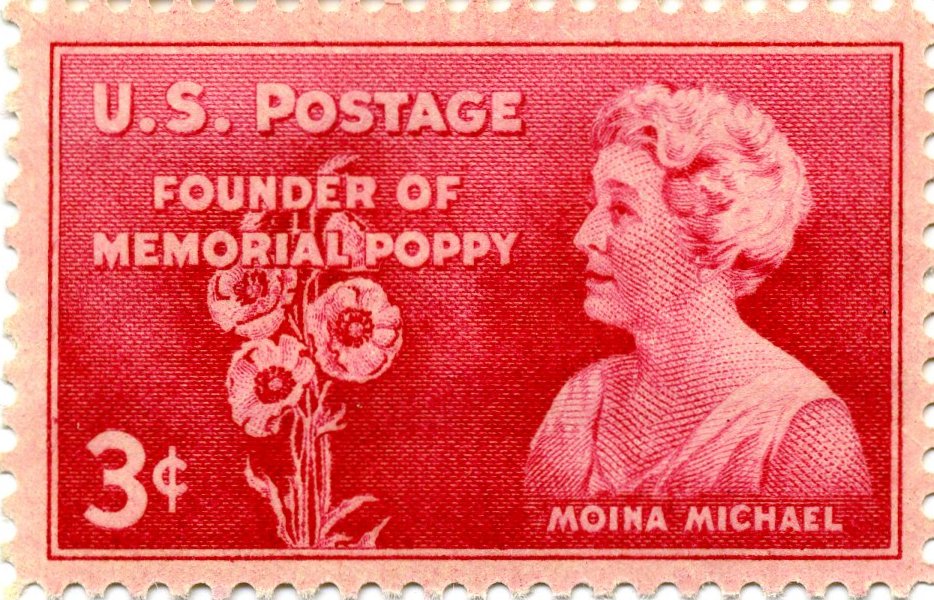
Moina Michael on a 1948 U.S. commemorative stamp
The Poppy Lady Georgia Historical Marker

Moina Belle Michael (August 15, 1869 – May 10, 1944) was an American professor and humanitarian who conceived the idea of using poppies as a symbol of remembrance for those who served in World War I.

Early life

[edit]

Michael was born in 1869 and lived on what is now known as 3698 Moina Michael Road in Good Hope, in Walton County, Georgia. She was the eldest daughter and second of the seven children of John Marion Michael, a Confederate veteran of the American Civil War, and Alice Sherwood Wise.[1] She was distantly related to General Francis Marion on her father's side, and the Wise family of Virginia state governors on her mother's side. Both sides of her family had Huguenot ancestry, with origins in Brittany and Flanders respectively. Her family was wealthy and owned a cotton plantation until 1898. She was educated at Braswell Academy in Morgan County, and the Martin Institute in Jefferson, Georgia.[2]

She became a teacher in 1885, initially in Good Hope and then in Monroe, Georgia. She taught at the Lucy Cobb Institute and State Normal School, both located in Athens, Georgia. She studied at Columbia University in New York City in 1912–13.

First World War

[edit]

Michael visited Europe in June and July 1914. She was in Germany when the First World War broke out in August 1914, and travelled to Rome to return home to the US. In Rome, she assisted around 12,000 US tourists to seek passage back across the Atlantic. She returned to the US on the RMS Carpathia and returned to teaching at Normal School in Athens, Georgia.

She was a professor at the University of Georgia when the U.S. entered World War I in April 1917. She took a leave of absence from her work and volunteered to assist in the New York-based training headquarters for overseas YWCA workers.[3]

Remembrance poppy

[edit]

On 9 November 1918, inspired by the Canadian John McCrae battlefront-theme poem "In Flanders Fields", she wrote a poem in response called "We Shall Keep the Faith".[3] In tribute to the opening lines of McCrae's poem – "In Flanders fields the poppies blow / Between the crosses row on row," – Michael vowed to always wear a red poppy as a symbol of remembrance for those who served in the war.[4]

After the war was over, Michael returned to the University of Georgia and taught a class of disabled servicemen. Realizing the need to provide financial and occupational support for these servicemen, she pursued the idea of selling silk poppies as a means of raising funds to assist disabled veterans. In 1921, her efforts resulted in the poppy being adopted as a symbol of remembrance for war veterans by the American Legion Auxiliary, and by Earl Haig's British Legion Appeal Fund (later the Royal British Legion) later that year.[4]

Later life

[edit]

Known as the "Poppy Lady" for her humanitarian efforts, Michael received numerous awards during her lifetime. She retired from the University of Georgia in 1934, and published an autobiography in 1941, The Miracle Flower: The Story of the Flanders Fields Memorial Poppy.

In 1944, a Liberty ship constructed in Georgia was named SS Moina Michael in her honor. In 1948, four years after her death, the U.S. Postal Service issued a commemorative 3-cent stamp honoring her life's achievement. In 1969, the Georgia General Assembly named a section of U.S. Highway 78 the Moina Michael Highway.[3] In 1999 she was named to the Georgia Women of Achievement Hall of Fame.[5] She was a member of the Daughters of the American Revolution and the United Daughters of the Confederacy.[citation needed] A statue of Moina Michael is located in front of the Court House in Monroe, GA. Moina Michael is buried in Rest Haven Cemetery, 200 North Madison Avenue in Monroe, GA.

See also

[edit]

References

[edit]
[edit]
Revisions and contributorsEdit on WikipediaRead on Wikipedia
from Grokipedia
Moina Belle Michael (August 15, 1869 – May 10, 1944) was an American educator, poet, and humanitarian best known for conceiving and promoting the red poppy flower as an international symbol of remembrance for soldiers killed in World War I. Born in Good Hope, Georgia, she dedicated much of her career to teaching and later to volunteer work supporting veterans, earning her the enduring nickname "The Poppy Lady." Michael's early life was marked by a commitment to education; she began teaching at age 15 in rural Georgia schools and advanced to administrative roles, including lady principal at Bessie Tift College from 1909 to 1912. After studying at Columbia University, she served as a YMCA volunteer in New York during the final months of World War I in 1918. Deeply moved by Lieutenant Colonel John McCrae's 1915 poem In Flanders Fields, which referenced the poppies growing amid the devastation of war graves, Michael penned her response poem, We Shall Keep the Faith, on November 9, 1918—the day before the Armistice. In it, she pledged to "keep the faith" with the fallen by always wearing a poppy, symbolizing ongoing tribute and support for the living disabled veterans. Her advocacy extended beyond symbolism; in 1918, Michael proposed using artificial poppies sold by volunteers to fund rehabilitation for wounded soldiers, launching the first poppy drive at a YMCA canteen in New York. By April 1919, she established the Flanders Fields Memorial Campaign, which gained traction when the American Legion adopted the poppy in 1920 and formalized it as a national program in 1924. These efforts evolved into a global tradition, with poppy sales by organizations like the American Legion Auxiliary raising billions (adjusted for inflation) for veterans' aid, including over $2.1 million from 3.5 million poppies sold in 2016 alone. In her later years, Michael returned to Georgia in 1919 to serve as social director at the State Normal School (now the ) in , where she retired in 1938 and published her autobiography, The Miracle Flower: The Story of the Flanders Fields Memorial Poppy, in 1941. Her legacy includes a bust at the , a named in her honor in 1944, and the designation of Georgia Highway 24 as the Moina Michael Highway in 1969; she was also commemorated on a U.S. in 1948. Michael's work not only honored the sacrifices of but also established a lasting mechanism for veteran support that continues worldwide on and .

Early Life and Education

Family and Childhood

Moina Belle Michael was born on August 15, 1869, in Good Hope, , to John Marion Michael, a local merchant, farmer, and Confederate veteran who had fought at the , and Alice Sherwood Wise, who came from a with deep in Georgia education dating back to the late . The traced its lineage to French Huguenots on the paternal side and had strong ties to Virginia's Wise of governors on the maternal side, though the Michaels had settled in Oglethorpe County by 1791 before moving to . As the eldest daughter and second of seven children—preceded by an older brother and followed by five younger siblings including Annie Laurie, Edwin Earl, Laney Cannon, Nelle Colquitt, and Alice May—Michael grew up on her father's amid the economic hardships of the post-Civil War . The , inherited through family lines, had been ravaged by , leading to widespread poverty in the rural South that shaped daily life with communal church gatherings at Baptist and Primitive Baptist meetinghouses and shared chores like curing meat in the family's original cherry , later repurposed as a smokehouse. Family dynamics emphasized self-reliance and , as Michael's supported her daughter's early teaching efforts with neighbors' children and younger siblings, while her father, despite financial strains, encouraged broad reading to cultivate intellectual growth. Michael's early exposure to , fostered by her mother's belief in women's education and her father's promotion of wide reading, sparked a lifelong interest in writing that would later influence her poetic response to . Her initial schooling occurred at the local Braswell Academy in neighboring Morgan County, where she attended for seven years, walking daily across the county line and demonstrating advanced abilities in reading and recitation from a young age. By age fifteen, these skills enabled her to begin teaching in a one-room schoolhouse in Good Hope, with two sisters and a brother among her first pupils.

Formal Education

Moina Michael received her early formal education at Braswell Academy in , where she studied for seven years, walking daily from her home in Good Hope. She continued her schooling at the Martin Institute in , attending from approximately 1882 to 1885, during which time she focused on general academic subjects that laid the foundation for her future career. At the age of sixteen, in June 1885, she left the Martin Institute and obtained a teaching certificate, qualifying her to begin instructing in local schools through Georgia's system. After several years of teaching in rural Georgia schools, Michael advanced her education by attending the Lucy Cobb Institute and the State Normal School in —a teaching college affiliated with the —where she both studied and later taught, honing her pedagogical skills through practical observation and classroom practice. These institutions provided structured preparation for educators, emphasizing methods suited to public instruction in the late nineteenth and early twentieth centuries. In 1912, Michael briefly enrolled in courses at in , pursuing advanced studies to further her professional development, though she did not complete a degree. Her time there represented a pivotal effort to deepen her expertise in education amid her ongoing teaching commitments. Throughout her twenties and thirties, Michael engaged in self-directed reading, particularly in poetry and history, which enriched her intellectual pursuits and influenced her later literary inspirations, including works by encountered during travels in 1914.

Professional Career

Early Teaching Positions

Moina Michael began her teaching career at the age of fifteen in , securing her first position in a one-room schoolhouse in Good Hope, , where she instructed local children in basic subjects such as . Among her initial pupils were two of her sisters and a brother, reflecting the close-knit rural community ties that shaped her early professional experiences. Over the following two decades, Michael held subsequent teaching roles in various rural and urban settings across Georgia, including county schools in and Greene counties during the 1880s, as well as positions in the from the 1890s into the early 1900s. These assignments exposed her to the demands of educating diverse student populations in resource-limited environments, though specific challenges such as compensation and class sizes were common in Georgia's public system at the time. Her work in these locations honed her commitment to , influenced by her rural upbringing and her father's pre-Civil War teaching background, which emphasized accessible learning for Southern children. By the early 1900s, Michael transitioned into administrative roles, serving as a teacher-supervisor in Social Circle and , from approximately 1900 to 1909, where she oversaw school operations and contributed to local educational improvements. Drawing from her rural roots, she focused on curricula relevant to Southern students to better prepare them for regional life. This experience laid the groundwork for her later advancement into higher education positions.

Academic and Administrative Roles

In 1909, Moina Michael was appointed as lady principal at in , a position she held until 1912, where she provided administrative leadership in a women's . This administrative role marked a significant advancement in her career, transitioning from classroom teaching to leadership in higher education for women. In late 1913, Michael joined the State Normal School (later incorporated into the ) in as house director, managing student housing until 1918, when she took leave for wartime service. Upon returning in 1919, she assumed the dual roles of social director and professor of education, positions she maintained until her retirement in 1938. As social director at Winnie Davis Memorial Hall, she managed student housing and organized social activities to foster community and personal growth among future teachers. In her professorial duties, she taught courses that prepared students for public education, including specialized summer classes for disabled veterans, integrating analysis to support their rehabilitation and reintegration. Michael contributed to at the institution by incorporating into teacher training programs, aiming to cultivate empathetic and culturally informed educators. Her approach emphasized the role of in moral , drawing from her own literary interests to enhance pedagogical methods in Georgia's normal schools. Throughout her tenure, Michael mentored numerous young educators, guiding them in professional development and encouraging involvement in state educational organizations, which solidified her reputation as a dedicated and inspirational figure in Georgia's academic circles. Colleagues and students regarded her as a leading educator who exemplified commitment to women's advancement in academia and .

World War I Involvement

YMCA Service in New York

In 1918, at the age of 48 (turning 49 later that year), Moina Michael volunteered as a canteen worker for the 's Overseas War Workers program, motivated by a strong sense of patriotic duty despite her lack of prior overseas experience and the physical demands of the role. Although she applied with the intention of serving abroad, her age led to an assignment at the training headquarters in , where she worked without pay while on leave from her teaching position at the State Normal School in . Michael underwent training at in September 1918 as part of the sixteenth YMCA Overseas Conference, preparing her to support the organization's efforts in coordinating soldier welfare and logistics for troops deploying to . Her duties focused on logistical and supportive roles, including organizing recreation activities, distributing supplies, and providing emotional support to s and their families at the , many of whom were in transit to or from the front lines. She also helped coordinate the transportation of fallen s arriving at New York ports back to their hometowns, ensuring dignified handling amid the chaos of wartime logistics. Throughout her service, Michael encountered significant wartime hardships, including the devastating 1918 influenza pandemic that killed thousands of troops before they could reach , as well as the ongoing strain on troop morale from prolonged reports and separations from home. She interacted closely with soldiers from the and other Allied nations, often noting their isolation—many lacked support—and offering comfort through conversations, letters, and small acts of to bolster their spirits. These encounters highlighted the human cost of the war, as she witnessed flag-draped caskets and consoled grieving relatives arriving at the ports. Following the on November 11, 1918, Michael persisted in her YMCA duties through the winter, continuing to aid in welfare efforts until January 1919, when the overseas headquarters relocated to ; she then returned to the and resumed her academic career in Georgia.

Inspiration from ""

While serving as a volunteer canteen worker for the YMCA at its overseas training headquarters in Hamilton Hall, Columbia University, New York, Moina Michael encountered John McCrae's poem "In Flanders Fields" in the November 1918 issue of Ladies' Home Journal on the morning of November 9, 1918—just two days before the Armistice ended World War I. The poem, titled "In Flanders Fields," had been written by Canadian physician and Lieutenant-Colonel John McCrae in May 1915 following the death of his friend Lieutenant Alexis Helmer during the Second Battle of Ypres in Belgium; it was first published anonymously in London's Punch magazine on December 8, 1915, and gained widespread popularity through subsequent reprints in various publications. The poem's vivid imagery profoundly affected Michael, particularly its depiction of red poppies emerging from the graves of fallen soldiers on the Flanders battlefields, serving as a haunting symbol of sacrifice, the voices of the dead urging the living to continue the fight, and the renewal of life amid devastation. Transfixed by the final stanza's call to "keep the faith," she experienced a deep emotional and spiritual response, feeling compelled by the silenced soldiers to honor their memory through a tangible emblem of remembrance. In immediate response, Michael penned her own poem, "We Shall Keep the Faith," pledging personal devotion to wearing a poppy as a tribute to the war dead. That same day, Michael acted on her commitment by securing $10 from YMCA delegates attending a conference and purchasing 25 artificial red silk poppies—one large and 24 small—from a New York to distribute among her colleagues as symbols of ongoing tribute. She wore one herself, marking the inception of her vision for the as a lasting of and renewal inspired directly by McCrae's words.

Remembrance Poppy Initiative

Development of the Symbol

Inspired by John McCrae's poem "In Flanders Fields," Moina Michael penned her response poem "We Shall Keep the Faith" on November 9, 1918, while attending a YMCA conference in New York City. In the poem, she pledged eternal remembrance of the war dead, vowing to always wear a red poppy as a symbol of that commitment and directly echoing McCrae's call to "keep the faith" with the fallen. This personal tribute marked the beginning of her effort to establish the poppy as a broader emblem for honoring World War I sacrifices. Following the poem's composition, Michael proposed the poppy as a national remembrance flower to her colleagues at the Overseas War Secretaries' headquarters during the conference. Using a $10 donation from the delegates, she purchased 25 artificial red silk poppies from in New York, distributing them to the group as the first instance of collective adoption of the symbol. The colleagues endorsed the idea, agreeing to wear the poppies in honor of the war dead and carry the practice with them as they returned to their posts in . Michael's early experiments with the symbol involved these handmade-like artificial poppies crafted from silk and fabric, which she sourced commercially to test their viability as wearable tributes while supporting immediate remembrance efforts amid the war's end. This hands-on approach highlighted the poppy's practicality and emotional resonance, laying the groundwork for its transformation from a personal pledge into a formalized . Upon her return to the in early 1919 after her overseas service, Michael presented the poppy concept to key American figures, including Colonel LaMotte T. Applegate of the , securing initial endorsements that bolstered its momentum. These early backings from military and relief organization leaders validated the symbol's potential for widespread use in veteran commemoration.

Flanders Fields Memorial Campaign

In April 1919, Moina Michael launched the Memorial Campaign from her base in , aiming to sell artificial poppies as a symbol of remembrance to generate funds for the relief of disabled veterans. Operating initially through local networks and her connections from service, Michael organized the production and distribution of silk poppies, drawing on her poem "We Shall Keep the Faith" as a motivational tool to rally support. The campaign emphasized direct aid to ex-servicemen, focusing on rehabilitation and welfare programs amid the postwar economic challenges faced by returning soldiers. Michael forged key partnerships with emerging veterans' organizations to expand the campaign's reach and legitimacy. The , established in 1919, officially adopted the as its emblem of remembrance in 1920, integrating poppy sales into its national activities and amplifying Michael's efforts across the . The followed suit in August 1922, designating the for similar commemorative and fundraising purposes, which helped standardize the symbol within American communities. These collaborations led to organized poppy drives on and , raising thousands of dollars in the early 1920s to support disabled veterans through medical care, prosthetics, and vocational training. Michael advocated specifically for poppies to be handmade by disabled women, creating employment opportunities for war-affected individuals and tying production directly to the campaign's charitable mission. The campaign's influence extended beyond the United States, promoting the poppy as an international emblem of sacrifice. In 1921, it inspired the Royal British Legion to adopt the poppy for annual remembrance appeals in the , where sales began supporting British veterans and their families. This transatlantic adoption, facilitated by Michael's correspondence and promotional materials, marked the beginning of the poppy's global role in veteran welfare, with similar endorsements soon following in , , and . By the mid-1920s, the initiative had established a sustainable model for ongoing , ensuring sustained for those impacted by the .

Later Life and Legacy

Retirement and Writings

After nearly two decades as a professor at the , Moina Michael retired in 1938, at which time the university granted her emerita status in recognition of her contributions, despite her never having earned a formal degree. In 1941, Michael published her , The Miracle Flower: The Story of the Flanders Fields Memorial Poppy, through Dorrance & Company, in which she chronicled her life, her inspiration from the World War I poem "," and the origins of the as a symbol for honoring the fallen. Following her retirement, Michael continued her quiet advocacy by personally supporting distribution efforts through local veterans' groups in Georgia, focusing on fundraising for disabled soldiers without assuming formal leadership roles. In her writings and interviews during this period, including the , Michael reflected on her academic career, wartime service with the , and the enduring importance of remembrance and humanitarian support for veterans, often describing the as a "messenger of remembrance" to perpetuate themes of and .

Death and Posthumous Honors

Moina Michael died on May 10, 1944, at the age of 74 in . She was buried at Rest Haven Cemetery in . In the year of her death, a launched in , was christened the SS Moina Michael to honor her contributions to wartime remembrance efforts. Four years later, in 1948, the issued a three-cent featuring Michael's portrait alongside a , designating her as the "Founder of the Memorial Poppy." A marble bust of Michael, sculpted by Steffen Thomas and sponsored by the Georgia Department of the , had been unveiled in the rotunda of the in in 1937 and remains on display as a lasting tribute. Further recognitions followed in subsequent decades. In 1969, the designated a section of U.S. Highway 78 between and Monroe as the Moina Michael Highway. In 1999, Michael was inducted into the Georgia Women of Achievement, acknowledging her role in establishing the as a symbol of tribute and support for veterans. Michael's enduring legacy is evident in the global tradition of remembrance poppy sales, which continue to generate millions of dollars annually for veterans' causes through organizations like the and the Royal British Legion.
Add your contribution
Related Hubs
User Avatar
No comments yet.