


Community hub
Recent from talks
Contribute something
Nothing was collected or created yet.
Mortsafe
View on Wikipedia
A mortsafe or mortcage was a construction designed to protect graves from disturbance, used in the United Kingdom. Resurrectionists had supplied schools of anatomy since the early 18th century. This was due to the necessity for medical students to learn anatomy by attending dissections of human subjects, which was frustrated by the very limited allowance of dead bodies – like the corpses of executed criminals, other deceased prisoners and suicide victims – granted by the government, which controlled the supply.[1]
Official inaction
[edit]Before the Anatomy Act of 1832, people wishing to study anatomy were restricted in their resources, with too much demand for corpses to dissect against a lack of bodies[2][3] despite the Murder Act 1751, which provided surgeons with the bodies of criminals.[4] Two categories of body snatchers emerged from this crisis: the surgeons, who stole for themselves or their professors,[5] and resurrectionists, outlaws who were hired to steal bodies and convey them from place to place, even across the sea, for sale to medical schools.[6]
The British authorities turned a blind eye to grave-rifling,[7] the body-snatchers working in a grey area, as the bodies were not considered under traditional theft laws.[8][9] Despite the authorities inaction, cases of grave-robbing that came to light caused public outrage, particularly in Scotland, where there was great reverence for the dead and belief in the Resurrection.[10] It was popularly believed that the dead could not rise in an incomplete state, which explained the determination to avoid possible desecrations.[11] This led to riots, damage to property and even fatal attacks towards body-snatchers.[12][7]
Precautions
[edit]People were determined to protect the graves of newly deceased friends and relatives. The rich could afford heavy table tombstones, vaults, mausoleums and iron cages around graves.[11] The poor began to place flowers and pebbles on graves to detect disturbances. They dug heather and branches into the soil to make disinterment more difficult. Large stones, often coffin-shaped, sometimes the gift of a wealthy man to the parish, were placed over new graves.
Friends and relatives took turns[13] or hired men[14] to watch graves through the hours of darkness for days, until the body had decomposed enough to be useless to body-snatchers.[7]
Publicity surrounding the crimes of Burke and Hare heightened the fear felt by many people,[15] leading to more measures to fight against body-snatching.
Mortsafe
[edit]
The mortsafe was invented in the early 19th century.[16] These were iron or iron-and-stone devices of great weight, in many different designs. Often they were complex heavy iron contraptions of rods and plates, padlocked together. A plate was placed over the coffin, and rods with heads were pushed through holes in it. These rods were kept in place by locking a second plate over the first, to form extremely heavy protection.[11][17]
They were placed over the coffins for about six weeks, then removed for further use when the body inside was sufficiently decayed.[18] The mortsafe would then be dug up to be used again.[19] Sometimes a church bought them and hired them out. Societies were formed to purchase them and control their use, with annual membership fees, and charges made to non-members.[20]
Vaults and watch-houses
[edit]
In addition to mortsafes, vaults (also known as morthouses), were built. The vaults were used to store coffins until it was safe to bury them elsewhere.[21] Some of these were above ground. Others – mainly in Aberdeenshire – were wholly or partly underground.[22]
In one Aberdeenshire village, Udny Green, the morthouse is a circular building with a thick studded wooden door and an inner iron door. Inside there is a turntable to accommodate seven coffins. A coffin would be moved round as further ones were added. By the time it reappeared, the body would be of no use to the dissectionists.[23]
Watch-houses were sometimes erected to shelter the watchers.[24] One watch-house in Edinburgh is a three-storey castellated building with windows. Watching societies were often formed in towns, one in Glasgow having 2,000 members. Many kirk session houses were used by watchers, but graves were still violated.
Before all these measures, an easier approach was the mortstone: the soil would be heavily compacted while filling the grave to make digging more difficult, with heavy stones, known as mortsones, placed on top.[11]
Disuse
[edit]In the end, these practices began to disappear with the Anatomy Act 1832, which provided surgeons with more corpses. The mortsafes were disposed of[25] or broken up for their iron,[18] with some of them left behind.[26]
Surviving examples
[edit]
Likely all communities near the Scottish schools of medicine in Edinburgh, Glasgow and Aberdeen employed some means of protecting the dead. Some used both mortsafes and watching, some of the watchtowers remaining to this day.[27]
Surviving mortsafes are generally found in churchyards and burial grounds. Some are very broken and rusting away, such as the one in St Maurs Glencairn [4]. Others are in reasonable conditions, for example near the old Aberfoyle church in Stirling [5], outside the front door of the Skene Parish Church[6], in the kirkyard at the remote hamlet of Towie,[28] at the Cluny Kirkyard [7], at the Kirk O’Muir Cemetery,[29] at the Logierait Churchyard [8], at Oyne,[16] at the Banchory-Devenick Graveyard [9], in the Cadder Parish Church [10] and at the Greyfriars Kirkyard. Tullibody has a famous stone coffin, and had an iron coffin case to thwart local body-snatchers.[18]
-
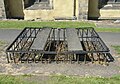 A mortsafe in Greyfriars Kirkyard, Edinburgh
 -
 A watchhouse and iron mortsafe in Cadder Parish Church near Glasgow


![[4]](https://commons.wikimedia.org/wiki/File:St_Maurs_Glencairn,_Kilmaurs,_East_Ayrshire,_Scotland_-_anchors_for_a_mortsafe.jpg)
![[5]](https://commons.wikimedia.org/wiki/File:Old_Aberfoyle_Kirk,_mortsafes_and_the_entrance,_Stirlingshire.jpg)
![[6]](https://commons.wikimedia.org/wiki/File:Skene_Mortsafe_-_geograph.org.uk_-_965904.jpg)
![[7]](https://commons.wikimedia.org/wiki/File:Mortsafes_in_Cluny_kirkyard_-_geograph.org.uk_-_174646.jpg)
![[9]](https://commons.wikimedia.org/wiki/File:Mortsafe_in_Banchory_Devenick_graveyard,_Aberdeenshire._Wellcome_M0015246EA.jpg)
![[10]](https://en.wikipedia.org/wiki/Mortsafe#/media/File:Cadder,_Parish_Church,_watchhouse_and_iron_mortsafe_-_geograph.org.uk_-_1343317.jpg)
References
[edit]- ^ Holder, Geoff (2010). Scottish Bodysnatchers. Stroud : The History Press. ISBN 978-0-7524-5603-4
- ^ Regis Olry. "Body Snatchers: the Hidden Side of the History of Anatomy". Archived from the original on 3 July 2025. Retrieved 19 October 2025.
- ^ James Moores Ball (1928). The sack-'em-up men : an account of the rise and fall of the modern resurrectionists. p. 46. Archived from the original on 15 November 2023. Retrieved 17 October 2025.
- ^ The Murder Act
- ^ Julia Bess Frank (1976). Body snatching: a grave medical problem. p. 401. Archived (PDF) from the original on 6 February 2025. Retrieved 17 October 2025.
- ^ William Roughead, “Notable British Trials: Burke and Hare”, p. 4, William Hodge & Company, Edinburgh, 1921?
- ^ a b c Julia Bess Frank (1976). Body snatching: a grave medical problem. p. 403. Archived (PDF) from the original on 6 February 2025. Retrieved 17 October 2025.
- ^ Eliza Beckett (24 May 2024). "Guardians of the Grave: Mort Safes of 19th Century Britain". Archived from the original on 18 June 2024. Retrieved 17 October 2025.
- ^ Julia Bess Frank (1976). Body snatching: a grave medical problem. p. 401. Archived (PDF) from the original on 6 February 2025. Retrieved 17 October 2025.
- ^ William Roughead, “Notable British Trials: Burke and Hare”, p. 3, William Hodge & Company, Edinburgh, 1921.
- ^ a b c d Martyn Gorman (2010). "An introduction to grave robbing in Scotland". Archived from the original on 2012-01-04. Retrieved 17 October 2025.
- ^ William Roughead, “Notable British Trials: Burke and Hare”, p. 5, William Hodge & Company, Edinburgh, 1921.
- ^ James Ritchie (30 November 1912). An Account of the Watch-houses, Mortsafes, and Public Vaults in Aberdeenshire Churchyards, formerly used for the Protection of the Dead from the Resurrectionists. p. 288. Archived from the original on 15 June 2025. Retrieved 17 October 2025.
- ^ William Roughead, “Notable British Trials: Burke and Hare”, p. 6, William Hodge & Company, Edinburgh, 1921.
- ^ James Ritchie (30 November 1912). An Account of the Watch-houses, Mortsafes, and Public Vaults in Aberdeenshire Churchyards, formerly used for the Protection of the Dead from the Resurrectionists. p. 287. Archived from the original on 15 June 2025. Retrieved 17 October 2025.
- ^ a b T.M. Robertson, G.H. Williams, George Haggarty and Nicholas Reynolds (1981). Recent excavations at Dunfermline Abbey. p. 12. Retrieved 17 October 2025.
{{cite book}}: CS1 maint: multiple names: authors list (link) - ^ Hallen, A. W. Cornelius (1889). Northern notes and queries or the Scottish antiquary. Vol. 3. Edinburgh: David Douglas. p. 51. Retrieved 19 October 2025.
- ^ a b c Hallen, A. W. Cornelius (1889). Northern notes and queries or the Scottish antiquary. Vol. 3. Edinburgh: David Douglas. p. 20. Retrieved 8 July 2017.
- ^ Raeburn, Gordon and David (2012). The Long Reformation of the Dead in Scotland (PDF). p. 186. Archived (PDF) from the original on 15 May 2024. Retrieved 17 October 2025.
- ^ James Ritchie (30 November 1912). An Account of the Watch-houses, Mortsafes, and Public Vaults in Aberdeenshire Churchyards, formerly used for the Protection of the Dead from the Resurrectionists. p. 323. Archived from the original on 15 June 2025. Retrieved 17 October 2025.
- ^ James Ritchie (30 November 1912). An Account of the Watch-houses, Mortsafes, and Public Vaults in Aberdeenshire Churchyards, formerly used for the Protection of the Dead from the Resurrectionists. p. 311. Archived from the original on 15 June 2025. Retrieved 17 October 2025.
- ^ For example, the vault pictured in James Ritchie (30 November 1912). An Account of the Watch-houses, Mortsafes, and Public Vaults in Aberdeenshire Churchyards, formerly used for the Protection of the Dead from the Resurrectionists. p. 311. Archived from the original on 15 June 2025. Retrieved 17 October 2025.
- ^ James Ritchie (30 November 1912). An Account of the Watch-houses, Mortsafes, and Public Vaults in Aberdeenshire Churchyards, formerly used for the Protection of the Dead from the Resurrectionists. pp. 319–322. Archived from the original on 15 June 2025. Retrieved 17 October 2025.
- ^ Raeburn, Gordon and David (2012). The Long Reformation of the Dead in Scotland (PDF). p. 184. Archived (PDF) from the original on 15 May 2024. Retrieved 17 October 2025.
- ^ James Ritchie (30 November 1912). An Account of the Watch-houses, Mortsafes, and Public Vaults in Aberdeenshire Churchyards, formerly used for the Protection of the Dead from the Resurrectionists. p. 326. Archived from the original on 15 June 2025. Retrieved 17 October 2025.
- ^ James Ritchie (30 November 1921). Relics of the Body-Snatchers: Supplementary Notes on Mortsafe Tackle, Mortsafes, Watch-houses, and Public Vaults, mostly in Aberdeenshire. p. 224. Archived from the original on 3 May 2025. Retrieved 17 October 2025.
- ^ Examples of watchtowers that still stand today are the one in Newille Churchyard [1], St Machar [2] or Eckford [3].
- ^ James Ritchie (30 November 1912). An Account of the Watch-houses, Mortsafes, and Public Vaults in Aberdeenshire Churchyards, formerly used for the Protection of the Dead from the Resurrectionists. p. 299. Archived from the original on 15 June 2025. Retrieved 17 October 2025.
- ^ Hanneke Booij and Ross Greenshields (2019). Kirk O’Muir. Graveyard and Gravestone Recording Report 2017-2019 (PDF). p. 13. Archived from the original (PDF) on 8 August 2024. Retrieved 17 October 2025.
![[1]](https://commons.wikimedia.org/wiki/File:Watch-house_at_gates_of_Newhill%27s_graveyard,_Aberdeenshire._Wellcome_M0015244.jpg)
![[2]](https://commons.wikimedia.org/wiki/File:St_Machar%27s_cathedral_with_watch_house_-_geograph.org.uk_-_174651.jpg)
External links
[edit]
Mortsafe
View on GrokipediaHistorical Context
Body Snatching in Early 19th-Century Britain
The limited supply of legally obtainable cadavers for anatomical study in early 19th-century Britain stemmed from the Murder Act of 1751, which took effect in 1752 and directed that executed murderers' bodies be dissected publicly to deter crime while providing specimens to surgeons.[3] This measure yielded only about 50-70 bodies annually across the kingdom, far short of the hundreds required as medical education expanded with new schools and larger student cohorts, particularly in Scotland where Edinburgh's university emphasized practical dissection.[4] Declining execution numbers—fewer than 60 murderers hanged yearly by 1800—compounded the scarcity, driving demand from anatomists seeking fresh subjects for surgical training essential to advancing procedures like amputations and ligatures.[5] Body snatching, or "resurrectionism," proliferated as a response, with professional gangs operating nocturnally in graveyards across England and Scotland from roughly 1800 to 1830.[6] These resurrection men targeted recent burials, using tools like spades and hooks to minimize disturbance, then transported wrapped corpses to medical lecturers for sale at prices escalating from £4 for an adult in the early 1800s to £10-£16 by the 1820s amid heightened competition and risk.[6] In Edinburgh, the epicenter due to its anatomy department's prominence, suppliers formed networks that delivered dozens of bodies per season, fueling dissections but sparking public outrage over violated graves of the poor, who buried in shallow, unsecured plots without means for guards.[7] The 1828 Burke and Hare case epitomized the crisis's escalation: Irish immigrants William Burke and William Hare, operating a lodging house in Edinburgh, murdered 16 lodgers and vagrants over 10 months by suffocation to preserve body freshness, selling the cadavers directly to anatomist Robert Knox for £7-£10 each without exhumation's logistical hazards.[8] Knox dissected the subjects before packed student audiences, unaware of their origins, highlighting how demand incentivized killing over mere theft when snatching grew riskier from watchmen and locked mausolea.[7] Human corpses held no legal property status in Britain at the time, rendering body snatching itself non-prosecutable as larceny and limiting charges to misdemeanor grave violations, which demanded witnesses to fresh disturbance—a rarity given operations' stealth.[9] Authorities exhibited pragmatic restraint in enforcement, prioritizing anatomical progress for public health benefits like improved surgery over curbing an illicit trade tacitly viewed as necessary, with few convictions until scandals forced reform via the 1832 Anatomy Act.[10][9]Demand for Cadavers in Medical Education
In the late 18th and early 19th centuries, Scotland's medical schools, led by Edinburgh, experienced rapid expansion amid the Enlightenment's emphasis on empirical science, drawing students from across Britain and Europe for practical anatomy training. By 1820, Edinburgh alone hosted around 2,200 students in medical classes, including extramural lectures that supplemented university instruction.[11] Glasgow's medical faculty grew from modest beginnings, establishing rival programs by the early 1800s, while Aberdeen's anatomy schools also intensified dissection requirements, collectively straining cadaver availability across the region.[11] This surge aligned with licensing standards mandating extensive hands-on dissection—typically at least three cadavers per student to master surgical anatomy—necessitating hundreds of bodies annually by the 1820s to support student cohorts without which theoretical knowledge alone proved insufficient for proficiency.[12] Legal procurement was severely restricted under the 1752 Murder Act, limiting supply to the bodies of executed criminals, which averaged fewer than 80 per year across Britain between 1805 and 1820, far short of Scottish schools' needs.[13] The resulting scarcity birthed a black market dominated by resurrectionists, who exhumed fresh graves to meet demand, with prices escalating from about £4–5 in the early 1800s to £7–10 per adult cadaver by the 1820s due to competition and risks like rapid decomposition or detection.[9] [14] These illicit transactions persisted despite hazards to snatchers, including exposure to infectious diseases from unembalmed bodies, as the premium on "fresh" subjects for detailed dissection outweighed perils in an unregulated trade.[9] The cadaver shortage underscored a causal bottleneck in medical progress: without sufficient subjects for repeated, individual dissections, students could not empirically map human anatomy's complexities, hindering advances in surgical precision and pathology.[12] Illicit access, though unlawful, facilitated breakthroughs such as refined techniques in vascular surgery and organ-specific interventions, as evidenced by Edinburgh anatomists' contributions to textbooks and procedures that elevated Scotland's global standing in medicine before the 1832 Anatomy Act reformed supply.[11] This demand-driven dynamic prioritized anatomical realism over ethical constraints, revealing how empirical imperatives clashed with societal norms on bodily integrity.Invention and Design
Origins of the Mortsafe
The mortsafe emerged around 1816 in Scotland, amid escalating body-snatching activities that threatened graves near medical institutions, prompting local craftsmen to devise heavy iron enclosures as an advanced deterrent over prior makeshift barriers like wooden planks or vigilance patrols. These early constructs, often resembling reinforced cages or grilles fitted over coffins, were engineered for temporary use, securing remains against resurrectionists until natural decomposition—typically within 6 to 12 weeks—made the cadavers valueless for dissection.[15][16][17] The name "mortsafe" combines "mort," from the Latin and French for death, with "safe" denoting a protective vault, reflecting its pragmatic function as a short-term safeguard rather than a permanent fixture. Funding for prototypes came primarily from parish heritors—local landowners responsible for church upkeep—or grieving families in lowland regions such as the Lothians and Aberdeenshire, where proximity to anatomy schools intensified risks; examples include communal purchases by kirk sessions to cover multiple plots.[18][19][20] While the 1816 innovations predated the 1828 Burke and Hare killings, which exposed vulnerabilities in even protected graves and spurred wider adoption, the core invention addressed pre-existing threats from opportunistic grave robbers supplying Edinburgh's surgeons with up to 17 cadavers weekly at peak demand. No formal patents are recorded for the initial designs, which varied by local ironworkers, emphasizing utilitarian strength over standardization.[1][21]Construction Features and Variations
Mortsafes were predominantly fabricated from heavy iron, forming cages, grids, or enclosure frameworks positioned directly over coffins within the grave to impede unauthorized exhumation.[22] These structures emphasized substantial mass as a primary deterrent, rendering them difficult to displace or dismantle without specialized equipment, with designs intentionally engineered for robustness against manual interference.[22] Iron bars or plates were commonly assembled into coffin-like shapes or open lattices, secured via bolts or integrated fastenings to the grave's masonry or soil.[23] Variations in construction reflected local fabrication practices and intended reusability, including elongated bar frameworks measuring approximately 6 feet in length and 16 to 22 inches in width for narrower profiles, or broader coffin-shaped enclosures up to 7 feet 2 inches long and tapering from 2 feet 3 inches to 1 foot 10 inches in width.[23] Some incorporated stone elements for added permanence, though pure iron variants predominated for portability. Modular aspects appeared in reusable models, facilitated by attachment points such as rings and rods for tackle systems—typically comprising a 6.5-inch iron ring, paired 3-foot-4-inch rods at the shoulders, and a longer 5-foot-4-inch rod at the foot, hooked to sheer poles for lowering into or hoisting from graves.[23] Private commissions often yielded lighter, less fortified iterations compared to communal ones, prioritizing cost-effective deterrence over maximal impregnability.[22] Engineering ingenuity centered on mechanical resistance, with dense iron lattices calibrated to counter prying implements like crowbars through sheer weight and interlocking geometry, while tackle integration enabled efficient deployment and retrieval after the body's initial vulnerability period.[2] These features underscored a pragmatic balance between immovability in situ and practical recoverability, hallmarks of early 19th-century Scottish ironworking adapted to funerary security.[22]Implementation and Usage
Adoption in Scotland and Beyond
Mortsafes saw primary adoption in Scotland during the 1820s and 1830s, particularly in regions with high demand for cadavers from medical schools, such as Edinburgh and Aberdeenshire.[24][1] In Edinburgh, the epicenter of anatomical studies, churchyards like Greyfriars equipped graves with these devices to counter resurrectionists targeting fresh burials.[25] Aberdeenshire parishes documented extensive use, with churchyards installing multiple shared units amid widespread fears of exhumation.[24] Usage peaked between 1828 and 1832, intensifying after the Burke and Hare murder scandal exposed the vulnerabilities of unprotected graves and spurred public outrage over body procurement.[26] This period aligned with heightened community vigilance in Scottish burial grounds, where mortsafes supplemented watch-houses during the weeks bodies remained vulnerable to theft.[27] Adoption tapered post-1832 with the Anatomy Act providing legal cadaver supplies, reducing reliance on such defenses.[26] Communities organized at the parish level, forming subscription societies to pool resources for acquiring and maintaining shared mortsafes in churchyards, enabling rental to families for short-term protection.[20] These societies, often church-led, charged modest fees to cover ironwork and deployment, ensuring broader access amid the crisis.[27] In Aberdeenshire, records detail coordinated efforts across kirkyards to distribute devices efficiently.[24] While concentrated in Scotland, mortsafes appeared sporadically in England, with scattered examples in southern churchyards reflecting lesser but present body-snatching threats.[28] Instances extended rarely beyond Britain, including isolated cases in United States cemeteries, likely influenced by Scottish immigrant practices amid similar anatomical demands. Overall, adoption remained tied to locales with acute medical cadaver shortages, limiting widespread international proliferation.[25]Practical Deployment and Rental Systems
Mortsafes were deployed immediately following burial to safeguard freshly interred bodies during the period of highest vulnerability to resurrectionists, typically assembled on-site at the grave due to their substantial weight, which could exceed several hundred pounds for iron models. The device was positioned directly over the coffin, secured with heavy padlocks and chains to encase the burial site, preventing access until natural decomposition rendered the remains unsuitable for anatomical dissection. This temporary placement lasted approximately six to eight weeks, after which the mortsafe was disassembled or removed—often requiring the labor of local smiths or community members—and relocated for reuse on another grave.[29][30] Rental systems facilitated access to mortsafes, primarily managed by local churches, parochial committees, or iron foundries that owned communal stocks of the devices, with families hiring them on a short-term basis to offset the high upfront costs of purchase and fabrication. Fees varied by region but commonly amounted to around one shilling per day, equating to roughly two pounds for a standard six-week period, rendering the protection feasible for middle-class households while imposing a significant financial strain on the working poor, who often pooled resources or relied on shared community devices. In Glasgow and surrounding areas, such rentals were coordinated through kirk sessions or specialized suppliers, ensuring availability amid peak demand following funerals.[31][17] To enhance security during deployment, families frequently integrated mortsafes with active vigilance measures, such as hiring night guards or organizing shifts among relatives to patrol the site, particularly in the initial days before the iron barrier fully deterred would-be thieves. This hybrid approach combined the passive durability of the mortsafe with human oversight, addressing gaps where resurrectionists might attempt sabotage or wait for opportunities, and was especially prevalent in rural Scottish kirkyards lacking dedicated watchhouses.[19][29]Complementary Precautions
Architectural Defenses like Vaults
Burial vaults and mausolea emerged as permanent architectural countermeasures to body snatching in early 19th-century Scottish kirkyards, particularly in urban settings where resurrectionist activity was rampant. These structures, typically built from reinforced stone or brick, enclosed remains in secure, above-ground or semi-subterranean chambers, providing long-term protection unavailable from temporary grave covers. Unlike portable or rental devices, vaults were designed for indefinite use, often incorporating heavy masonry walls and sealed entrances to deter forced entry by grave robbers supplying medical schools.[1] In areas like Glasgow, precursors to formal cemeteries such as the Necropolis incorporated vault systems to address the acute threat of body theft, with communal or family-funded constructions reflecting organized responses to the crisis. For instance, the Egyptian vaults on the Necropolis hill featured labyrinthine plans with internal passages and robust outer barriers, intended to complicate access for intruders. Locked iron doors or gates were common features in such designs, ensuring that only authorized family members could enter after the initial burial phase.[32][33] These permanent defenses were sometimes paired with interim safeguards during the high-risk weeks following interment, when fresh corpses commanded premium prices from anatomists, allowing families to transition from temporary vigilance to enduring security. Adoption was concentrated in wealthier urban parishes, where resources permitted investment in masonry works that outlasted the episodic terror of resurrectionism.[1]Community Vigilance Measures
Communities in early 19th-century Scotland and England countered body snatching through organized human surveillance, erecting watch-houses at graveyard peripheries, particularly near anatomy schools in Edinburgh. These modest shelters housed paid watchmen or rotating volunteers who patrolled burial sites, focusing on nights immediately after interments when corpses were most valuable to resurrectionists. Equipped with lanterns, dogs for alerting to intruders, and sometimes firearms, these guardians aimed to interrupt exhumations in progress, with parish authorities or local societies funding the efforts amid rising cadaver prices reaching £10 by the 1820s.[34][35] Supplementary grassroots tactics emphasized physical barriers to delay snatchers. Heavy stone slabs, termed mortstones, were positioned over newly filled graves to impede digging, a practice evident in numerous Scottish kirkyards where such slabs, intentionally weighted for immovability, remain visible today. Graves were occasionally excavated deeper than standard depths to extend the time required for body removal, exploiting the resurrectionists' preference for quick operations under cover of darkness.[36][37][38] Such vigilance measures curtailed thefts in monitored locales by raising risks and operational costs for body snatchers, who often bypassed guarded sites for unguarded ones. Yet, their efficacy waned due to the demanding nature of continuous night watches, which led to fatigue among personnel and gaps in coverage, rendering them unsustainable without communal commitment.[35][1]Effectiveness and Limitations
Success in Deterring Theft
Mortsafes demonstrated high efficacy in preventing body snatching due to their substantial weight—often exceeding 500 pounds—and reinforced iron construction, which rendered quick exhumation by small teams infeasible for resurrectionists reliant on fresh cadavers.[1] Historical surveys, such as those conducted by James Ritchie in the early 20th century, document their deployment in Scottish kirkyards like Towie and Greyfriars, where the devices successfully secured coffins against unauthorized access.[2] The strategy of temporary protection aligned with natural decomposition timelines, as human remains typically became unsuitable for anatomical dissection after one to two weeks, outlasting the period when body snatchers deemed intervention worthwhile.[2] In equipped parishes, this approach curtailed theft attempts, with resurrectionists redirecting efforts to less fortified graves, thereby reducing overall disturbances in protected areas as noted in contemporary accounts from Aberdeenshire and Edinburgh.[1] Parish-level records and antiquarian reports indicate a marked drop in successful exhumations following mortsafe adoption; for instance, sustained grave robbing near Edinburgh persisted for nine winters until combined vigilance measures, including such devices, took effect in 1818.[1] Breaches remained exceptional, requiring coordinated groups with heavy equipment, which exposed perpetrators to detection and rarely yielded viable specimens before decomposition set in.[2] This empirical success facilitated safer advancement in medical education by diminishing the immediate threat of grave desecration without resorting to escalated violence.[1]Criticisms Regarding Cost and Accessibility
The high cost of fabricating mortsafes from heavy iron, often requiring skilled blacksmith work, rendered individual ownership unaffordable for most families in early 19th-century Scotland, where a single unit could demand resources equivalent to months of laborer wages.[39] [29] To address this, parishes established mortsafe societies—communal groups that collectively purchased devices and rented them to members for short periods, typically 6 to 8 weeks, until decomposition deterred snatchers.[19] [17] These societies imposed annual subscriptions and usage fees, which, while spreading the burden, still excluded non-members, transients, or impoverished households lacking community ties, forcing reliance on makeshift alternatives like hired watchmen or simple railings.[17] [39] Logistical demands further compounded accessibility issues, as mortsafes' substantial weight—frequently exceeding several hundred pounds—necessitated on-site assembly and specialized transport, delaying burials and incurring additional labor costs in rural or remote kirkyards.[29] Removal for reuse after the rental term often damaged the devices or disturbed graves, with reports of irons bending or bars loosening during handling, while improper storage between uses led to theft or corrosion, reducing availability for subsequent families.[19] [40] In areas without organized societies, the absence of such infrastructure meant poorer graves remained unsecured, highlighting how resource-intensive deployment favored established communities over isolated or indigent ones. Contemporary parish records and accounts indicate that these expenses perpetuated socioeconomic disparities in burial protection, as wealthier kin or kirk-affiliated groups secured superior safeguards, whereas the destitute faced heightened vulnerability to resurrectionists, underscoring the measures' uneven efficacy amid widespread poverty.[39] Some local observers, post-1820s, critiqued persistent mortsafe use as extravagant once snatching incidents declined, arguing the ongoing fees diverted funds from other communal needs without proportional benefits.[19]Decline and Aftermath
Role in Prompting Legislative Reform
The widespread adoption of mortsafes from the early 1810s onward underscored the profound dysfunction in Britain's cadaver supply system, governed by the Murder Act 1752, which confined legal dissections to the bodies of executed criminals—yielding fewer than 60 annually despite demand from expanding medical schools exceeding 500.[41] These iron enclosures, alongside watchtowers and vigilante patrols, temporarily curbed grave robbings but at prohibitive costs—rental fees often reached £1 per week, equivalent to a laborer's monthly wage—leaving indigent families unprotected and exposing systemic inequities in burial security.[40] This patchwork of ad-hoc defenses publicized the futility of prohibition without adequate supply, as resurrectionists adapted by targeting unprotected graves or escalating to direct procurement methods, thereby amplifying public awareness of the crisis's root causes: mismatched incentives between medical education needs and moral-legal constraints on body sourcing.[9] The heightened risks imposed by mortsafes and similar barriers contributed to a perverse shift in criminal tactics, most notoriously in the "burking" murders by William Burke and William Hare, who suffocated at least 16 victims in Edinburgh from October 1828 to early 1829, bypassing exhumation altogether to furnish fresh cadavers to anatomist Robert Knox for £7–10 each.[42] Burke's execution on January 28, 1829, and the ensuing scandals—coupled with earlier resurrectionist exposures—galvanized parliamentary select committees, including the 1828 inquiry chaired by Henry Warburton, which documented how defensive measures like mortsafes merely displaced rather than resolved the illicit trade, fueling demands for regulated supply over punitive deterrence.[3] Advocates, including surgeons like Astley Cooper, argued that legalizing unclaimed paupers' bodies would eliminate the black market, a position vindicated by the Act's passage. Enacted August 1, 1832, the Anatomy Act authorized inspectors to allocate unclaimed corpses from workhouses, hospitals, and prisons for dissection after 48 hours, surging legal supplies to over 600 annually by 1834 and obviating the need for grave fortifications.[43] Mortsafes, rendered redundant by diminished theft incentives, were largely dismantled or repurposed by the mid-1840s, as evidenced by kirkyard records showing abandonment in favor of standard railings; this swift obsolescence affirmed their function as an interim expedient that bridged empirical necessity to statutory realism, preempting further violence by aligning policy with causal drivers of demand.[31]Surviving Examples and Preservation Efforts
Surviving mortsafes remain scarce, with intact specimens concentrated in Scottish churchyards where they were most commonly deployed. Logierait Churchyard in Perth and Kinross preserves three cast-iron examples, including two adult-sized cages and one smaller variant for child burials, installed during the early 19th century to deter resurrectionists.[16] Kinnernie graveyard in Aberdeenshire features additional preserved mortsafes, exemplifying regional adaptations in northeast Scotland.[2] At Inverurie, remnants of mortsafe tackle—iron frameworks and securing mechanisms—endure, as recorded in archaeological surveys of Aberdeenshire sites.[44] In Glasgow, an iron cage encloses a burial plot within the cathedral's grounds, one of the few urban examples still visible amid encroaching vegetation and weathering.[45] These artifacts often exhibit rust and structural decay, with many others dismantled for scrap iron post-1832 after the Anatomy Act reduced demand.[17] Preservation initiatives, including the Wellcome Collection's 2018 documentation of anti-grave-robbing measures, underscore their value as tangible relics of medical ethics tensions.[2] Current efforts involve systematic surveys of Scottish burial grounds to map and maintain these structures, preventing further loss through heritage advocacy by organizations like the Society of Antiquaries of Scotland.[46] Such work highlights the rarity of complete survivors, estimated in the dozens across the country, and promotes their interpretation as symbols of past community defenses against body snatching.[31]