Hubbry Logo
BassinetBassinetMain
Open search
Bassinet
Community hub
Bassinet
logo
8 pages, 0 posts
0 subscribers
Be the first to start a discussion here.
Bassinet
Bassinet
from Wikipedia
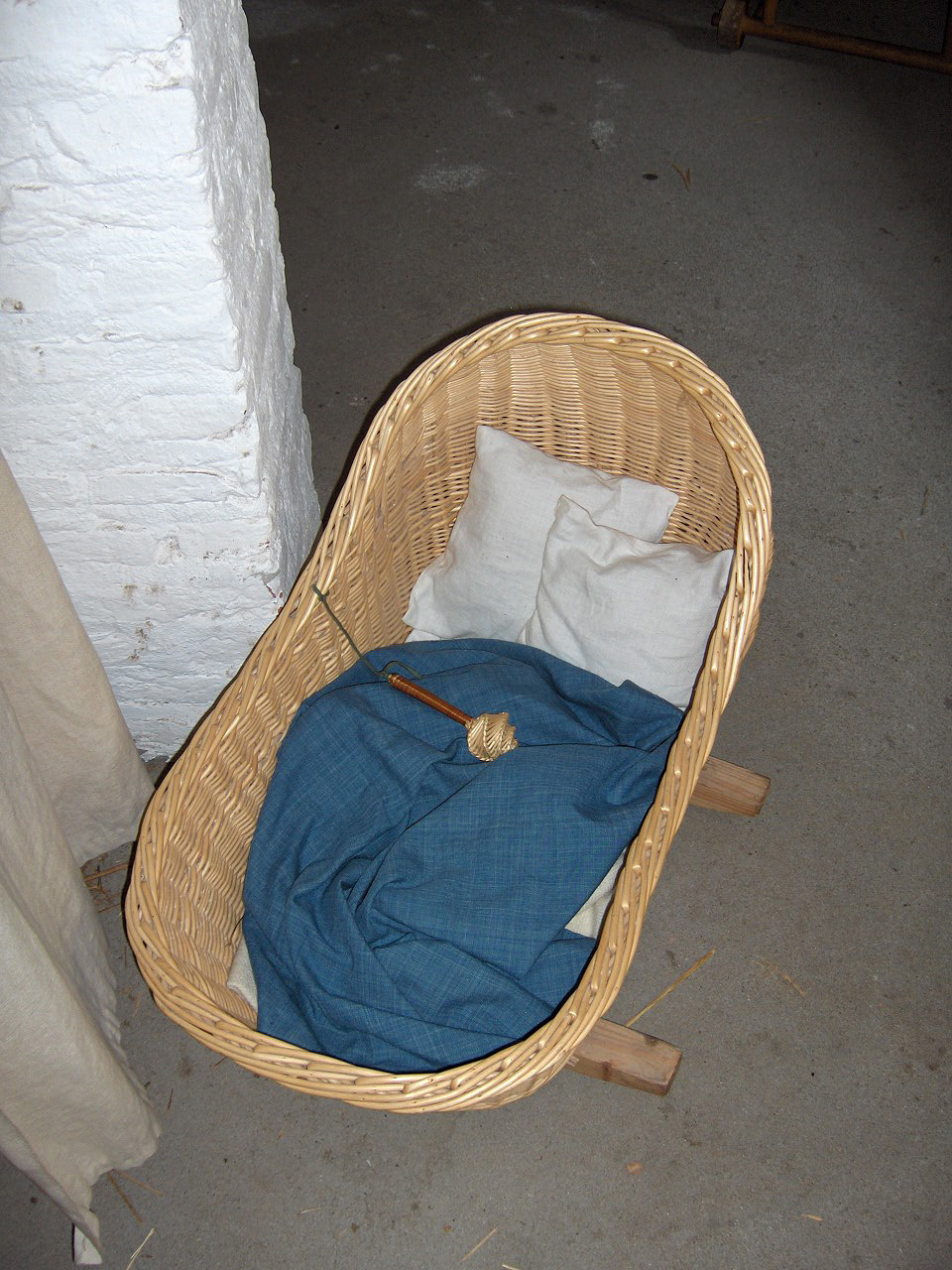
Modern reproduction of a medieval cot and rattle, c. 1465
Movable, but not portable, home bassinet
Rooming-in bassinet
A wooden cradle from India

A bassinet, bassinette, or cradle is a bed specifically for babies from birth to about four months. Bassinets are generally designed to work with fixed legs or caster wheels, while cradles are generally designed to provide a rocking or gliding motion. Bassinets and cradles are distinguished from Moses baskets and carry cots, which are designed to be carried and sit directly on the floor or furniture. After four months, babies are often transferred to a crib (American usage) or cot (UK usage). In the United States, however, the bedside sleeper is the prevalent option, since they are generally bigger, recommended up to 6 months, and often used up to a year.[citation needed]

Design

[edit]

A bassinet is typically a basket-like structure on free-standing legs, often with casters.[1] A cradle is typically set in a fixed frame, but with the ability to rock or glide.[1]

Use

[edit]

Bassinet usage in the United States nearly doubled to 20% from 1992 to 2006.[2] Greater than 45% of babies up to two months used a bassinet.[2] By 5–6 months, however, fewer than 10% of babies sleep in bassinets.[2] In a hospital environment, a special form of sealed bassinet is used in a neonatal intensive care unit.

On many long-haul flights, most airlines provide a bassinet (which is attached to a bulkhead) to adults travelling with an infant, i.e., a child under the age of two. The use of the bassinet is restricted by the infant's size and weight.[3] These need to be requested in advance with the airline. However, most USA and Canadian airlines have bassinet policies which mean they are only allocated at the airport gate.[4][5][6]

Research has shown that the mattress influences SIDS outcomes; a firm mattress lowers SIDS risk.[7]

Some bassinets are designed to rock or swing freely, with many carers finding their child calmed by this action. The process of lulling the child to sleep may be accompanied by prerecorded or live performance of lullabies.

Stationary or portable

[edit]

Although there are many variations, they fall generally into two categories:

  • light and portable types sometimes called Moses baskets
  • sturdier but less portable cradles

In both cases, they are generally designed to allow the resting baby to be carried from place to place. Within the home, they are often raised on a stand or other surface to reduce back strain when bending over to tend the baby. Wheeled frames to convert a bassinet into a pram or baby carriage are common.

Smart bassinets

[edit]

Bassinets that automatically soothe babies by sound and motion in response to crying recently have become available, starting with the Snoo in October 2016.[8][9] The Snoo has been criticized for its high price.[10] Graco, 4Moms, and other companies have introduced cheaper competing products.[11]

Rolling

[edit]

At three or four months of age babies are able to roll over by themselves; this means they could tip the bassinet over, so for safety they must use an infant bed or toddler bed instead.

See also

[edit]

References

[edit]
Revisions and contributorsEdit on WikipediaRead on Wikipedia
from Grokipedia
A bassinet is a small bed designed primarily to provide sleeping accommodations for an , typically supported by freestanding legs, a stationary frame or stand, a wheeled base, or a rocking or swinging mechanism, with a surface that is no more than 10 degrees from horizontal when at rest. These beds are intended for newborns and young infants up to approximately four to six months of age, or until the baby begins to roll over, on , or exceeds the manufacturer's weight or limits, at which point transition to a full-size crib is recommended. Bassinets promote safe practices by allowing room-sharing without bed-sharing, keeping the close to parents for monitoring and feeding while reducing risks associated with beds. The term "bassinet" originates from the French bassinet, a diminutive of bassin meaning "basin," reflecting the bed's traditional basket-like or basin-shaped design, and first appeared in English around 1854 to describe a cradle for babies. Earlier uses of similar sleeping vessels date back centuries, with woven baskets or cradles employed across cultures for securing newborns, though the modern bassinet as a standardized product emerged in the alongside advancements in care. One notable historical variant is the cardboard bassinet, introduced in in 1938 as a free government-provided option for new parents, emphasizing and affordability during a time of social welfare expansion. Bassinets come in various types to suit different needs, including traditional models with fixed or rocking bases and or slatted sides for ; bedside bassinets that attach to the parental for easy access; portable or versions that fold for mobility; smart bassinets with automated rocking, vibration, or sound features, sometimes controlled via apps; and specialized forms like baskets, which are lightweight containers placed on stands, or stroller-integrated bassinets for on-the-go use. Each type must adhere to structural guidelines, such as side heights of at least 7.5 inches (19 cm) above the upper surface of the uncompressed to prevent falls. Safety is paramount in bassinet design and use, governed by federal regulations under 16 C.F.R. part 1218 (as of the 2013 standard, incorporating ASTM F2194-13 with modifications, with a 2024 proposed rulemaking for updates including protections against elevated surface use), to address hazards like tipping, , and suffocation. Key requirements include a firm, flat surface free of incline greater than 10 degrees, breathable materials without loose or pillows, and stability to withstand forces equivalent to an infant's movement without overturning. The endorses bassinets as a safe environment when used in the parents' room for at least the first six months, with the placed on their back, alone, and without soft objects, to minimize (SIDS) risks. The voluntary ASTM standard was revised to F2194-25 in 2025. Parents should verify compliance with current standards, check for recalls, and discontinue use once the outgrows the product to maintain these protections.

History and Etymology

Origins and Terminology

The term "bassinet" derives from the French word bassinet, a form of bassin meaning "basin" or "little basin," reflecting its original basket-like shape resembling a small for an . This entered English in the mid-19th century, with the first known use recorded around 1836, though some linguistic analyses suggest influence from French bercelonnette, a double diminutive of berceau ("cradle"), leading to folk etymological associations with both basin and cradle forms. The conceptual origins of the bassinet trace back to ancient infant sleeping practices across cultures, where simple enclosures such as hammocks and wooden cradles served to soothe and protect newborns. In , the specific bassinet form emerged between the 15th and 19th centuries, evolving as a lightweight, elevated designed for easy access and portability, often crafted from or wood to mimic a protective basin. By the , bassinets had developed into more formalized portable beds, distinct from earlier rudimentary cradles, and became status symbols in affluent households by the mid-19th century. A bassinet is often distinguished from related infant beds by its elevated structure on fixed legs, providing a stable, bedside sleeping surface for newborns up to about four months; while some models include rocking features, it contrasts with a cradle, which primarily features a rocking or swinging motion for soothing. Unlike a basket, which is a lightweight, woven portable option intended to sit directly on the floor or furniture and be carried by handles, a bassinet emphasizes height for parental convenience and , without mobility as a primary function.

Historical Development

The modern bassinet emerged in the as a lightweight, hooded bed primarily constructed from or wood, gaining popularity in Victorian Europe among upper-class for use in nurseries. These designs often featured protective hoods to shield from drafts and included rockers or stands for mobility, reflecting a shift toward dedicated infant sleeping spaces distinct from larger family beds. By the , bassinets had developed as portable beds, evolving into elaborate showpieces by 1850 that displayed in affluent households, emphasizing aesthetics alongside functionality. In the late 19th and early 20th centuries, bassinets underwent significant shifts with the introduction of metal frames, particularly adopted in the and 1930s for use, enhancing durability and compared to earlier models. These metal constructions, often painted for use, allowed for adjustable heights and removable crib portions, making them practical for and settings. A notable innovation was the cardboard bassinet introduced in in 1938 as a free government-provided option for new parents, promoting and affordability during social welfare expansions. Following , amid the era, of bassinets accelerated, incorporating fabric linings for added comfort and affordability, as manufacturers scaled up to meet surging demand for infant care items. From the late into the early 21st, bassinets adapted to modern lifestyles with the rise of portable models in the 1980s, exemplified by innovations like Graco's Pack 'n Play playard introduced in 1987, which combined bassinet functionality with foldable portability suited to urban living and travel. By the 2000s, safety enhancements became integral, including mesh sides for improved airflow and visibility to reduce risks like suffocation or wedging, aligning with evolving standards from organizations such as the Consumer Product Safety Commission. Cultural variations in bassinet designs have long incorporated local materials; in , woven designs from or reeds, as seen in Ghana's region, provide durable, portable infant beds rooted in centuries-old basketry traditions.

Design and Construction

Materials and Structure

Contemporary bassinets are constructed using a variety of materials chosen for their breathability, lightweight properties, and durability to ensure infant safety and comfort. Traditional models often feature woven or baskets, which provide natural ventilation and a lightweight structure weighing around 10-15 pounds for easy mobility. Modern designs incorporate solid wood or metal frames for enhanced stability, supporting the overall weight without deformation under normal use. Breathable mesh or fabric linings are commonly used for the sides and interior, allowing airflow while preventing entrapment, with mesh openings designed to prevent entrapment according to ASTM F2194-13 requirements. The core structure consists of an elevated stand with fixed legs, typically raising the sleep surface 20-30 inches above the to facilitate parental access without excessive bending. The basin itself is a deep, oval or rectangular enclosure, usually measuring 30-35 inches in length and 15-20 inches in width to accommodate newborns up to about 4-5 months. At the base lies a firm, flat with minimal padding to promote safe by reducing suffocation risks. Bassinets are engineered with a typical weight capacity of 10-20 pounds, reflecting the growth of during early months, and include reinforced joints tested to withstand a static load of 54 pounds without collapse per ASTM F2194-13. Many models feature side heights of at least 7.5 inches above the surface to contain the securely. Hoods on bassinets vary as removable canopies made from fabric or , designed to shield infants from light and drafts while allowing visibility and ventilation; these attachments snap or clip onto the frame for easy removal during or non-use. In August 2025, ASTM approved an updated voluntary standard, F2194-25, which includes enhancements such as a proposed maximum thickness of 1.5 inches; however, the mandatory federal regulation remains based on F2194-13 as of November 2025.

Key Features

Bassinets commonly incorporate adjustability features to enhance usability for parents. Height-adjustable legs or attachments, particularly in bedside bassinets, allow the bassinet to be positioned level with the parent's bed mattress top. For low-profile mattresses (often resulting in bed heights of 20-26 inches from floor to top), bassinets typically require a minimum height of around 20-24 inches. For pillow-top mattresses (often 28-36 inches or more), a maximum height of 32-36 inches is necessary. Versatile bassinets offer adjustment ranges of approximately 21-34 inches or wider to accommodate various mattress types, facilitating easy access for feeding and soothing the without needing to stand or bend excessively. Foldable designs are also prevalent, enabling the bassinet to collapse compactly for storage or travel, which supports space-efficient organization in the home. Comfort elements are integral to bassinet design, prioritizing the infant's well-being. Interiors are typically lined with soft, fabrics that are gentle on sensitive skin and resistant to allergens, often machine-washable for easy maintenance. Optional storage pockets integrated into the frame provide convenient access to essentials such as diapers, wipes, or pacifiers, reducing the need to leave the baby's side during nighttime care. Ventilation features ensure a safe and comfortable sleeping environment by promoting airflow. Mesh panels on the sides or ends allow for adequate circulation, helping to prevent overheating while maintaining visibility for monitoring the baby; these elements align with safety standards by supporting breathability even in close-contact scenarios. Accessories enhance the practicality of bassinets without compromising core functionality. Fitted sheets are standard inclusions, designed to securely cover the firm and promote a taut surface. Some models integrate changing pads into the stand for quick changes, while mosquito netting may be provided as an optional canopy attachment in regions prone to . Aesthetic options allow bassinets to integrate harmoniously into nursery settings. Available in neutral colors such as white, gray, or beige, and featuring modern, minimalist styles, these designs complement contemporary decor while remaining versatile for various home aesthetics.

Types of Bassinets

Stationary Bassinets

Stationary bassinets are fixed-position infant sleepers elevated on sturdy legs, designed for placement in a dedicated nursery area rather than directly beside the parents' bed. They serve as a compact, enclosed sleeping solution for newborns from birth up to about four months or until the infant begins to roll over, pushes up on hands and knees, or exceeds the manufacturer's weight limit, typically around 15 to 20 pounds. This setup promotes safe sleep by keeping the baby in a separate, stable environment while allowing room-sharing benefits recommended by pediatric experts to reduce SIDS risk. These bassinets feature robust bases constructed from or metal to ensure tip-over resistance, with overall unit weights often ranging from 15 to 20 pounds to enhance stability during use in active home settings. Sides are typically made of breathable or fabric for airflow, supported by a firm, flat that meets federal incline limits of 10 degrees or less, and many include larger hoods or canopies for complete , blocking light and providing a womb-like feel. Compliance with ASTM F2194 standards mandates rigorous stability testing, where the bassinet must not tip when a 25-pound force is applied horizontally at various heights, simulating interactions from toddlers or pets, and the structure must support three times the recommended weight without failure. The primary advantages of stationary bassinets lie in their superior stability compared to mobile alternatives, making them ideal for households with active children or pets where tipping risks are higher, and their standalone design facilitates seamless integration with nursery furniture, often including under-basket storage for essentials like diapers or blankets. This permanence supports long-term use in a fixed location, contributing to a cohesive room aesthetic without the need for frequent repositioning. Representative examples of stationary bassinets include traditional wooden models such as the babybay Original, which uses solid beechwood slats for a durable, non-folding frame without mobility features, and standalone units like the Graco Dream Glide, featuring a heavy metal base for nursery placement. These designs emphasize classic, immovable construction over portability.

Portable and Bedside Bassinets

Portable and bedside bassinets are designed for mobility and proximity to caregivers, offering lightweight alternatives to stationary models for newborns up to approximately five months or 15-20 pounds. These bassinets emphasize ease of transport and to parental beds, facilitating room-sharing while minimizing risks associated with bed-sharing, as recommended by the for safe infant sleep environments. Portability is achieved through foldable frames that typically weigh under 15 pounds, allowing for simple storage and movement; for instance, models like the Boppy Bassinet fold flat without assembly and weigh less than 14 pounds, complete with carry bags or handles for travel. These features make them ideal for on-the-go use, with breathable mesh sides ensuring airflow and visibility while the structure collapses compactly for packing. Bedside bassinets attach directly to the adult using clamp-on mechanisms or adjustable straps to prevent movement, complying with Consumer Product Safety Commission standards for secure fixation. Bedside bassinets typically have adjustable height ranges to align the infant's sleep surface with the parent's bed mattress top. For low profile mattresses (often resulting in bed heights of 20-26 inches from floor to top), bassinets need a minimum height of around 20-24 inches. For pillow-top mattresses (often 28-36 inches or more), bassinets need a maximum height of 32-36 inches. Versatile bassinets offer adjustment ranges of approximately 21-34 inches or wider to accommodate both types. This design supports easy access during nighttime feedings or soothing. This design supports the AAP's guidance on keeping infants close in the parental room on a separate, firm surface. Common use cases include discharge, where portable models provide a familiar space during transition home; vacations, enabling consistent routines in temporary settings; and room-sharing arrangements that avoid full hazards like suffocation. Representative examples include collapsible models such as the Graco Travel Lite Portable Bassinet, which features a vented bottom and folds for easy transport, and convertible units like the 4-in-1 Pamo Babe Playard that transform into changing stations with removable bassinets for multifunctional use.

Rocking and Rolling Bassinets

Rocking bassinets incorporate built-in gliders or pendulum-style mechanisms that allow for natural side-to-side swaying, providing a soothing motion for infants without requiring electronic components. These mechanisms are designed to operate manually through gentle pushes from caregivers, ensuring controlled movement that complies with safety standards such as those outlined in ASTM F2194, which mandates a sleep surface angle of no more than 10 degrees from horizontal in the rest position to prevent tipping or instability. The rocking angle during motion is further limited to a maximum of 20 degrees to maintain stability and reduce the risk of the bassinet overturning, as specified in the standard's rock/swing requirements incorporated into 16 CFR Part 1218. Rolling bassinets feature lockable wheels attached to the base, enabling easy repositioning within a while prioritizing through secure locking mechanisms that prevent unintended movement. These wheels, typically 1 to 2 inches in diameter, include non-slip treads or brakes on at least two casters to ensure the bassinet remains stationary during use, aligning with general stability requirements under ASTM F2194 and CPSC guidelines. This design facilitates mobility for parents without the need to lift the entire unit, which can weigh 20 to 30 pounds when occupied. The primary benefits of rocking and rolling bassinets stem from their ability to replicate the gentle, rhythmic motions experienced in the womb, which stimulate the infant's and promote relaxation, leading to improved quality and reduced fussiness. Studies indicate that such rhythmic rocking positively influences brain development by enhancing neural connections related to balance and , while also extending durations by mimicking familiar prenatal movements. Additionally, the rolling capability simplifies parental tasks, such as moving the baby between rooms for feeding or monitoring, thereby reducing physical strain without compromising the infant's secure sleep environment. Representative examples include vintage hooded rockers, which feature curved wooden bases for manual swaying and hark back to historical cradle designs used for centuries to soothe newborns through simple mechanical motion. In modern contexts, wheeled stands compatible with standard bassinets, such as those from Delta Children, offer lockable casters for room-to-room transport while supporting optional manual rocking attachments for added versatility.

Smart and Electronic Bassinets

Smart and electronic bassinets integrate advanced sensors and to monitor and provide responsive soothing, aiming to extend duration for both babies and parents. These devices employ built-in microphones, motion detectors, and algorithms to identify signs of distress, such as or subtle movements, triggering gentle interventions that replicate the calming effects of parental holding. Unlike traditional bassinets, smart models prioritize data-driven responses to foster safer, more consistent sleep environments for newborns up to approximately six months old. Core technologies in these bassinets often include sensors for position detection and cry analysis, with select models incorporating non-invasive monitoring of breathing patterns or via or wearable integrations. Automatic rocking and vibrating mechanisms adjust dynamically, typically ranging from 0 to 180 beats per minute, to mimic the natural rhythm of a caregiver's arms and promote self-soothing. For example, the Snoo bassinet, launched in 2016 by Happiest Baby, uses microphone-based sensors to distinguish cries from ambient noise and escalates through five levels of motion and white noise for responsive calming, paired with patented sacks that secure the during operation. The Cradlewise smart bassinet employs AI-driven movement sensors for position tracking and initiates gentle bouncing or rocking upon detecting fussiness, while the Maxi-Cosi Starling features CryAssist AI sensors that classify cries (e.g., hunger or gas) and activate one of five motion patterns—Cradle, Sway, Flutter, Cascade, or Zephyr—at three speed settings. Connectivity enhances usability through app integration, allowing parents to receive real-time remote alerts, access comprehensive sleep tracking data, and remotely control features like white noise playback or motion intensity via or . The HALO BassiNest Connected Swivel Sleeper 3.0 pairs with a app to customize AutoSoothe responses—combining cry-activated rocking, , and sounds—while providing monitoring from bedside. Similarly, the Snoo's companion app offers sleep pattern analytics, cry response history, and adjustable settings, with premium tiers enabling deeper insights into nap durations and wake-ups; the Cradlewise app extends this with built-in camera feeds, monitoring, and multi-user access for shared caregiving. Power sources for smart bassinets vary, with most models relying on AC adapters for uninterrupted overnight use, though rechargeable lithium-ion batteries in portable variants provide 8-12 hours of runtime on a single charge, often via ports for convenience during travel or outages. The Snoo operates primarily on wall power to sustain its continuous motor-driven motions and sensor functions without interruption. In cases like the HALO BassiNest Connected, hybrid battery options support vibration and basic soothing for short periods, ensuring flexibility while maintaining core electronic capabilities. Safety guidelines for using automatic rocking features in smart bassinets emphasize adherence to American Academy of Pediatrics (AAP) recommendations for safe infant sleep, including placing the infant on their back on a firm, flat sleep surface with no soft bedding or loose attachments to reduce suffocation risks. The sleep surface must maintain an incline of 10 degrees or less in the rest position, as per Consumer Product Safety Commission (CPSC) standards under 16 CFR Part 1218 and ASTM F2194. Parents should supervise the use of these devices at all times to ensure proper operation and immediate response to any distress.

Usage Guidelines

Age and Duration Recommendations

Bassinets are recommended for use from birth through approximately 4 to 6 months of age, or until the reaches a weight limit of 10 to 20 pounds or begins to outgrow the sleeping space, as specified by most manufacturers and safety standards. The U.S. Consumer Product Safety Commission (CPSC) defines bassinets as sleep products intended for up to five months old, emphasizing their role in providing a firm, flat surface suitable for this early developmental stage. Parents should transition their baby from a bassinet to a crib when the shows signs of rolling over from back to tummy, pushing up on hands and knees, or exceeding the product's dimensional limits, aligning with (AAP) guidelines that prioritize safe sleep surfaces to prevent or suffocation risks. For newborns, bassinets offer practical benefits through their elevated height, which simplifies parental access for feeding, diapering, and soothing without excessive bending or lifting, particularly aiding recovery in the . Additionally, placing a bassinet in the parents' facilitates room-sharing, a practice the AAP recommends for at least the first six months to reduce the risk of (SIDS) by up to 50%. Bassinets are designed for short-term use only and are not suitable for extended sleep arrangements beyond infancy; in larger or oversized models, the maximum duration may extend to 5 to 8 months, but discontinuation is always required once developmental milestones like independent sitting or the product's limits are met.

Placement and Daily Use

Bassinets should be positioned in the same room as the parents for at least the first six months, and ideally up to one year, to facilitate close monitoring and while avoiding bed-sharing. This room-sharing arrangement supports safe practices without the risks associated with shared beds. To minimize hazards, the bassinet must be placed away from windows to prevent exposure to drafts or direct , at least three feet from any cords such as blinds or electrical outlets that could pose a strangulation , and distant from heat sources like radiators, vents, or fireplaces to avoid overheating. Additionally, the bassinet requires a flat, stable, and level surface to ensure stability and prevent tipping, with the sleep area itself being firm and flat to promote proper spinal alignment and reduce suffocation risks. In daily use, bassinets are primarily intended for sleep, including both daytime naps and nighttime rest, helping newborns establish consistent sleep patterns in a contained, womb-like environment. Parents can encourage familiarity by starting with short naps in the bassinet during the day before transitioning to longer nighttime sessions. For maintenance, linens and sheets should be cleaned weekly to remove allergens, , and spills, using mild and air-drying to preserve fabric integrity. Spot-clean the daily if needed, and perform a full wipe-down of the frame as part of routine household cleaning to maintain . Bassinets integrate well with supportive devices like baby monitors and humidifiers to enhance the sleep environment. Video or audio monitors can be positioned nearby to allow parents to observe without entering the room frequently, ensuring the bassinet remains the focal point for rather than play or extended awake time. Humidifiers, when placed 3 to 4 feet away, help maintain optimal room (40-60%) to ease breathing and prevent dry skin, but should be cleaned regularly to avoid mold buildup. Avoid using the bassinet as a , as this can lead to unsafe positioning or overuse beyond recommended sleep durations, typically up to 4-6 months or until the shows signs of rolling. Cultural practices influence bassinet placement, particularly in collectivist households where proximity to fosters bonding. In many non-Western cultures, such as those in or parts of and , bassinets or similar sleep spaces are often positioned adjacent to the family bed or shared sleeping area to support norms and frequent night feedings, contrasting with more solitary arrangements in individualistic Western settings. These variations prioritize communal care while adapting to local safe sleep guidelines.

Safety and Regulations

Safety Standards

In the United States, the Consumer Product Safety Commission (CPSC) enforces the Safety Standard for Bassinets and Cradles under 16 CFR Part 1218, which incorporates provisions from ASTM F2194-13 and requires bassinets to have side heights of at least 7.5 inches measured from the uncompressed mattress surface to the top of the side rail to prevent falls. This standard also mandates stability testing to ensure the base remains secure against tipping under specified forces, such as a 10-pound horizontal load applied at various heights. Additionally, the Consumer Product Safety Improvement Act (CPSIA) of 2008 prohibits on bassinets, limiting total lead content in paint and similar surface coatings to 90 parts per million. A proposed update in 2024 sought to align with ASTM F2194-22ε1 to enhance requirements for structural integrity and hazard prevention, but as of 2025, the mandatory standard remains based on ASTM F2194-13. In September 2025, the CPSC announced assessment of a revised voluntary standard incorporating ASTM updates for stability on elevated surfaces, including options for side wall integrity or a minimum external height of 16 inches. Internationally, the ASTM F2194 standard serves as a benchmark for performance and safety testing, including requirements for mattress support and restraint systems to minimize risks. In , EN 1130:2019 specifies safety requirements for cribs, cradles, and bedside sleepers up to 900 mm in length, addressing flammability through resistance to ignition sources and preventing via gap dimension limits and smooth edges. Voluntary certification programs, such as the Juvenile Products Manufacturers Association (JPMA) seal—now under the Baby Safety Alliance—verify compliance with ASTM F2194 and federal regulations through independent testing, providing consumer assurance beyond mandatory rules. The CPSC issues mandatory recalls for non-compliant models, such as the 2023 warning on 5in1 Rocker Bassinets due to fall and tip-over hazards from inadequate stability.

Hazards and Best Practices

One of the primary hazards associated with bassinets is suffocation, which can occur due to loose , pillows, or other soft objects that obstruct an 's airway, or from gaps between the and frame that allow . Infants under five months old are particularly vulnerable because they lack the strength to move their heads away from such obstructions. Additionally, falls pose a significant if the bassinet's side is inadequate—current CPSC standards require a minimum internal side of 7.5 inches; recent voluntary standards recommend an external of at least 16 inches from the support surface—or if the begins to roll or climb, potentially leading to injuries like head trauma. Tipping is another concern, especially on uneven floors or with unstable designs, which can cause the to roll into a position that compromises breathing. To prevent these hazards, always place the on their back for every on a firm, flat fitted snugly within the bassinet, ensuring no gap larger than two fingers between the and sides to avoid . Use only a tight-fitting sheet and avoid pillows, blankets, bumpers, or toys; opt for wearable blankets or sleep sacks instead to maintain warmth without loose fabric. For bedside bassinets, securely attach them to the adult bed according to manufacturer instructions to prevent gaps or detachment. For bassinets equipped with automatic rocking devices, follow American Academy of Pediatrics (AAP) guidelines by avoiding loose attachments in the sleep area and providing constant supervision during use to mitigate risks associated with motion and potential instability. Place the bassinet on a level, stable surface away from cords, curtains, or heaters, and inspect it monthly for wear, loose parts, or damage, discontinuing use if any issues are found. Reducing the risk of (SIDS) involves room-sharing without bed-sharing, which can lower SIDS incidence by up to 50% by allowing parents to monitor the closely. Maintain a comfortable —ideally 68-72°F—to avoid overheating, dressing the in no more than one additional layer than an adult would wear and checking for signs like sweating or a warm chest. Back sleeping on a firm surface further supports SIDS prevention by keeping airways open. For emergency response and safe transitions, strictly enforce the bassinet's weight limit, typically up to 20 pounds or five months of age, whichever comes first, as exceeding this can lead to structural failure. Immediately transition the to a crib if they show signs of mobility, such as rolling over or pushing up, to mitigate fall risks. Always verify the bassinet meets current CPSC standards and check for recalls before use.

References

Add your contribution
Related Hubs
User Avatar
No comments yet.