


Community hub
Recent from talks
Contribute something
Nothing was collected or created yet.
SR.N4
View on Wikipedia
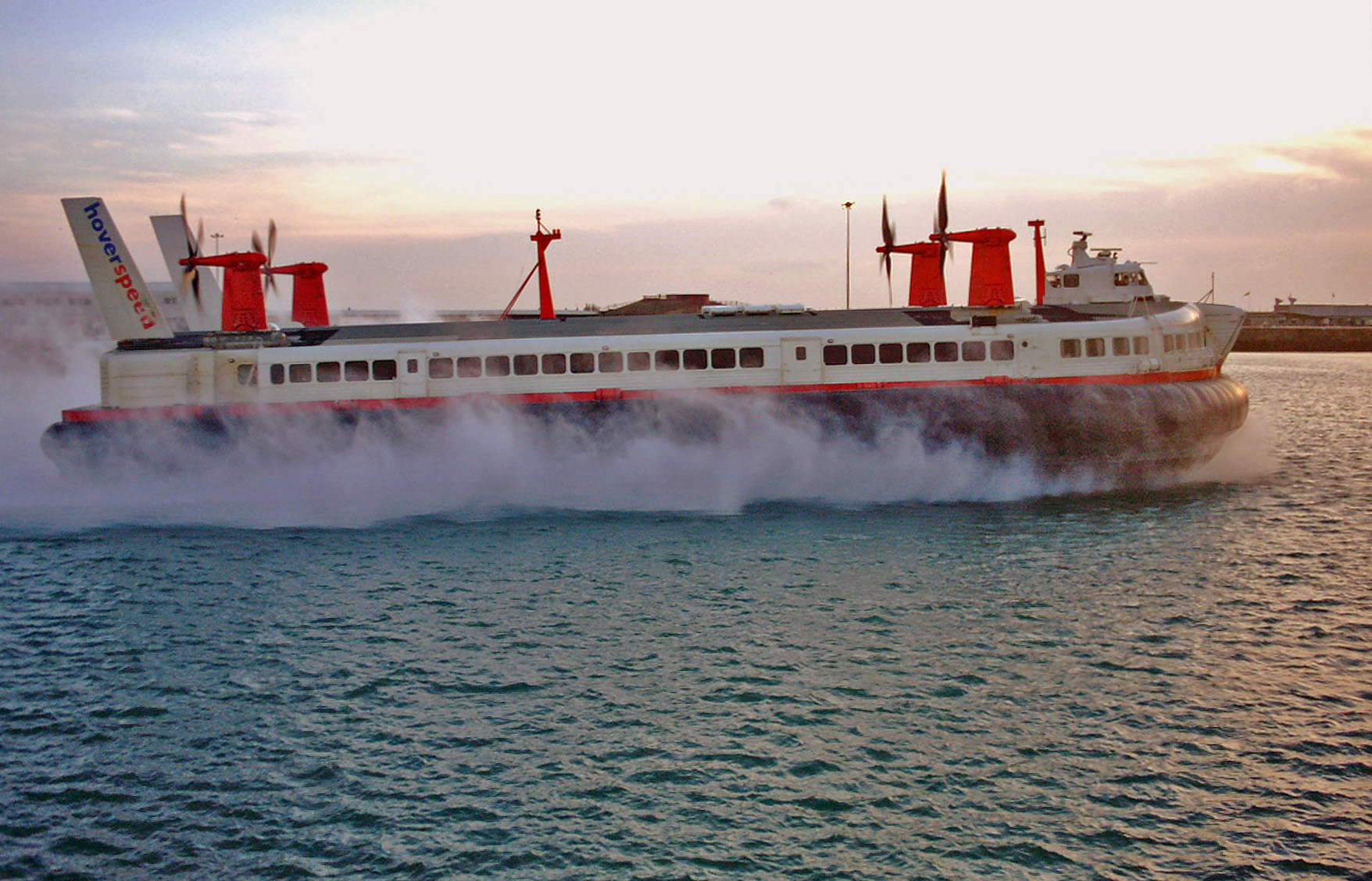
 Mark III SR.N4 arriving in Dover on its last commercial flight October 2000 | |
| Class overview | |
|---|---|
| Name | SR.N4 Mountbatten class |
| Builders | British Hovercraft Corporation |
| Operators | |
| In service | 1968–2000 |
| Completed | 6 |
| Active | 0 |
| Scrapped | 5 |
| Preserved | 1 |
| General characteristics (Mark III) | |
| Type | Hovercraft |
| Tonnage | 320 t |
| Length | 56.38 m (185 ft 0 in) |
| Beam | 23.77 m (78 ft 0 in) |
| Height | 11.48 m (37 ft 8 in) on landing pads |
| Installed power | 4 x 3,800 shp (2,800 kW) |
| Propulsion | 4 x Rolls-Royce Marine Proteus gas turbines for lift and propulsion, each driving a single four-bladed variable-pitch propeller |
| Speed | 70 knots (81 mph; 130 km/h) |
| Capacity | up to 60 cars and 418 passengers |
The SR.N4 (Saunders-Roe Nautical 4)[1] hovercraft (also known as the Mountbatten class hovercraft) is a retired combined passenger and vehicle-carrying class of hovercraft.[2] The type has the distinction of being the largest civil hovercraft to have ever been put into service.
Work on the SR.N4 was initiated in 1965 by Saunders-Roe. By the time that the vehicle's first trials took place in early 1968, Saunders-Roe had merged with Vickers' hovercraft division to form the British Hovercraft Corporation, who continued development. Power was provided by four Rolls-Royce Proteus marine turboshaft engines each driving its own lift fan and pylon-mounted steerable propulsion propeller. The SR.N4 was the largest hovercraft then built, designed to carry 254 passengers in two cabins besides a four-lane automobile bay which held up to 30 cars. Cars were driven from a bow ramp just forward of the wheelhouse. The first design was 40 metres (131 ft) long, weighed 190 long tons (193 t), was capable of 83 knots (96 mph; 154 km/h) and could cruise at over 60 knots (69 mph; 111 km/h).
The SR.N4s operated regular services across the English Channel between 1968 and 2000. In response to operator demands, stretched versions of the SR.N4 were developed, culminating in the Mk.III variant, which had almost double the capacity for carrying both cars and passengers as the Mk.I. While interest was expressed in military applications for the type, no vehicles were ultimately used for such purposes. Following the fleet's withdrawal from cross-channel services, a single remaining Mk.III example, GH-2007 Princess Anne, remains on static display at the Hovercraft Museum at Lee-on-Solent as of August 2021.
Development
[edit]Origins
[edit]In August 1962, the original concept for the SR.N4, which had been conceived at the same time as the SR.N2 was being designed, was abandoned.[3] This original concept had effectively been a pair of elongated SR.N2 fixed together in a side-by-side placement and would have been powered by an arrangement of four pairs of Blackburn A.129 turboshaft engines. In its place, a new proposed hovercraft, which was referred to as the SR.N4 as well, was considerably larger and heavier, and powered by three pairs of Rolls-Royce Proteus marinised gas turbine engine.[4] However, during early 1963, work on the SR.N4 was put on hold due to a greater priority having been placed on the completion of the SR.N5 instead. In late 1964, it was decided to recommence design work on the proposed SR.N4.[5]
By the end of 1964, it had been concluded that, due to the improved projected performance of the craft's flexible skirt having lowered the power requirements involved, only two pairs of Proteus engines would be required instead of three.[6] At this stage, the proposed design for the SR.N4 had a displacement of 165 tons and a payload of up to 33 cars and 116 passengers; this would not substantially differ from the final design adopted for the type.[6]
Experience gained from the SR.N5 and SR.N6 would contribute to the design of aspects of the larger SR.N4, which would be four times the size of any preceding hovercraft.[7][8] This approach is credited with having been less expensive and having resulted in a more commercially viable hovercraft than would have been if it had been constructed as per the earlier incarnation of the SR.N4 and then required to perform modifications to improve the capabilities of aspects such as the skirt, which had been considerably advanced by development of the SR.N5 and SR.N6.[9] Specific improvements included the adoption of triangular rubber 'finger'-like attachments to the curtain which provided for a better seal between the hovercraft and the water's surface as well as being cheaper and easier to maintain than previous configurations.[10]
During the mid-1960s, some management figures within British Rail had become interested in the potential for operating a fleet of hovercraft for scheduled services that would link up to Britain's national rail system.[11] In November 1965, Frank Cousins, the Minister of Technology, announced that British Rail would participate in the development of the SR.N4 and would be a customer for the type. While orders had already been placed for the SR.N4 by this point, the British Railways Board had decided to commit to taking delivery of the first craft to be produced; this was particularly convenient as the two orders which had been placed by Swedish operator Cross-Channel Hover Services specifically excluded accepting delivery of the first example.[12] By the end of 1965, having acquired three firm orders, it was now plausible for production of the SR.N4 to proceed.[13]
Prototype and testing
[edit]Having realised that the market for large hovercraft was not yet large enough to sustain a number of competing companies at that time, in 1966, the hovercraft divisions of both Saunders-Roe and Vickers Supermarine merged to form a new united entity, known as the British Hovercraft Corporation (BHC), which was headquartered on the Isle of Wight.[14] In autumn 1966, production work commenced on the structure of the first SR.N4, which was internally designated 001. The vehicle was assembled in the same hangar in which the three Saunders-Roe Princess flying boats had been constructed 15 years before.[9][6] During 1967, as 001 was taking shape, it was announced that the SR.N4 had been named the Mountbatten-class.[6] Throughout the development and production of 001, both Hoverlloyd and Seaspeed carefully monitored progress on the project.[15]
In October 1967, the completed 001 was officially presented to gathered members of the press and to various representatives and dignitaries.[16] On 20 November 1967, the first engine run was performed, after which 11 weeks of intense test runs on land were performed and the exposed faults were addressed. On 4 February 1968, 001 was launched onto water for the first time.[16][17] The launch, while successful, had involved some risk due to the lack of space to manoeuvre with an untested control system. Later that same day, 001 conducted its maiden flight.[16][18]
As experience with the prototype accumulated, the control arrangement proved to be quite effective even within confined spaces; incidents involving a loss of control did occur during the test programme, but these were mainly due to error on the part of the operator.[19] Ray Wheeler, BHC's chief engineer, was reportedly very pleased with the progress made during the initial trials. At the same time, 001 required substantial refinement and alteration in order to become a commercially viable craft.[20] The air intakes had to be substantially modified in order to minimise salt ingestion, and a revised skirt system was also developed.[20]
Design
[edit]![[icon]](https://en.wikipedia.org/wiki/File:Wiki_letter_w_cropped.svg) | This section needs expansion. You can help by adding missing information. (January 2017) |


The SR.N4 was the biggest hovercraft to have been completed upon its introduction. Its primary structure comprised a large modular buoyancy tank, the internal structure of which was divided into 24 watertight compartments.[21] It had an identical platform shape to the smaller SR.N5, being rectangular with a semi-circular bow and a beam-to-length ratio of 1:1.66.[22] The SR.N4 had a dual radar system for navigation, allowing the craft to operate in zero visibility - Type Racal Decca Bridgemaster. A GPS navigation system was fitted.[23]
The SR.N4 was powered by four Rolls-Royce Proteus turboprop engines.[6][24] The Proteus engines each drove a set of 19 ft (5.8 m) diameter steerable Dowty Rotol propellers, arranged in two pairs on pylons positioned on top of the craft's roof; upon the SR.N4's introduction to service, these were the largest propellers in the world.[22] Six independent electrohydraulic systems, each driven from the main gearboxes, powered the movement of the fins and pylons, while a further four units were used to actuate the variable-pitch propellers.[25]
The control cabin of the SR.N4 resembled the flight deck of an aircraft, being relatively cramped in comparison with the bridge of a typical vessel.[26] It housed a crew of three, comprising a captain, first officer/flight engineer, and a second officer/navigator; the main role of the second officer was to avoid collisions, primarily using a Decca 629 radar to do so.[26][27] The flying controls appeared broadly similar to a typical aircraft, using an assortment of rudder pedals, joysticks, yokes, separate propeller pitch levels, and engine speed controls; however, their functionality often differed substantially, such as the ability for the yoke to command the pitch of all four propellers.[26][28]
The SR.N4 is fitted with a 12-ton skirt which runs under the perimeter of the whole craft and employs a complex structure.[29] On the underside of the buoyancy tanks, five 21-inch[clarification needed] platforms (known as 'elephant feet') were positioned so that the craft could stably rest on three of them.[25]
Fuel was contained within flexible bags located at all four corners; the craft could be trimmed by redistributing fuel between the fore and aft tanks to better match the load and prevailing weather conditions.[22] The craft would consume 1,000 gallons per hour at a cruise of 50 knots (58 mph; 93 km/h) before refuelling with an approximate range of 150 miles (240 km). Maximum fuel capacity was 8,068 imp gal (36,680 L); about 29 tons.[30]
The stern of the craft featured a sizeable set of doors for the loading and unloading of vehicles onto the car deck as well as all four of the exhausts for the Proteus engines. Another set of loading doors was located at the bow.[24]
The SR.N4 could operate up to gale force 8 wind on the beaufort scale and 3.5m swell seas.[31]
Operational service
[edit]
Upon completion of the prototype SR.N4, Charles Brindle, the managing director of British Rail Hovercraft, was responsible for establishing the first cross-Channel route for scheduled services by the type.[32] In October 1966, Brindle and several engineers surveyed several potential sites on both the British and French sides of the English Channel using an SR.N6 to determine their suitability for the hovercraft service, which had been given the name Seaspeed. Amongst the most suitable candidates had been Dover or Folkestone on the English side and Calais or Boulogne on the French side.[33][34]
It was soon determined that Dover and Boulogne would be the preferable option for the maiden route, a decision that had been motivated in part by the local Chamber of Commerce having agreed to build a suitable hoverport to readily facilitate such operations.[35] As there was no funding available for pre-service passenger trials, the opening season of active operations effectively served as a continuation of the trials activities as well. Brindle was aware that BHC would not be paid until the SR.N4 was in service, and thus there was a considerable emphasis placed on getting the craft ready for commercial use right at the point of delivery.[36]
In August 1968, the first SR.N4 entered commercial service with the GH-2006 Princess Margaret being initially operated by Seaspeed between Dover and Boulogne.[citation needed] Rival operator Hoverlloyd built the world's first purpose-built hoverport at Ramsgate Hoverport, specifically designed for the SR.N4, to also serve the Calais route.[citation needed]
The journey time from Dover to Boulogne was roughly 35 minutes, with six trips per day being conducted at peak times. The fastest ever crossing of the English Channel by a commercial car-carrying hovercraft was 22 minutes, achieved on 14 September 1995 by the SR.N4 Mk.III GH-2007 Princess Anne on its 10:00 a.m. service.[37][38]

In 1972, the first SR.N4s were temporarily withdrawn for conversion to Mk.II specification which would provide for seven further car spaces and 28 more passengers. The first of the enlarged craft, the Swift, entered service at the beginning of February 1973.[39] The capacity increase was achieved by removing an inner passenger cabin in order to accommodate the extra cars and widening the outer passenger cabin: this was achieved without changing the overall footprint of the craft.[39] New aircraft-style forward-facing seats created an atmosphere of enhanced sophistication, and a redesigned skirt was intended to reduce window spray, enhancing the view out for passengers, and to give a smoother ride in rough seas: contemporary reports nevertheless commented on the "unsprung" nature of the ride.[39]
After 1976, a pair of SR.N4s were refitted with new deep skirts and stretched by almost 56.1 ft (17.1 m), increasing capacity to 418 passengers and 60 cars at the cost of a weight increase to roughly 320 t (315 long tons).[40] To maintain speed, the engines were upgraded to four 3,800 shaft horsepower (2,834 kW) models, which were fitted with four 21 ft (6.4 m) diameter steerable Dowty Rotol propellers. The work cost around £5 million for each craft, and they were designated Mark IIIs; the improvements allowed them to operate in seas up to 11 ft 6 in (3.5 m) high and with 57.5-mile-per-hour (92.5 km/h) winds.[41]
The two main commercial operators (Hoverlloyd and Seaspeed) merged in 1981 to form Hoverspeed, which operated six SR.N4 of all marks.[42] The last of the craft was withdrawn from service in October 2000 and Hoverspeed itself ceased operations in November 2005.[43]
Accidents
[edit]Most incidents were benign and resulted in little more than the vehicles towed back to shore. In 1978, the GH-2007 Princess Anne lost much of her air-cushion skirt in heavy seas 7 miles off Dover, resulting in a Marine Accident Investigation Branch investigation.[44] However, in March 1985, 4 passengers lost their lives when GH-2006 Princess Margaret crashed into a pier at the entrance of the Port of Dover from Calais in force 6 to 7 heavy seas.[45][46]
Military interest
[edit]The Royal Navy considered a mine sweeping version of the SR.N4, hovercraft being almost invulnerable to mines. A minesweeping version of the SR.N4 was thought to be capable of carrying the same equipment as a Hunt-class mine countermeasures vessel, while being cheaper to purchase, although more expensive to operate. The use of hovercraft for minesweeping never got further than the concept stage, although an SR.N3 was used by the Inter-Service Hovercraft Unit for trials.[47]
Surviving examples
[edit]
The two remaining Mk.III examples of the craft (GH-2006 Princess Margaret and GH-2007 Princess Anne) were bought by Wensley Haydon-Baillie for £500,000 and were stored at Lee-on-Solent, next to the Hovercraft Museum. Haydon-Baillie is the owner of the super yacht Brave Challenger which uses the same Rolls-Royce Proteus Marine engines as the SR.N4s. The purchase included seven years worth of spares including engines.
As of winter 2015 all engines and APUs had been removed from the craft. The SR.N4s were put up for sale and Hover Transit Services of Bolton, Ontario, proposed putting the hovercraft back in operation (following a US$10 million purchase and refurbishment) on Lake Ontario with service between Rochester, New York, and Toronto, Canada.[48] The plan did not come to fruition, with government officials concluding that the organisation lacked the experience necessary to be viable.[49]
The land on which the Hovercraft Museum stands is owned by Homes England. The proposed redevelopment of the site has led to the two craft being threatened with scrapping, but a petition was launched with the aim of preserving one of the craft,[50] which led into a 3-year lease of the hovercraft to the museum in August 2016 with the intention of subsequently permanently handing over the hovercraft to the museum, The Princess Anne was the craft chosen to be kept and will be restored in a former Seaspeed livery.[51]
In March 2018, GH-2006 Princess Margaret was scrapped at Lee-on-Solent.[52][53] GH-2007 The Princess Anne remains on site leased to the Hovercraft Museum.[54]
Production
[edit]
Built as Mk.I unless specified otherwise.
- 01 – GH-2006 Princess Margaret 1968, Seaspeed – originally the prototype, converted to Mk.III specification in 1979. Scrapped at Lee-on-Solent in March 2018
- 02 – GH-2004 Swift, Hoverlloyd – converted to Mk.II specification for February 1973, broken up in 2004 at the Hovercraft Museum
- 03 – GH-2005 Sure 1968, Hoverlloyd – converted to Mk.II specification in 1972, broken up in 1983 for spares
- 04 – GH-2007 Princess Anne, Seaspeed – converted to Mk.III specification in 1978, on display at the Hovercraft Museum
- 05 – GH-2008 Sir Christopher 1972, Hoverlloyd – converted to Mk.II specification in 1974, broken up 1998 for spares
- 06 – GH-2054 The Prince of Wales, Hoverlloyd – built as Mk.II, scrapped in 1993 following an electrical fire
Specification
[edit]Dimensions
[edit]| Mark 1 | Mark 2 | Mark 3 | |
|---|---|---|---|
| Length | 39.68 m (130 ft 2 in) | 56.38 m (185 ft 0 in) | |
| Beam | 23.77 m (78 ft 0 in) | ||
| Height | 11.48 m (37 ft 8 in) on landing pads | ||
| Gross weight | 165 t | 200 t | 320 t |
| Powerplant | 4 x 3,400 shp Rolls-Royce Proteus gas turbines | 4 x 3,800 shp Rolls-Royce Proteus gas turbines | |
| Load: | 30 cars and 250 passengers | 36 cars and 278 passengers | up to 60 cars and 418 passengers (112 tonnes maximum) |
Performance
[edit]- Max speed: Mark 1 – 65 knots (75 mph; 120 km/h) (calm water, zero wind, at gross laden weight)
Mk.II – 70 knots (81 mph; 130 km/h) - Normal operating speeds: 40 – 60 knots (69 mph; 110 km/h)
- Endurance: 4 hours (maximum power, 2,800 Imperial gallons of fuel)
- Gradient: 1 in 11
See also
[edit]References
[edit]Citations
[edit]- ^ "James' Hovercraft Site: SRN4". Retrieved 22 March 2008.
- ^ Wragg, David W. (1973). A Dictionary of Aviation (first ed.). Osprey Publishing. p. 250. ISBN 9780850451634.
- ^ Paine & Syms 2012, pp. 131, 236.
- ^ Paine & Syms 2012, p. 131.
- ^ Paine & Syms 2012, pp. 131, 147.
- ^ a b c d e Paine & Syms 2012, p. 238.
- ^ Paine & Syms 2012, p. 167–168.
- ^ Paine & Syms 2012, p. 202.
- ^ a b Paine & Syms 2012, p. 236.
- ^ Paine & Syms 2012, p. 236–238.
- ^ Paine & Syms 2012, p. 201–202.
- ^ Paine & Syms 2012, p. 202–203.
- ^ Paine & Syms 2012, p. 203.
- ^ Paine & Syms 2012, p. 165–166.
- ^ Paine & Syms 2012, p. 295.
- ^ a b c Paine & Syms 2012, p. 249.
- ^ Paine & Syms 2012, p. 297.
- ^ Paine & Syms 2012, p. 297–300.
- ^ Paine & Syms 2012, p. 303–305.
- ^ a b Paine & Syms 2012, p. 305.
- ^ Paine & Syms 2012, p. 240–241.
- ^ a b c Paine & Syms 2012, p. 241.
- ^ Investigation of Heavy Weather Damage, Annex 1.
- ^ a b Paine & Syms 2012, p. 242.
- ^ a b Paine & Syms 2012, p. 244.
- ^ a b c Paine & Syms 2012, p. 353.
- ^ Paine & Syms 2012, p. 379.
- ^ Paine & Syms 2012, p. 366–367.
- ^ Paine & Syms 2012, p. 513.
- ^ Yun, Liang; Bliault, Alan (2000). Theory and Design of Air Cushion Craft. Elsevier Science. p. 13. ISBN 9780080519067.
- ^ Investigation of Heavy Weather Damage, p. 9.
- ^ Charles Anthony Brindle National Railway Museum
- ^ Paine & Syms 2012, p. 230.
- ^ Paine & Syms 2012, p. 234.
- ^ Paine & Syms 2012, p. 230–234.
- ^ Paine & Syms 2012, p. 309–310.
- ^ "Hovercraft Facts". 1966: Hovercraft deal opens show. BBC News. 15 June 1966. Retrieved 9 April 2010.
- ^ "Hovercraft". Dover – Lock and Key of the Kingdom. www.dover-kent.co.uk. Archived from the original on 17 September 2012. Retrieved 23 January 2008.
- ^ a b c "Hovering along on the Crest of a Wave". Autocar. 8 February 1973. p. 6.
- ^ Paine & Syms 2012, p. 595.
- ^ Paine & Syms 2012, p. 595–596.
- ^ Parkinson, Justin (9 November 2015). "What happened to passenger hovercraft?". BBC News Magazine. UK. Retrieved 18 June 2023.
- ^ "Many jobs lost as ferries stop". BBC News. 4 November 2005. Retrieved 18 June 2023.
- ^ Investigation of Heavy Weather Damage.
- ^ Hollebone, Ashley (2012). The Hovercraft: A History. History Press. p. 26. ISBN 9780752490519.
- ^ "Report of the inquiry into the accident to hovercraft 'The Princess Margaret'". National Archives. England.
- ^ Brown & Moore 2012, p. 140–141.
- ^ "Can Fast Hovercraft Service Between U.S. And Toronto Stay Afloat?". CityNews. 9 April 2008. Retrieved 10 September 2010.
- ^ "Has fast ferry idea's time passed?". Toronto Star. 15 July 2008. Retrieved 29 March 2013.
- ^ "Petition to save last cross-Channel hovercraft". BBC News. 30 January 2016. Retrieved 4 February 2016.
- ^ "Cross-Channel hovercraft Princess Anne 'to open to public'". BBC News. 15 August 2016.
- ^ SRN4 Hovercraft Demolished Ships Monthly June 2018 page 7
- ^ Regional News Rail issue 857 18 July 2018 page 27
- ^ "Cross-Channel hovercraft Princess Margaret scrapped". BBC News. 24 May 2018.
Bibliography
[edit]- Brown, David K.; Moore, George (2012). Rebuilding the Royal Navy: Warship Design since 1945. Barnsley, England: Seaforth Publishing. ISBN 978-1-84832-150-2.
- Paine, Robin; Syms, Roger (2012). On a Cushion of Air: The Story of Hoverlloyd and the Cross-Channel Hovercraft. Robin Paine. ISBN 978-0-95689-780-0.
- Report of the Investigation of Heavy Weather Damage to Hovercraft GH2007 The Princess Anne (PDF) (Technical report). Marine Accident Investigation Branch. 5 June 2000.
External links
[edit]
- Hovercraft Museum: SR.N4 Mk.I Archived 12 March 2007 at the Wayback Machine
- Hovercraft Museum: SR.N4 Mk.II Archived 11 December 2004 at archive.today
- Hovercraft Museum: SR.N4 Mk.III Archived 12 March 2007 at the Wayback Machine
- Brave Challenger
SR.N4
View on GrokipediaDevelopment
Origins
The development of the SR.N4 hovercraft was rooted in the pioneering work on air-cushion vehicles that began with Christopher Cockerell's invention in the mid-1950s. Cockerell's concept gained traction when the National Research Development Corporation (NRDC) sponsored the project in 1958, leading Saunders-Roe—a post-war British aviation firm with expertise in large-scale structures—to construct the SR.N1, the world's first practical hovercraft, which made its inaugural flight in 1959. This success spurred further advancements, including the SR.N2 in 1961, which entered commercial passenger service across the Solent and demonstrated the viability of hovercraft for short-sea routes, and the SR.N5 in 1964, the first mass-produced model that carried up to 60 passengers and paved the way for broader applications.[6][7] By the mid-1960s, the hovercraft industry faced the need for larger vessels to meet commercial demands, particularly for the English Channel. In March 1966, the British Hovercraft Corporation (BHC) was formed through the merger of Saunders-Roe's hovercraft division (under Westland Aircraft) and Vickers Supermarine's equivalent operations, with NRDC encouragement and a 10% shareholding to consolidate expertise and resources. This organizational shift enabled the pursuit of ambitious projects, building on the aviation heritage of the partners to tackle scaled-up designs. The NRDC's overall investment in hovercraft research and development, totaling around £10 million by 1969, provided crucial government backing to transition from prototypes to viable commercial transport.[8][6] The SR.N4's inception stemmed from a 1965 decision to create a 150-200-ton class vehicle for cross-Channel operations, driven by economic pressures including rising tourism, trade volumes, and competition from conventional ferries that took up to 90 minutes for the crossing. In June 1965, Swedish Lloyd and the Swedish American Line placed the initial order for two SR.N4s through the newly formed Hoverlloyd for the Ramsgate-Calais route, followed by British Rail's order for the Dover-Boulogne service; these vessels were specified to accommodate 254 passengers and 30 cars, aiming to halve travel times to about 35 minutes while operating in diverse weather conditions. This move was motivated by the limitations of existing ports for larger ferries and the strategic goal of establishing a "motorway across the sea," positioning hovercraft as a faster alternative amid early discussions of fixed-link options like the Channel Tunnel proposed in the 1960s. The NRDC's funding supported these efforts, emphasizing the potential for hovercraft to enhance UK transport competitiveness.[9][10][11]Prototyping and testing
The first prototype of the SR.N4, designated Mk.I and hull number GH-2006, was launched on February 4, 1968, at the British Hovercraft Corporation's facility in Cowes on the Isle of Wight; it was later christened Princess Margaret. This marked the initial physical realization of the project, stemming from earlier conceptual work on large-scale passenger-carrying hovercraft. The prototype underwent initial structural and systems checks following launch, with construction emphasizing lightweight aluminum alloys for the hull to achieve the targeted 165-ton displacement. Key engineering trials focused on critical components, including skirt development to enhance stability over waves up to 4 feet high, integration of the four Rolls-Royce Marine Proteus gas turbine engines (each rated at approximately 3,400 shaft horsepower) for combined lift and propulsion, and calibration of the navigation and control systems. The engines drove centrifugal lift fans and variable-pitch propellers mounted on swiveling pylons, requiring extensive ground and water tests to ensure synchronized operation and efficient air cushion maintenance. The prototype achieved its first sustained hover in July 1968, validating basic air cushion functionality after months of component-level testing.[5][3][12] Several challenges emerged during testing, notably excessive noise from the Proteus engines and propellers, which exceeded acceptable levels for passenger comfort and prompted iterative muffler and exhaust redesigns; skirt wear from repeated wave impacts and abrasive surfaces, addressed through material reinforcements; and handling difficulties in crosswinds up to 30 knots, which affected directional stability. A significant advancement was the transition from an initial annular skirt design—prone to uneven inflation and higher drag—to a looped finger (or segment) configuration, which improved wave clearance, reduced air leakage, and enhanced overall seakeeping by allowing independent segment flexing. These modifications were tested iteratively on the prototype, with the looped finger skirt fitted by late 1968 to boost durability.[3][13][12] The certification process involved rigorous evaluations by the Civil Aviation Authority (CAA) for aeronautical aspects and the Board of Trade for maritime safety compliance, culminating in approvals by late 1968 under the newly enacted Hovercraft Act. This included static load tests simulating full passenger and vehicle payloads (up to 30 cars and 254 passengers) and dynamic sea trials in the Solent and English Channel, where the prototype demonstrated speeds of 70 knots in calm conditions, confirming operational viability prior to commercial entry.[14][15][16]Design
Air cushion system
The SR.N4 utilized a peripheral jet air cushion system to generate lift, enabling the hovercraft to float on a pressurized layer of air while traversing land, water, or ice. This system relied on four large centrifugal fans, each measuring 3.5 meters in diameter with 12 blades, driven by the craft's four Rolls-Royce Marine Proteus gas turbine engines, each of which also provides power for propulsion. These fans directed high-volume airflow downward through peripheral nozzles around the craft's perimeter, creating a plenum chamber beneath the hull that maintained a hover clearance of approximately 1.5 meters (5 feet). The design provided buoyancy and stability for the large-scale vehicle, supporting operations over varied surfaces without direct contact.[17] The skirt system was integral to containing the air cushion and enhancing efficiency, evolving significantly across variants to address performance in open water. Early Mk.I models featured a basic flexible skirt, but the Mk.II introduced an upgraded looped-finger configuration with enhanced bow protection and durability, allowing reliable operation in waves up to 1.8 meters (6 feet). Constructed from rubberized fabric such as neoprene-coated nylon, the skirt's lower section consisted of segmented fingers that flexed independently to seal the cushion while minimizing drag and leakage. This material composition balanced flexibility, air retention, and abrasion resistance, though skirts required regular maintenance and periodic replacement due to wear from wave impact, debris, and repeated inflation cycles, posing logistical challenges for high-utilization ferry operations.[5][18][19][20][21] Buoyancy was ensured by a modular hull structure incorporating 24 watertight compartments formed from light alloy, divided into sub-sections for compartmentalized flotation. These tanks, integrated into the primary frame, maintained positive buoyancy equivalent to 500% of the craft's displacement even if multiple sections were breached or the air cushion failed entirely, prioritizing safety in amphibious scenarios. The design distributed loads across the grid-like framework, preventing catastrophic flooding from isolated damage.[22] The air cushion system supported a gross weight of up to 320 tonnes in the stretched Mk.III variant, distributing the load via the pressurized plenum to achieve static and dynamic stability. Cushion pressure was fundamentally determined by the equation , where is the vehicle weight, is the cushion area (approximately 1,340 m² based on hull length of 56.4 m and beam of 23.8 m), and accounts for dynamic factors such as wave-induced leakage or acceleration. This yielded a nominal static pressure of about 2.3 kPa, sufficient to sustain hover while accommodating payloads like 30 cars and 250 passengers.[23][24][12]Propulsion and controls
The SR.N4 hovercraft was powered by four Rolls-Royce Marine Proteus gas turbines, each delivering 3,400 shaft horsepower (uprated to 3,800 shp in Mk III variants) for both lift and propulsion functions.[22][25] These turboshaft engines, derived from aero technology, were mounted in pairs at the rear of the craft, with each unit driving an integrated centrifugal lift fan and a separate propulsion propeller through a dual-output gearbox.[5] The total power output enabled high-speed over-water travel while maintaining the air cushion, with the engines operating at full rating during takeoff and cruise.[25] Propulsion was provided by four ducted, four-bladed variable-pitch propellers mounted on swiveling pylons, measuring 6.4 meters (21 feet) in diameter on Mk III variants.[5] This configuration allowed for precise thrust vectoring, permitting the craft to achieve a maximum speed of 70 knots and facilitating maneuvers such as reversing and braking by adjusting propeller pitch and pylon angle.[22] The skirt system briefly referenced from the air cushion design contributed to stability by channeling lift air effectively during forward motion.[5] The control systems featured a forward cockpit with stations for two pilots and an engineer, incorporating dual Decca radar units (including the Type 629 model) for all-weather navigation and collision avoidance.[25] An integrated autopilot assisted in maintaining course and altitude over water, while the multi-engine setup provided redundancy, allowing power rerouting from remaining units in case of a single engine failure to sustain operations.[22] Fuel consumption averaged 1,000 imperial gallons per hour at 50-knot cruise, supporting operational ranges of around 200 nautical miles.Production
Construction details
The SR.N4 hovercraft were manufactured at the British Hovercraft Corporation's (BHC) facility in East Cowes on the Isle of Wight, a site originally associated with Saunders-Roe before its integration into BHC as a subsidiary of Westland Aircraft.[4] This location leveraged existing expertise in marine and aeronautical engineering for large-scale amphibious vehicle production. Construction of the initial units commenced in 1967, with launches and completions spanning 1968 to 1977 for the six craft in the series.[26] The hull framing was primarily constructed from high-strength aluminium alloy, clad and treated for resistance to seawater corrosion to ensure structural durability in marine environments.[22] Welded construction techniques were employed to achieve watertight integrity, with the aluminium hull fabricated in sections that contributed to the overall rigidity of the buoyancy structure.[27] The flexible skirts, essential for maintaining the air cushion, consisted of rubberized fabric rather than rigid materials, allowing for efficient sealing against the surface during operation.[10] Assembly followed a modular approach, beginning with the fabrication of buoyancy tanks and plenum chambers to form the base structure, followed by integration of the four Rolls-Royce Marine Proteus gas-turbine engines for lift and propulsion.[28] Subsequent stages involved installing air ducting, passenger compartments, and vehicle decks, culminating in final outfitting such as electrical systems, controls, and interior furnishings.[28] This process was supported by BHC's production line capabilities, enabling the scaling from prototype testing to series production.[13] Each SR.N4 unit cost approximately £1.5 million in 1968 terms, reflecting the advanced engineering and materials involved.[29] Funding was provided by the primary operators, including Seaspeed (a British Rail subsidiary), which ordered GH-2006 Princess Margaret and GH-2007 Princess Anne, and Hoverlloyd, which ordered GH-2004 Swift, GH-2005 Sure, GH-2008 Sir Christopher, and GH-2054 The Prince of Wales, for cross-Channel ferry services.[5][26]Variants
The SR.N4 hovercraft was developed across three primary marks, each incorporating progressive enhancements to address operational challenges such as skirt wear, passenger comfort, and capacity demands for cross-Channel service. The Mk.I represented the initial production model, while subsequent marks focused on skirt durability, interior refinements, and structural expansions to boost efficiency and payload. No military variants were produced, as the design remained oriented toward civilian ferry operations.[10] The Mk.I, operational from 1968 to the early 1970s, featured a baseline configuration with capacity for 254 passengers and 30 cars, utilizing basic segmented skirts prone to wear from high-speed water contact. Four units were constructed to this standard: Princess Margaret (GH-2006, launched 1968), Princess Anne (GH-2007, launched 1969), Swift (GH-2004, launched 1969), and Sure (GH-2005, launched 1969). These early models established the core air cushion and propulsion systems but required frequent skirt replacements due to friction and environmental exposure.[26][5] The Mk.II variant addressed key limitations of the Mk.I through upgraded skirts with improved segmentation and materials for enhanced durability and reduced drag, alongside refined interiors that expanded the car deck to accommodate 36 vehicles and increased passenger space to 278. The initial four Mk I units were upgraded to Mk II specifications in 1973–1974. Two additional units were built to Mk II standard from the outset: Sir Christopher (GH-2008, launched 1972) and The Prince of Wales (GH-2054, launched 1977). These changes minimized skirt failures and improved ride stability over rough seas.[26][5] The Mk.III, entering service in 1977, marked the most substantial evolution with a 16.9-meter fuselage stretch that enlarged overall dimensions to 56.4 meters in length and 28 meters in beam, boosting capacity to 418 passengers and 55 cars. Powered by uprated Rolls-Royce Proteus engines delivering 2,833 kW each (compared to 2,535 kW in prior marks), it incorporated deeper 7.5-meter skirts for superior cushion retention and a dual radar navigation system for safer all-weather operations. The two units converted to this standard were Princess Margaret (GH-2006) and Princess Anne (GH-2007), both previously Mk II, optimized for higher payloads and reliability.[24][5][26] Mid-life refits across the fleet, particularly post-1976 for the Mk.I and Mk.II conversions to Mk.III standards, included skirt reinforcements with advanced fabrics to extend service life and engine muffling modifications that reduced cabin noise levels by integrating acoustic barriers around the Proteus turbines. These upgrades ensured sustained performance amid increasing regulatory pressures on environmental impact, without altering the fundamental design.[5][10]| Variant | Passenger Capacity | Car Capacity | Key Upgrades | Units Built/Converted |
|---|---|---|---|---|
| Mk.I (1968–early 1970s) | 254 | 30 | Basic skirts; initial Proteus engines (2,535 kW each) | 4 (Princess Margaret GH-2006, Princess Anne GH-2007, Swift GH-2004, Sure GH-2005) |
| Mk.II (1972–1977) | 278 | 36 | Improved skirts for durability; expanded interiors | Upgrades of 4 Mk I + 2 new (Sir Christopher GH-2008, The Prince of Wales GH-2054) |
| Mk.III (1977) | 418 | 55 | Stretched hull; deeper skirts; enhanced engines (2,833 kW each); dual radar | 2 conversions (Princess Margaret, Princess Anne) |