Recent from talks
Nothing was collected or created yet.
Mouse lemur
View on Wikipedia
| Mouse lemurs | |
|---|---|
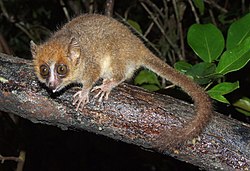
| Pygmy mouse lemur (M. myoxinus) | |
| Scientific classification | |
| Kingdom: | Animalia |
| Phylum: | Chordata |
| Class: | Mammalia |
| Order: | Primates |
| Family: | Cheirogaleidae |
| Genus: | Microcebus É. Geoffroy, 1834[1] |
| Type species | |
| Lemur pusillus É. Geoffroy, 1795
| |
| Diversity | |
| About 25 species | |
| Combined distribution of Microcebus[3] | |
| Synonyms[1][4] | |
| |
The mouse lemurs are nocturnal lemurs of the genus Microcebus. Like all lemurs, mouse lemurs are native to Madagascar.[4]
Mouse lemurs have a combined head, body and tail length of 20–30 centimetres (7.9–11.8 in) and weigh 30–65 grams (1.1–2.3 oz),[5] making them the smallest primates[6] (the smallest species being Madame Berthe's mouse lemur); however, their weight fluctuates in response to daylight duration.[7] Lemurs and mouse lemurs were announced by the IUCN as the most endangered of all vertebrates. There were two known mouse lemur species in 1992; by 2016, there were 24.[8] It was estimated that the 24 mouse lemur species evolved from a common ancestor 18–11 million years ago.[9] They can live for about 18 years in captivity.[10] Gestation is about 2 months.[10] The total population for mouse lemurs isn't yet known.[10]
Habitat
[edit]Mouse lemurs, like all lemurs, are endemic to Madagascar.[11] They live within the treetops in dry deciduous forests, sub-arid thorn scrublands, and secondary forests, as well as in coastal and bamboo forests, making burrows in the tree trunks.[11]
Diet
[edit]Mouse lemurs are omnivorous; their diets are diverse and include insect secretions, arthropods, small vertebrates, gum, fruit, flowers, nectar, and also leaves and buds depending on the season.[12]
Morphology
[edit]Mouse lemurs are considered cryptic species—with very little morphological differences between the various species, but with high genetic diversity. Recent evidence points to differences in their mating calls, which are very diverse. Since mouse lemurs are nocturnal, they might not have evolved to look different, but have evolved various auditory and vocal systems.[citation needed]
Mouse lemur brains can weigh less than 2 grams (0.071 oz) while their testes can weigh 2.5 grams (0.088 oz).[13]
As written in Genetics, mouse lemurs help to provide a more extensive understanding of the biology, behavior, and health of primates. Mouse lemurs are categorized as prosimian primates. They are among the smallest and most rapidly developing primates and are becoming more abundant in Madagascar and around the world. These tiny creatures are helping to prove valuable information about the biology and evolution of primates through the analysis of their phenotypes and mutations, especially as a model organism for human medical research.[14]
Behavior
[edit]Mouse lemurs live in a female dominated structure. Mouse lemurs are nocturnal, spending the day aloft the trees and at night gathering their food.[15] During the dry season females will become less active and tend to rarely leave their homes, while the males go out and gather food.[15] Mouse lemurs tend to live in closely related groups when no female kin are near, and the females sleep alone.[16]
Reproduction and evolution
[edit]Mouse lemurs are also known for their sperm competition. During breeding seasons, the testicles of male mouse lemurs increase in size to about 130% of their normal size. This was speculated to increase the sperm production thereby conferring an advantage for the individual to bear more offspring. There are various hypotheses relating the rapid evolution of mouse lemur species to this sperm competition.[17] In sexually inactive females the vulva is sealed, during the reproductive cycle the vulva is open. The vaginal morphology is also based on the time of day.[18] Analysis of the genomes of five different mouse lemur species revealed that Madagascar's biogeography had been undergoing change before the arrival of humans.[19]
Species
[edit]- Genus Microcebus: mouse lemurs[20]
- Arnhold's mouse lemur, M. arnholdi[21]
- Madame Berthe's mouse lemur, M. berthae
- Bongolava mouse lemur M. bongolavensis[22]
- Boraha mouse lemur M. boraha[23]
- Danfoss' mouse lemur M. danfossi[22]
- Ganzhorn's mouse lemur. M. ganzhorni[23]
- Gerp's mouse lemur. M. gerpi[24]
- Reddish-gray mouse lemur, M. griseorufus
- Jolly's mouse lemur, M. jollyae
- Jonah's mouse lemur, M. jonahi
- Goodman's mouse lemur, M. lehilahytsara
- MacArthur's mouse lemur, M. macarthurii[25]
- Claire's mouse lemur, M. mamiratra, synonymous to M. lokobensis[22]
- Bemanasy mouse lemur, M. manitatra[23]
- Margot Marsh's mouse lemur, M. margotmarshae[21]
- Marohita mouse lemur, M. marohita[26][27]
- Mittermeier's mouse lemur, M. mittermeieri
- Gray mouse lemur, M. murinus
- Pygmy mouse lemur, M. myoxinus
- Golden-brown mouse lemur, M. ravelobensis
- Brown mouse lemur, M. rufus
- Sambirano mouse lemur, M. sambiranensis
- Simmons' mouse lemur, M. simmonsi
- Anosy mouse lemur. M. tanosi[26][27]
- Northern rufous mouse lemur, M. tavaratra[28]
References
[edit]- ^ a b McKenna, MC; Bell, SK (1997). Classification of Mammals: Above the Species Level. Columbia University Press. p. 335. ISBN 978-0-231-11013-6.
- ^ "Checklist of CITES Species". CITES. UNEP-WCMC. Retrieved 18 March 2015.
- ^ "IUCN 2014". IUCN Red List of Threatened Species. Version 2014.3. International Union for Conservation of Nature. 2012. Retrieved 12 March 2015.
- ^ a b Groves, C. P. (2005). "Microcebus". In Wilson, D. E.; Reeder, D. M. (eds.). Mammal Species of the World: A Taxonomic and Geographic Reference (3rd ed.). Baltimore: Johns Hopkins University Press. ISBN 0-801-88221-4. OCLC 62265494.
- ^ Schwitzer, C; Mittermeier, R. A.; Louis Jr., E. E.; Richardson, M. C. (2013). "Family Cheirogaleidae: Mouse, giant mouse, dwarf and fork-marked lemurs". In Mittermeier, Russell A.; Rylands, Anthony B.; Wilson, Don E. (eds.). Handbook of the Mammals of the World. Volume 3. Primates. Barcelona: Lynx Edicions. p. 30. ISBN 978-84-96553-89-7.
- ^ "Primate Factsheets: Mouse lemur (Microcebus) Taxonomy, Morphology, & Ecology". wisc.edu.
- ^ Andrès, M; Gachot-Neveu, H; Perret, M (2001). "Genetic determination of paternity in captive grey mouse lemurs: pre-copulatory sexual competition rather than sperm competition in a nocturnal prosimian?". Behaviour. 138 (8): 1047–63. doi:10.1163/156853901753286560.
- ^ "Yoder Lab – Research". duke.edu.
- ^ Horvath, Julie E.; Weisrock, David W.; Embry, Stephanie L.; Fiorentino, Isabella; Balhoff, James P.; Kappeler, Peter; Wray, Gregory A.; Willard, Huntington F.; Yoder, Anne D. (2008). "Development and application of a phylogenomic toolkit: Resolving the evolutionary history of Madagascar's lemurs". Genome Research. 18 (3): 489–499. doi:10.1101/gr.7265208. PMC 2259113. PMID 18245770.
- ^ a b c "Mouse lemur". Wisconsin National Primate Research Center. Retrieved 2025-10-15.
- ^ a b "Mouse Lemurs | National Geographic". Animals. 2010-11-11. Retrieved 2025-10-15.
- ^ Schwitzer, C; Mittermeier, R. A.; Louis Jr., E. E.; Richardson, M. C. (2013). "Family Cheirogaleidae: Mouse, giant mouse, dwarf and fork-marked lemurs". In Mittermeier, Russell A.; Rylands, Anthony B.; Wilson, Don E. (eds.). Handbook of the Mammals of the World. Volume 3. Primates. Barcelona: Lynx Edicions. p. 42. ISBN 978-84-96553-89-7.
- ^ Montgomery, S. H.; Capellini, I.; Venditti, C.; Barton, R. A.; Mundy, N. I. (2011). "Adaptive Evolution of Four Microcephaly Genes and the Evolution of Brain Size in Anthropoid Primates". Molecular Biology and Evolution. 28: 625–638. doi:10.1093/molbev/msq237. PMID 20961963.
- ^ Ezran, Camille; Karanewsky, Caitlin J.; Pendleton, Joseph L.; Sholtz, Alex; Kransnow, Maya R.; Willick, Jason; Razafindrakoto, Andriamahery; Zohdy, Sarah; Albertelli, Megan A. (June 2017). "The Mouse Lemur, a Genetic Model Organism for Primate Biology, Behavior, and Health". Genetics. 206 (2). Mark A. Krasnow also contributed as a writer: 651–664. doi:10.1534/genetics.116.199448. PMC 5499178. PMID 28592502.
- ^ a b "Mouse Lemurs | National Geographic". Animals. 2010-11-11. Retrieved 2025-10-15.
- ^ "Mouse lemur". Wisconsin National Primate Research Center. Retrieved 2025-10-15.
- ^ Folia Primatol (Basel). 2003 Sep–Dec;74(5–6):355-66. Mating system in mouse lemurs: theories and facts, using analysis of paternity. Andrès M1, Solignac M, Perret M.
- ^ Rina Evasoa, Mamy; Radespiel, Ute; Hasiniaina, Alida F.; Rasoloharijaona, Solofonirina; Randrianambinina, Blanchard; Rakotondravony, Romule; Zimmermann, Elke (2018-05-16). "Variation in reproduction of the smallest-bodied primate radiation, the mouse lemurs (Microcebus spp.): A synopsis". American Journal of Primatology. 80 (7) e22874. doi:10.1002/ajp.22874. ISSN 0275-2565. PMID 29767414. S2CID 21709451.
- ^ Golembiewski, Kate (18 July 2016). "Ridiculously Cute Mouse Lemurs Hold Key to Madagascar's Past". Field Museum of Natural History. Retrieved 13 January 2022.
- ^ Mittermeier, Russell A.; Ganzhorn, Jörg U.; Konstant, William R.; Glander, Kenneth; Tattersall, Ian; Groves, Colin P.; Rylands, Anthony B.; Hapke, Andreas; Ratsimbazafy, Jonah; Mayor, Mireya I.; Louis, Edward E.; Rumpler, Yves; Schwitzer, Christoph; Rasoloarison, Rodin M. (December 2008). "Lemur Diversity in Madagascar". International Journal of Primatology. 29 (6): 1607–1656. doi:10.1007/s10764-008-9317-y. hdl:10161/6237. S2CID 17614597.
- ^ a b Louis, Edward E. (2008). "Revision of the Mouse Lemurs, Microcebus (Primates, Lemuriformes), of Northern and Northwestern Madagascar with Descriptions of Two New Species at Montagne d'Ambre National Park and Antafondro Classified Forest" (PDF). Primate Conservation. 23: 19–38. doi:10.1896/052.023.0103. S2CID 84533039. Archived from the original (PDF) on 2009-02-05.
- ^ a b c Stafford, Ned (2006-11-20). "Nature News: Lemur boom on Madagascar". Nature: news061120–15. doi:10.1038/news061120-15. S2CID 84701328. Retrieved 2007-12-10.
- ^ a b c Scott Hotaling; Mary E. Foley; Nicolette M. Lawrence; Jose Bocanegra; Marina B. Blanco; Rodin Rasoloarison; Peter M. Kappeler; Meredith A. Barrett; Anne D. Yoder; David W. Weisrock (2016). "Species discovery and validation in a cryptic radiation of endangered primates: coalescent-based species delimitation in Madagascar's mouse lemurs". Molecular Ecology. 25 (9): 2029–2045. Bibcode:2016MolEc..25.2029H. doi:10.1111/mec.13604. PMID 26946180. S2CID 43912903.
- ^ Radespiel, U.; Ratsimbazafy, J. H.; Rasoloharijaona, S.; Raveloson, H.; Andriaholinirina, N.; Rakotondravony, R.; Randrianarison, R. M.; Randrianambinina, B. (2011). "First indications of a highland specialist among mouse lemurs (Microcebus spp.) and evidence for a new mouse lemur species from eastern Madagascar". Primates. 53 (2): 157–170. doi:10.1007/s10329-011-0290-2. PMID 22198090. S2CID 8473176.
- ^ "New Primate Species Discovered on Madagascar". Archived from the original on 2011-07-19. Retrieved 2008-07-15.
- ^ a b Rasoloarison, Rodin M.; Weisrock, David W.; Yoder, Anne D.; Rakotondravony, Daniel; Kappeler, Peter M. (2013). "Two New Species of Mouse Lemurs (Cheirogaleidae: Microcebus) from Eastern Madagascar". International Journal of Primatology. 34 (3): 1–15. doi:10.1007/s10764-013-9672-1. S2CID 17860060.
- ^ a b Pappas, Stephanie (26 March 2013). "Tiny Lemur Twins Are 2 New Species". LiveScience.
- ^ Schüßler, Dominik; Blanco, Marina B.; Salmona, Jordi; Poelstra, Jelmer; Andriambeloson, Jean B.; Miller, Alex; Randrianambinina, Blanchard; Rasolofoson, David W.; Mantilla-Contreras, Jasmin; Chikhi, Lounès; Louis, Edward E. (2020). "Ecology and morphology of mouse lemurs (Microcebus spp.) in a hotspot of microendemism in northeastern Madagascar, with the description of a new species". American Journal of Primatology. 82 (9) e23180. doi:10.1002/ajp.23180. ISSN 1098-2345. PMID 32716088.
External links
[edit]- Mouse lemur skeleton – Skeleton from the University of Texas at Austin
- BBC video clips and news articles
Mouse lemur
View on GrokipediaTaxonomy and classification
Genus overview
The genus Microcebus comprises the mouse lemurs, a group of small, nocturnal primates in the family Cheirogaleidae, endemic to Madagascar. These are the world's smallest living primates, with species exhibiting head-body lengths of 9–13 cm, tail lengths of 11–15 cm, and body masses ranging from 30 g in Microcebus berthae to approximately 70 g in larger congeners like Microcebus ravelobensis.[8][1] Mouse lemurs are arboreal, primarily inhabiting diverse forest types across the island, including dry deciduous, spiny, and humid evergreen forests, where they forage solitarily at night for insects, fruit, and gum.[1][3] Taxonomic recognition within Microcebus has expanded rapidly due to molecular and morphological analyses revealing cryptic species diversity; as of 2024, 25 species are recognized, with ongoing debates over additional putative taxa.[9] This diversification reflects Madagascar's biogeographic isolation, with species distributions often limited to specific riverine or habitat barriers.[10] All species share traits such as large eyes adapted for nocturnality, a dental formula of 2/1,1/1,3/3,3/3, and seasonal fattening for torpor during resource scarcity.[1][3] Conservation assessments classify most Microcebus species as vulnerable or endangered on the IUCN Red List, threatened by habitat loss from deforestation and slash-and-burn agriculture, though their small size and adaptability aid persistence in fragmented landscapes.[11] Genetic studies underscore the genus's utility as a model for primate evolution and ecology, given its rapid speciation and physiological extremes like daily torpor.[12]Recognized species and recent discoveries
The genus Microcebus encompasses 25 recognized species as of 2024, reflecting rapid taxonomic revisions driven by mitochondrial DNA sequencing, nuclear genomic data, and morphometric analyses that reveal cryptic diversity among morphologically similar populations.[9] These species are primarily allopatric, with distributions confined to discrete forest fragments across Madagascar, where genetic divergence often exceeds 10% in cytochrome b sequences, supporting species-level distinctions under biological species concepts adapted for nocturnal, hard-to-observe primates.[13] Key recognized species include the gray mouse lemur (M. murinus), the type species from western dry forests; the brown mouse lemur (M. rufus) from eastern rainforests; and the golden-brown mouse lemur (M. ravelobensis) from northwestern regions, each exhibiting adaptations like varying pelage tones and body sizes from 40 to 80 grams.[1] Recent discoveries underscore ongoing speciation and the challenges of delineating boundaries in this hyper-diverse clade, with ancient introgression complicating phylogenies despite coalescent-based models. In 2020, Jonah's mouse lemur (M. jonahi) was formally described from the Mananara region in northeastern Madagascar, based on specimens captured in 2017 showing distinct cranial measurements, pelage patterns, and 5-7% mitochondrial divergence from sympatric M. tavaratra.[14] This species, weighing approximately 60 grams with a body length of 13 cm, represents the 25th recognized mouse lemur and highlights microendemism in fragmented habitats threatened by deforestation.[15] Earlier, in 2013, three additional eastern species—M. ganzhorni, M. manitatra, and M. boraha—were identified through integrative taxonomy, elevating the total from around 12 in the early 2000s to the current count.[16] Advancements in 2024, including single-cell transcriptomics and geometric morphometrics, have affirmed these delimitations while identifying putative lineages like "Analalava mouse lemur" pending formal description, suggesting the true diversity may approach 26 or more amid persistent habitat loss.[9][13] Such findings emphasize the genus's utility as a model for rapid radiation, with speciation linked to Pleistocene climate oscillations rather than recent anthropogenic factors alone.[17]Taxonomic debates
The taxonomic classification of mouse lemurs (genus Microcebus) has undergone rapid revision since the early 2000s, with the number of recognized species increasing from two to over 20, primarily driven by mitochondrial DNA (mtDNA) analyses revealing deep genetic divergences among morphologically similar populations.[18] [1] This proliferation has sparked debates over species delimitation criteria, as many lineages exhibit minimal morphological differentiation, leading critics to question whether observed genetic variation represents true biological species or intraspecific polymorphism exacerbated by incomplete lineage sorting in recently diverged clades.[19] [9] A core contention involves the reliance on mtDNA for initial species descriptions, which can overestimate diversity due to maternal inheritance biases, female philopatry, and historical hybridization events that introduce gene flow and phylogenetic discordance.[20] For instance, studies using genome-wide data like RADseq have revealed high levels of incomplete lineage sorting and ancient introgression among northeastern Microcebus lineages, challenging mtDNA-based boundaries and suggesting that multispecies coalescent models are necessary to distinguish speciation from reticulate evolution.[21] [14] Proponents of integrative taxonomy counter that combining genetics with morphometrics, vocalizations, and ecological data supports many splits, as quantitative analyses have identified subtle but consistent cranial and pelage differences across lineages, even in cryptic forms.[9] [22] Debates also highlight microendemism in regions like northeastern Madagascar, where habitat fragmentation may confine populations to small ranges, prompting arguments that some "species" are merely isolated demes rather than reproductively isolated entities capable of secondary contact.[21] Recent genomic work indicates climate-driven isolation during Pleistocene forest retreats contributed to divergence, but ongoing gene flow in contact zones complicates validation, with some researchers advocating caution against over-splitting to avoid inflating biodiversity estimates without evidence of ecological divergence.[23] [24] As of 2024, while approximately 24 species are proposed, consensus remains elusive, with calls for broader nuclear genomic sampling to resolve whether Microcebus represents a true adaptive radiation or a case of cryptic over-delineation.[25] [9]Evolutionary history
Ancestral origins
Mouse lemurs (genus Microcebus) belong to the family Cheirogaleidae within the infraorder Lemuriformes, representing one of the most basal extant lineages among Malagasy primates. The ancestral stock of lemuriforms diverged from other strepsirrhines, including lorisiforms, approximately 63 million years ago, based on molecular phylogenies calibrated with fossil constraints.[26] This divergence occurred on the African mainland, with the proto-lemur lineage achieving isolation in Madagascar through overwater rafting, a process inferred from biogeographic and genetic evidence rather than direct fossil intermediacy. Estimates for the initial colonization event vary, with molecular clock analyses supporting arrival between 50 and 60 million years ago, shortly after Madagascar's separation from Africa-India around 88 million years ago, though the island's position allowed for sporadic trans-oceanic dispersal.[27] Fossil evidence from Eocene sites in northern Africa, including dental remains from Egypt (Faiyum Depression, ~37 million years old) and Kenya (~56 million years old), indicates that lemuriform ancestors were part of a diverse afrotherian primate radiation, closely related to early lorisoids or afrosiracidans rather than Asian adapiforms. These African fossils, exhibiting primitive strepsirrhine traits such as small body size and insectivorous dentition, suggest the lineage persisted on the mainland longer than previously assumed, with rafting to Madagascar potentially delayed until the late Eocene or Oligocene (41-20 million years ago).[28] This challenges uniform early Eocene dispersal models, as no pre-Miocene lemur fossils exist in Madagascar, attributable to erosional loss of Paleogene sediments rather than absence of early arrivals. The lack of intermediate fossils underscores reliance on molecular divergence estimates, which consistently place the crown Lemuriformes radiation post-colonization.[29] Within Cheirogaleidae, the lineage leading to Microcebus represents a retention of plesiomorphic traits, such as diminutive size and nocturnal habits, mirroring inferred ancestral primate morphologies. Molecular data estimate the divergence of Microcebus from sister cheirogaleid genera (e.g., Cheirogaleus, Mirza) around 23 million years ago, during the early Miocene, coinciding with Madagascar's climatic shifts toward drier forests that may have favored dwarfing in small-bodied primates.[30] Ancient introgression events within Cheirogaleidae, detected via genomic analyses, further indicate reticulate evolution in the family's early history, complicating strict bifurcating phylogenies but affirming a single Malagasy origin without subsequent African gene flow.[13] These patterns highlight Microcebus as a model for reconstructing early primate adaptations, including arboreal locomotion and sensory specializations predating the lemur radiation.[12]Diversification patterns
The diversification of mouse lemurs (Microcebus) represents a recent evolutionary radiation characterized by multiple bursts of speciation rather than a singular adaptive event, with crown group ages estimated at approximately 5 million years ago using fossil-calibrated phylogenies or around 1.5 million years ago based on mutation-rate calibrations.[31] Significant increases in diversification rates occurred around 5-6 million years ago, particularly within Microcebus, coinciding with Miocene-Pliocene environmental shifts such as grassland expansion and montane uplift that fragmented forests and promoted allopatric speciation.[31] This pattern aligns with broader lemur evolution, where biotic factors like interspecific gene flow—evidenced by up to 7.9% introgressed loci in some clades—facilitated novel genetic combinations alongside abiotic isolation.[31] Pleistocene climatic fluctuations further drove repeated cycles of dispersal and isolation, initiating diversification as early as 540 thousand years ago in northern Madagascar, with longitudinal gene flow across the island ceasing around 55 thousand years ago.[32] Biogeographic barriers, including major rivers like the Rianila (divergence ~254 thousand years ago) and altitudinal gradients restricting species such as M. gerpi to elevations below 600 meters, enforced genetic differentiation and microendemism in humid rainforests.[33][32] These barriers, combined with habitat shifts between dry and humid forests during glacial-interglacial cycles, resulted in high cryptic diversity, with integrative taxonomic analyses validating 19 species from 26 candidates through genomic, morphological, and ecological data.[9] Ancient introgression events have obscured phylogenetic relationships, explaining persistent uncertainties in species trees despite dense sampling, and highlighting reticulate evolution's role in the genus's complex history.[9] Overall, Microcebus diversification exemplifies causal links between Madagascar's dynamic paleolandscape—featuring mosaic environments of wooded savannas and forests—and rapid, barrier-mediated speciation, yielding a clade of morphologically similar yet genetically distinct species adapted to isolated forest fragments.[32][33]Influence of biogeographic barriers
Major rivers in Madagascar function as primary biogeographic barriers limiting dispersal and gene flow in mouse lemurs (Microcebus spp.), thereby facilitating allopatric speciation through isolation of populations into inter-river systems.[34][35] For instance, the Tsiribihina River demarcates distributions between species such as M. myoxinus (northern populations) and M. berthae (western populations), with genomic analyses indicating restricted admixture across this boundary.[32] Similarly, in northern and northwestern Madagascar, eight major rivers divide habitats into discrete inter-river systems, each harboring genetically distinct lineages, as evidenced by the description of three new reddish mouse lemur species confined to single systems.[34] The efficacy of rivers as barriers correlates with their geomorphology; those with high-elevation headwaters, such as the Rianila River (headwaters at 600–1,000 m), impose stronger isolation than lower-elevation streams like the Morongola.[35] In M. gerpi (Gerp's mouse lemur), populations separated by the Rianila exhibit deep genetic divergence (~250,000 years ago, genetic differentiation index gdi = 0.933), equivalent to interspecific levels observed between sister taxa like M. jollyae and M. marohita, while smaller rivers permit ongoing admixture.[35] Restriction site-associated DNA sequencing and coalescent modeling across 62 M. gerpi individuals from seven sites confirmed reduced gene flow across the Rianila, underscoring its role in late Pleistocene diversification.[35] Altitudinal barriers compound riverine effects, as mouse lemurs are generally confined to lowlands below 600 m, preventing upstream crossings during dry periods when rivers contract.[35] The Central Highlands have historically acted as a mosaic barrier, separating eastern rainforest lineages from western and highland forms, with aridification around 55,000 years ago fragmenting habitats and reinforcing isolation.[32] These static and dynamic barriers, interacting with paleoclimatic cycles of forest contraction and expansion, have driven repeated episodes of vicariance and refugial persistence, contributing to the genus's high species diversity.[35][32]Physical characteristics
Size, morphology, and variation
Mouse lemurs (Microcebus spp.) are the smallest extant primates, characterized by head-body lengths of 9–14 cm, tail lengths of 11–15 cm, and body masses ranging from 30–100 g, with significant seasonal fluctuations influenced by resource availability.[1][18] Weights typically double during the wet season due to fat accumulation for dry-season torpor, as documented in Microcebus murinus where masses reach up to 80–100 g in captivity but average 40–60 g in the wild.[3][12] Morphologically, they possess a compact, agile build suited to nocturnal arboreal life, featuring short fore- and hindlimbs with grasping hands and feet, elongated hindlimbs for leaping, and a bushy tail exceeding body length for balance during vertical clinging and jumping.[1] Large, forward-facing eyes adapted for low-light vision dominate the rounded head, complemented by a wet rhinarium and simple dental formula (2/2, 1/1, 3/3, 3/3) typical of strepsirrhines, with dental eruption completing by around 100 days post-birth.[12] Dense, soft pelage covers the body, often gray-brown dorsally with rufous tones ventrally or on limbs, and ears are relatively small and rounded, lacking prominent tufts. Interspecific variation is pronounced, with over 20 recognized species differing in body size, cranial dimensions, pelage coloration, and ear morphology; for instance, Microcebus berthae (Madame Berthe's mouse lemur) is the smallest primate at ~30 g average mass and 9.2 cm head-body length, while larger species like Microcebus jonahi exhibit reddish-brown fur, denser pelage, and reduced ear size.[18] Cranial metrics show low variability within populations but distinct interspecies patterns, such as elongated snouts or robust mandibles, correlating with ecological niches; genetic and morphological analyses reveal consistent differences in limb proportions and fur texture across taxa.[36][37] Sexual dimorphism is minimal, though males may average slightly larger in some species like Microcebus gerpi.[38]Sensory and physiological adaptations
Mouse lemurs exhibit sensory adaptations suited to their nocturnal, arboreal lifestyle, integrating visual, olfactory, and auditory modalities for foraging, predator avoidance, and social interactions. Visual cues alone support prey detection success rates exceeding 90% in controlled trials, with performance enhancing when combined with other senses. Color vision influences fruit selection and seed dispersal, as demonstrated in experiments where olfactory and chromatic signals interact to guide choices among ripe and unripe fruits. The dorsal thalamus and superior colliculus show histological features supporting visual processing, including layered structures for retinotopic organization.[39][40][41] Olfactory capabilities are prominent, facilitating species discrimination through chemo-sensory signaling in their dispersed, solitary foraging patterns. Scent marks and volatile compounds from conspecifics elicit differential responses, underscoring olfaction's role in mate recognition and territorial delineation. Auditory adaptations include high sensitivity across a broad frequency range, optimized for detecting rustling prey sounds in dense vegetation, with large, mobile ears aiding localization. Electrophysiological assessments reveal an audible frequency threshold up to 70 kHz in gray mouse lemurs (Microcebus murinus), though sensitivity declines with age, potentially impacting foraging efficiency in older individuals.[42][43][44] Physiologically, mouse lemurs maintain elevated basal metabolic rates commensurate with their small body mass (typically 30–100 g across species), necessitating energy-conservation strategies like daily torpor. In M. murinus and the pygmy mouse lemur (M. myoxinus), torpor bouts occur during the diurnal rest phase, reducing metabolic rate by up to 80% and body temperature to near ambient levels (as low as 10–20°C) when external temperatures drop below 20°C or food is scarce. Arousal to euthermy relies on endogenous heat production via shivering and non-shivering thermogenesis, with torpor frequency and duration increasing under chronic food restriction—up to daily occurrences lasting 16–20 hours. These adaptations mitigate seasonal resource fluctuations in Madagascar's variable climate, enhancing survival without full hibernation. MicroRNA-mediated suppression of energy-intensive cellular processes during torpor further optimizes metabolic efficiency.[45][46][47][48][49]Distribution and habitat
Geographic range across Madagascar
Mouse lemurs of the genus Microcebus occupy a broad geographic range across Madagascar, inhabiting nearly all remaining forest types from the arid spiny thickets and dry deciduous forests of the southwest and west to the humid evergreen rainforests of the east and northern regions.[50][51] This distribution spans approximately 90% of the island's forested areas, reflecting their adaptability to diverse climatic and vegetative zones, though populations are fragmented due to ongoing habitat loss.[50] Individual species exhibit highly variable extents of occurrence, with some maintaining wide distributions and others restricted to localized pockets often smaller than 1,000 square kilometers. Western Madagascar hosts several species in dry forest habitats, including the critically endangered Microcebus berthae, which is confined to the Menabe Central region between the Tsiribihina and Manambolo Rivers, an area of highly seasonal deciduous woodland.[4][8] In contrast, eastern and northeastern forests support species like Microcebus rufus in tropical rainforests and Microcebus gerpi in the Sahafina Forest and adjacent savoka areas, highlighting micro-endemism driven by biogeographic barriers such as major rivers.[52][38] Northern distributions include disjunct populations of Microcebus myoxinus from the Tsiribihina River northward to Baie de Baly, underscoring the role of riverine barriers in shaping species boundaries.[53] The patchy nature of mouse lemur ranges correlates with Madagascar's heterogeneous landscape, where species richness peaks in humid eastern biomes but extends into transitional zones; for instance, Microcebus jonahi occupies northeastern humid forests with an estimated extent of occurrence around 12,000 square kilometers as of surveys in the early 2020s. Recent taxonomic revisions have identified over 20 species, many known only from specific interfluvial regions, emphasizing that full coverage requires ongoing field surveys to map fine-scale distributions amid deforestation pressures.[51][50]Habitat types and adaptability
Mouse lemurs (Microcebus spp.) primarily inhabit forested ecosystems across Madagascar, including dry deciduous forests, spiny thickets, humid evergreen rainforests, gallery forests along watercourses, littoral forests, and transitional zones between biomes.[1] Species distribution correlates with these habitat variations, with western taxa such as Microcebus murinus favoring dry deciduous and sub-arid thorn scrublands, while eastern forms occupy humid rainforests.[18] Densities tend to be higher in western dry forests than in eastern humid ones, reflecting differences in resource availability and vegetation structure.[54] These primates demonstrate notable adaptability to anthropogenic pressures, persisting in secondary forests, disturbed fragments, and even man-modified landscapes like plantations.[5] Their small body size—typically 40–150 grams—and low metabolic demands enable survival in resource-scarce, fragmented habitats where larger lemurs decline.[55] For example, Goodman's mouse lemur (Microcebus lehilahytsara) thrives in seasonally cold, arid highland fragments, indicating tolerance for climatic extremes and low vegetation density.[56] However, while resilient to moderate degradation such as selective logging or edge effects, populations in severely disturbed sites show reduced densities and increased vulnerability to further fragmentation.[57][58] Habitat use varies by species and local conditions; sympatric pairs often partition niches, with some preferring canopy layers in intact forests and others exploiting understory in degraded areas.[59] This ecological plasticity contributes to their widespread occurrence but does not confer immunity to ongoing deforestation, which affects even adaptable taxa through isolation and resource depletion.[60]Behavior and ecology
Nocturnal activity and locomotion
Mouse lemurs (genus Microcebus) are strictly nocturnal primates, with locomotor activity confined predominantly to the dark phase of the daily light-dark cycle in their Madagascar habitats. Individuals typically emerge from shared or solitary diurnal sleeping sites, such as tree hollows or dense foliage, within 30 minutes after sunset and cease activity before dawn, aligning their foraging and movement with minimal diurnal disturbance. This pattern is endogenously driven by a circadian clock with an intrinsic period of approximately 23.1 hours, strongly entrained by photoperiod, though external factors like light pollution can fragment rhythms and advance activity onset.[61][62][63] Activity levels vary seasonally and with age; under short photoperiods (<12 hours daylight), mouse lemurs enter a state of metabolic suppression akin to pseudo-hibernation, reducing overall nocturnal locomotion but maintaining its temporal restriction to darkness. In older adults, daily locomotor rhythms exhibit diminished amplitude, greater fragmentation, and phase shifts, correlating with declines in body temperature regulation and overall vigor. Torpor episodes, lasting up to several hours, intermittently interrupt nocturnal activity, particularly during food scarcity, serving as an energy-conserving adaptation without fully abolishing the circadian framework.[64][65][66] Locomotion in mouse lemurs is adapted for fine-branch arboreality, emphasizing agility over speed due to their diminutive size (35–80 grams). Primary modes include quadrupedal walking and running on horizontal and inclined substrates, vertical clinging and climbing on trunks, and short leaps (typically submaximal, spanning 1–2 meters) to bridge gaps in the discontinuous canopy. Neural oscillatory activity in the primary motor cortex modulates dynamically with substrate orientation and locomotor cycle phases, facilitating postural stability and precise grip adjustments on narrow branches (diameters <2 cm). Hand postures during traversal feature pronated palms and flexed digits for enhanced friction, with wrist extension minimizing slippage on vertical or sloping supports.[67][68][69] Juveniles achieve proficient arboreal locomotion within weeks post-birth, leveraging innate grasping reflexes and rapid neuromuscular maturation to execute climbs and leaps despite initial limb disproportions. This early competency supports solitary dispersal movements, where subadults cover linear distances up to 1 km nightly via repeated short bounds and scansorial paths, minimizing predation risk in low-light conditions.[70][71]Diet, foraging, and predation
Mouse lemurs exhibit an omnivorous diet dominated by arthropods, particularly insects such as orthopterans, lepidopterans, and arachnids, supplemented by fruits, gums, flowers, and occasionally small vertebrates or nectar.[5] In species like the brown mouse lemur (Microcebus rufus), fecal analyses from Ranomafana National Park revealed that fruit consumption can constitute a substantial portion, exceeding 50% during peak seasons, alongside insects making up 30-40% of intake, reflecting opportunistic feeding adapted to seasonal availability.[72] Dietary composition varies by species and habitat; for instance, grey mouse lemurs (Microcebus murinus) in dry forests prioritize insects during lean periods, shifting to exudates and ripe fruits when arthropod abundance declines.[39] Foraging occurs nocturnally in a solitary manner, with individuals traversing home ranges of 0.1-0.5 hectares using saltatory locomotion—leaping between vertical supports—to scan for food cues.[73] They rely on multimodal sensory detection, including olfaction for locating hidden prey and spatial memory to revisit productive patches, as demonstrated in experiments where M. murinus relocated stationary food items without visual or olfactory cues after delays of up to 24 hours.[74] Risk-sensitive behaviors modulate foraging; bolder individuals exploit higher-reward but riskier sites, while energy conservation via torpor during food shortages reduces activity to minimize exposure.[75] Competition over resources is typically scramble-based rather than contest, inferred from stable isotope ratios showing dietary overlap without aggression in solitary Microcebus spp.[76] As small-bodied primates, mouse lemurs face intense predation pressure from nocturnal carnivores including fossas (Cryptoprocta ferox), barn owls (Tyto alba), Madagascar long-eared owls (Asio madagascariensis), and snakes, with viverrids and introduced mongooses also posing threats in fragmented habitats.[77] Evidence from scat analysis and field observations confirms these predators target Microcebus spp., with predation events peaking during dry seasons when lemurs aggregate in resting sites.[78] Anti-predator strategies include rapid evasion via agility, olfactory recognition of predator scents (e.g., fossa odors eliciting avoidance in M. murinus), and daily torpor to reduce detectability, though efficacy varies by individual risk tolerance and habitat cover.[1] Domestic dogs and cats exacerbate mortality in areas near human settlements, contributing to population declines.[79]Social structure and communication
Mouse lemurs (Microcebus spp.) exhibit flexible social organizations, typically classified as dispersed multimale-multifemale systems, in which adults forage solitarily at night but form social bonds through shared sleeping sites and periodic associations during resting periods.[1][80] Females maintain stable, kin-biased sleeping groups, with home ranges that overlap extensively among related individuals, promoting matrilineal social networks that influence resource access and infant survival.[81][82] Males, by contrast, possess larger, more transient ranges that overlap multiple female groups, facilitating promiscuous mating strategies without forming enduring pair bonds.[83] This structure varies by species and habitat; for instance, in Microcebus ravelobensis, groups consist of 2–6 individuals with low-density ranging, while ecological pressures like food scarcity can reduce group cohesion and increase solitary tendencies.[84][80] Female dominance is evident in some species, such as M. murinus and M. lehilahytsara, where females control access to sleeping sites and resources, though tolerance levels differ intraspecifically based on population density and predation risk.[85][86] Social interactions are infrequent but purposeful, often centered on mating seasons when males increase ranging to locate estrous females, leading to brief consortships without paternal care post-copulation.[83] Tolerance experiments reveal moderate prosocial behaviors, such as food sharing among familiar females, but aggression rises in high-competition contexts, underscoring a balance between cooperation and competition shaped by phylogenetic constraints and environmental factors.[85] In sympatric populations, interspecific associations are rare, with spatial segregation minimizing conflict despite overlapping ranges.[50] Communication relies on multimodal signals, with vocalizations forming a diverse repertoire including trills, buzzes, and high-pitched whistles used for territorial defense, alarm against predators, and mate attraction.[82] These calls vary by context; for example, during mating, males emit specific advertisement calls to signal readiness, while anti-predator vocalizations coordinate escape responses among nearby individuals.[87] Scent marking supplements acoustics, involving deposition of urine, feces, saliva, and genital secretions on substrates to delineate ranges and convey reproductive status, though mouse lemurs lack specialized glandular structures found in larger lemurs.[1] Scent complexity correlates with sociality, as species with more female-biased groups exhibit richer volatile profiles in secretions, potentially aiding kin recognition and dominance signaling.[87] Tactile and visual cues play minor roles due to nocturnal habits, with interactions often mediated indirectly through these olfactory and auditory channels to minimize energy costs in a high-predation environment.[1]Reproduction and life history
Mating systems and seasonality
Mouse lemurs (Microcebus spp.) exhibit a polygynandrous mating system characterized by promiscuity, in which both sexes mate with multiple partners during the brief breeding period, facilitating genetic diversity through multiple paternity in litters.[88][89] In the gray mouse lemur (M. murinus), males pursue polygynous strategies by mating with several females within overlapping home ranges, while females exercise mate choice and guarding to solicit copulations from preferred partners.[3][90] Males compete via dominance hierarchies and expanded ranging during estrus, with reproductive success correlating to aggressive interactions and access to receptive females, though female control over intromission limits male coercion.[91] Paternity studies confirm that litters often result from multiple sires, reflecting the species' dispersed social structure where solitary individuals converge opportunistically for mating.[90][91] Reproductive seasonality is pronounced across the genus, with breeding tightly synchronized to photoperiod cues signaling the austral spring and summer, typically restricting mating to periods of increasing day length for energy-demanding reproduction.[1] In M. murinus, the primary breeding season spans September to March, aligning with resource availability post-dry season torpor, though some populations support a secondary cycle if annual rainfall surpasses 1,500 mm, enabling opportunistic second litters.[3][92] Species like Peters's mouse lemur (M. myoxinus) exhibit extended seasons from November/December to May/June, potentially adapting to localized climatic variations in northwestern Madagascar.[53] Environmental disruptions, such as artificial light pollution, can desynchronize timing by altering melatonin suppression, underscoring the primacy of photic entrainments over nutritional triggers alone.[93] Males undergo physiological priming, including testicular hypertrophy and increased body mass, preceding female estrus, which lasts 1–2 nights per cycle.[1]Gestation, birth, and parental care
Mouse lemurs exhibit a gestation period of approximately 59 to 62 days, during which females carry litters typically consisting of 1 to 3 offspring, though up to 4 have been recorded in some cases.[94][95][96] Newborn infants are altricial, born underdeveloped with limited mobility and dependence on maternal provisioning.[1] Births occur seasonally, aligned with resource availability, and females provide exclusive parental care without male involvement.[94] Mothers nurse infants for about 40 days, after which weaning is completed around 60 days of age, coinciding with the young beginning independent foraging.[94][1] In captivity, infants remain concealed in nests for the first three weeks post-birth before emerging.[1] Due to their small size and nocturnal habits, females employ an infant parking strategy, leaving young hidden in tree cavities, dense foliage, or nests during solitary foraging bouts and retrieving them for nursing, grooming, and transport via mouth.[97] Allomaternal care is minimal and primarily kin-directed when it occurs, such as occasional allo-nursing by related females, but does not substantially offset maternal investment.[97] Some studies indicate potential sex-biased maternal favoritism toward male infants in resource allocation during early development.[1]Lifespan and development
In the wild, mouse lemurs (Microcebus spp.) experience short lifespans due to high predation pressure and extrinsic mortality, typically surviving 4–5 years with a reproductive lifespan of no more than 5 years for species like the gray mouse lemur (M. murinus).[98][99] In captivity, lifespans extend significantly, with median survival around 5 years in research colonies but maximum records reaching 18.2 years for M. murinus.[99][98] Development is accelerated to facilitate early independence in a high-risk environment. Gestation lasts 54–69 days, typically resulting in 1–3 offspring (often twins), which are altricial and dependent on maternal nursing for about 40 days.[94] Infants commence independent exploration beyond the nest by 2 weeks of age, achieve weaning at 3 months, and attain sexual maturity between 6 months (243 days for both sexes in M. murinus) and 1 year.[100][99] Postnatal body mass growth follows a Gompertz function with a rate of 0.0362 days⁻¹, reaching adult size of 40–100 g by maturity depending on species.[99] Ontogenetic progression includes rapid gains in locomotor proficiency, such as quadrupedal running and short leaps, alongside morphological adaptations like increased hand and foot pull strength relative to body mass by 6 months.[100] Vocal development features babbling-like stages in the first months, paralleling early primate language acquisition precursors, while masticatory and grasping abilities mature through infant-to-juvenile transitions.[101][102] These traits underscore r-selected life history strategies prioritizing quantity over longevity.[98]Conservation status
Major threats
Habitat destruction represents the primary threat to mouse lemur species across their endemic range in Madagascar, driven predominantly by slash-and-burn agriculture (known locally as tavy), which clears forests for rice cultivation and cattle grazing, alongside commercial logging and conversion to plantations.[5][103] This anthropogenic deforestation has accelerated in recent decades, fragmenting remaining forest habitats and reducing available dry, humid, and spiny forest ecosystems essential for these nocturnal primates.[104] For instance, species with restricted distributions, such as Berthe's mouse lemur (Microcebus berthae), face heightened vulnerability, with populations estimated at fewer than 7,900 individuals amid ongoing habitat conversion.[105] Illegal hunting exacerbates these pressures, with mouse lemurs targeted for bushmeat consumption and the pet trade, particularly in rural communities where lemurs are sometimes viewed as accessible protein sources despite their small size.[106][103] Surveys indicate that bushmeat hunting affects multiple Microcebus taxa, contributing to localized declines even in protected areas, where enforcement remains inconsistent.[104] While larger lemurs draw more hunting attention, smaller species like mouse lemurs are incidentally captured in traps or directly pursued, amplifying extinction risks for data-deficient populations.[107] Emerging factors, including climate change-induced shifts in resource availability and artificial light pollution disrupting nocturnal behaviors, pose additional risks, though empirical data on their impacts remain limited compared to direct anthropogenic drivers.[108] Overall, these threats have led to 98% of lemur species, including most Microcebus taxa, being classified as threatened on the IUCN Red List, with habitat loss and hunting cited as the dominant causal factors.[11][103]IUCN assessments and population estimates
The International Union for Conservation of Nature (IUCN) evaluates mouse lemur species (genus Microcebus) individually under its Red List criteria, which consider factors such as habitat loss, fragmentation, and population decline rates. As of the latest comprehensive assessments in 2020–2021, statuses among the approximately 20–25 recognized species vary from Least Concern to Critically Endangered, reflecting differential habitat extents and threats; however, the majority are threatened, aligning with the broader pattern where 98% of lemur species face extinction risk.[11][109] Key examples include the gray mouse lemur (Microcebus murinus), classified as Least Concern in 2020 owing to its occurrence across a relatively broad range in western and northern Madagascar despite ongoing deforestation pressures.[5] In contrast, Madame Berthe's mouse lemur (Microcebus berthae), the world's smallest primate, was uplisted from Endangered to Critically Endangered in 2020 due to inferred severe population reductions exceeding 80% over three generations from habitat destruction in its limited Menabe region range.[109][110] Species such as Jolly's mouse lemur (Microcebus jollyae) and Goodman's mouse lemur (Microcebus lehilahytsara) are assessed as Endangered, based on observed declines and restricted distributions vulnerable to slash-and-burn agriculture.[111]| Selected Microcebus Species | IUCN Status (Year) | Primary Rationale |
|---|---|---|
| M. murinus (gray) | Least Concern (2020) | Wide distribution, adaptable to secondary habitats despite threats.[5] |
| M. berthae (Madame Berthe's) | Critically Endangered (2020) | Habitat loss >80% in three generations; tiny range in dry forests.[109] |
| M. jollyae (Jolly's) | Endangered (2018) | Fragmented habitat, ongoing deforestation; population decline inferred.[111] |
| M. rufus (rufous) | Critically Endangered (2018) | Severe habitat degradation in eastern rainforests; very small extent of occurrence.[111] |
| M. ravelobensis (golden-brown) | Vulnerable (2018) | Localized range in northern Madagascar; hunting and habitat conversion pressures.[111] |