



Community hub
Recent from talks
Contribute something to knowledge base
Content stats: 0 posts, 0 articles, 1 media, 0 notes
Members stats: 0 subscribers, 0 contributors, 0 moderators, 0 supporters
Subscribers
Supporters
Contributors
Moderators
Hub AI
Madrasa AI simulator
(@Madrasa_simulator)
Hub AI
Madrasa AI simulator
(@Madrasa_simulator)
Madrasa
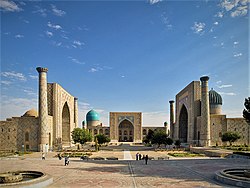
Madrasa (/məˈdræsə/, also US: /-rɑːs-/, UK: /ˈmædrɑːsə/; Arabic: مدرسة [madˈrasa] ⓘ, pl. مدارس madāris), sometimes romanized as madrasah or madrassa, is the Arabic word for any type of educational institution, secular or religious (of any religion), whether for elementary education or higher learning. In countries outside the Arab world, the word usually refers to a specific type of religious school or college for the study of the religion of Islam (loosely equivalent to a seminary in Christianity and a yeshiva or beit midrash in Judaism), though this may not be the only subject studied.
In an architectural and historical context, the term generally refers to a particular kind of institution in the historic Muslim world that primarily taught Sharia (Islamic law) and fiqh (jurisprudence), as well as other subjects on occasion. The origin of the madrasa is widely credited to Nizam al-Mulk, a vizier under the Seljuks in the 11th century, who was responsible for building the first network of official madrasas in Iran, Mesopotamia, and Khorasan. From there, the construction of madrasas spread across much of the Muslim world over the next few centuries, often adopting similar models of architectural design.
The madrasas became the longest-serving institutions of the Ottoman Empire, beginning service in 1330 and operating for nearly 600 years on three continents. They trained doctors, engineers, lawyers and religious officials, among other members of the governing and political elite. The madrasas were a specific educational institution, with their own funding and curricula, in contrast with the Enderun palace schools attended by Devshirme pupils.
The word madrasah derives from the triconsonantal Semitic root د-ر-س D-R-S 'to learn, study', using the wazn (morphological form or template) مفعل(ة); mafʻal(ah), meaning "a place where something is done". Thus, madrasah literally means "a place where learning and studying take place" or "place of study". The word is also present as a loanword with the same general meaning in many Arabic-influenced languages, such as: Urdu, Pashto, Baluchi, Persian, Turkish, Azeri, Kurdish, Indonesian, Somali and Bosnian.
In the Arabic language, the word مدرسة madrasah simply means the same as school does in the English language, whether that is private, state or religious school, as well as for any primary or secondary school whether Muslim, non-Muslim or secular. Unlike the use of the word school in British English, the word madrasah more closely resembles the term school in American English, in that it can refer to a university-level or post-graduate school as well as to a primary or secondary school. For example, in the Ottoman Empire during the Early Modern Period, madrasas had lower schools and specialised schools where the students became known as danişmends. In medieval usage, however, the term madrasah was usually specific to institutions of higher learning, which generally taught Islamic law and occasionally other subjects, as opposed to elementary schools or children's schools, which were usually known as kuttāb, khalwa or maktab. The usual Arabic word for a university, however, is جامعة (jāmiʻah). The Hebrew cognate midrasha also connotes the meaning of a place of learning; the related term midrash literally refers to study or learning, but has acquired mystical and religious connotations.
In English, the term madrasah or "madrasa" usually refers more narrowly to Islamic institutions of learning. Historians and other scholars also employ the term to refer to historical learning institutions throughout the Muslim world, which is to say a college where Islamic law was taught along with other secondary subjects, but not to secular science schools, modern or historical. These institutions were typically housed in specially designed buildings which were primarily devoted to this purpose. Such institutions are believed to have originated, or at least proliferated, in the region of Iran in the 11th century under vizier Nizam al-Mulk and subsequently spread to other regions of the Islamic world.
The first institute of madrasa education was at the estate of Zayd ibn Arqam near a hill called Safa, where Muhammad was the teacher and the students were some of his followers.[citation needed] After Hijrah (migration) the madrasa of "Suffa" was established in Madina on the east side of the Al-Masjid an-Nabawi mosque. Ubada ibn as-Samit was appointed there by Muhammad as teacher and among the students.[citation needed] In the curriculum of the madrasa, there were teachings of The Qur'an, The Hadith, fara'iz, tajweed, genealogy, treatises of first aid, etc. There was also training in horse-riding, the art of war, handwriting and calligraphy, and athletics and martial arts. The first part of madrasa-based education is dated from the first day of "nabuwwat" to the first portion of the Umayyad Caliphate.[citation needed] At the beginning of the Caliphate period, the reliance on courts initially confined sponsorship and scholarly activities to major centres.[citation needed]
In the early history of the Islamic period, teaching was generally carried out in mosques rather than in separate specialized institutions. Although some major early mosques like the Great Mosque of Damascus or the Mosque of Amr ibn al-As in Cairo had separate rooms which were devoted to teaching, this distinction between "mosque" and "madrasa" was not very developed. Notably, the al-Qarawiyyin (Jāmiʻat al-Qarawīyīn), established in 859 in the city of Fes, present-day Morocco, is considered the oldest university in the world by some scholars, though the application of the term "university" to institutions of the medieval Muslim world is disputed. According to tradition, the al-Qarawiyyin mosque was founded by Fāṭimah al-Fihrī, the daughter of a wealthy merchant named Muḥammad al-Fihrī. This was later followed by the Fatimid establishment of al-Azhar Mosque in 969–970 in Cairo, initially as a center to promote Isma'ili teachings, which later became a Sunni institution under Ayyubid rule (today's Al-Azhar University). By the 900s AD, the Madrasa is noted to have become a successful higher education system.
Madrasa
Madrasa (/məˈdræsə/, also US: /-rɑːs-/, UK: /ˈmædrɑːsə/; Arabic: مدرسة [madˈrasa] ⓘ, pl. مدارس madāris), sometimes romanized as madrasah or madrassa, is the Arabic word for any type of educational institution, secular or religious (of any religion), whether for elementary education or higher learning. In countries outside the Arab world, the word usually refers to a specific type of religious school or college for the study of the religion of Islam (loosely equivalent to a seminary in Christianity and a yeshiva or beit midrash in Judaism), though this may not be the only subject studied.
In an architectural and historical context, the term generally refers to a particular kind of institution in the historic Muslim world that primarily taught Sharia (Islamic law) and fiqh (jurisprudence), as well as other subjects on occasion. The origin of the madrasa is widely credited to Nizam al-Mulk, a vizier under the Seljuks in the 11th century, who was responsible for building the first network of official madrasas in Iran, Mesopotamia, and Khorasan. From there, the construction of madrasas spread across much of the Muslim world over the next few centuries, often adopting similar models of architectural design.
The madrasas became the longest-serving institutions of the Ottoman Empire, beginning service in 1330 and operating for nearly 600 years on three continents. They trained doctors, engineers, lawyers and religious officials, among other members of the governing and political elite. The madrasas were a specific educational institution, with their own funding and curricula, in contrast with the Enderun palace schools attended by Devshirme pupils.
The word madrasah derives from the triconsonantal Semitic root د-ر-س D-R-S 'to learn, study', using the wazn (morphological form or template) مفعل(ة); mafʻal(ah), meaning "a place where something is done". Thus, madrasah literally means "a place where learning and studying take place" or "place of study". The word is also present as a loanword with the same general meaning in many Arabic-influenced languages, such as: Urdu, Pashto, Baluchi, Persian, Turkish, Azeri, Kurdish, Indonesian, Somali and Bosnian.
In the Arabic language, the word مدرسة madrasah simply means the same as school does in the English language, whether that is private, state or religious school, as well as for any primary or secondary school whether Muslim, non-Muslim or secular. Unlike the use of the word school in British English, the word madrasah more closely resembles the term school in American English, in that it can refer to a university-level or post-graduate school as well as to a primary or secondary school. For example, in the Ottoman Empire during the Early Modern Period, madrasas had lower schools and specialised schools where the students became known as danişmends. In medieval usage, however, the term madrasah was usually specific to institutions of higher learning, which generally taught Islamic law and occasionally other subjects, as opposed to elementary schools or children's schools, which were usually known as kuttāb, khalwa or maktab. The usual Arabic word for a university, however, is جامعة (jāmiʻah). The Hebrew cognate midrasha also connotes the meaning of a place of learning; the related term midrash literally refers to study or learning, but has acquired mystical and religious connotations.
In English, the term madrasah or "madrasa" usually refers more narrowly to Islamic institutions of learning. Historians and other scholars also employ the term to refer to historical learning institutions throughout the Muslim world, which is to say a college where Islamic law was taught along with other secondary subjects, but not to secular science schools, modern or historical. These institutions were typically housed in specially designed buildings which were primarily devoted to this purpose. Such institutions are believed to have originated, or at least proliferated, in the region of Iran in the 11th century under vizier Nizam al-Mulk and subsequently spread to other regions of the Islamic world.
The first institute of madrasa education was at the estate of Zayd ibn Arqam near a hill called Safa, where Muhammad was the teacher and the students were some of his followers.[citation needed] After Hijrah (migration) the madrasa of "Suffa" was established in Madina on the east side of the Al-Masjid an-Nabawi mosque. Ubada ibn as-Samit was appointed there by Muhammad as teacher and among the students.[citation needed] In the curriculum of the madrasa, there were teachings of The Qur'an, The Hadith, fara'iz, tajweed, genealogy, treatises of first aid, etc. There was also training in horse-riding, the art of war, handwriting and calligraphy, and athletics and martial arts. The first part of madrasa-based education is dated from the first day of "nabuwwat" to the first portion of the Umayyad Caliphate.[citation needed] At the beginning of the Caliphate period, the reliance on courts initially confined sponsorship and scholarly activities to major centres.[citation needed]
In the early history of the Islamic period, teaching was generally carried out in mosques rather than in separate specialized institutions. Although some major early mosques like the Great Mosque of Damascus or the Mosque of Amr ibn al-As in Cairo had separate rooms which were devoted to teaching, this distinction between "mosque" and "madrasa" was not very developed. Notably, the al-Qarawiyyin (Jāmiʻat al-Qarawīyīn), established in 859 in the city of Fes, present-day Morocco, is considered the oldest university in the world by some scholars, though the application of the term "university" to institutions of the medieval Muslim world is disputed. According to tradition, the al-Qarawiyyin mosque was founded by Fāṭimah al-Fihrī, the daughter of a wealthy merchant named Muḥammad al-Fihrī. This was later followed by the Fatimid establishment of al-Azhar Mosque in 969–970 in Cairo, initially as a center to promote Isma'ili teachings, which later became a Sunni institution under Ayyubid rule (today's Al-Azhar University). By the 900s AD, the Madrasa is noted to have become a successful higher education system.
Recent media
Recent media