Recent from talks
Nothing was collected or created yet.
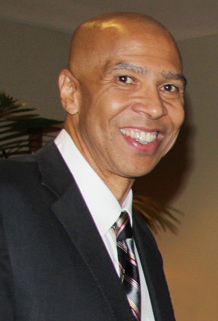
Mychal Thompson
View on Wikipedia
Mychal George Thompson (born January 30, 1955) is a Bahamian sports commentator and former professional basketball player. He was the first player born & raised in the Bahamas to make the NBA[1]. The top overall pick in the 1978 NBA draft, Thompson played the center position for the University of Minnesota and center and power forward for the National Basketball Association's Portland Trail Blazers, San Antonio Spurs, and Los Angeles Lakers. Thompson won two NBA championships with the Lakers during their Showtime era in the 1980s. He is the father of basketball players Klay Thompson and Mychel Thompson and baseball player Trayce Thompson.
Key Information
Early life
[edit]Thompson was born to a Catholic family in Nassau, Bahamas,[2] where he grew up playing pickup basketball on the local courts and fostered his love for the game.[3] In his teens, he moved to the United States in order to compete at a higher level. Settling in Miami, Florida, Thompson attended Miami Jackson Senior High School and played for its athletic team the Generals. In Thompson's senior year in 1974, he was part of a basketball starting lineup nicknamed the "Jackson 5" featuring himself, three other Bahamians and a Cuban; the Generals mowed through the regular season that year, beating opponents by an average of 30 points per game en route to a 33–0 record and winning the Class 4A state championship over Winter Park High School. Miami Jackson's team won the title with four key ineligible players due to falsified birth records, including Thompson.[4] Thompson then attended the University of Minnesota where he had a standout collegiate career.
NBA career
[edit]The Portland Trail Blazers selected Thompson with the first overall pick in the 1978 NBA draft, making him the first foreign-born player to be selected first.[5]
Thompson was in the Portland lineup for eight years, where he started at both power forward and center positions. He was named to the 1978 All-Rookie team, and had arguably his statistically best season in 1981–82, where he averaged 20.8 points and 11.7 rebounds per game. In the 1987 off-season, Thompson was traded to the San Antonio Spurs in exchange for center/forward Steve Johnson.
Thompson played only half a season with the Spurs, before he was traded again, February 1987, this time to Los Angeles for center/forward Frank Brickowski, center Pétur Guðmundsson plus a 1987 first-round draft pick and their 1990 second-round draft choice, along with an undisclosed amount of cash. Thompson was acquired as a back-up center and power forward. This gave the Pat Riley-coached Lakers a team that had four players who were overall #1 selections in the NBA draft, including Kareem Abdul-Jabbar (1969), Magic Johnson (1979), and James Worthy (1982). The trade proved valuable to the 1986–87 Lakers, who went on to defeat Boston for the 1987 NBA title. Thompson thrived as Abdul-Jabbar's backup. In Game six of the 1987 NBA Finals, he had 15 points and nine rebounds and played 37 minutes, as the Lakers won the series.[6]
Thompson appeared in 193 of a total of 197 regular season Laker games from the time of his acquisition through the 1988–1989 season, nine of them as a starter. He proved to be a reliable backup during 1987–88 and 1988–89 seasons for the aging Abdul-Jabbar (and later Vlade Divac) and power forward for A.C. Green. The Lakers won another title in 1988, beating the Detroit Pistons, and reached the Finals in 1989, falling to Detroit, and again, in 1991. He retired later that year.
As of 2022, Mychal and his son Klay are one of five father-son duos to have each won an NBA Championship as a player; the others were (in chronological order of completing the feat) Matt Guokas, Sr. and his son Matt Guokas, Jr., Hall of Famer Rick Barry and his son Brent Barry, Hall of Famer Bill Walton and his son Luke Walton, and Hall of Famer Gary Payton and his son Gary Payton II. The Thompsons, along with the Waltons, are also the only father-son tandems to have each won at least two championships, with the Thompsons being the only tandem to each win in two consecutive years.
NBA career statistics
[edit]| GP | Games played | GS | Games started | MPG | Minutes per game |
| FG% | Field goal percentage | 3P% | 3-point field goal percentage | FT% | Free throw percentage |
| RPG | Rebounds per game | APG | Assists per game | SPG | Steals per game |
| BPG | Blocks per game | PPG | Points per game | Bold | Career high |
| † | Won an NBA championship |
Regular season
[edit]| Year | Team | GP | GS | MPG | FG% | 3P% | FT% | RPG | APG | SPG | BPG | PPG |
|---|---|---|---|---|---|---|---|---|---|---|---|---|
| 1978–79 | Portland | 73 | — | 29.4 | .490 | — | .572 | 8.3 | 2.4 | .9 | 1.8 | 14.7 |
| 1980–81 | Portland | 79 | — | 35.3 | .494 | .000 | .641 | 8.7 | 3.6 | .8 | 2.2 | 17.0 |
| 1981–82 | Portland | 79 | 78 | 39.6 | .523 | — | .628 | 11.7 | 4.0 | .9 | 1.4 | 20.8 |
| 1982–83 | Portland | 80 | 80 | 37.7 | .489 | .000 | .621 | 9.4 | 4.8 | .9 | 1.4 | 15.7 |
| 1983–84 | Portland | 79 | 74 | 33.5 | .524 | .000 | .667 | 8.7 | 3.9 | 1.1 | 1.4 | 15.7 |
| 1984–85 | Portland | 79 | 55 | 33.1 | .515 | — | .684 | 7.8 | 2.6 | 1.0 | 1.3 | 18.4 |
| 1985–86 | Portland | 82 | 78 | 31.3 | .498 | — | .641 | 7.4 | 2.1 | .9 | .4 | 14.7 |
| 1986–87 | San Antonio | 49 | 6 | 24.7 | .436 | 1.000 | .735 | 5.6 | 1.8 | .6 | .8 | 12.3 |
| 1986–87† | L.A. Lakers | 33 | 1 | 20.6 | .480 | .000 | .743 | 4.1 | .8 | .4 | .9 | 10.1 |
| 1987–88† | L.A. Lakers | 80 | 0 | 25.1 | .512 | .000 | .634 | 6.1 | .8 | .5 | 1.0 | 11.6 |
| 1988–89 | L.A. Lakers | 80 | 8 | 24.9 | .559 | .000 | .678 | 5.8 | .6 | .7 | .7 | 9.2 |
| 1989–90 | L.A. Lakers | 70 | 70 | 26.9 | .500 | — | .706 | 6.8 | .6 | .5 | 1.0 | 10.1 |
| 1990–91 | L.A. Lakers | 72 | 4 | 15.0 | .496 | .000 | .705 | 3.2 | .3 | .3 | .3 | 4.0 |
| Career | 935 | 454 | 29.7 | .504 | .083 | .655 | 7.4 | 2.3 | .7 | 1.1 | 13.7 | |
Playoffs
[edit]| Year | Team | GP | GS | MPG | FG% | 3P% | FT% | RPG | APG | SPG | BPG | PPG |
|---|---|---|---|---|---|---|---|---|---|---|---|---|
| 1979 | Portland | 3 | — | 40.3 | .500 | — | .500 | 10.3 | 2.0 | .7 | 1.7 | 19.7 |
| 1981 | Portland | 3 | — | 44.0 | .608 | — | .722 | 7.7 | 1.3 | 1.0 | 3.0 | 25.0 |
| 1983 | Portland | 7 | — | 40.6 | .471 | — | .658 | 8.0 | 5.6 | .9 | 1.1 | 15.0 |
| 1984 | Portland | 4 | — | 30.3 | .500 | — | .773 | 7.3 | 3.8 | 1.3 | .8 | 15.3 |
| 1985 | Portland | 9 | 0 | 27.8 | .490 | — | .673 | 8.0 | 1.6 | .8 | 1.3 | 14.8 |
| 1986 | Portland | 4 | 4 | 35.0 | .574 | — | .538 | 8.3 | 3.5 | .3 | .8 | 19.0 |
| 1987† | L.A. Lakers | 18 | 0 | 22.3 | .453 | — | .680 | 4.9 | .5 | .4 | .9 | 8.8 |
| 1988† | L.A. Lakers | 24 | 0 | 25.6 | .513 | — | .581 | 7.1 | .5 | .7 | .9 | 9.7 |
| 1989 | L.A. Lakers | 15 | 0 | 25.1 | .508 | — | .683 | 5.1 | .7 | .4 | .8 | 11.4 |
| 1990 | L.A. Lakers | 9 | 8 | 25.0 | .477 | — | .615 | 4.3 | .2 | .2 | 1.4 | 6.4 |
| 1991 | L.A. Lakers | 8 | 0 | 5.3 | .286 | — | — | 1.1 | .0 | .0 | .4 | .5 |
| Career | 104 | 12 | 26.0 | .501 | — | .648 | 6.0 | 1.2 | .5 | 1.0 | 10.9 | |
Post-NBA career
[edit]Thompson and his family moved back to Portland in 1991 after his career. He worked on local sports radio in the area. He and his family relocated back to Los Angeles in 2003 when he was offered a job as a color commentator for the Lakers. He was first a co-host on the "Loose Cannons" radio show on KLAC AM570 in Los Angeles but was let go, due to the move of Lakers broadcasts from AM570 to KSPN AM710 for the 2009–10 season. With the move to KSPN AM710, he joined Andrew Siciliano as co-hosts on the "LA Sports Live" radio show on KSPN AM710 until the show was canceled on December 26, 2010. On June 4, 2015, it was announced that Thompson would be teaming up with Mike Trudell as co-hosts on the show "Thompson & Trudell" on KSPN AM710 until the show was canceled on October 19, 2017.
Thompson is currently employed as the Lakers radio color commentator. He first worked with Joel Meyers, then Spero Dedes, and is currently paired with John Ireland.
Personal life
[edit]Thompson married his wife Julie in 1987,[7] and they have three sons, Mychel, Klay, and Trayce. Mychel briefly played in the NBA for the Cleveland Cavaliers, while Klay is a shooting guard for the Dallas Mavericks and has won four NBA championships, and Trayce is an outfielder for the Boston Red Sox.
Thompson is nicknamed "sweet bells" after Walt Bellamy, who was nicknamed "bells."[8] Thompson's documentary about his life "Trailblazer: The Mychal Thompson Story" screened at Regal Cinemas at LA Live in Los Angeles on November 21, 2013.[9][10] Thompson's brother, Andrew (Andy) Thompson, was an executive producer of the Michael Jordan documentary mini-series The Last Dance.[11] Andy Thompson pitched Adam Silver the idea for the documentary while both were working for NBA Entertainment, knowing that Michael Jordan used to write his name as "Mychal Jordan" since he idolized Mychal Thompson.[12]
Thompson once implied he had interest in becoming Bahamian Prime Minister. Before he joined the NBA, some fans believed him to be the cousin of fellow NBA player (and basketball Hall of Fame member) David Thompson.[13] A street in Nassau leading to the Queen Elizabeth Sports Centre was named "Mychal Thompson Boulevard" in his honor during 2015.[14]
As of the 2025–26 season, Thompson is one of seven players born in The Bahamas to appear in an NBA game, and one of only five to be drafted.[15] Thompson was the first and only Bahamian NBA player until Ian Lockhart debuted in 1990 and appeared in only one career game.[15][16]
References
[edit]- ^ "BAHAMAS' MAIN MAN : Mychal Thompson Someday Might be the Prime Minister". Los Angeles Times. February 22, 1987.
- ^ Amick, Sam. "For NBA teams, religion can be unifying or divisive". USA TODAY. Retrieved January 29, 2021.
- ^ "About – Thompson Family Foundation".
- ^ Miami News, Oct 30, 1975
- ^ "Yao Ready For This?". NBA.com. Turner Sports Interactive, Inc. June 25, 2002. Archived from the original on September 1, 2010. Retrieved September 27, 2010.
- ^ Thomas, Mike (August 23, 2021). "Larry Bird Was Miffed at the Spurs After a 1987 Midseason Trade With the Lakers". Sportscasting. Retrieved May 9, 2022.
- ^ "Thompson & Trudell Show – PodCenter – ESPN Radio".
- ^ "Max & Marcellus: [hr2]". Archived from the original on April 6, 2017.
- ^ "thebahamasweekly.com – ESPN hosts Bahamian film 'The Trailblazer' in Los Angeles".
- ^ "Trailblazer: The Mychal Thompson Story (2103) – IMDb". IMDb.
- ^ "Banff World Media Festival 2022 – Andrew Thompson". Retrieved March 23, 2022.
- ^ "How 'The Last Dance' started with simple idea in '97". Tim Reynolds. The Associated Press. April 18, 2020. Retrieved March 23, 2022 – via NBA.com.
- ^ EDES, GORDON (February 22, 1987). "BAHAMAS' MAIN MAN : Mychal Thompson Someday Might Be the Prime Minister" – via LA Times.
- ^ Administrator. "Mychal Thompson honored with street in his name". Archived from the original on September 24, 2016. Retrieved October 29, 2015.
- ^ a b "NBA players born in The Bahamas". Stathead. Archived from the original on November 28, 2025. Retrieved November 28, 2025.
- ^ "Ian Lockhart Stats, Height, Weight, Position, Draft Status and more". Basketball Reference. Archived from the original on November 28, 2025. Retrieved November 28, 2025.
External links
[edit]- Career statistics from NBA.com · Basketball Reference
Mychal Thompson
View on GrokipediaEarly life and education
Childhood and high school
Mychal Thompson was born on January 30, 1955, in Nassau, the Bahamas.[1] Growing up in Nassau, he developed a passion for basketball through pickup games on local courts, fostering his skills in a setting where the sport was gaining popularity.[8] His family placed a strong emphasis on education alongside athletics, and when a coach recruited him to pursue higher-level competition in the United States, his father encouraged him to seize the opportunity for both academic and sporting advancement.[9] At around age 16, Thompson moved to Miami, Florida, to attend high school and elevate his game.[10] He enrolled at Miami Jackson Senior High School, where he played from 1971 to 1974.[1] As a senior in the 1973–74 season, Thompson anchored the team's renowned "Jackson Five" starting lineup, helping lead the Generals to an undefeated 33–0 record on the court and the Florida Class AAA state championship, though the title was later vacated by the Florida High School Athletic Association due to the use of ineligible players, including Thompson and three other Bahamians whose birth records were found to have been falsified, making them overage.[11][12] His dominant play as a 6-foot-10 forward-center, including consistent double-digit scoring and rebounding, established him as one of the nation's top recruits and drew attention from major college programs.[13] Following his high school success, Thompson transitioned to college basketball at the University of Minnesota.College career
Thompson enrolled at the University of Minnesota in 1974, where he played basketball for the Golden Gophers from 1974 to 1978.[14] As a 6-foot-10 center from the Bahamas, he started as a freshman and quickly became a dominant force, leading the team in scoring and rebounding in multiple seasons, including his sophomore year when he topped the Big Ten in rebounds.[15] Over his four-year career, Thompson averaged 20.8 points and 10.0 rebounds per game across 96 contests, showcasing his versatility as a scorer and rebounder with efficient shooting percentages that peaked at 60.6% from the field in 1976-77.[15] Thompson's individual excellence earned him three First-Team All-Big Ten selections from 1976 to 1978 and consensus All-American honors, including second-team in 1977 and first-team in 1978.[15][3] He led the Big Ten in scoring during his junior and senior seasons, averaging 22.0 points each year, and established several school records that still stand, such as 1,992 career points, 20.8 points per game, 823 field goals made, and 956 rebounds.[3] These accomplishments highlighted his development into one of the program's all-time greats, culminating in the retirement of his No. 43 jersey in 1978.[3] Under coach Jim Dutcher, the Golden Gophers achieved notable success during Thompson's tenure, including a 24-3 record in 1976-77 that featured a share of the Big Ten title, though the season was later vacated due to NCAA violations involving player eligibility.[16] Thompson's contributions were central to the team's fast-break style and defensive intensity, setting school marks for scoring average and field goal percentage that season despite the eventual forfeitures.[3] His leadership helped elevate Minnesota's profile in the conference, positioning him as the top prospect in the 1978 NBA Draft.[15]Professional basketball career
Portland Trail Blazers
Mychal Thompson was selected by the Portland Trail Blazers as the first overall pick in the 1978 NBA Draft, becoming the first foreign-born player to achieve that distinction.[17] He signed a multi-year contract with the team shortly thereafter and made his NBA debut on October 15, 1978, against the Chicago Bulls.[6] In his rookie season of 1978–79, Thompson quickly adapted to professional basketball, averaging 14.7 points, 8.3 rebounds, and 2.4 assists per game across 73 appearances while shooting 49.0% from the field.[1] His performance earned him a spot on the NBA All-Rookie First Team, recognizing his immediate impact as a versatile forward capable of contributing on both ends of the court.[18] Thompson's transition from college at the University of Minnesota to the NBA highlighted his ability to handle the increased physicality and speed, leveraging his 6-foot-10 frame for rebounding and interior scoring. Over eight seasons with Portland from 1978 to 1986, Thompson established himself as a cornerstone of the frontcourt, appearing in 551 regular-season games and averaging 16.7 points, 9.1 rebounds, and 3.3 assists per game.[19] He reached a career high in scoring during the 1981–82 season, putting up 20.8 points and 11.7 rebounds per game, which underscored his development into a double-double threat.[6] Known for his gifted mid-range shooting, high basketball IQ, deft passing, and strong defensive presence, Thompson excelled as a versatile power forward/center who could guard multiple positions and facilitate plays from the post.[20] His defensive prowess made him the franchise leader in blocks (768) and defensive rebounds (3,389) during his tenure, contributing to Portland's reputation for tough interior play.[21][22] Thompson helped lead the Trail Blazers to the playoffs in six of his eight seasons, including first-round victories in 1983 and 1985, as well as a Western Conference Semifinals appearance in 1985.[1] The team, coming off a Western Conference Finals run in 1978 just before his arrival, relied on his consistency to maintain competitiveness in a stacked Western Conference, though they struggled to advance deep into the postseason amid roster changes and injuries. In playoff games with Portland, he averaged 17.4 points and 10.0 rebounds, with a standout 25.0 points per game in the 1981 postseason series.[19] By the mid-1980s, Thompson's individual production began to dip amid team transitions and increased competition, with his scoring falling to 14.7 points per game in the 1985–86 season.[1] On June 20, 1986, Portland traded him to the San Antonio Spurs in exchange for forward Steve Johnson, marking the end of his foundational years with the franchise.[23]San Antonio Spurs
In June 1986, the Portland Trail Blazers traded Mychal Thompson and Larry Krystkowiak to the San Antonio Spurs in exchange for Steve Johnson.[24] This move brought the 31-year-old veteran forward to a Spurs team looking to bolster its frontcourt depth amid a rebuilding phase.[23] During the 1986–87 season, Thompson integrated into the Spurs' system under head coach Bob Weiss, providing scoring and rebounding support as a key rotation player.[25] He appeared in 49 games, starting six, and averaged 12.3 points and 5.6 rebounds per game while shooting 43.6% from the field.[1] Despite the team's overall struggles, finishing with a 28–54 record and last place in the Midwest Division, Thompson demonstrated his veteran experience through consistent production, including several double-digit scoring outings that highlighted his efficiency in the post.[25] His rebounding efforts were particularly notable in select matchups, such as grabbing nine rebounds against his former team, the Portland Trail Blazers, on December 9, 1986, where he also scored 21 points in a 104–120 loss.[26][27] Thompson's tenure with San Antonio ended abruptly on February 13, 1987, when the Spurs traded him to the Los Angeles Lakers in exchange for Frank Brickowski, Petur Gudmundsson, and a 1987 first-round draft pick, as the team sought to address ongoing performance issues.[28] This transaction marked the conclusion of his brief, transitional stint with the Spurs, where he contributed to team dynamics but could not reverse the franchise's challenging season.[1]Los Angeles Lakers
In February 1987, Mychal Thompson was acquired by the Los Angeles Lakers from the San Antonio Spurs in a multi-player trade that included forward Frank Brickowski, a future first-round draft pick, and cash considerations, primarily to serve as a reliable backup to aging center Kareem Abdul-Jabbar.[28] This move bolstered the Lakers' frontcourt depth during the 1986–87 season, allowing Thompson to contribute immediately off the bench in 33 games, where he averaged 10.1 points and 4.1 rebounds in 20.6 minutes per game.[29] His arrival helped stabilize the team's rotation behind the Magic Johnson-led "Showtime" offense, emphasizing his defensive versatility and rebounding prowess against tough opponents like the Boston Celtics.[30] Thompson thrived in a key sixth-man role during the 1987–88 season, providing scoring punch, rebounding, and leadership from the bench as the Lakers dominated the league. In the 1987 NBA Finals, he played a pivotal part in the championship-clinching Game 6 victory over the Boston Celtics, logging 37 minutes with 15 points and nine rebounds in a 106–93 win that secured the title. The following year, the Lakers repeated as champions, defeating the Detroit Pistons in the 1988 NBA Finals, with Thompson averaging 9.7 points and 7.1 rebounds across 18 playoff games while earning praise for his defensive contributions and veteran presence that supported stars like Johnson and Abdul-Jabbar.[29] Over his full seasons with the team, he averaged approximately 8.9 points and 5.4 rebounds in limited minutes, often under 25 per game, focusing on efficient play rather than high-volume scoring.[1] As Thompson transitioned into backing up younger center Vlade Divac in later years, his minutes and production declined due to age and roster evolution, culminating in his release by the Lakers after the 1990–91 season following four full campaigns.[29] Despite the reduced role—averaging just 4.0 points and 3.2 rebounds in 15 minutes that final year—his tenure solidified his legacy as a two-time champion who enhanced the Lakers' dynasty during their Showtime era.[1]International career
Following his release from the Los Angeles Lakers in October 1991, Mychal Thompson, then 36 years old, signed a one-year contract with Juvecaserta Basket (also known as Phonola Caserta) of the Italian Lega Basket Serie A for the 1991–1992 season, marking his only professional stint outside the NBA.[31][32][33] This move allowed Thompson to continue his playing career abroad after 13 NBA seasons, where he had sought opportunities to extend his time on the court amid diminishing roles in the league. In the Italian League, Thompson averaged 16.4 points and 10.2 rebounds per game, showcasing his veteran scoring and rebounding prowess while leading the team in scoring during several months of the season.[34][35] His contributions helped Juvecaserta secure an 8th-place finish in the 30-game regular season with a 15–15 record, qualifying for the playoffs in a competitive field.[36] Thompson also appeared in the FIBA European Champions Cup, averaging 15.4 points per game across group stage matches as the team finished 8th overall with a 3–11 record.[37] Thompson retired from professional basketball at the end of the 1991–1992 season, concluding his playing career after this brief but productive overseas chapter.[33]Career statistics and achievements
Regular season and playoff statistics
Mychal Thompson's NBA regular season career averages were 13.7 points, 7.4 rebounds, 2.3 assists, and 1.1 blocks per game across 935 games played, shooting 50.5% from the field and 65.7% from the free-throw line.[1][17]Portland Trail Blazers (1978–1986)
During his time with the Portland Trail Blazers, Thompson appeared in 551 games, averaging 17.0 points, 9.0 rebounds, 3.5 assists, and 1.4 blocks per game while shooting 50.4% from the field and 64.6% from the free-throw line.[1]| Season | GP | MP | FG% | FT% | TRB | AST | BLK | PTS |
|---|---|---|---|---|---|---|---|---|
| 1978-79 | 73 | 29.4 | .490 | .572 | 8.3 | 2.4 | 1.8 | 14.7 |
| 1980-81 | 79 | 35.3 | .494 | .641 | 8.7 | 3.6 | 2.2 | 17.0 |
| 1981-82 | 79 | 39.6 | .523 | .628 | 11.7 | 4.0 | 1.4 | 20.8 |
| 1982-83 | 80 | 37.7 | .489 | .621 | 9.4 | 4.8 | 1.4 | 15.7 |
| 1983-84 | 79 | 33.5 | .524 | .667 | 8.7 | 3.9 | 1.4 | 15.7 |
| 1984-85 | 79 | 33.1 | .515 | .684 | 7.8 | 2.6 | 1.3 | 18.4 |
| 1985-86 | 82 | 31.3 | .498 | .641 | 7.4 | 2.1 | 0.4 | 14.7 |
San Antonio Spurs (1986–1987)
Thompson played 49 games for the San Antonio Spurs, averaging 12.3 points, 5.6 rebounds, 1.8 assists, and 0.8 blocks per game while shooting 43.6% from the field and 73.5% from the free-throw line.[1]| Season | GP | MP | FG% | FT% | TRB | AST | BLK | PTS |
|---|---|---|---|---|---|---|---|---|
| 1986-87 | 49 | 24.7 | .436 | .735 | 5.6 | 1.8 | 0.8 | 12.3 |
Los Angeles Lakers (1987–1991)
With the Los Angeles Lakers, Thompson suited up for 335 games, averaging 9.1 points, 5.6 rebounds, 0.6 assists, and 0.8 blocks per game while shooting 52.3% from the field and 67.8% from the free-throw line.[1]| Season | GP | MP | FG% | FT% | TRB | AST | BLK | PTS |
|---|---|---|---|---|---|---|---|---|
| 1986-87 | 33 | 20.6 | .480 | .743 | 4.1 | 0.8 | 0.9 | 10.1 |
| 1987-88 | 80 | 25.1 | .512 | .634 | 6.1 | 0.8 | 1.0 | 11.6 |
| 1988-89 | 80 | 24.9 | .559 | .678 | 5.8 | 0.6 | 0.7 | 9.2 |
| 1989-90 | 70 | 26.9 | .500 | .706 | 6.8 | 0.6 | 1.0 | 10.1 |
| 1990-91 | 72 | 15.0 | .496 | .705 | 3.2 | 0.3 | 0.3 | 4.0 |

