


Community hub
Recent from talks
Contribute something
Nothing was collected or created yet.
Myrmarachne
View on Wikipedia
| Myrmarachne | |
|---|---|

| |
| Myrmarachne sp. mimicking an ant | |
Scientific classification 
| |
| Kingdom: | Animalia |
| Phylum: | Arthropoda |
| Subphylum: | Chelicerata |
| Class: | Arachnida |
| Order: | Araneae |
| Infraorder: | Araneomorphae |
| Family: | Salticidae |
| Subfamily: | Salticinae |
| Genus: | Myrmarachne MacLeay, 1839[1] |
| Type species | |
| M. melanocephala MacLeay, 1839
| |
| Species | |
|
188, see text | |
| Synonyms[1] | |
Myrmarachne is a genus of ant-mimicking jumping spiders that was first described by W. S. MacLeay in 1839.[5] They are commonly called ant-mimicking spiders, but they are not the only spiders that have this attribute. The name is a combination of Ancient Greek μύρμηξ (myrmex), meaning "ant", and ἀράχνη (arachne), meaning "spider".
This genus has undergone many changes, and is still under review as more information becomes available.[1] In 2016, several genera were split off, including Helicius and the monotypic genus Panachraesta.[6] The genus Emertonius was revalidated in 2018 after being synonymized with Myrmarachne for nearly thirty years.[7]
Description
[edit]Myrmarachne have an elongated cephalothorax with relatively long chelicerae that projects forward in males. The chelicerae of males can lack venom glands.[8] The cephalothorax has a waist, and the opisthosoma often has one too. The colors can vary from black to yellow, depending on ant species it is mimicking, and can change over the course of its life. For example, one African species was observed to mimic a certain species of ants as a juvenile, and another ant species as an adult.[9]
They tend to wave their front legs in the air to simulate antennae, and many have bodies that also closely resemble ants. It was assumed they didn't use their front legs for locomotion at all, but high-speed cameras have shown that they move around using all eight legs, raising their forelimbs only when stationary.[10]
The genus Bocus is so similar to Myrmarachne that it cannot be distinguished without the help of a microscope.[9]
Species
[edit]With about 80 described and many undescribed southeast Asian species, Myrmarachne is the most diverse genus of jumping spider in this region.[9] A few species, such as the palearctic M. formicaria, occur in temperate regions.[1]
Myrmarachne are found in the tropics from Africa to Australia, with some species found in the New World.[1]
As of October 2025[update], this genus includes 188 species and three subspecies.[1]
These species have articles on Wikipedia:
- Myrmarachne bicurvata (O. Pickard-Cambridge, 1869) – Sri Lanka
- Myrmarachne clavigera (Thorell, 1877) – Indonesia (Sulawesi)
- Myrmarachne elongata Szombathy, 1915 – Africa, Japan, China, Vietnam
- Myrmarachne formicaria (De Geer, 1778) – Macaronesia, Europe, Turkey, Caucasus, Russia (Europe, Caucasus, Far East), Iran, China, Korea, Japan. Introduced to Canada, United States
- Myrmarachne luctuosa (L. Koch, 1879) – Australia (New South Wales, South Australia, Victoria, Queensland)
- Myrmarachne melanocephala MacLeay, 1839 – Pakistan to Vietnam and Indonesia (type species)
- Myrmarachne melanotarsa Wesołowska & Salm, 2002 – Kenya, China?
- Myrmarachne morningside Benjamin, 2015 – Sri Lanka
- Myrmarachne prava (Karsch, 1880) – Pakistan, India, Sri Lanka
- Myrmarachne ramunni Narayan, 1915 – Pakistan, India, Sri Lanka
- Myrmarachne spissa (G. W. Peckham & E. G. Peckham, 1892) – India, Sri Lanka
- Myrmarachne striatipes (L. Koch, 1879) – Australia (New South Wales, Victoria, Tasmania)
- Myrmarachne uniseriata Narayan, 1915 – India, Sri Lanka
-
 Male M. albocincta
 -
 Female M. clavigera
 -
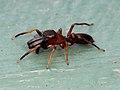 Male M. formicaria
 -
 Female M. formosana
 -
 M. ichneumon and ant model
 -
 Male M. inermichelis
 -
 Female M. japonica
 -
 Male M. kochi
 -
 Male M. melanocephala
 -
 Female M. plataleoides
 -
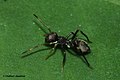 M. spissa
 -
 M. striatipes with prey


Complete species list as of October 2025[update]
|
|---|
|
References
[edit]- ^ a b c d e f "Gen. Myrmarachne MacLeay, 1839". World Spider Catalog. doi:10.24436/2. Retrieved 2025-10-17.
- ^ a b c Simon, E (1901). Histoire naturelle des araignées. Paris: Roret. doi:10.5962/bhl.title.51973.
- ^ Wanless, F. R. (1978). "A revision of the spider genera Belippo and Myrmarachne (Araneae: Salticidae) in the Ethiopian region". Bulletin of the British Museum of Natural History. 33: 18.
- ^ Bonnet, P. (1957), Bibliographia araneorum, vol. 2, Douladoure, Toulouse, pp. 1927–3026
- ^ MacLeay, W. S. (1839). "On some new forms of Arachnida". Annals of Natural History. 2 (7): 1–2.
- ^ Prószyński, J. (2016). "Delimitation and description of 19 new genera, a subgenus and a species of Salticidae (Araneae) of the world". Ecologica Montenegrina. 7: 4–32. doi:10.37828/em.2016.7.1.
- ^ Prószyński, J. (2018). "Review of genera Evarcha and Nigorella, with comments on Emertonius, Padilothorax [sic], Stagetillus, and description of five new genera and two new species (Araneae: Salticidae)". Ecologica Montenegrina. 16: 165. doi:10.37828/em.2018.16.12.
- ^ Yu, Guocheng; Wong, Boon Hui; Painting, Christina J; Li, Hongze; Yu, Long; Zhang, Zengtao; Zhang, Shichang; Li, Daiqin (28 December 2022). "Males armed with big weapons win fights at limited cost in ant-mimicking jumping spiders". Current Zoology. 70 (1): 98–108. doi:10.1093/cz/zoac101. PMC 10926263. PMID 38476142.
- ^ a b c Murphy, Frances; Murphy, John (2000). An Introduction to the Spiders of South East Asia. Kuala Lumpur: Malaysian Nature Society. p. 304.
{{cite book}}: CS1 maint: publisher location (link) - ^ Making eight legs look like six - Study untangles mystery of how jumping spiders mimic ants’ movement
Further reading
[edit]- Nelson, X.J.; Jackson, R.R.; Edwards, G.B.; Barrion, A.T. (2006). "Living with the enemy: jumping spiders that mimic weaver ants" (PDF). The Journal of Arachnology. 33 (3): 813–819. doi:10.1636/S04-12.1. S2CID 52000089. Retrieved 2023-11-04.
