


Community hub
Recent from talks
Contribute something
Nothing was collected or created yet.
NYC Pride March
View on Wikipedia
| NYC Pride March | |
|---|---|
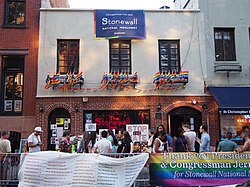
 The Stonewall Inn in Greenwich Village was the site of the June 1969 Stonewall riots. That event in New York City's queer history has served as a touchstone for various LGBTQ social movements, as well as the catalyst for Pride parades around the world.[1][2][3] | |
| Frequency | Annually, last Sunday in June |
| Locations | New York City, U.S. |
| Inaugurated | June 28, 1970, as part of Christopher Street Liberation Day |
| Next event | June 29, 2025 |
| Organized by | Heritage of Pride, since 1984 |
.jpg)
| Part of a series on |
| LGBTQ people |
|---|
 LGBTQ portal LGBTQ portal |
The NYC Pride March is an annual event celebrating the LGBTQ community in New York City. The largest pride parade and the largest pride event in the world, the NYC Pride March attracts tens of thousands of participants and millions of sidewalk spectators each June,[4][5] and carries spiritual and historical significance for the worldwide LGBTQ community and its advocates. Entertainer Madonna stated in 2024, "Aside from my birthday, New York Pride is the most important day of the year."[6] The route through Lower Manhattan traverses south on Fifth Avenue, through Greenwich Village, passing the Stonewall National Monument,[7] site of the June 1969 riots that launched the modern movement for LGBTQ rights.
A central component of NYC Pride observances, the March occurs on the last Sunday in June.[8] An estimated 4 million attended the parade in 2019,[9] coinciding with the 50th anniversary of Stonewall, which drew 5 million visitors to Manhattan on Pride weekend.[10] The 2020 (51st) and 2021 (52nd) editions of NYC Pride March were cancelled due to the COVID-19 pandemic in New York City. NYC Pride March returned in 2022 for the first time despite the COVID-19 pandemic in New York City; the first parade since the one held in 2019 occurred on June 26, 2022.
Origins
[edit]Early on the morning of Saturday, June 28, 1969, lesbian, gay, bisexual, and transgender (LGBT) people rioted, following a police raid on the Stonewall Inn, a gay bar at 53 Christopher Street in Greenwich Village, Lower Manhattan. This event, together with further protests and rioting over the following nights, marked a watershed moment in the modern LGBT rights movement and the impetus for organizing pride parades on a much larger scale. Veterans of the riot formed a group, the Stonewall Veterans Association, which has continued to drive the advancement of LGBT rights from the rioting at the Stonewall Inn, to the present day.
In the weeks following the riots, 500 people gathered for a "Gay Power" demonstration in Washington Square Park, followed by a march to Sheridan Square within the West Village.[11][12]
On November 2, 1969, Craig Rodwell, his partner Fred Sargeant, Ellen Broidy, and Linda Rhodes proposed an annual march to be held in New York City by way of a resolution at the Eastern Regional Conference of Homophile Organizations (ERCHO) meeting in Philadelphia.[13]
We propose that a demonstration be held annually on the last Saturday in June in New York City to commemorate the 1969 spontaneous demonstrations on Christopher Street and this demonstration be called CHRISTOPHER STREET LIBERATION DAY. No dress or age regulations shall be made for this demonstration.
We also propose that we contact Homophile organizations throughout the country and suggest that they hold parallel demonstrations on that day. We propose a nationwide show of support.[14][15][16][17]

All attendees to the ERCHO meeting in Philadelphia voted for the march except for Mattachine Society of New York, which abstained.[14] Members of the Gay Liberation Front (GLF) attended the meeting and were seated as guests of Rodwell's group, Homophile Youth Movement in Neighborhoods (HYMN).[18]
Meetings to organize the march began in early January at Rodwell's apartment in 350 Bleecker Street.[19] At first there was difficulty getting some of the major New York City organizations like Gay Activists Alliance (GAA) to send representatives. Craig Rodwell and his partner Fred Sargeant, Ellen Broidy, Michael Brown, Marty Nixon, and Foster Gunnison Jr. of Mattachine made up the core group of the CSLD Umbrella Committee (CSLDUC). For initial funding, Gunnison served as treasurer and sought donations from the national homophile organizations and sponsors, while Sargeant solicited donations via the Oscar Wilde Memorial Bookshop customer mailing list and Nixon worked to gain financial support from GLF in his position as treasurer for that organization.[20][21] Other mainstays of the organizing committee were Judy Miller, Jack Waluska, Steve Gerrie and Brenda Howard of GLF.[22] Believing that more people would turn out for the march on a Sunday, and so as to mark the date of the start of the Stonewall uprising, the committee scheduled the date for the first march for Sunday, June 28, 1970.[23] With Dick Leitsch's replacement as president of Mattachine NY by Michael Kotis in April 1970, opposition to the march by Mattachine ended.[24]
There was little open animosity, and some bystanders applauded when a tall, pretty girl carrying a sign "I am a Lesbian" walked by. – The New York Times coverage of Gay Liberation Day, 1970[25]
Christopher Street Liberation Day on June 28, 1970, marked the first anniversary of the Stonewall riots with a march from Sheridan Square, covering the 51 blocks to the Sheep Meadow in Central Park. The march took less than half the scheduled time due to excitement, but also due to wariness about walking through the city with gay banners and signs. Although the parade permit was delivered only two hours before the start of the march, participants encountered little resistance from onlookers.[26] The New York Times reported (on the front page) that the march extended for about 15 city blocks.[25] Reporting by The Village Voice was positive, describing "the out-front resistance that grew out of the police raid on the Stonewall Inn one year ago".[27] There was also an assembly on Christopher Street.
Organizers
[edit]The first March in 1970 was organized by the Christopher Street Liberation Day Committee.[28] Since 1984, the parade and related LGBT pride events in New York City have been produced and organized by Heritage of Pride (HOP), a volunteer spearheaded, non-partisan, tax-exempt, non-profit organization.[29] HOP welcomes participation regardless of age, creed, gender, gender identification, HIV status, national origin, physical, mental or developmental ability, race, or religion. HOP does not use qualifiers for participation.
In 2021, NYC Pride organizers announced that uniformed law enforcement would be banned from marching in the parade until 2025, when the ban will be reexamined by committees and the executive board of NYC Pride.[30][31]

Broadcast
[edit]For many years, the march was only available locally to Time Warner Cable customers, via its NY1 news channel. In 2017 WABC-TV broadcast the NYC LGBT Pride March live for the first time regionally, and made the stream available to all parts of the globe where such content is accessible.[32][33] WABC-TV continues to broadcast the first three hours of each years march (which has had an actual run time over nine hours in 2017 and 2018). Both the 2017 and 2018 broadcasts were Emmy nominated programs. In 2022, the WABC-TV broadcast was also available via streaming from ABC News Live and Hulu.
Schisms
[edit]Over the course of five decades, various groups have accused the NYC Pride March of losing its political, activist roots and becoming a venue for corporate pinkwashing, rainbow capitalism, and assimilation of queer identities.[34] Such critiques have given rise to various independent events conducted without permits or police. Since 1993 the NYC Dyke March has been held annually on the Saturday prior.[35] Since 1994 the New York City Drag March has been held annually on the Friday prior; it began as a protest against the ban on leather and drag during the 25th anniversary of Stonewall.[36][37] Coinciding with the 50th anniversary of Stonewall in 2019, the Reclaim Pride Coalition organized the first Queer Liberation March, held on Sunday morning, hours before the NYC Pride parade.[38][39]
Size
[edit]The first march, in 1970, was front-page news in The New York Times reporting the march extended for about fifteen city blocks.[25] The march had thousands of participants with organizers "who said variously 3,000 and 5,000 and even 20,000."[25] The variance could be due, in part, that although the march started with over a dozen homosexual and feminist contingents, parade spectators were encouraged to join the procession.[25] Currently, Heritage of Pride requires preregistration of marchers, and sets up barricades along the entire route discouraging the practice.[40]
Although estimating crowd size is an imprecise science, the NYC March is consistently considered the largest Pride parade in North America, with 2.1 million people in 2015, and 2.5 million in 2016.[41] In 2018, attendance was estimated around two million.[42] In 2024, the estimated crowd size was 2.5 million.[43] In 2019, as part of Stonewall 50 – WorldPride NYC, an estimated 5 million people took part over the final weekend of the celebrations,[44][45] with an estimated 4 million in attendance at the parade.[9][46] The 12-hour parade included 150,000 pre-registered participants among 695 groups.[47] It was the largest parade of any kind in the city's history and four times as large as the annual Times Square Ball on New Year's Eve.[48]
NYC Pride March edition dates
[edit]1981 and earlier
[edit]| Edition number | Date | Also known as |
|---|---|---|
| 1st | June 28, 1970 | NYC Pride March 1970 |
| 2nd | June 27, 1971 | NYC Pride March 1971 |
| 3rd | June 25, 1972 | NYC Pride March 1972 |
| 4th | June 24, 1973 | NYC Pride March 1973 |
| 5th | June 30, 1974 | NYC Pride March 1974 |
| 6th | June 29, 1975 | NYC Pride March 1975 |
| 7th | June 27, 1976 | NYC Pride March 1976 |
| 8th | June 26, 1977 | NYC Pride March 1977 |
| 9th | June 25, 1978 | NYC Pride March 1978 |
| 10th | June 24, 1979 | NYC Pride March 1979 |
| 11th | June 29, 1980 | NYC Pride March 1980 |
| 12th | June 28, 1981 | NYC Pride March 1981 |
1982–2019
[edit]| Edition number | Date | Also known as |
|---|---|---|
| 13th | June 27, 1982 | NYC Pride March 1982 |
| 14th | June 26, 1983 | NYC Pride March 1983 |
| 15th | June 24, 1984 | NYC Pride March 1984 |
| 16th | June 30, 1985 | NYC Pride March 1985 |
| 17th | June 29, 1986 | NYC Pride March 1986 |
| 18th | June 28, 1987 | NYC Pride March 1987 |
| 19th | June 26, 1988 | NYC Pride March 1988 |
| 20th | June 25, 1989 | NYC Pride March 1989 |
| 21st | June 24, 1990 | NYC Pride March 1990 |
| 22nd | June 30, 1991 | NYC Pride March 1991 |
| 23rd | June 28, 1992 | NYC Pride March 1992 |
| 24th | June 27, 1993 | NYC Pride March 1993 |
| 25th | June 26, 1994 | NYC Pride March 1994 |
| 26th | June 25, 1995 | NYC Pride March 1995 |
| 27th | June 30, 1996 | NYC Pride March 1996 |
| 28th | June 29, 1997 | NYC Pride March 1997 |
| 29th | June 28, 1998 | NYC Pride March 1998 |
| 30th | June 27, 1999 | NYC Pride March 1999 |
| 31st | June 25, 2000 | NYC Pride March 2000 |
| 32nd | June 24, 2001 | NYC Pride March 2001 |
| 33rd | June 30, 2002 | NYC Pride March 2002 |
| 34th | June 29, 2003 | NYC Pride March 2003 |
| 35th | June 27, 2004 | NYC Pride March 2004 |
| 36th | June 26, 2005 | NYC Pride March 2005 |
| 37th | June 25, 2006 | NYC Pride March 2006 |
| 38th | June 24, 2007 | NYC Pride March 2007 |
| 39th | June 29, 2008 | NYC Pride March 2008 |
| 40th | June 28, 2009 | NYC Pride March 2009 |
| 41st | June 27, 2010 | NYC Pride March 2010 |
| 42nd | June 26, 2011 | NYC Pride March 2011 |
| 43rd | June 24, 2012 | NYC Pride March 2012 |
| 44th | June 30, 2013 | NYC Pride March 2013 |
| 45th | June 29, 2014 | NYC Pride March 2014 |
| 46th | June 28, 2015 | NYC Pride March 2015 |
| 47th | June 26, 2016 | NYC Pride March 2016 |
| 48th | June 25, 2017 | NYC Pride March 2017 |
| 49th | June 24, 2018 | NYC Pride March 2018 |
| 50th | June 30, 2019 | NYC Pride March 2019 |
2022 and later
[edit]| Edition number | Date | Also known as |
|---|---|---|
| 53rd | June 26, 2022 | NYC Pride March 2022 |
| 54th | June 25, 2023 | NYC Pride March 2023 |
| 55th | June 30, 2024 | NYC Pride March 2024 |
| 56th | June 29, 2025 | NYC Pride March 2025 |
Grand marshals
[edit]2025
[edit]2024
[edit]- Miss Major; Michelle Visage; Raquel Willis; and DaShawn Usher of GLAAD
- Youth Activist grand marshals: singer-songwriter Baddie Brooks, Hetrick-Martin Institute advocate Robin Drake, and content creator Eshe Ukweli[49][50]
2023
[edit]- Billy Porter; Yasmin Benoit, the first openly asexual Grand Marshal;[51] artist and educator AC Dumlao; Hope Giselle;[52] and Randy Wicker[53]
2022
[edit].jpg)
- Ts Madison; Chase Strangio; Punkie Johnson; Schuyler Bailar; and Dominique Morgan of The Okra Project[54]
The COVID-19 pandemic in New York City resulted in cancelation of the 2020 and 2021 events.
2019: Stonewall 50
[edit]
- Mj Rodriguez, Indya Moore, and Dominique Jackson from the cast of Pose; Phyll Opoku-Gyimah; Monica Helms, creator of the 1999 transgender pride flag; The Trevor Project; and the Gay Liberation Front[55]
2018
[edit]2017
[edit]- American Civil Liberties Union; Brooke Guinan, the first openly transgender FDNY firefighter; Krishna Stone of Gay Men's Health Crisis; Geng Le, Chinese LGBT rights leader and founder of Blued[57]
2016
[edit]- Jazz Jennings; Cecilia Chung;[58] and Subhi Nahas, refugee and cofounder of the first LGBT magazine in Syria
2015
[edit]
- Ian McKellen; Derek Jacobi; Kasha Jacqueline Nabagesera; and J. Christopher Neal, the first openly bisexual Grand Marshal[59]
2014
[edit]2013
[edit]- Edith Windsor, plaintiff in United States v. Windsor, which struck down Section 3 of the Defense of Marriage Act;[60] Earl Fowlkes; and Harry Belafonte
2012
[edit]- Cyndi Lauper; Chris Salgardo of Kiehl's; Connie Kopelov & Phyllis Siegel, New York City's first legally married same-sex couple[61]
2011
[edit]
- Dan Savage and Terry Miller, It Gets Better Project; Rev. Pat Bumgardner, Metropolitan Community Church of New York; and the Imperial Court of New York[62]
2010
[edit]- Constance McMillen; Judy Shepard; and Lt. Dan Choi[63]
2009: Stonewall 40
[edit]2008
[edit]- Gilbert Baker; Candice Cayne; New York Governor David A. Paterson; New York Senator Charles Schumer;[64] and NYC Mayor Mike Bloomberg[65]
See also
[edit]


References
[edit]- ^ Julia Goicochea (August 16, 2017). "Why New York City Is a Major Destination for LGBT Travelers". The Culture Trip. Archived from the original on January 2, 2020. Retrieved February 2, 2019.
- ^ Eli Rosenberg (June 24, 2016). "Stonewall Inn Named National Monument, a First for the Gay Rights Movement". The New York Times. Retrieved June 25, 2016.
- ^ "Workforce Diversity The Stonewall Inn, National Historic Landmark National Register Number: 99000562". National Park Service, U.S. Department of the Interior. Retrieved April 21, 2016.
- ^ "Revelers Take To The Streets For 48th Annual NYC Pride March". CBS New York. June 25, 2017. Retrieved June 26, 2017.
A sea of rainbows took over the Big Apple for the biggest pride parade in the world Sunday.
- ^ Dawn Ennis (May 24, 2017). "ABC will broadcast New York's pride parade live for the first time". LGBTQ Nation. Retrieved September 26, 2018.
Never before has any TV station in the entertainment and news media capital of the world carried what organizer boast is the world's largest Pride parade live on TV.
- ^ Brendan Morrow (June 30, 2024). "Madonna celebrates NYC Pride at queer music fest: 'Most important day of the year'". USA Today. Retrieved July 7, 2024.
Thank you all for coming out," Madonna told the crowd, according to a video shared on social media. "Aside from my birthday, New York Pride is the most important day of the year." She concluded, "Thank you all, New York City. Without you, I am nothing.
- ^ Riley, John (March 20, 2019). "NYC Pride announces route for WorldPride NYC 2019/Stonewall 50 Pride March". Metro Weekly. Retrieved June 3, 2019.
- ^ "queerintheworld.com". January 6, 2019. Retrieved June 24, 2022.
- ^ a b O'Doherty, Cahir (July 4, 2019). "Irish march at historic World Pride in New York City". IrishCentral.com. Retrieved July 9, 2019.
- ^ About 5 million people attended WorldPride in NYC, mayor says Accessed July 3, 2019.
- ^ Black, Jonathan (July 31, 1969). "In the Wake of Stonewall: Gay Power Hits Back". The Village Voice. Archived from the original on September 13, 2018. Retrieved September 29, 2019.
- ^ "Celebrate at the Stonewall 50 Commemoration". WorldPride 2019 Guide. Archived from the original on June 26, 2019. Retrieved June 26, 2019.
- ^ Sargeant, Fred (June 22, 2010). "1970: A First-Person Account of the First Gay Pride March". The Village Voice. Archived from the original on June 23, 2017. Retrieved September 29, 2019.
- ^ a b Carter, p. 230
- ^ Marotta, pp. 164–165
- ^ Teal, pp. 322–323
- ^ Duberman, pp. 255, 262, 270–280
- ^ Duberman, p. 227
- ^ Nagourney, Adam. "For Gays, a Party In Search of a Purpose; At 30, Parade Has Gone Mainstream As Movement's Goals Have Drifte." New York Times. June 25, 2000. retrieved January 3, 2011.
- ^ Carter, p. 247
- ^ Teal, p. 323
- ^ Duberman, p. 271
- ^ Duberman, p. 272
- ^ Duberman, p. 314 n93
- ^ a b c d e Fosburgh, Lacey (June 29, 1970). "Thousands of Homosexuals Hold A Protest Rally in Central Park", The New York Times, p. 1.
- ^ Clendinen, pp. 62–64.
- ^ LaFrank, p. 20.
- ^ Stryker, Susan. "Christopher Street Gay Liberation Day: 1970". PlanetOut. Archived from the original on March 31, 2008. Retrieved June 28, 2010.
- ^ "About Heritage Of Pride". Nyc Pride. Archived from the original on March 24, 2008. Retrieved December 3, 2013.
- ^ "NYC Pride announces new policies to address police presence". May 15, 2021.
- ^ "NYC Pride ban on uniformed police reflects a deeper tension". Associated Press News. June 24, 2021.
- ^ "NYC Pride March makes its way through streets of Manhattan". ABC7 New York. June 25, 2017. Retrieved April 29, 2018.
- ^ "New York City Pride March to be broadcast by TV network for first time". NBC News. Retrieved April 29, 2018.
- ^ Gaffney, Emma. "Reclaiming the Revolutionary Spirit of Stonewall at the Queer Liberation March". indypendent.org. Retrieved July 11, 2019.
- ^ "Herstory". NYC Dyke March. Archived from the original on May 28, 2019. Retrieved May 18, 2019.
- ^ "Hundreds of Drag Queens Fill the NYC Streets Every Year for this Drag March". HuffPost. June 25, 2018. Retrieved May 18, 2019.
- ^ Maurer, Daniel (June 25, 2018). "This Year's 'Magical, Strengthening' Drag March". Bedford + Bowery. Retrieved May 18, 2019.
- ^ "Two marches set to highlight New York City's Pride events". Washington Blade. May 15, 2019. Retrieved May 18, 2019.
- ^ "'Queer Liberation March' sets stage for dueling NYC gay pride events". NBC News. May 15, 2019. Retrieved May 18, 2019.
- ^ Merelli, Annalisa (June 27, 2019). "There is a radical new alternative to the NYC Pride march that rejects corporate influence". Quartz. Retrieved July 11, 2019.
- ^ "The World's Biggest Pride Parades". The Active Times. June 4, 2018. Retrieved July 9, 2019.
- ^ Passy, Charles (June 24, 2018). "NYC Pride March Tries New Route to Prepare for Next Year's Event". The Wall Street Journal. Retrieved July 9, 2019.
- ^ Rossilynne Skena Culgan (July 1, 2024). "14 photos from NYC's 2024 Pride March that absolutely slay". Time Out. Retrieved July 10, 2024.
- ^ Allen, Karma; Katersky, Aaron (July 2, 2019). "Millions more attended WorldPride than expected". ABC News. Retrieved July 9, 2019.
- ^ Caspani, Maria; Lavietes, Matthew. "Millions celebrate LGBTQ pride in New York amid global fight for equality: organizers". Reuters. Retrieved July 8, 2019.
- ^ Lynch, Scott. "Photos: Massive Turnout For Euphoric NYC Pride March: Gothamist". Gothamist. Archived from the original on July 3, 2019. Retrieved July 9, 2019.
- ^ Burnett, Richard (July 9, 2019). "Cost, corporatization: Fierté Montréal preps bid for 2023 WorldPride". Montreal Gazette. Retrieved July 10, 2019.
- ^ Ford, James (June 28, 2019). "How the NYPD will keep Pride, the largest NYC public event ever, safe". WPIX 11 New York. Retrieved July 11, 2019.
- ^ White, Erin (May 4, 2024). "NYC Pride 2024 announces grand marshals including Baddie Brooks, Michelle Visage, Miss Major". audacy.com. Retrieved June 30, 2024.
- ^ Anderson, Renee (June 29, 2024). "NYC Pride March 2024 kicks off today. Map shows the route and where it will end". CBS New York. Retrieved June 30, 2024.
- ^ Monaghan, Ray (May 23, 2023). "Meet the First-Ever Asexual Grand Marshal at NYC Pride". Gayety. Retrieved May 28, 2023.
- ^ "'Live out loud': US Black queer activists fight against 'tactics of erasure'". The Guardian. Associated Press. October 15, 2023. Retrieved October 15, 2023.
- ^ "Grand Marshals announced for 2023 NYC Pride March". ABC7 New York. May 18, 2023. Retrieved May 28, 2023.
- ^ "NYC Pride announces grand marshals for 2022 LGBTQ march". NBC News. May 10, 2022. Retrieved May 28, 2023.
- ^ "The Cast of 'Pose' Named Grand Marshals of NYC Pride March". out.com. April 11, 2019. Retrieved April 14, 2019.
- ^ Zeigler, Cyd (March 30, 2018). "Billie Jean King named New York City Pride Grand Marshal". Outsports. Retrieved April 26, 2019.
- ^ "NYC Pride March: This year's Grand Marshals announced". NBC News. Retrieved April 6, 2017.
- ^ "The March – NYC Pride". Archived from the original on July 1, 2016. Retrieved June 27, 2016.
- ^ "From Brenda Howard to J. Christopher Neal: Bisexual Leaders and Pride". Human Rights Campaign. June 30, 2015. Archived from the original on December 22, 2015. Retrieved May 18, 2019.
- ^ "Opinion: My late wife is thanking you, too". CNN. Retrieved December 3, 2013.
- ^ "Heritage of Pride announces Grand Marshals for the 43rd annual LGBT Pride March" (PDF). March 14, 2012. Archived from the original (PDF) on January 17, 2016. Retrieved March 16, 2012.
- ^ "Judy Shepard to Make final official Pride Appearance & Serve as Grand Marshal of the 41st Annual NYC LGBT Pride March" (PDF). April 2011. Archived from the original (PDF) on November 9, 2011. Retrieved October 14, 2011.
- ^ Bolcer, Julie (April 13, 2010). "McMillen Named NYC Gay Pride Grand Marshal". Advocate.com. Retrieved December 3, 2013.
- ^ "Senator Charles Schumer Marches in NY Gay Pride Parade | PressPhoto International". Pressphotointernational.wordpress.com. June 29, 2008. Retrieved December 3, 2013.
- ^ Peters, Jeremy W. (June 30, 2008). "Celebrating Gay Pride and Its Albany Friend". The New York Times.
External links
[edit]
- NYC Pride (Heritage of Pride, Inc.)
- Gay and Proud, 1970 documentary film by Lilli Vincenz of the first march in New York City
NYC Pride March
View on GrokipediaHistorical Development
Origins in the Stonewall Uprising
The Stonewall Inn, located at 51-53 Christopher Street in Greenwich Village, was owned and operated by members of the Genovese crime family, who ran it without a valid liquor license and permitted activities such as dancing, which were illegal for bars catering primarily to gay patrons.[8] [9] These operations involved routine payoffs to corrupt police officers to avoid enforcement, though periodic raids still occurred to maintain appearances of upholding vice laws prohibiting homosexual conduct and unlicensed alcohol service.[10] [11] On the night of June 28, 1969, around 1:20 a.m., officers from the New York City Police Department's Public Morals Squad initiated a raid on the Stonewall Inn, arresting patrons for violations including cross-dressing and bar management for illegal sales.[11] Unlike prior raids that dispersed crowds without major resistance, patrons this time fought back by throwing coins, bottles, and garbage at police, leading to the overturning of a patrol wagon and escalation into street clashes that continued for several nights.[11] The unrest involved vandalism, such as smashing windows and setting small fires, and direct confrontations with NYPD reinforcements, marking a spontaneous rejection of routine harassment amid broader frustrations over discriminatory enforcement.[8] While activists Marsha P. Johnson and Sylvia Rivera participated in the post-raid protests and later gay liberation efforts, eyewitness testimonies and historical analyses indicate they were not present at the raid's outset—Johnson reportedly arriving after the initial violence—and their roles have been amplified in retrospective narratives over the broader, anonymous crowd dynamics that drove the uprising.[8] In the aftermath, the events galvanized nascent groups like the Gay Liberation Front, leading to the formation of the Christopher Street Liberation Day Committee in late 1969 to coordinate a public demonstration on the uprising's anniversary.[2] The committee planned the first Christopher Street Liberation Day March for June 28, 1970, explicitly as a protest against police raids and societal oppression rather than a celebratory parade, drawing 2,000 to 5,000 participants who proceeded up Sixth Avenue from Greenwich Village to Central Park without permits, asserting visibility and demanding an end to harassment of gay venues.[2] [12] This event laid the foundational trigger for the annual NYC Pride March, shifting from riotous defiance to organized dissent.[2]Early Marches and Activism (1970-1989)
The first commemoration of the Stonewall Uprising occurred on June 28, 1970, as the Christopher Street Liberation Day March, organized by the Christopher Street Liberation Day Committee with involvement from the Gay Liberation Front (GLF), a radical post-Stonewall activist group advocating sexual liberation and opposition to police authority.[5][12] The event drew an estimated 2,000 to 5,000 participants who marched from Greenwich Village, starting near Washington Square Park and Sheridan Square, along a 51-block route to Central Park, emphasizing visibility and protest rather than celebration.[13][14] Key demands included the repeal of sodomy laws criminalizing homosexual acts and an end to employment and housing discrimination against homosexuals, reflecting the era's focus on decriminalization amid ongoing police harassment.[15][16] Subsequent annual marches in the 1970s maintained a militant tone, with GLF and similar groups fostering anti-police sentiment rooted in Stonewall-era grievances, as participants carried signs protesting raids and entrapment.[17] Participation grew modestly, reaching approximately 50,000 by 1981, when the parade proceeded up Fifth Avenue to Central Park's Great Lawn, yet retained radical demands linking gay liberation to broader anti-establishment causes.[18] This expansion occurred against a backdrop of persistent small-scale activism, with early turnouts often numbering in the low thousands, underscoring the events' origins as defiant protests rather than mass spectacles.[19] By the mid-1980s, the marches began incorporating AIDS awareness, as the epidemic—disproportionately affecting gay men due to high-risk behaviors such as unprotected receptive anal intercourse and networks of multiple sexual partners promoted in liberationist circles—prompted demands for increased research funding and reduced hysteria.[20][21] Signs in 1983 marches, for instance, called for "A.I.D.S. We Need Research Not Hysteria," highlighting causal links between behavioral patterns in urban gay communities and surging case numbers, with New York City reporting thousands of diagnoses by 1985.[21][22] These elements shifted focus toward health crises without diluting the underlying activism against legal and social oppressions.[20]Institutional Growth Amid AIDS Crisis (1990-1999)
During the 1990s, the NYC Pride March transitioned toward greater institutionalization under Heritage of Pride, which had assumed organizational responsibilities by 1984 but expanded its professional structure to manage escalating logistical demands and integrate AIDS-related advocacy amid the epidemic's devastation. By the end of 1999, the U.S. Centers for Disease Control and Prevention (CDC) had recorded 733,374 cumulative AIDS cases nationwide, with over 430,000 associated deaths, disproportionately affecting urban centers like New York City where gay men comprised a primary transmission group through male-to-male sexual contact.[23] This context framed marches as platforms for both commemoration and confrontation, with AIDS Coalition to Unleash Power (ACT UP) activists embedding demands for accelerated drug approvals and federal funding—efforts that yielded tangible gains, such as FDA fast-tracking of AZT in 1987 and parallel track trials by 1990—directly into parade routes.[24] ACT UP's presence infused the events with militancy, countering celebratory elements; in 1990, participants marched behind a float simulating a hospital bed to underscore institutional neglect, while a banner proclaimed "The AIDS Crisis Is Not Over," reflecting persistent mortality peaks before protease inhibitors' widespread adoption around 1996.[25][26] Heritage of Pride formalized permit processes, volunteer coordination, and corporate sponsorships to sustain operations, replacing earlier ad-hoc committees and enabling hybrid formats that balanced festive visibility with activist contingents staging die-ins, such as the 1991 Fifth Avenue disruption calling for revised CDC surveillance criteria to prioritize research over stigma.[20] These adaptations professionalized the march as a semi-permanent institution, with attendance swelling to reflect broader mobilization—borough-specific spin-offs emerged in the early 1990s, decentralizing but amplifying overall reach.[27] A pivotal milestone occurred in 1994 for the 25th Stonewall anniversary, where the march traversed Manhattan amid international gatherings, drawing participant estimates from police figures of 90,000–100,000 marchers to organizer claims exceeding one million including spectators, highlighting discrepancies in crowd accounting amid heightened media scrutiny.[28][29] Internal debates intensified over assimilationist tendencies—favoring mainstream floats and corporate participation—versus radical calls for unyielding protest against unresolved health perils, as ACT UP factions argued festive optics diluted urgency during years when U.S. AIDS deaths still topped 14,000 annually.[30][31] Critics, including some public health observers, contended that the marches' emphasis on sexual liberation inadvertently sustained high-risk behaviors like unprotected anal intercourse, which epidemiological data linked to 60–70% of U.S. male AIDS cases by the decade's end, potentially undermining safer-sex campaigns amid peak transmissibility before effective antiretrovirals.[32] Yet empirically, the visibility amplified by institutionalized events correlated with policy accelerations, including New York State's 1990s expansions in needle-exchange programs and HIV testing mandates, driven by activist pressure rather than endorsement of behavioral risks.[33] This era marked Pride's maturation into a dual-purpose entity: a formalized spectacle sustaining participation growth while channeling crisis-driven demands into sustained advocacy.Mainstreaming and Milestones (2000-2019)
The U.S. Supreme Court's decision in Lawrence v. Texas on June 26, 2003, invalidated state sodomy laws, removing a major legal barrier to consensual same-sex relations and contributing to increased public visibility and participation in LGBTQ events, including the NYC Pride March. This ruling aligned with broader societal shifts toward tolerance, evidenced by growing attendance at the annual march, which evolved from smaller activist gatherings into larger public spectacles by the mid-2000s.[34] By the 2010s, the march routinely drew hundreds of thousands of participants and millions of spectators, reflecting mainstream acceptance tied to legal progress. The 2015 Obergefell v. Hodges ruling, legalizing same-sex marriage nationwide on June 26, 2015, was celebrated in subsequent Pride events, with parades incorporating festive elements like branded floats from corporations such as banks and tech firms, marking a transition from protest-oriented marches to inclusive celebrations. Attendance estimates reached 2 to 4 million spectators annually during this period, driven by corporate sponsorships and political endorsements, including participation by city officials.[35] The 2019 Stonewall 50 commemoration, marking the uprising's 50th anniversary as part of WorldPride, exemplified this mainstreaming, with approximately 150,000 marchers and up to 5 million attendees, the largest in the event's history according to Guinness World Records.[36] However, this growth prompted critiques from groups like the Reclaim Pride Coalition, who argued that heavy corporate and institutional involvement—evident in 150 corporate floats—diluted the original militant ethos of resistance against systemic oppression, transforming the march into a commercialized parade.[37] Such shifts correlated with empirical data on rising participation but highlighted tensions between broadened appeal and preservation of activist roots.Disruptions and Evolutions (2020-Present)
The NYC Pride March was canceled in 2020 for the first time in its 50-year history due to the COVID-19 pandemic, with organizers citing public health restrictions that prohibited large gatherings.[38] In-person events remained suspended in 2021, shifting to a primarily virtual format featuring live-streamed interviews and programming, though small-scale in-person elements were incorporated where feasible amid ongoing restrictions.[39] The march resumed fully in-person on June 26, 2022, under the theme "Unapologetically Us," drawing an estimated 2 million spectators and emphasizing community resilience post-pandemic.[40] Subsequent iterations have incorporated hybrid elements, such as expanded protest-oriented programming, reflecting a heightened emphasis on transgender rights and solidarity with broader social justice movements.[41] The 2025 edition, held on June 29, adopted the theme "Rise Up: Pride in Protest," honoring the event's activist origins while featuring grand marshals including White House Press Secretary Karine Jean-Pierre, activist Marti Gould Cummings, and DJ Lina, amid visible demonstrations against perceived threats to LGBTQ+ rights.[42] Attendance estimates ranged from 1 million to 2.5 million participants and spectators, consistent with pre-pandemic highs but occurring against a backdrop of national debates over transgender policies and cultural pushback.[43][3] Corporate sponsorship has empirically declined, with NYC Pride reporting losses of approximately $750,000 in 2025, part of a broader trend where 20-30% of major donors scaled back or withdrew support across U.S. Pride events.[44][45] This retreat, affecting brands like Mastercard, Citi, and PepsiCo, stems from economic pressures and consumer backlash tied to the events' increasing politicization, including prominent focus on transgender issues amid legislative restrictions in various states.[46] Organizers offset shortfalls through grassroots fundraising, raising $110,000 from over 250 individual donors in the days leading up to the march, though scaled-back programming highlighted fiscal strains.[47] These shifts underscore causal tensions between the march's evolving protest identity and its traditional reliance on corporate visibility, potentially influencing future turnout amid polarized national discourse.[48]Organizational Aspects
Heritage of Pride and Key Organizers
Heritage of Pride (HOP), the nonprofit entity principally responsible for organizing the NYC Pride March, was founded in 1984 as a fiscal sponsor to succeed the Christopher Street Liberation Day Committee, which had coordinated early marches but disbanded amid internal disputes. This formation represented an empirical pivot from ad hoc, activist-driven efforts to a structured 501(c)(3) organization focused on event logistics, permit acquisition from New York City authorities, and revenue generation via donations and corporate sponsorships. By the 1990s, HOP had assumed full lead organizer status, institutionalizing oversight through a volunteer board and membership model that prioritized scalability over purely confrontational activism.[49][50] HOP's governance comprises a 14-member executive board, elected by its individual members who establish overarching policies, with operational execution handled by staff and committees addressing areas like community relations and inclusivity initiatives. Fundraising remains central, dependent on event permits and contributions, though recent corporate withdrawals—such as from PepsiCo and Nissan amid shifts in diversity, equity, and inclusion policies—have created budgetary pressures, including a reported $750,000 gap for 2025 operations. A peer-to-peer campaign seeks $25,000 specifically for accessibility enhancements, underscoring reliance on grassroots donations amid broader fiscal vulnerabilities.[50][51][52] Leadership figures include Board Co-Chair Kazz, who joined in 2019 to link community agencies with membership services, reflecting an emphasis on networked coordination. Executive Director Sandra Perez assumed the role in late 2021, guiding thematic choices that influence event character; for instance, the 2025 theme "Rise Up: Pride in Protest" explicitly evokes Stonewall-era defiance while navigating modern tensions. Such decisions by organizers causally steer the march's tone toward protest-infused celebration, yet the nonprofit's evolution toward board-driven bureaucracy has elicited criticisms of elite capture, where donor dependencies may dilute original radical impulses in favor of institutionalized continuity.[53][54]Event Logistics and Route
The NYC Pride March follows a standard route beginning at 25th Street and Fifth Avenue, traveling south along Fifth Avenue to Eighth Street, then west on Eighth Street toward Greenwich Avenue, before dispersing near 15th Street and Seventh Avenue in Greenwich Village.[55][56] This 1.8-mile path closes key Manhattan arteries, including Fifth Avenue from 25th Street to Eighth Street, West Eighth Street between Fifth and Sixth Avenues, and Greenwich Avenue between Sixth Avenue and Seventh Avenue, with restrictions starting as early as 7:00 a.m. on the day of the event.[57][58] These closures, coordinated via city permits, disrupt crosstown traffic and public transit for 4 to 12 hours, straining urban mobility and requiring detours for residents and commuters.[59][60] Logistically, the march accommodates over 500 contingents, including community organizations, floats, and participants, managed through pre-event registration and staging areas. Security involves substantial NYPD deployment along the route, with officers providing crowd control, traffic management, and emergency response, though exact numbers fluctuate based on threat assessments.[61][62] Support services include medical teams from entities like NYC Health + Hospitals for on-site health needs, alongside volunteer crews handling accessibility and sustainability.[63] These elements, funded partly through public resources for policing and infrastructure, underscore the event's operational demands on city services.[64] Adaptations for contingencies emphasize continuity, with the march proceeding rain or shine absent extreme conditions warranting cancellation.[65] Post-2020, following the event's suspension due to the COVID-19 pandemic, organizers have integrated variable health protocols, such as enhanced sanitation and capacity guidelines aligned with prevailing public health directives, while maintaining empirical records of low major incident rates during execution.[66][64] Occasional disruptions, like prolonged durations or localized protests, occur but do not typically alter core routing or permit structures.[60]Grand Marshal Selection and Notable Figures
The Grand Marshal position in the NYC Pride March serves as an honorary role, with selected individuals or groups leading the procession symbolically to honor their contributions to LGBTQ advocacy. Organizers from Heritage of Pride, the nonprofit entity behind NYC Pride, choose honorees based on demonstrated resilience, activism, and efforts to advance queer community interests, often drawing from activists, entertainers, and public figures.[42] [67] Historically, selections in the march's formative years emphasized radical activists tied to the Stonewall Uprising and early liberation efforts, reflecting the event's origins as a protest commemoration rather than a formalized parade. By the 2000s, patterns shifted toward including politicians and mainstream influencers, as seen in the 2009 Stonewall 40th anniversary march, where grand marshals included AIDS activists Cleve Jones and Anne Kronenberg alongside Oscar-winning screenwriter Dustin Lance Black, with New York Governor David Paterson also participating prominently.[68] [69] This evolution has incorporated diverse representations, including transgender advocates and nonbinary figures, though selections have sparked debates on whether they adequately reflect grassroots radicalism versus institutional alignment.[70] Recent examples underscore the inclusion of political officeholders, such as the 2025 grand marshals: former White House Press Secretary Karine Jean-Pierre, nonbinary New York City official Marti Gould Cummings, DJ Lina Bradford, nonprofit leader Elisa Crespo, and the organization TransFormative Schools.[42] [71] [70] While marshals amplify visibility through leading the route from 25th Street and Fifth Avenue to Greenwich Village, empirical data on their direct causal influence remains limited, primarily manifesting in heightened media coverage rather than measurable policy shifts.[67]Scale and Visibility
Participation Estimates and Growth Trends
The inaugural NYC Pride March, held on June 28, 1970, as the Christopher Street Liberation Day March, attracted an estimated 2,000 to 5,000 participants along its 50-block route from Washington Place to Central Park.[72][73] Early growth was modest, with marcher numbers reaching around 1,000 to a few thousand annually through the 1970s and 1980s, reflecting limited visibility and participation amid ongoing social stigma. By the 2010s, following legal advancements such as the 2011 repeal of "Don't Ask, Don't Tell" and the 2015 Obergefell v. Hodges decision legalizing same-sex marriage nationwide, annual marcher participation expanded to tens of thousands, while total event attendance—including spectators—regularly exceeded 2 million.[74] Organizer estimates for total attendance peaked at around 4 million in 2019, coinciding with the Stonewall Uprising's 50th anniversary, though such figures encompass spectators, visitors to related Manhattan events, and broader metropolitan impacts rather than verifiable route-specific counts.[75] Independent media assessments, drawing from on-site observations and NYPD logistics data, typically report lower totals; for example, in 2025, NYC Pride organizers claimed 2.5 million attendees, while CBS News estimated over 1 million based on crowd density and turnout. Marcher numbers specifically hovered at approximately 75,000 in 2025, per The New York Times analysis, distinguishing active participants from the larger spectator base lining the route.[43][3] These discrepancies highlight tendencies toward inflated self-reported figures by event organizers for promotional purposes, contrasted with more conservative evaluations from law enforcement and journalists relying on empirical crowd mapping.| Year | Estimated Marchers | Estimated Total Attendees | Notes/Source |
|---|---|---|---|
| 1970 | 2,000–5,000 | N/A | Initial march; participant-focused counts.[72] |
| 2015 | ~22,000 | 2+ million | Growth post-military inclusion policy change.[74] |
| 2019 | N/A | ~4 million (organizers) | Peak tied to Stonewall anniversary.[75] |
| 2025 | ~75,000 | 1–2.5 million | Organizer vs. media/NYPD-influenced estimates.[3][43] |