
Recent from talks
Flag of Pakistan
Knowledge base stats:
Talk channels stats:
Members stats:
Flag of Pakistan
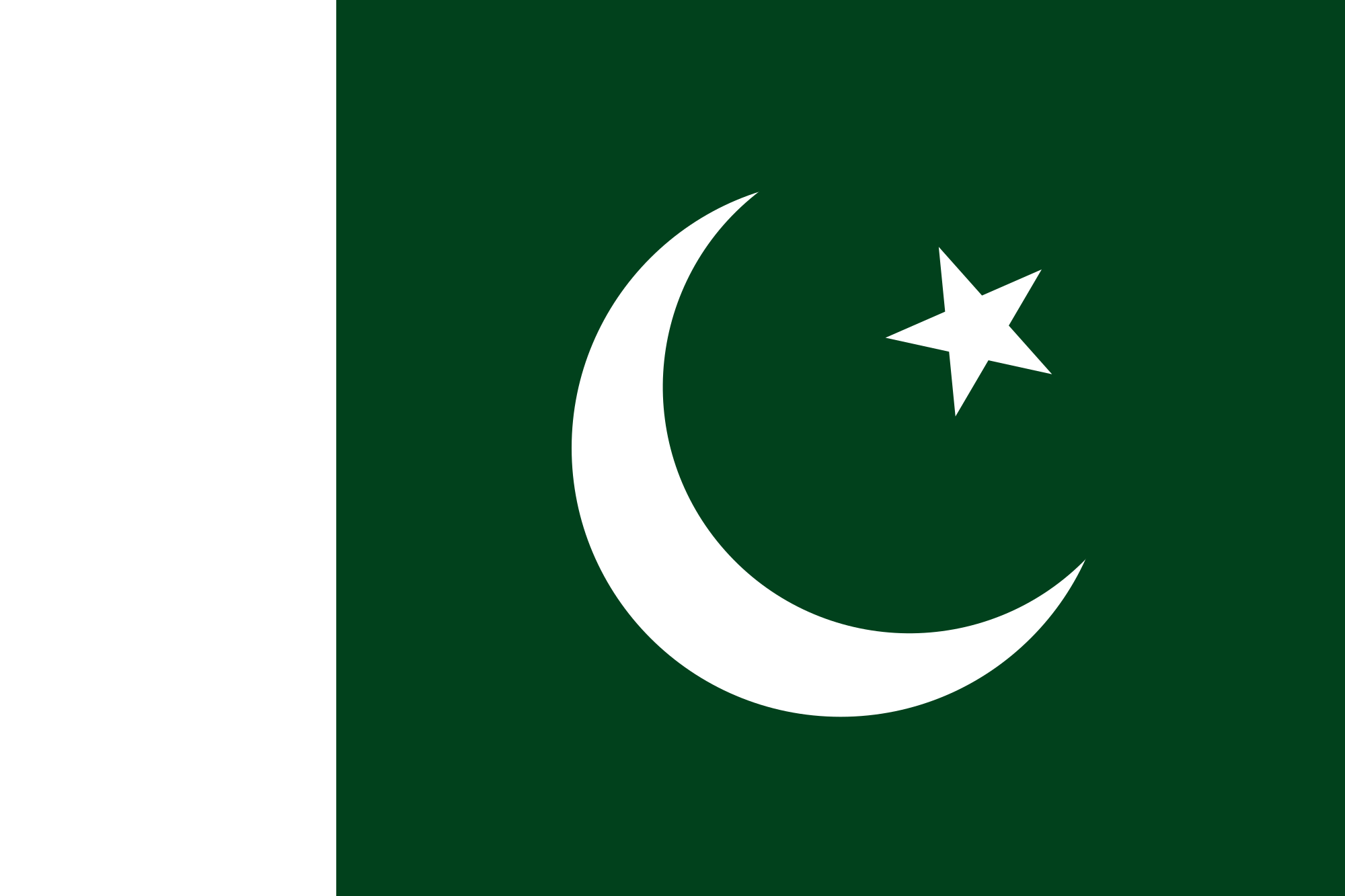
The national flag of Pakistan, also known as the Flag of the Star and Crescent (Parcam-e-Sitāra-o-Hilāl; پرچمِ ستارہ و ہلال), is made up of a green field with a stylized tilted white descending crescent moon and five-pointed star at its centre, and a vertical white stripe at its hoist-end. Though the specific shade of green on the flag is mandated only as 'dark green', its official and most consistent representation is in Pakistan green, which is shaded distinctively darker. It was adopted by the Constituent Assembly of Pakistan on 11 August 1947, and it became the official flag of the Dominion of Pakistan on 14 August 1947, following independence from the British Empire. The flag was subsequently retained as that of the Islamic Republic of Pakistan in 1956 and remains in use as the national flag to this day.
Most notably, the flag is referred to in the third verse of Pakistan's national anthem, and is widely flown on several important days of the year, including Republic Day, Independence Day and Defence Day. It is also hoisted every morning at schools, offices and government buildings to the playing of the national anthem and lowered again before sunset. A very elaborate flag-raising and lowering ceremony is carried out every evening by the Pakistan Rangers and their Indian Border Security Force counterparts at the Wagah–Attari border crossing between India and Pakistan, which is regularly attended by hundreds of spectators. The Government of Pakistan has formalized rules and regulations related to the flying of the national flag; it is to be displayed all day at full-mast on 23 March annually to commemorate the adoption of the Lahore Resolution in 1940 and the declaration of Pakistan as an independent Islamic republic with a constitution in 1956, both of which occurred on the same day. The same regulations also apply on 14 August annually, in celebration of Pakistan's day of independence; when the country was carved out from erstwhile British India as the homeland and nation-state for the Muslims of the Indian subcontinent.
In 1942, the Pakistan National Movement published a pamphlet, "The Millat of Islam and the menace of 'Indianism'", by the founder of the Pakistan Movement, Choudhry Rahmat Ali, depicting on its cover a flag of a proposed Pakistan with a thin white crescent and five white stars on a green field. A graphic illustration of Ali's flag in a critical work from 1946 more clearly portrays the stars in a pentagonal arrangement. Each star apparently represented a constituent nation of the proposed state: Punjab, Afghania (NWF), Kashmir, Sindh, and Balochistan. Ali also apparently designed a flag for an envisioned association of independent Muslim states distributed across South Asia, a 'Pak Commonwealth of Nations'. This flag featured a smaller crescent and ten stars.
The design eventually adopted as the Flag of Pakistan was based on the flag of the Muslim League. In 1937, the Muslim League began using a solid green banner charged with white descending crescent and star. In the early 1920s, during the era of the Khilafat Movement, Muslims had begun using a green banner with crescent and star, but as a religious rather than national symbol. By the 1930s, Muslims in India had become leery of the acceptance of the tricolor flag of the Congress Party as the national flag of India, in significant part because the discourses and rituals of hoisting the flag invoked explicitly Hindu religious themes. In 1940, Muhammad Ali Jinnah, leader of the Muslim League and future founder of the state of Pakistan, declared the League's flag the 'national flag of Muslim India'. By 1944, Muhammad Ali Jinnah was publicly declaring that they intended it to be the flag of Pakistan. This would become the flag of Pakistan, albeit charged with a white heraldic side or flank at the hoist. The resulting flag bears a striking resemblance to the various iterations of the Saudi flag from 1744 to 1937 which featured a white heraldic side or flank at the hoist and a green field charged with white calligraphic text (the Shahada).
In 1947, the Viceroy of India, Louis Mountbatten, proposed a national flag for the state of Pakistan which comprised the flag of the All-India Muslim League albeit with a Union Jack in the canton. This proposal was rejected by Muhammad Ali Jinnah on the grounds that a flag featuring both Saint George's Christian Cross alongside an Islamic star and crescent would not be accepted by the Pakistani people.
A team led by Syed Amir-uddin Kedwaii created the design that would ultimately be approved as the national flag. It was officially adopted by the Constituent Assembly of Pakistan on 11 August 1947, a few days before Pakistan gained its independence from British rule. Upon independence it became the flag of, first, the Dominion of Pakistan and then from 23 March 1956 that of the Islamic Republic of Pakistan. The design remains unchanged since its initial adoption.
The Islamic green of the flag represents the Muslim-majority populace of Pakistan while the white stripe on the hoist-end represents its various religious minorities i.e. Non-Muslims, such as Hindus, Christians, Sikhs, Zoroastrians and others. The combined star and crescent serve as a symbol of Islam, with the crescent representing progress and the five-pointed star representing light and knowledge. The flag symbolizes Pakistan's commitment to both Islam as well as the rights of religious minorities.
The Pakistan Flag is based on the original flag of the Muslim League, which itself drew inspiration from the flag of the Ottoman Empire.
Hub AI
Flag of Pakistan AI simulator
(@Flag of Pakistan_simulator)
Flag of Pakistan
The national flag of Pakistan, also known as the Flag of the Star and Crescent (Parcam-e-Sitāra-o-Hilāl; پرچمِ ستارہ و ہلال), is made up of a green field with a stylized tilted white descending crescent moon and five-pointed star at its centre, and a vertical white stripe at its hoist-end. Though the specific shade of green on the flag is mandated only as 'dark green', its official and most consistent representation is in Pakistan green, which is shaded distinctively darker. It was adopted by the Constituent Assembly of Pakistan on 11 August 1947, and it became the official flag of the Dominion of Pakistan on 14 August 1947, following independence from the British Empire. The flag was subsequently retained as that of the Islamic Republic of Pakistan in 1956 and remains in use as the national flag to this day.
Most notably, the flag is referred to in the third verse of Pakistan's national anthem, and is widely flown on several important days of the year, including Republic Day, Independence Day and Defence Day. It is also hoisted every morning at schools, offices and government buildings to the playing of the national anthem and lowered again before sunset. A very elaborate flag-raising and lowering ceremony is carried out every evening by the Pakistan Rangers and their Indian Border Security Force counterparts at the Wagah–Attari border crossing between India and Pakistan, which is regularly attended by hundreds of spectators. The Government of Pakistan has formalized rules and regulations related to the flying of the national flag; it is to be displayed all day at full-mast on 23 March annually to commemorate the adoption of the Lahore Resolution in 1940 and the declaration of Pakistan as an independent Islamic republic with a constitution in 1956, both of which occurred on the same day. The same regulations also apply on 14 August annually, in celebration of Pakistan's day of independence; when the country was carved out from erstwhile British India as the homeland and nation-state for the Muslims of the Indian subcontinent.
In 1942, the Pakistan National Movement published a pamphlet, "The Millat of Islam and the menace of 'Indianism'", by the founder of the Pakistan Movement, Choudhry Rahmat Ali, depicting on its cover a flag of a proposed Pakistan with a thin white crescent and five white stars on a green field. A graphic illustration of Ali's flag in a critical work from 1946 more clearly portrays the stars in a pentagonal arrangement. Each star apparently represented a constituent nation of the proposed state: Punjab, Afghania (NWF), Kashmir, Sindh, and Balochistan. Ali also apparently designed a flag for an envisioned association of independent Muslim states distributed across South Asia, a 'Pak Commonwealth of Nations'. This flag featured a smaller crescent and ten stars.
The design eventually adopted as the Flag of Pakistan was based on the flag of the Muslim League. In 1937, the Muslim League began using a solid green banner charged with white descending crescent and star. In the early 1920s, during the era of the Khilafat Movement, Muslims had begun using a green banner with crescent and star, but as a religious rather than national symbol. By the 1930s, Muslims in India had become leery of the acceptance of the tricolor flag of the Congress Party as the national flag of India, in significant part because the discourses and rituals of hoisting the flag invoked explicitly Hindu religious themes. In 1940, Muhammad Ali Jinnah, leader of the Muslim League and future founder of the state of Pakistan, declared the League's flag the 'national flag of Muslim India'. By 1944, Muhammad Ali Jinnah was publicly declaring that they intended it to be the flag of Pakistan. This would become the flag of Pakistan, albeit charged with a white heraldic side or flank at the hoist. The resulting flag bears a striking resemblance to the various iterations of the Saudi flag from 1744 to 1937 which featured a white heraldic side or flank at the hoist and a green field charged with white calligraphic text (the Shahada).
In 1947, the Viceroy of India, Louis Mountbatten, proposed a national flag for the state of Pakistan which comprised the flag of the All-India Muslim League albeit with a Union Jack in the canton. This proposal was rejected by Muhammad Ali Jinnah on the grounds that a flag featuring both Saint George's Christian Cross alongside an Islamic star and crescent would not be accepted by the Pakistani people.
A team led by Syed Amir-uddin Kedwaii created the design that would ultimately be approved as the national flag. It was officially adopted by the Constituent Assembly of Pakistan on 11 August 1947, a few days before Pakistan gained its independence from British rule. Upon independence it became the flag of, first, the Dominion of Pakistan and then from 23 March 1956 that of the Islamic Republic of Pakistan. The design remains unchanged since its initial adoption.
The Islamic green of the flag represents the Muslim-majority populace of Pakistan while the white stripe on the hoist-end represents its various religious minorities i.e. Non-Muslims, such as Hindus, Christians, Sikhs, Zoroastrians and others. The combined star and crescent serve as a symbol of Islam, with the crescent representing progress and the five-pointed star representing light and knowledge. The flag symbolizes Pakistan's commitment to both Islam as well as the rights of religious minorities.
The Pakistan Flag is based on the original flag of the Muslim League, which itself drew inspiration from the flag of the Ottoman Empire.
Recent media