Hubbry Logo
NeVe 1NeVe 1Main
Open search
NeVe 1
Community hub
NeVe 1
logo
8 pages, 0 posts
0 subscribers
Be the first to start a discussion here.
NeVe 1
NeVe 1
from Wikipedia
NeVe 1
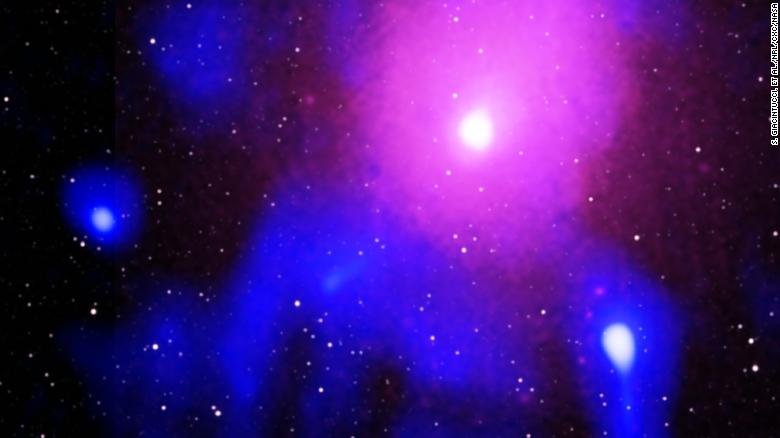
Combined XMM-Newton and GMRT image of the Ophiuchus Cluster, with NeVe 1 being the bright, purple spot. The blue cloud on its lower left is the remnant of the eruption.
Observation data (J2000 epoch)
ConstellationOphiuchus
Right ascension17h 12m 27.74s[1]
Declination−23° 22′ 10.8″[1]
Redshift0.02846[1]
Heliocentric radial velocity8530.9 km/s[1]
Distance411.2 Mly (126.08 Mpc)[1]
(comoving distance)
Group or clusterOphiuchus Cluster
Apparent magnitude (V)not visible
Characteristics
TypeE, cD[1]
Size~331,800 ly (101.74 kpc) (estimated) [1]
Notable featuresHost galaxy of the Ophiuchus Supercluster eruption
Other designations
WISEA J171227.81-232210.7; 2MASX J17122774-2322108; PGC 59827; Ophiuchus Cluster BCG; Ophiuchus A[1]

NeVe 1[2] is a supergiant elliptical galaxy, which is the central, dominant member and brightest cluster galaxy (BCG) of the Ophiuchus Cluster. It lies at a distance of about 411 million light-years away from Earth and is located behind the Zone of Avoidance region in the sky. It is the host galaxy of the Ophiuchus Supercluster eruption, the most energetic astronomical event known.[3][4][5]

Observation history

[edit]
The Ophiuchus Cluster as imaged by Pan-STARRS DR1, showing the giant galaxy NeVe 1 and its fuzzy halo partially obscured by the dense foreground stars of the Milky Way

Despite being in the relatively nearby, large Ophiuchus Cluster, due to its location behind the Milky Way galactic disc relative to the Earth's perspective (known as the Zone of Avoidance), the majority of the cluster including NeVe 1 are heavily obscured and invisible to the naked eye, such that it can only be observed in wavelengths beyond the visible spectrum, such as X-rays and infrared.

When first observed in 1985 it was initially thought to be a planetary nebula within the large, star-forming Rho Ophiuchi cloud complex.[6] In a catalogue published by the German astronomers Thorsten Neckel and Hans Vehrenberg using data retrieved from the Palomar Observatory Sky Survey, the object was then assigned as the first entry of their Atlas of Galactic Planetary Nebulae (NeVe, from their surnames Neckel and Vehrenberg).[6] The "planetary nebula" was then further incorporated in the Strasbourg-ESO Catalogue of Galactic Planetary Nebulae in 1991.[7]

In a subsequent survey using six films from the ESO/SERC Sky Survey Atlas, at least 4,100 galaxies including NeVe 1 were identified.[8] This was further attested by the detection of luminous X-ray and radio emission in the object that is indicative of an active galactic nucleus,[9] leading to its identification as not a nearby planetary nebula from a dying star, but a full-fledged giant galaxy lying beyond the Milky Way.

Characteristics

[edit]

NeVe 1's location in the sky behind the plane of the Milky Way makes it very difficult to study in the optical wavelengths. Using near-infrared and X-ray measurements it is shown to be a large elliptical galaxy—probably one of the largest such galaxies near the Milky Way, with the diameter twice that of Messier 87.[1] Observations using the Chandra X-ray Observatory in 2010 revealed that NeVe 1 sits at the center of a comet-like structure of its host cluster, indicative of ram-pressure stripping and the merger of at least two smaller subclusters. This enormous structure may have slowed down the velocity of NeVe 1 via the interaction of its stars and dark matter. The head of the structure sits about 4 kiloparsecs (13,000 light-years) from NeVe 1 and the galaxy itself is classified as a cooling core with high X-ray emission in contrast to the hot, intracluster medium of the Ophiuchus Cluster.[10]

Eruption

[edit]
The Ophiuchus Cluster with labels included. The central galaxy NeVe 1 is marked by the cross (+), while the dashed line shows the break in its X-ray halo—the boundary of the cavity and its associated radio emission. The image on the lower right by Chandra further details the cavity edge in NeVe 1's X-ray halo.
Credit: Chandra, 2MASS, XMM-Newton, GMRT.

In a paper published in 2020, NeVe 1 and its surrounding region has been identified as an extreme example of a giant radio fossil—with structures indicative of a much more violent AGN activity in the past.[11] In the case of NeVe 1 there is a striking concave arc terminating the bubble of the X-ray halo surrounding the galaxy, with smaller mini-lobes that may be a result of further, smaller activity of its AGN.[11] This concave arc is part of an enormous cavity, a void region of the intracluster medium with the diameter of at least 460 kpc (1.5 million light-years) that corresponds to an extensive, radio-emitting structure extending throughout the cluster.[11]

The creation of such an enormous cavity could be explained by an extraordinarily large AGN outburst from NeVe 1. Assuming that the cavity and the galaxy are roughly in the same radial orientation relative to Earth, the energy required to create the cavity (factoring in the density of the intracluster medium of the Ophiuchus Cluster that resist and must be displaced by the expansion) would be on the order of 5×1061 ergs (5×1054 J) of energy.[11] This violent outburst, likely to have happened no less than 240 million years before, is the Ophiuchus Supercluster eruption—the most energetic astronomical event known.[3][5] It was five times more energetic than the outburst at the galaxy cluster MS 0735.6+7421, and 4.2 million times more energetic than GRB 221009A—the most energetic gamma-ray burst known.[12] It was a high-energy low-power event, occurring over millions of years.[5]

The outburst has been attested to have been generated by NeVe 1's central supermassive black hole, which may have consumed an equivalent of 270 million solar masses of material—possibly from a cannibalized dwarf galaxy—that generated shock waves and relativistic jets of high-energy particles that displaced the intracluster medium to form the cavity.[13][14] The eruption occurred slowly over millions of years and released as much energy equivalent to thousands of gamma-ray bursts per year.[15] A later 2020 study by the NanoGRAV survey estimates the central black hole of NeVe 1 having a mass of 7 billion M (best fit; the range is between 2.5 billion to 19 billion M).[16][17]

The question remains as to how the still extant cool core of NeVe 1 would have survived such a cataclysmic activity, which would have completely destroyed the core. It has been suggested that the eruption may be the result of some form of large-scale hydrodynamic activity within the intracluster medium, allowing it to distribute the energy by a Kelvin–Helmholtz instability eddy allowing the core to survive.[11] Such structures have been found in the similar Perseus Cluster and its galaxy NGC 1275.

This observation is a result of collaboration among various space-based and Earth-based observatories including the Hubble Space Telescope, the Chandra X-ray Observatory, ESA’s XMM Newton X-ray space observatory and radio data from the Murchison Widefield Array (MWA) in Australia and the Giant Metrewave Radio Telescope (GMRT) in India.[18][19]

See also

[edit]

References

[edit]
Revisions and contributorsEdit on WikipediaRead on Wikipedia
from Grokipedia
2MASX J17122774-2322108 is a supergiant elliptical galaxy and the brightest cluster galaxy (BCG) at the center of the Ophiuchus galaxy cluster, located approximately 390 million light-years from Earth in the constellation Ophiuchus. It hosts a supermassive black hole estimated at several billion solar masses, which has driven powerful outbursts that shape the surrounding intracluster medium. As a cD-type galaxy, 2MASX J17122774-2322108 exhibits an extended stellar envelope and dominates the cluster's gravitational potential, influencing the dynamics of member galaxies. The galaxy's core features a currently faint (AGN), detectable as a compact radio source embedded within a diffuse radio minihalo spanning about 200 kiloparsecs. Observations in , radio, and wavelengths reveal 2MASX J17122774-2322108's role in heating the cluster's hot gas atmosphere, preventing runaway cooling and in the core. Its stellar population is dominated by old, low-mass stars, typical of massive ellipticals, with minimal ongoing due to the AGN's feedback mechanisms. 2MASX J17122774-2322108 gained prominence through evidence of an ancient, extraordinarily energetic eruption from its central , which excavated a vast cavity in the cluster's emitting gas roughly 1.5 million light-years across. This outburst, one of the most powerful known, released energy equivalent to hundreds of millions of solar masses and likely occurred over tens of millions of years, leaving a "radio fossil" of aged relativistic electrons detectable at low radio frequencies. The event, five times more energetic than the previous record holder in , highlights 2MASX J17122774-2322108's significance in understanding feedback in clusters.

Discovery and Observation History

Initial Identification

The Ophiuchus galaxy cluster, with NeVe 1 as its central brightest cluster galaxy, was first identified in 1981 through observations conducted by the HEAO 1 . The extended source, designated as a cluster at low galactic latitude, was optically confirmed using Sky Survey plates, revealing a rich aggregation of galaxies obscured by the Milky Way's plane. NeVe 1 was recognized as the dominant cD galaxy at the cluster core based on its extended envelope and central position. Early optical studies were limited by the region's heavy dust , but the initial identification established the cluster at a redshift of z ≈ 0.028, corresponding to a of about 390 million light-years.

Confirmation and Modern Surveys

Further confirmation came in 1987 with EXOSAT observations that detailed the hot and pointed to NeVe 1's through radio signatures. By 2000, a comprehensive optical survey using six ESO/SERC Southern Sky Survey Atlas fields detected 4,021 galaxies in the region, confirming NeVe 1 as the brightest cluster galaxy and mapping the large-scale structure. This survey revealed extended low-surface-brightness emission consistent with a massive spanning arcminutes on the sky. Post-2000, infrared observations from the (WISE) resolved NeVe 1's stellar envelope, penetrating the foreground obscuration and affirming its extragalactic nature.

Observational Challenges

The central galaxy of the Ophiuchus Cluster, NeVe 1, presents significant observational difficulties owing to its position behind the (ZoA), a region of the sky heavily obscured by the Milky Way's interstellar dust and dense stellar fields. This low Galactic latitude (b ≈ 9.3°) results in high extinction, with optical light from extragalactic sources severely attenuated, complicating direct imaging and spectroscopic studies of the galaxy. As a result, NeVe 1 is primarily accessible through non-optical wavelengths where absorption is minimal. In X-rays, the galaxy and its surrounding are prominent due to the cluster's high thermal emission, enabling detailed mapping of its core structures via space-based observatories such as NASA's , which provides the necessary and sensitivity for resolving faint extended features. In the infrared, particularly near- bands, dust extinction is reduced, allowing detection of the underlying stellar population; surveys like the VISTA Variables in Vía Láctea eXtended (VVVX) using the VISTA telescope have been essential for identifying member galaxies and characterizing the faint, obscured morphology of NeVe 1. Space-based facilities, including the (WISE), further support broad-area imaging by penetrating foreground confusion. These challenges significantly delayed comprehensive studies of NeVe 1 until the advent of multi-wavelength astronomy in the late 20th and early 21st centuries. Early efforts were hindered by the ZoA's obscuration, leading to incomplete assessments of its extent and membership. Only with coordinated , , and radio observations has full characterization of the galaxy's role as the brightest cluster galaxy become feasible, revealing its dynamic interactions within the cluster environment.

Role in the Ophiuchus Cluster

Position and Coordinates

NeVe 1 is situated in the constellation , serving as the central dominant galaxy of the Ophiuchus Cluster within the broader . Its precise equatorial coordinates in the J2000 epoch are 17h 12m 27.74s and −23° 22′ 10.8″. The galaxy's membership in the Ophiuchus Cluster is confirmed by its spectroscopic of z ≈ 0.028. This corresponds to a distance of 411.2 million light-years (126.08 Mpc) from , derived from the cluster's systemic velocity and standard ΛCDM cosmological parameters (H₀ ≈ 67 km s⁻¹ Mpc⁻¹, Ω_m = 0.3, Ω_Λ = 0.7).

Status as Brightest Cluster Galaxy

NeVe 1 is classified as the brightest cluster galaxy (BCG) and the central dominant member of the Ophiuchus Cluster, a type-cD situated at the gravitational core of this massive structure. As the BCG, it represents the most luminous galaxy within the cluster in both optical and bands, a status confirmed through deep observations that highlight its exceptional brightness relative to other members. The Ophiuchus Cluster itself is a rich, hot X-ray emitting , ranking as the second brightest in X-ray across the entire sky, with a total X-ray exceeding that of most known clusters due to its high and dense . NeVe 1 occupies the precise center of this environment, where the cluster's mass is most concentrated, serving as the dynamical and gravitational hub that anchors the distribution of hundreds of galaxies within a of several megaparsecs. This central positioning underscores its dominance, as evidenced by the alignment of the cluster's X-ray emission peak and velocity structure with NeVe 1's location. In its role as BCG, NeVe 1 exemplifies the evolutionary characteristics typical of such galaxies, including a history of hierarchical mergers that have built its extended envelope and facilitated ongoing interactions with the surrounding . These processes, unique to its central position, contribute to the cluster's overall dynamics by regulating gas cooling and feedback mechanisms, thereby shaping the large-scale structure and thermal evolution of the Ophiuchus Cluster.

Physical Properties

Morphology and Dimensions

NeVe 1, also designated 2MASX J17122774-2322108, is classified as a supergiant elliptical galaxy exhibiting cD morphology, characterized by a bright central elliptical component surrounded by an extended, low-surface-brightness envelope. This structure is indicative of repeated mergers with smaller galaxies over cosmic time, which contribute to the galaxy's large scale and diffuse outer regions. Making it one of the largest known ellipticals in the local . Its shape is generally smooth and featureless, consistent with the de Vaucouleurs r^{1/4} profile typical of elliptical galaxies. Compared to standard elliptical galaxies, which often have diameters of 10–100 kpc, NeVe 1's extension results in a significantly larger overall size, a feature commonly associated with brightest cluster galaxies that accrete material in dense cluster settings. This extended envelope enhances its dominance in the Ophiuchus Cluster, encompassing a vast shaped by the gravitational dynamics of the cluster core.

Intracluster Medium Features

The (ICM) surrounding NeVe 1 consists of a hot, diffuse plasma primarily composed of ionized and , with temperatures ranging from approximately 1 keV in the central regions to over 9 keV at larger radii, filling the space between galaxies in the Ophiuchus Cluster. This plasma emits brightly in X-rays due to thermal and line emission, making the Ophiuchus Cluster the second-brightest cluster in the 2–10 keV band after , with a total luminosity exceeding that of many other nearby clusters. The ICM's high , particularly in iron and , increases toward the core, reflecting enrichment from ejecta and stellar mass loss in the BCG and surrounding galaxies. At the center, NeVe 1 hosts a cooling core characterized by rapid radiative cooling of the ICM, where the gas density peaks sharply and the temperature drops to about 1 keV within the innermost kiloparsecs, leading to a cooling time shorter than 1 Gyr. This cool core is truncated, with an abrupt temperature rise to around 9 keV beyond approximately 30 kpc, creating a steep gradient that is more pronounced than in typical cool-core clusters. Such a structure is atypical for the brightest cluster galaxy in a massive system like Ophiuchus, where mergers or dynamical disturbances often disrupt prolonged cooling flows, though here the core persists despite the cluster's relaxed appearance. The ICM around NeVe 1 exhibits a comet-like morphology due to ram-pressure stripping as the cool core moves through the ambient cluster gas at velocities estimated around 200–300 km/s along a position angle of approximately 160°. This motion, likely induced by past cluster mergers, compresses the leading edge of the core while elongating trailing gas into tail-like features extending several kiloparsecs, displacing denser, cooler plasma and enhancing surface brightness asymmetries. The overall emission forms a bright halo enveloping the , with profiles peaking near the BCG and declining radially, excluding regions affected by dynamical features.

The Central Eruption

Detection of the Cavity

The detection of the massive cavity in NeVe 1, the brightest cluster galaxy of the cluster, originated from deep observations conducted in 2014 and analyzed in a 2016 study, which revealed a sharp, curved surface brightness discontinuity in the at a projected distance of about 120 kpc southeast of the cluster center. This feature was initially interpreted as a possible merger-induced gas dynamic effect rather than a cavity. Subsequent reanalysis of those data, combined with imaging and low-frequency radio observations from the Murchison Widefield Array and , confirmed the structure as a giant cavity in 2020. The cavity spans a diameter of approximately 460 kpc (1.5 million light-years), making it one of the largest known voids in a galaxy cluster's hot gas halo. Characterized by a concave edge marking a significant depression in the surface brightness, the cavity indicates the displacement of the surrounding ICM by buoyant relativistic plasma from a prior outburst. At its edges, the structure borders a region of diffuse radio emission, identified as a giant radio with a steep integrated of α ≈ 2.4, consistent with aged electrons in radio lobes generated by the outburst's jets. This radio feature fills the cavity , providing evidence of the pressure-driven expansion that shaped the void.

Energy Scale and Timescale

The eruption associated with NeVe 1 released an estimated total energy of approximately 5×10545 \times 10^{54} joules, calculated as the work required to inflate the enormous cavity against the pressure of the surrounding intracluster medium (ICM). This value represents the PdV energy needed to displace the hot ICM gas, forming a vast low-pressure region spanning over a million light-years, and is derived from X-ray observations of the cavity's volume and the ICM's thermal pressure profile. For context, this output equates to the energy of roughly 50 billion typical core-collapse supernovae, each releasing about 104410^{44} joules, highlighting the eruption's extraordinary scale. The timescale over which this event unfolded spans millions of years, based on the dynamical evolution of the radio plasma and the cavity's expansion inferred from spectral aging of the synchrotron emission. Detailed modeling of the radio structures suggests the outburst began at least 240 million years ago, allowing sufficient time for the relativistic plasma to propagate and cool while carving out the observed cavity; a 2025 study using upgraded GMRT observations refines the the electrons to approximately 174 million years and reveals extended structure reaching 820 kpc from the center with narrow filaments 5–10 kpc wide. This prolonged duration contrasts with shorter AGN flares, indicating a sustained injection of from the central engine that gradually displaced the ICM, enabling the bubble's inflation without immediate disruption. In comparison to other known phenomena, the NeVe 1 eruption surpasses typical (AGN) outbursts by orders of magnitude, exceeding the previous record holder in the cluster by a factor of five in total energy. It stands as the most energetic event detected since the , dwarfing the outputs of even the most powerful radio galaxies and providing a benchmark for understanding extreme feedback in cluster environments.

Supermassive Black Hole Activity

The residing at the core of NeVe 1 possesses an estimated mass of several billion solar masses. This substantial mass places it among the most massive known black holes in brightest cluster galaxies, consistent with expectations for central dominant galaxies in massive clusters like . A significant accretion event is thought to have fueled the black hole's activity, with the object likely consuming around 270 million solar masses of gas over a relatively short period. This influx of material powered an intense phase of (AGN) feedback, during which relativistic jets and radiative output from the AGN drove the excavation of a vast cavity in the surrounding . The jets, in particular, are inferred to have propagated asymmetrically due to the cluster's dynamical environment, carving out the observed radio fossil structure without a detectable counterpart lobe on the opposite side. Following this energetic outburst, the has entered a quiescent phase, exhibiting only weak radio and emissions indicative of minimal current accretion. This is attributed to the displacement of the dense gas peak in the cluster core by sloshing motions, which have starved the black hole of further fuel. Such a state highlights potential regulatory mechanisms limiting growth in cool-core clusters, where intermittent feedback episodes may cap mass accumulation after major events.

Scientific Implications

Effects on Cluster Evolution

The powerful outburst from the central (AGN) in NeVe 1 has significantly disrupted the cool core of the Ophiuchus Cluster by displacing the peak gas density through induced sloshing motions, thereby heating the (ICM) and potentially suppressing excessive that could otherwise fuel rapid in the central . This displacement has starved the of its primary fuel source, the cool gas, leading to a current state of diminished AGN activity. On a broader scale, the eruption has driven hydrodynamic instabilities, including large-scale sloshing of the ICM and potential weak shocks, which promote gas mixing across the cluster and regulate cooling flows by redistributing heated material. These processes enhance turbulence at subsonic levels, with turbulent heating contributing approximately 40% to offsetting radiative losses in the core, thereby influencing the overall thermal balance and gas dynamics throughout the cluster. Despite the immense energy injected, the cool core has demonstrated remarkable long-term survival, preserved through mechanisms such as the of sloshing motions and low nonthermal fractions (around 1-2.5%), which limit further disruption and allow partial recovery of the quiescent . This resilience challenges standard models of AGN feedback, as the core's persistence—evidenced by ongoing temperature gradients and metal abundance profiles—suggests more nuanced regulation than predicted by simulations of such violent events. Key gaps remain in understanding the role of smaller, recurrent AGN episodes in maintaining this balance, as well as the precise pathways for full core recovery following major outbursts, with current observations unable to resolve whether ongoing weak feedback or intrinsic ICM stability dominates.

Comparisons to Other Phenomena

The eruption associated with NeVe 1 in the Ophiuchus Cluster represents an extreme case among active galactic nucleus (AGN) outbursts in brightest cluster galaxies (BCGs), distinguished by its immense physical scale and energy output. The resulting X-ray cavity extends to a diameter of approximately 1.5 million light-years (about 460 kpc), dwarfing the paired cavities in MS 0735.6+7421, which measure roughly 200 kpc across, and the smaller inner cavities in the Perseus Cluster's central galaxy NGC 1275, spanning around 80 kpc. This vast size underscores NeVe 1's event as an outlier, carving a depression in the intracluster medium far beyond typical radio galaxy lobes or bubble structures observed in other clusters. In terms of , the outburst in NeVe 1 released approximately 5×10615 \times 10^{61} erg, primarily calculated from the pressure-volume work (pV) required to inflate the cavity, surpassing the previous benchmark set by by a factor of about five (with the latter at 1061\sim 10^{61} erg total, including shock contributions). By contrast, the Cluster's cavities involve energies on the order of 105910^{59} to 106010^{60} erg, highlighting how NeVe 1's event exceeds not only record holders but also routine AGN feedback episodes by orders of magnitude compared to typical cluster outbursts. Such immense injection, equivalent to the of hundreds of Milky Way-sized galaxies, positions this phenomenon as one of the rarest since the , occurring perhaps only a handful of times per cluster over cosmic history. Comparisons to other BCG-hosted eruptions further emphasize NeVe 1's uniqueness, as most documented cases involve far less extreme feedback. For instance, the outburst in the central galaxy of Abell 85 features modest cavities and shocks with energies below 106010^{60} erg, serving primarily to regulate cooling flows rather than excavate giant structures. Similarly, events in clusters like Hydra A exhibit powerful but contained lobes with total energies around 106110^{61} erg, yet without the expansive, fossilized radio emission seen in . These analogies illustrate that while AGN feedback is a common regulator in cool-core clusters, NeVe 1's eruption pushes the boundaries of observed extremes. Theoretically, NeVe 1's outburst tests the limits of AGN feedback models in massive clusters, where mechanical energy from supermassive black holes is expected to balance gas cooling and prevent runaway . Standard simulations predict outbursts capped at 10[61](/page/61)10^{[61](/page/61*)} erg to avoid over-disrupting the , but the Ophiuchus event—lacking a current active radio source yet showing aged relics—suggests mechanisms for sustained, high-efficiency energy coupling that challenge these assumptions and imply rarer, more violent episodes in early cluster evolution.
Add your contribution
Related Hubs
User Avatar
No comments yet.