


Community hub
Recent from talks
Contribute something
Nothing was collected or created yet.
Messier 19
View on Wikipedia| Messier 19 | |
|---|---|
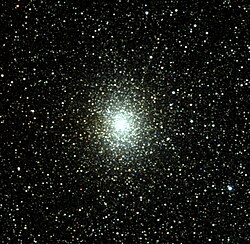
 Globular cluster Messier 19 in Ophiuchus | |
| Observation data (J2000 epoch) | |
| Class | VIII[1] |
| Constellation | Ophiuchus |
| Right ascension | 17h 02m 37.69s[2] |
| Declination | −26° 16′ 04.6″[2] |
| Distance | 28.7 kly (8.8 kpc)[3] |
| Apparent magnitude (V) | 6.8[4] |
| Apparent dimensions (V) | 17.0′ |
| Physical characteristics | |
| Mass | 1.10×10⁶[3] M☉ |
| Radius | 70 ly |
| Metallicity | [Fe/H] = –1.53[5] dex |
| Estimated age | 11.90 Gyr[5] |
| Other designations | NGC 6273, GCl 52[2] |
Messier 19 or M19 (also designated NGC 6273) is a globular cluster in the constellation Ophiuchus. It was discovered by Charles Messier on June 5, 1764[6] and added to his catalogue of comet-like objects that same year. It was resolved into individual stars by William Herschel in 1784. His son, John Herschel, described it as "a superb cluster resolvable into countless stars".[7] The cluster is located 4.5° WSW of Theta Ophiuchi and is just visible as a fuzzy point of light using 50 mm (2.0 in) binoculars. Using a telescope with a 25.4 cm (10.0 in) aperture, the cluster shows an oval appearance with a 3′ × 4′ core and a 5′ × 7′ halo.[6]
M19 is one of the most oblate of the known globular clusters.[7] This flattening may not accurately reflect the physical shape of the cluster because the emitted light is being strongly absorbed along the eastern edge. This is the result of extinction caused by intervening gas and dust. When viewed in the infrared, the cluster shows almost no flattening.[8] It lies at a distance of about 28.7 kly (8.8 kpc) from the Solar System,[3] and is quite near to the Galactic Center at only about 6.5 kly (2.0 kpc) away.[9]
This cluster contains an estimated 1,100,000 times the mass of the Sun[3] and it is around 11.9 billion years old.[5] The stellar population includes four Cepheids and RV Tauri variables, plus at least one RR Lyrae variable for which a period is known.[10] Observations made during the ROSAT mission failed to reveal any low-intensity X-ray sources.[11]

See also
[edit]References
[edit]- ^ Shapley, Harlow; Sawyer, Helen B. (August 1927), "A Classification of Globular Clusters", Harvard College Observatory Bulletin, 849 (849): 11–14, Bibcode:1927BHarO.849...11S.
- ^ a b c "M 19". SIMBAD. Centre de données astronomiques de Strasbourg. Retrieved 2006-11-16.
- ^ a b c d Boyles, J.; et al. (November 2011), "Young Radio Pulsars in Galactic Globular Clusters", The Astrophysical Journal, 742 (1): 51, arXiv:1108.4402, Bibcode:2011ApJ...742...51B, doi:10.1088/0004-637X/742/1/51, S2CID 118649860.
- ^ "Messier 19". SEDS Messier Catalog. Retrieved 21 July 2024.
- ^ a b c Forbes, Duncan A.; Bridges, Terry (May 2010), "Accreted versus in situ Milky Way globular clusters", Monthly Notices of the Royal Astronomical Society, 404 (3): 1203–1214, arXiv:1001.4289, Bibcode:2010MNRAS.404.1203F, doi:10.1111/j.1365-2966.2010.16373.x, S2CID 51825384.
- ^ a b Thompson, Robert Bruce; Thompson, Barbara Fritchman (2007), Illustrated Guide to Astronomical Wonders, Diy Science, O'Reilly Media, Inc., p. 331, ISBN 978-0596526856.
- ^ a b Burnham, Robert (1978), Burnham's Celestial Handbook: An Observer's Guide to the Universe Beyond the Solar System, Dover Books on Astronomy, vol. 2 (2nd ed.), Courier Dover Publications, p. 1263, ISBN 978-0486235684.
- ^ van den Bergh, Sidney (May 2008), "The Flattening of Globular Clusters", The Astronomical Journal, 135 (5): 1731–1737, arXiv:0802.4061, Bibcode:2008AJ....135.1731V, doi:10.1088/0004-6256/135/5/1731, S2CID 250750083.
- ^ Bica, E.; et al. (April 2006), "Globular cluster system and Milky Way properties revisited", Astronomy and Astrophysics, 450 (1): 105–115, arXiv:astro-ph/0511788, Bibcode:2006A&A...450..105B, doi:10.1051/0004-6361:20054351, S2CID 1559058.
- ^ Clement, Christine M.; et al. (November 2001), "Variable Stars in Galactic Globular Clusters", The Astronomical Journal, 122 (5): 2587–2599, arXiv:astro-ph/0108024, Bibcode:2001AJ....122.2587C, doi:10.1086/323719, S2CID 38359010.
- ^ Verbunt, F. (March 2001), "A census with ROSAT of low-luminosity X-ray sources in globular clusters", Astronomy and Astrophysics, 368: 137–159, arXiv:astro-ph/0012261, Bibcode:2001A&A...368..137V, doi:10.1051/0004-6361:20000469, S2CID 2442974.
External links
[edit]
- Messier 19, SEDS Messier pages
- Messier 19, Galactic Globular Clusters Database page
- Messier 19 on WikiSky: DSS2, SDSS, GALEX, IRAS, Hydrogen α, X-Ray, Astrophoto, Sky Map, Articles and images


| List |
|  |
|---|---|---|
| See also | ||

