


Community hub
Recent from talks
Contribute something
Nothing was collected or created yet.
Nea Makri
View on Wikipedia
Key Information


Nea Makri (Greek: Νέα Μάκρη) is a town in East Attica, Greece. Since the local government reform of 2011, it has been a municipal unit within the municipality of Marathon.[2] The municipal unit has an area of 36.662 km2.[3] It is part of the Athens metropolitan area.[4]
Geography
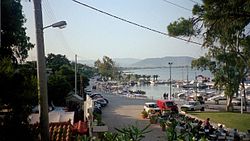
[edit]Nea Makri is situated on the coast of the Petalioi Gulf, a gulf of the Aegean Sea, in the easternmost part of the Attica peninsula. It is 7 km north of Rafina, 8 km south of Marathon and 25 km northeast of Athens city centre. The municipal unit Nea Makri also contains the village Neos Voutzas, 5 km south of Nea Makri town centre. Greek National Road 83 (Athens - Marathon - Rafina) passes through Nea Makri.
Popular locations near Nea Makri include Zoumberi Beach and the Brexiza Wetland. It is widely known and visited due to its beaches and coastline.
History
[edit]The area was once known as Plesti, but following the 1922 Greek military disaster in Asia Minor and the subsequent expulsion of the native Greeks of Makri in Turkey, it was renamed Nea Makri (New Makri) by the refugees who settled there.
The United States Navy operated a HF radio communications base north of Nea Makri from the mid to the late 20th century. The transmitters were located further north, at Kato Souli. The call sign of the station was NGR. The American naval communications station was the deployment location for Naval Mobile Construction Battalion 133, home-ported in Gulfport, MS.
Saint Ephraim the martyr was a monk who may have lived in the Monastery of the Annunciation in Nea Makri; it has become an important monastery in recent years and has become a site of pilgrimage for all Greeks.[5]
Population
[edit]| Year | Town population | Municipality population |
|---|---|---|
| 1981 | 8,516 | - |
| 1991 | 12,120 | 13,009 |
| 2001 | 13,986 | 14,809 |
| 2011 | 15,554 | 16,670 |
| 2021 | 16,906 | 18,114 |
See also
[edit]References
[edit]- ^ "Αποτελέσματα Απογραφής Πληθυσμού - Κατοικιών 2021, Μόνιμος Πληθυσμός κατά οικισμό" [Results of the 2021 Population - Housing Census, Permanent population by settlement] (in Greek). Hellenic Statistical Authority. 29 March 2024.
- ^ "ΦΕΚ B 1292/2010, Kallikratis reform municipalities" (in Greek). Government Gazette.
- ^ "Population & housing census 2001 (incl. area and average elevation)" (PDF) (in Greek). National Statistical Service of Greece.
- ^ "Athens Population 2022 (Demographics, Maps, Graphs)".
- ^ "Άγιος Εφραίμ (Νέας Μάκρης)". Retrieved 2021-09-03.


Nea Makri
View on GrokipediaNea Makri (Greek: Νέα Μάκρη) is a coastal town and municipal unit in East Attica, Greece, situated approximately 38 kilometers northeast of Athens along the southern shore of the Gulf of Euboea.[1] With a population of 16,904 as of the 2021 census, the town has experienced steady growth, reaching an estimated 18,049 residents by 2025, driven by suburban development and proximity to the capital.[2][3] Originally a rural area known historically as Plesti and resettled by refugees following the 1922 Greco-Turkish War, Nea Makri has evolved into a resort destination noted for its beaches, marina, and annual events such as the book fair, supporting a local economy centered on tourism and residential expansion.[4] Since the 2011 local government reform, it forms part of the larger Municipality of Marathon, enhancing its role as a commuter and leisure hub for Athenians.[5]
Geography
Location and Physical Features
Nea Makri is positioned along the eastern coast of the Attica peninsula in Greece, within the Municipality of Marathonas in the East Attica regional unit. It lies approximately 32 kilometers northeast of Athens, on the shores of the [Aegean Sea](/page/Aegean Sea). The town's geographic coordinates are roughly 38.08°N latitude and 23.98°E longitude.[6][7] The physical landscape of Nea Makri features a low-elevation coastal plain, with the town itself situated at about 14 meters above sea level, facilitating direct access to sandy beaches and a marina. The broader municipal unit encompasses varied terrain, rising from sea level to an average elevation of 217 meters and peaking at 777 meters inland, indicative of adjacent hilly and mountainous areas.[8][9] To the west, the area borders the Pentelikon mountain range, contributing to a backdrop of elevated terrain that contrasts with the flat, beachfront zones oriented toward the sea. The coastline includes organized beaches popular for recreation, supported by the gulf's sheltered waters.[10][7]Climate and Environmental Conditions
Nea Makri experiences a hot-summer Mediterranean climate (Köppen Csa), characterized by hot, dry summers and mild, wetter winters influenced by its coastal location along the Euboean Gulf. Average annual precipitation totals approximately 328 mm, with the majority falling between October and March; November records the highest monthly average at 56 mm, while July and August see minimal rainfall of about 5 mm each.[11] Temperatures peak in July and August with average highs of 31–32°C and lows around 22–23°C, rarely exceeding 35°C; winters are cooler, with January highs averaging 13°C and lows of 6–7°C, seldom dropping below 2°C.[12] Humidity levels vary seasonally, reaching up to 74% in January and dropping to 52% in August, while prevailing northerly winds average 13–16 km/h, stronger in winter.[11][12]| Month | Avg. High (°C) | Avg. Low (°C) | Precipitation (mm) |
|---|---|---|---|
| January | 11.9 | 7.5 | 49 |
| February | 13.3 | 8.4 | ~40 |
| March | 15.6 | 9.8 | ~38 |
| April | 18.6 | 12.3 | ~23 |
| May | 23.3 | 16.6 | ~13 |
| June | 27.5 | 20.7 | ~8 |
| July | 30.3 | 23.3 | 4 |
| August | 30.3 | 23.5 | 3 |
| September | 26.7 | 20.9 | ~10 |
| October | 21.7 | 17.0 | ~33 |
| November | 17.7 | 13.5 | 56 |
| December | 13.7 | 9.2 | 49 |
History
Ancient and Classical Periods
The region of modern Nea Makri preserves evidence of Attica's earliest known human settlement during the Neolithic period, dating from approximately 6000 to 4700 BC.[21] Excavations initiated by Dimitrios R. Theocharis in 1954–1955 at the coastal site, later continued by Maria Pantelidou Gofas, uncovered remains of Middle Neolithic dwellings, including ellipsoidal stilt huts with pitched roofs and above-ground storehouses featuring cobbled floors.[22][23] Artifacts such as pottery with incised and dotted decorations, stone tools, beads, and figurines indicate a sedentary community reliant on maritime resources and early agriculture, marking this as the oldest Neolithic site in Attica located at ancient Probalinthus.[21][24] Subsequent prehistoric phases show sparser occupation in the immediate Nea Makri area, with Middle and Late Bronze Age activity concentrated nearby in the broader Marathon plain, including limited evidence south of the marshes.[25] No major settlements from the Early Helladic period have been identified directly at Nea Makri, though Cycladic-influenced cemeteries like Tsepi, approximately 3 km inland, yielded pit graves with marble figurines and bronze tools around 2800–2000 BC.[21] In the Classical period (c. 480–323 BC), the coastal vicinity of Nea Makri fell within the Athenian tribal territory of Marathon, potentially linked to the deme of Probalinthos, but archaeological evidence remains minimal, with no prominent temples, fortifications, or burials attested specifically here.[21] The site's strategic proximity to the plain facilitated Athenian control following the Battle of Marathon in 490 BC, yet habitation appears secondary to inland agrarian centers.[26] A notable late ancient development occurred in the Roman Imperial era around 160 AD, when the rhetorician and benefactor Herodes Atticus, a native of Marathon, established the Sanctuary of the Egyptian Gods at Brexiza (Mikro Elos), incorporating syncretic worship of deities like Isis and Sarapis alongside a luxurious bath complex and cistern.[27] This complex, modeled partly on Hadrian's Canopus-inspired villa at Tivoli, featured an islet layout separated by canals, reflecting elite Roman-era cultural fusion without evident pre-Roman foundations.[27]Medieval and Ottoman Eras
The region encompassing modern Nea Makri, situated on Mount Amomon in eastern Attica, featured monastic establishments during the late Byzantine period, reflecting the continuity of Orthodox Christian institutions amid the empire's decline. The Monastery of the Annunciation of the Theotokos, one of Attica's ancient monastic sites potentially originating as early as the 10th century, served as a center for ascetic life and spiritual retreat.[28] By the early 15th century, it housed communities of monks, including figures like Ephraim (born Konstantinos Morphes in 1384 in Trikala, Thessaly), who entered monastic life young to evade Ottoman pressures and eventually became its abbot.[29] These institutions underscored the Byzantine emphasis on monasticism as a bulwark against external threats, though specific demographic or economic details for the sparse coastal settlements remain limited in records. Following the Ottoman conquests in the Balkans, the area experienced early incursions that devastated local Christian sites. In 1424, Ottoman troops raided and destroyed the Monastery of the Annunciation, slaughtering its monks while Abbot Ephraim, absent at the time, survived as a hermit amid the ruins.[29] Captured in a subsequent raid in September 1425, Ephraim endured prolonged torture—including beatings, starvation, and suspension—for refusing to convert to Islam, culminating in his martyrdom by impalement on May 5, 1426.[30] Attica's formal cession to the Ottomans around 1456 integrated the region into the empire's administrative structure, with Nea Makri's vicinity likely reduced to agrarian villages under timar holdings, subject to taxation and periodic levies.[30] The monastery lay abandoned in ruins throughout the Ottoman era, emblematic of the suppression of autonomous Christian monasticism, until its relics and structures were rediscovered centuries later.[29]Modern Independence and 20th Century Developments
Nea Makri's integration into the modern Greek state occurred following the Greek War of Independence (1821–1830), which culminated in the establishment of the Kingdom of Greece under King Otto in 1832, incorporating East Attica territories previously under Ottoman control. The locality, then sparsely inhabited and known regionally for its coastal and agricultural potential near the Marathon plain, experienced minimal infrastructural or demographic shifts during the 19th century, functioning primarily as a rural outpost with subsistence farming and seasonal fishing activities. The 20th century brought transformative developments, primarily driven by the aftermath of the Greco-Turkish War (1919–1922) and the Asia Minor Catastrophe, which displaced over 1.2 million ethnic Greeks from Anatolia and Eastern Thrace via the 1923 Convention Concerning the Exchange of Greek and Turkish Populations. Nea Makri emerged as a dedicated refugee settlement around 1923–1924, populated mainly by expatriates from Makri (now Fethiye) and adjacent Ionian communities such as Livissi (now Kayaköy), with the town's name explicitly denoting its status as the "New Makri." Initial settlement involved rudimentary housing amid the broader national effort to accommodate refugees, who comprised skilled artisans, merchants, and farmers contributing to local economic revival through small-scale commerce and cultivation. Subsequent decades saw steady urbanization, fueled by housing expansions that accommodated growing families and seasonal migrants. By the 1980s, these developments had elevated Nea Makri's status as an emerging suburban extension of greater Athens, with population figures rising from approximately 5,182 residents in the town proper in 1981 to integrated municipal growth reflecting broader Attica trends. This era also laid groundwork for tourism, as improved road access and coastal amenities attracted visitors, though agricultural roots persisted alongside nascent resort infrastructure.Post-World War II Era and U.S. Military Presence
Following the end of World War II in 1945, Greece grappled with the Greek Civil War (1946–1949), during which U.S. assistance under the Truman Doctrine provided military and economic aid to counter communist insurgents supported by Yugoslavia, Albania, and Bulgaria. While Nea Makri itself was not a primary site of conflict, its coastal location in Attica facilitated post-war reconstruction efforts, including infrastructure improvements tied to broader U.S.-Greece security cooperation as Greece aligned with the West.[31] Greece's accession to NATO in 1952 further solidified this partnership, paving the way for American military facilities in the region. The most significant post-war development in Nea Makri was the establishment of the U.S. Naval Communications Station (NAVCOMMSTA) Nea Makri in the early 1950s, located approximately 40 kilometers northeast of Athens near the site of the ancient Battle of Marathon.[32] This facility served as a critical node in the U.S. defense communications network, providing high-frequency radio transmission and reception capabilities for the U.S. Sixth Fleet operating in the Mediterranean.[33] By 1963, the station had been expanded to include electronic surveillance functions, monitoring maritime traffic in the Aegean Sea and relaying intelligence on Soviet naval activities during the Cold War.[34] Staffed by around 500 U.S. personnel at its peak, the base operated independently of NATO structures, functioning as a unilateral American installation to ensure reliable command-and-control links amid regional tensions.[35] The American presence stimulated local economic growth in Nea Makri, a modest fishing and agricultural community, through employment opportunities for Greek workers in construction, maintenance, and support services, as well as increased commerce from U.S. service members frequenting nearby businesses.[36] However, relations were not without friction; the 1974 Turkish invasion of Cyprus, perceived by many Greeks as enabled by U.S. inaction despite NATO alliances, led to anti-American sentiment in Nea Makri, where residents accused base personnel of complicity and demanded accountability for failing to avert the crisis.[37] Amid shifting U.S. foreign policy and Greek demands for reduced foreign basing in the late Cold War period, NAVCOMMSTA Nea Makri was decommissioned in 1990, with formal handover to the Greek Navy occurring on August 17, 1990, during a ceremony marking the lowering of the U.S. flag.[38] The closure, part of a broader drawdown that included the nearby Hellenikon Air Base, resulted in job losses estimated at hundreds for locals and a measurable downturn in ancillary economic activity, underscoring the town's prior dependence on the facility.[36] The site transitioned to Greek naval use for communications, though remnants of U.S.-era infrastructure persisted, contributing to local narratives of strategic legacy amid Greece's evolving role in post-Cold War security dynamics.[34]Demographics
Population Trends and Composition
The population of Nea Makri, a municipal unit within the Municipality of Marathon in East Attica, has exhibited consistent growth since the late 20th century, driven primarily by residential housing developments and its appeal as a coastal suburb accessible to Athens. This expansion aligns with broader suburbanization trends in the Attica region, where proximity to urban centers, beaches, and infrastructure has attracted families and seasonal residents.[4][39] Historical census data illustrate this upward trajectory, with the town transitioning from a largely rural base in the 1970s to a more urbanized community. The following table summarizes key population figures from Greek censuses:| Year | Population |
|---|---|
| 1981 | 8,516 |
| 1991 | 12,120 |
| 2001 | 13,986 |
| 2011 | 15,554 |
| 2021 | 16,904 |