


Community hub
Recent from talks
Contribute something
Nothing was collected or created yet.
New Kowloon
View on Wikipedia
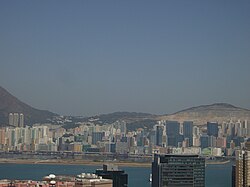
New Kowloon is an area in Hong Kong, bounded to the south by Boundary Street, and to the north by the ranges of the Eagle's Nest, Beacon Hill, Lion Rock, Tate's Cairn and Kowloon Peak. It covers the present-day Kwun Tong District and Wong Tai Sin District, and northern parts of the Sham Shui Po District and Kowloon City District.
Key Information


The name of this area is[when?] rarely used in day-to-day life. Areas that belong to New Kowloon are usually referred to as a part of Kowloon. However, in land leases, it is common to refer to land lots in lot numbers as "New Kowloon Inland Lot number #".
History
[edit] | You can help expand this article with text translated from the corresponding article in Cantonese. (November 2021) Click [show] for important translation instructions.
|
By the Convention of Peking in 1860, the territory of British-owned Kowloon was defined as area on the Kowloon Peninsula south of a line which later became Boundary Street (known as Kowloon, inclusive of Stonecutters Island), which was ceded by the Qing Empire (Ch'ing Empire, Manchu Empire) to the United Kingdom under the Convention.
On the other hand, the territory north of Boundary Street (later known as New Kowloon) remained part of Qing Empire until it was leased as part of the New Territories to the UK in 1898 for 99 years under the Convention for the Extension of Hong Kong Territory (also known as the Second Convention of Peking). The area of New Kowloon was defined in statutory law first in November 1900[1][2] (and referred to as such[3][4][5][6][7][8][9][10]) and again in December 1937[11][12][13] to increase land available for urban development.[citation needed] For most part the northern boundary of the area was defined by the 500 feet (152 metres) contour. In practice, nevertheless, both the areas to the south and to the north of Boundary Street (i.e. both Kowloon and New Kowloon), from the Lei Yue Mun strait in the east to Mei Foo Sun Chuen and Lai Chi Kok Bay in the west, are collectively known as "Kowloon". For example, a postal address in Kwun Tong will identify "Kowloon" as its regional destination, even though it is technically in New Kowloon and not part of Kowloon as statutorily defined.
Current situation
[edit]In modern-day conversations, the term "New Kowloon" is now[when?] rarely heard in Hong Kong. New Kowloon is no longer regarded as part of the New Territories, but as a part of the Kowloon urban area beyond Boundary Street. Nevertheless, the legal definitions of Kowloon, New Kowloon and New Territories remain unchanged—New Kowloon has remained legally part of the New Territories instead of Kowloon.[14] On 1 July 1997, the territories on both sides of Boundary Street (ceded and leased respectively) were transferred to China, along with the rest of Hong Kong.
However, the designation "New Kowloon" still has some legal implications. Almost[clarification needed] all lands of Hong Kong are government land (known as crown land in Commonwealth countries and before 1997 in Hong Kong), while all crown leases (now known as government leases in Hong Kong) of New Kowloon and New Territories lands had been expired on 27 June 1997, but automatically extended up to 30 June 2047 due to the Sino-British Joint Declaration.[15] This renewal implies that, all privately owned land leases of New Kowloon, has to pay government rent (crown rent in Commonwealth countries) as leases in the rest of the New Territories, and unlike the rest of the Kowloon.[16] Most Kowloon land leases (Kowloon south of the Boundary Street) are not required to pay the government rent to the government, unless they are new leases, or are old leases having been renewed and such clauses have been inserted in the renewed lease contract.
The land reclaimed from the Kowloon Bay water body, such as Kai Tak, are also referred as part of New Kowloon in land leases,[17][18] although these lots do not appear to be included in the 1937 map.
See also
[edit]References
[edit]- ^ New Territories (Extension of Laws) Ordinance 1900, Ordinance No. 8 of 1900
- ^ Plan of New Kowloon, signed by the Director of Public Works and countersigned by the Governor and deposited in the Land Office of the Colony, and deposited at the Magistracy and at the Office of the Colonial Secretary according to the New Territories (Extension of Laws) Ordinance 1900
- ^ Hong Kong Legislative Council
- ^ Administrative Reports for the Year 1909
- ^ Hong Kong Legislative Council
- ^ Hong Kong Legislative Council
- ^ Hong Kong Legislative Council
- ^ "HK Maps". Archived from the original on 10 July 2019.
- ^ "HK Maps". Archived from the original on 4 November 2018.
- ^ "HK Maps". Archived from the original on 30 June 2017.
- ^ Hong Kong Legislative Council
- ^ Sched 5 to the IGCO
- ^ Plan marked “New Kowloon” dated 8 December 1937, signed by the Director of Public Works, countersigned by the Governor and deposited in the Land Registry.
- ^ Schedules 4, 5 and 5A, Interpretation and General Clauses Ordinance (IGCO), HK Law Cap. 1
- ^ Annex III, – via Wikisource.
- ^ "Government Rent". Hong Kong: Rating and Valuation Department. 1 August 2019. Archived from the original on 11 May 2021. Retrieved 6 December 2020.
- ^ "Government to sell site in Kai Tak by public tender". info.gov.hk (Press release). Hong Kong Government. 23 October 2020. Retrieved 3 December 2020.
- ^ https://hos.housingauthority.gov.hk/mini-site/hos2022/common/pdf/DMC_Kai_Yan_Court.pdf https://hos.housingauthority.gov.hk/mini-site/hos2022/common/pdf/brochure/Sales_Brochure_Kai_Yan.pdf
External links
[edit]
- Definition of New Kowloon in the Laws of Hong Kong as defined in 1937, Cap 1 SCHED 5, Hong Kong Laws.
- Land Tenure System in Hong Kong - Legislative Council
22°20′03″N 114°11′14″E / 22.3341°N 114.1871°E

New Kowloon
View on GrokipediaGeography and Boundaries
Definition and Extent
New Kowloon constitutes a designated portion of Hong Kong's New Territories, legally defined under the Interpretation and General Clauses Ordinance (Cap. 1) as the area delineated in a plan marked "New Kowloon" dated 8 December 1937, signed by the Director of Public Works, countersigned by the Governor, and deposited in the Land Office.[3] This definition emerged from Ordinance No. 26 of 1937, which provided precise boundaries to facilitate urban administration and extension beyond the original Kowloon Peninsula ceded in 1860.[4] The area remains statutorily part of the New Territories, despite its integration into Kowloon's urban fabric for practical governance purposes.[3] The southern boundary aligns with Boundary Street, marking the limit of the pre-1898 Kowloon territory, while the western extent reaches Lai Chi Kok Bay and the eastern to Lei Yue Mun channel.[2] To the north, the boundary follows the 500-foot (approximately 152.4 meters) contour line along the Kowloon Ridge hills, encompassing upland areas up to peaks such as those near Devil's Peak.[2] This demarcation excludes higher elevations and rural hinterlands, focusing on developable lowland extensions suitable for residential and industrial growth. Subsequent land reclamations, including the 1950s extension of Kai Tak Airport's runway 13/31 into Victoria Harbour, have been incorporated into New Kowloon's administrative lots, expanding its effective footprint eastward without altering the core 1937 delineation.[1] In contemporary usage, New Kowloon primarily includes districts such as Kwun Tong, Wong Tai Sin, and parts of Kowloon City and Sham Shui Po north of Boundary Street, forming a densely urbanized zone integral to Kowloon's continuous built environment.[1] Its extent supports high population densities, with the broader Kowloon area (encompassing both the peninsula and New Kowloon) covering approximately 47 square kilometers and housing over 2 million residents as of early 2000s estimates.[5] This legal and geographical framework underscores New Kowloon's role as a bridge between the compact original Kowloon and the expansive New Territories, enabling systematic urban expansion under colonial planning.[4]Physical Features and Composition
New Kowloon features a topography dominated by northeast-southwest trending ridges and peaks rising from coastal lowlands, with elevations reaching up to 603 meters at Kowloon Peak. The underlying geology consists of granitic and volcanic rocks, forming rugged uplands and rounded hills prone to weathering and erosion, which have created deep gullies in areas like the Tai Lam badlands.[6] Significant portions of the coastal zone have been modified through land reclamation, notably in Kowloon Bay, where initial large-scale filling occurred in the early 1920s, followed by additional works between 1942 and 1945 under Japanese occupation. These reclamations produced extensive flat expanses of artificial land, enabling urban and industrial expansion amid the naturally steep foreshores and rocky headlands.[6] The landscape's vegetative cover is characterized by scrubland and grassland, resulting from historical deforestation, with approximately 10% woodland established through post-World War II reforestation by 1990. Reservoirs such as the Kowloon Reservoir integrate into the upland terrain, providing water features that contrast with the predominantly rocky and undulating terrain.[6]Historical Background
Pre-20th Century Context
The territory encompassing present-day New Kowloon was administered as part of Xin'an County under the Qing Dynasty prior to its inclusion in the 1898 lease of the New Territories to Britain via the Convention for the Extension of Hong Kong Territory, signed on 9 June 1898.[7] This coastal fringe north of the Kowloon Peninsula featured predominantly rural landscapes, with communities engaged in subsistence agriculture, rice cultivation, and coastal fishing, reflecting the broader pre-colonial economy of southern Guangdong Province.[8] Archaeological and historical records indicate earlier significance during the Song Dynasty (960–1279), when the Kowloon region supported salt production fields managed by imperial overseers, alongside rudimentary watchposts erected to counter pirate incursions from the South China Sea.[9] By the Qing period, population centers remained sparse, consisting of clustered Punti and Hakka villages fortified against banditry and smuggling, with land use centered on paddy fields and saltpans rather than urban settlement.[10] In response to growing maritime threats and European expansion—particularly after the First Opium War (1839–1842)—Qing authorities constructed defensive infrastructure, including the Kowloon Walled City around 1810 as a granite fortification housing a small garrison and administrative yamen to regulate trade and patrol the estuary.[11] This outpost, located in what became Kowloon City within New Kowloon, symbolized imperial efforts to assert control over the periphery amid weakening central authority, though the surrounding expanse northwards retained its agrarian character with minimal infrastructure until British surveys post-1898.[12]Establishment in the Colonial Era
The establishment of New Kowloon occurred during the British colonial administration following the acquisition of the New Territories through a 99-year lease under the Convention for the Extension of Hong Kong Territory, signed on 9 June 1898.[1] This lease encompassed approximately 235 square miles north of the Kowloon Peninsula, including rural and coastal areas adjacent to the existing urban core south of Boundary Street.[1] British authorities recognized the potential for urban expansion in the southern fringes of this leased territory, leading to incremental development of infrastructure and settlement in districts such as Sham Shui Po and Cheung Sha Wan to accommodate growing population pressures from mainland China.[13] By the early 20th century, the term "New Kowloon" emerged informally to denote this southern portion of the New Territories, distinguishing it from the more rural northern areas and integrating it administratively with the Kowloon Peninsula for urban planning purposes.[1] Initial boundary delineations appeared in maps as early as 1900, reflecting British intentions to extend the urban fabric northward.[14] However, these early definitions lacked statutory precision, prompting legislative action to formalize the area's status amid accelerating reclamation and development projects. The precise legal establishment of New Kowloon boundaries was enacted through an ordinance passed by the Hong Kong Legislative Council on 15 December 1937, which provided "new, more accurate and definite definitions" of the area.[4] This legislation referenced a detailed plan marked "New Kowloon," dated 8 December 1937 and signed by the Director of Public Works, delineating the territory in red on deposited maps.[15] The defined area encompassed key urbanizing zones including Kowloon Tong, Tai Hang Tung, and parts of Ngau Chi Wan, excluding later reclamations like those for Kai Tak Airport's extensions.[2] This statutory demarcation facilitated targeted land administration, lot numbering, and infrastructure allocation, embedding New Kowloon as an extension of colonial urban governance distinct from the broader New Territories.[3]Mid-20th Century Developments
Following the Second World War and the founding of the People's Republic of China in 1949, New Kowloon saw explosive population growth from an influx of refugees fleeing instability on the mainland, with the area's residents increasing from 23,000 in 1931 to over 850,000 by 1961.[16] This surge strained housing resources, leading to widespread squatter settlements across districts like Sham Shui Po and Wong Tai Sin. The Shek Kip Mei fire on December 25, 1953, destroyed a major squatter area in New Kowloon, rendering more than 50,000 people homeless and catalyzing the colonial government's resettlement program.[17] In response, the first resettlement estate was erected at Shek Kip Mei in 1954, consisting of basic multi-story blocks designed for rapid construction to rehouse fire victims and other squatters.[18] Additional estates followed in the 1950s and 1960s, including in Wong Tai Sin and Ngau Chi Wan, providing temporary low-cost accommodation that housed hundreds of thousands amid ongoing demographic pressures.[18] Industrial expansion paralleled housing initiatives to generate employment for the growing workforce. In Kwun Tong, the government initiated development in 1953, with land reclamation from 1954 to 1957 creating space for factories and marking it as Hong Kong's inaugural planned industrial district.[19] This effort attracted manufacturing, particularly textiles and light industries, contributing to economic resilience despite limited resources. Infrastructure projects included the mid-1950s extension of Kai Tak Airport's runway 13/31 onto newly reclaimed land in Kowloon Bay, which enhanced connectivity but also reshaped local geography; this reclamation was subsequently designated as part of New Kowloon for administrative purposes.[20] By the late 1960s, these developments had transformed New Kowloon from peripheral farmland into a densely populated urban extension, underpinning Hong Kong's post-war industrialization.Administrative and Legal Framework
Relation to the New Territories Lease
New Kowloon constitutes the southern portion of the New Territories, which were leased to the United Kingdom under the Convention for the Extension of Hong Kong Territory, signed on June 9, 1898, between Great Britain and the Qing Dynasty of China.[21] The lease encompassed approximately 235 square miles of territory north of the Kowloon Peninsula boundary established by the 1860 Convention of Peking, including the area later designated as New Kowloon, for a fixed term of 99 years commencing July 1, 1898, and expiring June 30, 1997.[21] This arrangement provided Britain with administrative control over the leased lands without perpetual sovereignty, distinguishing New Kowloon from the ceded territories of Hong Kong Island (1842) and southern Kowloon, which were granted in perpetuity.[7] In colonial land administration, grants within New Kowloon followed the lease's temporal constraints, typically issued for the residue of the 99-year term less three days to align with the overarching lease expiration.[22] This policy reflected the leased status of the underlying territory, subjecting New Kowloon properties to potential reversion to Chinese sovereignty upon lease termination unless renewed or renegotiated. Early administrative measures, such as the application of colony ordinances to New Kowloon on November 3, 1900, as delineated on official maps, integrated the area into Hong Kong's legal framework while preserving its leased character.[23] The formal definition of New Kowloon emerged through a proclamation dated December 8, 1937, signed by the Director of Public Works and incorporated into the Interpretation and General Clauses Ordinance, establishing precise boundaries within the leased New Territories for urban development and regulatory purposes.[15] This delineation facilitated the extension of Kowloon's urban infrastructure northward but did not alter the fundamental leased tenure, which influenced post-1940s planning by necessitating considerations of the impending 1997 expiry. Despite its administrative alignment with Kowloon, New Kowloon's inclusion in the New Territories lease underscored the inseparability of the territories during the 1984 Sino-British Joint Declaration, leading to the comprehensive handover of Hong Kong.[24]Evolution of Status Post-1940s
Following the Japanese occupation's end in 1945 and resumption of British colonial administration, New Kowloon underwent rapid urbanization driven by a massive influx of refugees from mainland China, with Hong Kong's population surging from approximately 600,000 in 1945 to over 2.1 million by 1951, much of which concentrated in underdeveloped areas north of Boundary Street.[25] This demographic pressure prompted the colonial government to prioritize industrial and residential development, including the establishment of factories in Kwun Tong and public housing estates following events like the 1953 Shek Kip Mei fire, which displaced over 50,000 squatters and accelerated planned urban expansion.[26] Legally, New Kowloon's status as part of the 1898-leased New Territories remained unchanged, with land grants issued under New Kowloon Inland Lots (NKIL) terms expiring on June 30, 1997, minus three days from the lease commencement, distinguishing them from broader New Territories leases.[27] However, administrative practices diverged from rural New Territories governance; the New Territories Ordinance, which preserved customary land rights like those of tso and tong associations, applied only to a limited extent in New Kowloon due to its densification, with exemptions or modifications for urban lots to facilitate industrial zoning and high-density housing.[28] By the 1950s, planning frameworks such as the 1948 Abercrombie Report designated much of New Kowloon for residential and industrial use, treating it as an urban extension rather than peripheral leased territory.[29] Further evolution occurred through land reclamation and infrastructural integration in the mid-20th century, exemplified by the extension of Kai Tak Airport's runway 13/31 in the 1950s, which added approximately 300 acres of new land statutorily incorporated into New Kowloon via lot numbering, expanding its effective boundaries despite originating from leased waters. Administrative district reorganization in the 1970s and 1980s reinforced this shift, with areas like Kwun Tong and Wong Tai Sin—encompassing NKIL lands—managed under Kowloon-focused district offices rather than New Territories rural boards, reflecting practical detachment from agrarian lease stipulations.[31] By the 1980s Sino-British negotiations, New Kowloon's urban character was acknowledged in handover provisions, ensuring continuity of developed lots under the Basic Law without altering its leased tenure, though its lot-specific grants were extended en bloc post-1997.[32]Post-Handover Integration
Following the transfer of sovereignty on 1 July 1997, New Kowloon integrated into the Hong Kong Special Administrative Region (HKSAR) as defined under the Basic Law, which established a high degree of autonomy for the territory while upholding the "one country, two systems" framework until 2047.[33] This incorporation preserved the area's pre-existing urban administrative divisions, including districts such as Kwun Tong, Wong Tai Sin, and Sham Shui Po (northern portions), which continued to operate under the HKSAR's district administration system without distinct legal status for New Kowloon as a whole.[27] Land administration in New Kowloon transitioned smoothly to HKSAR control, with existing leases—originally granted for terms expiring around 1997 as residues of the 1898 New Territories convention—automatically extended to 30 June 2047 without requiring premium payments, in line with the Interpretation and General Clauses Ordinance adaptations post-handover.[22] [27] New land disposals after 1997 have been handled by the HKSAR Lands Department, granting leases for up to 50 years under conditions set by auction or tender, as evidenced by ongoing allocations of New Kowloon Inland Lots (NKIL) for residential and commercial uses.[22] This policy ensured continuity in urban land use while adapting to HKSAR fiscal and planning needs, with no reported disruptions to property rights or development approvals specific to the area. A prominent example of post-handover integration is the redevelopment of the former Kai Tak Airport site in New Kowloon, which ceased operations on 6 March 1998 and was rezoned under HKSAR initiatives for mixed-use development including housing, offices, and sports facilities.[34] The Kai Tak Outline Zoning Plan, gazetted in phases starting from 2007, facilitated tenders for sites like NKIL No. 6576 (awarded in 2019 for residential development on 9,583 square metres) and NKIL No. 6590 (awarded in 2023 for non-industrial uses on 13,499 square metres), demonstrating the HKSAR's capacity to reclaim and repurpose former colonial infrastructure for modern urban expansion.[35] [34] These projects, managed through public-private partnerships, have integrated New Kowloon's land resources into broader HKSAR economic strategies without altering the area's fundamental tenure distinctions from the New Territories proper.Urban Development and Infrastructure
Population Growth and Housing
The population of New Kowloon expanded dramatically following World War II due to a massive influx of refugees from mainland China, transforming sparsely developed hillside areas into densely urbanized zones. Hong Kong's total population surged from approximately 600,000 in 1945 to over 2 million by 1951, with many settlers establishing squatter communities in New Kowloon north of Boundary Street.[36] This rapid growth strained housing resources, leading to widespread informal settlements vulnerable to fires and overcrowding. A pivotal event was the Shek Kip Mei fire on December 25, 1953, which destroyed squatter huts and left 53,000 to 58,000 people homeless in a single night.[37] In response, the colonial government initiated Hong Kong's public housing program, constructing the Shek Kip Mei Estate in 1954 as the first resettlement estate, providing basic multi-story blocks for fire victims and other squatters.[37] This marked the beginning of systematic housing development in New Kowloon, with subsequent estates like Choi Hung Estate built between 1962 and 1964 to accommodate ongoing population pressures.[38] By the late 20th century, New Kowloon's population stabilized around 1.5 million, reflecting sustained growth from the 1950s onward; for instance, it reached 1,649,950 in 1981 and 1,526,910 in 1986 amid broader urbanization.[36] Housing in the area predominantly consists of high-rise public rental estates managed by the Hong Kong Housing Authority, designed to maximize limited land through vertical development, with districts like Kwun Tong exhibiting some of Hong Kong's highest densities exceeding 50,000 persons per square kilometer.[39] These initiatives addressed immediate shelter needs but also fostered industrial-residential integration, as seen in Kwun Tong's early factories and worker dormitories.[1] Contemporary housing challenges in New Kowloon include aging estates requiring redevelopment and persistent high occupancy rates, with public housing serving over half of residents in core districts.[40] Population growth has slowed since the 1990s, aligning with Hong Kong-wide trends, but the area's legacy of rapid post-war expansion underscores its role in accommodating demographic shifts through state-led vertical urbanism.[36]Transportation and Connectivity
New Kowloon is integrated into Hong Kong's extensive Mass Transit Railway (MTR) network, with multiple lines providing high-capacity service across its districts. The Kwun Tong Line, operational since 1979 and extended over time, runs through areas such as Ngau Tau Kok, Kowloon Bay, and Kwun Tong, connecting them to central Kowloon and Hong Kong Island via interchange stations like Yau Ma Tei.[41] The Tsuen Wan Line serves Sham Shui Po and adjacent zones, while the Tuen Ma Line—completed in phases with full service by 2021—links western New Kowloon to eastern extensions, enhancing east-west connectivity with a total length of 56 km and six new stations added in recent expansions.[42] These lines collectively handle heavy patronage, forming a core of the MTR's nine heavy rail lines that span Kowloon and beyond.[43] Road infrastructure supports vehicular movement, with arterial roads like Kwun Tong Road and Prince Edward Road facilitating links to the New Territories and cross-harbour routes. The Central Kowloon Bypass, a 4.7 km trunk road tunnel from Yau Ma Tei to Kai Tak Development Area, is scheduled for commissioning by December 2025, reducing east-west travel times by bypassing congested urban streets and integrating with existing highways.[44] Bus services, primarily operated by Kowloon Motor Bus (KMB), cover New Kowloon's residential and industrial zones with over 400 routes region-wide, complemented by green minibuses numbering 82 in Kowloon as of December 2024.[45] Historically, transportation in New Kowloon centered on Kai Tak Airport in Kowloon Bay, which functioned as Hong Kong's principal aerodrome from its first commercial flight on 24 March 1936 until closure on 6 July 1998, accommodating up to 45 million passengers annually in its later years despite a single runway.[46] Post-closure, air connectivity shifted to Hong Kong International Airport, but the site's redevelopment has incorporated new MTR stations and road links, maintaining New Kowloon's role in regional logistics. Overall, these elements ensure robust multimodal connectivity, with public transport accounting for over 90% of daily motorized trips in denser Kowloon districts.[47]Economic and Industrial Role
New Kowloon, encompassing districts such as Kwun Tong and Kowloon Bay, played a pivotal role in Hong Kong's post-World War II industrialization as a major manufacturing hub. Land reclamation projects from 1954 to 1957 expanded the area, enabling the establishment of factories producing cotton textiles, electrical appliances, plastic goods, and other exports, which absorbed influxes of industrial workers and refugees, creating hundreds of thousands of jobs and driving economic expansion.[19][48][49] By the 1960s and 1970s, the vicinity of Hoi Bun Road in Kwun Tong featured high-density industrial buildings and waterfront freight facilities, solidifying Kowloon East's status as an epicenter of light manufacturing that supported Hong Kong's export-oriented growth model.[50][51] This development positioned New Kowloon as one of Hong Kong's first satellite towns, integrating industrial, commercial, and residential functions to address urban pressures.[52] Deindustrialization from the 1980s onward reduced manufacturing's dominance, with Kwun Tong reporting only 11,326 industrial workers by 2011 amid global supply chain shifts.[53] Contemporary efforts focus on revitalizing the area for innovation and technology sectors, alongside commercial and logistics uses, with initiatives to transform Kowloon East into a smart city leveraging its legacy infrastructure for higher-value economic activities.[54][55]Contemporary Issues and Challenges
Redevelopment Initiatives
Redevelopment initiatives in New Kowloon target the renewal of aging industrial zones, former airport lands, and dense urban fabrics into mixed-use developments emphasizing sustainability, connectivity, and economic vitality. The Kai Tak Development (KTD), launched on the 320-hectare site of the decommissioned Kai Tak Airport closed in 1998, integrates residential towers, commercial districts, a cruise terminal operational since 2013, a multi-purpose sports stadium, and a 26.7-hectare metro park, with phased completion targeted through the 2030s to foster a secondary central business district.[56][57] The Urban Renewal Authority (URA) drives multiple projects, including the Kwun Tong Town Centre initiative spanning 53,500 square meters across five development areas in Kwun Tong and Kowloon Bay; areas 1 through 3 yielded completed mixed-use buildings by 2014, while areas 4 and 5, re-tendered after a 2023 bid rejection, prioritize commercial-retail podiums atop residential towers to alleviate congestion and generate 17,314 jobs upon full realization.[58][59][60] In Kowloon City, URA's Ma Tau Wai Road/Lok Shan Road project, authorized on September 5, 2025, allocates HK$1 billion to redevelop sites for approximately 230 subsidized flats by 2033, impacting 180 households and 20 shops amid broader harborfront enhancements like the Hung Hom Urban Park Phase 2 opened in 2025.[61][62][63] The Energizing Kowloon East scheme, active since 2013, coordinates infrastructure upgrades in Kwun Tong and adjacent districts, including pedestrian networks and smart transit proposals like a 3.5-kilometer elevated system in Kai Tak announced in 2025, to integrate redeveloped sites into a cohesive urban framework.[49][64]Urban Density and Planning Debates
New Kowloon districts, such as Kwun Tong, exhibit extreme urban densities, with Kwun Tong recording up to 57,530 persons per square kilometer in older areas, contributing to Hong Kong's overall ranking among the world's densest cities.[65] This stems from post-war rapid industrialization and public housing expansion, where plot ratios and building heights were relaxed to accommodate population influx on limited land, averaging over 45,000 persons per square kilometer across Kowloon including New Kowloon extensions.[66][67] Planning debates in New Kowloon revolve around balancing intensified development for housing supply against livability thresholds, with government strategies under the Hong Kong 2030+ framework advocating sustained high-rise densities to counter land scarcity while incorporating urban design guidelines for ventilation, sunlight access, and green corridors.[68] Critics, including urban analysts, argue that unchecked density escalation exacerbates infrastructure strain, such as sewerage overload and traffic congestion in aging districts like Wong Tai Sin and Kwun Tong, where redevelopment often prioritizes taller structures over open space provision, potentially undermining long-term resilience to climate risks like heat islands.[65][69] These concerns are amplified by empirical data showing localized densities exceeding global benchmarks, prompting calls for density zoning reforms to cap heights in sensitive zones without halting supply-driven growth.[66] The Kai Tak redevelopment, reclaiming former airport land in New Kowloon since the 1950s extensions, exemplifies these tensions, with proposals to elevate plot ratios for over 30,000 housing units sparking opposition over obstructed views from adjacent private estates and inadequate integration with surrounding transport hubs.[70][71] Legislators and residents have questioned the equity of prioritizing public housing amid private development interests, while planning reviews emphasize transit-oriented density to mitigate broader Kowloon-wide mobility issues, though fragmented tendering risks suboptimal outcomes in connectivity and environmental mitigation.[72] Proponents counter that such high-density models, informed by post-1945 ordinances, remain essential for accommodating projected growth to 8 million residents by 2040, provided governance incorporates public input to address procedural justice gaps.[73][68]Socioeconomic Impacts
The rapid industrialization and population influx into New Kowloon following World War II fostered economic growth through manufacturing hubs but entrenched socioeconomic disparities, as legacy low-skill jobs and substandard housing persisted amid deindustrialization. Districts like Kwun Tong, Sham Shui Po, and Wong Tai Sin exhibit some of Hong Kong's lowest median monthly household incomes, with Kwun Tong at HK$22,100 in 2023—the territory's lowest—reflecting a shift to precarious service employment and vulnerability to economic shocks.[74] Sham Shui Po, historically an industrial enclave, scores highly on income deprivation indices due to limited community resources and aging infrastructure, exacerbating cycles of poverty among elderly residents and new migrants.[75] These areas' ultra-high population densities, exceeding 50,000 persons per square kilometer in parts of Kwun Tong, amplify deprivation through subdivided flats, elevated living costs, and reduced access to green spaces or quality amenities, correlating with higher rates of household overcrowding and health disparities compared to newer suburban developments.[75] Wong Tai Sin, with a disproportionately elderly population—over 20% aged 65 or above—faces intensified intergenerational poverty, as fixed pensions lag behind inflation in a district marked by fragmented land use and reliance on public housing.[76] Empirical clustering of socioeconomic data reveals New Kowloon's older urban cores as vulnerability hotspots, where family resilience is strained by income inequality and urban fragmentation, contrasting with more self-sufficient peripheral zones.[77] Government assessments underscore causal factors like historical resettlement policies prioritizing density over equitable resource allocation, yielding persistent gaps: New Kowloon districts contribute disproportionately to Hong Kong's overall poverty rate of approximately 20-23%, with localized effects including elevated elderly isolation and youth emigration pressures.[78] Redevelopment efforts have spurred some income gains in commercial nodes, yet they risk gentrification-induced displacement without addressing root inequalities in education and skill access.[75]References
- ./assets/New_Kowloon_Map.png