Hubbry Logo
Nick SaganNick SaganMain
Open search
Nick Sagan
Community hub
Nick Sagan
logo
8 pages, 0 posts
0 subscribers
Be the first to start a discussion here.
Nick Sagan
Nick Sagan
from Wikipedia

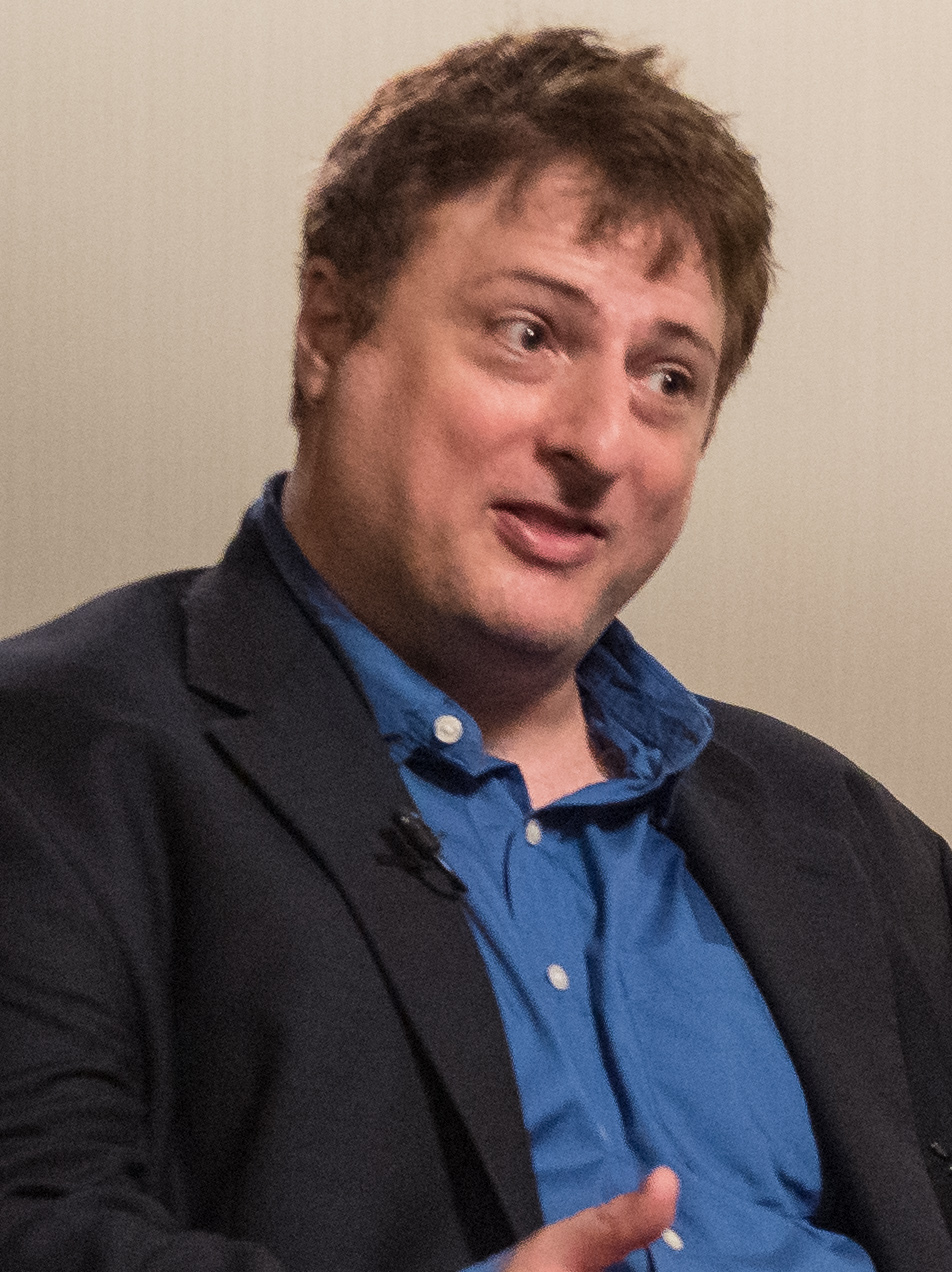
Nicholas Julian Zapata Sagan[1] (born September 16, 1970) is an American novelist and screenwriter. He is the author of the science fiction novels Idlewild, Edenborn, and Everfree, and has also written scripts for episodes of Star Trek: The Next Generation and Star Trek: Voyager. He is the son of astronomer Carl Sagan and artist and writer Linda Salzman.

Key Information

Life

[edit]

At age six, Sagan's greeting, "Hello from the children of planet Earth," was recorded and placed aboard NASA's Voyager Golden Record.[2] Launched with a selection of terrestrial greetings, sights, sounds and music, the Voyager 1 and Voyager 2 spacecraft are now the most distant man-made objects in the universe, with Voyager 1 having left the Solar System on August 25, 2012, being the first to do so.[3] Sagan went to the Mirman School as a child and received his bachelor's degree from the University of California, Los Angeles.

Sagan has been writing for Hollywood since 1992, crafting screenplays, teleplays, animation episodes and computer games. He has two older brothers; his brother Dorion is a science writer. He has worked for a variety of studios and production companies, including Paramount, Warner Brothers, New Line, Universal, Disney, actor/producer Tom Cruise, and directors David Fincher and Martin Scorsese.

Sagan co-wrote the award-winning computer adventure game, Zork Nemesis: The Forbidden Lands. His film credits include adaptations of novels by Orson Scott Card, Ursula K. Le Guin, Pierre Ouellette and Charles Pellegrino. His television credits include two episodes of Star Trek: The Next Generation and five episodes of Star Trek: Voyager, where he worked as a story editor.

At the turn of the millennium, astronaut Sally Ride recruited him to work for SPACE.com as Executive Producer of Entertainment & Games. During his tenure at SPACE.com, the inspiration for a series of novels came to Sagan, and he sold the Idlewild Trilogy to Penguin Putnam in 2002.

Idlewild received a starred review from Kirkus, a Book Sense 76 pick, and selection from both Borders and Barnes & Noble as one of the best science fiction/fantasy novels of the year. Neil Gaiman called it "absolutely fun, like a roller-coaster ride of fusion fiction" and "the kind of book you simply don't want to stop reading."

Edenborn continues the story from Idlewild (however it can also be read as a standalone). SFX Magazine gave Edenborn a perfect five star review, declaring it "one of the best post-apocalyptic novels you will ever read." SF Crowsnest hailed Sagan as "an adrenaline shot straight into the heart of science fiction," while SF Site called the novel "elegant SF, dark and haunting, with characters who linger in memory long after the last page is turned."

The series' third instalment, Everfree, was praised by Sci Fi Weekly as being "startlingly original" and "undeniably satisfying and triumphant." Kirkus remarked that "Sagan's mind-blowing post-apocalyptic trilogy comes to a satisfying, terrifying conclusion." They went on to hail the book as "a powerful plea for sensible human cooperation delivered via a knockout story."

Sagan taught screenwriting at Cornell University in the spring of 2007. He currently teaches screenwriting at Ithaca College.[4][5] Both institutions are in Ithaca, New York.

Works

[edit]

Novels

[edit]

Short stories

[edit]

Television credits

[edit]

Games

[edit]

References

[edit]
[edit]
Revisions and contributorsEdit on WikipediaRead on Wikipedia
from Grokipedia
Nick Sagan (born September 16, 1970) is an American novelist, screenwriter, and professor best known for his science fiction works, contributions to the Star Trek franchise, and as the son of astronomer . The son of astronomer and author and artist and writer Linda Salzman, Nick Sagan grew up in , and after his birth in , . At the age of six, he recorded the English-language greeting "Hello from the children of planet Earth" for inclusion on the , a attached to 's and 2 spacecraft launched in 1977 to represent humanity to potential extraterrestrial civilizations. Sagan graduated from the UCLA School of Theater, Film and Television and began his professional writing career in 1992, producing screenplays, teleplays, animation episodes, comic books, and video games for studios including Paramount, Warner Brothers, and . His television credits include writing two episodes of Star Trek: The Next Generation—"" (1993) and "Genesis" (1994)—and five episodes of (1997–2001), where he also served as a story editor. He co-wrote the award-winning adventure game (1996) and co-created the graphic novel series Shrapnel (2007–2011) with Mark Long, co-writing the arc Shrapnel: Hubris (2011) with his wife Clinnette Minnis, which was optioned for a film adaptation starring . As a , Sagan authored the post-apocalyptic Idlewild trilogy—Idlewild (2003), Edenborn (2004), and Everfree (2008)—published by Penguin Putnam and translated into multiple languages, exploring themes of human survival and in a ravaged world. Other projects include the non-fiction book You Call This the Future? From to : Where Sci-Fi Meets the Real World (2008, co-authored with Andy Walker and Mark Frary), the planetarium show The Searcher (2011, voiced by ), and the television special Alien Encounters (2012, for ). Since the early 2000s, Sagan has taught and film history as an in the Department of Media Arts, Sciences, and Studies at Ithaca College's Roy H. Park School of Communications, where he has been on faculty for over two decades as of 2025.

Early life and education

Family background

Nick Sagan was born on September 16, 1970, in , . He is the son of astronomer , known for his efforts in science communication through books, television, and public lectures, and artist and writer . Sagan has a half-sister, , from his father's marriage to , as well as half-brothers , Jeremy Sagan, and Samuel Sagan from his father's marriages to and . Growing up in a household that blended science, , and , Sagan was exposed to discussions on , creativity, and human experience from an early age. His parents' collaboration on projects like the , where Linda contributed artwork, further immersed the family in interdisciplinary explorations of space and culture.

Childhood and early career

Nick Sagan spent his early childhood in Ithaca, New York, following his family's relocation there when his father, astronomer , joined . The family later moved to the area, where Sagan continued his formative years amid the vibrant environment of Hollywood and scientific circles. Growing up as the son of and artist and writer , he was immersed in an intellectually stimulating household filled with discussions on science, philosophy, and the cosmos. The family library brimmed with classics, and Sagan often shared meals with luminaries like , Robert Heinlein, and , fostering his lifelong passion for speculative storytelling and imaginative narratives. Sagan's early interest in writing emerged during his youth, influenced by these surroundings and his father's work on projects like the , where at age six he recorded a from . By his early twenties, he began pursuing writing professionally; at age 22 in 1992, he started crafting unproduced screenplays, marking the onset of his career in Hollywood scriptwriting.

Formal education

Nick Sagan left high school early to pursue formal studies in at the (UCLA) School of Theater, and Television. As an undergraduate, he focused on within the film program, studying under Richard Walter, the head of the department, where he honed skills in narrative structure and techniques. He graduated summa cum laude with a in 1992. Following graduation, Sagan enrolled in UCLA's program in to further develop his craft. However, within six weeks of starting, he received multiple professional job offers, prompting him to forgo completing the degree and enter the industry directly. His studies exposed him to influential literature, aligning with his longstanding passion for the genre that originated in childhood writing experiments. The UCLA program facilitated Sagan's transition to professional work through targeted networking and script submissions; during his undergraduate years, he presented an original screenplay to Walter, securing an agent and an option from a production company shortly thereafter. This early momentum led to assignments adapting works like Orson Scott Card's Ender's Game and pitching ideas to television series, marking his entry into Hollywood screenwriting.

Literary career

Novels

Nick Sagan's literary debut in novels came with the science fiction trilogy Idlewild (2003), Edenborn (2004), and Everfree (2006), all published by , forming an interconnected post-apocalyptic narrative centered on humanity's remnants after a devastating plague known as . The series draws thematic inspiration from scientific exploration and human resilience, echoing the cosmological interests of Sagan's father, astronomer , in its examination of , , and technological intervention in a ravaged world. Idlewild, the first installment, follows a teenage named Halloween who awakens in a rural pumpkin patch with complete , gradually uncovering that he and nine other adolescents have been raised in isolation within a sophisticated simulation designed to prepare them for repopulating after Black Ep wiped out nearly all humanity. The dual narrative alternates between Halloween's disorienting journey of self-discovery in the simulated world and the real-world efforts of a survivor named Marcus to locate immune individuals amid the ruins. Themes of identity, the blurring boundaries between and artificial constructs, and the ethical perils of technology dominate, as Halloween grapples with fragmented memories and the simulation's manipulative programming. Critics noted the novel's ambitious blend of and dystopian elements but critiqued its reliance on familiar tropes, with noting that it "plods through terrain all too familiar to SF readers" despite Sagan's promising prose. The book received a starred review from for its brisk pacing and avoidance of overly protracted exposition, earning praise in the community for its tense exploration of virtual isolation. In Edenborn, set eighteen years after the events of Idlewild, the narrative shifts to the bioengineered "posthumans"—the now-adult survivors including Halloween—who have formed isolated communities to raise a second generation of children engineered for immunity to , only to face internal conflicts, emerging mutations, and the discovery of other survivor groups. Character arcs deepen as figures like the disillusioned Halloween exile himself, while younger posthumans such as the optimistic and the volatile Brad navigate in a fractured world, highlighting themes of legacy, genetic destiny, and the fragility of rebuilt societies. The novel expands the world-building with intricate depictions of post-plague ecosystems and interpersonal tensions, emphasizing psychological depth over action. described it as a to Sagan's well-received debut, noting its sharp observations on survival and the setup for the third volume, though some reviewers found the alternating viewpoints occasionally disjointed. The trilogy concludes with Everfree (2006), where the posthumans, having developed a cure for , awaken additional survivors from stasis only to confront escalating ideological clashes between utopian visions of renewal and darker impulses toward control and domination, culminating in violent confrontations that test the boundaries of . Themes of versus engineered perfection intensify, with detailed explorations of moral ambiguity among the younger generation as they inherit a world scarred by plague and . hailed the finale as a "mind-blowing" and "satisfying, terrifying conclusion," praising Sagan's ability to weave social, psychological, and genetic dilemmas into a cohesive arc, while noted its overabundance of ideas veering into tangents, describing it as a middling finale to an uneven series. The series garnered positive responses within circles for its innovative posthumans concept and emotional resonance, though it did not secure major awards; Goodreads user ratings averaged around 3.8 out of 5 across the volumes, reflecting steady appreciation for its conceptual depth over commercial blockbuster status.

Short fiction and essays

Nick Sagan's short fiction includes the story "Tees and Sympathy," published in Subterranean magazine issue #4 in 2006. The narrative humorously subverts tropes by depicting aliens who visit not to consume humans, but in the hope of being eaten themselves, blending satire with interstellar misunderstanding. Illustrated by Bob Eggleton, the piece appeared in a special "cliché" issue of the magazine edited by , which featured stories playing on genre conventions. Sagan also published an excerpt from his novel Edenborn in 2008, serving as a promotional piece that introduced elements of post-apocalyptic survival and central to the book's themes. In his essays, Sagan contributed to collaborative works exploring history and innovation. "The Life and Work of Godfrey Winton: A Panel Discussion on One of 's Lost Masters," co-written with and , originated as a live improvisational performance at Penguicon 5.0 in 2007 and was later transcribed for publication in the Summer 2007 issue of Subterranean magazine. The piece imagines a fictional panel discussing the career of an invented early sci-fi author, Godfrey Winton, blending humor and meta-commentary on the genre's evolution. An audio recording of the original performance is archived online. Sagan co-authored the nonfiction book You Call This the Future?: The Greatest Inventions Sci-Fi Imagined and Science Promised in 2008 with Andy Walker and Mark Frary, which examines how science fiction has anticipated real-world technological advancements, from virtual reality to space travel. Across these shorter works, Sagan's motifs of futuristic technology and human adaptability recur, often mirroring the resilience and innovation found in his novel trilogy without delving into extended narratives.

Television and screenwriting

Star Trek episodes

Nick Sagan contributed to the Star Trek franchise as a freelance writer for Star Trek: The Next Generation during its seventh and final season. He penned the episode "Attached," which aired on November 8, 1993, and centered on Captain Picard and Dr. Crusher developing an empathic bond through , forcing them to confront unspoken feelings while aiding a planetary federation dispute. His second TNG script, "Bloodlines," broadcast on May 2, 1994, delved into themes of family reunion and paternal legacy as Picard investigates a claim that he has an adult son, Jason Vigo, targeted by a vengeful from his past. Sagan joined as a story editor for its fifth season (1998–1999), where he helped shape episode premises and contributed to overarching season arcs under executive producer . In this role, he collaborated closely with and other writers on narrative development, including resolving lingering plot threads from prior seasons like the conflict. Sagan received writing credits on five episodes that season, blending concepts with character-driven stories. His first Voyager credit was as sole writer for "In the Flesh," which aired on November 4, 1998, and featured Voyager encountering a holographic simulation where aliens impersonate personnel to prepare an invasion of . Sagan co-wrote the story and teleplay for "" with , broadcast on February 3, 1999, exploring themes of romantic isolation as Tuvok becomes stranded on a planet with a seductive alien woman, testing his Vulcan discipline. He provided the teleplay for "Course: Oblivion," from a story by Fuller and airing on March 3, 1999, which examined through a duplicate Voyager crew slowly disintegrating while believing themselves to be the originals. Sagan contributed the teleplay for "," co-written with Fuller and Kenneth Biller, which aired on April 26, 1999, as Voyager encounters a massive mining vessel carrying a dangerous entity, forcing the crew to confront existential threats from within the ship. Finally, he co-wrote the story and teleplay for "Relativity" with Fuller and Michael Taylor, the season finale on May 12, 1999, involving time travel where intervenes from the 29th century to prevent Voyager's sabotage and destruction. These episodes highlighted Sagan's ability to integrate personal emotional stakes with Trek's speculative elements, influencing the season's tone of introspection and high-stakes adventure.

Other screenwriting projects

Beyond his work on Star Trek, Nick Sagan entered professional screenwriting in 1992, developing pitches and revisions for major studios while crafting original screenplays and teleplays. Sagan adapted several novels into unproduced screenplays, including Ursula K. Le Guin's , Pierre Ouellette's The Deus Machine, and Charles Pellegrino's . These projects drew on his interest in , though none advanced to production. In television, Sagan wrote the episode "Predator and Prey" for the sci-fi series Space Precinct, which aired in 1995 and explored interstellar law enforcement in a futuristic setting. His Star Trek experience served as a key stepping stone to these broader opportunities in genre television and film.

Other media contributions

Video games

Nick Sagan contributed to the interactive media landscape through his work on the 1990s adventure game genre, most notably as co-writer of the narrative for Zork Nemesis: The Forbidden Lands, released in 1996 by Activision. This graphic adventure game, set in the Zork universe, follows a darker tone than its predecessors, centering on a tale of alchemy, obsession, and revenge as the player investigates the disappearance of four alchemists in the Forbidden Lands, guided by the spirit of a young woman named Alexandria and confronting the vengeful entity Nemesis. Sagan co-wrote the story alongside Cecilia Barajas and Adam Simon, incorporating elements of puzzle-solving across five detailed worlds filled with over 65 innovative challenges, enhanced by live-action video sequences featuring Hollywood actors, ambient music, and special effects. The development process involved close collaboration with game designers and director Joe Napolitano, known for his work on television series like , where Sagan focused on crafting dialogue, subplots, and branching narrative paths to deepen player immersion in the game's atmospheric, logic-based puzzles. Drawing briefly from his screenwriting background, Sagan adapted linear techniques to the interactive format, ensuring plot twists and revelations aligned with player choices in this first-person point-and-click experience reminiscent of contemporaries like . Zork Nemesis received recognition for its production quality, winning the Best Prerendered Art award at the 1997 Spotlight Awards from the Game Developers Conference, and it contributed to the evolution of the 1990s genre by blending intricate fantastical narratives with environmental puzzles, earning acclaim in communities for its gripping storytelling and visual artistry.

Comics

Nick Sagan contributed to the science fiction series Shrapnel, published by Radical Comics, where he served as co-creator and plotter for the initial storyline and as writer for the sequel. The series explores themes of interstellar conflict, , and in a militarized future solar system. The first limited series, Shrapnel: Aristeia Rising (2009), was plotted by Sagan alongside Mark Long, with the script adapted by M. Zachary Sherman and artwork by Bagus Hutomo. Set in a dystopian future, the narrative centers on Samantha "Sam" Sharp, a rebel leader who orchestrates a high-stakes plan to break the Solar Alliance's blockade of the outer planets, where terraformed worlds populated by billions have risen against Earth's expansionist control after years of war and starvation. The story emphasizes political intrigue, tactical military maneuvers, and the human cost of interstellar governance, rendered in a dynamic visual style that highlights epic space battles and gritty planetary sieges. Shrapnel: Hubris (2010), a three-issue written by Sagan in collaboration with Clinnette Minnis and illustrated by Concept Art House, continues the saga with Sam emerging from exile to confront the forces she once commanded, amid alliances with religious sects and revolutionaries on the last free colony. This volume intensifies the focus on moral ambiguity in warfare and the fragility of , maintaining the series' blend of strategic depth and character-driven drama across its oversized, high-production format. Thematically, Sagan's work in Shrapnel echoes the post-apocalyptic societal breakdowns in his novel series, such as the Idlewild trilogy, by examining how colonial overreach leads to and resistance. The garnered positive but niche reception within the community, praised for their ambitious world-building and action sequences—earning an 8.2/10 from for the debut issue—but without major industry awards.

Teaching and later career

Academic roles

Since the early 2000s, Nick Sagan has taught and film history as an in the Department of Media Arts, Sciences, and Studies at Ithaca College's Roy H. Park School of Communications. He joined as a by 2016. In his teaching role, Sagan focuses on education, drawing on his industry expertise to guide students in narrative development and production techniques. He offers courses including Writing for Screen Media, which explores script creation for film and television, and Structuring the , emphasizing plot construction, character arcs, and dramatic tension in long-form storytelling. These classes incorporate practical workshops where students analyze professional scripts and develop their own projects, fostering skills applicable to both traditional and emerging media formats. Sagan's approach to instruction integrates his background in and environments, encouraging students to blend with disciplined revision processes. His tenure at reflects a commitment to mentoring aspiring writers, bridging professional practice with academic training in media arts.

Recent activities

After completing his Idlewild trilogy in 2008, Nick Sagan contributed to additional projects including the non-fiction book You Call This the Future? From to : Where Sci-Fi Meets the Real World (2011, co-authored with Andy Walker and Mark Frary), the planetarium show The Searcher (2013, voiced by ), and the television special Alien Encounters (2012, for ). Since around 2013, he has focused more on reflective interviews and public discussions about his career and family legacy. In a with Eos magazine, he reflected on the spacecraft's entry into interstellar space and the enduring significance of the Golden Record, which he narrated as a . Sagan has made occasional public appearances centered on his father's influence and writing. In a hosted by TJ Horgan on , he discussed his experiences as the son of astronomer , the challenges of sci-fi authorship, and themes like and human society. He has also contributed to tributes honoring Carl Sagan's legacy, including reflections in a 2014 interview tied to the Cosmos reboot, where he shared memories of his "strange" childhood amid scientific endeavors. In 2023, Sagan participated in an interview with Cinemasters on his screenwriting career, emphasizing the lasting impact of his episodes and his appreciation for diverse creative mediums. These engagements highlight a phase of career reflection rather than prolific output. Sagan resides in , where he balances occasional writing with and teaching.

References

Add your contribution
Related Hubs
User Avatar
No comments yet.