


Community hub
Recent from talks
Contribute something
Nothing was collected or created yet.
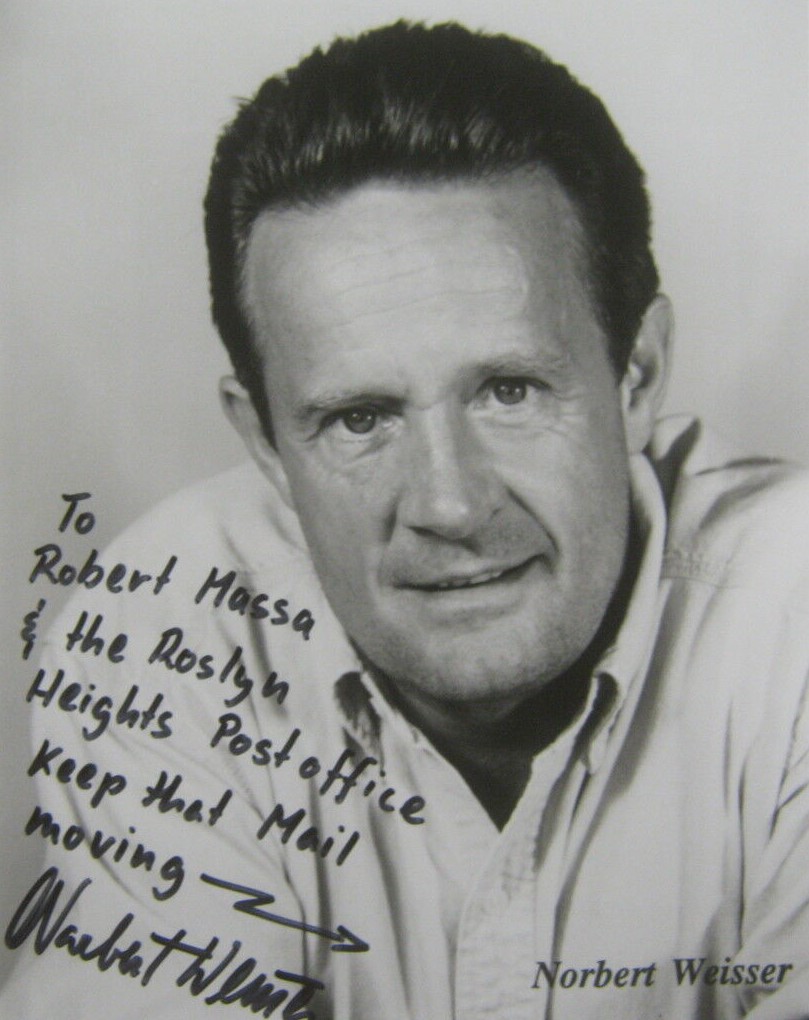
Norbert Weisser
View on Wikipedia
Norbert Weisser (born 1946)[1] is a German actor who has been based in the United States since the mid-1960s.
Key Information


Career
[edit]Based in Los Angeles, Weisser is a founding member of Odyssey Theatre Ensemble, the ProVisional Theater, and the Padua Playwrights Festival.[2] A long-time collaborator of Murray Mednick, he originated the role of the Trickester in the playwright's epic seven-hour Coyote Cycle, and has starred in numerous American and European theatrical productions, including opposite Ed Harris in Ronald Harwood's Taking Sides[3] and John O'Keefe's Times Like These, where he received an Ovation Award, an LA Weekly Theater Award and an L.A. Drama Critics Circle Award nomination for his performance. He has also directed plays at the Magic Theatre in San Francisco and at the Mark Taper Forum.[4][5]
Besides his extensive stage work, Weisser is also a prolific film and television actor, with over 90 credits to his name. Chiefly a character actor, he has starred in well-known and acclaimed films including Midnight Express, The Thing, Chaplin, Hocus Pocus, Schindler's List, and Pollock, and numerous titles directed by Albert Pyun. He had a memorable guest role in "Madrigal" (a fifth season episode of Breaking Bad), reprised in Better Call Saul, and had provided voice-over and motion capture to a number of video games such as Medal of Honor: Allied Assault and Wolfenstein II: The New Colossus.[5][6]
Personal life
[edit]Weisser lives in Venice, Los Angeles, California, with his wife Tandy. His son Morgan Weisser is also an actor.[7]
Theatre credits
[edit]| Year | Title | Role | Venue | Notes |
|---|---|---|---|---|
| 1970-1972 | The Threepenny Opera | Mac Heath | Odyssey Theater Ensemble | |
| 1978 | Julius Caesar | Decimus Brutus | The Matrix Theatre Company | |
| 1982-1983 | Mary Barnes | Eddie | Odyssey Theater Ensemble | |
| 1983 | Eminent Domain | Victor Salt | The Matrix Theatre Company | |
| Black Hole in Space | David Reed | MET Theater | ||
| 1984-1985 | The Coyote Cycle | The Trickster | Randall Davey Audubon Estate
LA Theater Works |
|
| 1985 | Three Sisters | Vershinin | Dallas Theater Center | |
| 1993 | The Ramp | Friederich | South Coast Repertory | |
| 1996 | Taking Sides | Helmuth Rode | Brooks Atkinson Theatre | |
| 2000 | The Coyote Cycle | The Trickster | Vineyard Playhouse | |
| 2001 | See Under: Love | Neigel | Traveling Jewish Theater | |
| 2002 | Times Like These | Oskar Weiss | Padua Playwrights | |
| 2003 | Danny Boy | Mr. Jones | Mark Taper Forum | |
| 2004-2005 | Times Like These | Oskar Weiss | Traveling Jewish Theater | |
| 2006 | Clown Show for Bruno | Bruno Schulz | Irish Repertory Theatre (22nd Street) | |
| 2007 | Silent Partners | Hans Eisler | The Workmen's Circle | |
| 2009 | Charles' Story | Todd | Pacific Resident Theatre | |
| 2010 | The Fire Raisers | Gottlieb Biedermann | Odyssey Theater Ensemble | |
| 2012 | Way to Heaven | The Commandant | ||
| 2013 | The Kepler Project | Johannes Kepler | Morrison Planetarium | |
| 2016 | The Gary Plays / Charles' Story | Todd | Atwater Village Theater | |
| 2017 | Krapp's Last Tape | Krapp | The Odyssey Theater |
Filmography
[edit]
Film[edit]
|
Television[edit]
|
Video games
[edit]| Year | Title | Role | Notes |
|---|---|---|---|
| 2002 | Medal of Honor: Allied Assault | Voice | |
| 2004 | Call of Duty: Finest Hour | ||
| 2014 | Wolfenstein: The New Order | Enemy Soldier | Voice |
| 2017 | Wolfenstein II: The New Colossus | Adolf Hitler | Voice |
References
[edit]- ^ Stoudt, Charlotte (November 30, 2011). "The Spotlight: Norbert Weisser in 'Way to Heaven' at the Odyssey". The Los Angeles Times. Retrieved January 26, 2023.
I was born in 1946...
- ^ Weisser, Norbert. "LinkedIn".
- ^ "Norbert Weisser". Playbill. Retrieved June 18, 2019.
- ^ "Norbert Weisser Fansite". www.norbert-weisser.com. Retrieved June 18, 2019.
- ^ a b "Norbert Weisser". www.norbertweisser.com. Retrieved June 18, 2019.
- ^ "Norbert Weisser | LATW". latw.org. Retrieved June 18, 2019.
- ^ "Norbert Weisser". Retrieved January 26, 2023.
Norbert Weisser, born in Germany, came to the US in the mid-'60s. He lives with his wife Tandy in Venice, California...His son, Morgan Weisser, is also an actor.
External links
[edit]| International | |
|---|---|
| National | |
| People | |
| Other | |

Norbert Weisser
View on GrokipediaEarly life and education
Childhood in Germany
Norbert Weisser was born on July 9, 1946, in Neu-Isenburg, Germany, into a family with no connections to the entertainment industry.[4][5] His father was too old to serve in the military during World War II, while his mother was a teenager at the time; after the war, his parents joined a Protestant pacifist sect, reflecting the era's emphasis on reconciliation and peace.[6] The family background included underlying anti-Semitism among some relatives, a sentiment Weisser later reflected upon as part of the broader societal undercurrents in post-war Germany.[6] Weisser grew up in the immediate aftermath of World War II, amid Germany's reconstruction and the pervasive shadow of the Nazi era. At age 12, around 1958, he viewed the documentary film Night and Fog, which profoundly impacted him, prompting early self-reflection on his German identity and the Holocaust's atrocities committed by "my people."[6] This experience, coupled with encounters in school where some teachers held lingering Nazi-era beliefs, instilled a sense of permanent shame and dissonance that shaped his worldview.[6] The rebuilding society of West Germany, focused on economic recovery and denazification efforts, provided a backdrop for these formative influences, fostering an awareness of historical accountability that later informed his interest in roles exploring human rights and tyranny.[6] During his childhood and adolescence, Weisser showed no formal involvement in theatre or acting, instead pursuing studies in mechanical engineering at a German college before immigrating to the United States in the mid-1960s, a move driven by his attraction to American ideals of freedom.[3][6]Studies and early career interests
Norbert Weisser attended a technical college in Germany in the early 1960s, where he studied mechanical engineering as part of an initial pursuit of a practical career path.[3][7] He later abandoned his engineering studies before immigrating to the United States in the mid-1960s, where he began his professional acting career.Career
Theatre beginnings and ensembles
Norbert Weisser arrived in Los Angeles from Germany in the late 1960s, immersing himself in the vibrant experimental theatre scene that defined the city's avant-garde movement during that era. This period was marked by innovative, boundary-pushing productions influenced by countercultural energies, where Weisser quickly established himself as an active participant through collaborative and original works.[9] In 1969, Weisser became a founding member of the Odyssey Theatre Ensemble, co-established by Ron Sossi and a collective of actors including Susan Gelb and Alan Abelew in a converted storefront church on Hollywood Boulevard. The ensemble rapidly gained prominence in Los Angeles's alternative theatre landscape, with Weisser contributing to its early repertoire of socially charged and experimental pieces, such as Bertolt Brecht's The Threepenny Opera (1970-1972), and adaptations like Jean-Claude van Itallie's The Serpent and Euripides' The Bacchae. These productions, often running for months in the group's intimate 81-seat venue, explored themes of power, morality, and societal critique, solidifying the Odyssey's role as a cornerstone of LA's 1970s avant-garde theatre.[10][3] Weisser extended his involvement into the 1970s as a founding member of the ProVisional Theater, another key experimental group in Los Angeles focused on original ensemble-created works and adaptations that delved into historical and social narratives. He was also a founding member of the Padua Hills Playwrights Festival, where he performed in notable productions such as Murray Mednick's The Coyote Cycle (1978-1985), a mythic epic blending shamanism and American folklore. Through these ensembles, he performed in provocative pieces that challenged conventional staging and narrative forms, honing his craft amid the city's burgeoning alternative theatre community and earning recognition among LA theatre circles for his versatile portrayals in thematically ambitious productions.[3][11]Film and television roles
Weisser began his film career in the 1970s with minor roles, transitioning from his theatre background to screen acting. His debut feature appearance came in Midnight Express (1978), where he portrayed Erich, a fellow inmate and confidant to the protagonist in the intense prison drama directed by Alan Parker.[12] This role marked a breakthrough, highlighting his capacity for portraying complex, emotionally charged characters in high-stakes dramatic scenarios.[13] In the 1980s and 1990s, Weisser secured several notable supporting parts in major productions, often embodying historical or antagonistic figures. He appeared uncredited as an immigrant in Michael Cimino's epic Western Heaven's Gate (1980), contributing to the film's expansive ensemble of settlers.[14] Two years later, in John Carpenter's horror classic The Thing (1982), he played the Norwegian helicopter pilot who desperately warns the American research team about the alien threat before his demise.[15] His work extended to Steven Spielberg's Schindler's List (1993), in which he depicted Albert Hujar, a ruthless SS officer overseeing the brutal liquidation of the Kraków ghetto, underscoring his skill in conveying villainous authority within Holocaust narratives.[16] On television, Weisser delivered memorable guest performances that showcased his versatility in ensemble-driven series. He portrayed Peter Schuler, a high-ranking executive at Madrigal Electromotive and key ally to Gus Fring, in the Breaking Bad episode "Madrigal" (2012), where his character grapples with the fallout of a criminal empire under DEA scrutiny. This role recurred in Better Call Saul, appearing in the episode "JMM" (2020), further exploring Schuler's corporate machinations and tense alliances in the prequel's timeline. These arcs emphasized his adeptness at playing calculated antagonists in serialized crime dramas. Throughout his screen career, Weisser's roles frequently featured Germans, Europeans, or authoritative figures, often drawing on his own German heritage to infuse authenticity into portrayals of scientists, officials, and immigrants in tense, morally ambiguous contexts.[13]Directing and recent projects
Weisser began his directing career in the 1980s, staging productions at the Magic Theatre in San Francisco and at the Los Angeles Theatre Center, including adaptations of classic works such as Heads at the Mark Taper Forum's New Works Festival.[17][18][19] As a founding member of the Odyssey Theatre Ensemble and the ProVisional Theater in Los Angeles, Weisser has expanded his contributions beyond acting to include producing and co-writing for ensemble productions, fostering new works in experimental theatre.[10][20] In recent independent cinema, Weisser voiced the Helicopter Pilot in the horror-action film Game of Death: The Six Doors to Hell (2024), directed by Timo Rose, and made a special appearance in its sequel Dark Secrets: Game of Death Chapter 2 (2025), highlighting his continued engagement with genre filmmaking.[21][22]Personal life
Family
Norbert Weisser is married to Tandy Weisser, with whom he shares a life centered in California.[23][18] The couple are the parents of one son, Morgan Weisser, born May 12, 1971, who pursued acting and gained recognition for his leading role as Lt. Nathan West in the science fiction series Space: Above and Beyond (1995–1996).[24][23] No other children are documented. The family has long been based in Venice, Los Angeles, where Weisser and Tandy have resided together.[23][13]Residence and later years
Norbert Weisser has resided in Venice, Los Angeles, California, since the late 1960s, establishing his home in this coastal neighborhood renowned for its bohemian vibe and thriving artistic enclave that emerged prominently during the 1960s and 1970s.[23][25] The area's history as a hub for creative communities, including writers, musicians, and performers, has aligned well with his longstanding commitment to theatre.[25] In his later years, Weisser has remained engaged in Los Angeles' cultural landscape, continuing his association with the Odyssey Theatre Ensemble as a founding member and participating in productions such as Samuel Beckett's Krapp's Last Tape in 2017.[10][26] He shares his Venice residence with his wife, Tandy, integrating family life into this artistic setting.[23] As of 2025, at age 79, Weisser maintains an active presence, as evidenced by recent public acknowledgments of his ongoing contributions to the performing arts.[27]Credits
Theatre credits
Norbert Weisser, a founding member of the Odyssey Theatre Ensemble since 1969, began his stage career in experimental productions during the late 1960s and 1970s in Los Angeles.[10] His notable theatre credits include:- The Threepenny Opera (1970–1972, as Mack the Knife/Macheath, Odyssey Theatre Ensemble, Los Angeles), an early production highlighting his work in Brechtian theatre with the ensemble he helped establish.[18]
- Julius Caesar (1978, as Decius Brutus, Matrix Theatre Company, Los Angeles), a role in a Shakespearean adaptation during his rising involvement in regional theatre.[9]
- Mary Barnes (1980s, as Eddie, Odyssey Theatre Ensemble, Los Angeles), portraying a key figure in a psychological drama based on the true story of a schizophrenic artist.[9]
- Three Sisters (1980s, as Vershinin, Dallas Theatre Center, Dallas), contributing to Chekhov's exploration of Russian provincial life.[9]
- The Ramp (1980s, as Frederic, South Coast Repertory, Costa Mesa), a performance in a contemporary play addressing social issues.[9]
- Eminent Domain (1980s, role unspecified, Matrix Theatre, Los Angeles), part of his ongoing regional work in original scripts.[9]
- Taking Sides (1996, as Helmuth Rode, Brooks Atkinson Theatre, Broadway, New York), his debut on Broadway opposite Ed Harris in Ronald Harwood's drama about Wilhelm Furtwängler.[28]
- See Under: Love (2001, role unspecified, Traveling Jewish Theatre, San Francisco), an adaptation of David Grossman's novel exploring trauma and imagination.[9]
- Times Like These (2002, as Oskar Weiss, Padua Playwrights Festival, Los Angeles), originating the role in John O'Keefe's play set in 1930s Berlin.[9]
- Times Like These (2004, role unspecified, Traveling Jewish Theatre, San Francisco), a reprise of the 1930s Berlin drama.[9]
- The Arsonists (2010, as Gottlieb Biedermann, Odyssey Theatre Ensemble, Los Angeles), earning a Los Angeles Drama Critics Circle nomination for his portrayal of a timid bourgeois in Max Frisch's satirical allegory.[29][30]
- Way to Heaven (2011, as the Commandant, Odyssey Theatre Ensemble, Los Angeles), a chilling depiction of a Nazi officer in Juan Mayorga's Holocaust-era two-hander.[31]
- The Arsonists (2012, as Biedermann, Odyssey Theatre Ensemble, Los Angeles), a revival where Weisser emphasized the character's nervous self-awareness in Frisch's farce.[32]
- The Kepler Story (2013, as Johannes Kepler, Morrison Planetarium, San Francisco), a one-man show recounting the life and discoveries of the astronomer.[33]
- The Gary Plays / Charles' Story (2016, as Todd, Atwater Village Theatre, Los Angeles), part of a cycle exploring the life of an unemployed actor.[34]
- Krapp's Last Tape (2017, as Krapp, Odyssey Theatre Ensemble, Los Angeles), a solo performance in Samuel Beckett's monologue about aging and regret.[35]
Film roles
Norbert Weisser made his film debut in the late 1970s and has since appeared in over two dozen feature films, frequently portraying European characters, scientists, and authority figures in supporting roles that highlight his distinctive accent and intense screen presence. His work spans major Hollywood productions and independent films, often contributing to ensemble casts in genres ranging from drama and historical epics to science fiction and horror. Weisser's early roles established him as a reliable character actor in high-profile projects. In Midnight Express (1978), he played Erich, a fellow German-speaking prisoner who aids the American protagonist Billy Hayes during his imprisonment in Turkey.[36] He followed this with an uncredited appearance as an Immigrant in Michael Cimino's epic Western Heaven's Gate (1980), depicting one of the struggling European settlers in 19th-century Wyoming. In John Carpenter's horror classic The Thing (1982), Weisser portrayed the Norwegian pilot, a key figure in the opening sequence who arrives at the American outpost warning of the shape-shifting alien threat before being killed.[37] Throughout the 1980s and 1990s, Weisser continued to take on varied supporting parts in both blockbusters and cult favorites. He appeared as Keller, the reclusive scientist who built the titular android companion, in the low-budget sci-fi film Android (1982). In ¡Three Amigos! (1986), a comedy directed by John Landis, he played The German's Friend, one of the antagonists' henchmen aiding a smuggler in a satirical Western tale. His role as the Zeppelin Pilot in The Rocketeer (1991) added to the film's retro adventure vibe, while in Richard Attenborough's biopic Chaplin (1992), he portrayed a German Diplomat involved in the early Hollywood scenes surrounding Charlie Chaplin's life. Weisser garnered attention for his portrayal of Sgt. Albert Hujar, a ruthless Gestapo officer overseeing the Kraków Ghetto, in Steven Spielberg's Schindler's List (1993).[38] That same year, he appeared as Thackery Binx's Father in the family fantasy Hocus Pocus (1993), a brief but memorable historical prologue role. In the 2000s, Weisser balanced mainstream and artistic projects. He played Hans Namuth, the innovative photographer who documented Jackson Pollock's drip-painting technique in the biopic Pollock (2000), directed by and starring Ed Harris. Later, in Ron Howard's thriller Angels & Demons (2009), he had a small role as a CERN Scientist, contributing to the film's high-stakes conspiracy plot involving the Vatican. Weisser's recent film work includes voice and supporting roles in independent genre films. In Game of Death: The Six Doors to Hell (2024), a dystopian horror directed by Timo Rose, he provided the voice for the Helicopter Pilot, guiding the protagonist through a tyrannical future.[21] His most recent credit is as Anthony Wagner in the sequel Dark Secrets: Game of Death Chapter 2 (2025), continuing the martial arts-horror series set in a demonic 2030.Television appearances
Weisser's early television work in the 1970s included guest appearances in American series, often portraying characters with European backgrounds reflective of his German heritage. In 1973, he appeared as Hans Mueller in an episode of Barnaby Jones.[39] By 1977, he guest-starred as Gurd, a henchman, in two episodes of The Hardy Boys/Nancy Drew Mysteries ("The Hardy Boys and Nancy Drew Meet Dracula, Parts 1 and 2"). These roles established him in episodic television during his initial years in the U.S. Throughout the 1980s, Weisser continued with guest spots in action and adventure shows. He played Yuri Petchernec, a Soviet agent, in the 1981 episode "Who's Watching the Warden?" of The Greatest American Hero.[39] In 1982, he portrayed the villainous Fredo Lureni in Knight Rider's "The Topaz Connection" and Hanus, a Nazi officer, in Tales of the Gold Monkey's "Naka Jima of Hour 14." The following year, 1983, saw him as a German officer in the Scarecrow and Mrs. King episode "I Am Not Now, Nor Have I Ever Been... a Spy."[39] Entering the 1990s, Weisser expanded into miniseries and period dramas. In 1991, he appeared as Gunter in the AIDS-focused miniseries Seeds of Tragedy.[40] His 1992 guest role as Reinhart, a quirky inventor, came in the Northern Exposure episode "The Three Amigos." He followed with supporting parts in TV movies and miniseries, including KLM Mechanic in Amelia Earhart: The Final Flight (1994), Otto in the Hallmark adaptation My Antonia (1995), and the antagonistic Deacon Tull in Riders of the Purple Sage (1996).[40] A notable highlight was his portrayal of rocket scientist Wernher von Braun in the 1998 HBO miniseries From the Earth to the Moon, appearing in multiple episodes including "1968," where he depicted the engineer's complex role in NASA's Apollo program.[41] In the 2000s, Weisser balanced guest roles in prime-time dramas. He played Jeroen Schiller, a mysterious operative, in the 2001 Alias episode "Doppelgänger."[42] The next year, he appeared as Konrad in The Agency's "The Understudy."[43] Further credits included Dr. Rutger, a pathologist aiding an investigation, in the 2003 NCIS episode "Left for Dead" (season 1, episode 10); Dr. Adler in ER's 2004 "Time of Death" (season 11, episode 6); and Patrick Roth, a haunted musician, in Ghost Whisperer's 2006 "The Curse of the Ninth" (season 2, episode 9).[44] Weisser's later television work featured high-profile recurring roles in acclaimed series. He portrayed Peter Schuler, a high-ranking Madrigal Electromotive executive entangled in the drug trade, across three episodes of Breaking Bad in 2012 (season 5: "Madrigal," "Gliding Over All," and "Buried").[45] He reprised the character in Better Call Saul, appearing in the 2020 episode "JMM" (season 5, episode 7), where Schuler's storyline ties into the prequel's corporate intrigue and cartel connections.[46] These performances highlighted his ability to convey tense, authoritative figures in suspenseful narratives.Video games
Norbert Weisser has contributed voice work to a select number of video games, often portraying German soldiers or authority figures in World War II-themed titles, leveraging his native accent for authenticity.[47] His roles span from early 2000s shooters to later alternate-history narratives, with no confirmed motion capture involvement.[13] The following table lists his known video game credits chronologically:| Year | Title | Role | Platforms |
|---|---|---|---|
| 2002 | Medal of Honor: Allied Assault | Voice talent (German soldiers) | Windows |
| 2004 | Call of Duty: Finest Hour | Cast (German soldiers) | PlayStation 2 |
| 2014 | Wolfenstein: The New Order | Enemy soldiers and public announcers (voice) | Windows, PlayStation 4, Xbox One |
| 2017 | Wolfenstein II: The New Colossus | Adolf Hitler (voice) | Windows, PlayStation 4, Xbox One, Nintendo Switch |