


Community hub
Recent from talks
Contribute something
Nothing was collected or created yet.
Neu-Isenburg
View on Wikipedia
 | This article needs additional citations for verification. (June 2015) |
Neu-Isenburg (German pronunciation: [nɔʏˈʔiːzn̩bʊʁk] ⓘ, lit. 'New Isenburg') is a town in Germany, located in the Offenbach district of Hesse. It is part of the Frankfurt Rhein-Main urban area and has a population of 38,204 (2020). The town is known nowadays mainly for its regionally used shopping centre, the Isenburg-Zentrum (IZ), the Hugenottenhalle, the Hotel Kempinski Frankfurt, the Autokino Gravenbruch (the oldest drive-in cinema in Europe), the Sportpark, the Waldschwimmbad (swimming pool) and its location near Frankfurt Airport.
Key Information


Geography
[edit]
Neighbouring communities
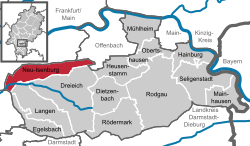
[edit]Neu-Isenburg borders in the west and north on the district-free city of Frankfurt am Main, in the east on the district-free city of Offenbach and in the south on the towns of Dreieich, Langen and Mörfelden-Walldorf (Groß-Gerau district).
Constituent communities
[edit]In 1959, building work began on the Wohnstadt im Grünen ("Living Town in the Green"), as it was marketed. This was Gravenbruch. Almost 7,000 people found a new home in this satellite town between the main town and Heusenstamm, lying in the woods. Owing to the great number of young families that moved there, this constituent community was known as the town with Europe's densest population of children. It is also well known for the Kempinski-Hotel and the drive-in cinema.
With the amalgamation of the formerly self-administering community of Zeppelinheim in the course of municipal reform in 1977, Neu-Isenburg also stretched farther westwards. Here is found the Zeppelinmuseum.
History
[edit]Neu-Isenburg was founded on 24 July 1699 as a town of exiles by Huguenots, French Protestants who had had to flee their homeland after the Edict of Nantes was revoked. Their new landlord, Count Johann Philipp von Isenburg-Offenbach, guaranteed them safety, the free use of the French language and religious freedom.
He gave them leave to settle in the Wildbann Dreieich, an old royal hunting forest, in the place where in the Middle Ages the pilgrimage chapel Zum Heiligen Kreuz ("To the Holy Cross") once stood. By way of thanks to the Count, the town was named Neu-Isenburg after him. The town plan was laid out by Andreas Loeber in a right-angled grid pattern. From corners ran diagonal streets to the marketplace. Also, the middles of the outer sides were linked by streets to the square marketplace. This township survives today in the streets of Kronengasse, Pfarrgasse, Löwengasse and Hirtengasse.
Neu-Isenburg was one of the planned towns of the 17th and 18th centuries. The settlers at first worked at farming, but later turned back to the handicraft trades that they had learnt, such as the stocking knitter's craft, thereby laying the groundwork for Neu-Isenburg's economic development. The surrounding communities eyed the French settlers with great mistrust and called the town welsches Dorf (the German word welsch refers to peoples who speak Romance languages, especially French; it is cognate with the English word Welsh, but does not have the same meaning). On 20 May 1700 – a Thursday – the clergyman Isaac Bermond held the first church services under an old oak in the middle of the church square.
About 1701, the Forsthaus was built (today an inn called Frankfurter Haus) by the city of Frankfurt am Main at the city limits with Neu-Isenburg. The first French Reformed church was built of wood between 1702 and 1706. The foundation stone was laid on Ascension Day 1702. Likewise in 1702, the Town Hall was built at the marketplace, and the Haus zum Löwen was mentioned for the first time. This was used until 1918 as an inn called Au Lion d'Or ("At the Golden Lion"), and today it houses the local history museum.
The first school followed in 1704, and in 1705 the Bansamühle (mill). The wooden church was replaced between 1773 and 1775 with a stone building. In 1781, the first German-language school was built.
After the Congress of Vienna in 1815, the County of Ysenburg, together with the Oberamt of Offenbach and its member municipalities, passed to the Grand Duchy of Hesse. In 1828, the Prussian-Hessian Customs Union built a customs house (Frankfurter Straße 10) as its main customs office on the border with what was then the Free City of Frankfurt.
Despite considerable reservations, German families, too, were moving into the town beginning in the 18th century, leading to the church's having to hold services alternately in German and French as of 1761, much to the French-speaking population's chagrin. In the end, German was confirmed as the town's official language in 1829.
In 1846, the Main-Neckar railway near Neu-Isenburg was completed, but the town did not get its own railway station until 1852. Other events in Neu-Isenburg's history, in brief, are as follows:
- 1860 The firm Müller markets Frankfurter Würstchen (sausages, but not the kind often called "Frankfurters" in the English-speaking world) for the first time.
- 1865 First postal station in Neu-Isenburg
- 1875 Volunteer fire brigade was founded
- 4 February 1889 Town rights were granted.
- 1889 The Waldbahn, a steam tramway, began running to Frankfurt.
- April 1896 The Höhere Bürgerschule (now Goetheschule) took on its task as Neu-Isenburg's first secondary school.
- 1899 On the occasion of its bicentenary, Neu-Isenburg received a coat of arms.
- 1907 The Jewish Women's Federation's home for Jewish girls was founded by Bertha Pappenheim.
- 23 October 1911 Consecration of the first Catholic church, St. Josef.
- 1929 The Waldbahn was electrified and incorporated into the Frankfurt tram network
- Between 1943 and 1945 the town suffered heavy damage from air raids.
- 1945 A broad area in the town's west had to be evacuated for the Occupying Power
- 1959 Building work began on Gravenbruch, a residential neighbourhood, after the woods there had been cleared.
- 1960 The Autokino Gravenbruch, Europe's first drive-in cinema, was opened.
- 1 January 1977 Amalgamation of the formerly self-administering community of Zeppelinheim, which itself had been cobbled together from parts of the self-administering municipal areas of Mitteldick and Gundwald (the latter in Groß-Gerau district) and parts of the community of Kelsterbach on 1 January 1938.
- 1997 Neu-Isenburg was linked to the Rhine-Main S-Bahn.
-
 Count Johann Philipp von Isenburg-Offenbach, the town's founder
 -
 Haus zum Löwen
 -
 The Autokino Gravenbruch, opened in 1960, was Europe's first drive-in cinema.
 -
 House on Zeppelinstraße, Neu-Isenburg, where Bertha Pappenheim housed her home for displaced Jewish girls


Population development
[edit]In 1834, Neu-Isenburg had only 1,762 inhabitants. By 1939, there were 15,081. After Zeppelinheim was amalgamated and Gravenbruch had been built, the population reached 35,000 by 1983.
Politics
[edit]Town council
[edit]The municipal elections held on 6 March 2016 yielded the following results,[3] compared to earlier municipal elections:[4][5]
| Parties and voter communities | CDU | SPD | AfD | GRÜNE | FDP | LINKE | FWG | Distribution of seats | |||
|---|---|---|---|---|---|---|---|---|---|---|---|
| 2016 | Share of the votes | 36.8 | 23.5 | 12.5 | 11.9 | 7.2 | 4.8 | 3.2 |
| ||
| Seats (out of 45) | 17 | 11 | 6 | 5 | 3 | 2 | 1 | ||||
| 2011 | Share of the votes | 44.1 | 24.5 | — | 20.2 | 3.6 | 3.5 | 4.2 |
| ||
| Seats (out of 45) | 20 | 11 | — | 9 | 2 | 1 | 2 | ||||
| 2006 | Share of the votes | 52.0 | 23.3 | — | 14.0 | 5.4 | — | 5.2 |
| ||
| Seats (out of 45) | 23 | 11 | — | 6 | 3 | — | 2 | ||||
| 2001 | Share of the votes | 48.0 | 26.5 | — | 16.9 | 5.2 | — | 3.4 |
| ||
| Seats (out of 45) | 22 | 12 | — | 8 | 2 | — | 1 | ||||
| 1997 | Share of the votes | 41.8 | 29.9 | — | 16.1 | 5.7 | — | 6.5 |
| ||
| Seats (out of 45) | 19 | 13 | — | 7 | 3 | — | 3 | ||||

The CDU formed a coalition with Die Grünen (“The Greens”), the FDP and the Freie Wähler (“Free Voters”).
Mayors
[edit]Past mayoral elections have yielded the following results:
|
|
|||||||||||||||||||||||||||||||||||||||||||||||||||||||||||||||||||||||||||||||||||||||
At the last election on 27 September 2015, the independent candidate Herbert Hunkel, who was supported by the CDU, was reelected with 77.4% of the vote over Thilo Seipel (FDP, 22.6%). Voter turnout was 30.3%.
Twin towns – sister cities
[edit]Neu-Isenburg is twinned with:[6]
 Andrézieux-Bouthéon, France
 Bad Vöslau, Austria
 Chiusi, Italy
 Dacorum, England, United Kingdom
- Veauche, France
 Weida, Germany


Friendly cities
[edit]Neu-Isenburg also has friendly relations with:[6]
 Alexandria, Minnesota, United States
 Sighisoara, Romania


Economy and infrastructure
[edit]

Economy
[edit]Given its proximity to the trade fair city of Frankfurt and to Frankfurt Airport, Neu-Isenburg is an attractive location for businesses of the most varied sectors. Among them are many hotels, which see more than 230,000 overnight stays every year, the highest figure in the Offenbach district.
Over time, the town has converted itself from a location for producing businesses to a service-industry-based location and is among the biggest high-technology locations in the Frankfurt Rhine Main Region.
Some of the businesses established here are:
- Aramark Holdings GmbH & Co. KG
- eprimo GmbH
- Harley-Davidson GmbH (Managing Germany, Austria and Switzerland)
- Jeppesen GmbH
- Kempinski Frankfurt AG
- Lorenz Snack-World GmbH (Bahlsen)
- Lufthansa Service GmbH (LSG Sky Chefs)
- AirPlus International
- Pepsi-Cola GmbH
- Symantec Corporation
- Keyence Deutschland GmbH
- UL International Germany GmbH
- Sescoi GmbH
- Alpha Industries GmbH & Co. KG
- Banque PSA Finance, SA.
- KarstadtQuelle Bank
- G. A. Müller GmbH (meat products factory, oldest manufacturer of the original Frankfurter Würstchen)
- Hans Wirth GmbH & Co. KG (meat products factory, manufacturer of the original Frankfurter Würstchen)
Around the 1980s and 1990s the airline Condor was headquartered in Neu-Isenburg.[7][8]
Transport
[edit]The town is close to several routes of the German Autobahn network (A 3, A 5, A 661).
Neu-Isenburg station is on the Main-Neckar Railway and is served by Rhine-Main S-Bahn line  and regional train RB 61,[9] although the station is somewhat remote from the town centre. It is the only station in Hesse that has loading tracks for a motorail service, connecting to several destinations in Austria, Italy and southern France. This service was discontinued in 2014. However the terminal remains.
  runs over the Mannheim–Frankfurt railway, stopping at Zeppelinheim station.
The Frankfurt tram network has a terminal at Isenburger Schneise, just within the Frankfurt boundary for reasons of municipal identity, linking the northern margin of Neu-Isenburg with Frankfurt Central Station.
Frankfurt Airport lies at the town limits.
Culture and sightseeing
[edit]
Hugenottenhalle
[edit]Neu-Isenburg is known far beyond its limits for the various events staged at the Hugenottenhalle. In this multipurpose hall with a variable capacity of up to 2,000 people, rock concerts are held, guest theatrical performances are given and dancing and music are performed. Citizens are offered a comprehensive cultural programme covering every genre.
Open-Doors-Festival
[edit]Neu-Isenburg is especially well known in the Frankfurt Rhine Main Region for its yearly summertime Open-Doors-Festival (formerly Musikspektakel). For three days, some 40 different bands and artists from all genres of music play. The free event is attended by some 15,000 guests and is held on several different stages throughout the town area.
Fastnacht
[edit]The parade through town on Shrove Monday (Rosenmontag) — sometimes called Lumpenmontag in Neu-Isenburg — enjoys great popularity.
Education
[edit]- Primary schools
- Albert-Schweitzer-Schule [1]
- Hans-Christian-Andersen-Schule
- Wilhelm-Hauff-Schule
- Ludwig-Uhland-Schule, Gravenbruch
- Selma-Lagerlöf-Schule, Zeppelinheim
- Gymnasium
- Comprehensive school
- Brüder-Grimm-Schule [4]
- Special school
- Friedrich-Fröbel-Schule, school for learning help and speech therapy
- Other schools
- Music school
- Folk high school [5]
Media
[edit]Ärzte-Zeitung, a newspaper for physicians, has its headquarters in Neu-Isenburg.[10]
Notable people
[edit]
- Bertha Pappenheim (1859–1936), feminist and social worker
- Franz Völker (1899–1965), operatic singer
- Wilhelm Leichum (1911–1941), athlete
- Anny Schlemm (born 1929), operatic singer
- Peter Dietrich (born 1944), footballer
- Horst Ludwig Störmer (born 1949), physicist, Nobel laureate
- Volker Steinbacher (born 1957), artist and graphic artist
- Torsten de Winkel (born 1965), guitarist
Honorary citizens
[edit]- Rudi Seiferlein (1921–2010), honorary chairman of the community of interests (IG) associations, posthumous award of honorary citizenship in March 2011
References
[edit]- ^ "Ergebnisse der letzten Direktwahl aller hessischen Landkreise und Gemeinden" (XLS) (in German). Hessisches Statistisches Landesamt. 5 September 2022.
- ^ "Alle politisch selbständigen Gemeinden mit ausgewählten Merkmalen am 31.12.2023" (in German). Federal Statistical Office of Germany. 28 October 2024. Retrieved 16 November 2024.
- ^ Statistical Office of Hesse: Results of the municipal election 2016
- ^ Statistical Office of Hesse: Results of the municipal elections 2011 and 2006
- ^ Statistical Office of Hesse: Results of the municipal elections 2001 and 1997
- ^ a b "Neu-Isenburg – mit der Welt verbunden". neu-isenburg.de (in German). Neu-Isenburg. Archived from the original on 27 March 2019. Retrieved 2 March 2021.
- ^ "World Airline Directory." Flight International. 30 March 1985. 70." Retrieved on 17 June 2009.
- ^ "World Airline Directory." Flight International. 24–30 March 1993. 84." Retrieved on 30 September 2009.
- ^ "Web-Bahnhofstafel". iris.noncd.db.de (in German). Retrieved 1 February 2023.
- ^ " Impressum." Ärzte-Zeitung. Retrieved on 4 April 2015. "Ärzte Zeitung Verlags-GmbH Am Forsthaus Gravenbruch 5 63263 Neu-Isenburg"
External links
[edit]


- Official website (in German and English)
- Hugenottenhalle cultural link (in German)
- Verein für Geschichte Heimatpflege und Kultur (in German)
(in German)
- Der Isenburger – Quarterly publication and online archive
Towns and municipalities in Offenbach district | ||
|---|---|---|
 | ||
| International | |
|---|---|
| National | |
| Geographic | |
| Other | |

Neu-Isenburg
View on GrokipediaGeography
Location and Topography
Neu-Isenburg is located in the Offenbach district of the state of Hesse, Germany, approximately 8 kilometers south of Frankfurt am Main's city center, within the Frankfurt Rhein-Main metropolitan region.[5] The town's geographic coordinates are roughly 50°03′N 8°42′E.[6] It borders Frankfurt am Main to the north and west, Offenbach am Main to the east, and municipalities such as Mörfelden-Walldorf and Langen to the south.[7] The municipality spans 24.3 km², encompassing flat terrain typical of the Upper Rhine Plain, with elevations averaging 130 meters above sea level.[6][8] This level topography, characterized by minimal elevation variation, supports extensive urban expansion and infrastructure development, including residential and commercial zones.[9] Neu-Isenburg lies about 11-12 kilometers northwest of Frankfurt Airport by road, positioning it within the airport's operational vicinity while maintaining separation from direct runway noise zones through its southerly placement relative to the city core.[10] The town consists of three main districts: the central Kernstadt, Zeppelinheim to the southwest, and Gravenbruch to the southeast, each integrated into the broader flat landscape conducive to interconnected green corridors and pathways.[3] Natural features include proximity to the Main River valley to the north, which shapes the regional hydrology and alluvial soils, though the town itself sits outside the river's immediate floodplain. Approximately 37% of the municipal area remains undeveloped, comprising forests, meadows, and protected natural zones that buffer urban expansion and contribute to local biodiversity in the Rhine-Main ecosystem.[8]Climate and Environment
Neu-Isenburg lies in a temperate oceanic climate zone (Köppen Cfb), typical of the Rhine-Main region, with mild winters, moderate summers, and consistent year-round precipitation influenced by westerly winds and proximity to the North Sea. Average annual temperatures range from lows of about -1°C (30°F) in winter to highs of 25°C (77°F) in summer, rarely dropping below -8°C (17°F) or exceeding 31°C (88°F); the annual mean is approximately 9.5°C, with January averaging 5°C and August peaking at 26°C. Precipitation totals around 746 mm annually, distributed fairly evenly with monthly averages of 50-60 mm, peaking slightly in summer due to convective storms rather than seasonal monsoons.[11] The town's environmental profile is markedly shaped by its location adjacent to Frankfurt Airport, Europe's busiest by cargo volume, resulting in elevated aircraft noise exposure that correlates with resident annoyance, noise sensitivity, and reduced health-related quality of life, particularly among those with multimorbidity. Noise levels in Neu-Isenburg stem primarily from southern flight paths and nighttime operations, with empirical studies linking chronic exposure to physiological stress responses independent of socioeconomic confounders. Air quality remains generally good, with current AQI readings in the "good" range for PM2.5 and other pollutants, though episodic spikes occur from airport emissions like nitrogen oxides and particulates, exacerbated by urbanization's impervious surfaces trapping pollutants.[12][13][14] Urban development has constrained natural floodplains along nearby streams feeding the Main River, elevating pluvial and fluvial flood risks during intense rainfall events, which climate models project to increase in frequency due to warmer atmospheric moisture capacity rather than solely anthropogenic forcing. Local adaptation efforts include a municipal climate strategy commissioned in recent years, focusing on resilient infrastructure like permeable surfaces and early warning systems to mitigate causal drivers such as soil sealing from expansion, without relying on unsubstantiated emission reduction narratives. Conservation initiatives emphasize integrating green spaces, with over 60% of planned industrial zones like newPark designated as vegetated to buffer noise and enhance microclimate cooling, though empirical data on biodiversity gains remains limited.[15][16][17]Demographics
Population Statistics
As of December 31, 2024, Neu-Isenburg had a population of 37,926 residents.[18] This marked an increase of 459 from January 1, 2024, reflecting net migration gains amid regional economic activity near Frankfurt Airport.[18] The town's population originated modestly with 46 inhabitants in 1699, following its founding as a Huguenot settlement.[19] By 1829, it reached 1,576, and grew to 1,762 by 1834.[19] Expansion accelerated in the early 20th century, hitting 15,081 in 1939, before postwar reconstruction drove surges to 25,362 by 1961 and 34,856 by 1970.[19]| Year | Population |
|---|---|
| 1699 | 46 |
| 1829 | 1,576 |
| 1834 | 1,762 |
| 1939 | 15,081 |
| 1961 | 25,362 |
| 1970 | 34,856 |
| 2024 | 37,926 |
Ethnic and Cultural Composition
As of the latest municipal data, foreign nationals comprise 31.3% of Neu-Isenburg's population of approximately 40,000 residents.[21][22] This proportion exceeds the Hessian average and stems from the town's proximity to Frankfurt Airport and logistics hubs, drawing short-term EU labor migrants for aviation and transport roles alongside permanent settlers from Turkey (historical guest worker communities), EU enlargement countries post-2004, and non-EU origins including Syria, Afghanistan, and Romania following intensified inflows since the 2015 migrant crisis.[23][24] Residents originate from over 130 nationalities, with non-EU migrants often concentrated in lower-wage sectors, contributing to economic output but highlighting compositional divides between native Germans (primarily in professional services) and transient or low-skilled foreign workers.[23] Linguistically, German remains the dominant language, yet migrant enclaves sustain home languages such as Turkish, Arabic, and Romanian, evident in bilingual signage and community events, though official registries show no comprehensive survey of primary language use beyond school enrollment data indicating multilingual classrooms. Religiously, the 2022 census records 15.6% Protestant affiliation (echoing early settler influences without dominating modern demographics) and 18.2% Catholic, while the majority—over 66%—report no religious membership, other faiths, or unknown status; Islam, prevalent among non-EU migrants, accounts for an estimated portion of the "other" category amid rising mosque attendance but lacks precise municipal enumeration.[25][1] Integration metrics reflect economic utility in labor-intensive industries, where foreign workers fill gaps in airport-related employment, yet district-level data from Offenbach (encompassing Neu-Isenburg) reveal disparities: migrant-background pupils comprise 44% of special education enrollments, correlating with lower overall school performance and higher repetition rates attributable to language deficits and socioeconomic factors rather than innate ability.[26] Employment gaps persist, with non-EU migrants facing 2-3 times the unemployment rate of natives in Hesse, driven by credential non-recognition and skill mismatches, fostering partial rather than seamless assimilation and occasional community silos observable in segregated neighborhoods.[24][26]History
Founding by Huguenots
Neu-Isenburg was established as a planned settlement for French Huguenot refugees following the 1685 revocation of the Edict of Nantes by Louis XIV, which ended official toleration of Protestantism in France and prompted mass emigration of skilled Calvinist artisans, merchants, and farmers.[27] Count Johann Philipp von Isenburg-Offenbach, a Reformed Protestant ruler tolerant of religious exiles, offered land in the dense forest south of Frankfurt am Main to attract these settlers, aiming to develop his territory's southern border through their labor and expertise while granting them autonomy from traditional feudal obligations.[27] [28] On July 24, 1699, 34 Huguenot families, primarily from southern France, swore allegiance to the count at Offenbach Castle, marking the formal founding of the town as an "exile settlement" (Exulantenstadt) named Neu-Isenburg after the count's domain.[27] [29] These families, totaling around 200 individuals, received plots for housing and agriculture, with the settlement laid out in a structured grid pattern centered on a marketplace to facilitate communal governance and trade, reflecting principles of orderly Protestant self-organization.[27] [28] The early economy emphasized self-reliance, with settlers engaging in farming on cleared woodland, viticulture, and handicrafts such as weaving and carpentry—skills brought from France—to avoid dependence on princely subsidies and establish viable trades free from guild restrictions imposed elsewhere in the Holy Roman Empire.[27] By 1702, the count had constructed a town hall on the marketplace, enabling the founding families to convene for self-administration, underscoring the settlement's design for independent Protestant communal life.[28] [30]Industrialization and Expansion
During the 19th century, Neu-Isenburg transitioned from a predominantly agricultural economy supplemented by home industries to one increasingly oriented toward manufacturing and small-scale industry, driven by regional economic pressures and proximity to Frankfurt. By the mid-1800s, traditional farming could no longer sustain the growing population, prompting diversification into proto-industrial activities such as textile production. A key catalyst was the establishment of a Kammgarnfabrik (worsted yarn factory), which significantly boosted employment and attracted workers, contributing to a quintupling of the population between 1853 and 1900.[31] This shift reflected broader Hessian trends, where rural areas near urban centers adapted to industrial demands through labor-intensive sectors like spinning and weaving, rather than heavy machinery-dependent production.[32] The arrival of rail infrastructure further accelerated expansion by linking Neu-Isenburg to Frankfurt's markets and jobs, facilitating commuter flows and the transport of goods. The Main-Neckar Railway's extension through the area, with connections operational by the late 1880s, enabled efficient access to the regional hub, drawing residents who worked in Frankfurt while benefiting from lower housing costs in Neu-Isenburg. This connectivity supported local manufacturing growth, including textile mills and emerging service industries like laundries, as evidenced by labor actions such as the 1897 Wäscherinnenstreik demanding better conditions amid expanding operations. Urban planning responded with incremental housing developments to accommodate influxes, though decisions prioritized ad-hoc expansions over comprehensive zoning until the early 20th century.[33] By the early 20th century, Neu-Isenburg's population had surged from approximately 2,000 residents in the mid-19th century to over 12,000 by 1910, more than tripling in the decades preceding World War I due to industrial appeal and commuter viability. This growth manifested in the development of worker settlements, including the 1930s founding of Zeppelinheim as a housing area tied to nearby aviation infrastructure, which incorporated zeppelin-related facilities and airport expansions to support Frankfurt's air transport ambitions. Such extensions underscored causal ties between transport advancements and demographic pressures, with local authorities balancing industrial zoning against agricultural remnants to sustain economic momentum.[32][34]World Wars and Postwar Reconstruction
During World War II, Neu-Isenburg suffered significant destruction from Allied air raids, culminating in the "Schreckensnacht" of December 20, 1943, when British bombers targeted the Rhein-Main area without prior warning. This single raid caused 40 to 45 deaths and inflicted 80% of the town's total wartime damage, affecting 2,153 buildings with nearly 50% destroyed or severely damaged, including the old town core, marketplace, Frankfurter Straße, the evangelical church, most schools, and numerous factories.[35][36] Overall, air campaigns resulted in at least 85 civilian fatalities and rendered hundreds homeless, exacerbating infrastructure failures such as the rupture of the main water line, which hindered firefighting efforts.[37][38] The war concluded in Neu-Isenburg in March 1945 with the unopposed entry of U.S. troops into the American occupation zone, facilitated by local citizens who averted potential combat destruction through negotiation with retreating German forces. Denazification proceeded under U.S. oversight, aligning with broader Allied efforts to purge Nazi influence from public life, though specific local proceedings emphasized administrative removal of regime affiliates rather than mass prosecutions. Post-liberation, the town faced acute challenges including rubble clearance, food shortages, and housing deficits, with women prominent in clearing debris and restoring social order amid the transition to civilian governance.[39] Reconstruction accelerated under mayors Alfred Bauer and Ludwig Arnoul, prioritizing salvaged materials for housing and utilities due to material scarcities, with efforts intensifying in the 1950s amid West Germany's market-led economic recovery. The influx of German expellees and refugees from Eastern territories—part of the national total exceeding 12 million by 1950—provided labor for rebuilding, though local integration strained resources initially. Proximity to Frankfurt Airport, expanded postwar with runways lengthened to nearly 4 kilometers under U.S. influence, spurred a shift toward service-oriented employment, leveraging private enterprise over rigid central planning to resolve housing shortages through incremental private construction and regional economic ties, yielding measurable progress in residential rebuilding by the late 1950s.[36][39][40]Government and Politics
Municipal Structure
Neu-Isenburg functions as a Stadt (town) within the Offenbach district of the state of Hesse, subject to the Hessian Municipal Code (Hessische Gemeindeordnung), which delineates local autonomy in administrative, fiscal, and service provision matters. The primary legislative body is the Stadtverordnetenversammlung, responsible for enacting bylaws, approving budgets, and overseeing municipal policy, with decision-making emphasizing consensus among elected members.[41] Executive authority resides with the Bürgermeister, who chairs the Magistrat—comprising the mayor, a full-time first councillor (Erster Stadtrat), and additional members—and exercises powers including the implementation of council resolutions, representation of the town in legal and intergovernmental affairs, and day-to-day administration under principles of subsidiarity and fiscal responsibility.[42] The Magistrat handles operational execution, with the mayor holding veto rights on certain executive decisions to ensure alignment with statutory mandates.[42] The municipality divides into three Stadtteile—the core Neu-Isenburg, Gravenbruch, and Zeppelinheim—each featuring Ortsbeiräte (local advisory councils) that facilitate community input on district-specific issues like infrastructure maintenance, without independent fiscal powers.[43] These divisions enhance localized representation while centralizing core services such as public safety and utilities through specialized Fachbereiche (departments), including finance, personnel, and a newly established digitalization and IT unit operational since March 1, 2025, aimed at streamlining administrative processes.[44] [45] Municipal funding derives principally from local taxes—property (Grundsteuer), trade (Gewerbesteuer), and other levies—accounting for the majority of revenues, augmented by state equalization payments and contributions linked to the Frankfurt Rhein-Main region's economic integration, such as airport-related levies.[8] The 2024–2025 double budget, totaling expenditures around €150 million annually, underscores reliance on these sources amid volatility in trade tax inflows, with administrative efficiency evidenced by initiatives like electronic file implementation targeted for completion by end-2025 to reduce processing times.[8] [46]Elected Officials and Elections
Dirk Gene Hagelstein of the Social Democratic Party (SPD) has served as mayor of Neu-Isenburg since April 11, 2022, following his narrow victory in the October 10, 2021, runoff election against Stefan Schmitt of the Christian Democratic Union (CDU).[47] In the first round on September 26, 2021, Schmitt led with 39.1% of the vote, but Hagelstein advanced to the runoff as the second-place candidate. This marked a shift from the previous mayor, Herbert Hunkel, a non-partisan figure supported by the CDU, who held office from 2010 to 2022 after winning elections in 2010 (58.9%) and 2015 (77.4%). Earlier mayors included Dirk-Oliver Quilling (CDU) from 1996 to 2010. The Neu-Isenburg city council (Stadtrat) comprises 45 members elected every five years, with the most recent election held on March 14, 2021, yielding a voter turnout of 41.7% among 27,727 eligible voters.[48] The CDU retained the largest bloc with 15 seats, but the Greens surged to 11 seats amid losses for the SPD and AfD, indicating a fragmented council requiring coalitions for governance.[48]| Party | Vote Share (%) | Seats (2021) | Seats (2016) | Change |
|---|---|---|---|---|
| CDU | 32.5 | 15 | 17 | -2 |
| Greens (Bündnis 90/Die Grünen) | 24.4 | 11 | 5 | +6 |
| SPD | 18.3 | 8 | 11 | -3 |
| FDP | 8.9 | 4 | 3 | +1 |
| AfD | 6.7 | 3 | 6 | -3 |
| Die Linke | 5.6 | 2 | 2 | 0 |
| FWG (Freie Wählergemeinschaft) | 3.6 | 2 | 1 | +1 |
Policy Debates and Controversies
In February 2025, Neu-Isenburg became a focal point for national debates on migration policy when Alternative for Germany (AfD) co-leader Alice Weidel held an election campaign rally at the Hugenottenhalle, emphasizing the financial pressures on local budgets from accommodating asylum seekers and the risks of cultural shifts in communities with rising non-European immigration. Attendees voiced specific worries about increased welfare expenditures and taxpayer burdens, with one participant stating, "I don't want to have to be squeezed financially," amid broader AfD critiques of federal migration policies straining municipal resources.[50][51] The rally provoked strong counter-mobilization, as around 9,000 demonstrators assembled to protest AfD's stances, attempting to block venue access under slogans like "Block Alice Weidel" and framing the party's migration rhetoric as inflammatory. Local authorities managed the event without major incidents, but it highlighted divisions over integration strategies, with opponents arguing for sustained humanitarian commitments despite fiscal costs, while AfD supporters cited national crime data showing non-German suspects comprising over 30% of total offenses in recent years—though localized empirical evidence for Neu-Isenburg remains limited and contested, with studies indicating no direct correlation between migrant influxes and elevated local crime rates.[52][53][54] Ongoing controversies also revolve around balancing Frankfurt Airport's economic contributions—providing thousands of jobs and logistics hubs in Neu-Isenburg—with aircraft noise pollution, as certain runway configurations, like nighttime uses of the south runway, disproportionately affect the town by funneling flights overhead. Residents have advocated for stricter noise abatement, including steeper approach angles and curfews, citing health studies linking chronic exposure to increased mortality risks, yet pro-growth factions defend expansions for fiscal revenues and employment, arguing that overregulation could undermine the region's competitiveness against green mandates prioritizing environmental restrictions over infrastructure development.[13][55][56]Economy
Major Sectors and Employment
Neu-Isenburg's economy is predominantly service-oriented, with services comprising approximately 65% of all registered businesses, underscoring the private sector's emphasis on professional, financial, and aviation-related activities. In 2022, the town recorded 6,641 businesses, distributed as 4,343 in services, 1,444 in trade, 728 in crafts, and 126 in industry, reflecting a balanced yet service-heavy structure that leverages the town's strategic location.[57][58] Logistics emerges as a core driver, facilitated by proximity to Frankfurt Airport and robust infrastructure including highways and rail; key players include REWE's advanced logistics center, LSG Group's airline catering operations employing thousands regionally, and NX Logistics Europe's facilities handling international freight.[59][60][61] Retail contributes notably through the Isenburg-Zentrum, a regional hub with over 110 shops spanning 40,000 m² of space, drawing consumers from the Frankfurt Rhein-Main area.[62] Employment reached 30,861 socially insured positions in 2022, marking a 4% rise (1,168 net new jobs) from 2021, primarily through expansions in medium-sized enterprises, startups, and international firms attracted by the town's business tax multiplier of 330%—the lowest in Offenbach district since January 2022.[58] This environment fosters job creation via private initiative, yielding high trade tax revenues of €116.9 million in 2022 and a commuter surplus of 14,481 workers inflowing daily.[58] Small businesses and the handicraft sector, with 728 establishments, preserve a traditional base amid modernization, providing resilient local employment less vulnerable to global disruptions. Airport dependency, while generating logistics and service roles, imposes causal trade-offs including heightened air pollution from aircraft emissions, which local policies must mitigate to sustain long-term viability.[58]Business Developments and Investments
Goodman Group, an Australian real estate developer, acquired a 4.5-hectare brownfield site in Neu-Isenburg in 2023, previously used by the Frankfurter Rundschau newspaper printing operations on Rathenaustrasse, to develop a powered shell data center facility spanning 45,000 square meters.[63][64] The project, designated Goodman FRA II, targets a 100 MVA electrical capacity to meet rising demand for digital infrastructure in the Frankfurt region.[65] An urban development agreement with Neu-Isenburg authorities was finalized on September 24, 2024, paving the way for construction with integrated sustainability measures, including the reuse of waste heat from servers to supply the local district heating network via a new plant built by Stadtwerke Neu-Isenburg on an adjacent site.[66] Regulatory approval followed on October 24, 2024, emphasizing the facility's role in enhancing the area's digital economy while addressing energy efficiency through heat recovery, which could reduce municipal heating costs but depends on operational uptime and grid reliability.[65] Such developments typically yield short-term construction employment—potentially hundreds of jobs during build-out—followed by 50-100 permanent roles in operations and maintenance, based on comparable European data center benchmarks, though Neu-Isenburg-specific projections prioritize technical expertise over mass hiring.[64] A feasibility study released on December 18, 2024, evaluated extending Frankfurt's tram line 17 southward through Neu-Isenburg to Dreieich and Langen, covering 8.4 kilometers and projecting strong economic viability through improved public transit access to employment hubs and reduced road congestion.[67] The assessment highlights technical feasibility and urban development gains, including better connectivity for data center workers and logistics, with estimated costs offset by long-term ridership revenue and property value uplifts, though implementation hinges on coordinated funding from regional authorities. These initiatives underscore Neu-Isenburg's pivot toward high-tech infrastructure, yet expose risks from foreign-led investments like Goodman's, which may prioritize global supply chains over local economic multipliers, and from energy-intensive operations amid Germany's variable renewable grid, potentially straining return on investment without unsubsidized efficiency gains.[66]Infrastructure and Transport
Road and Rail Networks
Neu-Isenburg station, operational since 1 November 1852, integrates the town into the Rhine-Main S-Bahn network, enabling rapid commuter rail service to Frankfurt am Main with trains departing every 20 minutes and typical journey durations of 7 to 12 minutes to key central stations such as Konstablerwache.[68] Regional trains further connect to surrounding areas, supporting daily passenger volumes amid the Frankfurt metropolitan region's high demand. Deutsche Bahn's investments in Hessian rail infrastructure, totaling €1.55 billion for stations and networks, include capacity enhancements at Neu-Isenburg to accommodate growing ridership and reduce bottlenecks.[69] The town's road network links directly to federal autobahns A3, A5, and A661, providing efficient access for vehicular traffic and logistics operations via multiple entry and exit points. The B43 federal road serves as a supplementary route to Frankfurt Airport, approximately 5 kilometers north. However, peak-hour congestion affects these corridors, with morning and evening rush periods seeing delays due to spillover from airport traffic and Frankfurt-bound flows, often requiring additional travel time beyond baseline estimates of 15-20 minutes by car to the city center.[70] [71] Public bus services, operated within the Rhein-Main-Verkehrsverbund framework, complement rail with local routes, though expansion efforts focus on light rail integration. A December 2024 feasibility study for extending Frankfurt's tram network through western Offenbach to Neu-Isenburg, Dreieich, and Langen demonstrated strong viability across technical, economic, and urban planning criteria, potentially adding dedicated tracks and stops to alleviate road dependency.[67]Aviation and Urban Connectivity
Neu-Isenburg lies approximately 10 kilometers south of Frankfurt Airport (FRA), Germany's busiest aviation hub and a central node in the Rhein-Main metropolitan region's transport network, facilitating swift access for local workers and businesses via public transport options including buses (21 minutes travel time) and regional trains (25 minutes).[10][72] This proximity supports the airport's role as a major cargo and passenger gateway, with Frankfurt handling over 70 million passengers annually in peak years like 2019, enabling logistics firms and commuters in Neu-Isenburg to integrate efficiently into the hub's operations for intercontinental freight and travel.[73] The Rhein-Main area's connectivity is enhanced by dedicated S-Bahn lines (S6 and S7) linking Neu-Isenburg station directly to the airport terminals, reducing reliance on road travel and supporting daily workforce flows estimated to contribute to the airport's broader economic footprint of around 116,000 regional jobs.[74][75] Urban planning in Neu-Isenburg has adapted to the airport's expansion through targeted noise mitigation measures, including Fraport's implementation of "noise respite periods" that alternate runway usage to distribute exposure, though certain configurations—such as exclusive use of the southern runway—increase noise levels in Neu-Isenburg and nearby Offenbach during specific hours.[13] Infrastructure investments, such as steeper approach paths on southern and central runways introduced in 2017 and active noise abatement procedures like optimized flight paths, aim to curb overflight impacts, with empirical monitoring showing variable but persistent strain on residents from aircraft operations.[76][77] These efforts reflect causal trade-offs in airport-adjacent development, where proximity drives logistical advantages but necessitates compensatory environmental controls. The adjacency yields economic benefits through spillover from the airport's cargo and passenger volumes, bolstering local employment in aviation-related services, yet imposes environmental and health costs, including elevated annoyance and reduced quality of life documented in surveys of nearby residents.[12] Noise pollution causally depresses property values, with hedonic studies around Frankfurt estimating a 1.7% price reduction per decibel increase in aircraft noise exposure, a factor particularly relevant for Neu-Isenburg's housing market under flight paths.[78] While the hub status attracts indirect tourism and business traffic—potentially amplifying regional connectivity—these gains are offset by verifiable health correlations, such as heightened stress from chronic exposure exceeding annoyance predictions in empirical models.[79] Overall, the net effect hinges on sustained mitigation, as unaddressed noise erodes residential appeal despite logistical premiums.[80]Culture and Society
Historical Landmarks and Events
Neu-Isenburg was established on 24 July 1699 by Count Johann Philipp von Isenburg-Offenbach as a planned settlement to accommodate Huguenot refugees fleeing religious persecution in France following the revocation of the Edict of Nantes in 1685.[81][82] The count granted the settlers religious freedom, tax exemptions for several years, and plots for farming and crafts, reflecting principles of Protestant refuge amid post-Reformation migrations. By 1703, approximately 200 Huguenot families, including skilled artisans such as silk-weavers, tanners, and hatters, had arrived, laying the foundation for the town's early economy centered on textile production and agriculture.[83] This founding event underscores Neu-Isenburg's origins as a deliberate experiment in confessional tolerance and economic self-sufficiency, with the settlement initially named Philippsdorf before adopting its current name to evoke continuity with the Isenburg lineage. Preserved landmarks tied to this heritage include the Haus zum Löwen, a half-timbered structure from the early 18th century that exemplifies Huguenot architectural influences and now serves as a museum displaying artifacts from the settlers' era, such as tools and documents illustrating their trades.[84] The Hugenottenhalle, constructed in the 1970s as a multipurpose cultural venue, honors the Huguenot legacy through its name and programming, though its modernist design has prompted debates over preservation; a 2024 architectural competition awarded plans for renovation to integrate contemporary functionality while safeguarding the original structure against deterioration, amid municipal budget pressures that prioritize essential maintenance over expansive restorations.[85] Local efforts also encompass the old town hall and the Alter Friedhof cemetery, where guided tours highlight graves of early Huguenot families, with ongoing conservation focusing on structural integrity despite fiscal constraints that limit comprehensive monument erection or full-scale excavations.[86] These sites embody the town's causal roots in refugee resettlement, yet maintenance costs—estimated in the low six figures annually for key buildings—strain resources, balancing historical authenticity against practical fiscal realism. Recurring events reinforce communal ties to this history. The annual Fastnacht carnival, part of the broader Rhineland-Palatinate tradition, culminates in a Rosenmontag parade through the town center, featuring floats, costumes, and local clubs with participation from thousands of residents and visitors, echoing pre-Lenten festivities adapted by early Protestant settlers.[87] The Open-Doors Festival, held each July since the early 2000s, transforms Neu-Isenburg into a venue for over 50 bands across 16 stages with free admission, drawing approximately 20,000 attendees over three days and spotlighting the Hugenottenhalle as a primary hub, thereby sustaining cultural vibrancy linked to the town's inclusive founding ethos while generating economic offsets through vendor activity that partially alleviate event-related expenditures.[88]Education and Cultural Institutions
Neu-Isenburg maintains a comprehensive public education system aligned with the Hessian state framework, encompassing six primary schools (Grundschulen), one gymnasium (Goetheschule), and one combined Hauptschule and Realschule (Brüder-Grimm-Schule), alongside a special-needs school (Albert-Schweitzer-Schule).[89][90] These institutions serve approximately 3,443 secondary-level students as of recent Kreis Offenbach data, with primary enrollment supported by high after-school care coverage at 84.2 percent, the highest in the district.[91][90] Vocational training programs emphasize practical skills tied to the local economy's logistics, retail, and aviation sectors, facilitated through school-company partnerships and the dual education model prevalent in Germany.[92] Higher education access relies on proximity to Frankfurt am Main, about 10 kilometers away, where institutions like Goethe University and Frankfurt University of Applied Sciences offer degree programs in business, engineering, and sciences relevant to Neu-Isenburg's workforce needs. Local adult education is provided by the Volkshochschule Neu-Isenburg, offering courses in languages, IT, and professional development, and the Musikschule for instrumental and vocal training. Specific local graduation rates are not publicly disaggregated, but Hessian Abitur pass rates hover around 94.5 percent statewide, reflecting strong overall performance though with noted gaps in integration for non-native speakers, where language barriers can hinder outcomes despite targeted programs like interkultural libraries and social pedagogy.[93][94] Cultural institutions include the Stadtbibliothek Neu-Isenburg, a public library system with a central location and branches in Westend, Gravenbruch, and Zeppelinheim, holding approximately 70,000 media items including books, audiobooks, DVDs, and digital resources, with interkultural offerings to support multilingual users.[95][96] The Hugenottenhalle serves as the primary venue for theater, concerts, and cultural events, accommodating up to 1,800 visitors and hosting professional performances alongside local amateur groups.[97] Local media comprises district-specific publications like the Stadtteilzeitungen from the municipal press office and coverage in the Neu-Isenburger Neue Presse, a regional edition of the Frankfurter Neue Presse focusing on municipal governance, events, and community issues within the Kreis Offenbach framework.[98][99] These outlets provide factual reporting on education and culture, though broader Hessian media reflects standard public broadcasting influences without notable deviations in local scope.[100]Social Dynamics and Challenges
Neu-Isenburg maintains a population of approximately 40,000 residents, with foreign nationals comprising about 19.6% as of 2019, a figure elevated by the town's proximity to Frankfurt Airport attracting transient skilled workers from EU countries in aviation and related fields. This composition fosters a multicultural environment beneficial for cultural exchange among professionals, yet the high turnover of temporary residents correlates with reduced social trust and weaker community bonds, as transient populations exhibit lower investment in local civic life compared to stable native groups, per patterns observed in similar Frankfurt suburbs.[101] Integration challenges persist, particularly for non-EU migrants including recent asylum seekers, prompting the establishment of advisory bodies like the Ausländerbeirat and programs such as integration multipliers to bridge gaps in language, health access, and interreligious dialogue via the Runder Tisch der Religionen.[102][103] The town's 2021 Integrationskonzept acknowledges barriers to full participation, including limited intergroup mixing, while local political discourse, such as CDU calls for stricter migration controls in 2024, highlights strains from unskilled inflows on family structures and community events amid national trends of welfare dependency among certain migrant cohorts.[104][105] Crime rates reflect contained challenges, with 2,076 registered offenses in 2024—a 12% decline from 2,358 in 2023 and below pre-pandemic levels—despite the diverse demographic, underscoring benefits of skilled migration in maintaining order but underscoring causal links in comparable areas where unskilled migration elevates petty crime and reduces cohesion without offsetting gains.[106][107]International Relations
Twin Towns and Partnerships
Neu-Isenburg has established formal partnerships with six cities to promote cultural, educational, and civic exchanges, including twin town agreements dating back to 1969. These ties emphasize people-to-people connections, such as youth programs, sports delegations, and municipal visits, though documented economic impacts remain limited to networking opportunities rather than measurable trade increases.[108] The international partnerships include Andrézieux-Bouthéon and Veauche in France, formalized on 30 August 1969 to commemorate the 75th anniversary of Neu-Isenburg's town rights; these have involved reciprocal hosting of delegations and cultural events.[108] Dacorum Borough in England, encompassing towns like Hemel Hempstead, was partnered on 3 May 1975, with historical exchanges in the initial decades giving way to revival efforts in recent years through joint festivals and citizen initiatives.[108][109] Bad Vöslau in Austria joined on 15 April 1978, supporting ongoing visits like the 45th anniversary delegation in 2023, focused on spa and wine heritage sharing.[108] Chiusi in Italy established ties on 3 July 2010, facilitating Tuscan cultural immersions and annual commemorations.[108][110] Domestically, Neu-Isenburg partners with Weida in Thuringia since 20 October 1990, originating from post-reunification outreach to foster East-West reconciliation through school exchanges and club collaborations.[108] Additionally, the town maintains friendly relations—less formal than twinships—with Sighișoara in Romania, involving aid packages in the 1980s and 1990s, and Alexandria in Minnesota, USA, linked to post-World War II care packages received by locals.[108] These arrangements prioritize symbolic goodwill over structured programs, with activities varying by partner engagement levels.[109]| Partner Type | City | Country/Region | Establishment Date | Key Activities |
|---|---|---|---|---|
| Twin Town | Andrézieux-Bouthéon | France | 30 August 1969 | Delegation visits, cultural events[108] |
| Twin Town | Veauche | France | 30 August 1969 | Blog-maintained exchanges, hosting[108] |
| Twin Town | Dacorum Borough | England | 3 May 1975 | Festivals, citizen diplomacy revival[108] |
| Twin Town | Bad Vöslau | Austria | 15 April 1978 | Anniversary visits, heritage sharing[108] |
| Twin Town | Chiusi | Italy | 3 July 2010 | Cultural immersions[108] |
| Partnership | Weida | Germany (Thuringia) | 20 October 1990 | School and club collaborations[108] |
| Friendly Relations | Sighișoara | Romania | Undated (1980s onward) | Historical aid exchanges[108] |
| Friendly Relations | Alexandria | USA (Minnesota) | Undated (post-1945) | Post-war package reciprocity[108] |
Notable Individuals
Residents and Natives
Franz Völker (1899–1965), a German dramatic tenor, was born on March 31, 1899, in Neu-Isenburg, where he began his career trajectory from a banking clerk to a prominent opera singer after vocal studies in Frankfurt.[111][112] He performed leading roles in major European houses, including Wagnerian parts at Bayreuth and the Metropolitan Opera, establishing a reputation for versatility and power through disciplined self-improvement.[113] Wilhelm Leichum (1911–1941), an athlete specializing in long jump and sprints, was born on May 12, 1911, in Neu-Isenburg.[114] He achieved European championships in long jump in 1934 and 1938, and secured a bronze medal at the 1936 Berlin Olympics with a leap of 7.73 meters, demonstrating rigorous training and competitive excellence before his death in military service.[115][116] Anny Schlemm (born February 22, 1929), an operatic soprano who later transitioned to mezzo-soprano roles, was born in Neu-Isenburg to a family connected to Frankfurt's opera scene.[117] She built an international career performing at venues like the Vienna State Opera and Salzburg Festival, known for interpretations in Strauss and Wagner, through persistent vocal development and stage presence.[118] Bertha Pappenheim (1859–1936), a pioneering feminist and social reformer, resided long-term in Neu-Isenburg from 1907, where she established and directed a home for Jewish girls displaced by hardship, advancing women's welfare and anti-trafficking efforts until her death there on May 28, 1936.[119][120] Her initiatives stemmed from personal recovery and organizational leadership, fostering self-reliance among residents amid early 20th-century social constraints.[121] Bernd Hölzenbein (1946–2024), a professional footballer and 1974 FIFA World Cup winner with West Germany, was a long-term resident of Neu-Isenburg's Gravenbruch district, where he lived for decades and contributed to local sports culture before his death on April 15, 2024.[122][123] Rising from modest beginnings to score over 200 goals for Eintracht Frankfurt, his career exemplified sustained professional achievement and community involvement.[124]Honorary Citizens
Franz Völker, a native tenor renowned for his Wagner interpretations, received honorary citizenship in 1949 for his contributions to opera that brought international acclaim to Neu-Isenburg as a cradle of musical talent.[125] Ludwig Arnoul was awarded the distinction on March 25, 1969, recognizing his 40 years of public service, including his tenure as mayor from 1954 to 1972, during which he oversaw post-war reconstruction and administrative stability.[126] Anny Schlemm, a soprano born in Neu-Isenburg in 1929, holds honorary citizenship for her distinguished career at major opera houses, embodying the town's legacy of producing world-class vocal artists whose performances enhanced local cultural institutions.[127] Rudolf "Rudi" Seiferlein was posthumously honored in March 2011 for decades of voluntary leadership in sports associations and community groups, fostering civic engagement and infrastructure like the local sportpark named after him.[128] That same year, Walter Norrenbrock earned the title for 22 years as chairman of TSG 1885 Neu-Isenburg, advancing amateur sports and youth development amid the town's growth.[129] Thomas Reiter, an astronaut and Neu-Isenburg native who logged over 350 days in space, was designated an honorary citizen for exemplifying scientific excellence and inspiring local education in STEM fields through his missions with the European Space Agency.[130] Herbert Hunkel, who served as mayor for over two decades until 2022, received the honor that year for his administrative leadership, including strengthening twin-town partnerships and urban planning that supported economic expansion without ideological favoritism.[131] These awards, drawn from municipal records, emphasize tangible impacts like governance efficiency, cultural prestige, and community vitality over political alignment.[132]References
- https://en.wikivoyage.org/wiki/Neu-Isenburg