Hubbry Logo
Western ApproachesWestern ApproachesMain
Open search
Western Approaches
Community hub
Western Approaches
logo
8 pages, 0 posts
0 subscribers
Be the first to start a discussion here.
Western Approaches
Western Approaches
from Wikipedia
Western Approaches

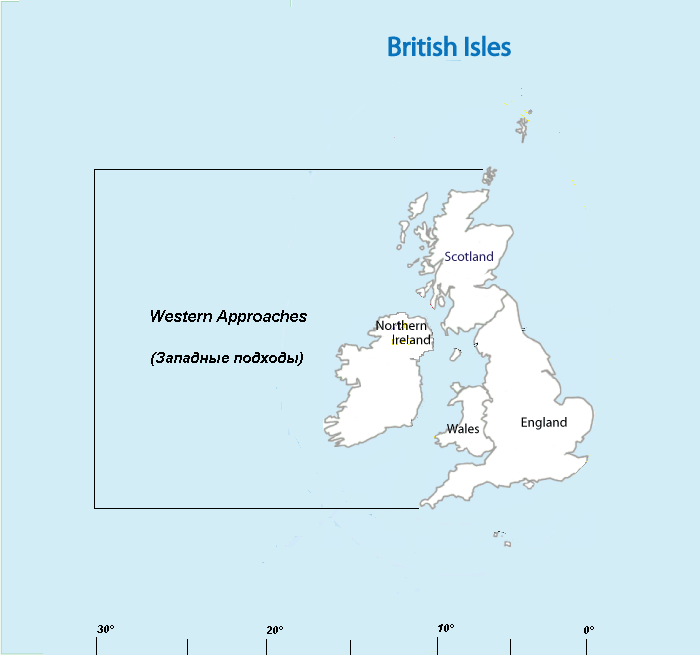
The Western Approaches is an approximately rectangular area of the Atlantic Ocean lying immediately to the west of Ireland and parts of Great Britain. Its north and south boundaries are defined by the corresponding extremities of Britain. The coast of the mainland forms the eastern side and the western boundary is the 30 degree meridian, which passes through Iceland. The area is particularly important to the United Kingdom, because many of its larger shipping ports lie within it.[1]

The term is most commonly used when discussing naval warfare, notably during the Napoleonic Wars, the First World War and the Battle of the Atlantic during the Second World War in which Nazi Germany's Kriegsmarine attempted to blockade the United Kingdom using submarines (U-boats) operating in this area. Since almost all shipping to and from the United Kingdom passed through this area, it was an excellent hunting ground and had to be heavily defended.[2]

See also

[edit]

References

[edit]
Revisions and contributorsEdit on WikipediaRead on Wikipedia
from Grokipedia
The Western Approaches is a critical maritime zone in the North Atlantic Ocean, comprising the waters immediately west of the British Isles that served as the primary gateway for transatlantic shipping to the United Kingdom and Ireland during World War II. This roughly rectangular area, extending from the coasts of Great Britain and Ireland westward toward the open Atlantic, encompassed vital convoy routes essential for delivering food, fuel, and military supplies from North America to sustain the Allied war effort against Nazi Germany. Its strategic significance peaked in the Battle of the Atlantic (1939–1945), where it became the epicenter of intense naval confrontations between Allied forces and German U-boats seeking to sever Britain's lifeline. Established in 1939 as an operational command of the Royal Navy, the Western Approaches Command was headquartered in from February 1941 onward, coordinating , escorts, and intelligence operations to counter the threat. Under leaders such as Sir Percy Noble and later Sir Max Horton, the command integrated advancements, code-breaking from , and innovative tactics developed by units like the (WATU), which used wargaming to refine escort strategies. These efforts were pivotal in turning the tide by mid-1943, when losses surged and Allied shipping losses plummeted, enabling the buildup for the D-Day invasion in 1944. The command's underground operations room at Derby House, preserved as the , exemplifies the 24/7 vigilance that protected over 1,000 s arriving at . Beyond its wartime role, the Western Approaches remain a busy shipping corridor today, while also holding geological and ecological importance as part of the and broader North Atlantic shelf. Historical analyses highlight the command's contributions to organizational learning in , influencing modern anti-submarine doctrines.

Geography

Location and Boundaries

The Western Approaches constitutes a roughly rectangular sea zone in the North Atlantic Ocean, positioned immediately westward of the , encompassing the waters adjacent to and the western coasts of . This area is bounded to the north and south by the latitudinal extremities of and , approximately from 48°N to 58°N, and to the east by the mainland coastal lines along roughly 10°W longitude. To the west, the demarcation follows the 30°W meridian, extending into the broader Atlantic and situated westward of . The zone's configuration facilitated direct maritime access to key United Kingdom ports, including Liverpool and Glasgow via the Irish Sea to the northwest, and Southampton through the English Channel to the southeast.

Strategic Maritime Features

The Western Approaches, encompassing the maritime region southwest of the British Isles, are characterized by challenging weather patterns that significantly impact navigation and maritime operations. Frequent storms, often driven by mid-latitude cyclones, occur year-round but peak in autumn and winter, with gale-force winds exceeding 34 knots commonly reported in the area. Fog is prevalent, particularly in spring and summer, forming due to the advection of warm, moist air over cooler sea surfaces, which reduces visibility to less than 1 km and heightens collision risks. Variable currents, influenced by the North Atlantic Drift—a warm extension of the Gulf Stream flowing northeastward—introduce further complexity, as this current moderates regional temperatures but interacts with opposing winds and tidal flows to create unpredictable eddies and drifts that can deviate vessels by several nautical miles. The seabed in the Western Approaches lies primarily on the continental shelf, with depths averaging 100-200 , gradually increasing toward the shelf break at 180-205 before descending steeply to over 4,000 on the continental slope. This relatively shallow , part of the broader and margins, consists of unconsolidated sediments overlaying older and Tertiary strata, including sands, muds, and outcrops that vary in carbonate content. Near coastal areas, such as off southwest and , depths shallows to under 50 , creating conditions favorable for deposition but restrictive for deep-draft vessels and influencing acoustic for in submarine activities. The seabed's tectonic history, marked by faulting and basin formation like the Melville and Southwest Channel Basins, results in irregular topography that affects bottom currents and stability, thereby complicating mine deployment and clearance operations. Key navigational hazards in the region include prominent rock formations and shoals that pose risks to shipping, exacerbated by the area's strong tidal regimes. Notable features encompass granite outcrops around the , rising to 51 meters above , and submerged phonolite pinnacles like Wolf Rock at 49°56′N 5°47′W and the Seven Stones reef, both extending to within 10-20 meters of the surface. Shoals such as Haig Fras, at approximately 40 meters below the surface, and Epson Shoal further offshore, combined with tidal sand ridges up to 60 meters high and spanning 200 kilometers on the outer shelf, create dynamic barriers influenced by semidiurnal tides reaching 4-5 meters in amplitude near the entrances. These elements, coupled with submerged cliffs at 38-69 meters depth and canyon heads incising the slope, demand precise charting and use, as tidal currents exceeding 2 knots can rapidly shift and amplify wreck risks in low-visibility conditions.

Historical Significance

Pre-20th Century Role

The Western Approaches, encompassing the sea area extending from the Atlantic Ocean to the , functioned as the principal gateway for transatlantic commerce during the Age of Sail from the 16th to 19th centuries. Merchant vessels carrying goods such as timber, , and from North American and ports navigated this route to reach British and European markets, forming a vital of global trade that underpinned . Historical records document substantial losses among these ships due to and severe storms, with privateers and rogue vessels preying on laden convoys in the open waters, while Atlantic gales frequently dashed hulls against rocky coasts like those of and . For instance, during the (c. 1650–1730), pirate attacks targeted merchant shipping in the North Atlantic, contributing to premiums that reflected the high risk of the approaches. Storms accounted for even greater attrition, with contemporary logs noting that transatlantic voyages in the frequently ended in wreck or foundering due to unpredictable weather patterns. In the (1793–1815), the Western Approaches emerged as a critical theater for British naval operations aimed at maintaining maritime supremacy and protecting trade. The Royal Navy established blockades in these waters to interdict French shipping and prevent reinforcements from reaching invasion forces, stationing squadrons at strategic chokepoints to enforce economic pressure on Napoleon's regime. These efforts effectively curtailed French access to overseas resources, with British cruisers patrolling the approaches to the and disrupting supply lines vital for continental warfare. Concurrently, French privateers, operating from ports like Brest and , exploited the area's vast expanse to raid British merchant convoys, capturing hundreds of vessels and inflicting economic damage estimated at millions of pounds annually. Notable actions, such as the 1796 Atlantic raid, highlighted the vulnerability of trade routes in the approaches, where French corsairs ambushed isolated ships before British escorts could respond. To counter the persistent threat of French invasion via the western coasts, Britain constructed early coastal fortifications, including chains of Martello towers along the Irish and Welsh shorelines in the early 19th century. These circular stone structures, inspired by 16th-century Corsican defenses, were erected between 1804 and 1812 as part of a broader defensive network, each mounting a 24-pounder cannon to deter amphibious landings and signal alerts across linked positions spaced about 600 yards apart. In Ireland, over 80 towers guarded vulnerable bays like Bantry, where a failed French expedition in 1796 had underscored the invasion risk; in Wales, examples at Fishguard and Pembroke Dock fortified the Pembrokeshire coast against potential cross-Channel assaults. Though never engaged in combat, as Napoleon's focus shifted eastward by 1812, these towers symbolized Britain's proactive stance in securing the approaches against continental aggression.

World War I Involvement

During , the Western Approaches became a focal point of as German U-boats launched campaigns against Allied shipping to starve Britain of essential supplies. Beginning in February 1915, declared the waters around the a war zone, allowing unrestricted submarine attacks on all vessels, including neutral ones, in a bid to disrupt the flow of food, munitions, and raw materials through these vital sea lanes. Over the course of the war, s sank nearly 5,000 Allied ships, totaling more than 13 million gross tons, with a significant portion of these losses occurring in the Western Approaches as submarines patrolled the approaches to key ports like and . These attacks peaked in during the renewed unrestricted campaign, when monthly shipping losses reached over 800,000 tons, posing an existential threat to Britain's . A pivotal incident that highlighted the vulnerability of the Western Approaches was the sinking of the RMS on May 7, 1915, by the German submarine U-20 approximately 11 miles off the , . The luxury liner, carrying 1,959 passengers and crew, was torpedoed without warning and sank in 18 minutes, resulting in 1,198 deaths, including 128 Americans; this tragedy inflamed worldwide and played a crucial role in shifting U.S. toward intervention, culminating in America's in April 1917. The incident underscored the strategic importance of the area, where pre-war transatlantic trade routes converged, making it a prime hunting ground for U-boats intent on severing Britain's lifeline. To counter the U-boat menace, the British experimented with and then adopted the convoy system in mid-1917, grouping merchant ships under armed escorts for protection during transit through the Western Approaches. The first transatlantic convoy sailed from , , on May 24, 1917, and subsequent convoys from and proved highly effective, with losses in escorted groups dropping to about one percent per voyage compared to approximately 15 percent for unescorted ships earlier in the war. By the final year of the conflict, this approach reduced overall Allied shipping losses by approximately 75 percent, allowing Britain to maintain its supply lines and avert starvation despite the continued U-boat presence. The success of these ad-hoc measures in the Western Approaches laid the groundwork for more formalized anti-submarine strategies in later conflicts.

Western Approaches Command

Formation and Organization

The Western Approaches Command was established in at the outbreak of , as a response to the anticipated threat of German against Allied shipping in the Atlantic. Initially integrated within the Plymouth Command, it was led by Admiral Sir VC, who had been appointed Commander-in-Chief Plymouth in October 1938 and assumed responsibility for the Western Approaches area from the war's beginning. This early organization built upon the convoy system precedents developed during to protect merchant vessels. By early 1941, the strategic situation had deteriorated following the German occupation of , prompting the command's reorganization as an independent entity. On 7 February 1941, its headquarters were relocated from Plymouth to Derby House in to better oversee northern routes, with Sir Percy Noble appointed as the first dedicated . Noble's leadership focused on streamlining administrative control over Atlantic operations. The command's structure was divided into key components: escort forces comprising destroyers, corvettes, and sloops for direct convoy protection; coordination with to provide air cover and reconnaissance; and dedicated intelligence units for decrypting enemy signals and plotting positions. Bases were established at ports including , , Londonderry, and later , supporting transatlantic and coastal routes. By 1943, these forces had expanded to include over 200 vessels, reflecting the command's growing scale in countering the . In November 1942, Admiral Sir Max Horton succeeded Noble as , serving until the war's end in 1945. An experienced submariner from , Horton restructured escort operations to prioritize offensive hunter-killer groups, which proved pivotal in shifting the balance against German submarines.

Headquarters and Infrastructure

The headquarters of Western Approaches Command was established in an underground beneath Derby House, a office building in Liverpool's Exchange Flags area, with construction beginning in 1939 and the facility becoming operational by early 1941 after the command relocated from Plymouth. This 55,000-square-foot complex featured reinforced concrete walls and ceilings up to seven feet thick, designed to withstand direct bomb hits, and included key facilities such as a central operations room with a large wall (measuring 70 by 22 feet) for real-time plotting of convoy positions, U-boat sightings, and aircraft deployments, alongside sections equipped with decoding devices and teleprinters for handling encrypted signals. The was engineered to accommodate up to 1,000 personnel across multiple shifts, with sleeping quarters and support areas to enable continuous operations. Supporting the command's efforts were extensive logistical infrastructures along the western British coasts, including major repair yards in —home to seven miles of docks and shipbuilding facilities that serviced damaged warships and merchant vessels—and in on the Clyde, where shipyards like handled repairs for escort vessels critical to convoy protection. Coastal stations, part of the broader network, provided vital early warning data on approaching threats, feeding information directly into the bunker's plotting rooms via dedicated communication lines. A sophisticated network of radio, , and systems linked the headquarters to the Admiralty in , coastal command centers, and , where Enigma decrypts (known as ULTRA intelligence) were relayed in real time to inform tactical decisions. Security measures were integral to the bunker's design and operations, including blast-proof construction with gas-filtering mesh curtains, strict blackout protocols to prevent detection from air raids, and mandatory signing of the by all personnel, with violations punishable by severe penalties. Access was tightly controlled through identity checks at a modest street-level entrance disguised as an , while the operations room operated on 24/7 shifts, largely staffed by women from the (WRNS)—often young plotters aged 18 to 21—who handled map updates, signal decoding, and coordination, comprising about 80% of the bunker's workforce.

World War II Operations

Role in the Battle of the Atlantic

The , spanning from September 1939 to May 1945, represented the longest continuous campaign of , with Western Approaches Command serving as the central hub for coordinating Allied defenses against German attacks on transatlantic supply lines. The command's efforts were particularly critical during the peak threat from 1940 to 1943, when German submarines sank over 7 million tons of Allied shipping in a bid to starve Britain into submission. By organizing escort forces and integrating , the command safeguarded the approaches to British ports, protecting approximately 80% of the Allied shipping tonnage bound for the and ensuring the delivery of vital food, fuel, and military supplies. Through systematic improvements in routing, escort allocation, and anti-submarine coordination, Western Approaches Command dramatically reduced losses over the course of the campaign. In , losses averaged around 10-12% in heavily targeted operations, contributing to over 4.3 million tons of Allied shipping sunk that year alone. By , enhanced defenses had lowered the overall loss rate to under 1%, with monthly sinkings dropping below 100,000 tons and enabling the Allies to outbuild German production. This turnaround was pivotal, as secure shipping lanes supported the buildup for operations like the Normandy invasion. Allied cooperation intensified following U.S. entry into the war in , with Western Approaches Command integrating U.S. Navy assets under joint operational control. The Destroyers for Bases Agreement of 1940 had already provided 50 obsolete U.S. destroyers to the Royal Navy, while supplied additional escort vessels starting in 1943, bolstering British escort groups in the North Atlantic. Shared intelligence from decrypted Enigma signals, coordinated through Anglo-American channels, further enabled preemptive routing of convoys away from packs, marking a key evolution in multinational naval strategy.

Convoy Protection and Tactics

The Western Approaches Command implemented a system to protect merchant shipping from German attacks during the , organizing outbound and inbound routes with standardized series such as HX for fast convoys and SC for slow convoys departing from , bound for the . These convoys typically comprised 40 to 60 ships, averaging around 50, and were escorted by groups of seven to eleven warships, primarily destroyers for speed and firepower alongside corvettes for anti-submarine screening. Routing emphasized evasive paths across the Atlantic, with convoys handed off at mid-ocean meeting points such as the Western Ocean Meeting Point (WESTOMP) at approximately 52° W longitude, where ocean escorts relieved coastal forces before proceeding to the Eastern Ocean Meeting Point (EASTOMP) at 22° W for final handover to United Kingdom-based escorts. Anti-submarine warfare tactics evolved significantly under Western Approaches Command, incorporating technological innovations to counter wolfpack strategies. The Hedgehog mortar, introduced in , allowed escorts to launch a pattern of 24 small explosive projectiles up to 250-300 yards ahead without creating a safe "dead zone" under the attacking ship, markedly improving upon traditional depth charges that often missed submerged targets due to timing errors. Enhancements to ASDIC (the British term for sonar) provided better detection ranges and integration with plotting tables, enabling more precise targeting when combined with improved depth charge patterns, including shallow-set fuses and larger spreads to cover evasive maneuvers. By late 1943, the command shifted toward specialized hunter-killer groups, comprising escort carriers with aircraft and destroyer escorts, which proactively hunted s independently of main convoys rather than solely providing defensive screens. A pivotal turning point occurred in Black May 1943, when Allied forces sank 41 U-boats—representing about 25 percent of the operational fleet—largely due to the closure of the mid-Atlantic "air gap" through extended-range B-24 Liberator bombers providing continuous aerial coverage over convoys previously vulnerable to undetected attacks. This surge in U-boat losses, coupled with minimal merchant shipping sunk under protected routes, forced German Admiral Karl Dönitz to temporarily withdraw submarines from the North Atlantic, decisively shifting momentum to the Allies.

Legacy

Post-War Dissolution

Following the unconditional surrender of on 8 May , the Western Approaches Command oversaw the formal capitulation of the remaining German fleet, with Admiral Sir Max Horton, its Commander-in-Chief, directing the process from Lisahally in , where the first submarines arrived on 14 May . The command's operational role diminished rapidly thereafter, as the immediate threat to Allied shipping subsided. The Western Approaches Command was officially disbanded on 15 August 1945, with its responsibilities and assets integrated into existing structures, primarily Plymouth Command, to support and mine-clearing efforts in the Atlantic and . This transition marked the end of a dedicated command focused on , as peacetime naval priorities shifted toward reconstruction and reduced operations. Derby House in , which had served as the command's since 1941, reverted to civilian use as commercial offices in the upper levels following the , while the reinforced underground was sealed off and left largely undisturbed. Shipping routes through the Western Approaches gradually normalized without the heavy escort requirements of wartime, reflecting a scaled-back naval footprint amid the broader demobilization of Allied forces. The dissolution came after a campaign that exacted a heavy toll, with over 70,000 Allied seamen—primarily from merchant navies—lost to attacks in the Atlantic, though Western Approaches' coordinated protections ultimately preserved thousands of lives and secured essential wartime supplies.

Commemoration and Museums

The , located in the preserved Derby House bunker in , serves as a primary site for commemorating the command's role in . Opened in 1993 to mark the 50th anniversary of the , the museum features a restored two-storey underground operations room with original wall maps used for tracking convoys and U-boats, alongside preserved WWII artifacts such as radio equipment and personal items from personnel. As of 2025, the museum continues to host events and restorations, including summer commemorations like VJ Day celebrations. Memorials dedicated to the , in which Western Approaches Command played a pivotal part, include the Memorial in , which commemorates over 24,000 Commonwealth merchant seamen lost at sea during with no known grave, as part of more than 36,000 from both world wars, many in Atlantic convoys. Unveiled in phases starting in 1959 but with significant commemorative events in 2013 for the 70th anniversary, it stands as an enduring tribute to the merchant navy's sacrifices. In Plymouth, the Plymouth Naval Memorial commemorates more than 27,000 Commonwealth naval personnel who died at sea during both world wars, including numerous victims from Atlantic operations, with annual wreath-laying ceremonies reinforcing the command's legacy. Annual commemorations for merchant navy victims occur on Merchant Navy Day, September 3, featuring services at sites like to remember the campaign's toll of around 30,000 lives. The museum's educational exhibits highlight key aspects of Western Approaches Command's operations, including codebreaking efforts through interactive stations in the Radio Room that demonstrate vital to convoy protection. Dedicated displays honor women's contributions, particularly the (WRNS) plotters who manned the operations room, with stories of figures like Superintendent Wren Agnes ‘Nan’ Currie accessible via audio dial-ins and exhibits in the Battery Corridor. These elements underscore the command's lasting influence on modern naval doctrine, as its (WATU) developed tactics via wargames that trained over 5,000 officers and informed postwar naval training methodologies still used today.

References

Add your contribution
Related Hubs
User Avatar
No comments yet.