


Community hub
Recent from talks
Contribute something
Nothing was collected or created yet.
Numeral system
View on Wikipedia | This article includes a list of general references, but it lacks sufficient corresponding inline citations. (January 2011) |
| Part of a series on |
| Numeral systems |
|---|
| List of numeral systems |

A numeral system is a writing system for expressing numbers; that is, a mathematical notation for representing numbers of a given set, using digits or other symbols in a consistent manner.
The same sequence of symbols may represent different numbers in different numeral systems. For example, "11" represents the number eleven in the decimal or base-10 numeral system (today, the most common system globally), the number three in the binary or base-2 numeral system (used in modern computers), and the number two in the unary numeral system (used in tallying scores).
The number the numeral represents is called its value. Additionally, not all number systems can represent the same set of numbers; for example, Roman, Greek, and Egyptian numerals don't have an official representation of the number zero.
Ideally, a numeral system will:
- Represent a useful set of numbers (e.g. all integers, or rational numbers)
- Give every number represented a unique representation (or at least a standard representation)
- Reflect the algebraic and arithmetic structure of the numbers.
For example, the usual decimal representation gives every nonzero natural number a unique representation as a finite sequence of digits, beginning with a non-zero digit.
Numeral systems are sometimes called number systems, but that name is ambiguous, as it could refer to different systems of numbers, such as the system of real numbers, the system of complex numbers, various hypercomplex number systems, the system of p-adic numbers, etc. Such systems are, however, not the topic of this article.
History
[edit]![[icon]](https://en.wikipedia.org/wiki/File:Wiki_letter_w_cropped.svg) | This section needs expansion. You can help by adding to it. (July 2024) |
| Western Arabic | 0 | 1 | 2 | 3 | 4 | 5 | 6 | 7 | 8 | 9 |
|---|---|---|---|---|---|---|---|---|---|---|
| Eastern Arabic | ٠ | ١ | ٢ | ٣ | ٤ | ٥ | ٦ | ٧ | ٨ | ٩ |
| Persian | ۰ | ۱ | ۲ | ۳ | ۴ | ۵ | ۶ | ۷ | ۸ | ۹ |
| Devanagari | ० | १ | २ | ३ | ४ | ५ | ६ | ७ | ८ | ९ |
Early numeral systems varied across civilizations, with the Babylonians using a base-60 system, the Egyptians developing hieroglyphic numerals, and the Chinese employing rod numerals. The Mayans independently created a vigesimal (base-20) system that included a symbol for zero. Indian mathematicians, such as Brahmagupta in the 7th century, played a crucial role in formalizing arithmetic rules and the concept of zero, which was later refined by scholars like Al-Khwarizmi in the Islamic world. As these numeral systems evolved, the efficiency of positional notation and the inclusion of zero helped shape modern numerical representation, influencing global commerce, science, and technology. The first true written positional numeral system is considered to be the Hindu–Arabic numeral system. This system was established by the 7th century in India,[1] but was not yet in its modern form because the use of the digit zero had not yet been widely accepted. Instead of a zero sometimes the digits were marked with dots to indicate their significance, or a space was used as a placeholder. The first widely acknowledged use of zero was in 876.[2] The original numerals were very similar to the modern ones, even down to the glyphs used to represent digits.[1]

By the 13th century, Western Arabic numerals were accepted in European mathematical circles (Fibonacci used them in his Liber Abaci). Initially met with resistance, Hindu–Arabic numerals gained wider acceptance in Europe due to their efficiency in arithmetic operations, particularly in banking and trade. The invention of the printing press in the 15th century helped standardize their use, as printed mathematical texts favored this system over Roman numerals. They began to enter common use in the 15th century.[3] By the 17th century, the system had become dominant in scientific works, influencing mathematical advancements by figures like Isaac Newton and René Descartes. In the 19th and 20th centuries, the widespread adoption of Arabic numerals facilitated global finance, engineering, and technological developments, forming the foundation for modern computing and digital data representation. By the end of the 20th century virtually all non-computerized calculations in the world were done with Arabic numerals, which have replaced native numeral systems in most cultures.
Other historical numeral systems using digits
[edit]The exact age of the Maya numerals is unclear, but it is possible that it is older than the Hindu–Arabic system. The system was vigesimal (base 20), so it has twenty digits. The Mayas used a shell symbol to represent zero[4]. Numerals were written vertically, with the ones place at the bottom. The Mayas had no equivalent of the modern decimal separator, so their system could not represent fractions.[citation needed]
The Thai numeral system is identical to the Hindu–Arabic numeral system except for the symbols used to represent digits. The use of these digits is less common in Thailand than it once was, but they are still used alongside Arabic numerals.[5]
The rod numerals, the written forms of counting rods once used by Chinese and Japanese mathematicians, are a decimal positional system used for performing decimal calculations. Rods were placed on a counting board and slid forwards or backwards to change the decimal place. The Sūnzĭ Suànjīng, a mathematical treatise dated to between the 3rd and 5th centuries AD, provides detailed instructions for the system, which is thought to have been in use since at least the 4th century BC.[6] Zero was not initially treated as a number, but as a vacant position.[7] Later sources introduced conventions for the expression of zero and negative numbers. The use of a round symbol 〇 for zero is first attested in the Mathematical Treatise in Nine Sections of 1247 AD.[8] The origin of this symbol is unknown; it may have been produced by modifying a square symbol.[9] The Suzhou numerals, a descendant of rod numerals, are still used today for some commercial purposes.[citation needed]
| 0 | 1 | 2 | 3 | 4 | 5 | 6 | 7 | 8 | 9 |
|---|---|---|---|---|---|---|---|---|---|

|

|

|

|

|

|

|

|

|

|
| −0 | −1 | −2 | −3 | −4 | −5 | −6 | −7 | −8 | −9 |

|

|

|

|

|

|

|

|

|

|
Main numeral systems
[edit]The most commonly used system of numerals is decimal. Indian mathematicians are credited with developing the integer version, the Hindu–Arabic numeral system.[10] Aryabhata of Kusumapura developed the place-value notation in the 5th century and a century later Brahmagupta introduced the symbol for zero. The system slowly spread to other surrounding regions like Arabia due to their commercial and military activities with India. Middle-Eastern mathematicians extended the system to include negative powers of 10 (fractions), as recorded in a treatise by Syrian mathematician Abu'l-Hasan al-Uqlidisi in 952–953, and the decimal point notation was introduced[when?] by Sind ibn Ali, who also wrote the earliest treatise on Arabic numerals. The Hindu–Arabic numeral system then spread to Europe due to merchants trading, and the digits used in Europe are called Arabic numerals, as they learned them from the Arabs.
The simplest numeral system is the unary numeral system, in which every natural number is represented by a corresponding number of symbols. If the symbol / is chosen, for example, then the number seven would be represented by ///////. Tally marks represent one such system still in common use. The unary system is only useful for small numbers, although it plays an important role in theoretical computer science. Elias gamma coding, which is commonly used in data compression, expresses arbitrarily sized numbers by using unary to indicate the length of a binary numeral.
The unary notation can be abbreviated by introducing different symbols for certain new values. Very commonly, these values are powers of 10; so for instance, if / stands for one, − for ten and + for 100, then the number 304 can be compactly represented as +++ //// and the number 123 as + − − /// without any need for zero. This is called sign-value notation. The ancient Egyptian numeral system was of this type, and the Roman numeral system was a modification of this idea.
More useful still are systems which employ special abbreviations for repetitions of symbols; for example, using the first nine letters of the alphabet for these abbreviations, with A standing for "one occurrence", B "two occurrences", and so on, one could then write C+ D/ for the number 304 (the number of these abbreviations is sometimes called the base of the system). This system is used when writing Chinese numerals and other East Asian numerals based on Chinese. The number system of the English language is of this type ("three hundred [and] four"), as are those of other spoken languages, regardless of what written systems they have adopted. However, many languages use mixtures of bases, and other features, for instance 79 in French is soixante dix-neuf (60 + 10 + 9) and in Welsh is pedwar ar bymtheg a thrigain (4 + (5 + 10) + (3 × 20)) or (somewhat archaic) pedwar ugain namyn un (4 × 20 − 1). In English, one could say "four score less one", as in the famous Gettysburg Address representing "87 years ago" as "four score and seven years ago".
More elegant is a positional system, also known as place-value notation. The positional systems are classified by their base or radix, which is the number of symbols called digits used by the system. In base 10, ten different digits 0, ..., 9 are used and the position of a digit is used to signify the power of ten that the digit is to be multiplied with, as in 304 = 3×100 + 0×10 + 4×1 or more precisely 3×10² + 0×101 + 4×100. Zero, which is not needed in the other systems, is of crucial importance here, in order to be able to "skip" a power. The Hindu–Arabic numeral system, which originated in India and is now used throughout the world, is a positional base 10 system.
Arithmetic is much easier in positional systems than in the earlier additive ones; furthermore, additive systems need a large number of different symbols for the different powers of 10; a positional system needs only ten different symbols (assuming that it uses base 10).[11]
The positional decimal system is presently universally used in human writing. The base 1000 is also used (albeit not universally), by grouping the digits and considering a sequence of three decimal digits as a single digit. This is the meaning of the common notation 1,000,234,567 used for very large numbers.
In computers, the main numeral systems are based on the positional system in base 2 (binary numeral system), with two binary digits, 0 and 1. Positional systems obtained by grouping binary digits by three (octal numeral system) or four (hexadecimal numeral system) are commonly used. For very large integers, bases 232 or 264 (grouping binary digits by 32 or 64, the length of the machine word) are used, as, for example, in GMP.
In certain biological systems, the unary coding system is employed. Unary numerals used in the neural circuits responsible for birdsong production.[12] The nucleus in the brain of the songbirds that plays a part in both the learning and the production of bird song is the HVC (high vocal center). The command signals for different notes in the birdsong emanate from different points in the HVC. This coding works as space coding which is an efficient strategy for biological circuits due to its inherent simplicity and robustness.
The numerals used when writing numbers with digits or symbols can be divided into two types that might be called the arithmetic numerals (0, 1, 2, 3, 4, 5, 6, 7, 8, 9) and the geometric numerals (1, 10, 100, 1000, 10000 ...), respectively. The sign-value systems use only the geometric numerals and the positional systems use only the arithmetic numerals. A sign-value system does not need arithmetic numerals because they are made by repetition (except for the Ionic system), and a positional system does not need geometric numerals because they are made by position. However, the spoken language uses both arithmetic and geometric numerals.
In some areas of computer science, a modified base k positional system is used, called bijective numeration, with digits 1, 2, ..., k (k ≥ 1), and zero being represented by an empty string. This establishes a bijection between the set of all such digit-strings and the set of non-negative integers, avoiding the non-uniqueness caused by leading zeros. Bijective base-k numeration is also called k-adic notation, not to be confused with p-adic numbers. Bijective base 1 is the same as unary.
Positional systems in detail
[edit]In a positional base b numeral system (with b a natural number greater than 1 known as the radix or base of the system), b basic symbols (or digits) corresponding to the first b natural numbers including zero are used. To generate the rest of the numerals, the position of the symbol in the figure is used. The symbol in the last position has its own value, and as it moves to the left its value is multiplied by b.
For example, in the decimal system (base 10), the numeral 4327 means (4×10³) + (3×10²) + (2×101) + (7×100), noting that 100 = 1.
In general, if b is the base, one writes a number in the numeral system of base b by expressing it in the form anbn + an − 1bn − 1 + an − 2bn − 2 + ... + a0b0 and writing the enumerated digits anan − 1an − 2 ... a0 in descending order. The digits are natural numbers between 0 and b − 1, inclusive.
If a text (such as this one) discusses multiple bases, and if ambiguity exists, the base (itself represented in base 10) is added in subscript to the right of the number, like this: numberbase. Unless specified by context, numbers without subscript are considered to be decimal.
By using a dot to divide the digits into two groups, one can also write fractions in the positional system. For example, the base 2 numeral 10.11 denotes 1×21 + 0×20 + 1×2−1 + 1×2−2 = 2.75.
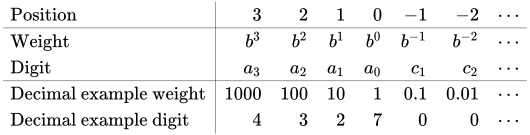
In general, numbers in the base b system are of the form:

The numbers bk and b−k are the weights of the corresponding digits. The position k is the logarithm of the corresponding weight w, that is . The highest used position is close to the order of magnitude of the number.

The number of tally marks required in the unary numeral system for describing the weight would have been w. In the positional system, the number of digits required to describe it is only , for k ≥ 0. For example, to describe the weight 1000 then four digits are needed because . The number of digits required to describe the position is (in positions 1, 10, 100,... only for simplicity in the decimal example).



A number has a terminating or repeating expansion if and only if it is rational; this does not depend on the base. A number that terminates in one base may repeat in another (thus 0.310 = 0.0100110011001...2). An irrational number stays aperiodic (with an infinite number of non-repeating digits) in all integral bases. Thus, for example in base 2, π = 3.1415926...10 can be written as the aperiodic 11.001001000011111...2.
Putting overscores, n, or dots, ṅ, above the common digits is a convention used to represent repeating rational expansions. Thus:
- 14/11 = 1.272727272727... = 1.27 or 321.3217878787878... = 321.32178.
If b = p is a prime number, one can define base-p numerals whose expansion to the left never stops; these are called the p-adic numbers.
It is also possible to define a variation of base b in which digits may be positive or negative; this is called a signed-digit representation.
Generalized variable-length integers
[edit]More general is using a mixed radix notation (here written little-endian) like for , etc.


This is used in Punycode, one aspect of which is the representation of a sequence of non-negative integers of arbitrary size in the form of a sequence without delimiters, of "digits" from a collection of 36: a–z and 0–9, representing 0–25 and 26–35 respectively. There are also so-called threshold values () which are fixed for every position in the number. A digit (in a given position in the number) that is lower than its corresponding threshold value means that it is the most-significant digit, hence in the string this is the end of the number, and the next symbol (if present) is the least-significant digit of the next number.


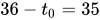
For example, if the threshold value for the first digit is b (i.e. 1) then a (i.e. 0) marks the end of the number (it has just one digit), so in numbers of more than one digit, first-digit range is only b–9 (i.e. 1–35), therefore the weight b1 is 35 instead of 36. More generally, if tn is the threshold for the n-th digit, it is easy to show that . Suppose the threshold values for the second and third digits are c (i.e. 2), then the second-digit range is a–b (i.e. 0–1) with the second digit being most significant, while the range is c–9 (i.e. 2–35) in the presence of a third digit. Generally, for any n, the weight of the (n + 1)-th digit is the weight of the previous one times (36 − threshold of the n-th digit). So the weight of the second symbol is . And the weight of the third symbol is .


So we have the following sequence of the numbers with at most 3 digits:
a (0), ba (1), ca (2), ..., 9a (35), bb (36), cb (37), ..., 9b (70), bca (71), ..., 99a (1260), bcb (1261), ..., 99b (2450).
Unlike a regular n-based numeral system, there are numbers like 9b where 9 and b each represent 35; yet the representation is unique because ac and aca are not allowed – the first a would terminate each of these numbers.
The flexibility in choosing threshold values allows optimization for number of digits depending on the frequency of occurrence of numbers of various sizes.
The case with all threshold values equal to 1 corresponds to bijective numeration, where the zeros correspond to separators of numbers with digits which are non-zero.
See also
[edit]- List of numeral systems
- Computer number formats
- Non-standard positional numeral systems
- History of ancient numeral systems
- History of numbers
- List of numeral system topics
- Number names
- Repeating decimal
- Residue numeral system
- Long and short scales
- Scientific notation
- -yllion
- Numerical cognition
- Number system
- Hebrew numerals
- List of books on history of number systems
References
[edit]- ^ a b O'Connor, J. J. and Robertson, E. F. Arabic Numerals. January 2001. Retrieved on 2007-02-20.
- ^ Bill Casselman (February 2007). "All for Nought". Feature Column. AMS.
- ^ Bradley, Jeremy. "How Arabic Numbers Were Invented". www.theclassroom.com. Retrieved 2020-07-22.
- ^ Batz, J. Mucía (2021-01-25). ""Nik" — The Zero in Vigesimal Maya Mathematics". Bulletin of the AAS. 53 (1).
- ^ "Wissanu rejects dumping Thai numerals". Bangkok Post. 31 May 2022. Retrieved 27 November 2024.
- ^ O'Connor, John J.; Robertson, Edmund F. (January 2004), "Chinese numerals", MacTutor History of Mathematics Archive, University of St Andrews
- ^ Shen Kanshen Crossley, John N.; Lun, Anthony W.-C. (1999). The Nine Chapters on the Mathematical Art: Companion and Commentary. Oxford University Press. p. 35. ISBN 978-0-19-853936-0.
zero was regarded as a number in India ... whereas the Chinese employed a vacant position
- ^ "Mathematics in the Near and Far East" (PDF). grmath4.phpnet.us. p. 262. Archived (PDF) from the original on 4 November 2013. Retrieved 7 June 2012.
- ^ Martzloff, Jean-Claude (2007). A History of Chinese Mathematics. Translated by Wilson, Stephen S. Springer. p. 208. ISBN 978-3-540-33783-6.
- ^ David Eugene Smith; Louis Charles Karpinski (1911). The Hindu–Arabic numerals. Ginn and Company.
- ^ Chowdhury, Arnab. Design of an Efficient Multiplier using DBNS. GIAP Journals. ISBN 978-93-83006-18-2.
- ^ Fiete, I. R.; Seung, H. S. (2007). "Neural network models of birdsong production, learning, and coding". In Squire, L.; Albright, T.; Bloom, F.; Gage, F.; Spitzer, N. New Encyclopedia of Neuroscience.
Sources
[edit]- Georges Ifrah. The Universal History of Numbers : From Prehistory to the Invention of the Computer, Wiley, 1999. ISBN 0-471-37568-3.
- D. Knuth. The Art of Computer Programming. Volume 2, 3rd Ed. Addison–Wesley. pp. 194–213, "Positional Number Systems".
- A.L. Kroeber (Alfred Louis Kroeber) (1876–1960), Handbook of the Indians of California, Bulletin 78 of the Bureau of American Ethnology of the Smithsonian Institution (1919)
- J.P. Mallory; D.Q. Adams, Encyclopedia of Indo-European Culture, Fitzroy Dearborn Publishers, London and Chicago, 1997.
- Hans J. Nissen; Peter Damerow; Robert K. Englund (1993). Archaic Bookkeeping: Early Writing and Techniques of Economic Administration in the Ancient Near East. University of Chicago Press. ISBN 978-0-226-58659-5.
- Schmandt-Besserat, Denise (1996). How Writing Came About. University of Texas Press. ISBN 978-0-292-77704-0.
- Zaslavsky, Claudia (1999). Africa counts: number and pattern in African cultures. Chicago Review Press. ISBN 978-1-55652-350-2.
External links
[edit]
 Media related to Numeral systems at Wikimedia Commons

| International | |
|---|---|
| National | |
| Other | |

Numeral system
View on GrokipediaFundamentals
Definition and Purpose
A numeral system, also known as a system of numeration, is a writing system for expressing numbers through a mathematical notation that represents quantities using symbols called digits in a consistent manner.[1] It consists of a set of numerals and rules for combining them to denote numbers systematically.[7] The primary purpose of numeral systems is to facilitate counting, arithmetic operations, and the communication of numerical values across contexts such as mathematics, commerce, and science.[8] They enable the representation and manipulation of abstract quantities, distinguishing between a number—which is an abstract concept or quantity answering "how many?"—and a numeral, which is the specific symbol or written representation of that quantity.[7] This separation is crucial for precise reasoning, as the same number can be expressed through different numerals depending on the system used.[7] Numeral systems originated from the human need for record-keeping and quantifying resources, evolving from simple methods to more structured notations.[8] For instance, the unary system uses tally marks, where each unit is represented by a single symbol, requiring a large number of marks to denote even modest quantities and thus lacking efficiency for larger values.[1] In contrast, the decimal system employs ten digits (0 through 9) to compactly represent numbers through positional values, allowing for more efficient counting and calculation of extensive quantities.[1]Key Components
A numeral system consists of digits, which are the basic symbols used to represent discrete values within the system. In positional numeral systems, these digits typically range from 0 to one less than the base, providing a finite set of symbols for constructing numbers. For example, in the decimal system, the digits are 0 through 9.[9][10] The base, also known as the radix, defines the total number of distinct digits available in the system and serves as the foundation for positional weighting. It is an integer greater than or equal to 2, determining the "width" of the counting cycle before advancing to the next place. The value of a multi-digit number in such a system is calculated as a weighted sum, where each digit's contribution depends on its position relative to the rightmost digit (the units place). Mathematically, for a digit string in base , the numerical value is given by where are the digits satisfying , and represents the place value for the -th position.[11][12] Place value is the core concept enabling efficient representation, as the significance of each digit is determined by its position, corresponding to successive powers of the base. The digit zero is essential in this framework, acting as a placeholder to indicate the absence of value in a position without altering the structure, thereby distinguishing representations like 102 from 12 in base 10. This positional mechanism ensures that the system enumerates natural numbers with unique finite representations for each positive integer, establishing a one-to-one correspondence between symbols and quantities in the natural numbers.[9][13][14]Historical Development
Ancient Systems
The earliest known numeral systems emerged in prehistoric times through tally marks, a form of unary notation where quantities were represented by repeated incisions or symbols, such as notches on bones or sticks, to track basic counts like days, lunar cycles, or animal herds.[15] Artifacts like the Lebombo bone from South Africa, dating back over 43,000 years, feature 29 distinct notches, illustrating this simple additive method for enumeration without distinct symbols for higher values.[15] These unary systems were intuitive for small numbers but became impractical for larger quantities, relying solely on repetition without any concept of grouping or place value. In ancient Mesopotamia, around 3000 BCE, the Sumerians developed a cuneiform numeral system based on a sexagesimal (base-60) structure, using wedge-shaped impressions on clay tablets to denote values through additive combinations of symbols.[16] Early forms employed distinct signs for 1 (a vertical wedge) and 10 (a chevron-like wedge), with numbers formed by repeating and grouping these— for instance, 23 was shown as two groups of 10 and three 1s—facilitating accounting for trade, agriculture, and astronomy.[17] Although later Babylonian refinements introduced limited positional elements, the initial system operated primarily on additive principles without a dedicated zero symbol, requiring contextual interpretation to distinguish magnitudes and often leading to ambiguity in records.[16] Contemporaneously, ancient Egyptian hieroglyphic numerals, dating from circa 3000 BCE, formed an additive decimal system using distinct symbols for powers of 10: a single vertical stroke for 1, a cattle hobble for 10, a coiled rope for 100, a lotus flower for 1,000, a pointing finger for 10,000, a burbot fish for 100,000, and a god with raised arms for 1,000,000.[18] Numbers were constructed by repeating these symbols additively—such as nine 10s for 90—without positional notation or a zero placeholder, allowing straightforward representation of integers up to millions but complicating the encoding of large values through sheer volume of glyphs.[19] This system supported practical applications in pyramid construction, taxation, and calendars, yet its lack of zero meant no efficient way to denote empty places or perform scalable arithmetic beyond repetition.[18] The Roman numeral system, originating around 500 BCE in the ancient Roman Republic, utilized an additive and subtractive framework with letters from the Latin alphabet: I for 1, V for 5, X for 10, L for 50, C for 100, D for 500, and M for 1,000.[20] Basic addition combined symbols (e.g., III for 3), while subtraction applied for efficiency in certain cases (e.g., IV for 4 as 5 minus 1), though usage was inconsistent and evolved over time from Etruscan influences.[20] Designed for record-keeping, clocks, and architecture, it excelled in simple counting but revealed significant limitations in multiplication and division, as operations required breaking down numbers into cumbersome groupings without a zero or standardized positional structure.[21] A common challenge across these ancient systems was the absence of a zero symbol, which rendered representations of large numbers verbose and prone to error; for example, in Babylonian sexagesimal notation, distinguishing 1 from 60 or 3,600 relied on spacing or context rather than a placeholder, often resulting in lengthy strings of wedges for high values.[22] Similarly, Roman numerals demanded multiple symbols for thousands (e.g., MMMM for 4,000), hindering complex computations and contributing to the eventual adoption of more efficient notations.[23]Transition to Positional Notation
The transition to positional notation marked a pivotal advancement in numeral systems, enabling more efficient representation and computation compared to earlier additive methods. In ancient China, around the 2nd century BCE, rod numerals emerged as an early form of positional decimal notation. These numerals, formed by arranging counting rods on a board, utilized vertical and horizontal strokes to denote digits in specific places, representing units, tens, hundreds, and higher powers of ten without a dedicated zero symbol. This system facilitated complex calculations and influenced the development of the suanpan abacus, which became a staple tool for merchants and mathematicians into the medieval period.[24][25] In India, the evolution toward a fully positional decimal system occurred around the 5th century CE, building on the Brahmi numerals that originated in the 3rd century BCE. Scholars like Aryabhata (c. 476–550 CE) introduced positional principles in his astronomical treatise Aryabhatiya, where numbers were denoted by their place values using letters or syllables, though without an explicit zero placeholder; instead, the term "kha" indicated an empty position. This innovation allowed for compact representation of large numbers essential for calculations in astronomy and algebra. The system's completeness was achieved with the invention of zero as a placeholder by Indian mathematicians, notably formalized by Brahmagupta (c. 598–668 CE) in his Brahmasphutasiddhanta (628 CE), where he defined arithmetic rules for zero, such as 1 + 0 = 1 and 0 × a = 0, transforming it from mere absence to a numeral with operational significance.[26][27][28] During the Islamic Golden Age (8th–13th centuries), the positional system was adopted and refined through contact with Indian scholarship. Muhammad ibn Musa al-Khwarizmi (c. 780–850 CE), working in Baghdad's House of Wisdom, documented the Hindu numerals—including zero—in his treatise On the Calculation with Hindu Numerals (c. 825 CE), adapting them for Arabic use and demonstrating algorithms for addition, subtraction, multiplication, and division. This work standardized the system across the Islamic world, enhancing trade, science, and navigation. The numerals' transmission to Europe occurred via Italian scholar Leonardo of Pisa, known as Fibonacci, who introduced them in his Liber Abaci (1202 CE), praising their superiority over Roman numerals for commercial arithmetic and providing practical examples that popularized their use among merchants.[29][30] European adoption of Hindu-Arabic numerals spanned the 13th to 16th centuries, gradually replacing cumbersome Roman numerals and fueling advancements in science, accounting, and engineering. Initial resistance from traditionalists persisted, but by the 15th century, the invention of the printing press by Johannes Gutenberg (c. 1450) standardized the glyphs and accelerated dissemination through texts like arithmetic manuals. This shift enabled precise record-keeping in burgeoning commerce and laid the groundwork for the Scientific Revolution, as positional notation simplified complex computations in fields like astronomy and physics.[29][31]Classification of Systems
Non-Positional Systems
Non-positional numeral systems, also known as additive or sign-value systems, represent numbers through the fixed values of individual symbols, where the total value is the sum of those symbols without any dependence on their position or place value.[7] In these systems, the order of symbols generally does not affect the value, allowing for flexible arrangements that emphasize repetition or grouping to denote quantity.[7] This additive principle contrasts with positional systems by relying solely on the intrinsic worth of each symbol, making representation straightforward but limited in scalability. A prominent example is the Roman numeral system, developed by ancient Romans around the 1st century BCE, which uses seven primary symbols: I for 1, V for 5, X for 10, L for 50, C for 100, D for 500, and M for 1000.[7] Numbers are formed additively by repeating or combining these symbols, such as III for 3 or XX for 20, but include a subtractive convention where a smaller symbol placed before a larger one indicates subtraction, as in IV for 4 (5 - 1) or IX for 9 (10 - 1).[7] This rule applies specifically to pairs like I before V or X, X before L or C, and C before D or M, reducing the need for excessive repetition while maintaining the core additive structure.[7] Another historical example is the Greek acrophonic, or Attic, numeral system, used from the 7th century BCE to the 1st century BCE, where symbols derive from the initial letters of number names in ancient Greek.[32] Key symbols include Ι (iota) for 1, Π (pi, from pente) for 5, Δ (delta, from deka) for 10, Η (eta, from hekaton) for 100, Χ (chi, from chilioi) for 1,000, and Μ (mu, from myrioi) for 10,000, with higher powers indicated by additional marks.[32] Values are added through repetition or juxtaposition, such as ΔΔΔ for 30 or ΗΔ for 110, forming numbers up to thousands without positional weighting.[32] These systems offer advantages in intuitiveness for small numbers, as the direct repetition of symbols visually conveys quantity, aiding quick comprehension in tally-like contexts.[33] For instance, Roman numerals require fewer symbols than purely repetitive systems like ancient Egyptian hieroglyphs for large values, such as CMXCIX for 999 versus 27 symbols (nine repetitions each of the symbols for 100, 10, and 1) in the ancient Egyptian system.[7] However, they are inefficient for large numbers, often resulting in lengthy strings of symbols, and cumbersome for arithmetic operations, as addition or subtraction demands manual regrouping and rule application rather than simple alignment.[7] The subtractive feature in Roman numerals, while helpful, introduces complexity that hinders efficient computation compared to positional alternatives.[7] In non-positional systems, representations lack uniqueness, allowing multiple valid ways to express the same number—such as IIII or IV for 4 in Roman numerals—leading to potential ambiguities resolved through established conventions.[34] Standard modern conventions favor subtractive notation for brevity in most formal writing, though traditional variants like IIII persist on clock faces to avoid visual confusion with IV.[7] Today, Roman numerals endure in decorative and symbolic roles, including clock dials, film title sequencing, outline numbering in legal documents, and event designations like Super Bowl editions.[7] These applications leverage their aesthetic and historical appeal over computational utility.[7]Positional Systems
Positional numeral systems, also known as place-value systems, represent numbers using a fixed set of digits where the value of each digit is determined by its position relative to a reference point, typically a radix point analogous to the decimal point. In such systems, the rightmost digit represents the units place (base^0), the next to the left the base^1 place, and so on, with positions to the right of the radix point representing negative powers of the base. This positional dependency allows for efficient encoding of numerical values, as the same digit can contribute different magnitudes based on its location.[35][2] Unlike non-positional systems, where symbols have intrinsic fixed values regardless of arrangement, positional systems enable scalable and compact notation by leveraging the base to multiply digit values exponentially. Common bases include binary (base-2, digits 0 and 1), widely used in digital computers for its alignment with binary logic gates; octal (base-8, digits 0-7), historically employed in early computing for grouping binary digits; decimal (base-10, digits 0-9), the everyday human standard rooted in counting practices; and hexadecimal (base-16, digits 0-9 and A-F), favored in programming and debugging for its concise mapping to four binary digits per symbol.[36][37][38]| Base | Name | Digits | Primary Use |
|---|---|---|---|
| 2 | Binary | 0, 1 | Digital electronics and computing |
| 8 | Octal | 0-7 | Early computing and binary grouping |
| 10 | Decimal | 0-9 | Human-readable arithmetic |
| 16 | Hexadecimal | 0-9, A-F | Low-level programming and memory addressing |
Positional Systems
Representation and Conversion
In positional numeral systems, numbers are represented using a base (where is an integer) and a sequence of digits satisfying . The value of a finite representation is given by the formula where the integer part corresponds to non-negative exponents () and the fractional part to negative exponents (); here, unless , and are non-negative integers denoting the extent of the fractional and integer portions, respectively.[43] This polynomial evaluation in base allows compact encoding of large numbers, with each position representing a power of the base.[44] To convert a positive integer from base 10 (decimal) to base , the standard algorithm involves repeated division by , recording the remainders as digits from least significant to most significant. Specifically, start with the decimal number ; the least significant digit is , then replace with , and repeat until ; the digits are read in reverse order of collection. For example, converting 255 from base 10 to base 2 (binary) yields remainders 1, 1, 1, 1, 1, 1, 1, 1, resulting in , since . Similarly, for base 16 (hexadecimal), 255 divided by 16 gives quotient 15 (F in hex) and remainder 15 (F), so , as .[45][44] Converting from base to base 10 involves evaluating the positional sum directly, often using Horner's method for efficiency to minimize multiplications: rewrite the expansion as , starting from the most significant digit and iteratively multiplying by and adding the next digit. This method reduces the number of operations from naive multiplications to . For fractions, the process mirrors the integer case but starts with the fractional part: multiply by , take the integer part as the next digit, and repeat with the new fractional part; termination occurs if the fraction becomes zero, though some fractions (like 1/3 in base 10) yield repeating sequences.[45][44] Edge cases in representation include leading zeros, which do not alter the value (e.g., ) but may be used for fixed-width formats in computing. In non-integer bases (e.g., base , the golden ratio), certain numbers admit multiple finite representations or infinite non-repeating expansions, unlike integer bases where representations are unique without trailing zeros.[43]Arithmetic in Positional Systems
Arithmetic in positional numeral systems relies on the structured representation of numbers as sums of powers of the base , enabling systematic algorithms for basic operations. These algorithms process digits from least to most significant, propagating carries or borrows as needed, and are generalizable across bases greater than or equal to 2. The efficiency and implementation details vary with the base, influencing computational hardware and software design.[44]Addition
Addition in positional systems is performed column-wise, starting from the rightmost digit (least significant). For each position, the sum of the digits from the two numbers plus any incoming carry is computed. The digit in the result is the remainder of this sum modulo , and the carry to the next column is , where is the total sum at that position. If the final carry is non-zero, an additional higher digit is appended. This carry propagation ensures the operation respects the base's capacity per digit.[44] For example, in base 10, adding 123 and 456 proceeds as follows:Units: 3 + 6 = 9 (no carry).
Tens: 2 + 5 = 7 (no carry).
Hundreds: 1 + 4 = 5 (no carry).
Result: 579. In a case with carry, such as 199 + 1 = 200, the units sum to 10, yielding digit 0 and carry 1; tens sum to 9 + 1 = 10, digit 0 and carry 1; hundreds: 1 + 1 = 2. Carry propagation can chain across all digits in worst cases, like adding strings of .[46] In binary (base 2), addition simplifies to bitwise operations: the sum bit is the XOR of inputs and incoming carry, while the outgoing carry is the majority function (AND of pairs). This hardware-friendly nature eliminates the need for multi-digit tables, enabling efficient implementation with logic gates.[47]
Subtraction
Subtraction follows a similar column-wise approach but from right to left, with borrowing when the minuend digit is smaller than the subtrahend digit. If the top digit borrow-in, borrow 1 from the next higher column (adding to ), set the result digit to borrow-in), and propagate the borrow. A leading borrow indicates a negative result, requiring sign handling or two's complement in signed systems.[44] In base 10, subtracting 123 from 1000:Units: 0 - 3 requires borrow, so 10 - 3 = 7, borrow 1.
Tens: 0 - 2 - 1 = borrow, 10 - 3 = 7, borrow 1.
Hundreds: 0 - 1 - 1 = borrow, 10 - 2 = 8, borrow 1.
Thousands: 1 - 0 - 1 = 0.
Result: 877. Borrowing can propagate fully, as in 1000 - 999 = 1. In binary, subtraction uses two's complement addition, avoiding explicit borrow logic by negating the subtrahend.[46]