Hubbry Logo
Off spinOff spinMain
Open search
Off spin
Community hub
Off spin
logo
8 pages, 0 posts
0 subscribers
Be the first to start a discussion here.
Off spin
Off spin
from Wikipedia
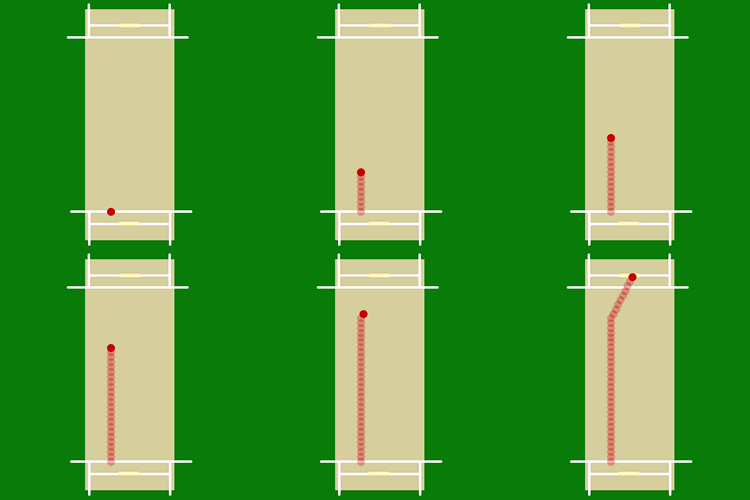
Animation of a typical off spin delivery, bowled from over the wicket.

Off spin is a type of spin bowling in cricket. A bowler who uses this technique is called an off spinner. Off spinners bowl with their right-arm and a finger spin action. Their normal delivery is called an off break,[1] which spins from left to right (from the bowler's perspective) when the ball bounces on the pitch. For a right-handed batter, the ball breaks towards them from the off side,[2] hence the name 'off break'.

Off spinners bowl mostly off breaks, varying them by adjusting the line and length of the deliveries. Off spinners also bowl other types of delivery, which spin differently. Aside from these variations in spin, varying the speed, length and flight of the ball are also important for the off spinner.

The bowler with the most wickets in the history of both Test matches and ODIs, Muttiah Muralitharan, was an off spinner.[3]

History

[edit]

Although rare now, in the past there were bowlers who used the off-break action who deliberately did not impart any considerable spin on the ball but relied on line and length (or even speed variations) to frustrate batters. They endeavoured to pitch the ball in an area that the batter was unable to play a scoring shot, even making last moment adjustments to "follow" a batter should they move within the crease to negate the bowlers tactics. Whilst this is primarily a defensive style, wickets were achieved by forcing a batsman to make a rash stroke or even bowling at the stumps instead of the retreating batter. Another wicket taking method was to impart more spin on the ball than usual, and surprise the batsman. An exponent of this style of bowling was "Flat" Jack Simmons who played for Lancashire and Tasmania in the 1970s and 1980s. With the advent of limited overs cricket promoting more adventurous batting styles and the use of ever heavier bats this style of bowling has declined, although some off-spinners will still use this tactic when the pitch is offering very little or no turn. It is a tactic often used by Kane Williamson when he bowls occasionally in limited overs format because his bowling style tends to be flatter and faster.

Comparison with other types of spin bowling

[edit]
Nathan Lyon bowling off spin

Off spin contrasts with leg spin, in which the ball spins from leg to off and which is bowled with a very different action (wrist spin).[4] Off spin is generally considered less difficult to play than leg spin, as off breaks typically spin less than leg breaks, and do not generally possess the same loopy, potentially deceptive flight. In addition, off spinners tend to have a smaller repertoire of deliveries to choose from. For a right-handed batter, the ball moves in towards the batter's body, meaning the batter's legs are usually in the path of the ball if it misses the bat or takes an edge. This makes it difficult for the bowler to get the batter out bowled or caught from an off break, but it does mean there is a chance of leg before wicket, assuming the ball has not turned enough to miss the leg stump. However, the off spinner often bowls faster and more accurately than a leg spinner, and can therefore deceive the batter with changes in the pace of the ball. A left-handed batter has more difficulty facing off break bowling, because the ball moves away from their body. This means that any miscalculation can more easily result in an outside edge off the bat and a catch going to the wicket-keeper or slips fielders.

A left-handed bowler who bowls with the same (finger spin) action as an off spinner is known as a left-arm orthodox spin bowler. While the orthodox spinner has the same action as an off-spinner, the ball itself spins in the opposite direction (akin to a right arm leg spinner).[5] Such a ball is not normally called an off break, but a left-arm orthodox spinner.

Terminology

[edit]

Off spin: Sometimes the term off spin is used to mean the off break delivery.[6][7][8][9] At other times the term off spin has a wider meaning, to include all deliveries bowled by an off spinner, including non-off break deliveries.[10][11][12]

Off spinner: The term off spinner can be used to mean either the bowler[13][14] or the off break delivery.[15][16][17][9]

Offie: The term offie can also be used to mean either the bowler[18][19] or the off break delivery.[20][21]

Technique

[edit]

An off break is bowled by holding the cricket ball in the palm of the hand with the seam running across under all the fingers.[2] As the ball is released, the fingers roll down the right side of the ball (for a right-handed bowler), giving the ball a clockwise spin as seen from behind.

Notable off spinners

[edit]

Notable off spinners include:

and more...

Other deliveries bowled by off spin bowlers

[edit]

Another common weapon of the off spinner is the arm ball, which does not spin but goes straight on "with the arm".[25] More skilled off-spinners also have the topspinner.[26]

See also

[edit]

References

[edit]
[edit]
Revisions and contributorsEdit on WikipediaRead on Wikipedia
from Grokipedia
Off spin, also known as off-break, is a type of in where the ball is delivered by a right-arm bowler with action, causing it to deviate from the toward the after pitching, typically turning into a right-handed batsman from left to right across the pitch. The technique relies on the bowler's fingers to impart spin (from the bowler's perspective) on the ball, with the standard grip placing the index and middle fingers across the seam and the ball supported by for release. This spin generates drift in the air toward the batsman and sharp turn off the pitch, often combined with variations like the (which skids straight without turning) or the (an off-spinner's delivery that turns away from the batsman, invented by ). Off spinners typically bowl at a slower pace than fast bowlers, around 70-90 km/h, emphasizing flight, dip, and deception to induce false shots such as edges to slip or lbw dismissals. Historically, off spin has been a cornerstone of 's spin bowling tradition since the 19th century, thriving on turning pitches in countries like , , and Australia, where it has produced legendary figures such as 's (193 wickets, including 19 in a single match), Sri Lanka's (the highest wicket-taker in history with 800 wickets, revolutionizing the art with his wrist-assisted off breaks), and 's (537 wickets, blending classical off spin with innovative variations). In modern , particularly in limited-overs formats, off spinners like 's and 's have adapted the style for quicker releases and tactical use against aggressive batting, maintaining its relevance despite the rise of wrist spinners.

Fundamentals

Definition and Role

Off spin is a type of in , primarily delivered by a right-arm bowler, in which the ball turns from the toward the after pitching for a right-handed batsman; the left-arm equivalent produces the opposite turn, from leg to off for a right-hander. This technique relies on the bowler's fingers to impart anticlockwise spin (viewed from above) on the , distinguishing it from wrist-based spins. The typical trajectory involves pitching the ball outside the off stump, where it often drifts farther away from the batsman in flight due to aerodynamic effects before sharply spinning back toward the stumps upon contact with the pitch. This dual movement—drift in the air followed by turn off the pitch—creates deception, enhanced by potential dip from overspin, making the delivery harder to predict and play. The underlying physics stems from the , where the ball's spin, generated by the wrist flick and seam alignment, produces a lateral force perpendicular to its path, causing the in-air deviation and aiding post-pitch turn. In cricket strategy, off spin functions as a key wicket-taking method, exploiting spin, variable bounce, and optical illusions to induce edges, lbw dismissals, or bowleds, particularly against batsmen playing for exaggerated turn. It plays a vital role in managing game tempo, such as restricting scoring in the middle overs of limited-overs formats to build , or dismantling on deteriorating pitches in Tests where turn increases over time. Tactically, bowlers set fields emphasizing slips for off-side edges and slips or short legs for leg-side deflections, while varying pace—alternating quicker arm balls with slower, looping deliveries—forces misjudgments and catches in these positions.

Grip and Stance

The standard grip for right-arm off spin positions the index and middle fingers spread across the seam, with their top knuckles gripping the on either side for leverage during release, while the thumb rests lightly underneath for support and the ring and little fingers are tucked into the palm to enhance control and prevent slippage. This grip allows the bowler to generate spin primarily through finger action, ensuring the is held comfortably without excessive pressure that could hinder rotation. Wrist and finger positioning play a crucial role in imparting the desired spin; at the point of , the bowler pronates the —turning it anticlockwise when viewed from above—to flick the over the ball, creating for dip and side-spin that turns the ball from off to for a right-handed batsman. This action ensures the back of the hand faces mid-wicket upon delivery, maximizing revolutions while maintaining flight and . For left-arm off spinners, known as orthodox spinners, the grip and are mirrored, with fingers and reversed to produce turn into left-handed batsmen (from off to for a left-handed batsman). The stance for off spin emphasizes balance and alignment, typically side-on or front-on, where the bowler's non-bowling points directly at the target to guide the delivery line, and the hips remain square to promote stability during the approach and release. This positioning allows for a coiled body at the crease, uncoiling efficiently as the front foot lands. The run-up is generally short and , spanning about 5-10 steps from a diagonal to the stumps, sufficient to build for pace and without sacrificing precision or increasing the of no-balls.

Technique

Bowling Action

The off spin bowling action commences with a run-up featuring controlled to generate sufficient while preserving balance and precision at the crease. This approach typically involves a shorter delivery stride length than in leg spin bowling, enabling off spinners to maintain stability and achieve a higher release point for greater control. Upon approaching the popping crease, the bowler pivots dynamically on the front foot, with the front aligned toward the target to facilitate optimal body positioning. The arm action emphasizes a high release , generally overhead or side-arm, positioning the bowling arm near the 11 o'clock mark relative to the body for enhanced height and effectiveness. To comply with regulations and avoid chucking, the must remain largely straight throughout the delivery, limiting extension to no more than 15 degrees as defined by the . This straight-arm principle ensures the action relies on natural rotation rather than flexion. Body rotation plays a pivotal role in power generation, with the hips leading the shoulders to create separation that builds through the . This alignment allows the to snap sharply at release, imparting the characteristic spin via the fingers' application on the , integrating the standard off spin grip established in the stance. The resulting rotational force enhances the ball's deviation without excessive . The follow-through involves a balanced of the back foot behind the crease to prevent no-balls and maintain footing, while the body drives forward in a fluid motion toward the target. This completion conserves energy, enabling bowlers to sustain long spells without fatigue or loss of accuracy. Common faults in the off spin action include a collapsing during release, which diminishes spin rate and effectiveness, and an excessively long delivery stride that reduces crease height and disrupts rotation. Corrections focus on wrist-strengthening drills to promote a firm snap and targeted practice of shorter strides to improve pivot control and overall consistency.

Delivery Mechanics

The release mechanics of an off spin delivery involve the bowler gripping the with the index and middle fingers spread across the seam, typically at an angle optimized for maximum spin rate, while the thumb provides light support underneath. At the point of release, a flicking action of these fingers rolls down the outer side of the , imparting rotation (as viewed from behind) for a right-arm bowler, which generates the sideways spin essential for deviation. The seam is positioned upright during flight to enhance aerodynamic effects leading to drift. The flight path of the off spin ball is influenced by the , where the clockwise spin creates lower air pressure on the , causing the ball to drift: slightly towards the as it rises and then towards the (away from a right-handed batsman) as it falls, with the drift most pronounced mid-flight. This results from asymmetric around the spinning ball, typically amounting to a net about 1 cm towards the off side over an 18 m distance in still air for a standard off-spin delivery with a side-spin component, though crosswinds can increase this to over 20 cm. Upon pitching, the same spin interacts with surface , producing a sharp turn back towards the batsman's legs, with the degree of turn depending on the pitch's grip. Bounce and skid in off spin vary significantly with pitch conditions; on firm, green surfaces, the ball may bounce more predictably with moderate turn, while on dry, cracked pitches, it grips sharply for exaggerated deviation and lower bounce. Incorporating topspin—achieved by angling the release slightly forward—causes the ball to dip in flight and skid straight on upon bouncing, reducing sideways turn but accelerating its pace off the pitch to surprise the batsman. Off spin deliveries are typically bowled at speeds of 70-90 km/h, with elite practitioners averaging around 75 km/h for the stock off-break, though speeds decrease on turning pitches to allow more time for spin-induced behaviors. A key element of deception in off spin lies in the deliberate loop imparted during flight, where the slower pace and overhead make the ball appear shorter or fuller than it is, misleading the batsman's judgment of length and prompting premature shots.

Variations

Common Off Spin Variations

Off spinners employ several standard variations to the basic off break delivery to deceive batsmen by altering pace, , bounce, or direction, enhancing unpredictability while maintaining the core finger-spin action. These modifications build on the foundational delivery mechanics, such as position and , to exploit the batsman's expectations of turn from off to leg. Common variations include the , top spinner, flighted delivery, and drifter, each designed to target specific weaknesses in the batsman's setup or footwork. The is a quicker, straighter delivery bowled without significant spin, relying instead on increased arm speed to make the skid onto the batsman with minimal turn or deviation after pitching. It mimics the line of a standard off break but hurries through at a pace closer to medium-fast , often catching batsmen off guard when expecting slower spin and forcing hurried defensive shots or edges. This variation is particularly effective on responsive pitches where seam movement can add subtle deviation, turning a stock bowler into a wicket-taking threat by varying the pace unexpectedly. The top spinner involves a sharper wrist flick at release to impart forward rotation on the , resulting in extra bounce and a hurried skid off the pitch rather than pronounced sideways turn. Delivered with the cocked at approximately 90 degrees and the rotating anti-clockwise from the bowler's view, it pitches on a good and rears up sharply, disrupting the batsman's judgment of and prompting mistimed pulls or lofty drives. This variation complements the standard off break by adding vertical threat, especially against batsmen playing back, and is bowled from the side of the hand to maintain disguise. A flighted delivery is a slower, loftier version of the off break, tossed higher into the air with less pace to create loop and draw the batsman forward onto the front foot. By releasing the ball with a higher arm action and subtle under-spin, the bowler induces uncertainty about the pitch point, tempting drives or advances that expose the stumps to turn or stumping if the batsman overcommits. This classic variation emphasizes deception through air time, allowing the ball to dip just before reaching the batsman and maximizing the potential for sharp off-to-leg deviation on turning tracks. The drifter features a subtle reduction in pace compared to the stock delivery, accentuating the natural aerodynamic from the right-handed batsman in the air without relying on excessive turn off the pitch. Bowled with the seam angled slightly towards fine leg and a smooth release, it moves laterally through the air due to the from the off-spin rotation, often pitching on or outside off stump to beat the outside edge or lure false shots. This variation exploits the batsman's focus on expected turn, using minimal wrist deviation to prioritize aerial movement over ground action, making it ideal for building pressure in longer spells.

Other Deliveries by Off Spinners

Off spinners employ a range of deceptive deliveries beyond their standard off break to unsettle batsmen, often borrowing techniques from other spin disciplines to alter trajectory, pace, or direction. These variations exploit the batsman's expectations, creating opportunities for surprise dismissals. The , meaning "second one" in , is a right-arm off spin delivery that turns away from a right-handed batsman, mimicking the direction of a leg break despite being bowled from an off spinner's arm. It relies on a wrist flick similar to leg spin, with the thumb and forefinger imparting reverse rotation while the arm action remains orthodox. Popularized by Pakistan's in the late 1990s, the doosra revolutionized off spin by adding mystery, though it has faced scrutiny for elbow extension, leading to bans for bowlers like in 2014. The is a faster off spin variation delivered with a quicker arm action and reduced finger rotation, resulting in minimal lateral turn as the ball skids straight on with low bounce. by pushing the ball down the thumb side of the hand, it drifts late before hurrying onto the batsman, often pitching fuller to exploit forward defenses. This delivery, which can achieve speeds up to 10-15% quicker than a stock ball, has been a staple for modern off spinners like England's to penetrate defensive lines in limited-overs . The offers off spinners a slower option with erratic bounce, achieved by gripping the seam with the knuckles rather than fingers, minimizing spin and promoting wobble in flight. This technique, inspired by baseball's , creates unpredictable deviation upon pitching due to aerodynamic instability, making it ideal for death overs in T20 formats. off spinner has mastered it since around 2010, using it to deceive aggressive batsmen by varying pace without obvious cues.

Comparisons

With Leg Spin

Off spin and leg spin represent the two primary forms of orthodox spin bowling in , distinguished fundamentally by the direction in which the ball turns after pitching. For a right-handed batsman, off spin causes the ball to deviate from the towards the , moving into the batsman and potentially threatening the inside edge or . In contrast, leg spin imparts turn from the leg side to the , causing the ball to move away from the right-handed batsman and often endangering the outside edge. This opposing turn direction shapes the tactical approach of each style, with off spin exploiting the batsman's tendency to play across the line and leg spin capitalizing on defensive shots down the . The grip and release mechanics further underscore these differences, as off spin relies primarily on finger control for its subtler rotation. An off spinner typically holds the ball with the index and middle fingers extended across the seam, thumb lightly supporting underneath, and imparts a clockwise spin through finger flick at release, allowing for greater accuracy but less pronounced turn. Leg spin, however, depends on a wrist flick for sharper deviation, using a similar seam grip but rotating the wrist anticlockwise to generate higher revolutions, which demands more flexibility but risks inconsistency in length and line. These techniques influence field settings accordingly: off spinners often position slips, gully, and point to capture off-side edges from batsmen misjudging the inward turn, while leg spinners set leg slips, short leg, and backward square leg to trap edges or sweeps on the leg side. Both styles excel on pitches offering grip and turn, such as dry, wearing surfaces that assist deviation, but off spin proves less risky on flatter tracks due to its superior control and lower spin rate, enabling consistent line and to build without excessive boundaries. Leg spin, with its higher spin rates from the wrist action, can extract more bounce and sharp turn on such pitches but is more vulnerable to being hit if the bowler errs in control. From a batting perspective, off spin challenges the inside edge by turning across the batsman, often leading to LBW or behind dismissals, whereas leg spin targets the outside edge, forcing batsmen into awkward reaches that can result in catches in the cordon or decisions. This dynamic makes leg spin generally more attacking against right-handers, while off spin emphasizes containment and subtle deception.

With Finger Spin and Wrist Spin

Off spin represents the primary form of right-arm finger spin in cricket, where the bowler imparts spin using the index and middle fingers to roll the ball down the pitch, causing it to turn from off to leg for a right-handed batsman. In contrast, left-arm finger spin, known as orthodox spin, mirrors this action but from the opposite arm, turning the ball away from the right-handed batsman toward the leg side. Left-arm chinaman bowling, however, is not finger spin but a wrist spin variation that mirrors right-arm leg spin, turning the ball from off to leg using the wrist for a sharper deviation. Unlike techniques, off spin relies predominantly on finger action for rotation rather than a pronounced flick, as seen in deliveries like the or flipper, which are wrist-dominant variations primarily associated with leg spinners. The finger-based mechanics of off spin allow for greater consistency in release and trajectory, reducing the variability inherent in movements that can lead to erratic bounce or direction. Off spin offers superior versatility in terms of control and accuracy compared to , enabling bowlers to maintain line and over long spells with fewer errors, while provides sharper turn and deception but at the cost of a higher or wide rate due to its technical demands. This reliability makes off spin particularly effective for building pressure through subtle variations in flight and pace, whereas 's aggressive turn suits surprise elements but risks overcompensation. In terms of pace and economy, finger spin like off spin is generally delivered at slower speeds—around 70-85 km/h—allowing for better grip on the pitch and more economical figures, with historical data showing finger spinners achieving lower averages (around 30-35 runs per wicket in Tests from the 1950s-60s) than spinners (40+). variations often exceed 90 km/h with quicker arm actions, leading to higher economy rates in controlled conditions but greater wicket-taking potential in helpful pitches. The evolution of these techniques across formats highlights off spin's suitability for , where its accuracy sustains long innings with economies below 3 runs per over, as seen in its resurgence in ODIs since (finger spinners taking around 75% of spin wickets). , conversely, has adapted better to T20 for disruptive bursts, with wrist spinners claiming over 140 wickets in IPL seasons like at strike rates under 20 balls per , capitalizing on limited-overs unpredictability.

History

Origins and Early Development

The origins of off spin trace back to the late 18th century in English village cricket, where underarm bowling prevailed and early experiments with spin emerged. George Lamborn, a shepherd and player for the Hambledon Club in the 1770s and 1780s, is recognized as one of the first bowlers to deliver off breaks, using a twisting action to make the ball deviate from off to leg after pitching. This underarm "twist" represented an initial form of spin bowling, often employed in informal matches to deceive batsmen on uneven village pitches. By the early 19th century, bowling techniques evolved amid growing professionalism, shifting from underarm lobs to round-arm deliveries, which were legalized by the Marylebone Cricket Club (MCC) in 1827 despite initial resistance. This transition enabled greater velocity and control, fostering rudimentary spin attempts in county and club games, though off spin remained limited by the hand's position below shoulder height. The 1860s brought a crucial advancement when Edgar Willsher, a Kent bowler, openly used overarm actions; during an 1862 match against Surrey at The Oval, he was no-balled six consecutive times by umpire John Lillywhite, prompting widespread debate. The controversy culminated in the MCC's 1864 rule change legalizing overarm bowling, which dramatically improved spin generation by allowing higher arm release and better wrist flexion, thus laying the foundation for recognized off spin. In the ensuing decades, off spin gained prominence through innovative bowlers like , who in the 1880s and 1890s popularized variations at medium pace for and . Lohmann's subtle finger placement imparted sharp turn and deceptive flight, enabling him to exploit wearing pitches effectively and claim 1,841 first-class wickets. This period also saw off spin's colonial dissemination; British professional teams toured starting with H.H. Stephenson's 1861-62 side, introducing spin techniques that influenced local development during subsequent visits by All XIs. In , British expatriates and propagated from the mid-19th century, with spin elements adopted in Parsi and European clubs by the , predating formal international exposure.

Evolution in Modern Cricket

In the post-World War II era, off spin reached a peak of dominance in during the 1950s and 1970s, particularly on uncovered pitches that deteriorated rapidly due to weather exposure, allowing spinners to exploit variable bounce and sharp turn. Bowlers like England's , who took 19 wickets in a single Test against in 1956, exemplified this advantage, as pitches often became "sticky wickets" favoring prolonged spells of . This period saw spinners accounting for a significant portion of wickets in matches played without pitch covers, with off-spinners like England's and Bob Appleyard frequently dismantling batting lineups through consistent turn and drift on wearing surfaces. The rise of off spin in the Asian subcontinent from the 1970s to the was bolstered by turn-friendly pitches, which provided natural assistance through dry, crumbly soil compositions that encouraged grip and deviation. In , off spinners such as Venkataraghavan and, later, in the late 1980s, thrived alongside the famous spin quartet, contributing to a strategy where spin accounted for over 11 wickets per Test on average between 1967 and 1978. These conditions in countries like and amplified the effectiveness of off breaks, leading to memorable series victories and a shift toward spin-heavy attacks on home soil. The advent of limited-overs in the , particularly One Day Internationals (ODIs), prompted off spinners to adapt by incorporating more flighted variations to deceive batsmen in shorter formats where aggressive scoring reduced opportunities for prolonged deterioration. Early ODIs saw fast bowlers dominate with 83% of deliveries in the , but spinners responded by emphasizing looped trajectories and subtle changes in pace to induce false shots, as seen in the gradual increase of spin's role post-1975 . By the , the emergence of T20 further shortened spells, requiring off spinners to tighter lines and quicker through the air to contain runs, often limiting them to 4-over bursts focused on middle-over breakthroughs rather than extended Test-like sessions. From the onward, technological aids such as video analysis and biomechanical studies revolutionized off spin techniques, enabling bowlers to refine actions for greater efficiency and legality. The (ICC) began employing biomechanical assessments in the late 1990s to evaluate actions, using high-speed cameras to analyze wrist angles and release points, which helped off spinners like those in elite programs optimize spin rates without risking calls. These tools, including kinematic modeling, allowed for precise adjustments in stride length and arm rotation, enhancing performance while reducing injury risks associated with repetitive spin deliveries. In recent trends up to 2025, off spinners have embraced hybrid roles in white-ball cricket, often functioning as all-rounders who contribute with the bat while leveraging data analytics to fine-tune field placements and variations. In IPL 2025, off-spinners contributed to a resurgence of spin, taking a higher share of wickets through varied lengths and pace variations, as of May 2025. Advanced metrics from tracking systems have optimized strategies, such as positioning slips for doosra deliveries based on predictive models of batsman tendencies, as evidenced in IPL and international T20s where spinners' economy rates have improved through real-time pitch behavior analysis. This data-driven approach has sustained off spin's relevance in fast-paced formats, with bowlers adapting to power-hitting eras by prioritizing wicket-taking overs informed by opposition scouting reports.

Notable Off Spinners

Historical Figures

, an English cricketer born in 1865 and who played until 1901, is regarded as a pioneering figure in off-spin bowling during the . He captured 112 Test wickets across 18 matches at an exceptional average of 10.75, making him one of the most effective bowlers of his era with remarkable accuracy that often rendered him unplayable on English pitches. Lohmann's medium-paced off-spin, combined with his precision, helped establish the tactical importance of spin in cricket's formative years, including nine five-wicket hauls that underscored his dominance. Clarrie Grimmett, an Australian off-spinner active in the 1920s and 1930s, took 216 Test wickets in 37 matches at an average of 24.21. Known for his flight and turn, Grimmett introduced the flipper variation and was instrumental in Australia's success on home pitches, claiming 13 five-wicket hauls. Jim Laker, an English off-spinner active from the 1950s to the 1960s, remains etched in cricket history for his unparalleled performance in the 1956 Ashes Test at Old Trafford, where he claimed a record 19 wickets for 90 runs, including all 10 in the second innings against Australia. Over his career, Laker secured 193 Test wickets in 46 matches at an average of 21.24, with nine five-wicket innings and three 10-wicket hauls, exemplifying his control and variation on wearing pitches. His dominance in that Ashes series, contributing to England's 2-1 series victory, highlighted the potency of classical off-spin in post-war cricket. Muttiah Muralitharan, a Sri Lankan off-spinner who played from 1992 to 2010, revolutionized the art with his wrist-assisted and , amassing a record 800 Test wickets in 133 matches at an average of 22.72. His unique action generated exceptional drift and turn, leading to 67 five-wicket hauls and dominance on subcontinental pitches. , a off-spinner born in 1934, exemplified economical bowling across diverse conditions, amassing 309 Test wickets—the first spinner to reach that milestone—in 79 matches at an average of 29.09 and an outstanding economy rate of 1.98 runs per over. Gibbs's subtle flight and turn proved effective on everything from bouncy tracks to turning surfaces, with 18 five-wicket hauls, including standout performances in series against and during the and . His longevity and consistency helped sustain off-spin's relevance in ' pace-dominated attack.

Contemporary Players

Graeme Swann, born in 1979, emerged as a key English and off-spinner during the late and early , capturing 255 wickets in 60 matches between 2008 and 2014 at an average of 29.96. Renowned for his mastery of drift, Swann imparted significant lateral movement on the ball, often deceiving batsmen with subtle flight and sharp turn, which proved particularly effective in English conditions and overseas tours. His contributions extended beyond , including 104 ODI wickets, but his legacy underscores the resurgence of in modern cricket. Ravichandran Ashwin, born in 1987, stands as one of India's most prolific off-spinners, amassing 537 Test wickets across 106 matches by his retirement in December 2024, placing him seventh on the all-time list. Ashwin's innovative approach revolutionized off-spin, incorporating variations such as the carrom ball flicked with his thumb for reverse movement, alongside tweaks in dip, drift, and pace to exploit subcontinental pitches. In the IPL during the 2020s, he adapted these skills for T20 cricket, achieving economical figures like 7.47 in 2023 for Rajasthan Royals while pioneering tactical maneuvers such as the first "retired out" in the format. Nathan Lyon, born in 1987, has been 's mainstay off-spinner since 2011, surpassing 500 Test wickets by 2023 and reaching over 550 by mid-2025, with notable endurance demonstrated in marathon spells on flat pitches like those in and . His ability to maintain accuracy and extract turn over extended periods—such as 24 five-wicket hauls—has been crucial in high-scoring games, including series against where he claimed 90 wickets at an average of 32.70. Washington Sundar, born in 1999, is an Indian who has adapted classical for limited-overs , taking 31 wickets in 9 matches at an average of 36.45 as of 2025, alongside strong performances in ODIs and T20Is with economical spells and variations like the . His tactical use in white-ball formats, including key contributions in the 2021 Brisbane victory, highlights 's evolution in modern aggressive batting environments. While primarily a batsman, , born in 1990, has provided occasional off-spin contributions in Tests as a part-time bowler, taking 27 wickets at an average of 73.88 across his career up to 2025. Root's gentle off-breaks have occasionally broken partnerships, such as in the 2021 India series, supporting the specialist attack without claiming starring roles. Emerging Australian talent , born in 2000, has risen as a promising off-spinner since his Test debut in 2023, taking around 25 wickets in 10 matches as of 2025 with his high-arm action and ability to generate bounce on varied surfaces. Positioned as Nathan Lyon's understudy, Murphy impressed in domestic cricket and Australia A tours, including a 2025 stint against A, signaling his potential to sustain Australia's off-spin tradition into the late 2020s.

References

Add your contribution
Related Hubs
User Avatar
No comments yet.