Hubbry Logo
Olene WalkerOlene WalkerMain
Open search
Olene Walker
Community hub
Olene Walker
logo
8 pages, 0 posts
0 subscribers
Be the first to start a discussion here.
Olene Walker
Olene Walker
from Wikipedia

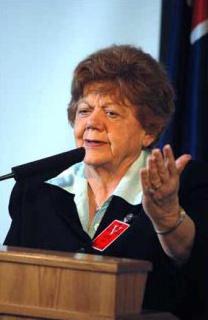
Olene Walker (née Smith; November 15, 1930 – November 28, 2015) was an American politician who served as the 15th governor of Utah from 2003 to 2005, succeeding the governorship after Mike Leavitt's resignation.

Key Information

A member of the Republican Party, Walker was Utah's first female lieutenant governor of Utah as well the first and currently only female governor.[1]

She is also the shortest serving Governor of Utah, serving for only a year and two months.

Early life and education

[edit]

Walker was born Olene Smith in Ogden, Utah, in 1930 to Thomas Ole Smith and Nina (née Hadley) Smith, the second of their five children. She graduated from Weber High School. Walker received her bachelor's degree from Brigham Young University in 1953, her master's from Stanford University, and her doctorate in education administration from the University of Utah.[2][3]

Career

[edit]

Walker's began her career in the Utah House of Representatives, including a term as Majority Whip, during which she helped create Utah’s Rainy Day Fund. She served in the Utah House from 1981 to 1989.[4] She served as the fourth Lieutenant Governor of Utah for the 10 years prior to becoming governor.[1] She founded the Salt Lake Education Foundation and served as its director. She served as director of the Utah Division of Community Development. She has chaired the Commission on Criminal and Juvenile Justice, the Utah State Housing Coordinating Committee, the Governor's Commission on Child Care, and the National Conference of Lieutenant Governors.[5][6] She also became the first woman governor of Utah. Senator Orrin Hatch said Walker "truly paved the way for women in government in Utah."[7] Also, throughout her political career "her passion across the board" was education.[3]

Governorship

[edit]

Walker assumed the office of Governor of the State of Utah after previous governor Mike Leavitt was nominated by President George W. Bush to lead the Environmental Protection Agency in 2003. Walker served as governor until the end of the term on January 3, 2005.[8]

During her short term as governor, Walker focused on supporting education in Utah. She created the Read With a Child Early Literacy Initiative, visited classrooms often to read to children, and vetoed a proposal for vouchers for private schools with the reasoning that the proposal would take funding away from public schools.[3] She also signed legislation ending the use of firing squads for execution in Utah and worked to preserve Utah wilderness and to create affordable housing.[9]

In a move that caused a degree of controversy within the state, the Utah Republican Party at its convention on May 8, 2004, elected not to place Walker on the ballot for the party primary (held on June 22, 2004), selecting instead Jon Huntsman, Jr. and Nolan Karras as the two potential Republican party candidates for the office of Governor of the State of Utah, the first time in 48 years that an incumbent Utah governor failed to win a party nomination.[10] Huntsman went on to win the primary election with more than 66% of the vote. These events effectively ruled out any possibility of Walker being on the ballot in the 2004 general election. Convention delegates defended their choice by claiming that many of the delegates were already pledged to other candidates, because Walker had served only six months as Governor before the party convention.[citation needed] She had also waited until two months before the nominating convention to choose to run for re-election, giving her rivals a head start to build their campaigns.[8] She left office with an 87% approval rating.[7]

Olene S. Walker Institute of Politics & Public Service

[edit]

In 2012 Walker created the Olene S. Walker Institute of Politics & Public Service to "help foster in Weber State University students and the broader community the ideals of public service and political engagement that motivated her decades-long career in Utah politics."[11] The Walker Institute coordinates internships for Weber State University students, holds public forums and debates on public policy issues, and provides leadership and engaged-citizenship workshops for students and the community at large.[12]

Personal life

[edit]

Walker was married to Myron Walker; they had seven children. Walker and her husband were Latter-day Saints (Mormons). She and her husband served as International Affairs missionaries for The Church of Jesus Christ of Latter-day Saints in New York City.[13] Starting in spring of 2010 she served as the Primary president in the Bloomington 7th Ward on the south side of St. George, Utah.[7]

Olene Walker died of natural causes on November 28, 2015, thirteen days after her 85th birthday.[14]

Recognition

[edit]

The State of Utah operates the Olene Walker Housing Loan Fund, which seeks to provide affordable housing throughout the state,[15] renovate rural housing, protect tenants from landlords who seek to exploit them, and in other ways provide livable housing options to low income residents of the state.

In 2003, The Salt Lake Tribune named her Utahn of the Year.[16]

In May 2010 the Utah County Democratic Party gave Walker its first distinguished service award.[17]

Walker was one of the first co-chairs of the Utah Debate Commission.

Olene Walker Elementary School opened in 2020.[18]

See also

[edit]

References

[edit]
[edit]
Revisions and contributorsEdit on WikipediaRead on Wikipedia
from Grokipedia
Olene Smith Walker (November 15, 1930 – November 28, 2015) was an American Republican politician and educator who served as the 15th of from November 5, 2003, to January 3, 2005, becoming the first woman to hold the office. Born in , to educator parents, Walker earned a from and a master's from before entering politics, where she served four terms in the , rising to majority whip. Appointed in —the first woman in that role—she ascended to the ship upon Michael O. Leavitt's resignation to head the Environmental Protection Agency, completing his term without seeking re-election. Her administration emphasized , launching statewide early programs and initiatives to support foster youth transitioning to adulthood, alongside efforts to protect watersheds and reform the tax code. Walker faced intra-party tension for opposing expansion, prioritizing public education funding over privatization measures favored by some conservatives.

Early Life and Education

Family Background and Upbringing

Olene Smith Walker was born on November 15, 1930, in , to Thomas Ole Smith and Nina Hadley Smith, as the second of their five children. Her parents, both educators, operated a 100-acre west of in the community of Wilson (now part of West Haven), where the family resided during her early years. Thomas Smith served as superintendent of the for 25 years, reflecting a household oriented toward community involvement and educational priorities amid Utah's rural socioeconomic context of the era. Walker's upbringing on the farm emphasized practical labor and , with routines including milking cows and thinning sugar beets, activities that fostered a strong typical of agrarian Mormon pioneer descendants in northern . She engaged in informal sports such as football and alongside her siblings, pursuits uncommon for girls in and 1940s, which highlighted her active, tomboyish disposition and early exposure to physical resilience. Family life integrated regular church participation in The Church of Jesus Christ of Latter-day Saints, including weekly meetings and community events, reinforcing values of diligence and communal responsibility. These formative experiences in a conservative, education-valuing environment—where parental roles modeled contribution through teaching and local leadership—instilled a pragmatic orientation toward self-sufficiency and service, aligning with Utah's prevailing cultural ethos of and individual initiative. The farm's demands and familial emphasis on opportunity through personal effort shaped her foundational worldview, distinct from urban or elite influences prevalent elsewhere.

Academic Pursuits and Degrees

Olene Walker obtained a in from in 1953, during which time she also earned a certificate qualifying her to teach at the high school level. This early academic training in provided a foundation in and public affairs, while the teaching certification enabled her initial practical engagement with education. Following her undergraduate studies, Walker pursued a in at , completing it in 1954 on a . She subsequently applied her credentials in teaching roles, including high school English in , balancing these with family responsibilities. These experiences highlighted her commitment to educational practice, bridging theoretical knowledge with classroom instruction. Walker's advanced academic pursuits culminated in a doctoral degree in educational administration from the , awarded in 1981 after commencing studies around 1976. This degree emphasized and administrative frameworks in , aligning with her evolving interest in systemic improvements such as , as evidenced by her concurrent role as an education consultant for the U.S. Department of Education from 1970 to 1973, where she focused on federal Title III programs. Her trajectory from to educational administration underscored a deliberate progression toward policy-oriented expertise in teaching and institutional .

Pre-Gubernatorial Career

Legislative Service

Olene Walker entered elected office as a Republican representative for Utah's 54th House district, winning her first term in the November 1980 general election and serving from January 1981 to January 1989 across four terms. Her legislative tenure emphasized balanced budgeting and efficient resource allocation, reflecting a commitment to fiscal restraint amid Utah's conservative political landscape. Walker advanced to leadership roles, including assistant majority whip and a full term as majority whip, positions that positioned her to influence House priorities on intervention. In these capacities, she coordinated Republican caucus efforts to prioritize spending on core state functions like funding without broadening governmental scope or relying on federal expansions. A hallmark of her service was co-sponsoring and advocating for the creation of Utah's Rainy Day Fund in the mid-1980s, legislation that established a dedicated reserve from surpluses to buffer against revenue shortfalls, thereby avoiding hikes or service cuts during recessions. This measure aligned with empirical , as evidenced by its role in stabilizing state finances independent of external dependencies, and she shepherded dozens of related bills through passage to enhance efficiency and local control over expenditures. Her voting alignment consistently supported Republican-led initiatives for workforce preparation tied to economic self-sufficiency, such as targeted investments that linked to measurable outcomes rather than unchecked growth.

Lieutenant Governorship and Key Initiatives

Olene Walker served as Utah's first female from 1993 to 2003, initially appointed by on January 5, 1993, and reelected in 1996 and 2000. In this role, she focused on executive-level preparations for state policy, including chairing task forces on workforce development and healthcare , while overseeing elections and promoting fiscal safeguards. Her initiatives emphasized practical outcomes in , access, and services, often through interagency consolidations that prioritized self-sufficiency and over expanded entitlements. A key achievement was her leadership of the Workforce Development Task Force, established in 1994, which consolidated five state agencies—including employment services, , and job training—into the unified Department of Workforce Services by 1997. This restructuring aimed to streamline job placement and skills training, reducing administrative overlap and emphasizing readiness amid Utah's growing , with the department serving over 100,000 individuals annually by the early 2000s through targeted programs rather than broad welfare growth. Walker chaired the effort to foster collaborations across government and private sectors, aligning with conservative principles of intervention by focusing resources on metrics like placement rates, which improved post-consolidation as reported in state audits. In healthcare, Walker spearheaded the Healthcare Reform Task Force as chair of the state's Health Policy Commission, leading to Utah's implementation of the (CHIP) in 1998, which extended coverage to approximately 20,000 low-income children ineligible for by providing subsidized insurance premiums. This initiative built on federal legislation from 1997 but adapted it to state needs, achieving enrollment targets through targeted outreach and cost controls that kept per-child expenditures below national averages, as verified in subsequent legislative reports. Her approach involved bipartisan input but maintained fiscal restraint, avoiding mandates on employers or taxpayers beyond matched federal funds. Walker also advanced education initiatives by establishing statewide programs for early literacy, such as the Read with a Child program, which distributed books and training to families and educators to build foundational reading skills from onward. These efforts complemented her oversight of processes, where she implemented procedural updates including enhanced voter registration verification and provisional ballot protocols prior to federal requirements, improving accuracy in Utah's county-based system without expanding voting access beyond existing statutory limits. Throughout, her work reflected a commitment to data-driven, conservative-leaning reforms that secured budgets—building on prior rainy day mechanisms—and measurable service delivery, as evidenced by departmental performance indicators showing reduced duplication and higher program efficiency.

Governorship

Ascension to Office and Term Overview

Olene Walker assumed the office of Governor of Utah on November 5, 2003, following the resignation of Governor Michael O. Leavitt, who had been appointed Administrator of the United States Environmental Protection Agency by President George W. Bush. As the state's Lieutenant Governor since 1993, Walker was sworn in as Utah's 15th governor, marking her as the first woman to hold the position in the state's history. Her ascension occurred amid Utah's constitutional framework, which provides for the Lieutenant Governor to succeed the Governor in cases of vacancy, ensuring administrative continuity within the Republican-dominated executive branch. Walker's term lasted 14 months, concluding on January 3, 2005, when was inaugurated after winning the 2004 election. Serving as an interim Republican leader during this period, she maintained fiscal stability in line with Utah's long-standing conservative governance tradition, which includes a constitutional mandate for balanced budgets. The state experienced economic recovery following the , with Utah's population growing at 1.4% from to , ranking eighth nationally, and rates declining notably—dropping by 0.6 percentage points in the annual average from to . Under her watch, administrative operations emphasized budget management and continuity, avoiding major disruptions as the state navigated post-recession growth. Initially focused on completing the state budget, Walker delayed her decision on seeking a full term but announced her candidacy in March 2004, positioning her tenure as a stabilizing bridge to the next elected administration. This approach reflected pragmatic adherence to , prioritizing short-term governance over extended political ambition amid Utah's tradition of steady, low-debt executive leadership.

Major Policy Achievements

Walker's administration prioritized , notably launching the "Read With a Child" initiative on December 5, 2003, which promoted daily reading aloud to ren to enhance vocabulary, comprehension, and attention spans amid concerns over declining early rates. This program aligned with broader efforts to address empirical gaps in readiness, drawing on data showing that early language exposure correlates with long-term academic outcomes and reduced costs. In child welfare, Walker established statewide programs to support foster youth transitioning to adulthood, including expanded access to scholarships and services that linked education and vocational training to employment stability, reducing risks of homelessness and dependency post-18. These measures built on causal evidence that structured support improves self-sufficiency rates, with the Olene S. Walker Transition to Adult Living Scholarship providing up to $5,000 for postsecondary pursuits among qualifying youth exiting care. Environmental policy under Walker included actions to designate and protect watershed areas in every county, safeguarding and supply against development pressures through targeted legislative protections. This initiative contributed to long-term fiscal resilience by averting potential cleanup costs and supporting agriculture-dependent sectors, which comprise a significant portion of the state's . Walker advanced tax code efficiency by proposing and partially enacting reforms to simplify structures and reduce redundancies, aiming to lower compliance burdens while maintaining revenue neutrality amid post-2001 recovery. These steps, informed by analyses of outdated provisions, facilitated subsequent full overhauls and helped stabilize state finances without broad rate hikes. Her tenure also saw the bolstering of budget security mechanisms, including enhancements to Utah's Rainy Day Fund, which buffered against downturns by accumulating reserves equivalent to 4-5% of general fund expenditures by the mid-2000s, enabling sustained program funding during the 2008 without deep cuts. This approach demonstrated causal efficacy in linking prudent savings to expenditure predictability, contrasting with states lacking similar reserves that faced steeper .

Controversies and Political Opposition

During her governorship, Olene Walker encountered substantial pushback from conservative Republicans in , who criticized her for moderating on key issues like and fiscal reforms. In March 2004, she vetoed House Bill 115, a measure allocating $1.4 million in state funds as vouchers for parents of children with disabilities to access private schooling alternatives, contending that it lacked sufficient accountability and would undermine public financing. Opponents, including free-market advocates, argued this stance impeded parental autonomy and perpetuated reliance on government-monopolized systems, viewing it as a dilution of Republican principles favoring over centralized control. This veto exacerbated tensions leading into the Utah Republican Party's state nominating convention on May 8, 2004, where delegates rejected Walker's placement on the primary ballot by a wide margin, forcing her withdrawal from the race. Votes instead divided primarily between , who garnered about 61% on the second ballot, and Nolan Karras, reflecting delegate preference for candidates signaling firmer support for expansion and other conservative priorities amid perceptions of Walker's pragmatism as overly conciliatory toward interests. Party insiders attributed the outcome to her opposition and prior vetoes prioritizing budgets over choice mechanisms, which alienated the activist base despite her overall Republican record on spending restraint. Walker's defenders framed these moves as fiscally responsible governance amid legislative overreach and limited resources, but the convention's empirical rejection—evident in delegate balloting data showing her failure to secure 60% threshold advancement—underscored a rift, with right-leaning critics decrying her positions as blocking from states with successes in enhancing outcomes for disadvantaged students. While some mainstream outlets portrayed the snub as ideological , her in other areas, such as budget balancing, did little to mitigate base dissatisfaction rooted in specific policy deviations.

Post-Governorship and Legacy

Establishment of the Olene S. Walker Institute

The Olene S. Walker Institute of Politics & Public Service was established in 2012 at Weber State University by former Utah Governor Olene Walker, who envisioned it as a venue for students and community members to engage in learning about politics and public service. The institute opened in fall 2012, reflecting Walker's commitment to fostering political engagement following her tenure as governor from 2003 to 2005. Walker, who had attended Weber College (the predecessor to Weber State University) on a debate scholarship, drew on her Ogden-area roots in Weber County to create this non-partisan center dedicated to promoting leadership and public service among university students. The institute's mission centers on cultivating civic dispositions such as political efficacy, civic empathy, duty, and confidence, while encouraging dialogue across political differences and active participation in democracy. It emphasizes non-partisan education in politics and public service, aiming to prepare students for roles in government and civic life through programs that prioritize civility, respect, and mutual goodwill on campus. Key initiatives include the Weber State Votes program, which hosts events for voter education, mobilization, and registration, with goals to exceed national average voter turnout among students and support national civic holidays like National Voter Registration Day. Additional offerings encompass civic symposiums, Constitution Day speakers, and a robust internship program in local, state, and national politics and government, providing hands-on experience to approximately 30 students annually. Walker's direct involvement shaped the institute's focus on practical , aligning with her lifelong advocacy for and informed by real-world application rather than abstract ideology. By establishing the institute post-governorship, she sought to inspire future political leaders in through , including student-led initiatives that promote empirical engagement with policy issues via internships and community dialogues. This approach counters prevailing trends in academic political by maintaining a non-partisan stance that privileges evidence-based civic participation over partisan conformity, as evidenced by the institute's sustained outputs in voter mobilization and bipartisan event hosting since its inception.

Ongoing Policy Influences and Recognition

The Olene Walker Fund, established during her tenure to low-income housing developments, remains active in Utah's ecosystem, supporting rehabilitation, construction, and transitional projects as outlined in state community plans through 2025. Funds from the program have been integrated into initiatives targeting family homelessness, with 2025 legislative directives prioritizing mixed-income developments that include units for families exiting shelter systems, thereby extending her emphasis on community development beyond her governorship. Walker's establishment of the Salt Lake Education Foundation in 1974 endures as a for local educational advancement, fostering innovative programs and fundraising that continue to bolster public schools in the region independent of her later political roles. This legacy aligns with peer recognitions of her broader policy impacts, such as the creation of Utah's Rainy Day Fund, which has provided fiscal stability during economic downturns, and advancements in tax code reforms that prioritized balanced revenue without excessive increases. While commended by Republican leaders for pioneering female leadership in a traditionally male-dominated party—marking Utah's first woman —Walker's moderate approach has drawn conservative criticism for insufficient , exemplified by her of a 2004 school bill intended to expand parental choice in education. Detractors argue her 14-month term constrained opportunities for more aggressive free-market reforms, limiting the depth of right-leaning shifts in areas like education and taxation. Posthumous honors, including the 2025 Spirit of Olene Walker Award bestowed on the Food Bank for civic contributions, reflect sustained appreciation for her amid these debates.

Personal Life

Marriage and Family

Olene Walker married Myron Walker, a businessman and vice president of a major food company, on March 25, 1954, in the . The couple settled in with their growing family by 1963, establishing a stable domestic foundation amid Walker's advancing educational and professional pursuits. Together, they raised seven children, prioritizing family life even as Walker balanced motherhood with obtaining advanced degrees and commitments. This domestic structure provided resilience, with Myron's supportive role as homemaker and eventual first gentleman underscoring the causal link between familial steadiness and her capacity to navigate high-stakes political demands without evident disruption to household continuity. The Walkers' household expanded to include 25 grandchildren by the time of her later years, reflecting sustained intergenerational ties that reinforced personal priorities over external accolades.

Death and Memorials

Olene Walker died on November 28, 2015, in , , at the age of 85 from natural causes. A public viewing took place at the on December 3, 2015, drawing friends, family, and state officials to pay respects. Funeral services followed on December 4 at the Canyon Rim Stake Center in Millcreek, with interment at the Salt Lake City Cemetery. Memorial tributes focused on her policy priorities, including advancements in and children's health insurance through the (CHIP), as well as fiscal safeguards like the creation of Utah's Rainy Day Fund to buffer against economic downturns. U.S. Senator , a Republican colleague, highlighted her post-governorship advocacy for , such as the Read With a Child Early Literacy Initiative promoting daily family reading, and her broader commitment to civility and without partisan divisiveness. These remembrances underscored her , with no prominent post-mortem critiques from Republican figures emerging in immediate coverage.

References

Add your contribution
Related Hubs
User Avatar
No comments yet.