Hubbry Logo
Operant conditioning chamberOperant conditioning chamberMain
Open search
Operant conditioning chamber
Community hub
Operant conditioning chamber
logo
8 pages, 0 posts
0 subscribers
Be the first to start a discussion here.
Operant conditioning chamber
from Wikipedia

Skinner box

An operant conditioning chamber (also known as a Skinner box) is a laboratory apparatus used to study animal behavior. The operant conditioning chamber was created by B. F. Skinner while he was a graduate student at Harvard University. The chamber can be used to study both operant conditioning and classical conditioning.[1][2]

Skinner created the operant conditioning chamber as a variation of the puzzle box originally created by Edward Thorndike.[3] While Skinner's early studies were done using rats, he later moved on to study pigeons.[4][5] The operant conditioning chamber may be used to observe or manipulate behaviour. An animal is placed in the box where it must learn to activate levers or respond to light or sound stimuli for reward. The reward may be food or the removal of noxious stimuli such as a loud alarm. The chamber is used to test specific hypotheses in a controlled setting.

Name

[edit]
Students using a Skinner box

Skinner was noted to have expressed his distaste for becoming an eponym.[6] It is believed that psychologist Clark Hull and his Yale students coined the expression "Skinner box". Skinner said that he did not use the term himself; he went so far as to ask Howard Hunt to use "lever box" instead of "Skinner box" in a published document.[7]

History

[edit]
An old black and white drawing of a puzzle box used by Edward Thorndike. The box looks similar to a cage with an opening at the front. The front door is connected to wiring which connects to a lever.
Original puzzle box designed by Edward Thorndike

In 1898, American psychologist, Edward Thorndike proposed the 'law of effect', which formed the basis of operant conditioning.[8] Thorndike conducted experiments to discover how cats learn new behaviors. His work involved monitoring cats as they attempted to escape from puzzle boxes. The puzzle box trapped the animals until they moved a lever or performed an action which triggered their release.[9] Thorndike ran several trials and recorded the time it took for them to perform the actions necessary to escape. He discovered that the cats seemed to learn from a trial-and-error process rather than insightful inspections of their environment. The animals learned that their actions led to an effect, and the type of effect influenced whether the behavior would be repeated. Thorndike's 'law of effect' contained the core elements of what would become known as operant conditioning. B. F. Skinner expanded upon Thorndike's existing work.[9] Skinner theorized that if a behavior is followed by a reward, that behavior is more likely to be repeated, but added that if it is followed by some sort of punishment, it is less likely to be repeated. He introduced the word reinforcement into Thorndike's law of effect.[10] Through his experiments, Skinner discovered the law of operant learning which included extinction, punishment and generalization.[10]

Skinner designed the operant conditioning chamber to allow for specific hypothesis testing and behavioural observation. He wanted to create a way to observe animals in a more controlled setting as observation of behaviour in nature can be unpredictable.[2]

Purpose

[edit]
A rat presses a button in an operant conditioning chamber.

An operant conditioning chamber allows researchers to study animal behaviour and response to conditioning. They do this by teaching an animal to perform certain actions (like pressing a lever) in response to specific stimuli. When the correct action is performed the animal receives positive reinforcement in the form of food or other reward. In some cases, the chamber may deliver positive punishment to discourage incorrect responses. For example, researchers have tested certain invertebrates' reaction to operant conditioning using a "heat box".[11] The box has two walls used for manipulation; one wall can undergo temperature change while the other cannot. As soon as the invertebrate crosses over to the side which can undergo temperature change, the researcher will increase the temperature. Eventually, the invertebrate will be conditioned to stay on the side that does not undergo a temperature change. After conditioning, even when the temperature is turned to its lowest setting, the invertebrate will avoid that side of the box.[11]

Skinner's pigeon studies involved a series of levers. When the lever was pressed, the pigeon would receive a food reward.[5] This was made more complex as researchers studied animal learning behaviours. A pigeon would be placed in the conditioning chamber and another one would be placed in an adjacent box separated by a plexiglass wall. The pigeon in the chamber would learn to press the lever to receive food as the other pigeon watched. The pigeons would then be switched, and researchers would observe them for signs of cultural learning.

Structure

[edit]
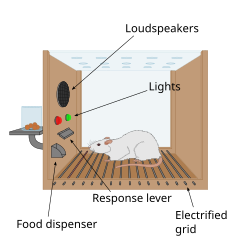
On the left are two mechanisms including two levers and light signals. There is a light source and speaker above the box and an electrified floor at the bottom.

The outside shell of an operant conditioning chamber is a large box big enough to easily accommodate the animal being used as a subject. Commonly used animals include rodents (usually lab rats), pigeons, and primates. The chamber is often sound-proof and light-proof to avoid distracting stimuli.

Operant conditioning chambers have at least one response mechanism that can automatically detect the occurrence of a behavioral response or action (i.e., pecking, pressing, pushing, etc.). This may be a lever or series of lights which the animal will respond to in the presence of stimulus. Typical mechanisms for primates and rats are response levers; if the subject presses the lever, the opposite end closes a switch that is monitored by a computer or other programmed device.[12] Typical mechanisms for pigeons and other birds are response keys with a switch that closes if the bird pecks at the key with sufficient force.[5] The other minimal requirement of an operant conditioning chamber is that it has a means of delivering a primary reinforcer such as a food reward.

A pigeon is pecking at one of four lights which corresponds with the coloured stimuli presented. It correctly pecks the yellow light (was shown a yellow image) and is therefore, rewarded with food pellets.
A pigeon offering the correct response to stimuli is rewarded with food pellets.

A simple configuration, such as one response mechanism and one feeder, may be used to investigate a variety of psychological phenomena. Modern operant conditioning chambers may have multiple mechanisms, such as several response levers, two or more feeders, and a variety of devices capable of generating different stimuli including lights, sounds, music, figures, and drawings. Some configurations use an LCD panel for the computer generation of a variety of visual stimuli or a set of LED lights to create patterns they wish to be replicated.[13]

Some operant conditioning chambers can also have electrified nets or floors so that shocks can be given to the animals as a positive punishment or lights of different colors that give information about when the food is available as a positive reinforcement.[14]

Research impact

[edit]

Operant conditioning chambers have become common in a variety of research disciplines especially in animal learning. The chambers design allows for easy monitoring of the animal and provides a space to manipulate certain behaviours. This controlled environment may allow for research and experimentation which cannot be performed in the field.

There are a variety of applications for operant conditioning. For instance, shaping the behavior of a child is influenced by the compliments, comments, approval, and disapproval of one's behavior.[15] An important factor of operant conditioning is its ability to explain learning in real-life situations. From an early age, parents nurture their children's behavior by using reward and praise following an achievement (crawling or taking a first step) which reinforces such behavior. When a child misbehaves, punishment in the form of verbal discouragement or the removal of privileges are used to discourage them from repeating their actions.

Skinner's studies on animals and their behavior laid the framework needed for similar studies on human subjects. Based on his work, developmental psychologists were able to study the effect of positive and negative reinforcement. Skinner found that the environment influenced behavior and when that environment is manipulated, behaviour will change. From this, developmental psychologists proposed theories on operant learning in children. That research was applied to education and the treatment of illness in young children.[10] Skinner's theory of operant conditioning played a key role in helping psychologists understand how behavior is learned. It explains why reinforcement can be used so effectively in the learning process, and how schedules of reinforcement can affect the outcome of conditioning.

Commercial applications

[edit]

Slot machines, online games, and dating apps are examples where sophisticated operant schedules of reinforcement are used to reinforce certain behaviors.[16][17][18][19]

Gamification, the technique of using game design elements in non-game contexts, has also been described as using operant conditioning and other behaviorist techniques to encourage desired user behaviors.[20]

See also

[edit]

References

[edit]
[edit]
Revisions and contributorsEdit on WikipediaRead on Wikipedia
from Grokipedia
An operant conditioning chamber, commonly known as a Skinner box, is a controlled apparatus designed to study animal behavior by observing how actions are influenced by their consequences, such as rewards or punishments. Invented by B.F. Skinner in the 1930s, it provides a small, distraction-free environment where subjects like rats or pigeons can perform repeatable responses, such as pressing a or pecking a key, to receive reinforcements like food pellets or avoid aversive stimuli like mild electric shocks. Skinner developed the chamber as part of his broader theory of operant conditioning, which he formalized in 1937 to distinguish behavior shaped by environmental consequences from reflexive responses studied in classical conditioning. This apparatus allowed for precise, automated experimentation, enabling the analysis of reinforcement schedules—patterns like fixed-ratio, variable-interval, or fixed-interval that determine when rewards are delivered—revealing how they strengthen or weaken behaviors over time. Detailed in Skinner's seminal 1938 book The Behavior of Organisms, the chamber revolutionized behavioral research by shifting focus to observable, measurable response rates rather than internal mental states. Structurally, the chamber is typically an enclosed box, often made of metal or , with and dim lighting to isolate the subject from external influences. Essential components include a manipulandum (e.g., a for or a disk for birds), a feeder for positive reinforcers, and sometimes a shock grid for negative ones, all connected to recording devices like cumulative recorders that plot response rates as sloping lines. Modern versions incorporate computer for complex stimuli, such as lights or tones, facilitating studies beyond basic conditioning. The chamber's applications extend from foundational experiments demonstrating operant principles—such as rats learning to press levers for —to broader fields including , where it assesses drug effects on behavior, and research, modeling self-administration of substances. Its influence permeates in education and therapy, underscoring Skinner's legacy in understanding how consequences drive learning across .

Historical Development

Invention by B.F. Skinner

Burrhus Frederic Skinner, a prominent American psychologist, developed the operant conditioning chamber during his early career, drawing inspiration from Edward Thorndike's puzzle box experiments conducted in the late 19th century, which demonstrated how animals learn through trial-and-error to escape confinement and obtain rewards. Skinner's background in psychology, shaped by his graduate studies at Harvard University in the late 1920s and early 1930s, emphasized empirical observation of behavior over introspective methods, motivating him to create a controlled environment for studying voluntary actions in animals without external influences. In the 1930s, while a researcher at Harvard, Skinner invented the operant conditioning chamber—commonly known as the Skinner box—to systematically measure response rates and behavioral contingencies in isolated subjects, primarily rats. This device was first detailed in his seminal 1938 book, The Behavior of Organisms: An Experimental Analysis, where he described its use in experiments that quantified how behaviors are shaped by consequences. A key precursor to the chamber was Skinner's invention of the cumulative recorder in 1933, a mechanical device that produced real-time graphical records of an animal's responses by plotting cumulative actions over time, allowing precise tracking of behavior without manual counting. Early prototypes of the chamber consisted of a simple wooden enclosure for rats, featuring a protruding that the animal could press to activate a food pellet dispenser as reinforcement, along with an electric grid floor capable of delivering mild shocks for negative reinforcement. These basic designs enabled Skinner to observe how rats spontaneously explored and learned to associate presses with delivery, establishing foundational data on operant responses. Skinner later adapted principles from his behavioral research for practical applications, including the design of an "air crib"—a climate-controlled enclosure for infants intended to provide a safe, stimulus-free environment—but this was a distinct invention from the operant conditioning chamber and not used for conditioning experiments. A common misconception persists that Skinner tested the chamber on his daughter in this air crib, portraying it as a "baby cage" that caused psychological harm; in reality, the air crib was solely for comfort and hygiene, and no such conditioning occurred, with his daughter growing up without reported issues.

Evolution and Key Milestones

Following , the operant conditioning chamber expanded beyond basic laboratory use into applied contexts, particularly military training simulations. In the 1940s, led , a U.S. initiative during , where pigeons were conditioned in modified operant chambers to steer guided missiles by pecking at projected images of targets, demonstrating the device's utility for precise behavioral guidance in high-stakes environments. Although the project was ultimately discontinued due to technological alternatives like , it highlighted the chamber's adaptability for complex, real-time response training. In the and , refinements focused on enhancing and environmental control to support intricate experimental designs. Researchers introduced relay-based automated controls for delivery, improved to minimize external distractions, and multi-chamber configurations for simultaneous testing of multiple subjects. These advancements were prominently featured in Charles B. Ferster and B.F. Skinner's Schedules of Reinforcement (1957), a comprehensive study using pigeon chambers equipped with automated feeders, key-peck response detectors, and cumulative recorders to map behavioral patterns across diverse schedules, enabling unprecedented precision in timing and . The 1970s and marked a shift toward digital integration, with microprocessors enabling computerized control for exact event timing, stimulus presentation, and automated data logging. Early examples include microprocessor-based systems for high-speed recording of operant responses in chambers, reducing manual intervention and allowing for more complex, variable protocols. This also saw the adoption of video monitoring in the , permitting non-invasive observation of subtle behaviors without disturbing the controlled environment. Key contributors beyond Skinner included Nathan H. Azrin and William C. Holz, who in the refined mechanisms through chamber-based experiments, systematically analyzing how aversive stimuli suppress reinforced behaviors under varying intensities and schedules, as detailed in their influential review. By the 1990s, chambers evolved further with integration into setups for human studies, combining operant tasks with techniques like fMRI to correlate behavioral responses with brain activity during reward and decision-making processes. In the , the operant conditioning chamber continued to evolve with the rise of affordable, open-source technologies. By the , systems using microcontrollers and devices allowed researchers to build low-cost, customizable chambers, democratizing access to behavioral experimentation. As of 2025, advancements include AI-driven adaptive reinforcement schedules and integrations for more ecologically valid studies across species.

Theoretical Foundations

Operant Conditioning Principles

Operant conditioning refers to a form of associative learning in which the strength of a is modified by its consequences, such as rewards or punishments, thereby increasing or decreasing the likelihood of that behavior recurring. Unlike respondent conditioning, which pairs stimuli to elicit reflexive responses, focuses on voluntary behaviors emitted by the organism that operate on the environment to produce outcomes. This process was formalized by in his , emphasizing observable actions rather than internal mental states. The foundational idea traces back to Edward Thorndike's Law of Effect, proposed in 1905, which posited that behaviors followed by satisfying consequences are more likely to be repeated, while those followed by discomforting consequences are less likely to recur. Skinner expanded this into his framework of radical behaviorism, a philosophical stance that prioritizes the scientific study of observable environmental contingencies shaping behavior, deliberately excluding unobservable private events like thoughts or feelings as causal explanations. In this view, behavior is understood through its functional relations to consequences, allowing for precise experimental control in settings like the operant conditioning chamber. Central to operant conditioning are mechanisms for modifying frequency. Positive increases a by presenting a desirable stimulus, such as delivering to an after it presses a in the chamber. Negative strengthens a by removing an aversive stimulus, for instance, terminating a mild electric shock when the is pressed. Conversely, positive decreases a by introducing an unpleasant stimulus, like a loud following an undesired action, while negative reduces it by withdrawing a positive one, such as removing access to . occurs when a previously reinforced diminishes due to the withholding of the reinforcing consequence, leading the organism to cease responding over time, as seen when presses no longer yield in the chamber. The timing and pattern of reinforcement, known as schedules, profoundly influence behavior persistence and resistance to extinction. Fixed-ratio schedules deliver reinforcement after a fixed number of responses, producing high response rates with brief pauses after each reinforcer, akin to a chamber setup where food is given after every 10 lever presses. Variable-ratio schedules provide reinforcement after an unpredictable number of responses, yielding steady, rapid responding that resists extinction, similar to gambling machines but replicated in the chamber by randomizing food delivery after an average of 50 presses. Fixed-interval schedules reinforce the first response after a set time interval, resulting in a scalloped pattern of accelerating responses toward the end of the interval, as in chamber experiments where food follows the first press after 5 minutes. Variable-interval schedules reinforce after varying time periods, promoting consistent low-to-moderate responding, such as unpredictable food availability every few minutes in the chamber. Behaviors are often shaped through successive approximations, a technique where reinforcements are provided for progressively closer approximations to the target , enabling complex actions to emerge incrementally in the controlled environment of the chamber. For example, a might first receive food for approaching a , then for touching it, and finally for pressing it fully, building the full operant response step by step.

Relation to Classical Conditioning

Classical conditioning, pioneered by in the late 1890s and early 1900s, involves the association of an involuntary response with a previously neutral stimulus, such as dogs learning to salivate at the sound of a bell paired with food presentation. seminal experiments, detailed in his 1902 work The Work of the Digestive Glands, demonstrated how reflexive behaviors could be elicited through repeated stimulus pairings, forming the basis for understanding stimulus-response learning. In contrast, operant conditioning, developed by B.F. Skinner, focuses on voluntary behaviors shaped by their consequences, such as rewards or punishments, rather than antecedent stimuli. This distinction is fundamental: classical conditioning elicits respondent behaviors through stimulus association, while operant conditioning strengthens or weakens emitted actions based on outcomes, allowing for the study of purposeful, goal-directed learning. Skinner emphasized this separation in his 1938 book The Behavior of Organisms, arguing that classical methods inadequately explained complex, voluntary actions. Skinner deliberately designed the operant conditioning chamber to isolate operant behaviors, excluding elements that could introduce classical conditioning influences and confound results with elicited reflexes. By creating a barren, controlled space free from extraneous cues, the chamber ensured that observed responses, like lever pressing, arose from the subject's active exploration rather than conditioned stimuli, aligning with Skinner's focus on behavior as a function of its consequences. Despite these efforts, overlaps between the two paradigms can occur, particularly in studies involving punishment or aversion, where classical elements like fear conditioning may intrude. For instance, aversive stimuli in the chamber can pair with contextual cues to elicit fear responses via classical mechanisms, complicating the analysis of operant suppression. Skinner himself explored such blending in his 1948 "superstition" experiments, where pigeons developed ritualistic behaviors under random reinforcement schedules, potentially influenced by incidental stimulus-response associations alongside operant contingencies. Critics have noted these intrusions as limitations, highlighting how the chamber's enclosed design, while minimizing external stimuli, can inadvertently foster classical conditioning to apparatus features. The chamber's suitability for operant studies stems from its ability to minimize extraneous stimuli, thereby emphasizing emitted behaviors over elicited ones and providing a precise environment for examining how consequences drive learning. This controlled isolation allows researchers to attribute behavioral changes directly to or , distinguishing operant processes from the passive associations of .

Design and Components

Basic Physical Structure

The operant conditioning chamber, often referred to as a Skinner box, consists of a controlled designed to minimize external influences on the subject's . Standard chambers for small animals like rats feature internal dimensions typically around 30 cm wide, 26 cm deep, and 20 cm high, allowing sufficient space for movement and interaction while maintaining isolation. For pigeons, chambers are similarly compact, with animal workspace dimensions of approximately 30 cm long, 30 cm deep, and 31 cm high, accommodating the bird's upright posture and pecking responses. Human-adapted versions scale up significantly to cubicle-sized enclosures, providing room for seated participants to engage with response interfaces like buttons or screens. Construction materials prioritize durability, transparency for observation, and acoustic isolation. Walls are commonly made of clear Plexiglas or acrylic panels for visibility, paired with sound-attenuating outer enclosures of metal or medium-density (MDF) to block external noise. Floors typically feature or aluminum wire mesh grids, which facilitate and allow for potential aversive stimuli delivery, while ventilation systems with low-noise fans ensure air circulation without disrupting the subject. Environmental controls maintain consistent conditions to standardize experimental variables. Chambers include dim house , often from overhead LEDs set to low intensity (e.g., 1-5 ), to reduce visual distractions while enabling basic orientation. White noise generators produce continuous masking sounds, typically around 65-80 dB, to obscure extraneous auditory cues, and is regulated between 20-25°C via integrated heating or cooling elements, aligning with optimal ranges for mammalian subjects. Species-specific adaptations influence the chamber's layout to promote natural exploratory behaviors. Rat chambers emphasize a horizontal orientation with wall-mounted levers positioned at an accessible height to encourage quadrupedal navigation and pressing. Pigeon versions favor vertical designs with response keys at pecking height, often including perches to support perching and flight-like movements within the confined space. These configurations derive from early prototypes developed in the mid-20th century, refined for modern use across species.

Essential Mechanisms and Features

The operant conditioning chamber incorporates response manipulanda to enable subjects to perform detectable behaviors that can be reinforced or punished. Common examples include levers for rats, which are typically mounted on one wall and connected to microswitches that register depressions with high sensitivity, or pecking keys and disks for pigeons, often recessed plastic surfaces that close electrical circuits upon contact. Modern adaptations may employ touch screens, allowing for visual discrimination tasks where subjects interact with illuminated panels to indicate choices. Reinforcement delivery systems provide immediate consequences to shape behavior, with food hoppers being a standard mechanism for positive in and avian studies; these devices raise a of pellets or grain for brief access periods upon activation. dips or token lights serve similar roles for liquid or conditioned reinforcers, ensuring precise timing to maintain contingency between response and outcome—modern electronic controls achieve millisecond accuracy, such as 1 ms onset and offset for dispenser operation. Punishment systems introduce aversive stimuli to suppress behaviors, primarily through electrified grid floors that deliver mild electric shocks, with intensities ranging from 0.1 to 2 mA to avoid tissue damage while effectively reducing response rates. Timeout periods, where all stimuli and reinforcements cease for a fixed duration (e.g., 10-60 seconds), function as negative by withholding access to the environment's rewarding aspects. Stimulus presentation facilitates discriminative control over operants, utilizing automated panels for lights (e.g., LED arrays in various colors and positions), tones (via speakers delivering frequencies from 1-10 kHz), or odors (pumped through vents for concentration-specific delivery). These elements signal availability of or impending , allowing precise temporal pairing with responses. Recording tools capture behavioral data continuously, with early designs featuring cumulative recorders that plot response rates as upward steps on a moving paper chart, providing real-time visualization of operant strength as developed by . Contemporary systems integrate digital sensors for movement tracking, such as beam breaks or video-based pose estimation, to quantify locomotion, latency, and spatial patterns alongside traditional event counts. Safety features mitigate risks to subjects during extended sessions, including ventilation fans to regulate and prevent overheating in sealed enclosures, and mechanisms like automatic shutoffs to limit delivery (e.g., capping daily ) or interrupt shocks if detection circuits fail. These ensure ethical operation without compromising experimental .

Operational Use

Experimental Procedures

Experimental procedures in operant conditioning chambers begin with subject preparation to ensure motivation for responding. For rats, a common protocol involves 23-hour deprivation prior to sessions, maintaining body weight at approximately 80-85% of free-feeding levels. Similar or restriction schedules are applied for pigeons or other subjects depending on the reinforcer type. Once prepared, subjects are placed in the chamber for an initial acclimation period lasting 1-2 days, allowing familiarization with the environment without to reduce novelty effects. This is followed by a shaping phase to establish the target response, such as lever pressing in rats, through successive approximations where behaviors progressively closer to the goal are reinforced immediately with food pellets or other rewards. Shaping typically requires several sessions until the response rate stabilizes at a consistent level. Trial structures generally start with baseline measurements, recording response rates under initial conditions without intervention to quantify natural behavior levels. An intervention phase then introduces variables, such as a specific reinforcement schedule, to observe changes in responding. Reversal designs alternate between baseline and intervention conditions across sessions to demonstrate the intervention's causal effect on behavior. Sessions typically last 30-60 minutes and occur 5-7 days per week to allow for recovery and consistent while minimizing fatigue. Control measures include of stimulus presentations to prevent temporal cues from influencing responses and counterbalancing of conditions across subjects to account for individual differences or order effects. Common protocols encompass discrimination training, where responses are reinforced only during presentation of a discriminative stimulus (SD, e.g., a ) and not during its absence (SΔ), establishing over behavior. trials systematically withhold following the target response to decrease its occurrence, often resulting in an initial burst of responding before decline. The chamber's levers, lights, and feeders enable precise implementation of these protocols.

Data Collection and Analysis Methods

In operant conditioning chambers, focuses on quantifying al responses through automated and observer-based methods to capture the dynamics of operant . Key metrics include response rate, typically expressed as the number of responses per minute, which provides an overall measure of al output; latency, defined as the time elapsed from the onset of a discriminative stimulus to the initiation of a response; and inter-response time (IRT), the interval between successive responses within a bout of . These metrics are recorded in real-time via sensors detecting presses, nose pokes, or other manipulanda, allowing researchers to assess how schedules influence al patterns. Historically, analog cumulative recorders served as the primary tool for , plotting the total number of responses cumulatively over time on a moving paper chart, where the slope of the line directly indicates the response rate—steeper slopes reflecting higher rates. Developed by in the 1930s, these devices revolutionized the field by providing immediate visual feedback on behavioral variability without manual tallying. In contemporary setups, digital software such as Med-PC from Med Associates automates data logging, enabling precise timestamping of events across multiple chambers and integration with up to 80 inputs and outputs per unit for complex protocols. Custom scripts in programming languages like Python or further extend this by processing raw event data into structured formats for analysis. Analysis of collected data begins with , such as mean response rates and variability measures (e.g., standard deviation of IRTs), to summarize session performance, followed by inferential tests like analysis of variance (ANOVA) to compare effects across reinforcement schedules—for instance, evaluating differences in response rates between fixed-interval and variable-ratio conditions. Visualization techniques enhance interpretability: cumulative records display response rates as continuous lines, often showing characteristic patterns like scalloping (accelerating responses post-reinforcement) in interval schedules; step-function graphs approximate discrete changes in fixed-interval responding; and scatterplots of IRTs versus cumulative responses reveal clustering in ratio schedules, highlighting pauses or bursts. Modern advancements incorporate video ethology systems, which use overhead cameras and tracking software to record qualitative behaviors like locomotion or rearing alongside quantitative metrics, facilitating of unprogrammed actions within the chamber. Machine learning algorithms, such as supervised classifiers, detect subtle patterns in spatiotemporal data, for example, distinguishing approach behaviors toward reward ports with high accuracy from video frames, reducing manual coding efforts. To ensure reliability, researchers calculate inter-observer agreement, often exceeding 90% for event-based measures through concurrent independent scoring, and assess replication by comparing data across multiple sessions or subjects to confirm consistent schedule effects.

Research Applications

Animal Behavior Studies

The operant conditioning chamber has been instrumental in foundational studies of animal learning, particularly through B.F. Skinner's early experiments demonstrating how behaviors are shaped by consequences. In his 1938 work, Skinner trained rats in the chamber to press a lever to obtain food pellets, establishing that operant responses increase in frequency when followed by positive reinforcement, such as food delivery, while responses decrease under extinction conditions where rewards are withheld. Similarly, Skinner adapted the chamber for pigeons, training them to peck at a key to access grain, which allowed precise measurement of response rates and reinforced the principle that arbitrary behaviors could be conditioned through contingent rewards. Research using the chamber revealed key insights into schedules and their effects on behavior persistence. Variable-ratio schedules, where occurs after an unpredictable number of responses, produced the highest and most steady response rates among animals; for instance, a 5:1 average ratio in pigeon studies led to rapid, sustained key-pecking comparable to behaviors in humans. These findings, detailed in Ferster and Skinner's analysis, underscored how intermittent fosters resistance to , influencing broader understandings of and formation in animals. The chamber also illuminated interactions between operant conditioning and instinctive behaviors, as seen in Skinner's 1948 superstition experiments with pigeons. When food was delivered at fixed intervals regardless of behavior, pigeons developed ritualistic actions—such as circling or wing-flapping—superimposed on random movements, suggesting that adventitious reinforcement could establish superstitious patterns mimicking instinctual responses. Across species, the chamber facilitated targeted research: rats were commonly used to model addiction through drug self-administration paradigms, where lever-pressing delivered substances like cocaine, building on 1950s operant techniques to reveal compulsive seeking behaviors. In contrast, monkeys in modified chambers demonstrated complex cognition, such as delayed matching-to-sample tasks via touchscreen interfaces, highlighting advanced decision-making and memory processes. Seminal publications, including Ferster and Skinner's schedules work, profoundly shaped drug self-administration models by providing frameworks for analyzing contingencies in substance use studies, paving the way for paradigms that quantified vulnerability in . However, these chamber-based investigations primarily emphasized isolated, simple operant responses, offering limited insight into social or environmental contexts that influence natural animal behaviors. Recent advancements (as of 2025) have integrated operant chambers with tools, such as custom setups combining lever-pressing tasks with via miniscopes to study neural activity during in mice. Open-source designs, including Python-based systems, enable flexible testing of and in , while modular "operant houses" support multi-species cognitive research.

Human and Clinical Research

Adaptations of the operant conditioning chamber for subjects, often referred to as human operant boxes or laboratories, emerged in the mid-20th century to accommodate larger physical spaces and human-scale response mechanisms. These setups typically feature enclosed booths equipped with buttons, joysticks, keyboards, or touchscreens to record responses, allowing researchers to study voluntary behaviors under controlled schedules since the . Unlike smaller animal chambers, human versions prioritize comfort and extended session durations, enabling investigations into complex cognitive and social processes. In clinical settings, operant conditioning principles have been applied through token economy systems to modify behaviors in psychiatric populations. Pioneering work by Teodoro Ayllon and Nathan Azrin in the 1960s implemented token economies on hospital wards, where patients earned tokens for adaptive behaviors like personal hygiene or task completion, which could be exchanged for privileges; this approach significantly increased engagement and reduced institutional dependency among chronic psychiatric patients. These ward-based systems functioned as large-scale operant environments, demonstrating the scalability of reinforcement techniques beyond isolated chambers to therapeutic interventions. Cognitive applications of human operant chambers include tasks assessing and , such as delay discounting paradigms where participants choose between immediate small rewards and larger delayed ones via button presses. These setups reveal how humans devalue future rewards, with steeper discounting linked to impulsivity traits. Similarly, gambling simulations in operant booths mimic slot machines, using levers or buttons to deliver probabilistic rewards, helping to study persistence in risky behaviors and the reinforcing effects of near-misses. Key findings from human research underscore the efficacy of operant reinforcement in clinical populations. For attention-deficit/hyperactivity disorder (ADHD), operant-based interventions, including contingent reinforcement in lab settings, improve attention and reduce impulsive responding in children by strengthening adaptive behaviors through immediate rewards. In autism spectrum disorder, —an operant method breaking skills into discrete components with repeated reinforcement—enhances language and social skills, with structured sessions in controlled environments yielding measurable gains in acquisition rates. Modern advancements integrate operant chambers with neuroimaging, such as (fMRI), to examine neural correlates of . Participants perform operant tasks, like choice-based reinforcements, while scanned, revealing activations in regions like the ventral striatum during reward anticipation and valuation processes. These hybrid setups bridge behavioral and brain-level insights, advancing understanding of reinforcement's neurobiological mechanisms. Ethical protocols in human operant research emphasize participant safeguards, including to outline procedures, risks, and voluntary participation, as well as to mitigate any or confusion from experimental contingencies. These measures ensure and prevent unintended psychological effects, aligning with broader guidelines for behavioral studies.

Broader Impacts

Scientific and Educational Influence

The operant conditioning chamber, developed by in , fundamentally advanced by providing a controlled apparatus for studying how consequences shape voluntary behaviors, establishing it as the dominant psychological paradigm until the of the . This shift emphasized observable environmental contingencies over internal mental processes, transforming into a more empirical science. The chamber's automated mechanisms allowed for precise, quantifiable measurements of response rates and effects, significantly reducing subjectivity in behavioral observations that had plagued earlier qualitative methods. Beyond , the chamber's methodology influenced by integrating operant principles into the analysis of instinctive and learned animal behaviors in natural contexts, and by modeling how reinforcements drive adaptive responses to environmental pressures. In behavioral pharmacology, it became a for investigating impacts on schedules, enabling detailed assessments of how substances modify response patterns under controlled conditions. Similarly, in , operant conditioning laid foundational concepts for , where choice behaviors under variable reinforcements parallel mechanisms in , such as asymmetric valuations of gains and losses. Educationally, the chamber has been integral to undergraduate curricula, where physical setups demonstrate schedules in exercises, fostering hands-on understanding of behavioral principles. Virtual simulations, such as Sniffy the Virtual Rat developed in the late 1990s and widely adopted since the early 2000s, extend this role by allowing ethical, accessible replications of operant experiments without live subjects. The chamber's frameworks have also permeated artificial intelligence, inspiring algorithms like , which emulate operant schedules to optimize agent decisions in dynamic environments. Skinner's invention earned him major accolades, including the in 1968 for his behavioral contributions and the American Psychological Association's Award for Outstanding Lifetime Contribution to in 1990, underscoring the chamber's lasting scientific legacy. His operant conditioning works have amassed tens of thousands of citations, highlighting the tool's ongoing quantitative impact in reducing interpretive biases across behavioral studies.

Ethical and Modern Considerations

The use of chambers has raised significant ethical concerns regarding , particularly due to the stress induced by electric shocks, prolonged confinement, and deprivation of food or to motivate responses. These procedures often involve isolating animals in small enclosures, limiting natural behaviors and causing psychological distress, as seen in studies where or pigeons endure repeated aversive stimuli like shocks to condition avoidance behaviors. In the mid-1960s, media exposés on the theft of pets sold to research labs, including those in , and growing public outcry over animal mistreatment contributed to the passage of the 1966 Animal Welfare Act, which established initial federal oversight for laboratory animals. These advocacy efforts culminated in the formation of Institutional Animal Care and Use Committees (IACUCs) through the 1985 amendments to the Animal Welfare Act, mandating ethical of protocols involving chambers to minimize pain and ensure humane endpoints. In human applications, operant conditioning techniques, such as token economies in clinical settings for disorders like , have prompted ethical debates over coercion and , as patients may feel pressured to participate due to institutional dependencies. The (APA) has addressed these issues through its ethical standards, first published in 1953 and revised multiple times thereafter, including in the , which emphasize voluntary participation, full disclosure of risks, and avoidance of exploitative contingencies in behavioral interventions. For instance, APA guidelines require that therapists obtain ongoing and monitor for in reward-based therapies, ensuring that human subjects are not subjected to manipulative reinforcements without . Contemporary advancements have shifted toward more ethical, non-invasive designs, including wireless and (VR)-based chambers that reduce physical restraint and aversive stimuli. Since the 2010s, open-source platforms using microcontrollers have enabled low-cost, customizable setups for operant tasks, allowing natural behaviors in less confining environments. Post-2020 integrations of (AI) in training, such as machine psychology frameworks that apply operant principles to non-axiomatic reasoning systems, have further minimized animal use by simulating conditioning via computational models. These models, including algorithms, replicate behavioral outcomes without live subjects, promoting ethical alternatives like VR biofeedback for motor rehabilitation. Looking ahead, ethical AI analogs and simulation-based platforms are poised to largely supplant physical chambers, aligning with regulatory pushes for the 3Rs (replacement, reduction, refinement) in animal research.

References

Add your contribution
Related Hubs
User Avatar
No comments yet.