


Community hub
Recent from talks
Contribute something
Nothing was collected or created yet.
Operation Eagle
View on Wikipedia | This article needs additional citations for verification. (November 2016) |
| Operation Eagle | |||||||
|---|---|---|---|---|---|---|---|
| Part of Sinai insurgency | |||||||
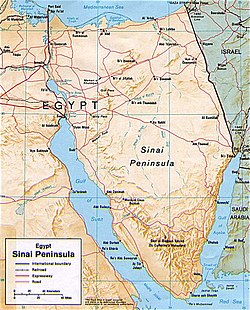
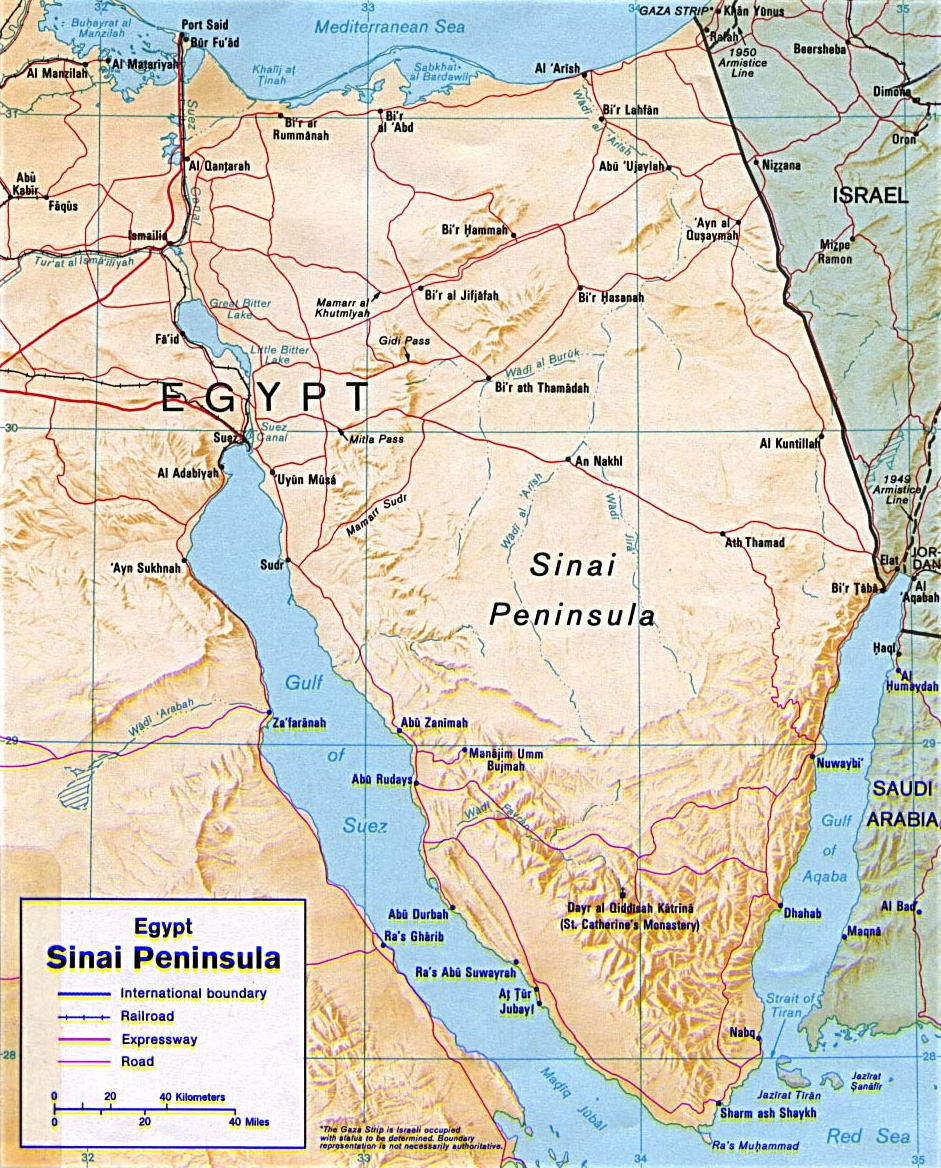
 Map of the Sinai Peninsula | |||||||
| |||||||
| Belligerents | |||||||
| |||||||
| Commanders and leaders | |||||||
 Sami AnanM. H. Tantawi Sami AnanM. H. Tantawi | Unknown | ||||||
| Units involved | |||||||
| Insurgent Cells | |||||||

Operation Eagle (Arabic: عملية نسر) was an Egyptian military campaign in the Sinai Peninsula, that was launched in August 2011 to confront the Sinai insurgency. The campaign was aimed against Islamist insurgents, who had been attacking the Egyptian security forces in the Sinai and using the area as a base from which to attack Israel since early 2011. Successive Egyptian operation against insurgents in 2012, named Operation Sinai,[14][15] was initially referred as the second part of Operation Eagle. It was the first in a number of campaigns to retake the Sinai from insurgents which was achieved.
Background
[edit]Historic perspective
[edit]Sinai was an integral part of Egypt since the inception of the Muhammad Ali dynasty in the early 19th century. Israel briefly captured the Sinai Peninsula from Egypt in the 1967 Six-Day War. As part of the 1979 Egypt–Israel peace treaty, in 1982 Israel withdrew from the peninsula. Among the treaty's other provisions was an agreement that the peninsula would be left effectively demilitarized.[16][17]
A number of factors have enabled armed Islamist groups to take root and proliferate in the Sinai. Including local population susceptibility to Propaganda and smuggling to Gaza.[18]
Early Islamist attacks
[edit]The security situation in the Sinai began deteriorating early in 2011, as a fallout of the 2011 Egyptian revolution.[19] Since February to August of that year, the Egypt–Israel pipeline in El-Arish was attacked five times by saboteurs.[20][21]
On 30 July, militants staged an attack on an Egyptian police station in El-Arish, killing six.[22]
On 2 August, a group claiming to be the Sinai wing of Al-Qaeda declared its intention to create an Islamic caliphate in the Sinai.[23]
Operation
[edit]After working out arrangement with the Israeli government to permit more forces in the Sinai Peninsula than is allowed for by the security annex of the 1979 Egypt-Israel Peace Treaty. SCAF launched Operation Eagle on 14–15 August 2011.
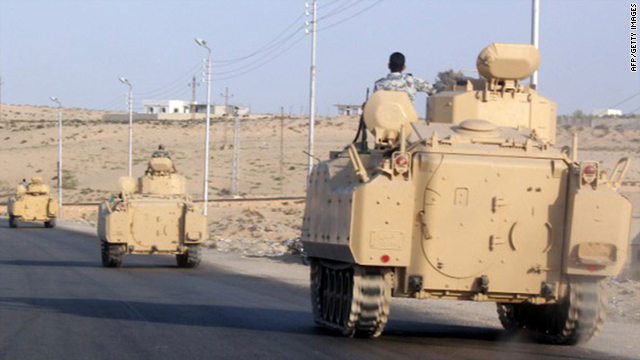
Egypt deployed 2,500 troops and 250 armored personnel carriers including two special forces brigades, tanks and Apache helicopters, in key locations in North Sinai, with armored personnel carriers operating around al Arish, Rafah and Shaykh Zuweid.[24][25][26][27] The move marked the first time Egypt has deployed military forces on such a scale since its treaty with Israel.[28] The objectives of the operation are to confront Islamist insurgents and criminal gangs threatening Egypt's national security and to restore law and order.[29]
| External image | |
|---|---|
 "A convoy of Egyptian armoured vehicles head along a road on the Sinai Peninsula near the Gaza border on August 13, 2011"—CNN[30] "A convoy of Egyptian armoured vehicles head along a road on the Sinai Peninsula near the Gaza border on August 13, 2011"—CNN[30] |
On 15 August, Egyptian security forces swept through a house known to be used by five leading Islamist figures. One of the five was killed; the remaining four were taken into custody.[31]
On 16 August, a group of gunmen believed to be affiliated with jihadist movements attacked an Egyptian army checkpoint. Egypt's forces suffered no casualties in the assault.[31]
On 17 August, two Bedouins were killed in southern Sinai. Their families blamed Egyptian police for their deaths, but the police said it was not involved in the incident.[32][33]
On 18 August, a coordinated attack was staged upon Israeli military and civilians from Sinai, resulting in 6 Israeli civilians and two soldiers and 5 Egyptian soldiers killed, as well as 10 attackers.
On 26 August, then Israeli defense minister Ehud Barak said that Israel will agree for Egypt to employ thousands of troops in the Sinai.[34]
Aftermath
[edit]Following the 2012 Egyptian-Israeli border attack, forces from Egypt's army and the police engaged in an operation against armed men who have been targeting security personnel in North Sinai.[35] A number of clashes between armed men and security forces at several security checkpoints in the Sinai occurred during this time.[36] Initially, the press related to the 2012 operation as the continuation of Operation Eagle, though later turning to an Egyptian official name Operation Sinai (2012).
Egyptian security sources have said that over 2,000 Islamic militants reside in the Sinai region. The military said that the goal of the operation is to "restore security by pursuing and targeting armed terrorist elements in Sinai."[37]
Reactions
[edit]Israel
[edit]The 1979 Camp David Accords, which established peace between Egypt and Israel, mandates that the Sinai must remain demilitarized.
During the beginning of the operation in 2011, Israel allowed the deployment of thousands of troops in the Sinai, with helicopters and armored vehicles, but not tanks.[34]
During the beginning of August 2012, when Operation Eagle intensified, Israel approved a request from Barak to allow Egypt to deploy attack helicopters in the Sinai.[38]
However, concern began to be raised as Egypt began deploying more force and tanks without coordination from Israel. On 21 August, Israeli foreign minister Avigdor Lieberman said that it is important for Israel to make sure that the Egyptian-Israeli peace treaty is upheld, and not to remain silent as Egyptian military forces enter the Sinai. Concern was raised by Israeli officials over Egyptian failure to notify Israel about the deployment of tanks in the Sinai, which violates the peace treaty. Lieberman said, "We must make sure that every detail is upheld, otherwise we'll find ourselves in a slippery slope as far as the peace treaty is concerned."[39]
On the same day, Israeli daily Maariv reported that Israel sent a message to Egypt via the White House, protesting Egypt's ongoing increase in military presence in the Sinai without coordination from Israel, and telling Egypt that it must remove tanks from the Sinai because their presence violates the Egyptian-Israeli peace treaty of 1979, which states that Sinai Peninsula is to remain demilitarized. The Israeli daily Maariv reported was reinforced by an article in The New York Times, which stated that Israel was "troubled" by the entry of Egyptian tanks into the northern Sinai Peninsula without coordination with Israel and had asked Egypt to withdraw them.[40] Partly due to Egypt's military deploying tanks in the Sinai Peninsula, Israel is increasingly worried about what has long been their most critical regional relationship.[41] The lack of coordination around their deployment is seen as potentially undermining a peace treaty that has been a cornerstone of Israel's security for decades according to the New York Times.[41] Israel is also concerned that Egypt may use Operation Eagle to build up its military presence in the Sinai, and leave the tanks and armored carriers in the Sinai while not doing much more than symbolic action to eliminate the terrorist threat.[42]
Israel has not issued a formal complaint, and instead prefers to resolve the issue through quiet contacts, as well as mediation from the U.S., to avoid straining its relationship with Egypt.[43]
On 24 August 2012, a senior Egyptian military source said that Egyptian Defense Minister Abdel Fattah el-Sissi and Israeli Defense Minister Ehud Barak have reached an agreement on the issue of the militarization of the Sinai. Al Hayat reported that Sissi phoned Barak and said that Egypt was committed to maintaining the peace treaty with Israel.[44] Sissi also said that the militarization was temporary, and is needed for security and to fight terrorism. However, an Israeli defense official denied that such a conversation took place.[45]
In late August 2012, then Egyptian president Mohamed Morsi said that the security operations do not threaten anyone, and "there should not be any kind of international or regional concerns at all from the presence of Egyptian security forces". Morsi added that the campaign was in "full respect to international treaties". The Egyptian-Israeli peace deal places limits on Egyptian military deployment in the Sinai. Officials in Israel were concerned about Egypt building up heavy armour in Sinai.[46]
On 8 September, an Israeli official confirmed that coordination exists between Israel and Egypt regarding Operation Eagle. Egyptian Military spokesman Ahmed Mohammed Ali had earlier announced that Egypt has been consulting with Israel regarding its security measures in the Sinai.[47]
United States
[edit]According to CNN, in a move to increase security in the Sinai, help Morsi, and reassure Israel, U.S. Defense Secretary Leon Panetta offered Egypt classified intelligence-sharing capabilities to help Egypt identify military threats in the area, which he discussed during his recent trips to Egypt and Israel. The technology has been widely used in Iraq and Afghanistan to identify vehicles at great distances. The technology may also be used by the Multinational Force and Observers in Sinai. The United States is also offering increased intelligence sharing, including satellite imagery and drone flights, as well as cellphone intercepts and other communications among militants suspected of plotting attacks.[48]
On 22 August, the State Department urged Egypt to be transparent over Operation Eagle and any security operations in the Sinai. The State Department said that the United States supports Operation Eagle against terrorism, but stressed that Egypt must continue coordination with Israel regarding these operations and military increases in the Sinai, according to the 1979 Camp David Accords.[49] The State Department also called on Egypt to fulfill its obligations under the 1979 Egyptian-Israeli peace treaty and deal strongly with security threats in the Sinai, while ensuring that "lines of communication stay open."[50]
On 23 August, then Secretary of State Hillary Clinton, speaking with Egyptian foreign minister Mohamed Kamel Amr, urged Amr to maintain lines of communication with Israel, and emphasized the importance of being transparent over the militarization of the Sinai.[43]
Multinational Force and Observers in Sinai
[edit]The Multinational Force and Observers in Sinai, a 1650-strong international organization created in 1979 during the Camp David Accords with peacekeeping responsibilities, kept a low profile during the intensification of Operation Eagle in 2012. A representative for the organization said that "we are unable to respond to queries from the media at this time" in response to whether Egypt asked permission to move weaponry into the Sinai, and whether Israel granted it.[51]
See also
[edit]References
[edit]- ^ "Perpetrators of second Rafah massacre arrested". Daily News Egypt. 1 September 2013. Retrieved 9 November 2013.
- ^ "Egypt's Sinai desert: A haven for malcontents". The Economist. 13 July 2013. Retrieved 17 July 2013.
- ^ "Jund al Islam claims credit for Sinai suicide car bomb attacks". The Long War Journal. 12 September 2013. Retrieved 9 October 2013.
- ^ "(Allied) Popular Resistance Movement". Tahrir Institute for Middle East Policy. 9 April 2015.
- ^ "Egypt army arrests head of Sinai radical militant group, dozens others". Ahram Online. 1 November 2013. Retrieved 5 November 2013.
- ^ "Egypt sentences 14 to death for 2011 Sinai attacks". The Times of Israel. 24 September 2012. Retrieved 12 December 2013.
- ^ "Ansar al Sharia Egypt in the Sinai". Long War Journal. 6 July 2013. Archived from the original on 6 October 2014.
- ^ Bill Roggio, Mujahideen Shura Council denies involvement in Sinai assault, Long War Journal (Foundation for Defense of Democracies) 06-08-2012 Archived 15 August 2014 at the Wayback Machine
- ^ "Jaysh al-Islam". Tahrir Institute for Middle East Policy. 22 July 2014. Retrieved 15 January 2016.
- ^ "Deadly attacks in Sinai highlight the region's growing instability". American Enterprise Institute. 23 July 2013. Archived from the original on 3 February 2016. Retrieved 15 January 2016.
- ^ "Jihadists attack international peacekeeper base in Egypt's Sinai | FDD's Long War Journal". 15 September 2012.
- ^ "Al Furqan Brigades". Terrorism Research & Analysis Consortium. Retrieved 16 January 2016.
- ^ "Ajnad Misr". Terrorism Research & Analysis Consortium. Retrieved 16 January 2016.
- ^ "mainstream". Archived from the original on 12 September 2012. Retrieved 16 September 2012.
- ^ media
- ^ Gonn, Adam (24 August 2011). "Egypt aims to boost Sinai security with Israeli consent after attacks". Xinhua. Jerusalem. Archived from the original on 8 November 2012. Retrieved 26 August 2011.
According to the agreement, Israel in 1982 evacuated all its military bases and settlements from Sinai, which it had captured in the 1967 war, and returned it to Egypt in exchange for the area becoming a demilitarized zone with only a limited number of Egyptian troops deployed.
- ^ Katz, Yaakov (14 August 2011). "Egypt launches massive operation to control Sinai". Jerusalem Post. Retrieved 26 August 2011.
- ^ "Sinai Peninsula – from Buffer Zone to Battlefield" (PDF). February 2015. Archived from the original on 18 April 2015. Retrieved 4 April 2016.
{{cite news}}: CS1 maint: bot: original URL status unknown (link) - ^ Attalah, Lina (21 August 2011). "Sinai contested: Outlaws, Islamists, Israel and army". Almasry Alyoum. Arish. Retrieved 22 August 2011.
The question of militant Islamist groups operating in the peninsula has been simmering for months, since security there collapsed in the wake of the uprising that brought down former President Hosni Mubarak.
- ^ Tobias Buck; Heba Saleh (18 August 2011). "Seventeen killed in Israel attacks". Financial Times. Jerusalem; Cairo. Retrieved 20 August 2011.
In the past six months, suspected Islamist militants in the Sinai have blown up a pipeline carrying natural gas to Israel five times.
- ^ "Egypt's Dilemma After Israel Attacks". Business Insider. Stratfor. 19 August 2011. Retrieved 20 August 2011.
- ^ Awad, Marwa (16 August 2011). "Egypt army operation nets militants in Sinai-sources". Reuters Africa. Cairo. Archived from the original on 27 September 2012. Retrieved 19 August 2011.
- ^ Hassan, Amro (17 August 2011). "Nearly 20 alleged gas pipeline saboteurs arrested". Los Angeles Times. Cairo. Retrieved 19 August 2011.
Concerns over the security situation in Sinai intensified on Aug. 2 when a group referring to itself as Al Qaeda's wing in Sinai called for the creation of an Islamic caliphate in the peninsula.
- ^ ElBoluk, Salah (14 August 2011). "Army tanks in N. Sinai for first time since Israeli peace treaty". Almasry Alyoum. Retrieved 24 August 2011.
An official source said that Israeli authorities agreed to the entry of Egyptian armed forces to Rafah for a specific period in order to restore security in the border area.
- ^ Cook, Steven A. (17 August 2011). "The Eagle Has Landed In...Sinai?". Council on Foreign Relations. Archived from the original on 22 August 2011. Retrieved 19 August 2011.
- ^ Katz, Yaakov (14 August 2011). "Egypt launches massive operation to control Sinai". Jerusalem Post. Retrieved 19 August 2011.
- ^ "Special forces deployed to Sinai to restore security". 11 August 2011.
- ^ "Hamas moves to arrest Army of Islam leader Mumtaz Daghmash". Almasry Alyoum. 18 August 2011. Retrieved 24 August 2011.
The initiative, named Operation Eagle, saw Egyptian army tanks and troops deployed to the streets of Sinai towns for the first time since the 1970s.
- ^ Khaled, Osama (11 August 2011). "Special forces deployed to Sinai to restore security". Almasry Alyoum. Retrieved 19 August 2011.
The troops are expected to start by cracking down on all organized crime in Arish, and will then head to Rafah and Sheikh Zuwaid, where they expect to face fierce resistance due to the large numbers of armed criminals and insurgents.
- ^ Fahmy, Mohamed Fadel (16 August 2011). "Egypt cracks down on terror cells in Sinai; bin Laden's doctor spotted". CNN. Cairo. Archived from the original on 16 August 2011. Retrieved 22 August 2011.
- ^ a b Halawi, Jailan (18 August 2011). "Clamp-down in Sinai". Al-Ahram Weekly. Cairo. Archived from the original on 19 August 2011. Retrieved 19 August 2011.
- ^ "Tension mounts in Egypt's Sinai as two locals killed". TIME. 17 August 2011. Retrieved 19 August 2011.
Angry Bedouins blocked a main road in the Egyptian city of South Sinai and fired shots in the air Wednesday, in protest at the killing of two local men by unknown gunmen.
- ^ "Egypt kills 2 Beduin at Sinai military checkpoint". Jerusalem Post. 17 August 2011. Retrieved 19 August 2011.
- ^ a b Barak agrees to Egypt deploying troops, vehicles in Sinai
- ^ Hatem Maher & Sherif Tarek (8 August 2012). "UPDATED: Egyptian troops strike hard in North Sinai after multiple attacks". Ahram News. Retrieved 8 August 2012.
- ^ "Egypt army kills 20 terrorists in Sinai". Ynetnews. Yedioth Ahronot. Reuters. 8 August 2012. Retrieved 8 August 2012.
- ^ "Egyptian army declares success in crackdown on Sinai terrorists". The Times of Israel. Associated Press. 8 August 2012. Retrieved 8 August 2012.
- ^ Herb Keinon (9 August 2012). "Security cabinet okays Egypt attack helicopters in Sinai". The Jerusalem Post. Reuters. Retrieved 9 August 2012.
- ^ Somfalvi, Attila (21 August 2012). "Lieberman: Don't let Egypt get away with violations". Ynetnews. Yedioth Ahronot. Retrieved 21 August 2012.
- ^ Kershner, Isabel (21 August 2012). "Israel Asks Egypt to Remove Tanks From Sinai". The New York Times. Retrieved 29 August 2012.
- ^ a b Rudoren, Jodi (22 August 2012). "Developments in Iran and Sinai Deepen Israel's Worries About Egypt". The New York Times. Retrieved 29 August 2012.
- ^ Winer, Stuart (21 August 2012). "After buildup, Israel tells Egypt to remove tanks from Sinai". The Times of Israel. Retrieved 21 August 2012.
- ^ a b "Clinton urges Egypt, Israel to talk on Sinai". The Jerusalem Post. Reuters. 23 August 2012. Archived from the original on 23 August 2012. Retrieved 23 August 2012.
- ^ Davidovitch, Joshua (24 August 2012). "Barak and Egyptian counterpart reportedly come to terms over Sinai offensive". The Times of Israel. Retrieved 24 August 2012.
- ^ "Egypt tells Israel military presence in Sinai is temporary". The Times of Israel. 25 August 2012. Retrieved 26 August 2012.
- ^ "Morsi's message to Israel: No reason for concern". Ynetnews. Yedioth Ahronot. 28 August 2012. Retrieved 28 August 2012.
- ^ Shmulovich, Michal (8 September 2012). "Egypt says it has killed 32 'criminals' and arrested 38 since Sinai terror attack". The Times of Israel. Retrieved 8 September 2012.
- ^ "CNN: US offers Egyptian army intelligence aid for Sinai battles". Israel Hayom; Reuters. Israel Hayom. 21 August 2012. Retrieved 22 August 2012.
- ^ Winer, Stuart; Ben Zion, Ilan (22 August 2012). "Washington calls for Egyptian transparency amid military buildup in Sinai". The Times of Israel. Retrieved 23 August 2012.
- ^ "US urges Egypt to retake control of Sinai". The Jerusalem Post. 23 August 2012. Retrieved 24 August 2012.
- ^ Keinon, Herb (21 August 2012). "Int'l force in Sinai quiet amid concern of Egypt violations". The Jerusalem Post. Archived from the original on 21 August 2012. Retrieved 21 August 2012.
External links
[edit]Operation Eagle
View on GrokipediaBackground
Strategic Importance of Sinai Peninsula
The Sinai Peninsula spans roughly 60,000 square kilometers, representing about 6% of Egypt's land area, and acts as a critical land bridge linking Africa to Asia via its position between the Mediterranean Sea, Gulf of Suez, and Gulf of Aqaba.[6] [7] This geography underscores its role in facilitating overland and maritime connectivity, historically serving as a buffer against invasions from the east.[8] The Suez Canal, bordering Sinai's western flank, handles approximately 12% of global trade volume, including a substantial share of container shipping and oil transiting from the Persian Gulf to Europe and North America.[9] Instability in Sinai directly imperils canal operations, as evidenced by militant sabotage attempts on pipelines and infrastructure that export Egyptian natural gas to Israel and Jordan, potentially disrupting regional energy supplies and Egypt's transit fee revenues exceeding $5 billion annually in the early 2010s.[2] The peninsula also contains key oil and gas fields along the Gulf of Suez, contributing around 38% of Egypt's crude oil output when combined with adjacent Red Sea areas, bolstering national energy security and export capabilities.[10] Militarily, Sinai's demilitarized status under the 1979 Egypt-Israel Peace Treaty limits Egyptian forces to prevent threats to Israel, yet its proximity to Gaza's borders enables smuggling of weapons and fighters via tunnels and desert routes from Libya and Sudan.[11] [12] Jihadist groups exploiting this terrain, as seen in 2011 attacks breaching the Israel-Egypt border and targeting gas pipelines, amplify risks of spillover violence that could undermine the peace treaty and invite Israeli intervention.[2] For Egypt, securing Sinai asserts sovereignty over a vulnerable frontier, counters transnational terrorism, and safeguards economic lifelines against insurgents who view the area as a base for operations against Cairo and its allies.[7]Post-Arab Spring Instability and Jihadist Emergence
The Egyptian Revolution of 2011, culminating in the ouster of President Hosni Mubarak on February 11, created a profound security vacuum across the country, particularly in the Sinai Peninsula where state authority was already weak due to geographic isolation, economic neglect, and the demilitarization provisions of the 1979 Camp David Accords limiting permanent military presence. Police forces, symbols of the old regime, largely collapsed or retreated, enabling a surge in smuggling operations via Gaza tunnels, arms trafficking from post-Gaddafi Libya, and tribal lawlessness among Bedouin communities long marginalized by Cairo's policies. This environment allowed dormant militant networks to revive, with attacks resuming shortly after the revolution, including multiple bombings of the Arab Gas Pipeline supplying Israel and Jordan—disrupted at least seven times between February and October 2011, causing significant economic losses.[13][14] Amid this instability, Salafi-jihadist groups emerged as a cohesive threat, coalescing from remnants of earlier al-Qaeda-affiliated cells responsible for the 2004–2006 Sharm El-Sheikh, Dahab, and Taba bombings, which had been suppressed under Mubarak's counterterrorism campaigns. Ansar Bayt al-Maqdis (ABM), founded around mid-2011 by local Bedouins and Egyptian jihadists with ties to Gaza-based networks, quickly asserted itself through claimed operations like rocket attacks on Israel and ambushes on Egyptian security posts, promoting an ideology that decried the Egyptian state as apostate and sought to establish Islamic governance in Sinai while targeting Israeli interests. Recruitment drew on Bedouin grievances over land expropriation, unemployment exceeding 50% in some areas, and lack of development, with militants offering financial incentives and ideological purpose amid the post-revolutionary disillusionment.[3][15][1] The jihadist surge was exacerbated by broader regional dynamics, including the flow of weapons and fighters from Libya's civil war and ideological inspiration from al-Qaeda's global narrative of exploiting state failures. By July 2011, coordinated assaults killed over a dozen Egyptian soldiers near the Israeli border, signaling organizational maturation. The crisis peaked on August 18, 2011, when ABM-linked militants infiltrated Israel from Sinai, killing eight civilians and one soldier in a bus and car attack, exposing the penetration of jihadist elements into cross-border operations and prompting Cairo's military response. These developments underscored how the Arab Spring's power transition, rather than quelling extremism, provided fertile ground for jihadists to transition from sporadic terrorism to sustained insurgency, unhindered by the pre-2011 intelligence apparatus.[13][16]Prelude to the Operation
Escalating Islamist Attacks (2010-2011)
In early 2010, Islamist militants in the Sinai Peninsula began launching Grad rockets toward southern Israeli cities such as Eilat, marking a shift from previous Gaza-originated attacks and indicating the region's emergence as a jihadist launchpad. These incidents, attributed to al-Qaeda-linked groups exploiting porous borders, heightened concerns over Sinai's destabilization amid smuggling networks and returning foreign fighters.[17] The Egyptian revolution in February 2011 exacerbated the security vacuum, leading to a series of sabotage attacks on the Arab Gas Pipeline traversing northern Sinai, which supplied natural gas to Israel and Jordan. On February 5, 2011, an explosion halted flows, followed by another on April 27, 2011, that cut supplies for weeks and caused economic losses exceeding $300 million for Egypt. Additional blasts occurred on July 4 and July 12, 2011, with perpetrators using improvised explosives or gunfire, often claimed by Bedouin militants intertwined with Salafi-jihadist elements protesting government neglect and the peace treaty. These attacks disrupted regional energy security and underscored the growing boldness of anti-state actors.[18][19][20] The escalation peaked on August 18, 2011, when a coordinated assault by gunmen originating from Sinai targeted Israeli vehicles near the border, killing eight civilians—including six from a bus attack—and wounding over 30 others in ambushes using automatic weapons and anti-tank missiles. Egyptian security forces pursued the attackers, killing five militants, but the incident exposed intelligence failures and the infiltration of jihadist networks, including Palestinian and global elements, prompting Israel to strike Gaza targets in retaliation while pressuring Cairo for action. This cross-border incursion directly precipitated Operation Eagle, as it demonstrated Sinai-based groups' capability to threaten the 1979 peace treaty's stability.[21][22]Egyptian Military Preparations and Coordination
Following the August 5, 2012, attack at the Kerem Shalom border crossing, where armed militants killed 16 Egyptian soldiers and stole armored vehicles, President Mohamed Morsi directed the armed forces to prepare a large-scale counterinsurgency response in the Sinai Peninsula.[3] This marked the initiation of Operation Eagle (also referred to as Operation Eagle II in some accounts), involving the mobilization of infantry units, armored brigades from the Second Field Army, and support from air assets including AH-64 Apache helicopters.[5] Preparations emphasized rapid reinforcement of understrength garrisons in North Sinai, with logistics focused on securing supply lines across the Suez Canal and establishing forward operating bases near Rafah and Sheikh Zuweid to address jihadist strongholds.[4] A key element of the preparations was a high-level military command reshuffle on August 12, 2012, in which Morsi dismissed Field Marshal Hussein Tantawi and appointed General Abdel Fattah el-Sisi as minister of defense, streamlining decision-making for the operation.[5] This transition facilitated the integration of intelligence from military and general intelligence services, which identified militant networks linked to smuggling tunnels and arms caches originating from Gaza.[1] The Egyptian forces prioritized sealing border areas and conducting pre-operation raids to disrupt insurgent logistics, drawing on lessons from prior limited engagements that had proven insufficient against escalating threats. Coordination with Israel was essential due to the 1979 Egypt-Israel peace treaty's restrictions on military deployments in Sinai, which limit forces to four border battalions and prohibit heavy armor or aircraft without mutual consent. Egyptian officials secured Israeli approval for temporary enhancements, including tanks and aviation units, framing the buildup as a defensive measure against shared transnational threats.[23] An Israeli official confirmed on September 8, 2012, that such coordination was in place, allowing Egypt to exceed treaty limits without triggering security concerns. The United States endorsed the preparations, with the State Department expressing support for counterterrorism efforts while reiterating the need for ongoing treaty compliance.[24] This diplomatic alignment enabled the operation's swift execution, though it drew domestic criticism for perceived delays in addressing Sinai's security vacuum post-Arab Spring.[25]Execution of the Operation
Deployment of Forces and Tactics
Operation Eagle was launched on August 14, 2011, as the Egyptian Armed Forces' first major deployment to the Sinai Peninsula since the 1973 Yom Kippur War, in response to rising jihadist violence following the Arab Spring.[3] The operation initially deployed two brigades of Saiqa (Thunderbolt) special forces units, specialized in rapid assault and counterterrorism, to North Sinai areas including Arish and Rafah.[26] These forces were supported by army infantry and mechanized units for broader security perimeters, emphasizing mobility and intelligence-driven targeting over static garrisons.[5] Tactics centered on coordinated air-ground operations, including helicopter gunship strikes and Apache attacks on suspected militant positions, combined with ground sweeps to clear tunnels and smuggling routes near the Gaza border.[3] Special forces conducted raids on hideouts, leading to arrests and neutralizations of armed cells, while establishing temporary checkpoints and buffer zones to restrict insurgent mobility and logistics.[26] The approach prioritized containment of threats through periodic offensives rather than sustained occupation, aiming to degrade jihadist networks without alienating local Bedouin populations, though it involved demolitions of homes suspected of harboring militants.[3] In the expanded phase, following the August 5, 2012, attack that killed 16 border guards, Operation Eagle II reinforced deployments with additional mechanized brigades and engineering units to fortify the border fence and expand no-go zones.[5] Tactics evolved to include joint task forces for tunnel destruction using explosives and bulldozers, alongside intelligence sharing for preemptive strikes, reflecting a shift toward integrated border security amid ongoing insurgent adaptations.[26] This contained immediate threats but perpetuated a cycle of low-intensity conflict, as jihadists exploited terrain and local grievances for asymmetric warfare.[3]