Hubbry Logo
logo
Opone
Community hub

Opone

logo
0 subscribers
Read side by side
from Wikipedia
Ancient
Opone
.
Location Hafun, Somalia[1]
City-state existed: 1st millennium BC–500 AD

Opone (Ancient Greek: Ὀπώνη ἐμπόριον) was an ancient seaport and emporium located in present-day Somalia. It is primarily known for its trade with the Ancient Egyptians, Romans, Greeks, Persians, and the states of ancient India.[2][3] The historic port has been identified with the city of Hafun through archaeological remains.[4] It is possible that it corresponds to the Land of Punt as known by the ancient Egyptians during the Old, Middle, and New Kingdom.[5][6][7]

History and trade

[edit]

Opone, like other city-states such as Avalites, Malao, and Mosylon, came into existence with the collapse of the Macrobian kingdom.[8][9][10]

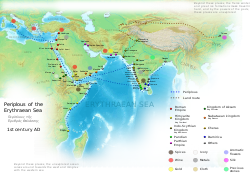
Pottery found in Oponean tombs date back to the Mycenaean Kingdom of Greece that flourished between the 16th and 11th century BC.[11] Its major periods of activity were during the 1st century BC and the 3rd to the 5th centuries AD.[12] Opone was mentioned by an anonymous Greek merchant in the 1st century AD Periplus of the Erythraean Sea. The town is featured in the ancient document's thirteenth entry, which in part states:

And then, after sailing four hundred stadia along a promontory, toward which place the current also draws you, there is another market-town called Opone, into which the same things are imported as those already mentioned, and in it, the greatest quantity of cinnamon is produced, (the arebo and moto), and a great quantity of tortoiseshell, better than that found elsewhere.

Opone served as a port of call for merchants from Phoenicia, Egypt, Greece, Persia, Yemen, Nabataea, Azania, the Roman Empire and elsewhere,[13] as it sat at a strategic location along the coastal route from the Mochan trading center of Azania to the Red Sea. Merchants from as far afield as Indonesia and Malaysia passed through the city, exchanging spices, silks, and other goods, before departing south for Azania or north to Yemen or Egypt on the trade routes that spanned the length of the Indian Ocean's rim. As early as 50 AD, it was well known as a center for the cinnamon trade, along with the barter of cloves and other spices, ivory, exotic animal skins and incense.

Archaeological remains

[edit]

Ancient Egyptian, Roman and Persian Gulf pottery has been recovered from the site by an archaeological team from the University of Michigan. In the 1970s, Neville Chittick, a British archaeologist, initiated the British-Somali expedition where he and his Somali colleagues encountered remains of ancient drystone walls, houses with courtyards, and the location of the old harbour.

See also

[edit]

References

[edit]
Revisions and contributorsEdit on WikipediaRead on Wikipedia
from Grokipedia
Opone was an ancient trading port and emporium located on the northeastern coast of the Horn of Africa, at the site of modern-day Hafun (Ras Hafun) in Somalia, flourishing from the 1st millennium BCE to around the 5th century CE as a key node in Indian Ocean commerce.[1] It served as a vital hub for the exchange of goods between African inland regions, the Roman Empire, India, and the Arabian Peninsula, facilitating the export of local products such as spices, incense (including myrrh and frankincense), ivory, rhinoceros horn, tortoise shell, and slaves, while importing items like iron tools, wheat, wine, cloth, and ceramics from distant civilizations.[2] The city's prominence is best documented in the Periplus of the Erythraean Sea, a 1st-century CE Greco-Roman navigational and trade manual, which describes Opone as a bustling marketplace where cinnamon from inland sources was gathered in significant quantities for shipment to the Red Sea ports.[2] Archaeological evidence from excavations at Hafun, including sites like Hafun West (active from the 1st century BCE to the 3rd century CE) and Hafun Main (2nd to 5th century CE), has revealed imported artifacts such as Roman amphorae, Parthian-Sassanian pottery, Indian ceramics, and even a rare Mesopotamian glazed jar, underscoring Opone's integration into expansive intercultural trade networks without evidence of large-scale urbanization or central political authority.[3] These findings highlight the role of nomadic pastoralist communities in sustaining the port's economy, channeling high-value exports like aromatic resins to global markets while adapting to Mediterranean and Asian influences.[3] Although some scholars have speculated on links to the earlier Egyptian Land of Punt due to shared trade goods like myrrh and ebony, this connection remains debated and unconfirmed by direct evidence.[4] Opone's legacy endures as a testament to the Horn of Africa's early contributions to maritime globalization, bridging African, Eurasian, and Mediterranean worlds through commerce rather than conquest.

Geography and Location

Site Identification

Opone, an ancient Somali port city, is widely identified with the archaeological site at Hafun (also spelled Xaafuun), located on the Hafun Peninsula in northeastern Somalia. This identification stems from correlations between descriptions in classical texts and the site's geographical position, approximately 150 kilometers south of Cape Guardafui, where early excavations revealed occupation layers dating to the 1st century CE consistent with trading activities.[1][5] The site's coordinates are roughly 10°25′N 51°16′E, placing it at the easternmost tip of the African continent along the Indian Ocean coast.[1] The name Opone derives from the Greek term "Ὀπώνη ἐμπόριον" (Opōnē emporion), as recorded in the 1st-century CE Periplus of the Erythraean Sea, where "emporion" denotes a market town or trading emporium. This anonymous Greek merchant's guide describes Opone as a key commercial hub on the Azanian coast, emphasizing its role in maritime exchange. The term "Opōnē" likely represents a transliteration of a local indigenous name, adapted into Koine Greek for navigational and trade purposes.[6][7] Historical nomenclature for the site includes variations such as Opun or Oponi in later scholarly interpretations of the Periplus, reflecting phonetic adaptations in ancient texts. In modern Somali coastal terminology, the location is known as Xaafuun, a name that may connect to regional Cushitic linguistic roots denoting coastal or harbor features, though direct etymological links to the ancient Greek form remain unconfirmed. Opone formed part of a broader network of ancient Somali city-states along the Horn of Africa's seaboard.[5][8]

Environmental and Strategic Setting

Opone occupies a prominent coastal position on the northeastern tip of Somalia, along the Guardafui Channel, which forms a critical gateway to the Indian Ocean and positions the site strategically close to the Red Sea through established overland caravan routes across the arid Horn of Africa landscape.[9] This location at Hafun, as identified through archaeological surveys, enabled the port to serve as a pivotal node in maritime networks, leveraging its exposure to open ocean currents while benefiting from terrestrial connections that bypassed longer sea voyages around the Arabian Peninsula.[3] The environmental setting of Opone is characterized by an arid to semi-arid climate typical of northeastern Somalia, with hot temperatures year-round and minimal annual rainfall concentrated in irregular patterns, rendering the surrounding terrain largely unsuitable for intensive agriculture but ideal for pastoral and maritime activities. Seasonal monsoons dominate the region's weather dynamics: the northeast monsoon (December to March) brings moderate northeast winds, while the southwest monsoon (June to September) drives stronger southerly winds along the coast, creating upwelling and influencing navigation patterns by dictating seasonal sailing windows across the Indian Ocean. Rainfall is concentrated in the inter-monsoonal periods of Gu (April to June) and Deyr (October to December), with overall minimal annual precipitation.[10][11] Fringing coral reefs front much of the shoreline near Hafun, including low-lying beaches backed by sand dunes, which both protect inland settlements from erosion and pose navigational challenges by creating shallow barriers that funneled vessels toward sheltered anchorages.[12] Strategically, the natural harbor at Hafun, formed by a 25-kilometer tombolo connecting a sandstone peninsula to the mainland, offered secure anchoring for ancient vessels amid the otherwise exposed coastline, mitigating risks from rough seas and enabling reliable offloading in the Guardafui Channel.[9] This configuration, combined with the site's alignment to prevailing monsoon winds, allowed Opone to exert control over transoceanic trade routes dating back to the first millennium BCE, as winds facilitated predictable voyages between East Africa, Arabia, and India during favorable seasons.[6] The port's tactical positioning thus amplified its role as a resilient hub, where environmental constraints were offset by geological features that supported sustained maritime operations.

Historical Context

Origins and Early Mentions

Opone emerged as a settlement in the Horn of Africa during the 1st millennium BC, amid shifting regional dynamics following the decline of earlier entities like the legendary Macrobian kingdom. The Macrobians, described by the Greek historian Herodotus in the 5th century BC as a tall, long-lived people inhabiting lands near the southern sea—likely the Indian Ocean coast of present-day Somalia—were renowned for their wealth, sophisticated embalming practices, and resistance to Persian incursions under Cambyses II around 525 BC. This kingdom's decline created opportunities for coastal trading centers like Opone to rise, capitalizing on established routes for spices, incense, and other goods. Archaeological evidence points to possible Bronze Age connections in the region, with pottery suggesting Mycenaean influences from the 16th to 11th centuries BC, hinting at early Mediterranean trade networks reaching eastern Africa. Such finds, though limited, indicate that pre-Oponean activity may have involved indirect exchanges via intermediary ports, laying groundwork for later commercial prominence. These roots underscore Opone's evolution from a peripheral outpost to a key emporium. The earliest textual references potentially linking Opone's locale to ancient Egyptian interactions appear in records of expeditions to the Land of Punt, spanning circa 2500–1500 BC, where pharaohs like Sahure and Hatshepsut sought myrrh, frankincense, and exotic goods from the Somali coast. Identification of Opone specifically with Punt remains speculative, as Egyptian inscriptions describe a broader "divine land" rich in aromatics, but the site's position aligns with described trade endpoints (see Legacy section for further discussion).[13] This association highlights Punt's role in fostering enduring East African-Mediterranean ties, which Opone later expanded into classical-era commerce.

Classical Era Developments

Opone experienced significant growth during the classical era, flourishing from the 1st century BC to the 5th century AD, with peak activity occurring between the 1st and 3rd centuries AD. This period coincided with the height of Greco-Roman and Persian influences in the Indian Ocean, as documented in the Periplus of the Erythraean Sea, a 1st-century AD navigational guide that highlights Opone as a prominent market-town on the northern Somali coast.[14] Archaeological evidence from Ras Hafun, the site's modern identification, supports this timeline, revealing occupation layers with imported Roman pottery and glass dated to the 2nd through 5th centuries AD, indicating sustained external connections.[9] The societal structure of Opone evolved into a merchant-led emporium characterized by multicultural inhabitants, blending local Cushitic-speaking communities with foreign traders from Arabia, India, and the Greco-Roman world. The settlement lacked evidence of centralized political authority, fostering a dynamic environment where diverse groups coexisted for commercial purposes, likely facilitated by local protectors.[15] This merchant-driven organization reflected broader classical patterns of emporia in the Horn of Africa, where nomadic pastoralists and seafaring merchants interacted.[15] By around 500 AD, Opone's prominence waned, as evidenced by reduced imported artifacts post-3rd century, likely due to broader shifts in regional trade networks.[9]

Economy and Trade

Trade Partners and Routes

Opone functioned as a vital commercial hub in the ancient Indian Ocean trade system, engaging with merchants from diverse regions across the 1st millennium BCE to the 5th century CE. Primary trade partners included Greeks and Romans, with the Periplus of the Erythraean Sea (1st century CE) portraying Opone as a key stop for Greco-Roman vessels originating from Egyptian Red Sea ports like Berenice and Myos Hormos.[6] Persians, particularly under the Sasanian Empire, contributed through ceramic imports unearthed at Ras Hafun, indicating direct or indirect ties to the Gulf trade sphere.[16] Yemenis (Sabaeans) and Nabataeans participated actively, leveraging their control over Arabian incense routes that extended to East African emporia for reciprocal exchanges.[16] While evidence for direct involvement from Indonesians and Malays remains limited, their indirect participation occurred via extended Indian Ocean circuits connecting Southeast Asia to the Horn through Indian intermediaries during the early centuries CE.[16] The principal maritime routes relied on monsoon winds to navigate the Indian Ocean, enabling seasonal voyages from Azania (modern-day Tanzania) northward along the East African coast to the Red Sea, where cargoes integrated into Mediterranean supply chains. The Periplus outlines this coastal pathway in detail, noting a southward-trending Berber coast beyond the Cape of Spices (near Ras Hafun), with Opone positioned approximately 400 stadia (about 74 km) from the prior anchorage at Pano, accessible via a promontory sheltered from northern swells but subject to eastward currents.[6] These sea lanes formed part of a larger circuit linking the Red Sea to the Persian Gulf and western India, with departures from Egypt timed for July to capitalize on the southwest monsoon for the return leg. Overland paths supplemented maritime access, branching from Opone into Somalia's interior to gather regional produce and link with caravan trails toward the Ethiopian highlands.[16] Within the Indo-Greco-Roman trade framework, Opone competed with proximate ports like Malao and Mosylon for traffic, as all three served overlapping roles in funneling East African goods into broader networks while importing Mediterranean and Arabian wares.[6] This rivalry underscored Opone's strategic position, enhancing its integration into a resilient, multi-ethnic commercial web that sustained economic vitality across empires.

Key Commodities

Opone served as a vital export center for luxury goods originating from the Somali interior, with cinnamon being the most prominent commodity. The Periplus of the Erythraean Sea describes Opone as exporting the greatest quantity of cinnamon, including varieties such as arebo and moto, alongside large amounts of high-quality tortoise-shell superior to that from other regional ports.[6] Frankincense, myrrh, and ivory were also brought to the coast for shipment, reflecting the port's role in channeling aromatic resins and wildlife products from inland sources to maritime traders.[16] Slaves of the better sort were exported in considerable numbers, primarily destined for Egypt, underscoring the human element in Opone's trade economy.[6][16] Imports to Opone consisted mainly of manufactured goods and staples from Mediterranean and Near Eastern regions, facilitating a barter-based exchange system as detailed in ancient accounts. The Periplus notes that the port received flint glass, various cloths, and metals—likely including iron and unworked metal—similar to other East African market-towns, with these items arriving via ships from Egypt and beyond.[6] Wheat and wine were imported in modest quantities to supplement local needs, while luxury items such as coral and antimony from Roman and Persian influences enriched the trade balance.[6][16] Roman coinage, both gold and silver, was accepted in limited amounts, indicating direct engagement with imperial economies.[16] As a transshipment hub along the Indian Ocean routes, Opone profited significantly from markups on high-demand exports like frankincense and myrrh, which were essential for religious rituals across the Mediterranean world and drove substantial economic prosperity in the region.[16][17] This intermediary position allowed local traders to capture value by aggregating interior goods for redistribution to distant markets, including those connected to Egypt and Rome.[16]

Archaeological Evidence

Major Excavations

The major archaeological investigations at Opone, identified with the site of Ras Hafun in northeastern Somalia, began in the 1970s through collaborative efforts between international scholars and Somali authorities. In 1975, Neville Chittick, director of the British Institute in Eastern Africa, led a British-Somali expedition that conducted a reconnaissance survey along the northeastern Somali coast, focusing on pre-Islamic coastal settlements. This work included surface collections and limited test excavations, such as a 2x1 meter trench at the Hafun Main Site, which revealed occupation deposits up to 1.7 meters deep consisting of sand, charcoal, and pottery sherds, indicating a substantial settlement layout near a natural anchorage suitable for harbor activities. At the nearby Hafun West Site, the team documented rectangular stone structures, including a multi-room building with a walled courtyard constructed from cut sandstone blocks, suggesting organized port-related infrastructure dating potentially to the early first millennium BCE or earlier based on associated ceramics.[18] Following Chittick's initial fieldwork, which was curtailed by the 1977 Ogaden War, further analysis of the recovered materials was undertaken by Henry T. Wright of the University of Michigan in collaboration with Matthew C. Smith during the late 1970s and 1980s. Their efforts emphasized the study of stratified ceramic assemblages from the Hafun sites, documenting layers that spanned the first millennium BCE and provided evidence of continuous occupation and trade connections. These investigations involved detailed classification of pottery types, including imports from the Mediterranean and Arabian regions, to reconstruct the site's chronological sequence and settlement patterns without additional fieldwork due to ongoing regional tensions.[19] Subsequent archaeological access to Opone has been severely restricted by Somalia's political instability, particularly the civil war that erupted in 1991, which led to the loss or inaccessibility of excavated materials and halted systematic research. No major excavations or surveys have occurred at the site since the 1980s, with scholarly attention shifting to archival analysis of prior findings amid persistent security challenges in the region.[20]

Key Artifacts and Structures

Archaeological investigations at Opone, located at Ras Hafun in northeastern Somalia, have revealed a range of imported artifacts that underscore its prominence as a classical-era trading port. Fragments of Roman amphorae, used for transporting goods such as wine and olive oil, were recovered from the site, evidencing direct maritime links with the Roman Empire during the 1st to 3rd centuries AD.[16] Similarly, ceramics from the Persian Gulf, including Parthian and later Sasanian glazed wares, indicate sustained exchange with regions in modern-day Iran and the Arabian Peninsula, likely involving spices and other commodities.[21] These finds, analyzed in detailed ceramic studies, highlight Opone's integration into broader Indian Ocean networks.[22] Earlier occupation layers contain Mycenaean sherds dating to the 16th–11th centuries BC, suggesting prehistoric connections with the Aegean world, possibly through intermediary trade routes.[21] Fragments of Egyptian pottery, including Ptolemaic types, further attest to ancient ties with Egypt, reflecting the site's long history of multicultural interactions predating the classical period.[18] A rare Mesopotamian glazed jar, recovered from a cairn necropolis at Hafun Main and dated to the 3rd–5th centuries CE, provides additional evidence of links to Mesopotamian regions.[3] Radiocarbon dating of organic remains from stratified deposits confirms continuous activity from the 1st century BC to the 5th century AD, with diverse artifact assemblages pointing to successive waves of foreign merchants and local inhabitants coexisting in a vibrant commercial environment.[23] The structural remains at Opone demonstrate sophisticated urban planning oriented toward trade. Drystone walls and courtyard houses, constructed from local coral and stone, form the core of the main settlement, providing evidence of organized residential and possibly mercantile spaces.[18] Adjacent to these is an ancient harbor basin, a natural inlet enhanced for anchoring vessels, which supported the influx of international shipping. The absence of defensive fortifications across the site implies a context of relatively peaceful commerce, reliant on economic interdependence rather than military protection.[5] These elements collectively illustrate Opone's function as a secure, multicultural entrepôt in antiquity.

Legacy

Scholars have long speculated on connections between Opone, the ancient port at modern Hafun in Somalia, and the legendary Land of Punt described in Egyptian texts from the Old, Middle, and New Kingdoms. Egyptian records, particularly the reliefs at Queen Hatshepsut's mortuary temple at Deir el-Bahri, depict her expedition to Punt around 1470 BCE as a maritime voyage to a coastal region south of Nubia, where traders accessed myrrh trees, incense, gold, and exotic animals amid mangrove-fringed lagoons and elevated terrains. These descriptions align with Hafun's geography, featuring a natural lagoon harbor and proximity to the Darror Valley, a known source of myrrh resins dating back to the 2nd–3rd centuries BCE.[5] Despite these parallels, significant differences distinguish Punt as a broader regional entity—potentially encompassing multiple sites across the Horn of Africa—from Opone's role as a specific urban emporium in the 1st century CE, as referenced in the Periplus of the Erythraean Sea. No direct textual evidence links Opone by name to Punt, but overlapping trade profiles, including exports of aromatic resins and maritime exchange networks, suggest possible continuity or inclusion within Punt's sphere. Punt appears in Egyptian sources as a diffuse source of luxury goods rather than a singular city-state, contrasting with Opone's characterization as a fortified trading hub with Hellenistic and Roman influences.[5] Modern scholarship proposes archaeological overlaps to bridge these gaps, with archaeologist Neville Chittick identifying Hafun as Opone in 1979 based on excavations revealing imported pottery and shell middens indicative of sustained coastal trade akin to Punt's economy. Other researchers highlight etymological ties, such as the possible derivation of "Opone" from ancient "Punt" or related terms like "Pouen" in inscriptions, though such links remain hypothetical. Consensus among historians leans toward Punt as an expansive area incorporating sites like Opone, rather than a precise match, emphasizing regional trade evolution over direct equivalence.[5]

Modern Rediscovery and Significance

The modern rediscovery of Opone, identified as the site at Ras Hafun on Somalia's northeastern coast, began with 19th-century European explorations of the Horn of Africa, where French traveler Georges Revoil documented ancient coastal trade remnants during his 1882 expedition along the Somali littoral, though specific identification of Opone occurred later.[20] In the 20th century, systematic research advanced through international collaborations, including the British Institute in Eastern Africa's 1975–1976 excavations led by Neville Chittick, which uncovered layers of pre-Islamic occupation and imported artifacts linking the site to ancient maritime networks described in the Periplus of the Erythraean Sea.[5] Somali-led initiatives emerged post-independence, with the Soviet-Somali Expedition in the 1970s documenting related eastern sites and establishing national archaeological frameworks, followed by efforts like those of archaeologist Sada Mire in the 2000s to build local capacity through heritage management and site surveys in the broader Somali context.[20][24] The outbreak of the Somali Civil War in 1991 severely disrupted research at Opone, rendering the site largely inaccessible due to ongoing instability in the Puntland region and leading to widespread looting of archaeological materials across southern Somalia, including losses from the National Museum in Mogadishu where pre-war collections from Hafun were stored.[20] This conflict not only halted fieldwork but also exacerbated site degradation through uncontrolled scavenging and environmental exposure, with reports indicating systematic plunder of coastal heritage areas amid the broader collapse of state protections.[20] Opone holds profound significance as a testament to pre-Islamic Somali maritime prowess, serving as a major emporium that exported vast quantities of aromatics like frankincense, myrrh, and cinnamon while importing goods such as glass and metals, thereby positioning Somali traders as active agents in global Indian Ocean networks connecting Africa, Arabia, and the Greco-Roman world.[25] This role underscores narratives of African agency in ancient trade, where local Somali communities managed seasonal fairs, protected caravans, and sustained economic systems with minimal foreign cultural imposition, challenging Eurocentric views of passive peripheral involvement.[25] Preservation efforts have included calls for UNESCO protection, with Somalia's 2020 ratification of the 1972 World Heritage Convention and the 2025 revision of its Tentative List amid threats from conflict and climate change.[26] In contemporary Somali studies, Opone contributes educational value by illuminating indigenous trade histories and urban-nomadic dynamics, fostering a sense of national heritage in curricula and community programs. Stabilized conditions could unlock tourism potential, similar to northern sites like Laas Geel, drawing visitors to explore its role in ancient global commerce.[20]
User Avatar
No comments yet.